
Digital Signal Processor Market Size and Share
Market Overview
| Study Period | 2020 - 2031 |
|---|---|
| Market Size (2026) | USD 2.77 Billion |
| Market Size (2031) | USD 3.23 Billion |
| Growth Rate (2026 - 2031) | 3.10 % |
| Fastest Growing Market | Asia-Pacific |
| Largest Market | Asia-Pacific |
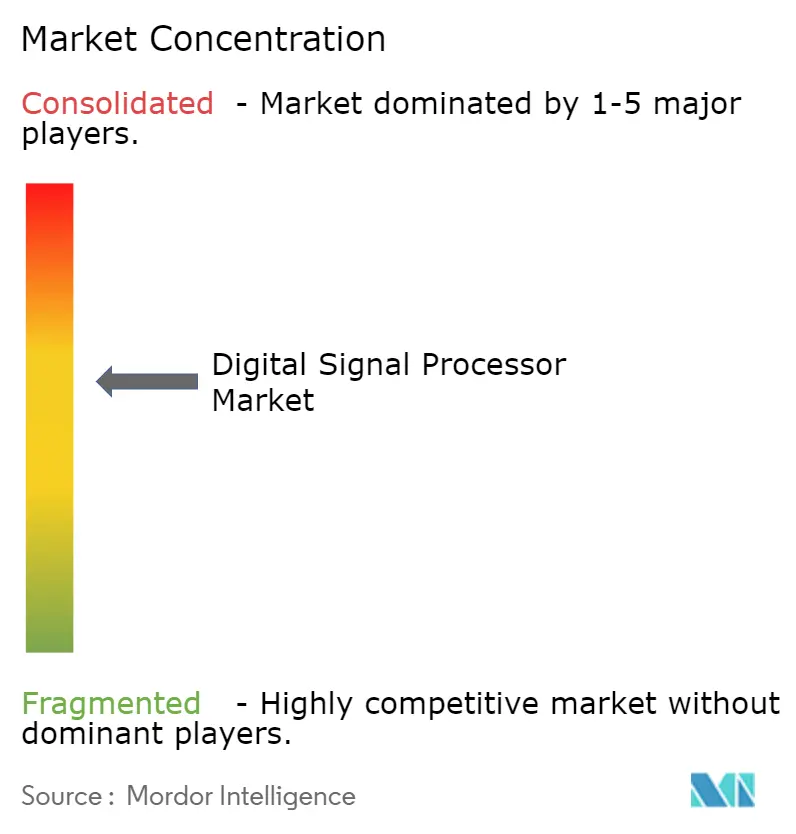
| Market Concentration | Medium |
Major Players.webp) *Disclaimer: Major Players sorted in no particular order Image © Mordor Intelligence. Reuse requires attribution under CC BY 4.0. | |
Digital Signal Processor Market Analysis by Mordor Intelligence
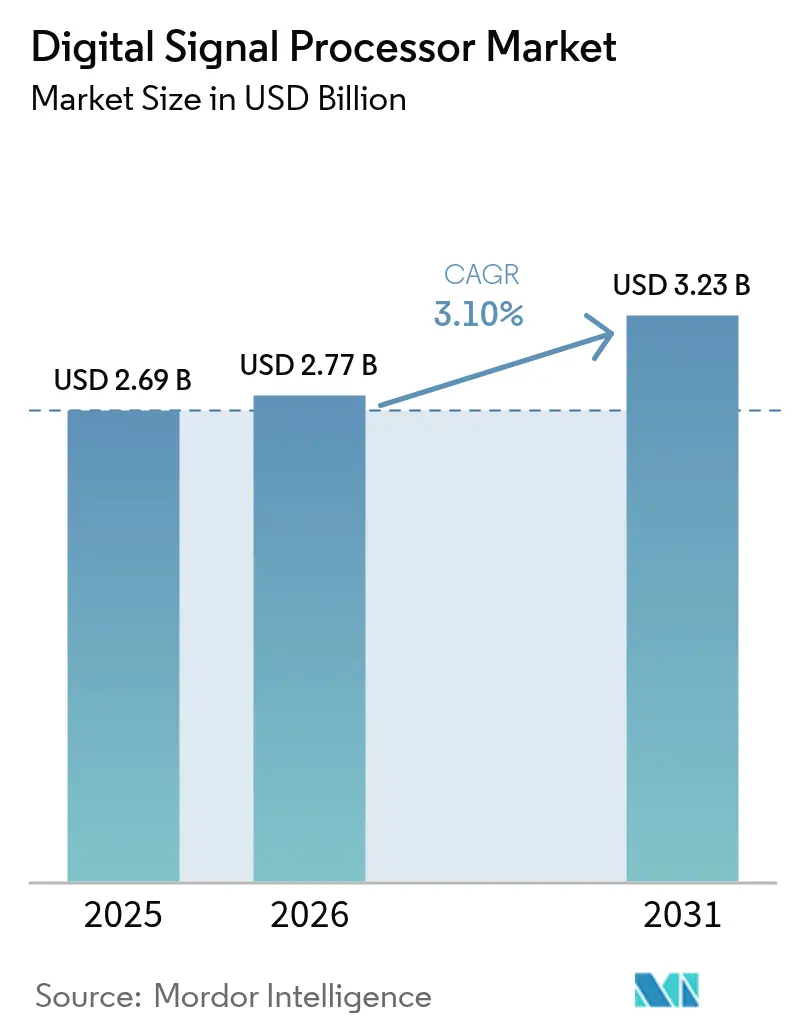
The digital signal processor market size is expected to grow from USD 2.69 billion in 2025 to USD 2.77 billion in 2026 and is forecast to reach USD 3.23 billion by 2031 at 3.10% CAGR over 2026-2031. This steady headline number conceals a deeper architectural shift from stand-alone chips toward highly integrated system-on-chip (SoC) solutions that fuse DSP, CPU, and neural engines for edge artificial-intelligence workloads. Semiconductor vendors are prioritizing power-efficient multicore designs, hybrid numeric formats, and software ecosystems that shorten design cycles. 5G Open RAN roll-outs, automotive ADAS demand, emerging cloud-native radio access networks, and factory-floor machine-vision upgrades are sustaining volume growth even as unit pricing moderates. Meanwhile, supply-chain uncertainty at process nodes below 7 nm keeps lead-times volatile, giving added value to platforms that can migrate quickly between mature and advanced nodes.
Key Report Takeaways
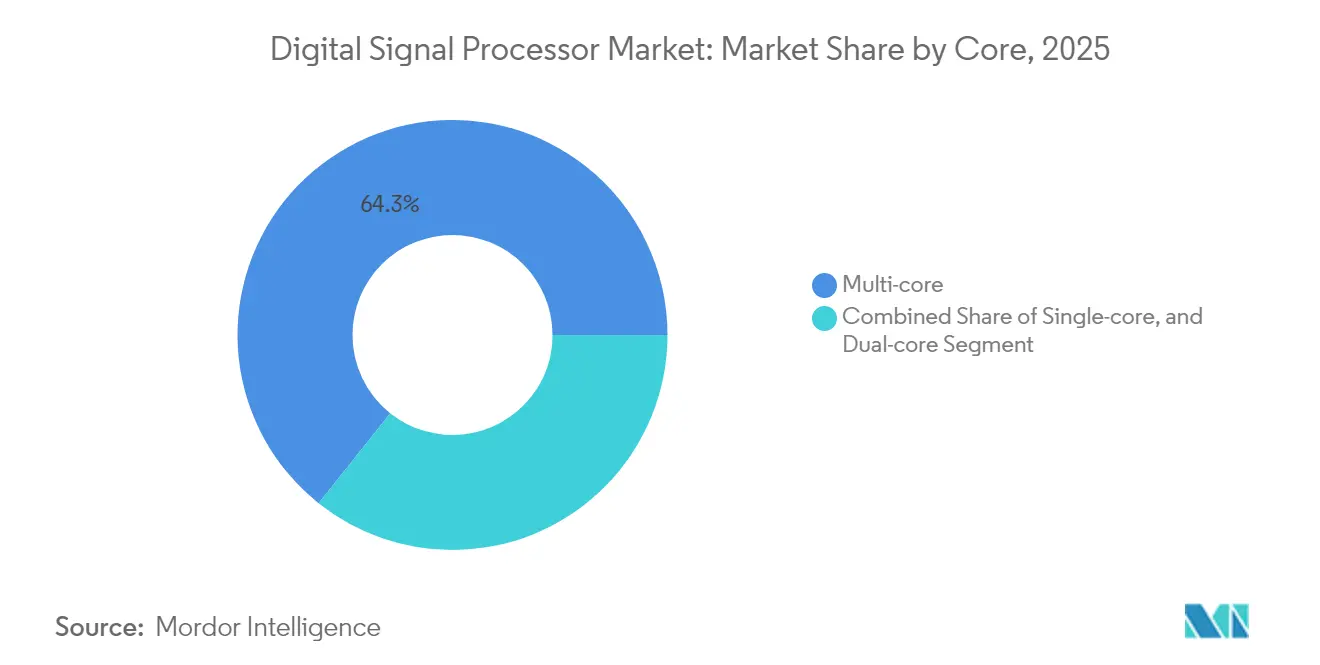
- By core type, multi-core devices led with 64.30% digital signal processor market share in 2025; the segment will expand at a 3.64% CAGR through 2031.
- By product type, application-specific DSPs captured 47.60% of the digital signal processor market size in 2025, while embedded DSP IP cores are projected to grow at a 4.02% CAGR to 2031.
- By architecture, SIMD designs accounted for 51.85% of the digital signal processor market size in 2025; VLIW cores record the fastest 4.21% CAGR to 2031.
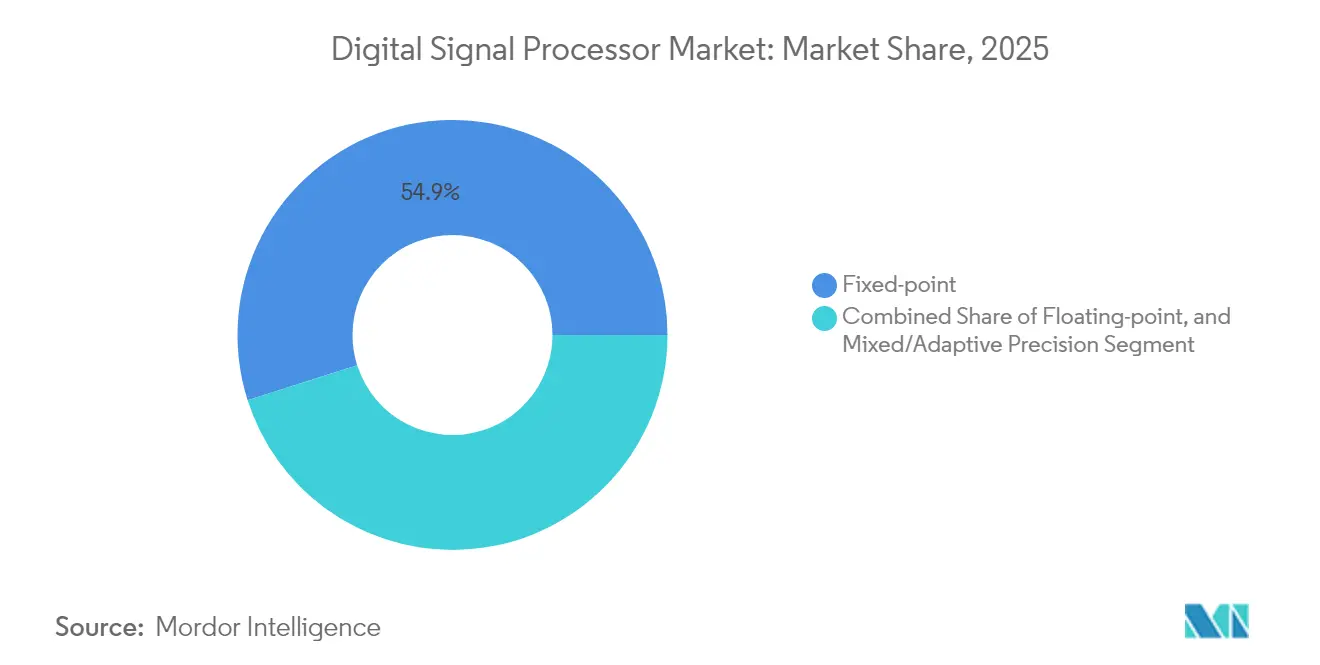
- By numeric format, fixed-point processors held 54.90% of 2025 revenue; floating-point devices are advancing at a 4.62% CAGR.
- By end-user industry, communications retained 39.65% revenue share of the digital signal processor market size in 2025, whereas automotive applications are rising at a 5.29% CAGR.
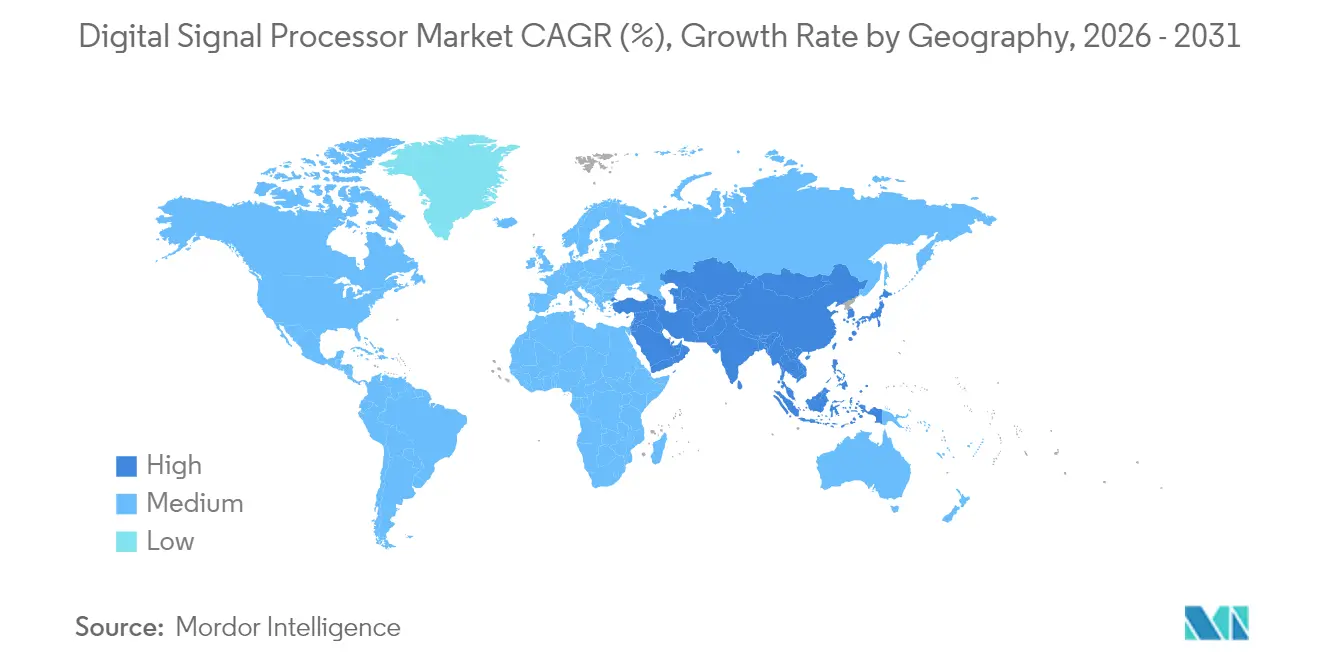
- By geography, Asia-Pacific dominated with 48.20% revenue in 2025 and is on course for a 3.74% CAGR through 2031.
- Texas Instruments, Analog Devices, Qualcomm, Intel, and NXP commanded a combined 64.20% share of global revenue in 2025.
Note: Market size and forecast figures in this report are generated using Mordor Intelligence’s proprietary estimation framework, updated with the latest available data and insights as of 2026.
Market Trends and Insights
Drivers Impact Analysis of Digital Signal Processor Market*
| Driver | (~) % Impact on CAGR Forecast | Geographic Relevance | Impact Timeline |
|---|---|---|---|
| 5G Open-RAN deployments | +0.8% | Asia-Pacific, spillover to North America | Medium term (2-4 years) |
| ADAS migration to DSP-centric SoCs | +0.7% | Global, strong in Europe & Asia-Pacific | Medium term (2-4 years) |
| AI-enhanced audio & voice in hearables | +0.5% | North America, Europe, Urban Asia | Short term (≤ 2 years) |
| Software-defined radar adoption | +0.4% | North America, Europe | Long term (≥ 4 years) |
| Edge machine vision for Quality 4.0 | +0.3% | Europe, North America | Medium term (2-4 years) |
| Cloud-native RAN baseband demand | +0.6% | Global | Medium term (2-4 years) |
| Source: Mordor Intelligence | |||
Proliferation of 5G Open-RAN Deployments in Asia
Open RAN architectures separate hardware and software functions, replacing proprietary baseband cards with programmable DSP platforms that can be retargeted in software. Operators in China, Japan, and South Korea are using these open stacks to trim vendor lock-in and speed feature updates. Testbeds combining NVIDIA ARC GPUs with high-performance DSP cores have exceeded 500 Mbps downlink under multi-user loads.[1] This performance proof drives a procurement wave for multicore, floating-point-capable DSPs that execute beam-forming, channel estimation, and fronthaul compression in real time. The resulting pull-through effect is lifting orders for both merchant silicon and licensable DSP IP in Asia-Pacific and secondary deployments in North America.
Automotive ADAS Tier-1 Designs Migrating from MCU to DSP-centric SoCs
As camera, radar, and LiDAR counts rise per vehicle, microcontrollers lack the throughput to perform real-time sensor fusion. Tier-1 suppliers are therefore shifting to heterogeneous SoCs combining multi-core DSP engines with AI accelerators. AMD’s Zynq UltraScale+ XA MPSoC shows how a tightly coupled DSP fabric processes radar chirps while adjacent AI engines classify objects, all inside a single safety-certified package.[2] The automotive supply chain in Europe and East Asia is committing design wins through 2027, anchoring double-digit unit growth even as average selling prices drift lower.
AI-enhanced Audio & Voice Processing in Hearables and Smart Speakers
Wearables now blend classic audio DSP functions—noise suppression, echo cancellation—with on-device AI that personalizes frequency response and recognizes spoken intent. Specialist cores must execute both fixed-point FIR pipelines and neural-network inference within milliwatt budgets. Edge-AI audio chips announced in 2025 integrate on-chip SRAM to cut DRAM accesses and deliver double-digit battery-life gains.[3]Unit volumes in earbuds and voice assistants sustain an attractive long-tail revenue stream for mid-range DSP suppliers.
Adoption of Software-Defined Radar in Aerospace & Defense
Defense prime contractors are re-architecting radar platforms so that mission modes from weather scanning to electronic support measures run on common reprogrammable DSP engines. AMD’s Versal AI Edge integrates DSP, AI, and programmable logic to reconfigure pulse compression or target-tracking kernels between sorties. Longer program lifecycles and demand for rapid field upgrades underpin a steady replacement market for high-end floating-point DSPs.
Restraints Impact Analysis of Digital Signal Processor Market*
| Restraint | (~) % Impact on CAGR Forecast | Geographic Relevance | Impact Timeline |
|---|---|---|---|
| Advanced-node foundry volatility | –0.6% | Global, concentrated in Asia | Short term (≤ 2 years) |
| Fixed- vs floating-point trade-offs in battery devices | –0.4% | Global | Medium term (2-4 years) |
| Rising royalties for licensable cores | –0.3% | Global, higher in emerging markets | Medium term (2-4 years) |
| Export-control restrictions | –0.5% | China, Russia, Middle East | Long term (≥ 4 years) |
| Source: Mordor Intelligence | |||
Supply-chain Volatility in Advanced Node (≤ 7 nm) Foundries
A limited pool of ultra-modern fabs in Taiwan and South Korea faces periodic geopolitical and logistics disruptions. When capacity tightens, DSP lead-times stretch beyond 40 weeks, pushing designers to retape-out on mature processes that meet neither power nor performance targets. Chipmakers with multi-foundry strategies and adaptable physical-design kits remain better insulated than rivals locked to single-source partnerships.
Integration Trade-offs Between Fixed- and Floating-Point Precision in Battery-Powered Devices
Wearables, hearables, and IoT sensors must choose between power-lean fixed-point math and the higher numeric fidelity of floating-point. Academic work using Polynomial Chaos Expansions models quantization noise to right-size word lengths, yet implementation still adds weeks to verification schedules.[4]As algorithms grow more AI-centric, many OEMs find they need mixed-precision pipelines, complicating IP selection and tool flows.
*Our forecasts treat driver/restraint impacts as directional, not additive. The impact forecasts reflect baseline growth, mix effects, and variable interactions.
Digital Signal Processor Market Segment Analysis
By Core:
Multi-core dominance reflects rising parallel workloadsMulti-core devices generated 64.30% of 2025 revenue, equivalent to a USD 1.73 billion slice of the digital signal processor market size, underscoring their essential role in 5G baseband, automotive radar, and industrial vision. The digital signal processor market favors these parts because task-level parallelism maps naturally to multiple homogeneous cores, allowing deterministic latency under real-time constraints. Texas Instruments’ C66x family demonstrates how eight fixed-/floating-point cores harness a unified Multicore Navigator fabric to eliminate copy overhead. The configuration headroom supports product-line variants spanning medical imaging, motor control, and SATCOM terminals.
Single-core and dual-core options survive in deeply embedded, price-sensitive end-nodes such as smart meters, while heterogeneous multi-core SoCs that blend DSP, CPU, and AI accelerators are gaining traction. Sustained 3.64% CAGR through 2031 keeps the multi-core slice of the digital signal processor market expanding faster than overall industry revenue. As open-source toolchains mature, multicore programming burdens fall, reinforcing supplier roadmaps that prioritize scalable tile-based fabrics, scratchpad memory hierarchies, and inter-core message passing.

By Product Type:
Application-specific solutions accelerate differentiationApplication-specific DSPs captured 47.60% of revenue in 2025, or USD 1.28 billion of the digital signal processor market size, because tightly focused instruction sets and accelerator blocks deliver watt-efficient performance in smartphones, base stations, and infotainment head units. Their growth aligns with OEM demands for BOM savings and board-space reductions. Qualcomm’s modem-integrated DSP blocks and Analog Devices’ RF-optimized cores exemplify this fit-for-purpose approach.
The fastest expansion, however, comes from licensable embedded DSP IP inserted into wider SoC projects. At a 4.02% CAGR, this vector raises the total addressable slice for EDA vendors and soft-IP houses. General-purpose discrete DSPs now orient toward military, aerospace, and laboratory instrumentation niches that value long product lifecycles. FPGA-based hybrids fill customization gaps where mid-volume customers need reconfigurability without ASIC risk.
By Architecture:
SIMD stays king while VLIW outruns on growthSIMD implementations delivered 51.85% of 2025 revenue, equating to USD 1.39 billion within the digital signal processor market. They thrive on workloads such as beam-forming and audio filtering that broadcast one instruction across long data vectors. Compiler maturity, predictable latency, and small area per MAC keep SIMD attractive versus newer schemes.
VLIW devices, though smaller in absolute dollars, accelerate at 4.21% CAGR on complex math in automotive perception and industrial analytics. Synopsys’ ARC VPX5 mixes VLIW control with SIMD datapaths, attaining 512-bit vector operations for floating-point linear algebra. The approach extracts instruction-level parallelism without the control-flow overhead faced by superscalar CPUs. Emerging SIMT and heterogeneous instructional formats appear in research prototypes but are yet to move the revenue needle.
By Numeric Format:
Fixed-point efficiency holds, floating-point precision risesFixed-point processors dominated 2025 with 54.90% share, roughly USD 1.48 billion of digital signal processor market revenue. Their low-leakage multipliers and narrow data paths keep thermal budgets in check for earbuds, tablets, and IoT gateways. Toolchains now automate saturation arithmetic and scaling, easing developer burdens once unique to fixed-point coding.
Floating-point SKUs, however, advance at a faster 4.62% CAGR. IEEE-754 compliance eliminates overflow guardrails, boosting productivity in Matlab-to-silicon flows for predictive maintenance and medical ultrasound. Synopsys confirms that an optimized VLIW/SIMD fusion can deliver single-precision throughput at under 0.5 mW/MFLOP. A hybrid future looms where adaptive precision engines switch format per kernel, letting end-products toggle between power sipping and accuracy as use-case dictates.
By End-user Industry:
Communications remain anchor, automotive surges fastestCommunications systems consumed 39.65% of 2025 shipments, translating to USD 1.07 billion of the digital signal processor market size. Massive-MIMO antennas, front-haul compression, and open-interface virtual DU stacks rely heavily on multithreaded DSP arrays to meet sub-millisecond scheduling deadlines. As operators densify 5G picocells and experiment with 6G terahertz trials, platform refresh cycles shorten to three-year windows, cementing recurring silicon demand.
Automotive revenues clock the strongest 5.29% CAGR as Level-2+ autonomy proliferates. Radar and camera attach rates now exceed eight sensors per premium vehicle, each streaming data to DSP-accelerated fusion hubs. The digital signal processor industry plays a pivotal role here, with European and Japanese OEMs lining up 32-TOPS heterogeneous SoCs for 2027 model years. Consumer electronics, industrial automation, aerospace, and healthcare sectors round out the demand map, each leaning on distinct blends of throughput, power, and certification.
Geography Analysis
APAC Digital Signal Processor Market
Asia-Pacific generated 48.20% of worldwide revenue in 2025, just under half of the global digital signal processor market. China alone drives more than one quarter of wafer demand as its telecom operators build ultra-dense 5G grids and EV makers load vehicles with radar and infotainment processors. South Korea and Japan add further pull through their advanced memory, sensor, and automotive supply chains. A 3.74% CAGR keeps the region at the top of the growth league, and its installed fab capacity secures a supply advantage when advanced-node allocations tighten.
North America Digital Signal Processor Market
North America ranks second in both revenue and R&D depth. Silicon Valley start-ups and Austin-based incumbents push leading-edge multicore architectures and neural-DSP hybrids, while US defense projects guarantee a steady market for rad-hard floating-point parts. Federal incentives under the CHIPS and Science Act catalyze domestic fab expansions scheduled to come online by 2027, promising to ease node scarcity for local DSP houses.
EMEA and South America Digital Signal Processor Market
Europe completes the triad with robust demand from German and French automakers and a growing cohort of machine-vision integrators. Regional initiatives such as IPCEI Micro-electronics support pilot lines for 12-in wafers, narrowing the production gap with Asia. Meanwhile, South America plus the Middle East & Africa contribute an emerging tail, largely tied to telecom infrastructure roll-outs and satellite broadband gateways that rely on high-throughput DSP-based modems.
Mordor Intelligence provides coverage of the digital signal processor market across other key regional markets, including Europe, each with their regulatory frameworks and demand patterns. Detailed country-level analysis extends to Japan incorporating local coverage and market participation, as required.
Value Chain Analysis
The DSP value chain starts with algorithm and system definition at OEMs and Tier-1s across telecom infrastructure, automotive ADAS, industrial vision, and defense. From there, vendors choose between stand-alone DSPs, application-specific DSP subsystems in SoCs, and licensable DSP IP, while IP and toolchain providers such as compilers, libraries, verification, and safety artifact suppliers shape early design-in decisions, especially as heterogeneous SoCs integrate DSP, CPU, and neural engines for edge AI workloads.
Manufacturing depends on foundry access and advanced packaging capacity, and the report context flags volatility at process nodes at or below 7 nm that can stretch lead-times beyond 40 weeks. That dynamic pushes some teams toward retape-outs on more mature nodes where power and performance trade-offs are clearer, and it also introduces variability from materials and back-end steps such as substrates, interposers, and assembly and test. Downstream, high-volume programs such as smartphones, base stations, and vehicles typically use direct OEM supply, while long-lifecycle industrial and defense deployments often run qualification cycles lasting 18 to 24 months; in parallel, some Tier-1 DSP vendors manage packaging input risk by holding 90-120 days of safety stock.
Competitive Landscape
The five largest vendors—Texas Instruments, Analog Devices, Qualcomm, Intel, and NXP—controlled roughly 65% of global revenue in 2024, pointing to a moderately concentrated structure. Texas Instruments and Analog Devices continue to amplify domain-specific portfolios, delivering reference software and analog front-ends that lock in automotive and industrial customers for decade-long lifecycles. Qualcomm leverages modem expertise to fold DSP subsystems into smartphone basebands, while Intel bundles signal-processing cores within heterogeneous x86 platforms aimed at telecom DUs.
Competition intensifies where AI inference blurs classical DSP borders. Cadence promotes licensable Tensilica cores as drop-in neural accelerators, arguing that soft-IP averts obsolescence in rapidly evolving AI models. Start-ups like Retym attract venture outlays by targeting ultra-low-power inference at the sensor edge, betting on architectural innovations outside the x86/ARM hegemony. Differentiators now cluster around compiler toolchains, model-compression libraries, and end-to-end security, rather than raw MAC counts.
Strategic partnerships span optical DSP roadmaps-MaxLinear and Marvell both unveiled 1.6 Tbit/s PAM4 devices to feed AI datacenter interconnects-as well as automotive AI compute, where AMD’s Versal AI Edge Gen 2 stakes a claim for sensor-fusion supremacy. Suppliers are also bundling encrypted over-the-air update frameworks to lock firmware revenues. For late entrants, white-space opportunities exist in mixed-signal sensor hubs and medical imaging, markets still underserved by generalist megacaps.
Digital Signal Processor Industry Leaders
-
Texas Instruments Inc.
-
Intel Corporation
-
Analog Devices Inc.
-
Infineon Technologies AG
-
NXP Semiconductors NV
- *Disclaimer: Major Players sorted in no particular order
Digital Signal Processor Market Companies Covered in this Report
- Texas Instruments Inc.
- Analog Devices Inc.
- Qualcomm Technologies Inc.
- Intel Corporation
- NXP Semiconductors N.V.
- STMicroelectronics N.V.
- Infineon Technologies AG
- Renesas Electronics Corp.
- Xilinx Inc. (AMD)
- Broadcom Inc.
- Samsung Electronics Co. Ltd.
- Toshiba Corp.
- Cirrus Logic Inc.
- MediaTek Inc.
- HiSilicon Technologies Co. Ltd.
- Marvell Technology Inc.
- ARM Ltd. (DSP IP)
- CEVA Inc.
- Cadence Design Systems (Tensilica DSP)
- Synopsys Inc. (ARC DSP)
- ON Semiconductor Corp.
- Silicon Labs Inc.
- Realtek Semiconductor Corp.
Market Opportunities and Future Outlook
Audio and voice processing remains one of the clearer commercialization lanes for next-generation DSP IP that combines classic filtering with embedded AI inference. Cadence announced the Tensilica HiFi iQ DSP IP in January 2026, describing a sixth-generation DSP architecture with higher AI performance and lower energy than the prior HiFi 5s generation, which supports OEM efforts to move keyword spotting, noise suppression, and personalization onto device within milliwatt budgets.
Edge-AI integration within real-time embedded controllers is also widening the competitive set beyond discrete chips into microcontrollers and heterogeneous SoCs used in industrial automation and automotive subsystems. Texas Instruments introduced the MSPM0G5187 and AM13Ex MCU families in March 2026 with an integrated TinyEngine NPU, aligning with the report theme that the market is shifting from stand-alone DSPs toward integrated compute fabrics, and it creates pull for licensable DSP IP, development tools, and mixed-precision libraries that help teams map signal-processing and AI kernels. On the policy side, India Semiconductor Mission 2.0, approved by the Union Cabinet in July 2026 with a budget outlay of INR 1.27 lakh crore, provides a pathway for local chip design, advanced packaging, and ecosystem build-out, reinforcing the same emphasis on multi-foundry strategies and adaptable design kits during periods of advanced-node supply volatility.
Recent Industry Developments in Digital Signal Processor Market
- June 2026: Lauterbach announced support aimed at speeding development of NXP Semiconductors CoolFlux DSPs through its debug tooling. Faster bring-up and visibility at the DSP core level helps OEMs and Tier-1s shorten integration cycles in audio and embedded signal-processing designs that depend on CoolFlux-class DSP subsystems.
- March 2026: Texas Instruments introduced the MSPM0G5187 and AM13Ex microcontroller families with an integrated TinyEngine neural processing unit for edge AI. By combining real-time control with on-device inference, the launch reinforces the market shift toward integrated compute platforms where DSP-class workloads sit alongside AI acceleration in a single embedded device.
- May 2025: MaxLinear introduced its Rushmore 1.6T PAM4 DSP for optical links optimized for AI/ML interconnects. The product targets higher-bandwidth coherent and pluggable module designs, supporting network upgrade cycles that pull advanced DSP capability into data center and cloud-edge connectivity.
Digital Signal Processor Market Report Scope and Research Methodology
Market Definition and Coverage
This market covers revenue generated from digital signal processors that are sold as dedicated DSP chips or DSP IP inside processors, and used to run real-time math for audio, video, communications, radar, and similar workloads across end devices and infrastructure.
Scope exclusions: We do not count general purpose CPUs or GPUs where signal processing is only a minor instruction set feature, and we also exclude broader embedded software and services revenue.
Segments Covered in This Report
- By Core
- Single-core
- Dual-core
- Multi-core
- By Product Type
- General-purpose Stand-alone DSPs
- Application-specific DSP (ASSP/ASIP)
- Embedded DSP IP Cores
- FPGA/SoC-based Hybrid DSPs
- By Architecture
- SIMD (Single Instruction Multiple Data)
- VLIW (Very-long-instruction-word)
- SIMT/Vector DSPs
- MLIW and Novel Heterogeneous Designs
- By Numeric Format
- Fixed-point
- Floating-point
- Mixed/Adaptive Precision
- By End-user Industry
- Communication
- Cellular Infrastructure (4G/5G, Open-RAN)
- Data Center and Cloud Edge
- VoIP and IP Video
- Automotive
- ADAS and Autonomous Driving
- In-vehicle Infotainment
- Consumer Electronics
- Smartphones and Tablets
- Hearables/Wearables
- Smart TVs and STBs
- Industrial
- Motor Control and Drives
- Machine Vision and Robotics
- Smart Grid and Energy
- Aerospace and Defense
- Radar and EW Systems
- Satellite and Space Electronics
- Healthcare
- Medical Imaging
- Patient Monitoring and Diagnostics
- Communication
- By Geography
- North America
- United States
- Canada
- Mexico
- Europe
- Germany
- United Kingdom
- France
- Italy
- Spain
- Rest of Europe
- Asia-Pacific
- China
- Japan
- South Korea
- India
- South East Asia
- Australia
- Rest of Asia-Pacific
- South America
- Brazil
- Rest of South America
- Middle East and Africa
- Middle East
- United Arab Emirates
- Saudi Arabia
- Rest of Middle East
- Africa
- South Africa
- Rest of Africa
- Middle East
- North America
Data Sources, Market Sizing, and Validation
Desk Research
Desk work started with building a clean map of where DSPs sit in the semiconductor value chain and where demand is created. We referenced public datasets and standards sources such as ITU and 3GPP releases for 4G and 5G signal chain needs, the FCC equipment authorization database for radios and wireless devices, and OECD and World Bank indicators to sanity check electronics production and investment cycles.
To anchor volumes and end market signals, we also reviewed sources such as UN Comtrade trade statistics for relevant semiconductor categories, as well as technical publications and conference proceedings (for example IEEE) to understand adoption patterns in audio, imaging, automotive ADAS, and industrial sensing. Company filings, investor presentations, and trusted press coverage were used to identify product ramps, pricing direction, and supply constraints. Where helpful, paid subscriptions for company financial intelligence, patent databases, and news and financials were used to speed up fact checking and timeline validation. These sources are illustrative only, and many other references were used to collect data, validate it, and clear up open questions.
Primary Interviews and Surveys
Primary work focused on interviews and structured surveys with chip designers, OEM and ODM engineering leaders, distributor and channel stakeholders, and system integrators who build communication, consumer, automotive, and industrial products. Since this is a global market, respondents were balanced across APAC, EMEA, and the Americas so assumptions on DSP attach rates, ASP movement, and design win timing could be checked against what is seen on the ground.
Distribution of primary research fieldwork respondents
| Company type | Respondent position | Region |
|---|---|---|
| Top tier: 29% | CXOs: 15% | APAC: 42% |
| Mid tier: 56% | Functional/Unit leaders: 39% | EMEA: 31% |
| Smaller Players: 15% | Managers: 46% | Americas: 27% |
Market-Sizing & Forecasting
Sizing followed a top-down and bottom-up structure, where electronics production and connectivity rollouts were first translated into a DSP demand pool, and then checked using selective supplier and channel math. On the top-down side, we estimated how many DSP-capable units are shipped into key use cases, then applied attach rates and value per unit for dedicated DSPs and DSP blocks. After that, we used regional weighting and currency normalization to arrive at the forecast.
Inputs were kept practical and tied to observable signals, including smartphone and consumer electronics shipments, 4G and 5G RAN rollout pace, vehicle production and ADAS penetration, industrial automation investment cycles, and the mix shift from fixed point to floating point architectures, which affects ASPs. Where data was thin, gaps were handled using proxy indicators such as adjacent semiconductor content per device, then confirming the range with expert feedback.
For forecasting, we used scenario analysis supported by a multivariate regression view of demand drivers, since DSP uptake often tracks device shipments and network capex rather than a single factor. Assumptions on ASP change and design cycle timing were revisited after interviews, and the forecast was adjusted only when multiple indicators moved in the same direction.
Data Validation & Update Cycle
Outputs were tested through triangulation across supply signals and demand indicators, with independent reality checks such as shipment trends, major platform transition timing, and regional electronics cycles. When a line item moved too sharply, it was flagged for review, rechecked against the source trail, and then validated again through follow-up calls if needed.
Before sign-off, the model and assumptions go through multi-step analyst review so category overlaps, double counting, and currency timing issues can be removed. The report is refreshed annually, and interim updates are triggered when there are material events such as a major design win wave, a step change in capacity, or a demand shock. Right before delivery, a final pass is performed so the view reflects the latest public information.
Mordor Intelligence's Global Digital Signal Processor Market Sizing Compared With Other Published Estimates
Published market sizes for DSPs can look far apart because the term gets used loosely across the semiconductor stack, and because some studies mix chips, IP blocks, and broader signal-processing IC families into one number. Differences also show up when one source uses shipment-based logic while another leans more on spending-based assumptions, which can shift totals in years with sharp pricing moves.
A common gap driver in this market is whether adjacent categories are added, like AI accelerators, baseband modems, or audio codec ICs, and whether revenue is counted at the chip level only, or also at the system module level. Another factor is how ASP progression is handled, since a move to higher performance multi-core and floating point designs can lift value even if unit growth stays modest, a modeling choice applied to keep the scope tight and repeatable by Mordor Intelligence.
Benchmark comparison
| Source | Market Size | Gaps in Research Methodology |
|---|---|---|
| Mordor Intelligence | USD 2.77 B (2026) | |
| Industry Data Publisher A | USD 4.11 B (2024) | Uses a broader DSP IC framing and a different base year, and it can capture wider IC groupings plus revenue counted across both shipments and value which inflates totals versus a DSP-only view. |
| Trade Portal B | USD 13.80 B (2024) | Likely folds in multiple semiconductor categories that use DSP functions, and applies faster growth assumptions tied to IoT and connected devices without clearly separating dedicated DSP revenue from adjacent processors and modules. |
The spread in the table is mainly explained by scope choices and the year used for the headline value, which then flow into different ASP and growth assumptions. By keeping the counted revenue tied to dedicated DSP chips and clearly defined DSP IP content, and by cross-checking totals with shipment and rollout indicators, the final number stays traceable to inputs that can be repeated and revalidated.
Key Questions Answered in the Report
What factors are driving growth in the digital signal processor market between 2026 and 2031?
Demand from 5G Open RAN deployments, automotive ADAS sensor-fusion needs, cloud-native radio access networks, and edge-based machine-vision upgrades are the primary forces expanding the digital signal processor market at a 3.10% CAGR.
How big is the digital signal processor market in 2026 and what value will it reach by 2031?
The digital signal processor market is valued at USD 2.77 billion in 2026 and is projected to reach USD 3.23 billion by 2031.
Which region leads the digital signal processor market today?
Asia-Pacific holds 48.20% of global revenue and posts the fastest 3.74% regional CAGR, keeping it firmly at the top of the digital signal processor market rankings.
Why are multi-core devices so dominant in the digital signal processor market?
Parallel workloads in 5G baseband, radar, and industrial vision map efficiently to multi-core architectures, giving these parts 64.30% of the digital signal processor market and sustaining a 3.64% growth rate.
How will floating-point adoption affect the digital signal processor market?
Rising AI and high-precision workloads are lifting floating-point shipments at a 4.62% CAGR, nudging vendors to add mixed-precision engines that widen addressable opportunities inside the digital signal processor market.
Who are the key players in the digital signal processor market and how concentrated is it?
Texas Instruments, Analog Devices, Qualcomm, Intel, and NXP collectively control about 64.20% of the digital signal processor market, indicating a moderately concentrated competitive landscape.