
Market Overview
| Study Period | 2020 - 2031 |
|---|---|
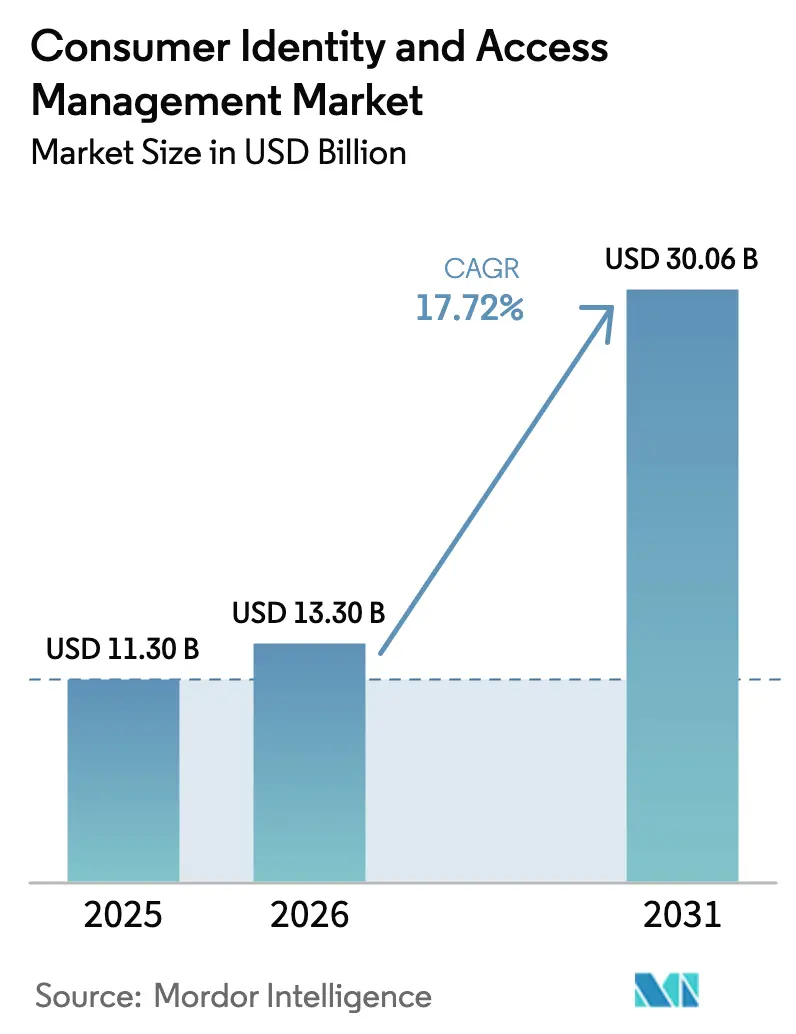
| Market Size (2026) | USD 13.3 Billion |
| Market Size (2031) | USD 30.06 Billion |
| Growth Rate (2026 - 2031) | 17.72 % |
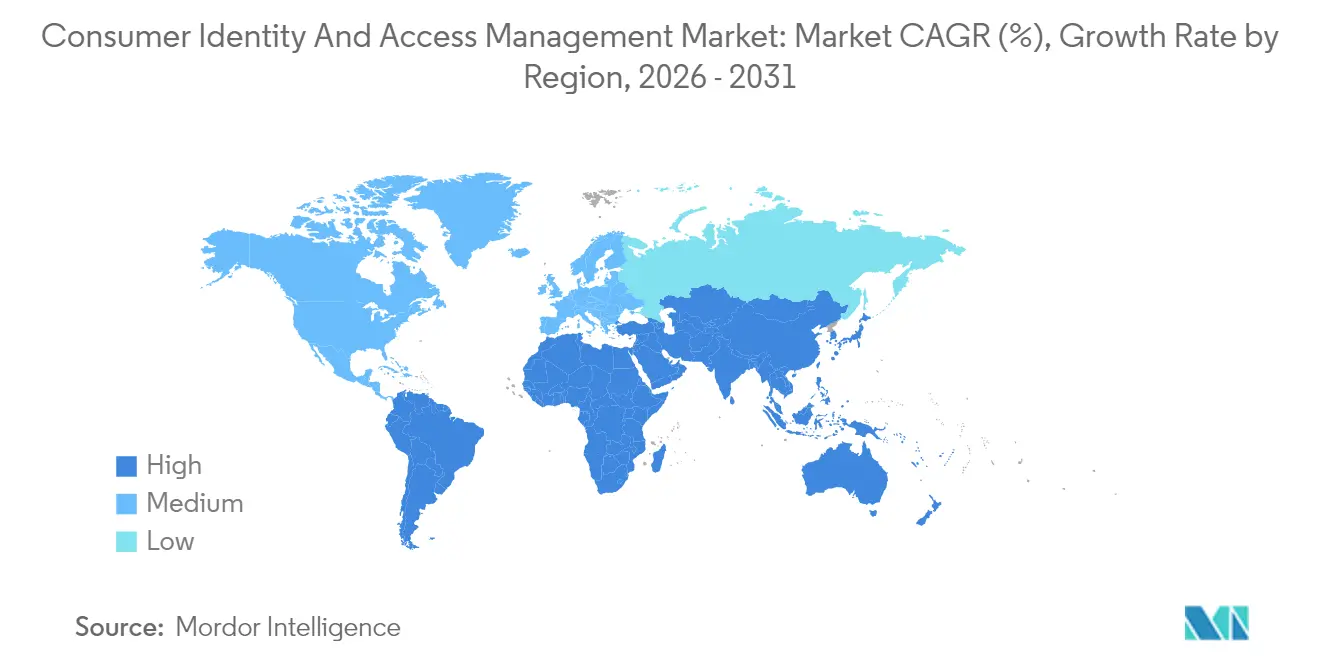
| Fastest Growing Market | Asia Pacific |
| Largest Market | North America |
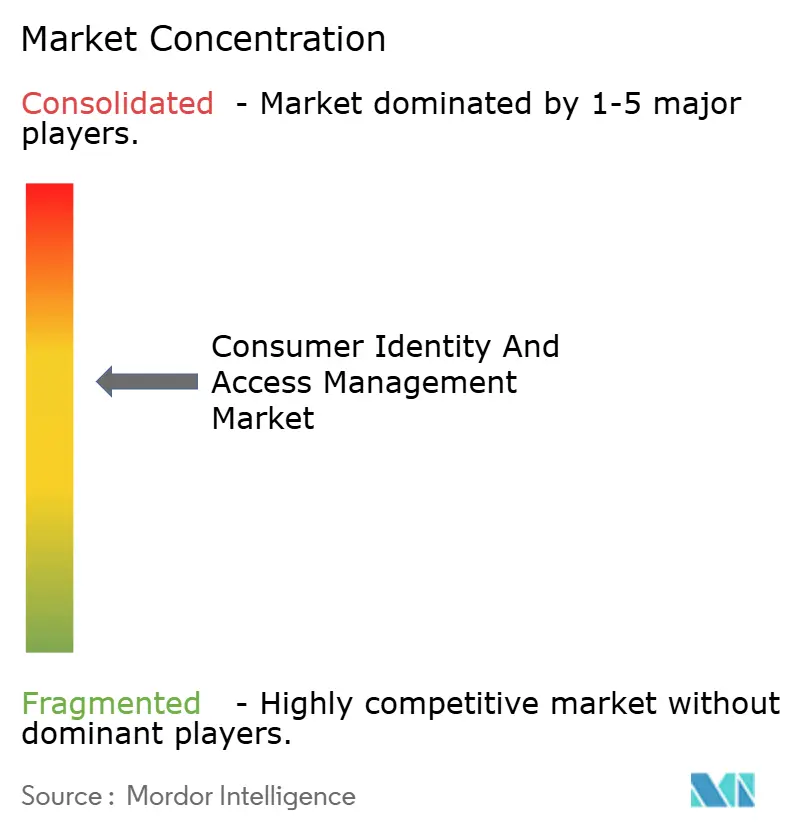
| Market Concentration | Medium |
Major Players *Disclaimer: Major Players sorted in no particular order Image © Mordor Intelligence. Reuse requires attribution under CC BY 4.0. | |
Consumer Identity And Access Management Market Analysis by Mordor Intelligence
The customer identity and access management market size was valued at USD 11.3 billion in 2025 and estimated to grow from USD 13.3 billion in 2026 to reach USD 30.06 billion by 2031, at a CAGR of 17.72% during the forecast period (2026-2031). Sustained growth reflects enterprise moves toward customer-centric digital engagement, rising regulatory compliance duties, and a sharp uptick in sophisticated cyber threats. Generative-AI adaptive authentication, mandatory PSD3 consent orchestration, and eIDAS 2.0 digital identity wallets combine to accelerate adoption, while businesses face USD 186 billion in yearly losses from API-layer bot attacks. Solutions continue to account for the bulk of spending, but managed services gain momentum as organizations outsource complex orchestration tasks. Cloud deployment dominates new projects, driven by infrastructure modernization and regulatory acceptance of cloud controls. Healthcare, embedded finance, and super-app ecosystems offer outsized opportunities as each segment demands seamless yet privacy-preserving identity journeys.
Key Report Takeaways
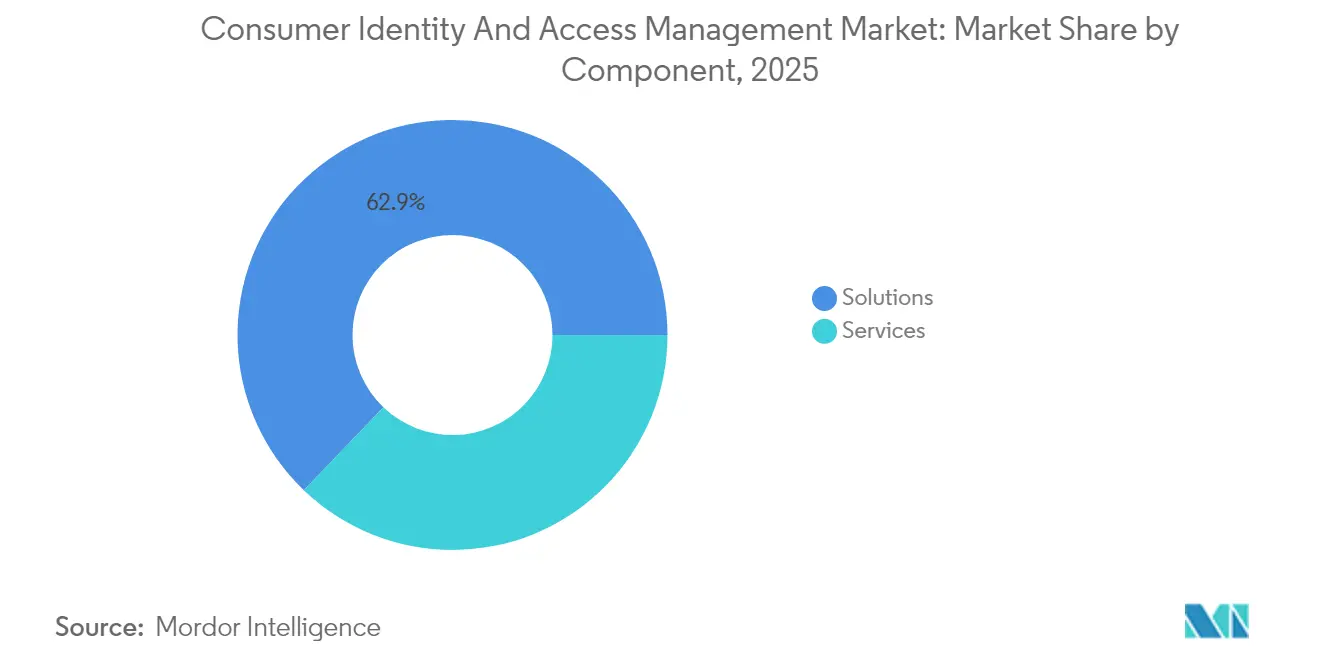
- By component, solutions held 62.85% of the customer identity and access management market share in 2025, whereas services are set to record a 18.6% CAGR to 2031.
- By deployment mode, cloud captured 77.35% of the customer identity and access management market size in 2025 and is projected to rise at a 19.35% CAGR during the forecast window.
- By end-user industry, BFSI led with 28.55% revenue share in 2025, while healthcare is advancing at a 19.08% CAGR through 2031.
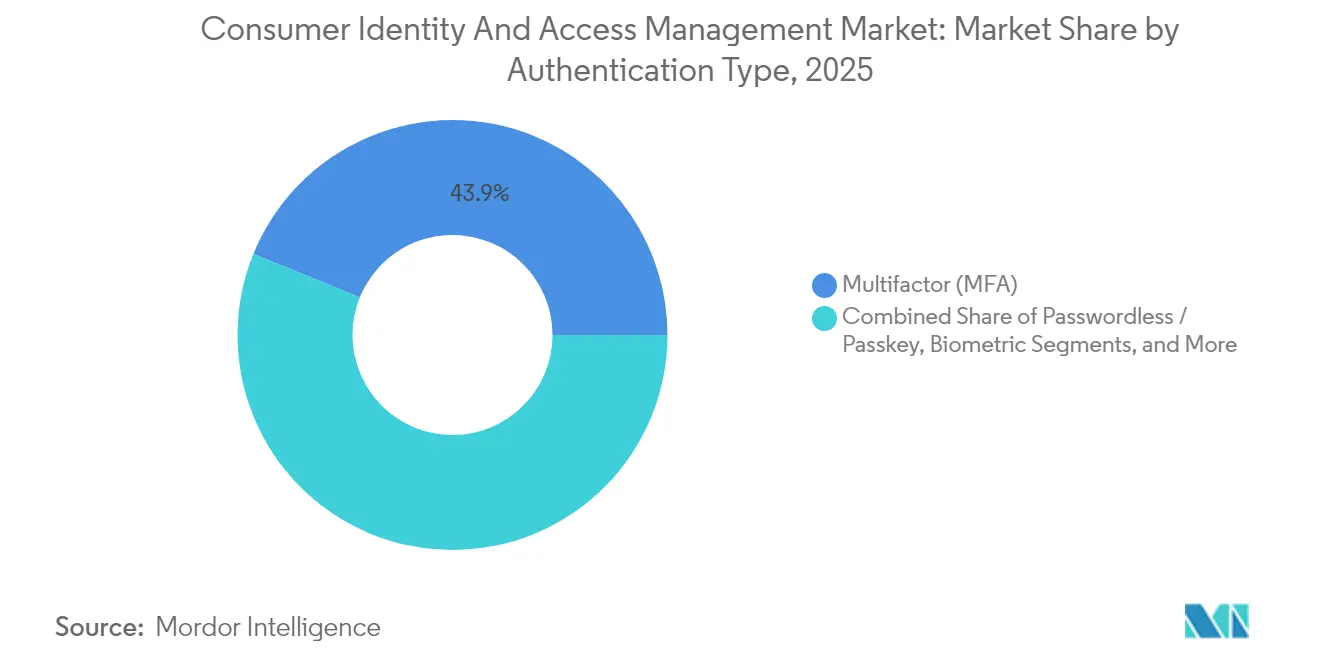
- By authentication type, multifactor authentication represented 43.85% share of the customer identity and access management market size in 2025; passwordless/passkey solutions are expanding at a 23.65% CAGR to 2031.
- By organization size, large enterprises commanded 61.15% share in 2025, whereas SMEs are growing at an 18.28% CAGR.
- By geography, North America accounted for 43.25% of the customer identity and access management market share in 2025; Asia-Pacific is forecast to post the fastest 17.98% CAGR to 2031.
Note: Market size and forecast figures in this report are generated using Mordor Intelligence’s proprietary estimation framework, updated with the latest available data and insights as of 2026.
Market Trends and Insights
Drivers Impact Analysis of Consumer Identity And Access Management Market*
| Driver | (~) % Impact on CAGR Forecast | Geographic Relevance | Impact Timeline |
|---|---|---|---|
| Gen-AI adaptive authentication | +3.2% | Global, early uptake in North America and EU | Medium term (2-4 years) |
| Privacy–user-experience balance elevates CIAM budgets | +2.8% | Global, strongest in EU | Short term (≤ 2 years) |
| Embedded finance and super-apps need federated CIAM | +4.1% | APAC core, Latin America spill-over | Medium term (2-4 years) |
| Mandatory PSD3/CPRA consent orchestration | +2.9% | EU and expanding US scope | Long term (≥ 4 years) |
| Passwordless FIDO2 roll-out by Big Tech | +3.5% | Global, led by North America | Short term (≤ 2 years) |
| Digital identity wallets under eIDAS 2.0 and NIST | +2.7% | EU primary, US emerging | Long term (≥ 4 years) |
| Source: Mordor Intelligence | |||
Gen-AI Adaptive Authentication
Generative AI moves CIAM from reactive control to predictive risk assessment. Strivacity’s AI Assist shows real-time analysis of user journeys and automated compliance checks, and analysts expect 35% of organizations to embed generative AI in identity functions by 2025. [1] Dynamic policies based on behavior, device fingerprinting, and context trim user friction while raising security, a balance valued by healthcare providers integrating Clear with Epic for rapid patient sign-in. Adaptive mechanisms tailor step-up requirements to individual risk profiles and mitigate over-authentication fatigue that erodes conversion rates.
Growing Privacy–UX Trade-off Awareness Drives Budgets
The eIDAS 2.0 mandate effective May 2024 obliges EU states to issue national digital identity wallets by 2026, pushing enterprises to adopt privacy-protective CIAM strategies. Consumers demand frictionless journeys, so firms abandon legacy log-in screens that prioritize security at the expense of convenience. Healthcare providers illustrate this pivot; identity wallets let patients retrieve records across networks while retaining HIPAA compliance. Privacy moves from blocker to enabler of superior user experience.
Surge in Embedded Finance & Super-apps Requiring Federated CIAM
Super-apps that bundle messaging, shopping, and financial services rely on federation to authenticate users across multiple partners. The OECD Digital Economy Outlook 2024 links rapid digital services adoption in APAC to 7.6% ICT sector growth. Peru’s Yape and Plin e-wallets show 340% transaction growth, underscoring identity federation needs. CIAM platforms must manage multiple identity contexts while sustaining unified security policy enforcement.
Mandatory PSD3/CPRA Consent Orchestration Compliance
PSD3 will introduce delegated authentication and outcome-based SCA, compelling banks and fintechs to modernize consent workflows. The California Privacy Rights Act increases complexity with granular consent preferences. CIAM vendors must evolve into orchestration engines that store, update, and verify dynamic privacy directives across regions and channels.
Restraints Impact Analysis of Consumer Identity And Access Management Market*
| Restraint | (~) % Impact on CAGR Forecast | Geographic Relevance | Impact Timeline |
|---|---|---|---|
| API-layer bot attacks outpace mitigation | –2.1% | Global, highest in North America and EU | Short term (≤ 2 years) |
| Fragmented data-residency laws inflate cost | –1.8% | Global, acute in APAC and emerging markets | Medium term (2-4 years) |
| CIO skill gap in CIAM orchestration | –1.4% | Global, sharpest among SMEs | Medium term (2-4 years) |
| Customer trust erosion after breaches | –1.2% | Global, varying by region | Long term (≥ 4 years) |
| Source: Mordor Intelligence | |||
API-layer Bot Attacks Outpace CIAM Mitigation Speed
Bots exploiting APIs compromise customer journeys and raise security costs. Enterprises now manage an average 613 API endpoints that widen attack surfaces, and related incidents climbed 28% in 2024, costing USD 186 billion annually. [2] Effective deterrence requires integrating CIAM with dedicated API security analytics, stretching budgets, and prolonging roll-outs.
CIO Skill Gap in CIAM Orchestration & DevSecOps Integration
Modern CIAM demands scripting policies, wiring event streams to security information and event management (SIEM) tools, and embedding automation into DevSecOps pipelines. Many SMEs lack staff with requisite IAM knowledge, echoing CISA findings that premium SSO services price out smaller firms. [3] Outsourcing partially bridges the gap but heightens vendor lock-in concerns.
*Our forecasts treat driver/restraint impacts as directional, not additive. The impact forecasts reflect baseline growth, mix effects, and variable interactions.
Consumer Identity And Access Management Market Segment Analysis
By Component:
Managed Services Take Center StageServices revenue is outpacing software as firms seek turnkey deployment. The component segment captured 62.85% of the customer identity and access management market size for solutions in 2025, yet services are forecast to grow 18.6% annually through 2031. Large enterprises shift orchestration to experts, and SMEs, citing JumpCloud’s survey of 42% outsourcing, follow suit.
The rising complexity of privacy, adaptive authentication, and multi-channel consent workflows makes managed services attractive. Healthcare organizations rely on Clear integrations that minimize in-house coding. As customer identity and access management market adoption broadens, competitive differentiation leans more on implementation quality than feature checklists.

By Deployment Mode:
Cloud Leads ModernizationCloud installations accounted for 77.35% share of the customer identity and access management market size in 2025 and will advance at a 19.35% CAGR as legacy on-premise estates retire. Microsoft’s Entra ID showcases continuous feature delivery, convincing risk-averse sectors that cloud meets or exceeds security benchmarks.
Hybrid deployments remain for data-sovereignty or low-latency needs, but most new roll-outs default to cloud. Enterprises prize API-first extensibility and automated scaling. Managed service providers build standardized stacks that shorten time-to-value and keep compliance artefacts current across regions, reinforcing cloud preference.
By End-user Industry:
Healthcare Rises FastHealthcare is projected to post a 19.08% CAGR, surpassing every other vertical. Digital front-door strategies, telemedicine, and interoperability programs such as SMART on FHIR compel providers to adopt modern CIAM. Meanwhile, BFSI retains a 28.55% share as of 2025, reflecting long-standing regulatory drivers.
Patient misidentification costs and cross-provider data exchange spur biometric and passkey implementations. Clear’s hospital kiosks illustrate benefits: faster check-in, fewer manual errors, and higher patient satisfaction. Growth in healthcare cements domain-specific templates as a must-have for vendors aiming to expand customer identity and access management market reach.
By Authentication Type:
Passwordless Gains GroundMultifactor methods hold a 43.85% share, yet passwordless/passkey authentication is racing ahead at a 23.65% CAGR. The customer identity and access management market is transitioning from shared secret models toward public-key cryptography backed by device biometrics. The FIDO Alliance data shows 15 billion passkey-enabled accounts as of 2024.
Enterprises grapple with account recovery and legacy compatibility, slowing full conversion. Nevertheless, Big Tech standardization lowers integration costs, and regulators increasingly recognize passkeys as strong consumer-grade authentication. Industries with high-value assets, such as healthcare and finance, lead deployments.
By Organisation Size:
SMEs Close the GapLarge enterprises retain 61.15% share, but SMEs will clock an 18.28% CAGR. The customer identity and access management market must accommodate constrained budgets and lean IT teams. Freemium tiers and simplified orchestration help vendors penetrate this segment.
CISA notes that high subscription fees deter adoption among small businesses. Vendors respond with bundled offers, managed setups, and AI-driven configuration wizards that shrink deployment times. As barrier-free digital commerce becomes table stakes, SMEs cannot ignore robust identity, fueling steady uptake.
Geography Analysis
North America Consumer Identity And Access Management Market
North America held 43.25% of 2025 revenue owing to entrenched enterprise programs and plentiful vendor ecosystems. Ongoing enhancements focus on adaptive risk analytics and regulatory alignment with CPRA, yet overall expansion rates moderate as base penetration grows. Government attention on SME affordability, reflected in CISA studies, supports broader adoption and keeps the customer identity and access management market vibrant.
APAC Consumer Identity And Access Management Market
Asia-Pacific is forecast to record the fastest 17.98% CAGR, propelled by government identity wallet schemes, super-app economics, and mobile-first consumer habits. ICT growth across OECD member economies averaged 7.6% in 2024 and was higher in leading APAC nations, underlining fertile ground for identity platforms. Vendors localize data storage and comply with national standards to capture demand.
Europe Consumer Identity And Access Management Market
Europe advances on the back of eIDAS 2.0, which mandates interoperable wallets by 2026. The initiative will enlarge the customer identity and access management market as public and private sectors converge on shared digital ID frameworks. Privacy leadership positions European vendors to export expertise abroad, although varied implementation timelines and economic headwinds inject execution risk.
Regulatory Landscape
Consumer identity and access management (CIAM) deployments are increasingly shaped by privacy and digital-identity requirements that call for auditable consent, stronger authentication, and demonstrable governance across jurisdictions. In the European Union, eIDAS 2.0 requires member states to issue national digital identity wallets by 2026, which reinforces wallet-ready CIAM patterns (verified attributes, selective disclosure, and consent logging). In the United States, NIST finalized SP 800-63 Revision 4 in July 2025, tightening expectations around phishing-resistant authentication and identity proofing practices used by many regulated buyers as a baseline control framework.
State and cross-border enforcement adds operational pressure to CIAM programs that rely on centralized consumer identity profiles. In California, updated CCPA/CPRA regulations that introduce cybersecurity audits, risk assessments, and automated decision-making technology obligations became effective January 1, 2026, increasing demand for consent orchestration and defensible identity risk controls. Additional policy motion, including the US Consumer Data Privacy and Security Act of 2026 (S. 4211) introduced on March 25, 2026, alongside UK government work on national digital identity and Digital Verification Services (DVS) in 2026, points to continued convergence between consumer privacy compliance and identity verification ecosystems that CIAM platforms must integrate with.
Competitive Landscape
Market consolidation is underway as established providers add AI layers and cloud hyperscalers bundle CIAM into broader platforms. Ping Identity’s ForgeRock integration produced a unified orchestration suite that targets regulated verticals and extends regional data-residency coverage. Microsoft, IBM, and Okta maintain scale advantages courtesy of long-standing enterprise contracts and ecosystems.
Disruptors concentrate on vertical niches and rapid deployment. Strivacity focuses on low-code orchestration with embedded generative AI, while Frontegg emphasizes developer-centric APIs. Semiconductor supply constraints affect biometric device roll-outs as the wider component market reached USD 627.6 billion in 2024. Vendors able to secure hardware pipelines gain leverage, especially in sectors reliant on on-device biometrics.
Competition is shifting from feature counts to compliance and integration depth. Buyers value out-of-the-box orchestration for PSD3 and eIDAS 2.0, plus connectivity into API security, fraud analytics, and consent vaults. Partnerships with system integrators and managed service providers are integral to winning large multi-region deals and expanding customer identity and access management market presence.
Consumer Identity And Access Management Industry Leaders
-
Microsoft Corporation
-
IBM Corporation
-
Okta Inc. (incl. Auth0)
-
Ping Identity Holdings
-
Salesforce Inc.
- *Disclaimer: Major Players sorted in no particular order
Consumer Identity And Access Management Market Companies Covered in this Report
- Microsoft Corporation
- IBM Corporation
- Okta Inc. (incl. Auth0)
- Ping Identity Holdings
- ForgeRock Inc.
- Salesforce Inc.
- Amazon Web Services Inc.
- Broadcom Inc. (Symantec)
- Thales Group (Gemalto)
- HID Global (Assa Abloy)
- CyberArk Software Ltd.
- Micro Focus Intl. plc
- Duo Security (Cisco)
- OneLogin (One Identity)
- Strivacity
- Frontegg
- LoginRadius Inc.
- Authgear
- SAASPASS Inc.
- IDCUBE Systems Pvt Ltd.
- AlertEnterprise Inc.
- Convergint Technologies LLC
Read Analysis of Consumer Identity And Access Management Companies
Market Opportunities and Future Outlook
A whitespace is forming around CIAM capabilities purpose-built for wallet-based identity and cross-ecosystem consent. The eIDAS 2.0 milestone requiring EU member states to issue digital identity wallets by 2026 is pulling demand toward CIAM stacks that can accept wallet assertions, manage verified attributes, and preserve auditable consent trails across channels, especially for regulated onboarding journeys in BFSI and healthcare. At the same time, the shift from password-based login to phishing-resistant authentication continues to gain momentum as passkeys scale and buyers consolidate authentication, recovery, and step-up policies into a single orchestration layer.
Identity for AI agents and machine-to-application access is another adjacency to consumer journeys (agent-assisted support, shopping, and embedded finance). Vendor roadmaps in 2026 show product motion in this direction, including Ping Identity platform extensions positioned for agentic enterprise use cases (programmable interfaces and agent governance) and Auth0 capability updates oriented to AI agents and token handling. As these use cases expand the set of actors that need identity controls beyond human users, CIAM platforms that can unify consumer identity, consent, and policy enforcement with non-human identity governance, alongside modern OAuth-based protections, become more central to digital engagement architectures than standalone login systems.
Recent Industry Developments in Consumer Identity And Access Management Market
- May 2026: Okta detailed Auth0 product innovations focused on enabling identity for AI agent use cases, including capabilities such as agent-as-principal patterns and token vaulting. The update broadens CIAM scope beyond human-only authentication and pushes buyers to evaluate platforms on how well they govern new machine-driven actors interacting with consumer-facing services.
- April 2026: Microsoft announced general availability of single sign-on (SSO) from native apps to embedded web views for Microsoft Entra External ID native authentication. This reduces friction in mobile app journeys that use embedded web views while keeping identity controls centralized, which supports higher conversion and more consistent policy enforcement across channels.
- June 2024: The FIDO Alliance reported passkeys reaching 15 billion passkey-enabled accounts, reinforcing broad ecosystem momentum for passwordless authentication. This scale milestone pushes CIAM vendors and adopters to prioritize passkey rollout, migration tooling, and account recovery design as core elements of consumer identity programs.
Consumer Identity And Access Management Market Report Scope and Research Methodology
Market Definition and Coverage
This market covers revenue generated from consumer identity and access management offerings that help organizations register, authenticate, authorize, and manage customer identities across digital channels, including consent and privacy controls. It counts software and related services sold for consumer-facing use cases across industries and regions.
Scope exclusions: We exclude workforce-only identity and access tools used mainly for employee access, physical access control systems, and standalone fraud scoring tools that do not manage customer identities end to end.
Segments Covered in This Report
- By Component
- Solutions
- Authentication and Authorisation
- Identity Verification and Proofing
- User Profile and Consent Management
- Services
- Professional
- Managed
- Solutions
- By Deployment Mode
- Cloud-based
- On-premise
- By End-user Industry
- BFSI
- Healthcare
- IT and Telecom
- Government
- Energy and Utilities
- Transportation
- Aerospace and Defense
- Education
- By Authentication Type
- Multifactor (MFA)
- Passwordless / Passkey
- Biometric
- Social and Federated Login
- By Organisation Size
- Large Enterprises
- Small- and Medium-sized Enterprises (SMEs)
- Geography
- North America
- United States
- Canada
- Mexico
- South America
- Brazil
- Argentina
- Chile
- Europe
- Germany
- United Kingdom
- France
- Italy
- Spain
- Russia
- Asia-Pacific
- China
- Japan
- India
- South Korea
- Rest of ASEAN
- Middle East and Africa
- GCC
- Turkey
- South Africa
- Rest of Africa
- North America
Data Sources, Market Sizing, and Validation
Desk Research
Desk research was used to set the CIAM market boundary and to anchor adoption signals that can be checked year over year. We relied on public sources such as NIST digital identity guidance, CISA cybersecurity advisories, ENISA reports, and OECD and World Bank digital economy indicators to understand policy, risk, and digitization patterns that drive CIAM demand.
We also reviewed company annual reports, investor presentations, and product documentation to confirm how vendors draw the CIAM line versus broader IAM, and where revenue recognition typically sits for software subscriptions and services. For added context on patents, security incidents, and public contracting, we used paid subscriptions for company financials and intelligence, news and financials, patent databases, and global contracts and tenders. These desk sources are illustrative only, and other public materials were also used to collect data points, validate assumptions, and close open questions.
Primary Interviews and Surveys
Primary discussions were run with a mix of CIAM solution providers, system integrators, and enterprise buyers that own customer login and digital onboarding programs. We used these interviews to confirm what gets budgeted as CIAM, how cloud versus on-premise pricing is shifting, and which industries are expanding deployments fastest across APAC, EMEA, and the Americas.
Distribution of primary research fieldwork respondents
| Company type | Respondent position | Region |
|---|---|---|
| Top tier: 31% | CXOs: 14% | APAC: 51% |
| Mid tier: 54% | Functional/Unit leaders: 39% | EMEA: 31% |
| Smaller Players: 15% | Managers: 47% | Americas: 18% |
Market-Sizing & Forecasting
Sizing was first built using a top-down model where enterprise digital account volumes and online engagement trends are translated into a CIAM spend pool through adoption and budget-share assumptions, then split by region based on digitization levels and regulatory intensity. To keep the totals grounded, we corroborated results with selective bottom-up checks, including sampled vendor revenue disclosures, channel feedback on typical contract sizes, and ASPs linked to deployed identity volumes for common use cases.
Key inputs used in the model include the share of consumer interactions moving to digital channels, MFA and passwordless adoption rates, consent and privacy compliance activity, cloud subscription pricing direction, and managed services attach rates. Where bottom-up evidence was incomplete for smaller providers and private firms, gaps were handled with cautious penetration assumptions and range checks against observed pricing bands shared by interviewees.
For the forecast, scenario analysis was applied around security incident intensity and regulatory enforcement timing, followed by a smoothing step to avoid unrealistic year-to-year jumps in adoption. Expert inputs were used to stress test how quickly passwordless, progressive profiling, and identity proofing features are being bundled into CIAM contracts across regions.
Data Validation & Update Cycle
Outputs were validated through multiple checks, including cross-verifying implied CIAM spend per digital customer account, comparing regional splits with public digitization indicators, and reviewing whether growth patterns are consistent with changes in authentication and privacy requirements. When large variances appeared, assumptions were revisited and, where needed, respondents were re-contacted to confirm pricing, bundling, or scope treatment.
Before sign-off, the model is reviewed in analyst steps to catch outliers, inconsistent growth rates, and currency conversion timing issues, and then to ensure definitions stay consistent across years. Reports are refreshed annually, with interim updates when material events affect demand drivers, and a final pre-delivery review is done so clients receive the most current view.
Mordor Intelligence's Global Consumer Identity and Access Management Market Size Versus Other Published Estimates
Published market values for consumer identity and access management can differ even when they describe the same overall growth story. Variances typically come from how each study draws the CIAM boundary, what year is used as the current estimate, and whether services and adjacent identity tools are included.
The benchmark table shows a spread that is mainly explained by scope and timing, and in the Mordor Intelligence model, revenue is counted only for dedicated CIAM software plus related services across cloud and on-premise deployments, while workforce-only IAM and standalone fraud scoring are excluded. The current value is also presented for 2026 rather than back-casting a 2025 figure.
Benchmark comparison
| Source | Market Size | Gaps in Research Methodology |
|---|---|---|
| Mordor Intelligence | USD 13.30 B (2026) | |
| Trade Journal A | USD 16.05 B (2025) | Uses a different current-year anchor and often bundles broader customer IAM spending, which can pull in adjacent identity proofing and security spend that is not consistently separated from CIAM software and services. |
| Industry Brief B | USD 12.60 B (2026) | Leans more heavily on vendor-reported projections and a narrower solution set, which can undercount services and implementation work that buyers frequently purchase alongside CIAM subscriptions. |
Taken together, the comparison points to two repeatable drivers of variance, which are the year used for the current market value and how tightly the offering scope is kept to true CIAM revenues. Our approach stays traceable because each step ties back to observable demand signals, pricing logic, and interview-based checks that can be re-run when market conditions change.
Key Questions Answered in the Report
What is the current size of the customer identity and access management market?
The market is valued at USD 13.3 billion in 2026 and is forecast to reach USD 30.06 billion by 2031.
What compound annual growth rate (CAGR) is projected for the customer identity and access management market through 2031?
Analysts expect an 17.72% CAGR during the 2026-2031 period.
Which deployment model is expanding the fastest?
Cloud-based CIAM commands 77.35% of 2025 revenue and is growing at a 19.35% CAGR as organizations modernize infrastructure and embrace API-first architectures.
Why is healthcare the quickest-growing end-user segment?
Hospitals and clinics need secure, seamless patient identity verification for telehealth, electronic health records, and interoperability, driving a 19.08% CAGR in the segment.
How are passkeys influencing CIAM strategies?
Wide passkey adoption—15 billion enabled accounts in 2024—pushes enterprises toward passwordless, phishing-resistant authentication that improves user experience and security.
Which regions will fuel the next wave of CIAM demand?
Asia-Pacific is set to post a 17.98% CAGR on the back of digital identity wallets, super-app ecosystems, and mobile-first consumers, while Europe gains momentum from eIDAS 2.0 regulations.