
Coconut Milk and Cream Market Size and Share
Market Overview
| Study Period | 2021 - 2031 |
|---|---|
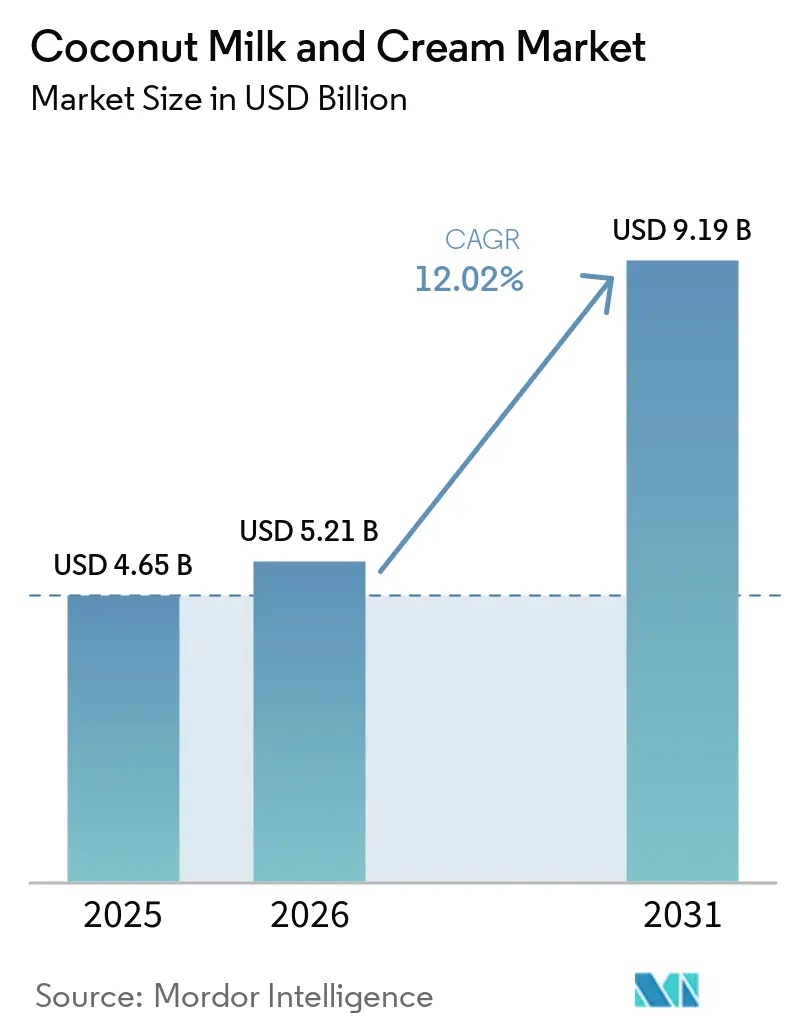
| Market Size (2026) | USD 5.21 Billion |
| Market Size (2031) | USD 9.19 Billion |
| Growth Rate (2026 - 2031) | 12.02 % |
| Fastest Growing Market | North America |
| Largest Market | Asia Pacific |
| Market Concentration | Medium |
Major Players *Disclaimer: Major Players sorted in no particular order Image © Mordor Intelligence. Reuse requires attribution under CC BY 4.0. | |
Coconut Milk and Cream Market Analysis by Mordor Intelligence
The coconut milk and cream market size in 2026 is estimated at USD 5.21 billion, growing from 2025 value of USD 4.65 billion with 2031 projections showing USD 9.19 billion, growing at 12.02% CAGR over 2026-2031. The market growth is driven by increasing demand for plant-based nutrition, broader culinary applications, and expansion of organized retail channels. The products' functional benefits, including medium-chain triglycerides, natural electrolytes, and clean ingredient profiles, contribute to their market appeal. The sustainability aspects of coconut cultivation, characterized by long-productive palm trees and minimal irrigation needs, further support market growth. The market expansion is also supported by increased production capacity among integrated processors and the implementation of traceability and ethical sourcing certifications, leading to greater premium retail presence. Despite El Niño-related harvest disruptions causing price fluctuations, consumers' association of higher prices with quality and origin has positively influenced the market's value growth.
Key Report Takeaways
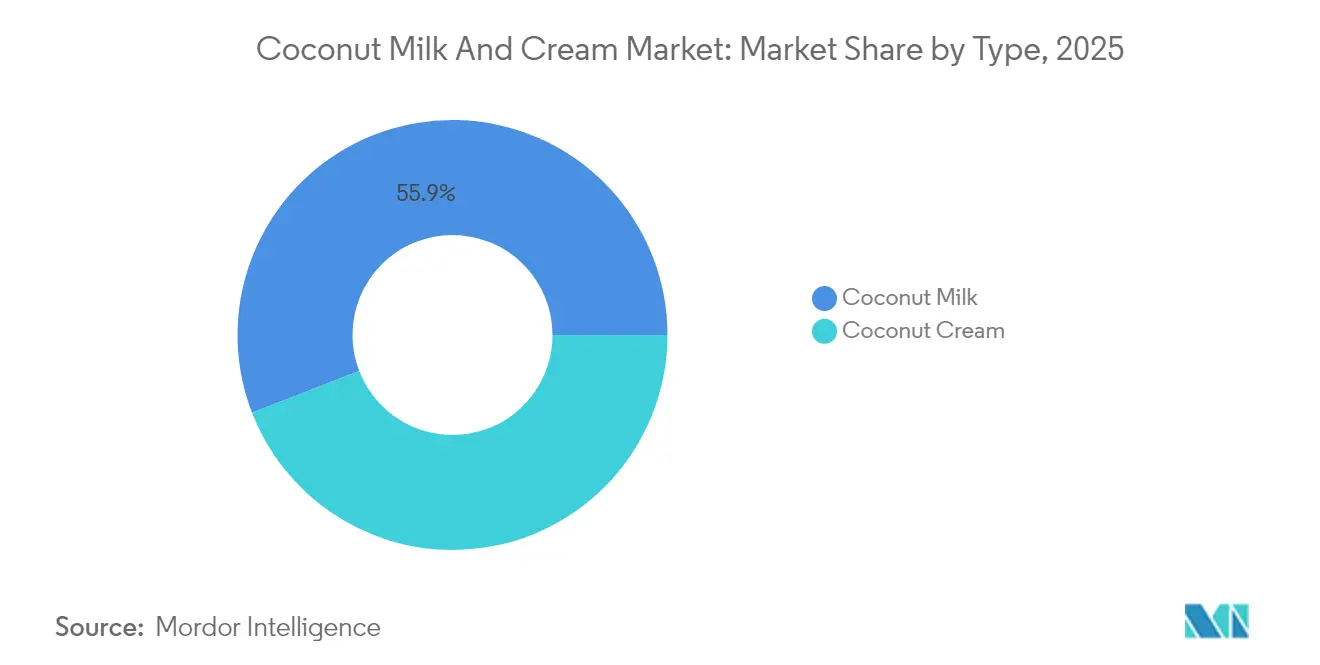
- By product type, coconut milk held 55.88% of the coconut milk and cream market share in 2025, whereas coconut cream is forecast to expand at a 13.05% CAGR between 2026-2031.
- By category, conventional offerings accounted for 65.92% of the coconut milk and cream market size in 2025, while organic lines are set to rise at a 16.18% CAGR through 2031.
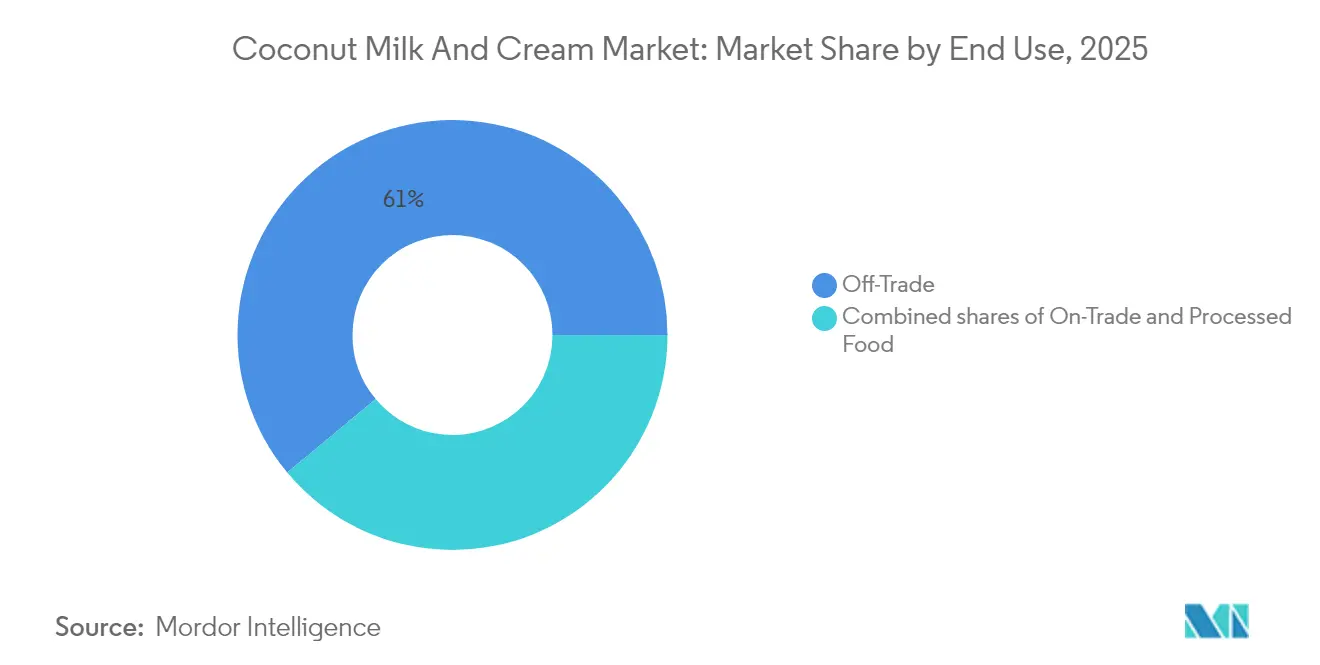
- By end use, off-trade channels captured 61.05% revenue share in 2025, and processed food applications are positioned for the highest 13.52% CAGR over the forecast window.
- By geography, Asia-Pacific led with 54.62% value share in 2025, but North America is projected to deliver the fastest 13.72% CAGR to 2031.
Note: Market size and forecast figures in this report are generated using Mordor Intelligence’s proprietary estimation framework, updated with the latest available data and insights as of 2026.
Market Trends and Insights
Drivers Impact Analysis of Coconut Milk and Cream Market*
| Driver | (~) % Impact on CAGR Forecast | Geographic Relevance | Impact Timeline |
|---|---|---|---|
| Plant-based and vegan diet adoption | +2.1% | North America, Europe, Global | Medium term (2-4 years) |
| Increasing lactose intolerance | +1.8% | Asia-Pacific, North America | Long term (≥ 4 years) |
| Clean-label ingredient preference | +1.5% | North America, EU, APAC | Medium term (2-4 years) |
| Ethical and sustainable sourcing focus | +1.2% | EU, North America, Urban APAC | Long term (≥ 4 years) |
| Packaging formats that extend shelf life | +0.9% | Developed markets worldwide | Short term (≤ 2 years) |
| Established food certifications | +0.8% | EU, North America, Emerging APAC | Medium term (2-4 years) |
| Source: Mordor Intelligence | |||
Rising Consumer Preference for Plant-Based and Vegan Diets
The coconut milk market has undergone a remarkable transformation, evolving from a specialized health product into a widely embraced dairy alternative in the global food and beverage industry. This shift reflects changing consumer preferences, as individuals increasingly value the product's distinctive functional attributes and sensory characteristics. The rich, creamy texture of coconut milk, combined with its exceptional performance in high-temperature cooking applications, has established it as a versatile ingredient in both commercial and household kitchens. Market acceptance has expanded beyond traditional plant-based consumers to encompass a broader demographic, including flexitarians and health-conscious individuals who seek to reduce dairy consumption while maintaining familiar taste and texture experiences. This trend is particularly evident in European markets, as highlighted by GFI Europe's 2024 report, which documents consistent growth across major countries including France, Germany, Italy, Spain, the Netherlands, and the UK. The market's expansion has been notably supported by the introduction of affordable private-label products, especially in the plant-based milk and beverages category, making these alternatives more accessible to a wider consumer base [1].
Growing Lactose Intolerance Fueling Demand for Dairy Alternatives
Lactose intolerance affects a significant portion of the global adult population, creating a substantial market for coconut-based dairy alternatives. Unlike trend-driven consumption, the medical necessity of lactose-intolerant individuals ensures consistent demand across various product categories. Coconut milk offers advantages over soy and nut-based alternatives due to its natural enzyme composition and lack of common allergens, particularly in markets where multiple food sensitivities are prevalent. The Asia-Pacific region shows strong market potential due to high rates of genetic lactose intolerance and established coconut milk consumption patterns. The growing medical recognition and diagnosis of lactose intolerance as a cause of digestive issues continues to expand the market beyond traditional consumer segments, as healthcare providers increasingly recommend suitable dairy alternatives to their patients. This medical validation strengthens market growth prospects, as consumers seek long-term solutions for their dietary requirements rather than following temporary food trends. According to Boston Children's Hospital, approximately 30-50 million Americans are lactose intolerant. This includes 80% of African-Americans and Native Americans, and over 90% of Asian-Americans [2].
Consumer Preference for Natural Ingredients and Clean-Label Products
Coconut milk's straightforward ingredient composition and minimal processing requirements give it a distinct competitive advantage in the plant-based alternatives market. Its formulation remains simple and uncomplicated, contrasting significantly with alternatives that depend on stabilizers, emulsifiers, and flavor masking agents. Consumer studies demonstrate that coconut-based products consistently receive higher naturalness ratings, primarily because consumers recognize and trust coconut as a familiar whole food ingredient. This positive market perception enables companies to implement premium pricing strategies, as consumers demonstrate strong willingness to pay more for products they consider minimally processed. In response to this market dynamic, major brands have begun implementing comprehensive traceability systems to document coconut sourcing from farms and processing facilities, addressing the growing consumer demand for ingredient transparency.
Increasing Interest in Sustainable and Ethically Sourced Food Products
The growing emphasis on sustainability has transformed from an aspirational goal to a key purchasing factor, with coconut cultivation offering environmental advantages compared to dairy production and other nut alternatives. Coconut palms demonstrate environmental benefits through their multi-generational productive lifespan and contribution to tropical ecosystem preservation, unlike annual crops that require frequent soil disturbance and agricultural inputs. The sustainability profile, however, faces challenges due to child labor issues in major producing countries, particularly the Philippines, where the industry is implementing certification programs and farmer partnerships to improve supply chain ethics. The European Union's Deforestation Regulation presents opportunities for compliant coconut suppliers to access premium European markets, while creating barriers for non-compliant sources. The impact of sustainability certifications on consumer behavior varies by region, with European and North American markets showing the strongest connection between environmental certifications and purchasing decisions.
Restraints Impact Analysis of Coconut Milk and Cream Market*
| Restraint | (~) % Impact on CAGR Forecast | Geographic Relevance | Impact Timeline |
|---|---|---|---|
| Regulatory challenges in labeling and food safety standards | -1.2% | EU & North America primarily, expanding globally | Medium term (2-4 years) |
| Limited availability of high-quality raw coconuts in some regions | -0.8% | Global supply chain, acute in processing regions | Short term (≤ 2 years) |
| High cost of coconut milk and cream compared to conventional dairy | -0.6% | Global, particularly price-sensitive emerging markets | Long term (≥ 4 years) |
| Challenges in ensuring sustainable and ethical sourcing across the supply chain | -0.4% | EU & North America compliance markets, APAC production regions | Medium term (2-4 years) |
| Source: Mordor Intelligence | |||
Regulatory Challenges in Labeling and Food Safety Standards
Regulatory complexity surrounding plant-based milk nomenclature creates market entry barriers and compliance costs that disproportionately impact smaller coconut milk producers while benefiting established players with regulatory expertise and resources. The European Union's restrictions on dairy terminology usage for plant-based alternatives require careful labeling strategies that avoid consumer confusion while maintaining product appeal, creating ongoing legal and marketing expenses that reduce profitability margins. Food safety standards variations across jurisdictions necessitate multiple production protocols and testing regimens, particularly challenging for coconut milk products that require specific pathogen controls due to their neutral pH and nutrient profiles that can support microbial growth. The FDA's evolving guidance on plant-based milk nutritional labeling requirements creates uncertainty for product development timelines and marketing strategies, as companies must balance regulatory compliance with competitive positioning needs. Organic certification requirements add additional complexity layers, as coconut sourcing must meet diverse national organic standards that may conflict or require separate supply chain management systems for different export markets.
Limited Availability of High-Quality Raw Coconuts in Some Regions
The concentration of supply chains in tropical coconut-producing regions exposes the industry to risks from weather disruptions, political instability, and agricultural disease outbreaks, which can limit global coconut milk production. El Niño weather patterns in 2024 have affected coconut yields in the Philippines, Indonesia, and Sri Lanka, causing raw material price increases that reduce processor margins and restrict market growth in price-sensitive segments. The requirement for premium coconut varieties in milk production creates supply constraints, as food-grade coconut milk needs specific maturity levels, fat content, and flavor profiles from select coconuts. Fresh coconut transportation and preservation challenges restrict processing facility locations and pose quality degradation risks, particularly affecting smaller processors without advanced supply chain management systems. The long-term supply stability faces threats from climate change impacts on coconut palm productivity, with rising sea levels and changing precipitation patterns affecting traditional growing regions, while new cultivation areas require decades to become productive. In 2025, the coconut industry faces limited availability of high-quality raw coconuts in some regions, hindering market growth. Challenges like declining productivity, extreme weather, aging plantations, and poor agronomic practices restrict supply, affecting the industry's capacity to meet rising demand for diverse coconut-based products, thereby limiting expansion potential [3].
*Our forecasts treat driver/restraint impacts as directional, not additive. The impact forecasts reflect baseline growth, mix effects, and variable interactions.
Coconut Milk and Cream Market Segment Analysis
By Product Type:
Cream Segment Drives Premium GrowthCoconut milk maintains its dominant position in product type segmentation, capturing 55.88% market share in 2025. This substantial market presence stems from its widespread application in various culinary preparations and strong consumer acceptance as a reliable dairy milk alternative. The versatility of coconut milk in both household and commercial kitchens has established it as an essential ingredient across multiple food categories.
Meanwhile, coconut cream demonstrates remarkable growth potential, advancing at a CAGR of 13.05% through 2031. This growth is primarily driven by its increasing adoption in professional food service environments and its superior functional characteristics in cooking and baking applications. Professional chefs consistently choose coconut cream for its exceptional performance in high-heat cooking, sauce preparation, and dessert making, where standard coconut milk alternatives often fall short. Food manufacturers increasingly incorporate coconut cream into their premium product formulations, particularly in ice cream, chocolate, and confectionery items, where its rich texture and stable emulsification properties significantly enhance the final product quality. The segment's evolution continues with innovative developments, exemplified by companies like Whole Moon, which has introduced whole coconut meat formulations that deliver complete protein profiles while maintaining the premium market positioning that fuels category expansion.

By Category:
Organic Segment Captures Health-Conscious PremiumConventional coconut products hold 65.92% market share in 2025, driven by established supply chains and competitive pricing that enables widespread consumer adoption across economic segments. The organic segment is projected to grow at 16.18% CAGR through 2031, as consumers demonstrate willingness to pay 30-50% premiums for certified organic coconut products that meet health and environmental preferences. This growth pattern highlights a market division between cost-conscious mainstream consumers and premium segment buyers.
The growth in organic coconut milk consumption stems from improved supply chain efficiency, which has enhanced product availability and decreased price differentials compared to conventional options. The segment's expansion is further supported by increased shelf space allocation in mainstream grocery retailers, as consumer demand validates premium positioning beyond traditional natural food stores.
By End Use:
Retail Dominance with B2B Innovation GrowthThe off-trade segment commands a substantial 61.05% market share in 2025, encompassing a diverse network of retail channels including supermarkets, hypermarkets, convenience stores, and online retailers. This dominant position reflects the successful transformation of coconut milk from a niche ingredient to an essential household item, supported by comprehensive retail expansion strategies and targeted consumer education initiatives. The widespread availability across multiple retail touchpoints has enabled consumers to easily incorporate coconut milk into their daily cooking routines, while retailers have optimized shelf placement and promotional activities to drive both trial purchases and customer retention.
The processed food segment exhibits remarkable growth potential with a projected CAGR of 13.52% through 2031, underscoring the increasing adoption of coconut milk by food manufacturers as a versatile ingredient solution. This growth trajectory is driven by manufacturers' strategic initiatives to reformulate existing product lines, replacing conventional additives and dairy components with coconut-based alternatives. The shift aligns with consumer preferences for recognizable, natural ingredients while maintaining product functionality and performance standards. Within the distribution landscape, traditional supermarkets and hypermarkets maintain their leadership position, while online retail platforms continue to capture increasing market share through innovative offerings such as subscription models and bulk purchase programs designed to serve regular coconut milk consumers.
Geography Analysis
APAC Coconut Milk and Cream Market
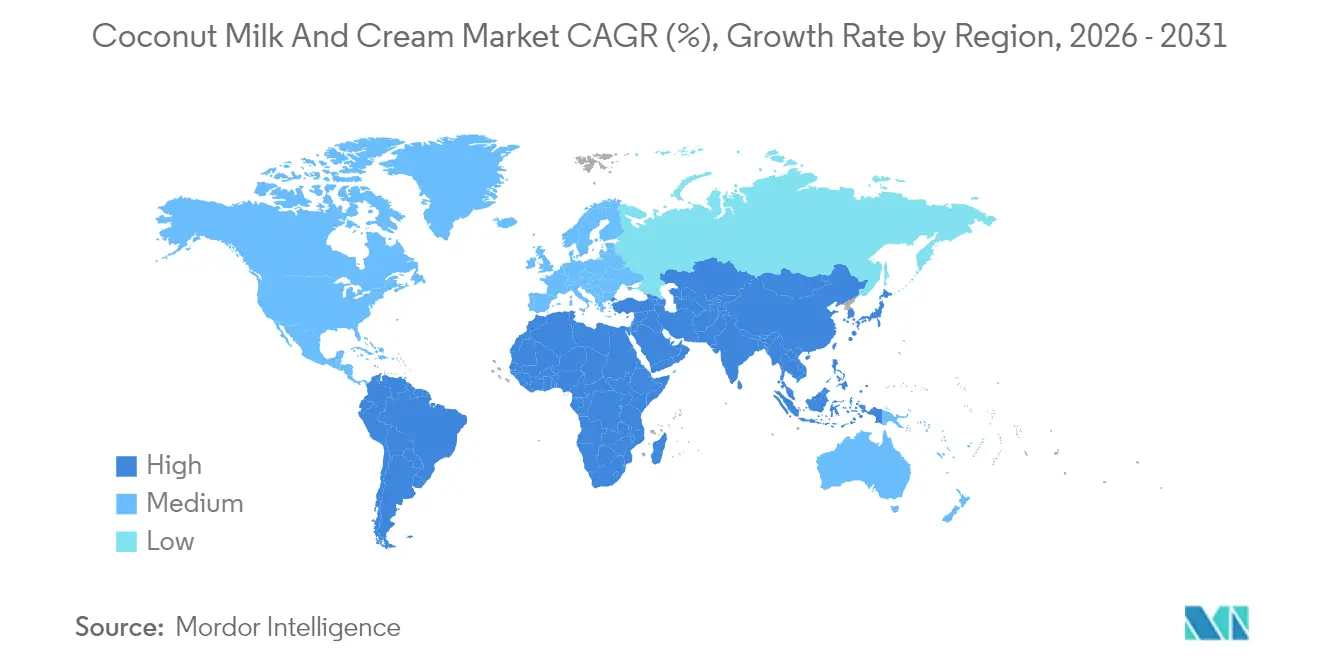
The Asia-Pacific region commands a substantial 54.62% of the global market share in 2025, building on its strong foundation in coconut cultivation and deeply rooted consumption patterns. The region's market leadership is a direct result of its competitive advantages in production costs and well-established supply chain networks, supported by generations of expertise in coconut cultivation and processing.
The Americas, EMEA and APAC Coconut Milk and Cream Market
North America has emerged as the most dynamic market, achieving a remarkable 13.72% CAGR through 2031. This growth is primarily fueled by consumers increasingly embracing plant-based diets and their willingness to invest in premium coconut milk products, creating favorable conditions for manufacturers to maintain healthy profit margins. European markets continue to evolve with stringent requirements for organic and sustainable products, particularly with the implementation of the EU Deforestation Regulation in 2024-2025. Meanwhile, South America shows promising developments despite infrastructure limitations, while the Middle East and Africa represent emerging opportunities driven by urbanization and changing consumer preferences. Recent market activities, including Dehusk's introduction of fortified coconut milk in the Philippines, demonstrate the industry's response to growing regional demand while building export capabilities.
Regulatory Landscape
International trade and product compliance for coconut milk and cream are anchored by Codex Alimentarius, notably the Standard for Aqueous Coconut Products (CXS 240-2003, amended 2024). It defines compositional expectations that are used to support buyer specifications in export channels.
Labeling requirements draw on Codex general labeling principles (CXS 1-1985), which affects how ingredients are declared and how product identity is described for reconstituted items. For trade compliance, the United States moved to mandatory full 10-digit HTS reporting for coconut-based shipments in September 2025, tightening documentation discipline.
Value Chain Analysis
The value chain begins with coconut cultivation, which remains dominated by smallholder farming in major origins. It then moves through aggregation and primary handling (dehusking, shelling, and desiccation), before industrial processing steps such as comminution, pressing, standardization, homogenization, and thermal processing (UHT/aseptic or retort) support ambient distribution for both retail and B2B customers.
Export-oriented processors and brand owners coordinate quality assurance, packaging (cans and aseptic cartons), and logistics for off-trade retail networks, while also supplying processed foods and foodservice. In these applications, consistency in fat content and sensory profile becomes a key constraint for reformulation and culinary performance. Bottlenecks are most visible upstream and at factory operations, including ageing plantations that limit raw coconut availability, weather-driven yield variability (including the El Nino period through May 2024 in major origins), and competition for coconuts from alternative export channels. Processors also face energy intensity and infrastructure gaps, which has encouraged circular practices such as using husks and shells for biomass energy, as highlighted by Chaokoh's push to power processing operations with upcycled biomass. Operational resilience is another recurring issue, with events such as the June 2026 earthquake in southern Philippines prompting temporary processing interruptions for safety checks.
Competitive Landscape
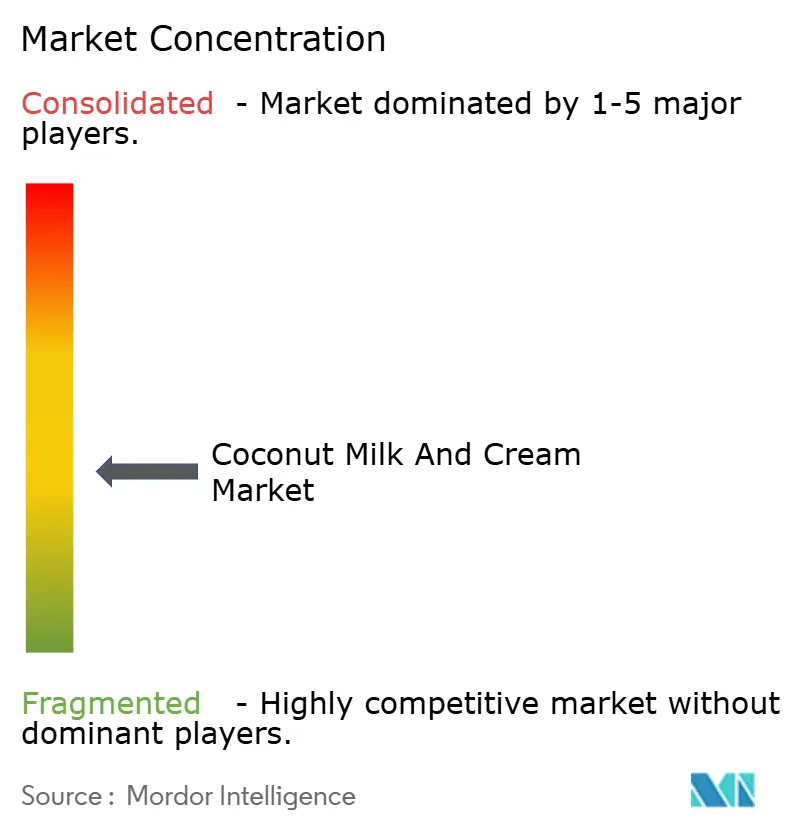
The coconut milk and cream market demonstrates moderate fragmentation, presenting significant opportunities for both established companies seeking market share consolidation and new entrants aiming to grow through differentiation strategies. Major industry players such as Thai Coconut, Vita Coco, and Goya Foods maintain their market positions through vertical integration advantages and well-established distribution networks. In contrast, emerging brands have successfully captured market share by focusing on premium product offerings, obtaining organic certifications, and implementing direct-to-consumer sales channels that circumvent traditional retail barriers.
Strategic partnerships between coconut processors and major food companies continue to reshape the competitive landscape of the industry. A notable example is Century Pacific's expanded agreement with Vita Coco, which includes a substantial USD 40 million investment in production capacity announced in July 2024, aimed at securing long-term supply relationships. The market has evolved beyond traditional competition based on price and distribution, as companies like Nestlé invest in product innovation, developing specialized fruit fat-based formulations that enhance both sensory characteristics and functional performance in plant-based milk applications.
The market presents numerous opportunities in specialized segments, particularly in developing barista-grade coconut milk formulations, creating fortified products that address specific nutritional requirements, and implementing sustainable packaging solutions that balance environmental concerns with product protection. Companies that invest in advanced supply chain traceability systems and sustainable sourcing verification mechanisms are gaining competitive advantages, as both regulatory requirements and consumer preferences increasingly demand greater transparency in ingredient sourcing and production methodologies.
Coconut Milk and Cream Industry Leaders
-
Thai Coconut Public Co. Ltd.
-
Theppadungporn Coconut Co., Ltd.
-
Goya Foods Inc.
-
Danone S.A.
-
McCormick & Company Inc.
- *Disclaimer: Major Players sorted in no particular order
Coconut Milk and Cream Market Companies Covered in this Report
- Thai Coconut Public Co. Ltd.
- Theppadungporn Coconut Co., Ltd.
- Goya Foods Inc.
- Danone S.A.
- McCormick & Company Inc.
- Sambu Group
- Axelum Resources Corp.
- Vita Coco Company, Inc.
- GraceKennedy Ltd.
- Pacific Foods of Oregon, LLC
- Renuka Agri Foods PLC
- Kapar Coconut Industries Sdn Bhd
- Cardinal Agri Products Inc.
- Adamjee Lukmanjee & Sons (Pvt.) Ltd.
- Greenville Agro Corporation
- Betrimex Coconut JSC
- Nestlé S.A. (Nature’s Charm, Maggi)
- PT Sari Segar Husada
- Fraser and Neave Ltd. (F&N)
- Cocos (Keeling) Islands Co-op.
Market Opportunities and Future Outlook
Capacity additions and modernization in origin markets create openings for export-grade coconut milk and cream, particularly when investments link farm procurement to aseptic or retort capability for longer shelf-life distribution. Facility announcements and progress also support private label and OEM contracting, including a P1-billion coconut processing facility in Misamis Oriental designed to process 500,000 coconuts per day for export, along with a Philippine factory developing coconut milk production at 93 percent completion.
Government programs are also aimed at improving raw material stability and trade promotion, which supports processors and exporters that depend on predictable throughput. In February 2026, India announced a Coconut Promotion Scheme centered on replacing non-productive trees with high-yielding varieties in major growing states, while in May 2026 the Philippine National Sectoral Committee on Coconut moved to request fuller access to a special account to support trade promotion and market expansion. On the technology side, published work on non-thermal pre-treatments and membrane-based filtration adds to the process pipeline for improving yields, reducing thermal damage, and enabling broader product formats for beverages and processed foods.
Recent Industry Developments in Coconut Milk and Cream Market
- May 2026: Sustainability and energy-management upgrades were disclosed for Chaokoh operations, with ISO 14001:2015 and ISO 50001:2018 certifications. The disclosure points to continued integration of environmental and energy-management programs that suppliers and retailers use as screening inputs for coconut milk and cream produced within the Chaokoh ecosystem.
- June 2025: A beverage launch extends coconut milk usage into ready-to-drink formats, with ChaSiam introduced at SIAL China 2025. The expansion widens the addressable beverage portfolio that can be produced through integrated coconut processing lines and supports private label and OEM channels.
- July 2024: A beverage-with-pulp production line investment was announced to lift coconut water capacity from 360,000 to 398,000 tons per year. The update strengthens throughput and supports integrated supply to coconut milk and cream channels.
Coconut Milk and Cream Market Report Scope and Research Methodology
Market Definition and Coverage
For this study, the market covers the sales value of coconut milk and coconut cream products sold through retail and foodservice channels, counted at the point where they are sold as packaged products for consumption or further cooking use.
Scope exclusions: We exclude farm-level coconut output value and downstream coconut derivatives such as oil, water, desiccated coconut, and non-coconut plant-based dairy alternatives.
Segments Covered in This Report
- By Product Type
- Coconut Milk
- Coconut Cream
- By Category
- Organic
- Conventional
- By End Use
- Processed Food
- On-Trade
- Off-Trade
- Supermarket/Hypermarket
- Convenience and Grocery Stores
- Online Retailers
- Others
- By Geography
- North America
- United States
- Canada
- Mexico
- Rest of North America
- Europe
- Germany
- United Kingdom
- Italy
- France
- Spain
- Netherlands
- Poland
- Belgium
- Sweden
- Rest of Europe
- Asia-Pacific
- China
- India
- Japan
- Australia
- Indonesia
- South Korea
- Thailand
- Singapore
- Rest of Asia-Pacific
- South America
- Brazil
- Argentina
- Colombia
- Chile
- Peru
- Rest of South America
- Middle East and Africa
- South Africa
- Saudi Arabia
- United Arab Emirates
- Nigeria
- Egypt
- Morocco
- Turkey
- Rest of Middle East and Africa
- North America
Data Sources, Market Sizing, and Validation
Desk Research
Desk work starts with mapping supply and demand signals that can be checked over time, and then aligning them to the packaged coconut milk and cream scope. Public sources such as FAOSTAT, UN Comtrade, national customs and statistics offices, and USDA databases help us understand coconut availability, trade flows, and relevant food category trends.
We also use materials such as annual reports and investor decks, reputable press coverage, and websites of industry bodies and food standard setting agencies to confirm labeling norms and category boundaries. Where needed, we referenced paid subscriptions that support company financials and intelligence, patent coverage for processing and packaging trends, and shipment-level import and export records to sanity-check directionally consistent movements. These examples are not exhaustive, and many other sources were also used for data collection, validation, and clarification during the analysis.
Primary Interviews and Surveys
Primary work focused on validating what is actually counted as coconut milk and cream in different regions, and how volumes and pricing move across retail and foodservice. We spoke with a mix of manufacturers, distributors, category managers, and foodservice stakeholders across APAC, EMEA, and the Americas so gaps from desk findings could be closed and assumptions corrected before finalizing the model.
Distribution of primary research fieldwork respondents
| Company type | Respondent position | Region |
|---|---|---|
| Top tier: 39% | CXOs: 13% | APAC: 53% |
| Mid tier: 43% | Functional/Unit leaders: 36% | EMEA: 29% |
| Smaller Players: 18% | Managers: 51% | Americas: 18% |
Market-Sizing & Forecasting
Sizing was built using top-down and bottom-up logic, starting with region-level demand pools that can be reconstructed from consumption cues, trade availability, and channel presence, and then narrowed to coconut milk and cream packaging formats sold for food and beverage use. The totals were corroborated using selective bottom-up checks, such as sampled average selling prices by pack type multiplied by estimated volumes, along with cross-checks against supplier and distributor views, before the final values were locked.
Key inputs used in the model include coconut supply availability and import dependency by region, observed shifts between retail and foodservice demand, organic versus conventional mix, typical pack sizes and form preferences (liquid versus powder), and price movements linked to raw coconut and freight conditions. For forecasting, we used scenario analysis supported by a simple multivariate regression layer where it was practical, because variables such as trade flows, category penetration in dairy-alternative use, and channel mix often move together and need to be kept consistent. When gaps appeared in bottom-up approximations, they were filled using conservative interpolation guided by adjacent-year trends and then rechecked through interviews so outliers did not distort the global total.
Data Validation & Update Cycle
Outputs are validated through repeated cross-checks across regions, including variance checks against trade direction, per-capita consumption reasonability, and price and mix movements that should show up in the value trend. Anomalies are reviewed in steps, first by the analyst building the model and then by a separate reviewer who checks assumptions, arithmetic, and whether the scope is applied consistently.
If a key input changes materially (for example, a sharp price move or a trade disruption), follow-up calls are triggered to confirm the impact on volumes, pricing, and channel mix. Reports are refreshed annually, with interim updates for material events, and before delivery we perform a fresh pass so clients receive the latest updated view.
Mordor Intelligence's Global Coconut Milk and Cream Market Sizing Compared With Other Published Estimates
Published market sizes for coconut milk and cream can look far apart because the boundaries and counting points are not always the same, even when the market name is identical. Differences also come from how prices are treated across regions, and whether the estimate is anchored to consumption signals or to broader ingredient and coconut derivative pools.
Trade flow direction, pack-form mix checks, and channel split validation are the evidence that keeps Mordor Intelligence tied to packaged coconut milk and cream demand rather than being inflated by wider coconut derivative categories or overlapping plant-based beverages.
Benchmark comparison
| Source | Market Size | Gaps in Research Methodology |
|---|---|---|
| Mordor Intelligence | USD 5.21 B (2026) | |
| Global Consultancy A | USD 4.30 B (2026) | The published value appears to apply more conservative pricing and may undercount foodservice usage in regions where coconut-based menu penetration is high, which can pull down the 2026 value. |
| Industry White Paper B | USD 3.46 B (2025) | This figure is presented inside a wider coconut-kernel derivatives context, so the category boundary and the year basis can be different, and it may not fully separate packaged coconut milk and cream sold through consumer channels. |
Across the three figures, the spread is largely explained by scope boundaries, pricing and channel treatment, and the year used for the current value. Using repeatable checks like trade and availability signals, along with interview-led confirmation of what is counted as coconut milk and cream, helps keep the estimate traceable to clear demand drivers.
Key Questions Answered in the Report
How large is the coconut milk and cream market in 2026?
The coconut milk and cream market size is valued at USD 5.21 billion in 2026 and is projected to reach USD 9.19 billion by 2031.
What is the growth rate forecast through 2031?
The market is expected to register a 12.02% CAGR between 2026 and 2031, driven by plant-based diet adoption and clean-label demand.
Which region leads global sales?
Asia-Pacific holds the largest share at 54.62% of 2025 revenue thanks to integrated supply chains and traditional consumption.
What segment is growing the fastest?
Coconut cream is forecast to grow at a 13.05% CAGR through 2031 because of premium applications in food-service and confectionery.
How are companies addressing sustainability concerns?
Leading processors are investing in traceable sourcing, fair-trade certification, and satellite monitoring to meet new EU deforestation rules.