
Market Overview
| Study Period | 2020 - 2031 |
|---|---|
| Market Size (2026) | USD 23.21 Billion |
| Market Size (2031) | USD 29.79 Billion |
| Growth Rate (2026 - 2031) | 5.12 % |
| Fastest Growing Market | Asia Pacific |
| Largest Market | North America |
| Market Concentration | Medium |
Major Players *Disclaimer: Major Players sorted in no particular order Image © Mordor Intelligence. Reuse requires attribution under CC BY 4.0. | |
Cardiac Rhythm Management Devices Market Analysis by Mordor Intelligence
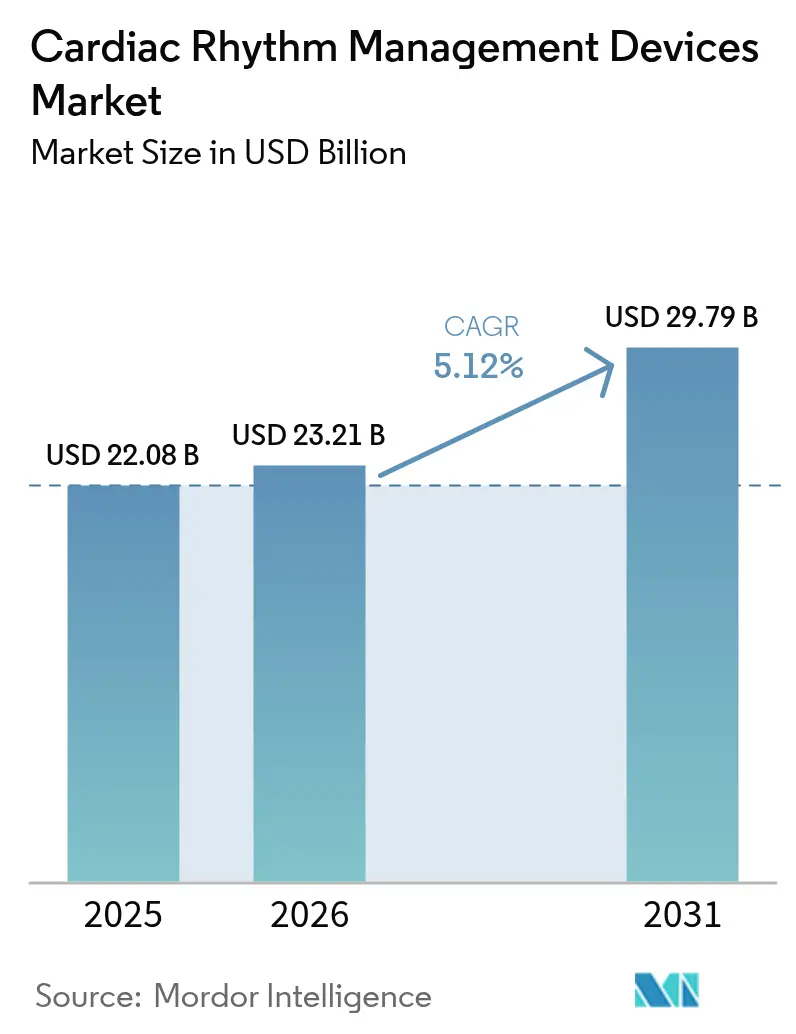
The cardiac rhythm management devices market size is expected to grow from USD 22.08 billion in 2025 to USD 23.21 billion in 2026 and is forecast to reach USD 29.79 billion by 2031 at 5.12% CAGR over 2026-2031. Growth is underpinned by an aging global population, rising arrhythmia incidence, and the expanding use of implantable devices that lower rehospitalization risks.[1]Rapid advances in leadless pacemakers and artificial-intelligence (AI)–enabled monitoring platforms are improving clinical outcomes while reducing procedure times and follow-up visits. Reimbursement reforms that now cover next-generation devices in major markets are widening patient access, and remote patient-monitoring mandates are generating steady recurring revenue for device makers. Supply-chain pressures tied to semiconductor tariffs and specialty-metal price swings continue to tighten margins, but sustained R&D investment and targeted acquisitions keep competitive intensity high.
Key Report Takeaways
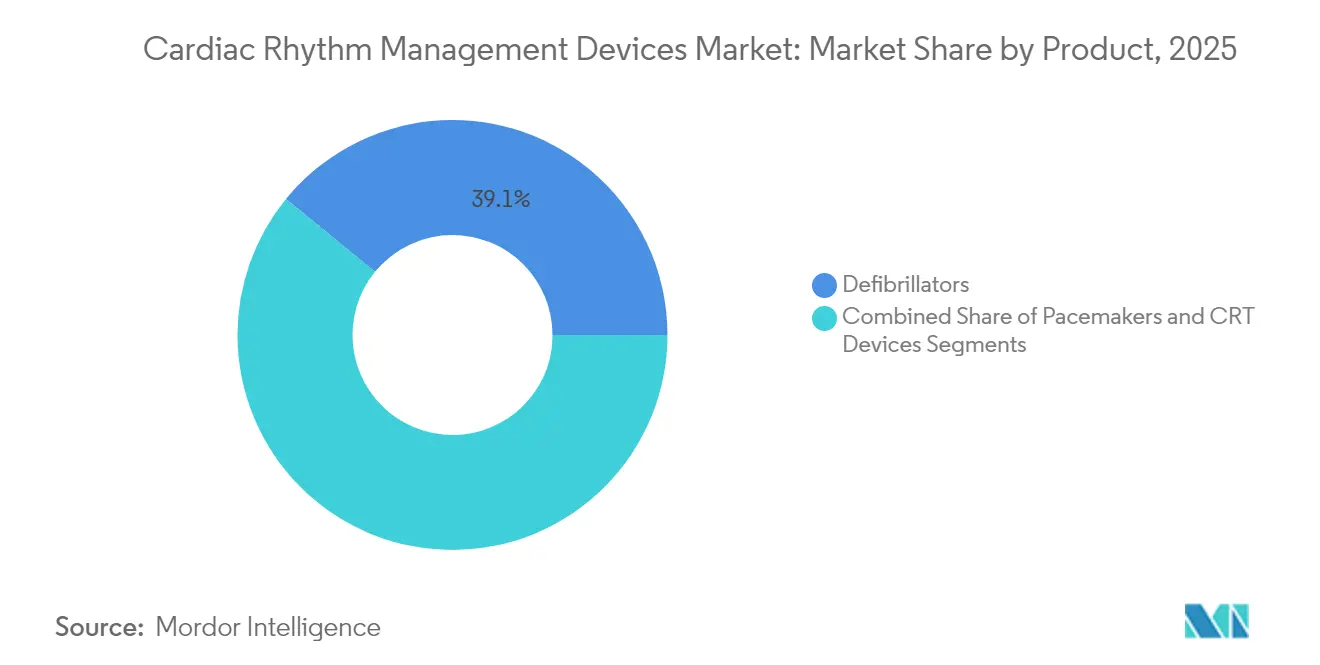
- By product category, defibrillators led with 39.10% revenue share of the cardiac rhythm management devices market in 2025, while pacemakers are projected to expand at a 7.25% CAGR through 2031.
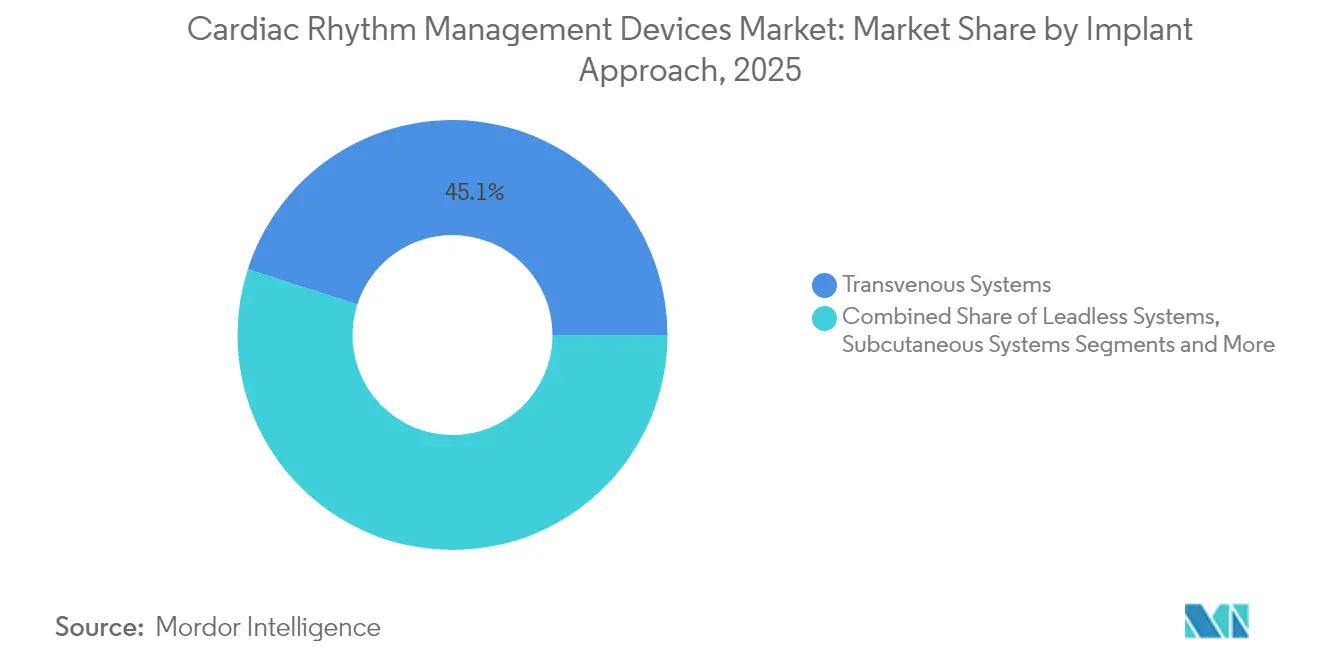
- By implant approach, transvenous systems held 45.05% of the cardiac rhythm management devices market share in 2025; leadless systems record the fastest growth at 7.78% CAGR to 2031.
- By end user, hospitals accounted for 60.70% share of the ardiac rhythm management devices market in 2025, whereas home and pre-hospital care settings are forecast to grow at an 8.10% CAGR.
- By geography, North America commanded 36.10% share of the ardiac rhythm management devices market in 2025; Asia-Pacific shows the strongest momentum with a 7.55% CAGR through 2031.
Note: Market size and forecast figures in this report are generated using Mordor Intelligence’s proprietary estimation framework, updated with the latest available data and insights as of 2026.
Market Trends and Insights
Drivers Impact Analysis of Cardiac Rhythm Management Devices Market*
| Driver | (~) % Impact on CAGR Forecast | Geographic Relevance | Impact Timeline |
|---|---|---|---|
| Surge In Cardiovascular Disease Prevalence Coupled with Increasing Aging Population | +1.8% | Global, with highest impact in North America and Europe | Long term (≥ 4 years) |
| Expanding Adoption and Reimbursement For Rhythm Management Systems | +1.2% | North America & EU, expanding to APAC | Medium term (2-4 years) |
| Large Public-Access AED Roll-Outs In Transport Hubs | +0.4% | Global, with early gains in developed urban centers | Short term (≤ 2 years) |
| Remote Patient Monitoring and Telehealth Integration | +0.9% | Global, accelerated adoption in APAC and rural areas | Medium term (2-4 years) |
| Technological Advancement and Device Miniaturization | +1.1% | Global, led by innovation centers in US and Europe | Long term (≥ 4 years) |
| Increasing Adoption of Implantable Devices Coupled with Launch of New Products | +0.8% | Global, with premium adoption in developed markets | Medium term (2-4 years) |
| Source: Mordor Intelligence | |||
Surge in Cardiovascular Disease and Population Aging
Cardiovascular disease will affect nearly 45 million U.S. adults by 2050, with hypertension prevalence expected to climb to 61% during the same period.[1]Similar demographic shifts across Europe and parts of Asia increase demand for durable pacemakers, implantable cardioverter-defibrillators (ICDs), and cardiac resynchronization devices. Longer life expectancy extends device replacement cycles, raising the lifetime value of each implantation. Payers favor rhythm management over repeated hospitalizations, underpinning steady procedural volumes. The resulting uptick in elective implants cushions the cardiac rhythm management devices market against cyclical funding pressures.
Wider Adoption and Reimbursement of Next-Generation Systems
Medicare added specific billing codes for leadless pacemakers in mid-2024, removing a key barrier to adoption.[2] European authorities continue moving toward value-based payment models, rewarding devices that demonstrate lower rehospitalization rates. Japan’s reference-pricing revisions pressure list prices yet still allow premium positioning when clinical evidence shows superior outcomes. Together these policies shorten the path from regulatory approval to widespread clinical use, lifting procedural volumes and driving incremental revenue for manufacturers.
Public-Access AED Roll-Outs in Transport Hubs
Major cities now mandate automated external defibrillators (AEDs) in airports, subways, and large-capacity venues, enlarging a high-volume replacement market. Studies show that strategic AED placement can cut response times by up to three minutes and lift survival from shockable rhythms by more than 30%. Programs often bundle maintenance contracts, giving OEMs annuity-like service income. Although bystander use remains below optimal levels, targeted training initiatives improve utilization and reinforce the value proposition of public-access defibrillators.
Remote Monitoring and Telehealth Integration
AI-enhanced algorithms in insertable cardiac monitors filter nuisance alerts by as much as 85%, saving clinical staff hundreds of hours each year. Hospital-at-home models show 30% cost savings and an 83% reduction in readmissions for eligible arrhythmia patients. These outcomes justify payer coverage for remote platforms, creating predictable recurring revenue streams. Continuous data capture also supports predictive analytics that may guide earlier interventions, further elevating the cardiac rhythm management devices market’s clinical relevance.
Restraints Impact Analysis of Cardiac Rhythm Management Devices Market*
| Restraint | (~) % Impact on CAGR Forecast | Geographic Relevance | Impact Timeline |
|---|---|---|---|
| Cyber-Vulnerability Of Connected CRM Devices | -0.7% | Global, with highest concern in developed markets | Medium term (2-4 years) |
| Lengthy Regulatory Approval Cycles | -0.5% | Global, with variations by regulatory jurisdiction | Long term (≥ 4 years) |
| Post-Radiation Malfunctions In Implantables | -0.3% | Global, affecting cancer treatment centers | Medium term (2-4 years) |
| Lithium & Tantalum Price Volatility Inflates BOM Costs | -0.6% | Global, with supply chain concentration in Asia | Short term (≤ 2 years) |
| Source: Mordor Intelligence | |||
Cyber-Vulnerability of Connected Devices
The FDA now requires cybersecurity plans as part of pre-market submissions, citing recent alerts that certain patient monitors could be remotely accessed.[3] Older implants lacking modern encryption remain in service, exposing hospitals to network breaches and creating liability concerns. Manufacturers are investing in over-the-air patching and zero-trust architectures, but any data-breach headline can slow adoption of cloud-connected platforms, dampening cardiac rhythm management devices market growth.
Lengthy Regulatory Approval Cycles
Novel systems such as the AVEIR VR leadless pacemaker still face multiyear reviews that delay commercial rollout. Added evidence requirements for AI-enabled devices raise trial costs, discouraging smaller entrants. Regional divergence in data-submission formats further stretches timelines and heightens compliance overhead, limiting the number of new competitors able to scale globally.
*Our forecasts treat driver/restraint impacts as directional, not additive. The impact forecasts reflect baseline growth, mix effects, and variable interactions.
Cardiac Rhythm Management Devices Market Segment Analysis
By Product:
Defibrillators Maintain Scale While Pacemakers Drive InnovationDefibrillators represented 39.10% of the cardiac rhythm management devices market in 2025, anchored by widespread clinical guidelines that recommend ICD therapy for sudden-death prevention. New extravascular ICDs show 98.7% effective defibrillation rates, adding non-intravascular alternatives for infection-prone patients. External AED demand rises alongside mandated public installations, though real-world utilization remains below targets. Complementary service contracts add recurring revenue, supporting the cardiac rhythm management devices market size for defibrillator makers.
Pacemakers deliver the fastest expansion, advancing at a 7.25% CAGR as leadless designs eliminate pocket infections and venous complications. Dual-chamber leadless systems preserve physiologic pacing and achieve near-universal implant success, attracting electrophysiologists who previously hesitated to forgo transvenous leads. AI-driven alert filtering suppresses false positives by 85%, improving clinic efficiency and reinforcing the cardiac rhythm management devices market size advantage for connected pacemaker platforms.

By Implant Approach:
Leadless Systems Disrupt Transvenous DominanceTransvenous implants still account for 45.05% of the cardiac rhythm management devices market share due to entrenched surgical workflows and broad indication coverage. Multichamber configurations remain best suited for complex heart failure cases, and replacement familiarity sustains transplant volumes. Yet leadless solutions are advancing at an 7.78% CAGR, reflecting strong clinician acceptance of minimally invasive procedures with lower complication rates. Early studies report a 94% complication-free rate for single-chamber leadless implants, far surpassing historical benchmarks for wired systems. Retrievable modules now allow staged upgrades without leaving redundant hardware in place, enhancing long-term device management flexibility.
By End User:
Hospitals Dominate; Home Care Gains TractionHospitals generated 60.70% of 2025 revenues as most device implantations still require catheter labs, anesthesia support, and acute-care monitoring. Same-day discharge pathways cut inpatient stay but keep procedure volumes high. Meanwhile, home and pre-hospital care segments grow at an 8.10% CAGR, propelled by payers that reimburse remote monitoring kits and telecardiology visits. Continuous patch-ECG services and cloud-connected pacemakers lower follow-up costs, positioning decentralized care as the next growth frontier.
Geography Analysis
North America Cardiac Rhythm Management Devices Market
North America led with 36.10% of 2025 sales thanks to favorable reimbursement and rapid uptake of AI-enabled monitoring. Updated CMS codes for leadless pacemakers widened access across U.S. electrophysiology centers. Canada’s national tender programs and Mexico’s private cardiology clinics add to regional demand, stabilizing the cardiac rhythm management devices market size in the short term.
Europe Cardiac Rhythm Management Devices Market
Europe maintains steady growth on the back of value-based procurement that rewards outcome improvements. CE-marked dual-chamber leadless systems launched widely in 2024, accelerating replacements of legacy single-chamber devices. Country-level cost-containment pressures persist, yet proven reductions in rehospitalizations offset initial device premiums.
APAC Cardiac Rhythm Management Devices Market
Asia-Pacific is the fastest-growing arena, expanding at a 7.55% CAGR. Japan’s device market encourages technology adoption despite price cuts, while China’s localization policies spur domestic production alongside foreign joint ventures. India scales public-health spending and private cardiac centers, and Australia subsidizes remote-monitoring platforms for rural populations, supporting sustained region-wide momentum within the cardiac rhythm management devices market.

Regulatory Landscape
In the United States, cardiac rhythm management (CRM) devices and connected platforms continue to face tightening expectations for quality systems and premarket evidence, with additional scrutiny for connected-device cybersecurity within FDA submissions. A key 2026 inflection is the FDA Quality Management System Regulation (QMSR) becoming effective in February 2026, replacing the legacy 21 CFR Part 820 framework and aligning medical-device quality management more directly with ISO 13485:2016 principles. Manufacturers with combination-product elements also have to maintain compliance with 21 CFR Part 4 and applicable drug and device cGMP requirements.
Globally, clinical evidence generation and documentation requirements are moving alongside updated standards and regional submission pathways. ISO published ISO 14155:2026 on March 23, 2026, updating expectations for clinical investigations of medical devices, while Europe’s MDR requirements (including Article 117 for relevant drug-device combinations) add procedural steps such as Notified Body input for device components that are not independently CE marked. These steps can extend time to approval and affect how CRM manufacturers plan post-market clinical follow-up across jurisdictions.
Value Chain Analysis
The CRM device value chain begins with specialized inputs (high-purity fatigue-resistant alloys, polymers, electronics, and battery chemistries) that require validated traceability and change-control. Design, verification, and clinical evidence generation (often via multicenter electrophysiology studies) feed into regulated manufacturing under quality-system controls, followed by sterilization, packaging/UDI labeling, and distribution to hospitals, cardiac specialty centers, and ambulatory sites, where procedure kits, delivery tools, and trained staff influence utilization. Post-implant services (remote monitoring platforms, software updates, and follow-up workflows) extend the value chain into recurring revenue, while explant handling and lithium-battery disposal protocols add operational steps on the provider side.
Bottlenecks concentrate in component qualification and re-validation, particularly for leads and materials where sourcing changes can trigger lengthy testing and regulatory documentation updates. Regulatory and clinical practice shifts toward conduction system pacing also increase demand for dedicated lead and delivery-catheter capabilities, including Medtronic receiving FDA approval in March 2026 for an expanded indication for its OmniaSecure defibrillation lead for left bundle branch area placement. In parallel, EU MDR requirements such as enhanced post-market clinical follow-up and UDI can lengthen regional rollouts, pushing manufacturers to balance in-house manufacturing with qualified outsourcing to manage compliance burden and capacity planning.
Competitive Landscape
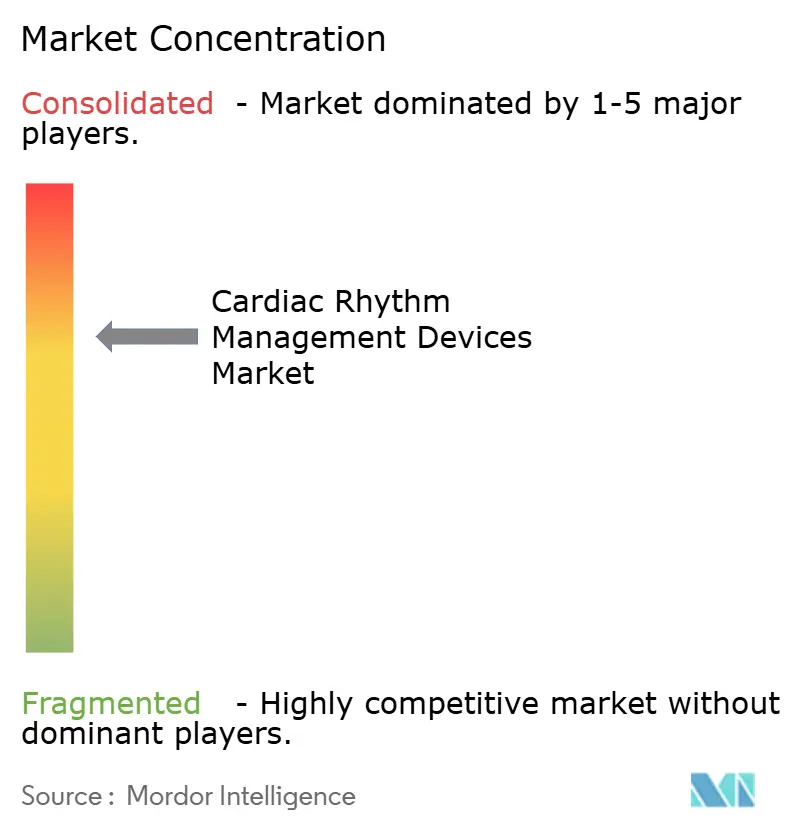
Moderate consolidation defines the field, with Medtronic, Abbott, and Boston Scientific holding leadership through full-line portfolios and deep clinical trial pipelines. Medtronic reported high-single-digit rhythm-management growth in fiscal Q1 2025, fueled by strong ICD sales and double-digit pacing-therapy expansion. Abbott’s AVEIR franchise sets benchmarks in leadless innovation, and Boston Scientific’s cardiovascular revenue surged 26.2% on FARAPULSE adoption.
Strategic acquisitions augment platform coverage. Johnson & Johnson’s USD 16.6 billion purchase of Abiomed adds heart-recovery devices, broadening its procedural stack. Teleflex agreed to acquire BIOTRONIK’s vascular intervention unit for USD 825 million, gaining access to a USD 10 billion coronary market that overlaps rhythm-management referrals. Niches such as pediatric leadless pacing and implant cybersecurity invite smaller specialists, but scale advantages in manufacturing and distribution give incumbents a persistently strong footing in the cardiac rhythm management devices market.
Cardiac Rhythm Management Devices Industry Leaders
-
Abbott
-
Boston Scientific Corporation
-
Medtronic PLC
-
MicroPort Scientific
-
Stryker
- *Disclaimer: Major Players sorted in no particular order
Cardiac Rhythm Management Devices Market Companies Covered in this Report
- Medtronic
- Abbott Laboratories
- Boston Scientific
- BIOTRONIK
- MicroPort CRM (MicroPort Scientific)
- Koninklijke Philips
- LivaNova plc
- Asahi Kasei
- Stryker
- Mindray
- Schiller
- Lepu Medical
- Terumo
- EBR Systems
- Nihon Kohden
- AliveCor
- MicroPort CardioFlow MedTech
- Impulse Dynamics
- Cardiac Science
Read Analysis of Cardiac Rhythm Management Devices Companies
Market Opportunities and Future Outlook
Conduction system pacing is emerging as a specific whitespace for CRM suppliers because it changes hardware requirements, including purpose-built ICD and pacing leads, delivery tools, and implantation workflows, rather than only software updates. A recent proof point is Medtronic securing expanded FDA approval in March 2026 for the OmniaSecure defibrillation lead for left bundle branch area placement, which formalizes a pathway for broader clinical adoption of CSP-enabled lead configurations. Abbott has also been advancing CSP-specific pipelines, including trial disclosures around investigational CSP lead programs presented around major electrophysiology meetings, indicating that large OEM R&D and clinical evidence generation are being directed toward this shift.
Another opportunity is scaling connected therapy where implantable therapy, remote monitoring, and clinic workflow automation are integrated to reduce nuisance alerts and follow-up burden, aligning with payer and provider focus on reducing rehospitalizations. Regulatory tightening can also create a competitive opening for manufacturers with mature quality and clinical-investigation systems, since the FDA QMSR becomes effective in February 2026 and ISO 14155:2026 is published in March 2026. These changes raise expectations for quality management and clinical-study governance, favoring companies that can complete compliance transitions quickly while sustaining global trial throughput and post-market surveillance coverage.
Recent Industry Developments in Cardiac Rhythm Management Devices Market
- April 2026: Abbott released late-breaking clinical updates across multiple electrophysiology studies at Heart Rhythm Society 2026, including data tied to its TactiFlex Duo ablation catheter and its investigational conduction system pacing (CSP) lead program. The updates reinforced the companys clinical-evidence strategy around next-generation ablation and physiologic pacing workflows that connect procedure tools with longer-term rhythm management pathways.
- May 2025: Element Science received FDA PMA approval for its Jewel Patch wearable cardioverter-defibrillator for patients needing temporary protection from elevated sudden cardiac arrest risk. The approval broadened the competitive set in external defibrillation by adding an FDA-approved patch-form factor that fits transitional care periods between diagnosis, therapy optimization, and longer-term device decisions.
- December 2024: Abbott reported the worlds first in-human leadless left-bundle-branch pacing procedures using its investigational AVEIR conduction system pacing technology, which has FDA Breakthrough Device Designation. The milestone strengthened the clinical narrative for leadless physiologic pacing and signaled a pipeline direction toward leadless platforms that address more complex pacing targets.
Cardiac Rhythm Management Devices Market Report Scope and Research Methodology
Market Definition and Coverage
This market covers revenue generated from devices used to manage abnormal heart rhythms through pacing, defibrillation, or resynchronization therapy, including implantable and external systems that deliver therapy and the related device system components.
Scope exclusions: We exclude purely diagnostic cardiac monitors and wearable ECG patches that do not provide therapeutic pacing, shocks, or resynchronization.
Segments Covered in This Report
- By Product
- Defibrillators
- Implantable Cardioverter Defibrillators (TV-ICD, S-ICD)
- External Defibrillators (Manual, AED, Wearable)
- Pacemakers
- Implantable (Single, Dual, Leadless, MRI-compatible)
- External Pacemakers
- Cardiac Resynchronization Therapy Devices
- CRT-Defibrillators (CRT-D)
- CRT-Pacemakers (CRT-P)
- Defibrillators
- By Implant Approach
- Transvenous Systems
- Leadless Systems
- Subcutaneous Systems
- Extravascular / Substernal Systems
- External / Non-invasive Systems
- By End User
- Hospitals
- Cardiac Specialty Centers
- Ambulatory Surgical Centers
- Home & Pre-Hospital Care Settings
- By Geography
- North America
- United States
- Canada
- Mexico
- Europe
- Germany
- United Kingdom
- France
- Italy
- Spain
- Rest of Europe
- Asia-Pacific
- China
- Japan
- India
- Australia
- South Korea
- Rest of Asia-Pacific
- Middle East and Africa
- GCC
- South Africa
- Rest of Middle East and Africa
- South America
- Brazil
- Argentina
- Rest of South America
- North America
Data Sources, Market Sizing, and Validation
Desk Research
Desk research is used to build the base structure for the model, especially the demand pool by geography and the clinical context behind procedure volumes. We typically rely on non-paywalled sources such as the World Health Organization for cardiovascular burden, OECD health statistics for care delivery indicators, CDC data for heart disease trends, and public pages from regulators such as the US FDA for device approvals and safety actions.
To pressure-test the market logic, we also use sources such as national health ministry portals, medical society and association publications, peer-reviewed cardiology journals for adoption and guideline direction, and public company filings and investor presentations for product mix cues. Paid subscriptions that cover company financials and intelligence, news and financials, and patent databases are used selectively to confirm timelines and cross-check directional signals. The examples above are illustrative only, and we use additional public sources for collection, validation, and clarification.
Primary Interviews and Surveys
Primary work is used to validate assumptions that desk research cannot fully settle, such as pricing changes over time, replacement cycles, and how quickly newer therapy options are adopted across hospitals and cath labs. We speak with a mix of device industry participants, hospital and cath lab stakeholders, and clinical experts across APAC, EMEA, and the Americas, so the model is grounded in real-world procedure behavior and procurement patterns. The inputs from these discussions are then used to refine scenario choices and to confirm that regional growth differences are not being overstated.
Distribution of primary research fieldwork respondents
| Company type | Respondent position | Region |
|---|---|---|
| Top tier: 34% | CXOs: 14% | APAC: 44% |
| Mid tier: 51% | Functional/Unit leaders: 41% | EMEA: 37% |
| Smaller Players: 15% | Managers: 45% | Americas: 19% |
Market-Sizing & Forecasting
The core sizing is built using a top-down approach where epidemiology signals and treated-patient pathways are translated into expected therapy volumes, and then converted into revenue using typical device system pricing by region and care setting. To keep the totals realistic, selective bottom-up approximations are also done, such as sampled average selling price ranges times procedure volumes, and supplier and channel checks in major countries, which are then used to adjust outliers.
Key inputs that typically move the model include arrhythmia prevalence and diagnosis rates, implant and replacement procedure volumes, mix shift across pacemakers, ICDs, and CRT therapy, reimbursement coverage signals, and the pace of technology adoption (for example leadless pacing and remote follow-up enabled care). Where country data is missing, gaps are handled using proxy indicators like population age bands, cardiology infrastructure, and procedure intensity in comparable markets, before the final roll-up is completed.
For forecasting, scenario analysis is used to reflect different adoption and replacement-speed outcomes, while the assumptions remain consistent with what primary experts expect for procedure recovery, pricing progression, and mix movement over the forecast window. The final curve is checked to ensure growth does not conflict with practical constraints, such as implant capacity, trained staff availability, and payer uptake timing.
Data Validation & Update Cycle
Outputs are validated through triangulation across independent signals, including procedure volume direction, installed base implications for replacements, and publicly visible regulatory and reimbursement changes. Variance checks are run at region and major-country level, and unusual jumps are reviewed again to ensure a single assumption is not driving the total without support.
Before sign-off, the model and key assumptions go through multi-step analyst reviews, and we re-contact experts when results conflict with clinical adoption behavior or when a price or mix change appears too aggressive. The dataset is refreshed annually, with interim updates triggered by material events such as major approvals, safety actions, or reimbursement shifts. A final update pass is completed close to delivery so clients receive the most current view available at that time.
Mordor Intelligence's Global Cardiac Rhythm Management Devices Market Market Size Measured Against Other Published Estimates
Published market sizes for cardiac rhythm management devices often vary because the product scope is not treated the same way, and because different studies choose different base years and pricing paths. Differences also come from how procedure volumes are reconstructed by country, which endpoints are counted as therapy revenue, and how often the numbers are refreshed.
The main gap comes from whether diagnostic cardiac monitoring is blended into the same total, and from how device system revenue is counted when remote follow-up and accessories are bundled. In Mordor Intelligence's model, the total is kept to therapy-delivering pacemakers, defibrillators, and CRT systems, and diagnostic-only monitors and wearable ECG patches are left out. This changes the numerator even when the patient story looks similar.
Benchmark comparison
| Source | Market Size | Gaps in Research Methodology |
|---|---|---|
| Mordor Intelligence | USD 22.08 B (2025) | |
| Global Consultancy A | USD 20.77 B (2024) | Uses an earlier base year and may treat pricing and mix with a different starting point, which can pull the total down if replacement-heavy categories are not fully reflected in that year. |
| Trade Journal B | USD 23.80 B (2024) | Combines cardiac monitoring with therapy devices, which expands the scope and lifts the total even if the core implant volumes and ASP assumptions are similar. |
The spread in the table is mainly explained by scope and timing, rather than a single growth assumption. By keeping the counted revenue tied to therapy devices and by checking totals against procedure and replacement signals, the market size becomes easier to trace, reproduce, and update when new approvals or reimbursement changes occur.
Key Questions Answered in the Report
What is the current valuation of the cardiac rhythm management devices market and how fast is it expanding?
The cardiac rhythm management devices market is valued at USD 23.21 billion in 2026 and is forecast to reach USD 29.79 billion by 2031, reflecting a 5.12% CAGR over 2026-2031.
Which product segment is growing the fastest?
Pacemakers lead growth with a 7.25% CAGR through 2031, fueled by leadless technology that simplifies implantation and reduces complications.
Why are leadless systems gaining momentum over traditional transvenous implants?
Leadless devices eliminate lead-related infections, offer simpler procedures, and now include dual-chamber options that preserve natural heart synchrony, pushing their CAGR to 7.78%.
How are reimbursement changes influencing market adoption?
Updated Medicare billing codes and value-based payment models in Europe have lowered financial barriers, accelerating uptake of next-generation pacemakers and ICDs.
Which region offers the strongest growth opportunity?
Asia-Pacific is the fastest-growing region, advancing at a 7.55% CAGR as healthcare access expands and aging populations drive demand for advanced cardiac therapies.
What major risk could slow market expansion?
Cyber-vulnerabilities in connected implants remain a key concern; tighter FDA rules now require robust security plans, and any breach could dampen clinician and patient confidence.