
Battery Management IC Market Size and Share
Market Overview
| Study Period | 2020 - 2031 |
|---|---|
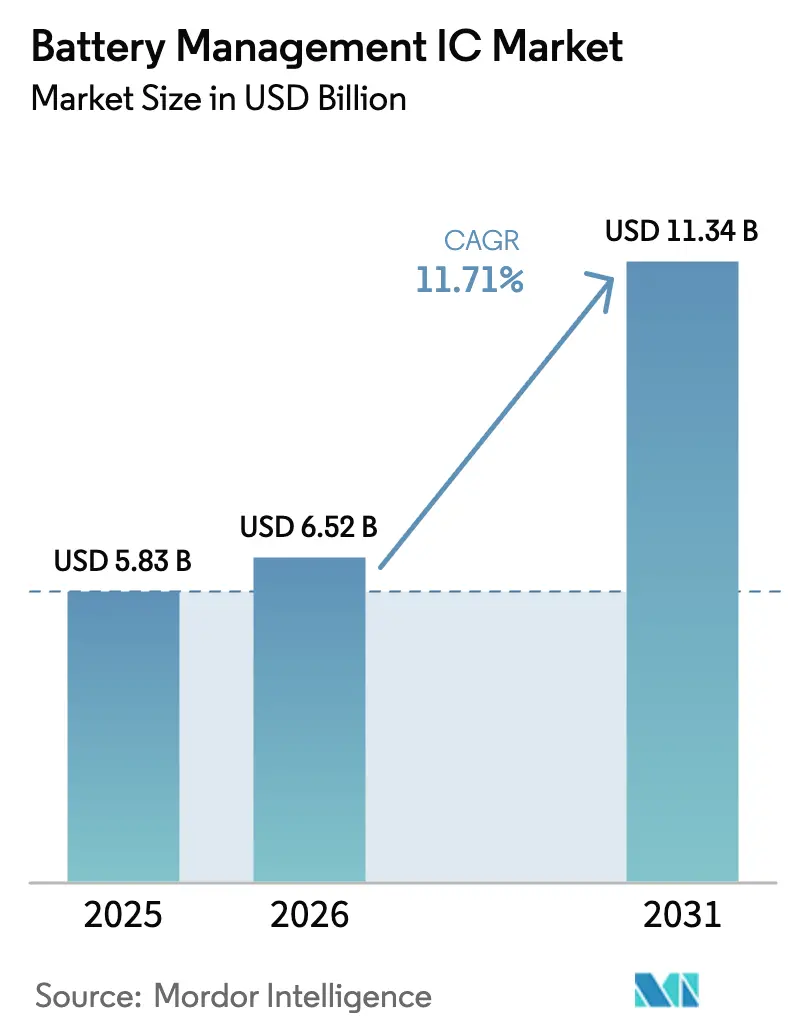
| Market Size (2026) | USD 6.52 Billion |
| Market Size (2031) | USD 11.34 Billion |
| Growth Rate (2026 - 2031) | 11.71 % |
| Fastest Growing Market | Asia-Pacific |
| Largest Market | North America |
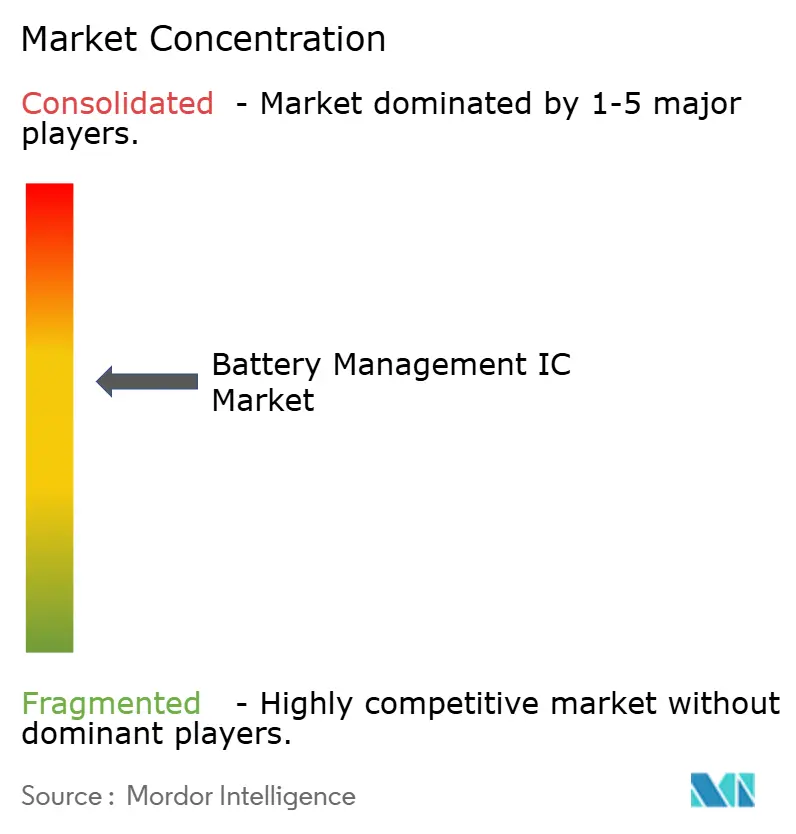
| Market Concentration | Medium |
Major Players_(1).webp) *Disclaimer: Major Players sorted in no particular order Image © Mordor Intelligence. Reuse requires attribution under CC BY 4.0. | |
Battery Management IC Market Analysis by Mordor Intelligence
The battery management IC market size reached USD 6.52 billion in 2026 and is projected to advance to USD 11.34 billion by 2031, reflecting an 11.71% CAGR over the forecast period. Growth stems from rapid electric-vehicle adoption, a wider ecosystem of mobile and wearable devices, and the commercial viability of second-life energy-storage projects. Authentication IC demand is surging as automakers impose anti-counterfeit safeguards, while multi-cell monitor and charger ICs are being redesigned for 800-volt platforms that rely on silicon-carbide and gallium-nitride power semiconductors. A technology race among incumbents with deep analog expertise is underway to meet tighter functional-safety, cybersecurity, and voltage-handling requirements. Consequently, the battery management IC market is evolving into a platform-centric arena in which software, analytics, and wireless connectivity determine long-term differentiation.
Key Report Takeaways
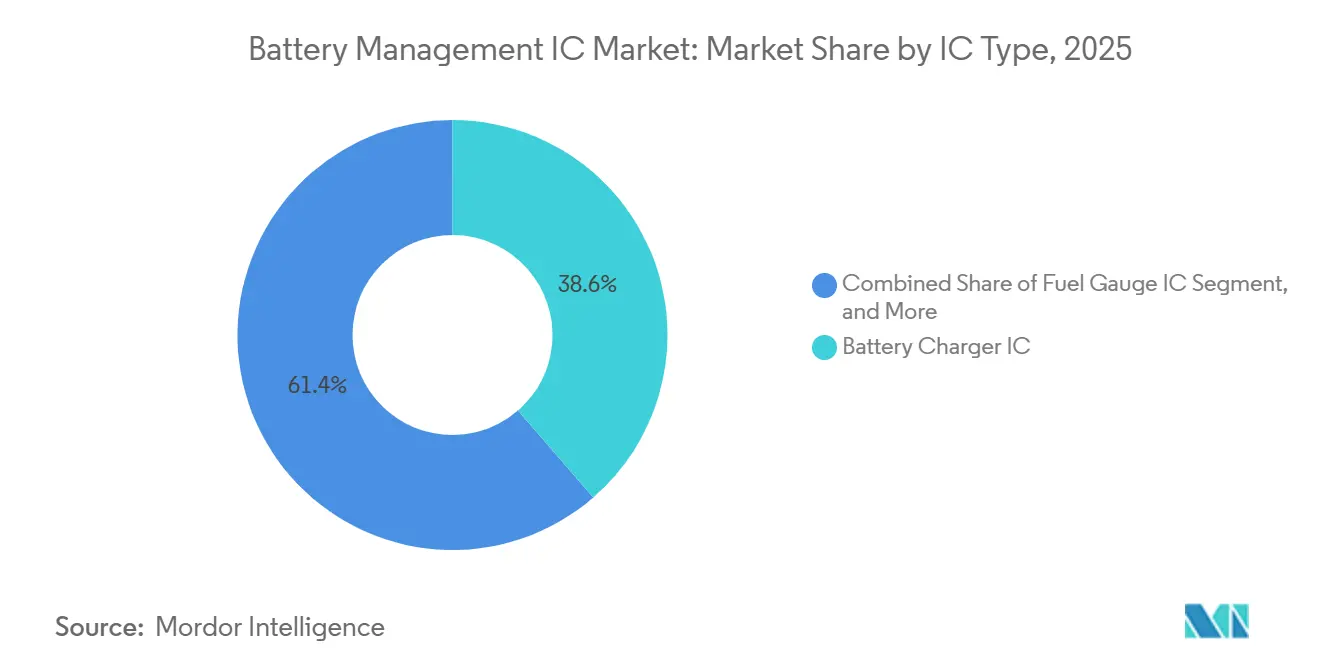
- By IC type, battery charger ICs led with a 38.63% share of the battery management IC market in 2025, whereas authentication ICs are set to expand at a 12.34% CAGR through 2031.
- By chemistry, lithium-ion accounted for 71.74% of the battery management IC market share in 2025 and is on track to grow at a 13.11% CAGR to 2031.
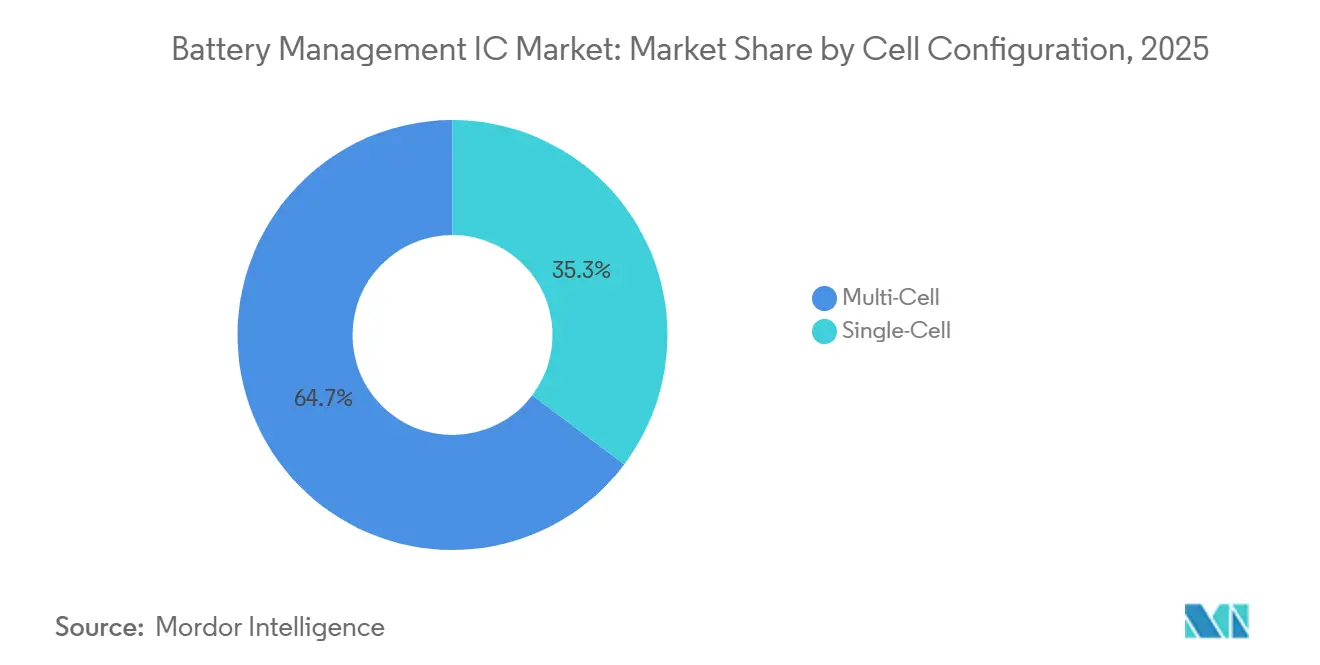
- By cell configuration, multi-cell systems captured 64.72% of the battery management IC market size in 2025 and will register a 12.78% CAGR over the forecast window.
- By end-use industry, the automotive sector held 28.73% of the battery management IC market share in 2025, while energy-storage systems represented the fastest-growing segment at a 12.66% CAGR from 2026 to 2031.
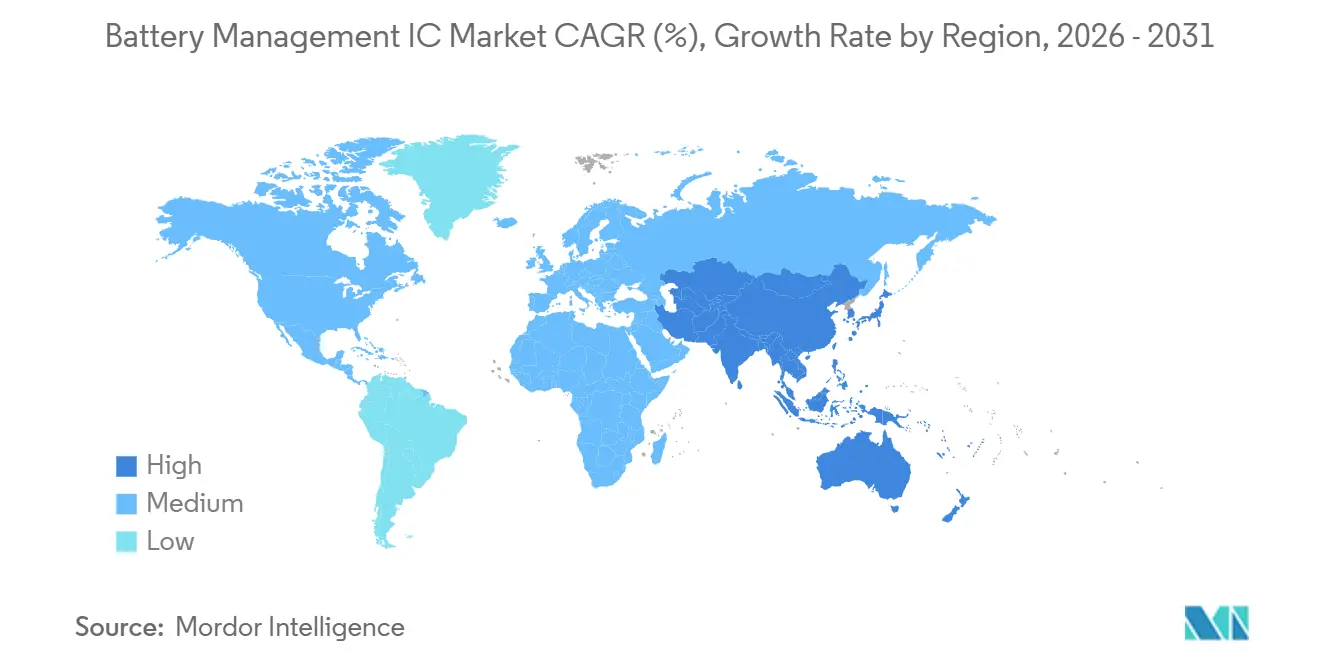
- By geography, North America held 38.73% of the battery management IC market share in 2025, while Asia-Pacific represents the fastest-rising user base at a 12.74% CAGR to 2031.
Note: Market size and forecast figures in this report are generated using Mordor Intelligence’s proprietary estimation framework, updated with the latest available data and insights as of January 2026.
Global Battery Management IC Market Trends and Insights
Drivers Impact Analysis*
| Driver | (~) % Impact on CAGR Forecast | Geographic Relevance | Impact Timeline |
|---|---|---|---|
| Surging EV production commitments | +3.2% | Global, with concentration in China, Europe, North America | Medium term (2-4 years) |
| Rising adoption of mobile and wearable devices | +2.1% | Global, led by Asia Pacific and North America | Short term (≤ 2 years) |
| Regulatory push for battery-safety IC integration | +1.8% | Europe and North America, expanding to ASEAN | Medium term (2-4 years) |
| 48-volt mild-hybrid commercial vehicles boom | +1.5% | North America, Europe, China commercial-vehicle corridors | Short term (≤ 2 years) |
| Second-life stationary storage deployments | +1.3% | Europe, North America, Japan | Long term (≥ 4 years) |
| SiC/GaN transition enabling high-voltage chargers | +1.2% | Global, early adoption in premium EV segments | Medium term (2-4 years) |
| Source: Mordor Intelligence | |||
Surging EV Production Commitments
Automakers publicly committed to building more than 30 million battery-electric vehicles per year by 2030. Fulfilling those targets requires roughly 120 million multi-cell controllers annually, as each pack integrates both module-level and pack-level devices. Original equipment manufacturers now specify cryptographic authentication ICs to exclude counterfeit cells that previously triggered costly warranty claims.[1] Cell-to-pack architectures, pioneered by Tesla, eliminate intermediate modules and consolidate battery-management intelligence into fewer yet more sophisticated ICs, capable of supervising as many as 400 series cells. Vendors able to blend high-voltage analog front-ends, digital signal processing, and wireless transceivers on the same die are increasingly preferred partners.
Rising Adoption of Mobile and Wearable Devices
Global smartphone shipments stabilized at more than 1 billion units during 2025, but higher energy demand from 5G radios and AI-enhanced imaging accelerated battery degradation. Device brands responded by integrating adaptive fuel-gauge ICs that learn from user behavior to tighten state-of-charge estimates. Apple extended the trend by requiring third-party repair shops to install batteries embedded with authentication ICs that interface with its iOS diagnostic framework. More than 500 million wearable devices shipped in 2025, each needing miniaturized protection and monitoring circuits to maximize runtime. Foldable phones and flexible batteries introduce new failure modes, driving demand for impedance-spectroscopy-enabled monitor ICs able to detect internal swelling before catastrophic events.
Regulatory Push for Battery-Safety IC Integration
The European Union Battery Regulation, phased in from 2024, requires portable batteries exceeding 2 kWh to incorporate management electronics that report the state of health and cycle count.[2] California’s Right-to-Repair statute complements this mandate by granting service technicians data access while simultaneously compelling manufacturers to secure that pathway through authentication. Updated standards, such as IEC 62619, require fault interruption in under 200 milliseconds, a capability that is most easily achieved via integrated protection ICs. The upshot is a regulatory flywheel that turns compliance into design-win criteria for battery management IC vendors.
48-Volt Mild-Hybrid Commercial Vehicles Boom
With stricter emissions ceilings, truck and bus makers fitted 1.5 million vehicles with 48-volt systems in 2025, 40% more than in 2024. Belt-starter generators and dual-voltage accessories recoup braking energy, lowering diesel consumption by up to 5% on urban duty cycles.[3] These hybrids rely on charger ICs that tolerate regenerative currents above 100 A and on multi-cell monitors that maintain millivolt-level balance across pouch cells exposed to vibration and temperature extremes.
Restraints Impact Analysis*
| Restraint | (~) % Impact on CAGR Forecast | Geographic Relevance | Impact Timeline |
|---|---|---|---|
| Complex integration in advanced SoCs | -1.4% | Global, pronounced in consumer electronics | Short term (≤ 2 years) |
| Raw-material price volatility | -1.1% | Global, supply-chain dependencies in Asia Pacific | Medium term (2-4 years) |
| Shortage of battery-test qualification capacity | -0.9% | North America, Europe, China | Short term (≤ 2 years) |
| Rising cybersecurity certification costs | -0.7% | Europe, North America, expanding to Asia Pacific | Medium term (2-4 years) |
| Source: Mordor Intelligence | |||
Complex Integration in Advanced SoCs
Smartphone and notebook platforms have begun integrating battery-charging and gauging functions into application processors to conserve board space and reduce costs. Qualcomm’s Snapdragon and Apple’s M-series incorporate on-die power-management blocks, trimming external component count by as much as 15%. While the shift benefits large silicon houses capable of mixed-signal co-design, it squeezes stand-alone IC suppliers that lack tight foundry and ecosystem partnerships. Maintaining 1% coulomb-counting accuracy on digital-noise-heavy silicon remains challenging, necessitating iterative mask spins that increase R&D expenses.
Raw-Material Price Volatility
Spot prices for lithium carbonate swung between USD 10,000 and USD 25,000 per metric ton during 2024-2025. Sudden cost increases ripple down to battery-cell orders, dampening near-term IC demand because suppliers ship components several weeks before assembly. Cobalt and nickel price shocks compel cathode makers to reformulate chemistries, altering voltage profiles and accelerating validation cycles for monitor and protection ICs. Vendors must therefore hedge revenue exposure through diversified application portfolios able to absorb automotive slowdowns.
*Our forecasts treat driver/restraint impacts as directional, not additive. The impact forecasts reflect baseline growth, mix effects, and variable interactions.
Segment Analysis
By IC Type: Authentication IC Momentum Counters Counterfeits
Authentication devices are set to expand at a 12.34% CAGR, the fastest among all categories, as brands deploy cryptographic handshakes to block counterfeit batteries that triggered recalls and lawsuits in 2024. Battery charger ICs, while still holding the largest 2025 revenue slice at 38.63%, face slower growth because system-on-chip designs now integrate fundamental charging logic. Fuel-gauge ICs maintain relevance where 1% accuracy is life-critical, notably in infusion pumps and delivery drones monitored by aviation regulators.
Protection ICs, the oldest category, continue to serve single-cell applications in consumer electronics, yet their revenue is stagnant as device manufacturers shift to integrated solutions. Texas Instruments introduced an authentication IC in 2024 that employs SHA-256 cryptographic hashing to verify battery provenance, a feature that LG Energy Solution mandated for all replacement cells sold through authorized service centers. Consequently, the battery management IC market is rewarding suppliers that wrap silicon with secure firmware, reference designs, and cloud analytics, rather than those that ship catalog parts alone.

By Battery Chemistry: Lithium-Ion Dominance Deepens
Lithium-ion variants represented 71.74% of 2025 revenue and are on a trajectory to widen their footprint at a 13.11% CAGR. Energy-density gains, cost reductions, and improvements in recycling infrastructure reinforce the chemistry’s hegemony. Lithium iron phosphate blends, prized for their thermal stability, are widening their use in commercial trucks and stationary storage. However, their flatter voltage curves complicate state-of-charge estimation, prompting a demand for algorithm-rich monitor ICs.
Cutting-edge cells, such as CATL’s Qilin or Panasonic’s 4680, create new electrical signatures, including quicker transient responses and higher spine temperatures, that must be tracked every few milliseconds. IC vendors aligning early with those cell innovators can secure multi-year design wins that directly translate into gains in battery management IC market share. Solid-state batteries remain pre-commercial but underline the need for future-proof architectures that can measure impedance and ionic resistance, a capability a handful of suppliers are prototyping with university partners.
By Cell Configuration: Multi-Cell Platforms Gain Two-Thirds Share
Multi-cell designs captured 64.72% of the 2025 revenue and are expected to expand at a 12.78% CAGR, as 400-volt and 800-volt traction batteries dominate passenger-car and light-truck platforms. Tighter cell-to-cell matching down to 10 mV is crucial to unlocking the promised kilometers per charge, so automakers purchase monitor ICs that offer hardware balancing and redundant temperature sensing.
Single-cell consumer devices continue to use simpler protection ICs, yet emerging two-wheeler markets in Southeast Asia adopt 10- to 20-cell packs that sit between smartphone and EV complexity. Vendors are releasing cost-optimized monitor ICs targeting these mid-range voltages, aiming to defend margins in a segment where price elasticity is high. Wireless management, now headed toward automotive production, may cascade into power-tool and e-bike packs next, shaving gram-level weight from handheld devices and adding another layer of battery management IC market growth.
By End-Use Industry: Automotive Commands a Significant Share
Automotive’s 28.73% 2025 share is underpinned by 14-million unit global EV sales that are tracking toward 30 million units in 2030. High-voltage architectures, bidirectional charging and stringent functional-safety norms amplify controller complexity and dollar content per vehicle, reinforcing the centrality of automotive to the battery management IC market.
Consumer electronics remain the volume leader in units, but face slowed replacement cycles, nudging vendors to develop combo PMICs that bundle charging, gauging, and protection in a single die. Energy-storage systems represent the fastest-rising vertical, such as residential batteries attached to rooftop PV, while grid-scale projects mitigate renewable intermittency. Battery cabinets often employ Ethernet-based distributed architectures that rely on daisy-chained monitor ICs to coordinate megawatt-hour arrays. The convergence of vehicle-to-home functionality further blurs the boundary between industry and automotive, enabling cross-segment reuse of common silicon blocks.
Geography Analysis
North America commanded 38.73% of 2025 revenue, lifted by the Inflation Reduction Act’s local-content incentives that encourage U.S. battery cell production and provide certainty for semiconductor sourcing. Detroit-area automakers locked in multi-year supply agreements with Texas Instruments and Analog Devices, guaranteeing domestic fabrication capacity for Automotive Safety Integrity Level D devices. Canada’s lithium-hydroxide refineries and Mexico’s growing EV assembly base create regional supply-chain density that shortens lead times and lowers inventory buffers, stabilizing the North American battery management IC market.
Asia Pacific is projected to post a 12.74% CAGR, the fastest among regions, due to the sheer scale of China’s gigafactory pipeline and the technical leadership of Japanese and South Korean material suppliers. ASEAN nations add momentum as two-wheeler electrification gathers pace, favoring simplified monitor ICs tuned for tropical climates. India’s production-linked incentive program for advanced chemistry cells, budgeted at USD 2.4 billion, is set to spur domestic IC demand around 2027 when planned 20 GWh plants reach volume.
Europe enforces the strictest regulatory environment, mandating digital battery passports and recycled-content thresholds that require authentication and extensive logging. Gigafactory consortia such as Volkswagen PowerCo-Northvolt-ACC are building more than 200 GWh of capacity by 2030, a pipeline translating into tens of millions of high-voltage controllers per year. Meanwhile, Middle East and African microgrid deployments and African off-grid solar kits represent niche openings where cost-sensitive single-cell monitors dominate. Collectively, geographic diversification cushions suppliers against regional policy swings and commodity shocks, a resilience critical as the battery management IC market enters its next consolidation phase.
Regulatory Landscape
Battery management IC design requirements are tightening through product rules and application standards that push more in-pack measurement, logging, and secure data access. In the European Union, Regulation (EU) 2023/1542 (phased in from 2024) elevates traceability and battery information requirements, including state-of-health related parameters, across portable, LMT, and EV batteries. This is steering OEMs toward authenticated sensing and robust data retention within the BMS electronics stack. Separately, the application date for certain due diligence obligations under the same framework was deferred to 26 July 2026 via Regulation (EU) 2025/1561, giving supply chains more time to align reporting processes while product-level electronics requirements continue to influence IC selection.
Standardization is also rising across transport and stationary storage, alongside China-specific automotive qualification. IATA Dangerous Goods Regulations, 67th Edition, impose stricter conditions for lithium-ion air shipments effective 1 January 2026, shaping logistics policies that feed into how packs are produced, stored, and shipped, and therefore how battery monitoring and protection functions are validated. For stationary energy storage, IEEE Std 2686-2024 (published 7 February 2025) reinforces recommended practice for BMS implementation, including interoperability and cybersecurity considerations that expand monitor and communication IC software and interface requirements. In China, QC/T 1264-2025, implemented on 1 July 2026, sets technical requirements and test methods for EV BMS analog front-end chips, adding localized compliance checkpoints that affect AFE supplier qualification and test coverage.
Value Chain Analysis
The battery management IC value chain starts with EDA and analog and mixed-signal IP, then moves to wafer fabrication on automotive-qualified analog and mixed-signal nodes (commonly 180 nm to 130 nm BCD processes). After that, assembly and test and functional-safety validation happen before modules and packs are built. Battery monitor/AFE, charger, fuel-gauge, protection, and authentication ICs are designed by semiconductor vendors such as Texas Instruments, Analog Devices, NXP Semiconductors, STMicroelectronics, and Renesas, then integrated by tier-1 BMS suppliers and battery pack makers into EV traction packs, energy-storage cabinets, and high-volume consumer devices. Downstream, OEMs and platform owners increasingly require secure provisioning, diagnostics, and software hooks that tie silicon features, such as cryptographic identity or advanced sensing, to service workflows.
Constraints and leverage points in the chain cluster around qualification time, test capacity, and automotive-grade mixed-signal supply. Automotive-qualified BMS AFE lead times were cited at 26 to 40 weeks as of June 2026, reflecting bottlenecks tied more to validated analog capacity and long reliability and safety sign-off cycles than to advanced logic itself. Re-qualifying a new BMS architecture can take 9 to 18 months due to functional-safety validation. The chain is also being reshaped by scale and vertical integration in China, where BYD Semiconductor reported cumulative shipments of automotive-grade BMS AFE chips surpassing 100 million units by July 2026, signaling how large domestic ecosystems can internalize demand and influence sourcing patterns. On the technology side, moves such as NXP's October 2025 EIS-enabled battery management chipset point to deeper electrochemical diagnostics upstream, with downstream implications for test, calibration tools, and software ecosystems alongside the IC sale.
Competitive Landscape
The competitive field shows moderate concentration and the top five vendors held most of the 2025 revenue. Each maintains proprietary analog process nodes, functional-safety IP, and field-application-engineering teams that serve as entry barriers. Nevertheless, smaller fabless entrants exploit algorithmic differentiation, pushing machine-learning state-of-health analytics that outperform legacy coulomb counters under cell aging and variable temperature conditions. Patent filings in wireless battery monitoring increased 40% year-over-year in 2024, underscoring the anticipated shift away from heavy harnesses.
Established vendors are bundling silicon with cloud dashboards, calibration tools, and over-the-air firmware frameworks, turning one-time component sales into service subscriptions. Infineon’s partnership with software supplier Elektrobit typifies the shift toward complete platforms where secure boot, data logging, and functional-safety diagnostics come pre-integrated. Meanwhile, the rising cost of ISO 26262 and ISO 21434 compliance deters greenfield competition but also raises the capital intensity curve, encouraging joint ventures and IP licensing models.
Wireless battery management, authentication fusion and ultra-high-voltage compatibility constitute the next battlegrounds. Success will depend on mastering mixed-signal co-design, embedding encryption engines without heavy current draw, and proving lifetime accuracy in pack-level deployments well past 1,500 cycles. Companies that solve those challenges can convert design wins into durable battery management IC market share as electric mobility and energy storage scale over the decade.
Battery Management IC Industry Leaders
-
Renesas Electronics Corporation
-
NXP Semiconductors N.V
-
Analog Devices, Inc.
-
STMicroelectronics N.V.
-
Microchip Technology Incorporated
- *Disclaimer: Major Players sorted in no particular order
Market Opportunities and Future Outlook
White space is emerging around higher-fidelity battery diagnostics and pack-level scalability that reduce external sensing, shorten validation cycles, and support more data-driven safety and service requirements. In 2026, product activity shows vendors embedding electrochemical sensing and higher cell counts directly into monitor ICs. Texas Instruments introduced the automotive-grade BQ79826Z-Q1 in June 2026 with an integrated electrochemical impedance spectroscopy (EIS) engine and support for up to 26 cells in series. STMicroelectronics released the L9963F in June 2026 as an upgrade path for designs that need 4 to 14 cells per IC and scalability up to 434 cells. These launches align with unmet needs in EV and energy-storage packs for richer state-of-health observability without adding discrete hardware, and they support tighter functional-safety and cybersecurity compliance workflows already shaping OEM specifications.
Another opportunity is building supply-chain resilience and capacity for analog and protection devices used across mobility, ESS, and critical infrastructure. MinebeaMitsumi announced a 25 billion peso investment in the Philippines in June 2026 to expand production capacity for analog semiconductors and battery protection modules for data centers, starting in 2027, reflecting demand from backup power architectures beyond traditional EV volumes. The market also offers room for multi-source strategies and localized qualification, as regulatory and standard-setting steps, including EU battery traceability rules and China-specific EV AFE requirements, raise redesign costs and increase the value of pre-validated platforms, reference designs, and software toolchains bundled with battery management ICs.
Recent Industry Developments
- June 2026: Texas Instruments launched the BQ79826Z-Q1 automotive battery monitor IC with an integrated electrochemical impedance spectroscopy (EIS) engine and support for up to 26 cells in series. The release expands in-silicon diagnostic capability and strengthens state-of-health observability within pack designs. It raises the bar for platform vendors offering calibration, safety, and cybersecurity features aligned with OEM qualification programs.
- December 2025: Texas Instruments allocated USD 300 million to expand its Richardson, Texas analog fab dedicated to ISO 26262-certified battery management ICs. The investment strengthens supply availability for automotive-qualified mixed-signal devices where long lead times and safety validation can constrain program ramps. It also supports OEM sourcing strategies that prioritize domestic or regionally secure semiconductor capacity for safety-critical BMS functions.
- November 2024: NXP Semiconductors unveiled a wireless battery management system solution using Ultra-Wideband (UWB) technology to simplify vehicle manufacturing and architecture. Wireless BMS reduces wiring complexity in packs, shifting value toward robust RF links, synchronization, and security features within the IC and system design. The move broadened the competitive focus from purely analog measurement performance to system-level connectivity and validation in automotive environments.
Research Methodology Framework and Report Scope
Market Definition and Coverage
For this study, the battery management IC market is counted as revenue from integrated circuits that monitor, protect, and manage rechargeable batteries, covering key functions like cell balancing, protection, fuel gauging, and charging control across end-use devices.
Scope exclusions: We exclude full battery packs, battery management system software, discrete component-only solutions, and broader power management ICs that are not primarily used for battery management.
Segmentation Overview
- By IC Type
- Fuel Gauge IC
- Battery Charger IC
- Authentication IC
- Battery Monitor IC
- Protection IC
- By Battery Chemistry
- Lithium-Ion
- Lithium-Polymer
- Nickel-Metal Hydride
- Lead-Acid
- By Cell Configuration
- Single-Cell
- Multi-Cell
- By End-Use Industry
- Automotive
- Consumer Electronics
- Industrial
- Telecom Equipment
- Medical Devices
- Energy Storage Systems
- Other End-Use Industries
- Geography
- North America
- United States
- Canada
- Mexico
- South America
- Brazil
- Argentina
- Rest of South America
- Europe
- Germany
- United Kingdom
- France
- Italy
- Spain
- Rest of Europe
- Asia-Pacific
- China
- Japan
- India
- South Korea
- ASEAN
- Rest of Asia-Pacific
- Middle East and Africa
- Middle East
- Saudi Arabia
- United Arab Emirates
- Rest of Middle East
- Africa
- South Africa
- Nigeria
- Rest of Africa
- Middle East
- North America
Data Sources, Market Sizing, and Validation
Desk Research
Our desk work starts by fixing the definition and mapping where battery management IC demand shows up, then we pull public reference series to anchor the model. We use official and sector sources such as IEA battery and EV publications, USGS mineral and battery-material context, UN Comtrade trade statistics for relevant electronics categories, and standards and safety references published by IEC and UL to understand adoption triggers.
On the supply side, we review company annual reports, investor presentations, and earnings call notes to capture product positioning and end-market exposure. We also cross-check any reported capacity commentary, fab utilization signals, and pricing direction when companies discuss it. Select paid subscriptions for company financials and news intelligence, patent databases, and shipment-level import and export datasets are used to validate timelines and direction of change. These sources are not exhaustive, and we consulted additional public documents and references to fill gaps, validate assumptions, and clarify items that were unclear in the first pass.
Primary Interviews and Surveys
Primary work was used to pressure-test assumptions that desk sources do not spell out clearly, especially around attach rates, multi-cell configurations, and how content per device changes as battery packs get larger. We spoke with a mix of IC suppliers, module and pack ecosystem participants, and OEM-side engineering and sourcing contacts across APAC, EMEA, and the Americas to reconcile different viewpoints before finalizing the market model.
Distribution of primary research fieldwork respondents
| Company type | Respondent position | Region |
|---|---|---|
| Top tier: 28% | CXOs: 13% | APAC: 51% |
| Mid tier: 56% | Functional/Unit leaders: 39% | EMEA: 31% |
| Smaller Players: 16% | Managers: 48% | Americas: 18% |
Market-Sizing & Forecasting
Sizing is built using a top-down and bottom-up mix that starts from the demand pool and then gets sanity-checked against supplier realities. The top-down path reconstructs IC demand by linking battery shipments and installed base trends to typical battery pack architectures and the attach rate of management IC content by end use (for example, EV packs, consumer devices, and stationary storage).
To keep the model practical, a few variables carry most of the weight, and they are reviewed every cycle. These include EV and hybrid production levels, stationary storage deployments, shifts in lithium-ion chemistries like LFP versus NMC that affect monitoring needs, average cells per pack and pack voltage class, and observed ASP direction for key IC functions as integration rises. Bottom-up checks are then applied using sampled revenue disclosures, channel feedback on lead times, and a volume-times-ASP approximation for a short list of commonly used IC categories, with gaps handled by using conservative ranges agreed in interviews.
For forecasting, we rely on scenario analysis because the market is sensitive to EV policy changes, battery cost curves, and cycles in consumer electronics. Assumptions for each scenario are reviewed with primary respondents, and then converted into year-by-year demand and pricing paths to generate the final forecast.
Data Validation & Update Cycle
Outputs are checked against independent signals, such as EV and battery shipment trends, major platform transitions, and regional production footprints, and then inconsistencies are investigated before the numbers are signed off. Large variances trigger a second pass on attach rates, pack architecture assumptions, and currency timing, followed by re-contacting selected experts when the reason for the change is not clearly evidenced.
Each report is refreshed annually, and interim updates are made when material events occur, such as sharp changes in battery deployment outlook, supply constraints, or regulatory shifts that affect safety and monitoring requirements. Before delivery, we complete a final review pass so the client version reflects the most current available information.
Mordor Intelligence's Global Battery Management Ic Market Size Versus Other Published Estimates
Published market sizes for battery management ICs can look far apart even when the topic sounds identical, since teams differ in what they count as an IC, the end uses they prioritize, and the year they treat as the starting point. Differences also come from how pricing is trended, how quickly assumptions are refreshed, and whether the totals are tied back to measurable shipment and deployment indicators.
Some external estimates fold in adjacent power management and charging chip revenues, or they apply aggressive content-per-pack assumptions as EV platforms scale up. In Mordor Intelligence, revenues are counted only for dedicated battery management IC functions and then tied back to demand signals like battery shipments, EV production, and storage deployments, which tends to limit double counting when broader PMIC categories are reported together.
Benchmark comparison
| Source | Market Size | Gaps in Research Methodology |
|---|---|---|
| Mordor Intelligence | USD 6.52 B (2026) | |
| Trade Journal A | USD 5.01 B (2024) | Uses an earlier base year and often groups battery management chips with wider mixed-signal and power IC categories, which can compress or blur dedicated BMIC-only revenue. |
| Industry Research Bulletin B | USD 4.80 B (2025) | Applies a narrower interpretation focused on lithium battery management ICs and selected applications, and the pricing path is typically carried forward with fewer checks against changing cell counts and pack architectures. |
Taken together, the spread mainly comes from year selection and what is treated as in-scope chip revenue, plus how content and ASP changes are handled as batteries scale. By keeping the model traceable to a few observable demand drivers and then using targeted supplier and OEM checks, the final number stays repeatable for decision-making across regions and end uses.
Key Questions Answered in the Report
What is the current value of the battery management IC market?
The battery management IC market size stood at USD 6.52 billion in 2026.
How fast is the market expected to grow over the next five years?
It is forecast to register an 11.71% CAGR and reach USD 11.34 billion by 2031.
Which IC category is expanding the quickest?
Authentication ICs lead growth with a projected 12.34% CAGR through 2031 as manufacturers block counterfeit batteries.
Why are multi-cell monitor ICs critical for electric vehicles?
They balance up to 400 series cells within 10 mV, safeguarding battery life and enabling 800-volt fast-charging platforms.
Which region will grow the fastest, and why?
Asia Pacific is set to expand at a 12.74% CAGR thanks to China’s gigafactory build-out and ASEAN two-wheeler electrification.