
Global Axial Spondyloarthritis (axSpA) Market Size and Share
Market Overview
| Study Period | 2020 - 2031 |
|---|---|
| Market Size (2026) | USD 4.68 Billion |
| Market Size (2031) | USD 6.46 Billion |
| Growth Rate (2026 - 2031) | 6.66 % |
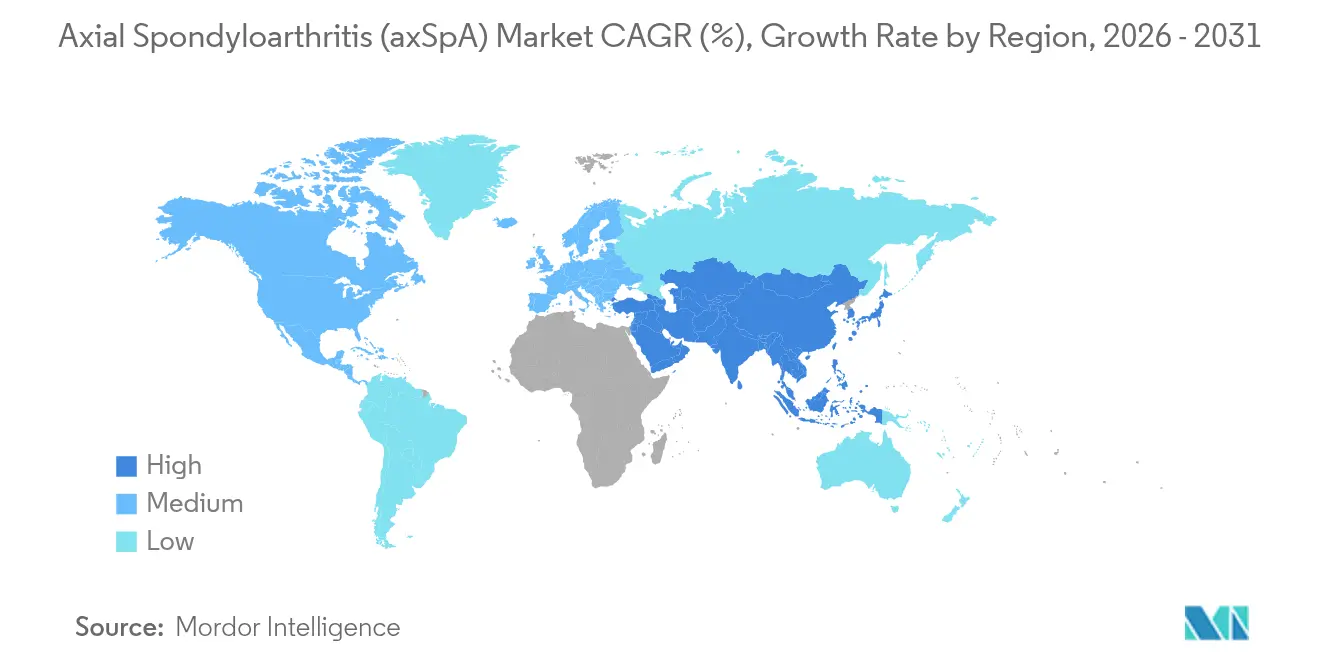
| Fastest Growing Market | Asia-Pacific |
| Largest Market | North America |
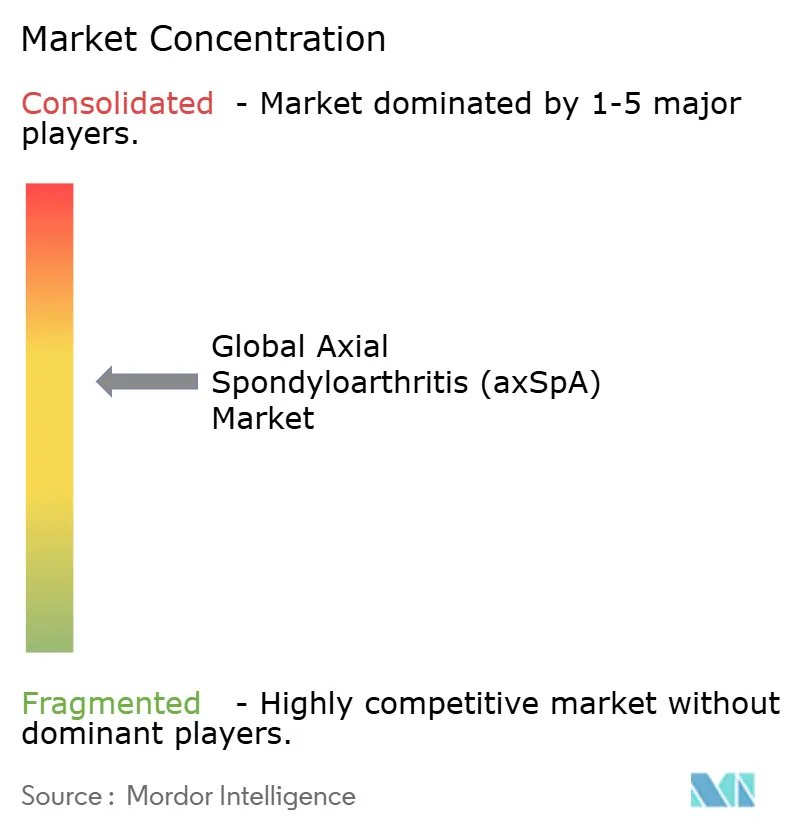
| Market Concentration | Medium |
Major Players *Disclaimer: Major Players sorted in no particular order Image © Mordor Intelligence. Reuse requires attribution under CC BY 4.0. | |
Global Axial Spondyloarthritis (axSpA) Market Analysis by Mordor Intelligence
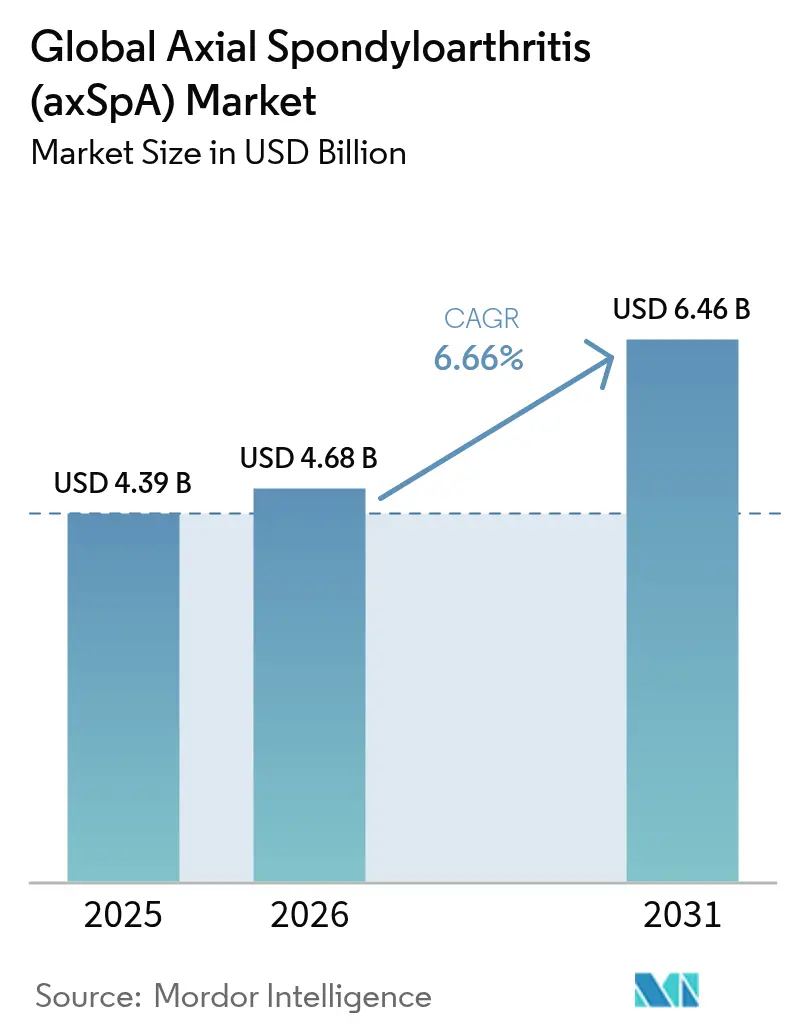
The axial spondyloarthritis market size was valued at USD 4.39 billion in 2025 and estimated to grow from USD 4.68 billion in 2026 to reach USD 6.46 billion by 2031, at a CAGR of 6.66% during the forecast period (2026-2031). Earlier diagnosis through MRI advocacy, the entry of dual IL-17A/IL-17F and JAK inhibitors, and broader patient‐assistance programs are expanding the axial spondyloarthritis market size and widening treatment access[1]. Uptake of subcutaneous biologics remains strong, yet oral JAK inhibitors are winning share as convenience considerations grow. Biosimilar adalimumab variants continue to reset formularies, reinforcing price competition[2]. Geographically, North America retains leadership, but Asia-Pacific is the fastest‐growing arena as healthcare infrastructure matures and biologic reimbursement widens[3].
Key Report Takeaways
- By drug class, disease-modifying antirheumatic drugs (DMARDs) held 49.02% of axial spondyloarthritis market share in 2025; the same segment is expanding at a 7.11% CAGR through 2031.
- By route of administration, subcutaneous formulations led with 45.82% of the axial spondyloarthritis market size in 2025, while oral therapies are predicted to grow at 7.28% CAGR.
- By distribution channel, hospital pharmacies accounted for 43.11% revenue share in 2025; online pharmacies post the quickest growth at 7.22% CAGR.
- By geography, North America commanded 39.78% market share in 2025; Asia-Pacific is forecast to grow at 7.19% CAGR to 2031.
Note: Market size and forecast figures in this report are generated using Mordor Intelligence’s proprietary estimation framework, updated with the latest available data and insights as of 2026.
Market Trends and Insights
Drivers Impact Analysis of Global Axial Spondyloarthritis (axSpA) Market*
| Driver | % Impact on CAGR Forecast | Geographic Relevance | Impact Timeline |
|---|---|---|---|
| Rising diagnosis rates due to MRI advocacy programs | +1.2% | Global, with strongest impact in North America & EU | Medium term (2-4 years) |
| Rapid uptake of IL-17 & JAK inhibitors in treatment guidelines | +1.8% | Global, led by developed markets | Short term (≤ 2 years) |
| Expansion of biosimilar TNF-α inhibitors improves affordability | +0.9% | Global, particularly emerging markets | Long term (≥ 4 years) |
| Growing employer-sponsored specialty pharmacy benefits | +0.7% | North America primary, expanding to EU | Medium term (2-4 years) |
| AI-assisted MRI algorithms enabling earlier detection | +0.6% | Developed markets initially, global expansion | Long term (≥ 4 years) |
| Microbiome-targeted adjuvant therapies showing disease-modifying potential | +0.3% | Research centers globally, clinical translation pending | Long term (≥ 4 years) |
| Source: Mordor Intelligence | |||
Rising diagnosis rates due to MRI advocacy programs
Updated ASAS classification and insurance alignment have cut diagnostic delay from more than eight years to roughly three in centers that mandate MRI for early back-pain evaluation. Enhanced Dixon sequencing now reaches 96% diagnostic accuracy, unlocking larger treatable populations and fueling the axial spondyloarthritis market. Early identification also prevents structural damage and supports long-term work productivity, strengthening payers’ cost-saving arguments.
Rapid uptake of IL-17 & JAK inhibitors in treatment guidelines
The 2022 ASAS/EULAR recommendations promoted IL-17 and JAK inhibitors once NSAIDs and at least one TNF blocker fail. Bimekizumab, approved in 2024, delivered ASAS40 responses above 44%, setting a new efficacy bar and providing the first dual cytokine blockade option. Upadacitinib and other JAK agents broaden oral alternatives despite cardiovascular warnings, enlarging the axial spondyloarthritis market as second-line therapy is standardized.
Expansion of biosimilar TNF-α inhibitors improves affordability
Formulary switches by pharmacy benefit managers to prefer biosimilars such as Cyltezo and Hyrimoz have trimmed annual patient costs by USD 3,500, sparking wider biologic initiation in cost-sensitive regions. Emerging markets gain the most, seeing 30-50% price decreases that lift biologic penetration and further expand the axial spondyloarthritis market.
Growing employer-sponsored specialty pharmacy benefits
Employers link early biologic use with reduced absenteeism, so plans now bundle specialty coverage, financial assistance, and adherence coaching. Programs like COSENTYX Connect ease copays and injection training, raising treatment persistence and propelling revenue growth, chiefly in North America.
Restraints Impact Analysis of Global Axial Spondyloarthritis (axSpA) Market*
| Restraint | % Impact on CAGR Forecast | Geographic Relevance | Impact Timeline |
|---|---|---|---|
| Persistently high treatment costs of novel biologics | -1.4% | Global, most pronounced in emerging markets | Long term (≥ 4 years) |
| Limited long-term safety data for JAK inhibitors | -0.8% | Global, regulatory focus in developed markets | Medium term (2-4 years) |
| Access inequality in low-income regions for imaging & biologics | -0.6% | Emerging markets, rural areas in developed countries | Long term (≥ 4 years) |
| Cold-chain logistics bottlenecks for biologic distribution | -0.4% | Global, particularly challenging in tropical regions | Medium term (2-4 years) |
| Source: Mordor Intelligence | |||
Persistently high treatment costs of novel biologics
Bimekizumab’s USD 8,281 per injection illustrates ongoing affordability barriers despite biosimilar rivalry. Total annual therapy outlays hover near USD 10,000, straining payer budgets and limiting uptake in lower-income settings. Added monitoring, administration overhead, and adverse-event management inflate economic burden and temper the axial spondyloarthritis market’s fullest potential.
Limited long-term safety data for JAK inhibitors
Cardiovascular and malignancy signals from the ORAL Surveillance trial triggered FDA and EMA warnings that confine JAK use to TNF failures, encourage older-patient caution, and mandate extra monitoring. Such guardrails curb prescriber enthusiasm and slow axial spondyloarthritis market expansion for orally delivered options.
*Our forecasts treat driver/restraint impacts as directional, not additive. The impact forecasts reflect baseline growth, mix effects, and variable interactions.
Global Axial Spondyloarthritis (axSpA) Market Segment Analysis
By Disease Type:
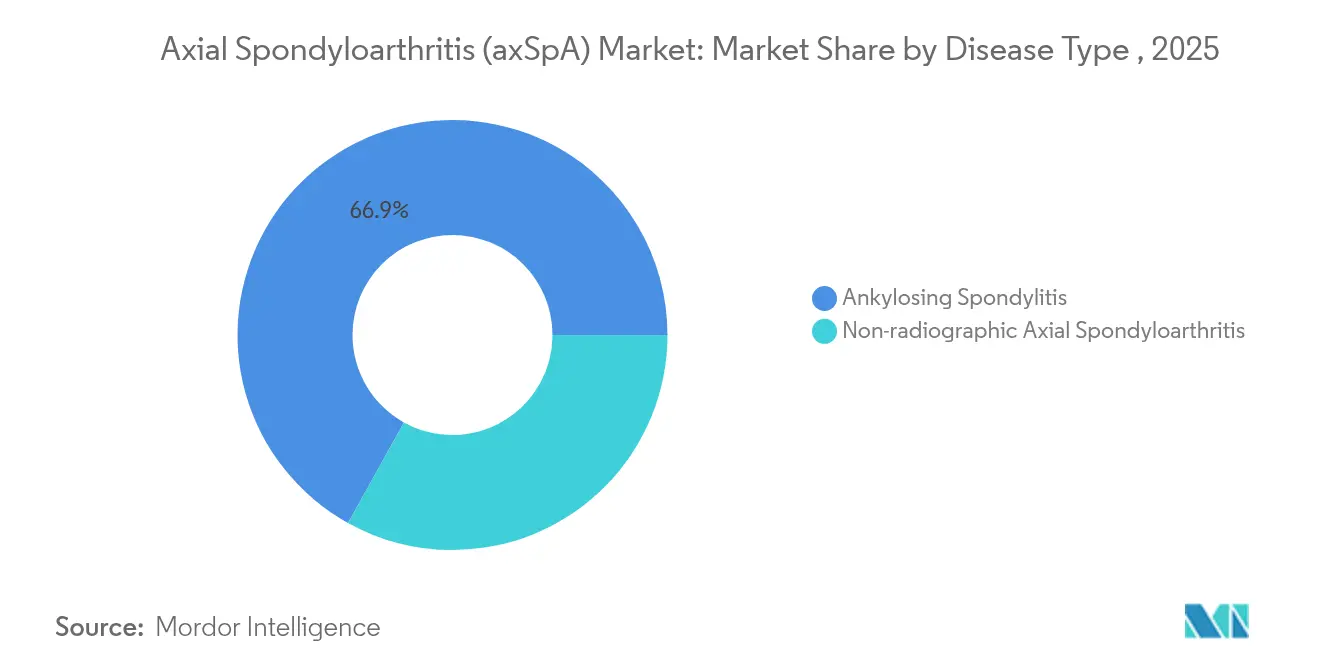
Non-radiographic Momentum BuildsAnkylosing spondylitis led revenue with 66.92% share in 2025, yet non-radiographic presentations are rising at a 7.69% CAGR to 2031. Early MRI adoption now picks up inflammatory lesions before structural damage, swelling the non-radiographic patient base inside the axial spondyloarthritis market. Clinical trials report similar biologic response rates for both phenotypes, validating aggressive treatment earlier in the disease course. Inter-regional contrasts are pronounced; Asian cohorts show just 14.4% non-radiographic incidence, half that of Western peers, reflecting divergent genetics and care accessibility. Harmonized nomenclature and ASAS criteria continue to raise awareness, sustaining double-digit gains for diagnostically driven volumes and enlarging axial spondyloarthritis market opportunity across all drug classes.
Elevated research interest centers on biomarkers that predict radiographic conversion, aiming to target therapy before irreversible fusion. Commercial upside lies in companion diagnostics that would differentiate aggressiveness, potentially justifying premium pricing. Education campaigns by patient groups further speed recognition, while tele-rheumatology may shrink urban-rural gaps, reinforcing structural tailwinds that support prolonged segment expansion within the axial spondyloarthritis market.

By Drug Class:
DMARD Innovation Takes Center StageDMARDs represented 49.02% of global revenue in 2025 and are set for 7.11% CAGR, propelled by biologic and targeted synthetic launches. Dual IL-17 inhibition through bimekizumab augments this category, offering superior ASAS40 outcomes. JAK agents deepen flexibility, though monitoring demands persist. The axial spondyloarthritis market size for DMARDs is forecast to climb steadily as real-world data strengthen payer confidence and formulary positions broaden.
NSAIDs and glucocorticoids remain crucial for symptom flare control but face stagnant growth, mainly due to gastrointestinal and bone-density risk profiles. Novel entrants like NLRX1 agonists and microbiome modulators promise to diversify mechanisms, ensuring continuous pipeline replenishment. Observational registries will likely influence guideline placement, particularly if newer molecules prove durable with clean long-term safety signatures, thus safeguarding DMARD dominance inside the axial spondyloarthritis market.
By Route of Administration:
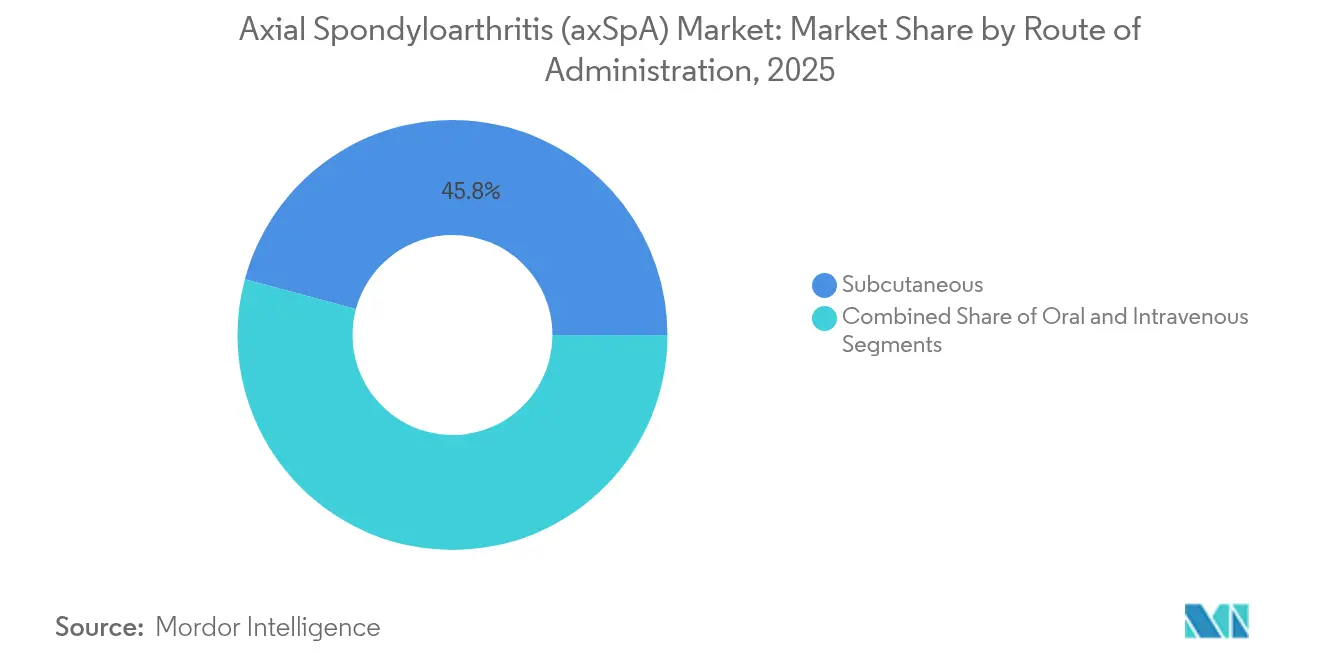
Oral Therapies Gain GroundSubcutaneous injections captured 45.82% revenue in 2025 on the back of established TNF and IL-17 agents. Oral formulations, however, enjoy a 7.28% CAGR as young, working-age patients gravitate toward pill regimens that simplify travel and lifestyle management. Payors welcome the lower administration costs, nurturing market shift toward tablets within the axial spondyloarthritis market.
Intravenous delivery holds a narrower place for high-severity or hospital-based dosing scenarios. Long-acting injectables are under study to cut frequency to quarterly or biannual visits, which could reshape adherence metrics. Safety debates around JAKs may slow oral momentum in select cohorts, yet convenience and cost dynamics still point to sustained growth in this modality.
By Distribution Channel:
Digital Dispensing AcceleratesHospital pharmacies owned 43.11% of sales in 2025 thanks to initiation protocols and cold-chain stewardship. Nevertheless, online channels exhibit the fastest 7.22% CAGR as telehealth familiarity and home-delivery reliability improve. Specialty e-pharmacies bundle financial aid, nurse coaching, and IoT shipping sensors to protect drug integrity, unlocking new revenue streams and reinforcing axial spondyloarthritis market expansion across dispersed geographies.
Retail outlets continue to serve chronic NSAID users and refill biologic pens yet face margin pressure from mail-order rivals. Manufacturers increasingly partner with integrated digital hubs to collect real-time adherence data, feeding value-based contracts. Regions with fragmented logistics still rely on hospital sites, but policy reforms and private investment in refrigerated last-mile transport promise to democratize access.
Geography Analysis
North America Axial Spondyloarthritis (axSpA) Market
North America anchors 39.78% of global revenue and benefits from high biologic penetration, employer-funded specialty benefits, and streamlined FDA approval pathways. MRI density and AI-enabled reading tools have trimmed average diagnostic latency to 2.7 years, amplifying treated prevalence. Biosimilar diffusion is reshaping rebates and opening space for novel agents without swelling payer budgets, sustaining revenue leadership across the axial spondyloarthritis market.
APAC Axial Spondyloarthritis (axSpA) Market
Asia-Pacific records the quickest 7.19% CAGR through 2031 as China broadens reimbursement and hospital capacity. Ankylosing spondylitis prevalence of up to 0.42% implies sizable underdiagnosis. Japan exhibits high biologic utilization tied to universal coverage, whereas India still struggles with specialist scarcity and out-of-pocket limits. Regional public–private projects to add MRI scanners and tele-rheumatology services will likely raise drug volumes. Cultural integration of yoga and Tai Chi into standard care underscores local adaptation in managing axial disease.
EMEA and South America Axial Spondyloarthritis (axSpA) Market
Europe remains a mature market with universal coverage, but access variability lingers. Central and Eastern states lag in biologic uptake (27.9%) and endure longer diagnostic delays (4.2 years), muting growth. The continent nevertheless pioneers biosimilar policy, fostering competitive pricing. Middle East & Africa trail, constrained by fiscal capacity and cold-chain gaps, yet targeted donor programs and urban clinic build-outs are stirring incremental demand. South America offers mid-single-digit expansion tempered by macroeconomic volatility and reimbursement lag.
Regulatory Landscape
Regulation of axSpA therapies follows standard prescription-drug approval and post-marketing pharmacovigilance requirements across major markets, with indication language increasingly differentiating radiographic ankylosing spondylitis and non-radiographic axSpA and emphasizing validated endpoints such as ASAS responses and durability. A key global access marker in the period has been the September 2024 US FDA approval of UCBs BIMZELX (bimekizumab-bkzx) for active non-radiographic axSpA and active ankylosing spondylitis, which broadened labeled options for both disease phenotypes under a single brand and reinforced the role of IL-17 pathway blockade in regulated treatment pathways.
In Europe, the centralized EMA pathway continues to shape competitive entry for both innovators and biosimilars, including marketing authorizations for severe, active ankylosing spondylitis and severe non-radiographic axSpA such as Gobivaz (17 November 2025) and Gotenfia (10 February 2026). Alongside approvals, standard-setting and reimbursement decisions influence prescribing and non-drug care compliance, including the American College of Rheumatologys 2026 clinical practice guideline update for axial spondyloarthritis and the Netherlands policy move to implement reimbursement for long-term, person-centered active exercise therapy for severe axSpA in the basic insurance package (implemented January 2026).
Value Chain Analysis
The axSpA value chain starts with discovery and clinical development by originator biopharma, followed by regulatory submission, biologics or small-molecule manufacturing, and specialty distribution that supports complex initiation and monitoring. For biologics, upstream activities include cell-line development, sterile fill-finish, and cold-chain logistics into hospital and specialty pharmacy channels that manage onboarding, adherence support, and temperature-controlled delivery, reflecting the continued importance of subcutaneous therapies in this market.
Biosimilars and partnered commercialization are material linkages that connect manufacturing scale with regional market access. Recent examples that illustrate the chain include Lupins July 2025 license and supply agreement with Zentiva to commercialize a certolizumab pegol biosimilar across Europe and CIS markets, and Bio-Thera Solutions March 2026 licensing of the golimumab biosimilar BAT2506 to Intas Pharmaceuticals for markets including the US, Canada, and India, aligning manufacturing capability with established local commercial infrastructure. Pipeline replenishment feeds the front end of the chain, highlighted by XBiotechs June 2026 initiation of a Phase II study of vilamakitug (PT064) in active axSpA following FDA review without a clinical hold and Alfasigmas EULAR 2026 presentation of Phase 3 OLINGUITO data for filgotinib, both of which can reshape downstream demand for oral versus injectable distribution and associated monitoring workflows.
Competitive Landscape
Competitive intensity is rising as dual cytokine blockers, JAKs, and biosimilars jostle for position. AbbVie, Johnson & Johnson, Novartis, and UCB controlled roughly 62% of global revenue in 2024 by leveraging broad immunology franchises, co-pay assistance, and large-scale manufacturing. UCB’s BIMZELX has quickly disrupted TNF incumbents, winning guidelines mentions and stimulating head-to-head trials.
Pipeline strategies now focus on mechanistic novelty—NLRX1 agonists, IL-23 blockade, and microbiome adjuncts—over marginal reformulations. M&A activity, exemplified by AbbVie’s Landos Biopharma deal, secures access to first-in-class molecules before Phase 3 onset. Biosimilar producers exploit expiring patents to challenge originators; major PBMs have already de-listed Humira in favor of cheaper alternatives, triggering defensive contracting and patient-support enhancements.
Digital health is another battleground. Companies integrate AI dosing algorithms, Bluetooth-enabled autoinjectors, and real-world evidence dashboards to strengthen payer negotiations and differentiate brands. As cold-chain technology improves, regional players in emerging markets can viably distribute high-value biologics, heightening price pressure yet broadening overall axial spondyloarthritis market reach.
Global Axial Spondyloarthritis (axSpA) Industry Leaders
-
Janssen Biotech
-
AbbVie
-
UCB
-
Novartis Pharmaceuticals Corporation
-
Eli Lilly and Company
- *Disclaimer: Major Players sorted in no particular order
Global Axial Spondyloarthritis (axSpA) Market Companies Covered in this Report
- Abbvie
- Johnson & Johnson
- Novartis
- Pfizer
- Eli Lilly and Company
- Amgen
- UCB
- Kyowa Kirin
- Acelyrin
- Bristol-Myers Squibb
- Biogen
- Samsung Bioepis
- Celltrion Healthcare
- Gilead Sciences
- Fresenius
- Sun Pharmaceuticals Industries
- Lupin
- Dr. Reddy’s Laboratories
- Sandoz Group
- Sanofi
- Roche
- Boehringer Ingelheim
- Takeda Pharmaceuticals
- Galapagos NV
Read Analysis of Global Axial Spondyloarthritis (axSpA) Companies
Market Opportunities and Future Outlook
Opportunities center on expanding access in cost-constrained systems and broadening treatment choice for patients who fail NSAIDs and prior biologics, supported by concrete regulatory and guideline signals. In Europe, EMA authorizations such as Gobivaz (17 November 2025), a biosimilar to Simponi with a severe non-radiographic axSpA indication, underscore payer-ready paths for lower-cost biologic options that can shift formulary mix and enable broader initiation in appropriate patients. In the US, the September 2024 FDA approval of UCBs BIMZELX for both active non-radiographic axSpA and active ankylosing spondylitis expanded labeled, differentiated biologic competition beyond TNF inhibitors, increasing switching and sequencing options within DMARD regimens.
Oral targeted therapies and region-specific pipeline activity create additional whitespace in patient segments prioritizing convenience or requiring alternative mechanisms. The June 2026 ACR axSpA guideline update provides a clearer evidence-based placement for Janus kinase inhibitors as a strong recommendation within treatment algorithms (while not as first-line b/tsDMARD therapy), and EULAR 2026 dissemination of Phase 3 OLINGUITO data for filgotinib adds clinical evidence across radiographic and non-radiographic axSpA. In China, local development momentum is reflected by Jiangsu Hengrui Pharmaceuticals announcement of NMPA acceptance of an NDA for ivarmacitinib for active non-radiographic axSpA, highlighting in-country pathways aimed at capturing NSAID-refractory populations as reimbursement breadth and diagnostic capacity expand.
Recent Industry Developments in Global Axial Spondyloarthritis (axSpA) Market
- June 2026: XBiotech initiated a Phase II clinical trial (V-SPINE/PT064) evaluating vilamakitug for patients with active axial spondyloarthritis after FDA review proceeded without a clinical hold. The study adds a novel pipeline asset into a market where mechanism differentiation matters for patients who cycle through TNF and IL-17 options. Continued clinical progress here can diversify future competitive sets beyond established biologic classes.
- June 2026: Livzon Pharmaceutical Group reported receiving an NMPA acceptance notice for the marketing authorization application of Lecankitug Injection for adult patients with active ankylosing spondylitis. The filing signals advancing late-stage commercialization steps inside China, where local entrants can influence pricing and access dynamics. It also adds pressure on incumbents to defend share through contracting, assistance programs, and portfolio sequencing.
- November 2025: Gobivaz gained European marketing authorization for severe non-radiographic axial spondyloarthritis and active ankylosing spondylitis, expanding payer-facing competition and signaling a broader European access path for a biosimilar option. The approval reinforces the shift toward diverse biosimilar choices in European axSpA care and may influence formulary placement and patient initiation patterns.
Global Axial Spondyloarthritis (axSpA) Market Report Scope and Research Methodology
Market Definition and Coverage
For this methodology, the axial spondyloarthritis market is defined as global revenues from prescription medicines used to treat radiographic ankylosing spondylitis and non-radiographic axSpA, measured at the manufacturer level across major pharmacy channels.
Scope exclusions: This sizing excludes surgery, stand-alone diagnostics and imaging, and non-drug rehabilitation services.
Segments Covered in This Report
- By Disease Type
- Ankylosing Spondylitis (Radiographic axSpA)
- Non-radiographic Axial Spondyloarthritis
- By Drug Class
- Non-steroidal Anti-inflammatory Drugs (NSAIDs)
- Glucocorticoids
- Disease-modifying Antirheumatic Drugs (DMARDs)
- Others
- By Route of Administration
- Oral
- Subcutaneous
- Intravenous
- By Distribution Channel
- Hospital Pharmacies
- Retail Pharmacies
- Online Pharmacies
- By Geography
- North America
- United States
- Canada
- Mexico
- Europe
- Germany
- United Kingdom
- France
- Italy
- Spain
- Rest of Europe
- Asia-Pacific
- China
- Japan
- India
- Australia
- South Korea
- Rest of Asia-Pacific
- Middle East and Africa
- GCC
- South Africa
- Rest of Middle East and Africa
- South America
- Brazil
- Argentina
- Rest of South America
- North America
Data Sources, Market Sizing, and Validation
Desk Research
Desk work starts by setting the clinical and treatment boundary so the model follows axSpA drug demand only, not the wider musculoskeletal pain space. We use non-paywalled sources such as the World Health Organization, national health agencies (for example, CDC and NHS), clinical guidance bodies, and peer-reviewed rheumatology journals to map diagnosis patterns, standard of care, and treatment switching logic.
Once the care pathway is clear, we pull supporting signals to quantify demand and pricing direction, such as public regulator labels and approvals, government health spending series, and trade and customs statistics where relevant for pharma movements. Company annual reports, investor presentations, and reputable press are used to validate commercial focus areas and regional exposure. Where needed, we also reference paid subscriptions for company financials and intelligence and patent databases to cross-check pipeline activity and loss-of-exclusivity timing. These desk sources are illustrative, and many other public documents were also reviewed for data collection, validation, and clarification.
Primary Interviews and Surveys
Primary work is used to pressure-test the desk assumptions with people who see axSpA treatment decisions in real life, including rheumatologists, hospital pharmacists, payer or reimbursement specialists, and channel participants. We also use these discussions to confirm how often biologics, biosimilars, and oral therapies are used by patient type, and how access rules differ across major regions, which then helps close gaps that desk sources do not explain well.
Distribution of primary research fieldwork respondents
| Company type | Respondent position | Region |
|---|---|---|
| Top tier: 32% | CXOs: 15% | APAC: 39% |
| Mid tier: 50% | Functional/Unit leaders: 28% | EMEA: 36% |
| Smaller Players: 18% | Managers: 57% | Americas: 25% |
Market-Sizing & Forecasting
The core build uses a top-down approach where diagnosed and treated axSpA patient pools are reconstructed by region, and then translated into therapy-class volumes using treatment-share and line-of-therapy logic. Those volumes are priced using class-level annual cost of therapy and expected net price behavior, and then rolled up across channels to reach a global revenue total.
To keep totals realistic, we corroborate results with selective bottom-up checks, such as rolling up a sample of country-level sales signals from public filings, validating class mix through channel feedback, and sanity-checking implied spend per treated patient. Key inputs that materially move the model include the split of radiographic versus non-radiographic patients in treated cohorts, biologic and biosimilar uptake rates, step-therapy and prior-authorization intensity, diagnosis and referral trends, and expected net price changes after biosimilar entry. When a country has thin public data, we use proxy ratios from similar reimbursement settings and then adjust after follow-up expert checks.
For forecasting, scenario analysis is used so uncertainty (such as access broadening, biosimilar pricing steps, and adoption speed of newer mechanisms) maps to a small set of traceable outcomes. The final forecast path is selected after aligning those scenarios with what primary respondents describe as the most likely payer and prescriber behavior over the next few years.
Data Validation & Update Cycle
Before sign-off, our totals are checked against independent signals like biologic class growth rates, known reimbursement expansions, and regional therapy-mix expectations, and then any outliers are reviewed at the country and class level. If the model implies a jump that cannot be explained by patient counts, uptake, or price movement, we re-check inputs and re-contact sources to confirm what changed.
A second analyst review is completed to confirm formulas, unit logic, and that assumptions are consistent across regions. The report is refreshed annually, and we also make interim updates when material events occur, such as major approvals, safety actions, or meaningful biosimilar launches. Before delivery, we run a final update pass so the numbers reflect the latest available public information and validated expert feedback.
Mordor Intelligence's Global Axial Spondyloarthritis Market Size Measured Against Other Published Estimates
Published market values for axSpA often do not match because the counted revenue pool is not always the same, and because pricing and patient assumptions can move totals quickly in a specialty disease area. Differences usually come from what therapies are included, whether gross or net pricing is used, and how fast newer biologics and biosimilars are assumed to penetrate.
The spread is also shaped by whether studies include only ankylosing spondylitis or also count non-radiographic axSpA, and whether they treat supportive drugs as part of the market or focus only on advanced biologics. Some estimates take an aggressive view on access broadening or use currency conversions from different time points, which can inflate global totals. Keeping ex-manufacturer drug revenue tied to treated-patient build-ups and net price progression, instead of list prices or mixed indications, explains the more measured total shown by Mordor Intelligence.
Benchmark comparison
| Source | Market Size | Gaps in Research Methodology |
|---|---|---|
| Mordor Intelligence | USD 4.68 B (2026) | |
| Global Consultancy A | USD 5.35 B (2026) | This estimate appears to lean toward biologics-only revenues but applies list-price style annual therapy costs and faster uptake in earlier lines, which can overstate net realized sales in restricted-access markets. |
| Industry Association B | USD 4.10 B (2026) | This figure likely limits scope mainly to radiographic ankylosing spondylitis and excludes meaningful non-radiographic treatment volumes, and it may undercount biosimilar substitution effects across retail and hospital channels. |
Overall, the gap across published numbers is explained more by scope and pricing mechanics than by disagreement on disease growth. By anchoring the model to treated patients, therapy mix, and plausible net price steps, the final value stays traceable to inputs that can be reviewed and repeated over time.
Key Questions Answered in the Report
What is the current value of the axial spondyloarthritis market?
The market is valued at USD 4.68 billion in 2026 and is projected to reach USD 6.46 billion by 2031.
Which therapy class holds the largest share of revenue?
DMARDs lead with 49.02% of axial spondyloarthritis market share in 2025.
Why is Asia-Pacific growing faster than other regions?
Expanding reimbursement, rising diagnostic capacity, and large undiagnosed prevalence in countries such as China are propelling a 7.19% CAGR.
How are biosimilars influencing treatment costs?
Preferred formulary placement for adalimumab biosimilars has cut annual patient expenses by roughly USD 3,500.
What are the key safety concerns for JAK inhibitors?
Cardiovascular events and malignancy risks in older patients with comorbidities have led regulators to restrict use to those failing TNF blockers.
Which companies are leading innovation in axial spondyloarthritis?
UCB with bimekizumab, AbbVie through its Landos acquisition, and Johnson & Johnson via guselkumab expansion are notable innovators.