
Aircraft Brakes Market Size and Share
Market Overview
| Study Period | 2020 - 2031 |
|---|---|
| Market Size (2026) | USD 9.80 Billion |
| Market Size (2031) | USD 12.56 Billion |
| Growth Rate (2026 - 2031) | 5.11 % |
| Fastest Growing Market | Asia Pacific |
| Largest Market | North America |
| Market Concentration | High |
Major Players *Disclaimer: Major Players sorted in no particular order Image © Mordor Intelligence. Reuse requires attribution under CC BY 4.0. | |
Aircraft Brakes Market Analysis by Mordor Intelligence
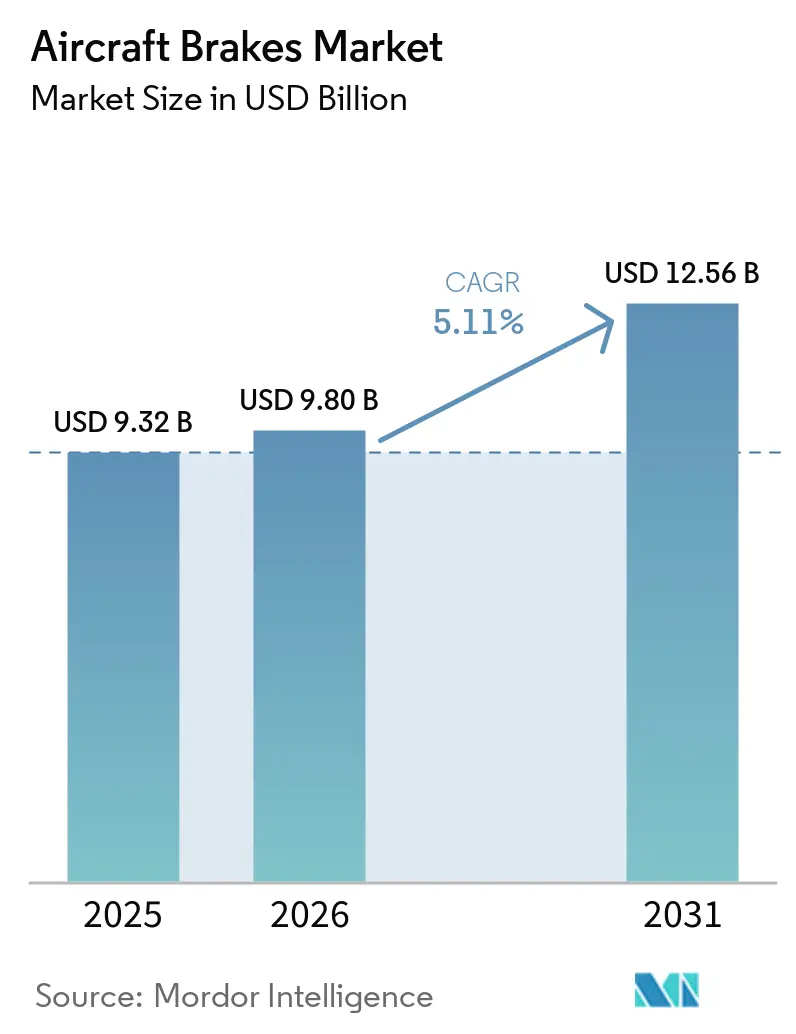
The aircraft brakes market size in 2026 is estimated at USD 9.8 billion, growing from 2025 value of USD 9.32 billion with 2031 projections showing USD 12.56 billion, growing at 5.11% CAGR over 2026-2031. Rising fleet deliveries, steady defense modernization programs, and the industry-wide pivot from steel to advanced carbon braking systems sustain momentum. Commercial airlines are lengthening aircraft retirement cycles, increasing maintenance, repair, and overhaul (MRO) demand; brake-by-wire technology is gaining traction as more electric aircraft architectures enter service. Carbon brakes dominate new installations because they cut weight, curb fuel burn, and last longer than steel alternatives, while breakthrough carbon-ceramic concepts promise even higher thermal tolerance. Regional market dynamics favor North America for installed base revenues, yet Asia-Pacific is expanding the fastest as low-cost carriers add narrowbody jets and regional regulators streamline certification pathways. Supply chain tightness in aerospace-grade carbon fiber and the rigorous certification regime for novel brake materials continue to cap near-term capacity additions. Still, OEM investments in new factories underscore confidence in multiyear demand.
Key Report Takeaways
- By product type, carbon brakes led with 64.92% revenue share in 2025; carbon-ceramic/CMC brakes are projected to advance at a 7.55% CAGR to 2031.
- By actuation technology, conventional hydraulic systems held 75.60% share in 2025, whereas fully electric/brake-by-wire solutions are expected to grow at 6.29% CAGR through 2031.
- By aircraft class, commercial held a 75.70% share in 2025, and is expected to grow at a 6.05% CAGR through 2031.
- By end user, linefit installations represented 54.10% of the aircraft brakes market share in 2025; retrofit activity is forecasted to rise at a 5.39% CAGR as operators upgrade aging fleets.
- By geography, North America accounted for 30.60% of the aircraft brakes market in 2025, while Asia-Pacific is poised to register the fastest regional CAGR at 6.72% to 2031.
Note: Market size and forecast figures in this report are generated using Mordor Intelligence’s proprietary estimation framework, updated with the latest available data and insights as of 2026.
Market Trends and Insights
Drivers Impact Analysis of Aircraft Brakes Market*
| Driver | ( ~ ) % Impact on CAGR Forecast | Geographic Relevance | Impact Timeline |
|---|---|---|---|
| Expansion of worldwide aircraft fleet and sustained growth in deliveries | +1.8% | Global; strongest in Asia-Pacific and North America | Medium term (2-4 years) |
| Industry transition from steel brakes to advanced carbon braking solutions | +1.2% | North America and Europe, spreading to Asia-Pacific | Long term (≥ 4 years) |
| Global defense fleet modernization programs stimulating brake demand | +0.9% | North America, Europe, Asia-Pacific | Medium term (2-4 years) |
| Rising MRO requirements from aging commercial aircraft fleets | +1.1% | North America and Europe | Short term (≤ 2 years) |
| Increasing adoption of brake-by-wire systems in more-electric aircraft architectures | +0.7% | Early uptake in North America and Europe | Long term (≥ 4 years) |
| Wider acceptance of PMA parts in cost-sensitive aviation markets | +0.4% | Strongest in North America | Short term (≤ 2 years) |
| Source: Mordor Intelligence | |||
Expansion of worldwide aircraft fleets drives sustained brake demand
Boeing’s 2024 outlook calls for 43,975 new jet deliveries over 2024-2043, and 76% of them are single-aisle models that operate high landing-cycle missions, accelerating brake wear and replacement frequency.[1] India’s traffic is expanding more than 7% annually, underpinning a need for 2,835 additional aircraft by 2045, which compounds brake demand in both the original-equipment and aftermarket channels. Aircraft retirements remain below historic norms, extending fleet average age and intensifying MRO cycles, including repetitive brake overhauls. Regulatory oversight by ICAO and national authorities standardizes global brake performance benchmarks, ensuring that every newly delivered or overhauled unit meets identical stopping-distance, thermal-fade, and wear-rate criteria.
Industry transition from steel to carbon braking solutions reshapes market dynamics
Operators value carbon brakes because they trim weight and last longer than steel sets; Collins Aerospace’s DURACARB® discs deliver about 35% extra lifespan on Boeing 737NG aircraft, translating into fewer shop visits and lower fuel burn. Safran’s Equipment & Defense division, which bundles landing and carbon-brake products, posted 17.70% organic revenue growth in 2024, a signal of shifting operator preferences toward premium carbon technology. Meanwhile, Mitsubishi Chemical Group has demonstrated carbon-fiber reinforced ceramic matrix composites (CMCs) capable of withstanding 1,500 °C, paving the way for next-generation brake discs that tolerate extreme heat without a mass penalty. New production capacity, such as Collins Aerospace’s USD 200 million Spokane expansion, will lift global carbon brake output by 50%, helping alleviate backlog pressure.
Global defense fleet modernization programs stimulate brake upgrades
The US Air Force’s F-16 brake control redesign pivots to Crane’s Mark V brake-by-wire architecture, removing single-point failures and elevating stopping-distance reliability. Similarly, the B-52J re-engining and drag-chute retrofit aim to cut landing-roll brake wear, spotlighting how propulsion upgrades trigger brake system redesign. FlightGlobal tallied 52,642 active military aircraft worldwide, and order books for 4,350 new fixed-wing combat platforms will require freshly certified brakes and long-term sustainment. NATO standardization aligns performance and maintenance metrics, creating a homogeneous defense aftermarket that encourages multi-country brake supply contracts.
Rising MRO requirements from aging commercial fleets bolster aftermarket revenue
Deferred retirements and delivery delays compel airlines to stretch legacy airframes, raising annual shop visit counts for wheels and brakes. North American and European MRO facilities report high utilization rates as airlines schedule proactive brake overhauls to mitigate operational disruptions. Line-replaceable overhaul kits centered on carbon stacks command premium pricing, so brake OEMs invest in additional field-stocking locations and digital tracking tools that precisely monitor heat-soak cycles and wear thickness to time part replacement. The Asia-Pacific maintenance market is projected to grow to USD 109 billion by 2043, and brake specialist capabilities are a critical slice of that expansion.
Restraints Impact Analysis of Aircraft Brakes Market*
| Restraint | ( ~ ) % Impact on CAGR Forecast | Geographic Relevance | Impact Timeline |
|---|---|---|---|
| Volatility in global carbon fiber supply and rising energy costs | -0.8% | Highest in Asia-Pacific production hubs | Medium term (2-4 years) |
| Lengthy OEM certification processes and retrofit program backlogs | -0.6% | North America and Europe | Medium term (2-4 years) |
| Stricter international regulations on brake particulate emissions | -0.3% | Europe leading, global uptake | Long term (≥ 4 years) |
| Growing OEM vertical integration reducing tier-2 supplier participation | -0.4% | North America and Europe | Long term (≥ 4 years) |
| Source: Mordor Intelligence | |||
Volatile carbon fiber supply constrains production scaling
Aerospace-grade carbon fiber capacity additions lag demand because qualification cycles stretch several years, and most new lines aim at lower-grade products for wind blades, not aircraft brakes.[2] Heat-treatment furnaces and chemical vapor infiltration used to make carbon-carbon discs consume large amounts of electricity and natural gas; fluctuating utility prices squeeze suppliers’ margins and push brake selling prices upward. Extended lead-times for titanium, specialty stainless, and alloy castings—often 30 weeks or more—delay hub and torque-tube deliveries for brake assembly. Geopolitical shipping disruptions add further risk to trans-Pacific logistics, prompting OEMs to dual-source raw materials or consider in-region production shifts.
Certification bottlenecks delay technology implementation
EASA deferred its runway-overrun system mandate by 18 months because OEMs cited shortages of certified suppliers and lengthy test-data reviews. In August 2024, the FAA introduced System Safety Assessments that require every brake installation to demonstrate elimination of significant latent failures; complying with the new rule can prolong project timelines by a year or more. While a five-nation pact strives for harmonized powered-lift rules, brake suppliers still face duplicate audit burdens under FAA and EASA requirements, adding cost and complexity. For airframers racing to launch eVTOLs, a protracted brake qualification window can jeopardize entry-into-service targets, forcing some to select mature hardware over next-generation options.
*Our forecasts treat driver/restraint impacts as directional, not additive. The impact forecasts reflect baseline growth, mix effects, and variable interactions.
Aircraft Brakes Market Segment Analysis
By Product Type:
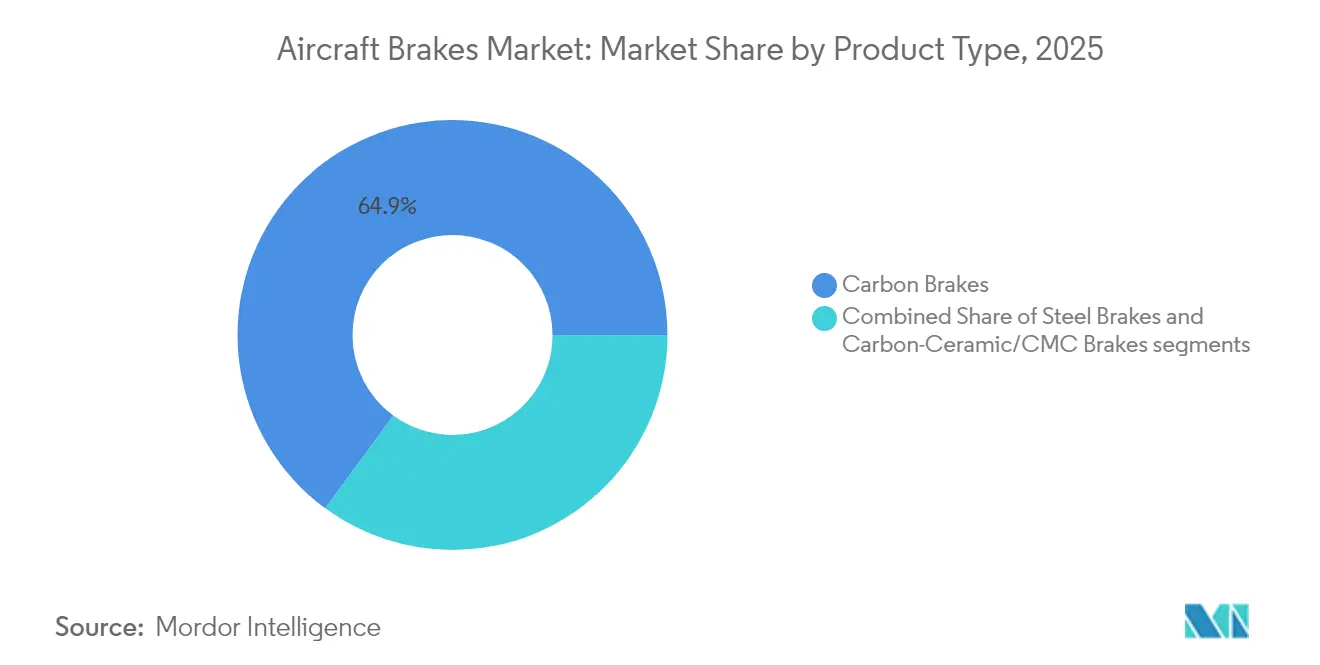
Carbon brakes anchor premium growthCarbon technology commanded a 64.92% of the aircraft brakes market share in 2025 due to the strength of weight savings that cut fuel burn and increased payload capacity. Steel sets retain a niche in light aircraft and cost-constrained operators, yet carriers are quantifying whole-life savings and switching fleets to carbon at the next overhaul cycle. Carbon-ceramic/CMC variants are the fastest-growing sub-category at a 7.55% CAGR, driven by their 1,500 °C heat-resilience and outstanding fade resistance, critical for repeated short-haul missions.
Manufacturing investments mirror this shift. Collins Aerospace doubled Spokane output with a USD 200 million expansion, and Safran is building a new carbon brake plant in France to shore up European capacity. Certification protocols under FAA Part 25 require brake discs to withstand nine-stop rejected-takeoff tests without structural degradation, and carbon stacks routinely outperform steel in this regime. Environmental regulations favor carbon because it eliminates cadmium plating and reduces particulate emissions versus steel-based linings.

By Actuation Technology:
Hydraulic dominance confronts an electric futureTraditional hydraulics represent 75.60% of the aircraft brakes market size, prized for proven reliability and global MRO familiarity. Aircraft braking systems increasingly combine conventional hydraulic components with electronic controls, sensors, and electric actuation technologies to improve braking precision and support more-electric aircraft architectures. Electro-hydraulic hybrids add electronic precision while leveraging existing pumps and reservoirs, serving as a bridge technology for new-builds that still share line architecture with legacy fleets. Fully electric systems, or brake-by-wire, are accelerating at a 6.29% CAGR to 2031 as OEMs pursue all-electric secondary power architectures; Safran’s 787 unit sets the precedent, pairing smart-sensor wear gauging with cockpit annunciations.
Military programs expedite adoption: Crane’s Mark V architecture on the F-16 offers dual redundant signal paths that comply with MIL-HDBK-516C airworthiness criteria. Electric brakes reduce hydraulic fluid mass and eliminate thermal soak-back issues that raise wheel-well temperatures in composite fuselages. As battery-electric regional aircraft and eVTOL prototypes mature, lightweight distributed brake actuators with regenerative capabilities are emerging design baselines in preliminary certification packages.
By Aircraft Class:
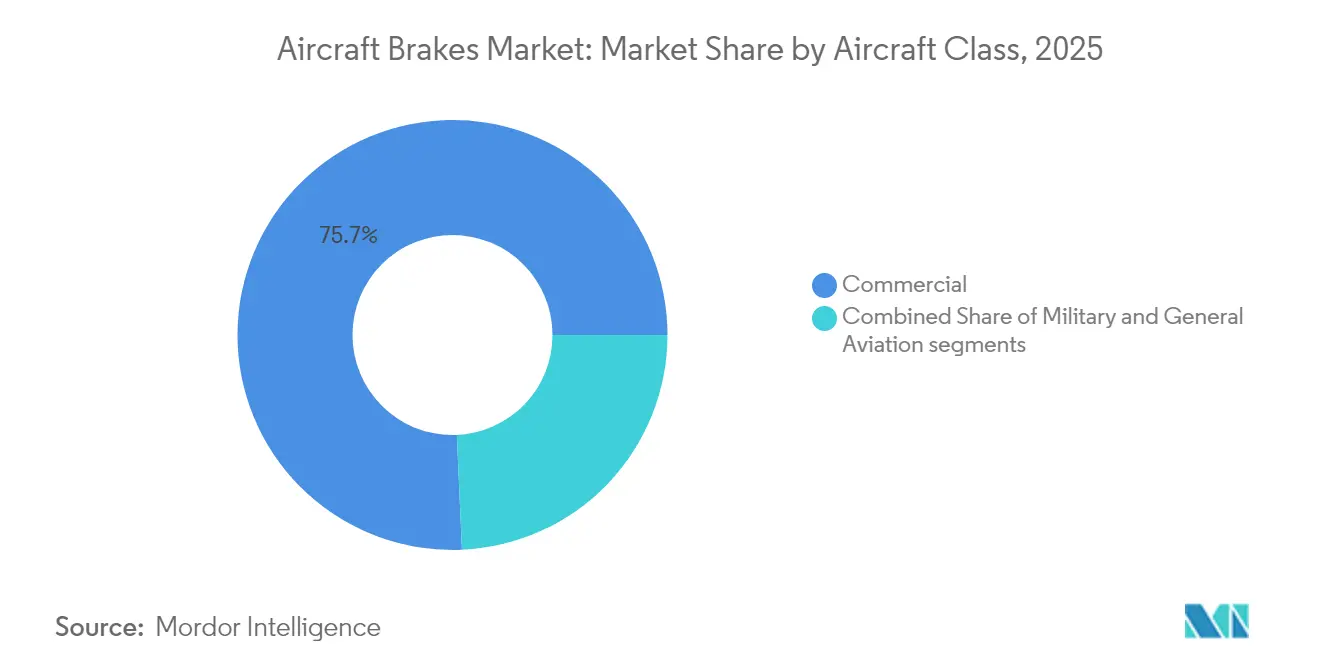
Commercial aviation underpins volume, defense accelerates technologyCommercial operators generated 75.70% of 2025 demand, led by narrowbody programs such as B737 and A320 lines that account for most annual landings. Widebodies contribute higher unit revenue per set due to larger disc diameters and more complex antiskid control valves. Regional jets and turboprops are converting to carbon brakes as airlines chase lower turnaround times and simplified stocking.
Defense fleets, although smaller in volume, drive frontier technology; the US Air Force (USAF) funds brake-by-wire retrofits, and NATO fleets align specification sheets to streamline coalition logistics. General aviation—including business jets—demands high-energy-absorption discs rated for steep-approach landing fields, a design requirement that increasingly tilts toward carbon. Rotorcraft applies mandatory rotor brakes under 14 CFR 27.921, a regulation that ensures safe rotor stoppage before ground personnel approach.
By End User:
Line-fit secures early revenue, retrofit extends lifecycle valueLinefit contracts supplied 54.10% of the aircraft brakes market in 2025, embedding OEM hardware for decades of follow-on spares. Negotiated alongside airframe purchase agreements, these deals lock in brake specifications and often bundle maintenance packages that guarantee predictable cost per landing over a set horizon.
Retrofit demand grows at 5.39% CAGR through 2031 as carriers seek fuel savings and lower maintenance burden by replacing steel stacks with carbon during heavy checks; Copa Airlines’ B737NG upgrade to Collins carbon brakes is a recent reference. PMA alternatives intensify competition, letting operators mix OEM and non-OEM parts within the same assembly under approved engineering orders. Military life-extension programs recapitalize existing fleets rather than buy new airframes, elevating retrofit scope for brake control computers and high-temperature discs.
Geography Analysis
North America Aircraft Brakes Market
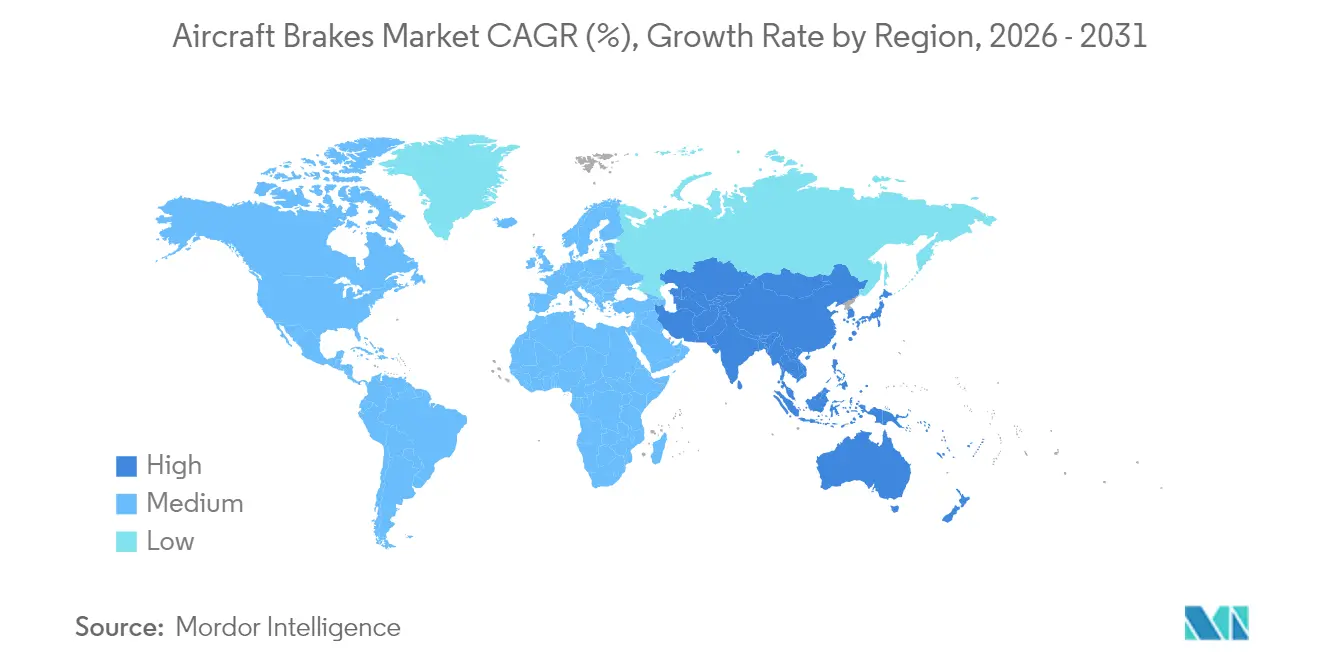
North America has the largest aircraft brakes market share, at 30.60%, because it combines the world’s biggest military inventory with the densest commercial traffic flows and a mature MRO network. US-based suppliers benefit from Buy-American preferences and a robust defense budget that accelerates brake modernization cycles on legacy platforms.
EMEA and APAC Aircraft Brakes Market
Asia-Pacific registers the steepest growth at 6.72% CAGR owing to prolific fleet additions and regulatory streamlining that shortens certification lead-times for new component entrants. Domestic production incentives in China and India foster local assembly of wheels-and-brake subcomponents, reducing import dependency and creating strategic partnerships with global OEMs. Europe remains pivotal through Airbus output and stringent environmental directives that steer early adoption of low-emission brake materials. The Middle East and Africa are growing from a small base as Gulf carriers upgrade fleets and African nations add connectivity under the Single African Air Transport Market protocols.
Regulatory Landscape
Aircraft wheel and brake assemblies are governed by harmonized performance-based certification frameworks led by the FAA and EASA, with FAA TSO-C135 and EASA ETSO-C135a defining minimum standards for transport-category hardware. Compliance is tied to type-certification airworthiness requirements such as 14 CFR 25.735 and associated FAA guidance (for example AC 25.735-1), which drive substantiation for kinetic energy absorption, deceleration capability, thermal and fade behavior, and overtemperature or burst prevention across both line-fit and retrofit installations.
Post-entry-into-service oversight also shapes product configurations and retrofit demand through airworthiness directives and rulemaking actions. In 2025, EASA issued AD 2025-0095 addressing Airbus A320-family main landing gear brake rod inspection requirements. In 2026, the FAA advanced actions affecting in-service brake hardware, including an NPRM (FAA-2026-2729) for Airbus A350-941 brake rod center pin nut sub-assemblies and an April 2026 directive requiring replacement of brake pipe assemblies tied to brake shuttle valve configurations. For smaller aircraft segments, EASA CS-ETSO updates (including requirements applied via ETSO-C26d under Amendment 12) sit alongside transport-category rules, creating a parallel compliance pathway for GA and rotorcraft brake approvals.
Value Chain Analysis
The aircraft brakes value chain begins with upstream feedstocks and specialized processing for friction materials and metallic structures, then moves through design and certification, manufacturing, and lifecycle services. For carbon-carbon brakes, production typically includes carbon fiber and resin inputs, preform needling or layup, carbonization, chemical vapor infiltration (CVI) densification, and precision CNC machining of discs, alongside sourcing of specialty metals (for example titanium and nickel alloys) for torque tubes, pistons, and related structures. Certification, qualification testing, and traceability controls under FAA and EASA requirements are integral, which extends lead times and raises the value of validated suppliers and approved processes.
Downstream, brake OEMs and landing-systems integrators supply through line-fit deals to airframers and through a broader aftermarket that includes airline and defense MRO networks, parts distributors, and performance-based service contracts. Support By Hour agreements and long-term service packages are a key commercialization route for widebody fleets, illustrated by Safran Landing Systems signing an Airbus A350 Support By Hour agreement with Japan Airlines (March 2026) and expanding MRO capabilities for Boeing 787, Airbus A350, and Airbus A330 platforms (June 2026). Supply constraints remain a persistent friction point, with extended lead times for critical metals and constrained composite heat-treatment capacity increasing the value of repaired or remanufactured solutions such as disk life extension and re-machining processes, while also incentivizing OEM capacity investments and broader logistics partnerships for wheels and brakes availability.
Competitive Landscape
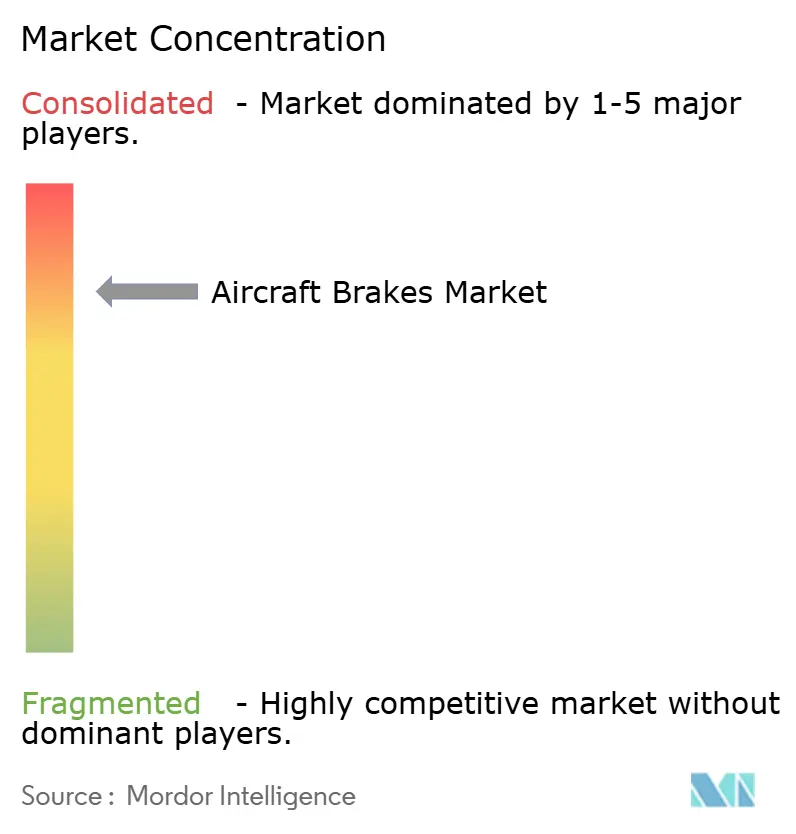
Five integrated groups—Safran, Collins Aerospace, Honeywell International Inc., Crane Aerospace & Electronics, and Meggitt PLC—collectively command a majority share, underpinned by technology portfolios, established FAA/EASA approvals, and dense global service networks. Safran’s planned French carbon-brake plant and its USD 1.8 billion actuation acquisition underscore a strategy of deep vertical integration from design to aftermarket. Collins Aerospace is countering through capacity expansions and pioneering environmentally friendly carbon-stack chemistries that remove heavy metals.
Tier-2 suppliers face squeezed line-fit prospects but are carving niches in PMA and regional-aircraft programs. Rapco Fleet Support scaled carbon PMA offerings, while C&L Aero bundled PMA discs into Saab 340 overhauls, highlighting an aftermarket pivot. Digital twin initiatives are another battleground; proprietary algorithms predict heat-soak cycles and disc wear, letting airlines defer changes without safety compromise, a service differentiator that OEMs monetize through subscription models.
Electric-brake ecosystems attract new entrants from power electronics and software backgrounds. Start-ups collaborating with eVTOL OEMs are formulating lightweight electromechanical actuators rated for thousands of high-frequency landings. However, steep certification costs and protracted development timelines favor incumbents with existing DER staff and DER-approved test rigs, slowing disruptive threats.
Aircraft Brakes Industry Leaders
-
Honeywell International Inc.
-
Meggitt Ltd. (Parker-Hannifin Corporation)
-
Crane Aerospace & Electronics (Crane Company)
-
Collins Aerospace (RTX Corporation)
-
Safran SA
- *Disclaimer: Major Players sorted in no particular order
Aircraft Brakes Market Companies Covered in this Report
- Safran SA
- Collins Aerospace (RTX Corporation)
- Honeywell International Inc.
- Crane Aerospace & Electronics (Crane Company)
- Meggitt Ltd. (Parker-Hannifin Corporation)
- BERINGER AERO
- Advent Aircraft Systems, Inc.
- Tactair (Young & Franklin Inc.)
- Matco Aircraft Landing Systems
- Rapco Fleet Support, Inc.
- CFC CARBON CO., LTD.
- AMETEK MRO (AMETEK, Inc.)
- Grove Aircraft Landing Gear Systems Inc.
- TAE Aerospace
- SGL Carbon SE
- Carlyle Johnson Machine Co., LLC
Market Opportunities and Future Outlook
White-space is visible where operators and OEMs look for brake system architectures that reduce hydraulic complexity and improve maintainability, while still meeting tightening certification documentation and traceability requirements for advanced materials. More-electric aircraft programs and the move toward electro-mechanical and electric carbon brake configurations also create room for suppliers that can integrate actuation electronics, anti-skid control, and health monitoring into certified braking packages, particularly for high-cycle narrowbody applications and emerging advanced air mobility use cases.
Capacity and service-network expansion are also actionable opportunity areas, anchored in completed investments and named fleet wins. In August 2024, Collins Aerospace (RTX) broke ground on a USD 200 million expansion of its Spokane carbon/carbon brake facility, targeting higher C/C brake output to help relieve backlog pressure. In November 2025, Safran Landing Systems secured a long-term agreement to supply wheels and electric carbon brakes for Riyadh Airs fleet of more than 70 Boeing 787-9 aircraft, reinforcing demand for electric carbon brake offerings on new widebody deliveries. In the aftermarket, long-term maintenance contracting and MRO capability build-outs, including Safrans 2026 widebody MRO expansions, point to near-term whitespace for regional stocking, faster repair turn times, and certified remanufacturing of heat sinks and carbon stacks where supply chain lead times remain elevated.
Recent Industry Developments in Aircraft Brakes Market
- May 2026: Crane Aerospace and Electronics announced it is supplying a brake control system solution for Northrop Grummans YFQ-48A Talon Blue autonomous aircraft following taxi testing conducted on May 14, 2026. The program association links brake control development to next-generation military autonomy platforms, raising the importance of modular, safety-assessed control architectures and ruggedized electronics in braking system competitions.
- November 2025: Safran Landing Systems signed a long-term agreement to supply wheels and electric carbon brakes for Riyadh Airs fleet of more than 70 Boeing 787-9 aircraft. The selection strengthens electric carbon brake penetration on new widebody deliveries and supports multi-year aftermarket pull-through tied to a large, single-airline fleet commitment.
- June 2024: Avianca chose RTXs Collins Aerospace for wheel and brake solutions. The airline-level selection expands Collins Aerospace installed base in commercial operations, supporting follow-on spares and MRO demand as fleets cycle through scheduled brake overhauls.
Aircraft Brakes Market Report Scope and Research Methodology
Market Definition and Coverage
For this study, the aircraft brakes market is defined as the revenue generated from brake equipment used on aircraft to slow down, stop, and maintain control during landing, taxiing, and rejected takeoff events, counted across global demand.
Scope exclusions: Excluded from this market are aircraft wheels and tires, since these are treated as separate landing-gear consumables even when bundled in braking-system discussions.
Segments Covered in This Report
- By Product Type
- Carbon Brakes
- Steel Brakes
- Carbon-Ceramic/CMC Brakes
- By Actuation Technology
- Conventional Hydraulic
- Electro-Hydraulic
- Fully Electric/Brake-by-Wire
- Integrated Self-Powered Systems
- By Aircraft Class
- Commercial
- Narrowbody
- Widebody
- Regional Jets
- Military
- Combat
- Transport
- Special Mission
- Military Helicopters
- General Aviation
- Business Jets
- Commercial Helicopters
- Commercial
- By End User
- Linefit
- Retrofit
- By Geography
- North America
- United States
- Canada
- Mexico
- Europe
- United Kingdom
- France
- Germany
- Italy
- Spain
- Rest of Europe
- Asia-Pacific
- China
- India
- Japan
- South Korea
- Australia
- Rest of Asia-Pacific
- South America
- Brazil
- Rest of South America
- Middle East and Africa
- Middle East
- United Arab Emirates
- Saudi Arabia
- Rest of Middle East
- Africa
- South Africa
- Rest of Africa
- Middle East
- North America
Data Sources, Market Sizing, and Validation
Desk Research
Desk research helped us build the starting structure for demand, supply, and pricing signals before any interviews were run. We relied on public aviation and trade references such as FAA and EASA airworthiness and safety publications, ICAO traffic indicators, IATA fleet and traffic summaries, and OEM delivery backlogs and monthly order updates.
To tighten the numbers, we also reviewed sources such as aircraft and engine certification databases, aviation accident and incident summaries that reference braking performance and anti-skid functions, and customs trade statistics for relevant brake materials and components where classification allowed. Company filings, investor presentations, and trusted aerospace press were used to cross-check product mix shifts (for example, carbon versus steel adoption) and aftermarket intensity. A few paid subscriptions were used only for aircraft fleet and deliveries, import and export shipment-level signals, and patent activity checks tied to braking actuation and control logic. The desk sources listed above are illustrative, and many other public references were used for validation and clarification.
Primary Interviews and Surveys
Primary work was used to confirm what is actually shipped and replaced in the field, and what average selling prices look like across aircraft types and regions. We spoke with a mix of brake component makers, MRO organizations, airline and military maintenance teams, and distribution partners, and then used these inputs to pressure-test assumptions by region (APAC, EMEA, and the Americas) and by linefit versus retrofit demand.
Distribution of primary research fieldwork respondents
| Company type | Respondent position | Region |
|---|---|---|
| Top tier: 36% | CXOs: 12% | APAC: 49% |
| Mid tier: 42% | Functional/Unit leaders: 39% | EMEA: 31% |
| Smaller Players: 22% | Managers: 49% | Americas: 20% |
Market-Sizing & Forecasting
Sizing starts from a top-down demand pool that is rebuilt using aircraft production and deliveries, active fleet by platform, and expected landing cycles that drive wear and replacement needs. Once that pool is shaped, results are corroborated with selective bottom-up approximations such as sampled program-level brake shipset values, typical replacement intervals from operators, and channel checks on aftermarket order patterns, which are then used to adjust totals where gaps appear.
Key model inputs include global aircraft deliveries by category, fleet in service and utilization (landings per aircraft per year), replacement and overhaul intervals for brake stacks, average shipset content per aircraft, and observed ASP movement for carbon versus steel assemblies as programs mature. For forecasting, scenario analysis is used because deliveries, utilization, and defense budgets can shift quickly, and the scenarios are anchored to consensus expectations gathered in interviews. Where program or region visibility is thin, we fill gaps with comparable-platform ratios and then re-check the implied spend against utilization and maintenance cadence to keep the total realistic.
Data Validation & Update Cycle
Outputs are checked against independent signals like fleet growth, aircraft delivery timing, and the implied aftermarket spend per landing cycle, and then mismatches are reviewed before sign-off. We also run variance checks by region and by linefit versus retrofit so that one fast-growing pocket does not inflate the full market unintentionally.
Before finalizing, assumptions that drive the total most, such as replacement intervals and ASP progression, are reviewed by another analyst and are re-tested when new aircraft order changes or maintenance advisories emerge. Reports are refreshed annually, and interim updates are triggered when material events occur, such as major delivery schedule resets or sharp utilization shifts. Right before delivery, an analyst performs a fresh pass so clients receive the latest updated view.
Mordor Intelligence's Global Aircraft Brakes Market Market Size Measured Against Other Published Estimates
Published market numbers for aircraft brakes can vary even when the topic looks identical, because each publisher draws the product boundary differently and does not always treat aftermarket demand in the same way. Differences also show up when the base year is not aligned, when currency conversion timing is inconsistent, and when forecasts assume either faster fleet utilization recovery or a more cautious replacement cycle.
Aircraft wheels and wheel assemblies sit outside Mordor Intelligence's scope for this market, and that alone can shift totals for sources that package wheels, valves, and other braking-system elements into one combined figure. In addition, some estimates lean heavily on OEM delivery growth without re-checking brake replacement cadence against landing cycles, which can pull the model away from real maintenance-driven demand in the aftermarket.
Benchmark comparison
| Source | Market Size | Gaps in Research Methodology |
|---|---|---|
| Mordor Intelligence | USD 9.32 B (2025) | |
| Global Consultancy A | USD 7.33 B (2025) | This figure is presented for a broader braking-system build that can include wheels, actuators, valves, and other components, which changes what is counted as core brake revenue. It also runs longer-term forecasts where utilization and replacement timing may be smoothed, reducing near-term aftermarket sensitivity. |
| Industry Research Firm B | USD 9.10 B (2024) | The base year differs, and the scope presentation is more limited on what is included beyond brake types, which can lead to mismatches in how retrofit demand and control-support elements are handled. A higher stated growth rate suggests more aggressive delivery and utilization assumptions through the forecast window. |
Looking across the table, the spread is mainly explained by what is bundled into the braking value chain and how the aftermarket replacement rhythm is translated into annual spend. By keeping the count tied to brake equipment demand drivers like fleet utilization and replacement intervals, the estimate stays traceable to clear variables that can be re-checked as new delivery and traffic signals come in.
Key Questions Answered in the Report
What is the current value of the aircraft brakes market?
The aircraft brakes market was valued at USD 9.8 billion in 2026 and is projected to reach USD 12.56 billion by 2031, progressing at a 5.11% CAGR.
Which brake material dominates commercial fleets today?
Carbon brakes lead with 64.92% share owing to weight savings and extended service life.
Why are brake-by-wire systems gaining attention?
They fit more-electric aircraft architectures, cut hydraulic complexity, and enable real-time health monitoring.
Which region is expanding the fastest?
Asia-Pacific is forecasted to grow at a 6.72% CAGR through 2031 on the back of large narrowbody orders.
How do PMA parts affect brake procurement?
PMA-approved discs and linings give operators certified, lower-cost alternatives to OEM components.