
Market Overview
| Study Period | 2020 - 2031 |
|---|---|
| Forecast Data Period | 2026 - 2031 |
| Base Year Market Size (2025) | USD 14.25 Billion |
| Market Size (2026) | USD 14.84 Billion |
| Market Size (2031) | USD 18.19 Billion |
| Growth Rate (2026 - 2031) | 4.15 % |
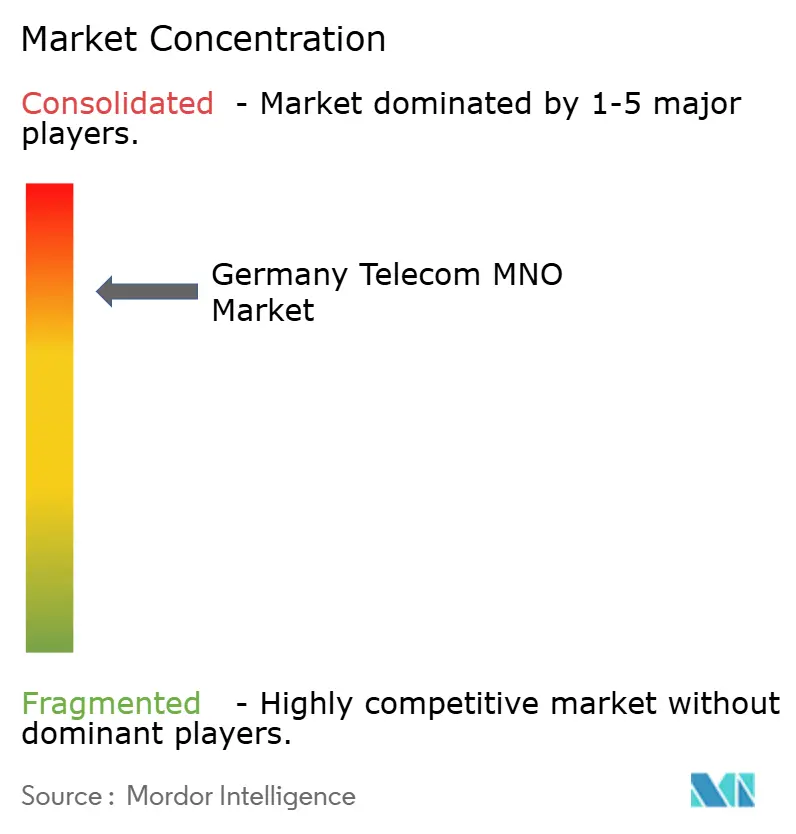
| Market Concentration | High |
Major Players *Disclaimer: Major Players sorted in no particular order Image © Mordor Intelligence. Reuse requires attribution under CC BY 4.0. | |
Germany Telecom MNO Market Analysis by Mordor Intelligence
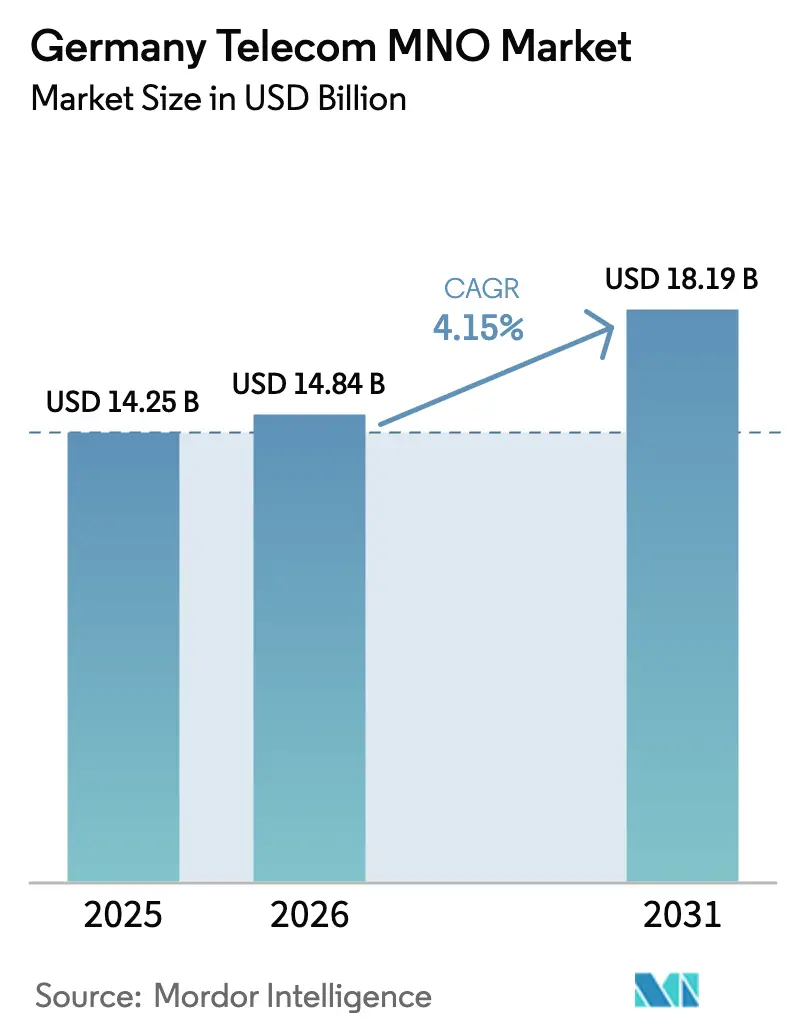
The Germany Telecom MNO Market size was valued at USD 14.25 billion in 2025 and estimated to grow from USD 14.84 billion in 2026 to reach USD 18.19 billion by 2031, at a CAGR of 4.15% during the forecast period (2026-2031).
Network-modernization investments approaching EUR 50 billion through 2030, the federal Gigabit Strategy, and swift 5G standalone roll-outs are sustaining momentum even as economic growth moderates. Operators are prioritizing fiber-to-the-home coverage, fixed–mobile convergence bundles, and AI-enabled network automation to strengthen average revenue per user (ARPU) and cut operating costs. Enterprise digitalization, particularly in manufacturing and automotive clusters, is accelerating premium connectivity demand, while consumer data traffic keeps climbing on the back of streaming. Regulatory pressure, including stringent energy-efficiency rules and spectrum-coverage obligations, is reshaping capital-allocation priorities and nudging smaller players toward partnership or exit.
Key Report Takeaways
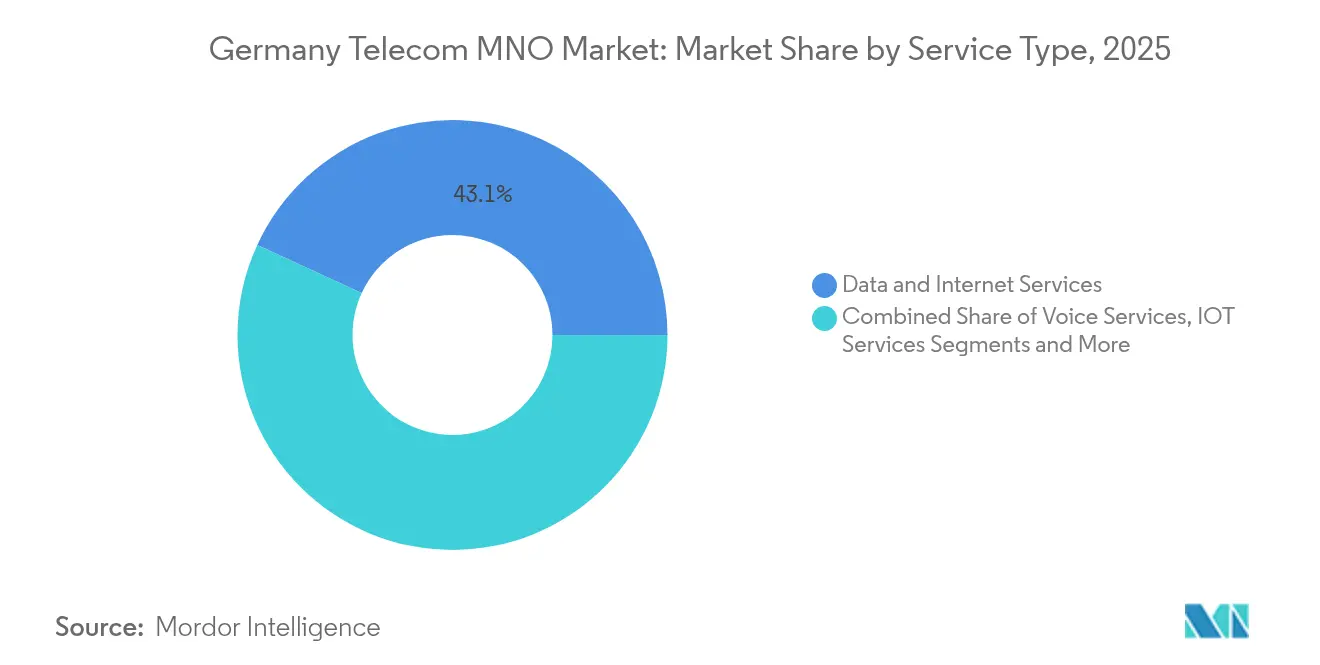
- By service type, Data and Internet Services captured 43.12% of German telecom market share in 2025.
- By end-user, enterprise services are projected to grow at a 4.62% CAGR between 2025 and 2031, outpacing consumer growth.
Note: Market size and forecast figures in this report are generated using Mordor Intelligence’s proprietary estimation framework, updated with the latest available data and insights as of 2026.
Germany Telecom MNO Market Trends and Insights
Drivers Impact Analysis*
| Driver | (~) % Impact on CAGR Forecast | Geographic Relevance | Impact Timeline |
|---|---|---|---|
| Surging FTTH build-out and government gigabit targets | +1.2% | National, early urban gains | Medium term (2-4 years) |
| Rapid 5G standalone roll-outs powering eMBB demand | +0.9% | National, industrial regions | Short term (≤ 2 years) |
| Enterprise digitalization and campus-network uptake | +0.7% | Manufacturing hubs nationwide | Medium term (2-4 years) |
| Fixed–mobile convergence bundles boosting ARPU | +0.5% | National | Short term (≤ 2 years) |
| AI-based network automation cutting OPEX | +0.4% | National | Long term (≥ 4 years) |
| Rising spectrum-sharing and neutral-host models | +0.3% | Industrial zones | Long term (≥ 4 years) |
| Source: Mordor Intelligence | |||


Surging FTTH Build-out and Government Gigabit Targets
Germany’s Gigabit Strategy requires 50% of premises to be fiber-connected by 2025 and near-universal coverage by 2030, spurring aggressive capital programs.[1]Federal Ministry for Digital and Transport, “Gigabit Strategy of the Federal Government,” bmvi.de EUR 3 billion in federal Gigabitförderung 2.0 subsidies accelerates builds in underserved districts, while Deutsche Telekom aims for 10 million additional fiber lines by 2030 and Vodafone leverages Unitymedia assets to pass 25 million homes. Operators with deeper fiber footprints command higher ARPU through multi-play bundles and premium enterprise links. Early deployments create temporary market fragmentation favoring fiber-rich localities, yet nationwide roll-out remains a prerequisite for long-term competitiveness. Successful execution directly lifts German telecom market revenue trajectories by expanding capacity for data-heavy services.
Rapid 5G SA Roll-outs Powering eMBB Demand
All three national carriers met initial 99% coverage targets by 2024, and Deutsche Telekom plans 99% population reach in 2025.[2]Light Reading, “Germany achieves 100 Mbit/s everywhere all the time,” lightreading.com Standalone architecture unlocks low-latency network slicing crucial for manufacturing and automotive campuses at BMW, Mercedes-Benz, and Volkswagen sites. Consumers are also driving revenue uplift as mobile data usage rose 30-34% year-over-year across operators, monetized via larger allowances and unlimited plans. Operators gain efficiency from retiring legacy cores and converging frequency layers, which lowers per-gigabyte costs while improving user experience. Early 5G SA adopters therefore secure durable competitive advantages and stimulate incremental German telecom market growth.
Enterprise Digitalization and Campus-Network Uptake
The industrial IoT economy doubled to EUR 16.8 billion between 2017 and 2022, with automotive IoT expanding more than 20% annually as factories embed sensor networks and connected-car platforms. Private 5G campus solutions offer guaranteed throughput and security, letting operators charge premium fees. Vodafone earmarked EUR 250 million for B2B cloud telephony and unified communications, while Deutsche Telekom’s campus networks at BMW, Mercedes-Benz, and Tesla illustrate willingness to pay for mission-critical connectivity. Small and midsize enterprises are also shifting toward cloud-based collaboration, though price sensitivity caps premium uptake. Nonetheless, enterprise contracts underpin higher-margin segments and reinforce the German telecom market’s enterprise-led expansion trajectory.
Fixed–Mobile Convergence Bundles Boosting ARPU
Bundled offers integrating broadband, mobile, and entertainment are central to churn reduction. The July 2024 law abolishing landlord-collected cable fees compelled providers to compete directly for 12 million households, intensifying the need for sticky convergent propositions. Deutsche Telekom, O2, Vodafone, and Sky now promote discount structures and unified billing that elevate household ARPU and lower acquisition costs. Cross-selling opportunities arise as subscribers migrate from single-service to triple-or quad-play bundles, mitigating price pressure in standalone segments. The strategy’s success, however, hinges on seamless service integration and transparent pricing perceived as valuable by price-conscious consumers.
Restraints Impact Analysis*
| Restraint | (~ ) % Impact on CAGR Forecast | Geographic Relevance | Impact Timeline |
|---|---|---|---|
| MDU cable-TV law slashing fixed revenue | −0.8% | Urban rental markets | Short term (≤ 2 years) |
| Stringent energy-efficiency rules raising capex | −0.4% | National | Medium term (2-4 years) |
| High fiber & 5G capex burden on challengers | −0.3% | National, smaller operators | Medium term (2-4 years) |
| OTT voice migration eroding legacy revenues | −0.2% | National | Long term (≥ 4 years) |
| Source: Mordor Intelligence | |||
MDU Cable-TV Law Slashing Fixed Revenue
The July 2024 repeal of the Nebenkostenprivileg removed automatic inclusion of cable TV in rental bills, exposing Vodafone’s MDU subscriber base to direct competition and slashing the cohort from 8.5 million to 4 million accounts.[3]Telecoms, “Germany Takes the Shine off Vodafone’s Otherwise Solid First Half,” telecoms.com An estimated EUR 800 million in annual revenue is at risk sector-wide, with Tele Columbus losing 40% of TV customers in mere months. Streaming platforms such as Netflix, Amazon Prime, Waipu, and Zattoo now vie for the same households without bearing network costs, intensifying price pressure. Operators must reposition TV within convergent bundles to defend share, yet short-term churn spikes and EBITDA compression remain likely.
Stringent Energy-Efficiency Rules Raising Capex
European sustainability directives mandate measurable reductions in network power consumption, compelling operators to invest in renewable sourcing, liquid-cooling radio units, and advanced energy-management software. These outlays push per-site 5G deployment costs higher just as competitive intensity rises, squeezing free cash flow. Smaller carriers lack the scale economics to spread environmental-compliance spend, nudging them toward infrastructure-sharing or consolidation. While green credentials can enhance brand appeal, the near-term capital burden restrains German telecom market expansion capacity by diverting funds from revenue-generating projects.
*Our forecasts treat driver/restraint impacts as directional, not additive. The impact forecasts reflect baseline growth, mix effects, and variable interactions.
Segment Analysis
By Service Type: Data Services Lead Market Evolution
Data and Internet Services delivered USD 6.15 billion in 2025, 43.12% of the German telecom market share, and are CAGR-forecast at 4.33% through 2031 on buoyant video streaming and enterprise cloud connectivity. Operators documented mobile data surges-Vodafone 34% to 1.8 billion GB, Deutsche Telekom 30% to 2.4 billion GB, and O2 beyond 3 billion GB-while fixed consumption surpassed 121 billion GB with average household loads of 275 GB monthly. 5G standalone and fiber upgrades underpin differentiated service tiers that fetch premium pricing from industrial users seeking network-slice guarantees. Consequently, German telecom market size gains at the segment level will continue to eclipse legacy categories.
Voice Services still produced USD 3.91 billion (27.45% share) in 2025, but OTT migration and planned 2G shutdowns by 2028 portend gradual contraction. Telefónica Deutschland already routes 80% of calls via VoLTE, and both Deutsche Telekom and Vodafone are reallocating spectrum to 5G. IoT and M2M Services, worth USD 1.36 billion in 2025, exhibit the fastest 4.45% CAGR, reflecting Germany’s leadership in connected-factory and automotive telematics. Pay-TV and other value-added services face direct streaming competition, yet roaming and wholesale traffic are recovering alongside international travel. As data-centric products outpace voice, overall portfolio mix shifts toward higher-growth, margin-accretive categories.


By End-user: Enterprise Segment Drives Premium Growth
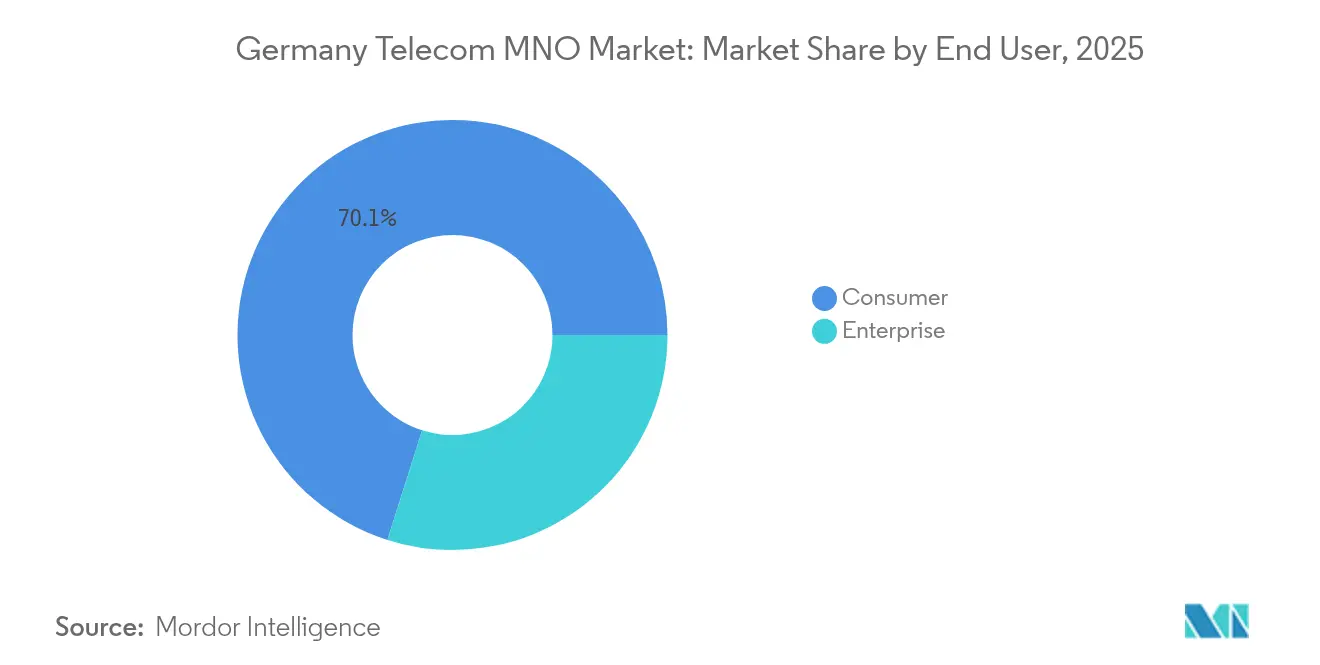
Enterprise accounts generated USD 4.26 billion in 2025, equivalent to 29.90% of the German telecom market, and are set to widen to USD 5.59 billion by 2031 at a 4.62% CAGR. Private 5G networks and industrial IoT projects in automotive and machinery verticals confer pricing power because latency guarantees and security assurances are mission critical. The German telecom market size for campus-network contracts is enlarging as manufacturers digitize production lines and autonomous-vehicle testing zones. Vodafone’s EUR 250 million B2B fund and Deutsche Telekom’s multi-plant deals highlight operator focus on value-rich accounts that dampen volatility. Aggressive cloud-telephony uptake among SMEs adds incremental layers, though average revenue per line remains below large-enterprise benchmarks.
Consumer services retained USD 9.99 billion in 2025, 70.10% of the German telecom market. Data traffic climbed 30-34% year-over-year across major networks, yet intense price rivalry tempered ARPU lift. Regulatory changes, including the cable-TV billing shift, eroded legacy fixed revenue streams, forcing providers to cross-sell mobile and entertainment bundles. Future growth depends on widespread adoption of fixed–mobile convergence, premium 5G data plans, and differentiated content partnerships. While overall consumer uptake underpins volume, margin recovery will rely on disciplined pricing and loyalty-driven initiatives that limit churn.
Regulatory Landscape
Germany's mobile network operators operate under the Telecommunications Act (TKG 2021), with sector oversight from Bundesnetzagentur (BNetzA). Policy direction continues to be shaped by the federal Gigabit Strategy and subsidy mechanisms for underserved areas. In January 2026, BNetzA published a regulatory approach for copper-to-fibre migration, outlining a more rule-based process for copper switch-off and migration management that affects incumbent fixed-network economics and the timing of fibre-led fixed-mobile convergence offers.
In 2026, security and enforcement requirements tightened further. NIS2 implementation steps require relevant operators to register activities with the Federal Office for Information Security (BSI) by March 6, 2026, and BNetzA has been developing more granular, risk-based security obligations for telecom providers. Separately, the TKG was amended on May 12, 2026, aligning national rules with EU Roaming Regulation (EU) 2022/612 and strengthening BNetzA enforcement powers, reinforcing compliance-driven investment priorities alongside spectrum and coverage obligations.
Competitive Landscape
Germany’s nationwide regulatory framework drives homogeneous baseline coverage, yet regional disparities in fiber density and industrial concentration create revenue pockets. Southern states such as Bavaria and Baden-Württemberg host dense automotive and machinery clusters where enterprise campus-network demand is strongest, supporting above-average ARPU for Deutsche Telekom and O2. Northern federal states lag in FTTH penetration, steering operators to prioritize subsidy-backed rural builds that bolster long-term German telecom market size expansion while tempering near-term margins. Urban centers like Berlin, Hamburg, and Munich already record gigabit-class fixed availability above 80%, enabling early 5G SA monetization through bundled plans and premium entertainment.
Rural broadband gaps are narrowing as the Gigabitförderung 2.0 program subsidizes unserved communities. Open-access fiber builders partner with incumbent operators under wholesale-only models, widening reach without duplicating investment. While subsidy frameworks reduce capital intensity, execution complexity lengthens deployment timelines, requiring robust project-management capabilities. Consequently, regional roll-out speed influences competitive dynamics: first movers can lock in high-value residential contracts, whereas laggards face price compression.
Cross-border traffic with Austria, the Netherlands, and Poland is rising as roaming returns to pre-pandemic levels, lifting wholesale revenues. Edge-data-center initiatives around Frankfurt’s internet hubs accelerate low-latency application adoption, reinforcing Germany’s role as continental connectivity nexus. Yet energy-cost differentials across Länder influence siting of network infrastructure, with renewable-rich locales attracting new deployments. Aggregate geography-specific factors collectively steer investment sequencing, shaping overall German telecom market performance.
Germany Telecom MNO Industry Leaders
Deutsche Telekom AG
Vodafone GmbH
O2 Telefonica Germany GmbH & Co. OHG
1&1 AG
- *Disclaimer: Major Players sorted in no particular order

Market Opportunities and Future Outlook
Copper-to-fibre migration rules and gigabit policy execution create room for wholesale-led fibre participation models that let MNOs scale fixed coverage without fully replicating civil works. This is visible in Deutsche Telekom's long-term bitstream purchasing agreements with regional operators e.discom and Wemacom (announced May 2026), which support faster addressability for converged bundles and enterprise access, particularly outside the highest-density urban areas.
Enterprise connectivity and resilience use cases are also moving beyond classic mobile broadband into private-network adjacent offerings (industrial IoT, managed connectivity, and redundancy). Operators can package SLAs, security controls, and multi-access options around these requirements. Telefónica Deutschland's July 2026 partnership with Unsere Grüne Glasfaser (UGG) for Fibre-to-the-Site (FTTS) connectivity, and its July 2026 launch with Crout of a resilient connectivity solution for critical industrial processes, reflect ongoing commercial activity around fibre-backed enterprise sites and mission-critical IoT connectivity. At the same time, industry associations such as VATM and DIALOG CONSULT pointed to continued capex commitments into 2026 for fibre and mobile expansion, reinforcing that investment-led competition and open-access or wholesale constructs remain key levers for differentiation as the market works through the post-2024 cable-TV billing reform and higher security and energy-efficiency compliance demands.
Recent Industry Developments
- July 2026: For critical industry processes and applications, Telefonica Deutschland and Crout launch Resilient Connectivity Solution CoreSIM. The launch targets converged connectivity for industrial IoT and strengthens enterprise connectivity offerings and IoT applicability in Germany.
- June 2026: Mobile phone network via satellite testing of digitally sovereign satellite-mobile communications with OQ Technology. The testing explores alternate backhaul and coverage options, expanding network resiliency and coverage options beyond traditional terrestrial networks.
- June 2026: Expansion update: 4500 network expansion projects implemented in H1 2026. The update signals aggressive capacity and coverage growth supporting bundled mobile and fixed offerings.


Research Methodology Framework and Report Scope
Market Definition and Coverage
This market covers telecom operator revenue generated in Germany from providing connectivity and related telecom services to consumers and enterprises, across fixed and mobile access. It reflects the service spending that customers pay to operators, expressed in nominal terms for each year.
Scope exclusions: We exclude sales of handsets and standalone network equipment, as well as non-telecom digital services that sit outside operator telecom service billing.
Segmentation Overview
- Overall Telecom Revenue and ARPU
- Service Type
- Voice Services
- Data and Internet Services
- Messaging Services
- IoT and M2M Services
- OTT and PayTV Services
- Other Service Types (VAS, Roaming And International Services, Enterprise And Wholesale Services, etc.)
- End-user
- Enterprises
- Consumer
Data Sources, Market Sizing, and Validation
Desk Research
Desk research was used to define the boundary of telecom revenue in Germany and to compile anchor metrics for time series. Public sources such as the Bundesnetzagentur annual telecommunications report, Germany and EU statistical releases (for example, Eurostat and Destatis), and OECD broadband and mobile indicators helped us align terminology and keep definitions consistent over time.
We also reviewed operator annual reports and investor presentations for service revenue splits and key operating stats. Where available, we referenced regulator spectrum and coverage publications and trade association releases (such as VATM and Bitkom) to cross-check external market views. Patent databases were used selectively to sanity check timing of technology shifts that typically influence network investment cycles and service mix. This list is illustrative, and we referenced additional sources to collect data points, validate assumptions, and close gaps during research.
Primary Interviews and Surveys
Primary work focused on confirming which revenue lines count as telecom services versus adjacent items, and then validating the main drivers that move ARPU and the subscriber mix year to year. We spoke with operator-side leaders, wholesale and enterprise connectivity specialists, and industry experts across Germany to pressure test assumptions on pricing, churn, bundle migration, and the timing of fiber and 5G adoption.
Distribution of primary research fieldwork respondents
| Company type | Respondent position |
|---|---|
| Top tier: 26% | CXOs: 13% |
| Mid tier: 56% | Functional/Unit leaders: 41% |
| Smaller Players: 18% | Managers: 46% |
Market-Sizing & Forecasting
The market model starts from a top-down build that reconstructs operator service revenue for Germany using regulator and industry totals, then it is split into practical service buckets based on observed mix indicators. To keep the approach grounded, we corroborate totals with selective bottom-up checks, such as sampled operator revenue disclosures, subscriber base movements, and a simple ASP (ARPU) x connection volume logic for fixed broadband and mobile SIMs.
Key inputs that influenced the sizing and forecast included active SIM profiles, fixed broadband connections by access type (DSL, HFC, FTTH/FTTB), fiber homes passed and take-up, usage growth that typically supports tier upgrades, and investment levels that can indicate rollout pace and capacity. Where bottom-up approximations had gaps, we bridged them using conservative mix shares derived from multiple interviews, then tested the resulting splits against the official market totals before acceptance.
Forecasts were produced using scenario analysis supported by short-cycle trend indicators, and then aligned with expert consensus on likely pricing behavior, bundle migration, and adoption curves for fiber and 5G. This keeps the forward view explainable, since each step links back to observable demand and network signals.
Data Validation & Update Cycle
Validation was done through triangulation across independent signals, followed by focused variance checks at both the service level and total market level. If the model output disagreed with regulator totals, operator disclosures, or stable ratios such as revenue per connection, we rechecked the drivers and recontacted experts to resolve the mismatch.
Before sign-off, the work goes through a multi-step analyst review so assumptions, conversions, and growth logic remain consistent and traceable. Reports are refreshed annually, and interim updates are triggered when material events occur, such as major pricing resets, regulatory changes, or step changes in rollout pace. Right before delivery, a final analyst pass is completed so clients receive the most recent updated view.
Mordor Intelligence's Germany Telecom Market Size Measured Against Other Published Estimates
Published telecom market values for Germany can differ widely because groups do not always count the same revenue streams, and because they select different anchor years and conversion timing. Variance also appears when one estimate is services-only while another blends devices, distribution, or broader ICT spending.
By tracking service revenue boundaries and refresh cadence, Mordor Intelligence keeps the model aligned to operator telecom service billing in Germany and avoids including handset and non-operator digital revenue in the same total, which is a common driver of spread across publications.
Benchmark comparison
| Source | Market Size | Gaps in Research Methodology |
|---|---|---|
| Mordor Intelligence | USD 14.25 B (2025) | |
| National Regulator A | USD 66.00 B (2024) | Uses external revenue for the full telecommunications market and is not limited to an MNO scoped view, so fixed, mobile, and other revenue categories can sit together in one aggregate. The year and currency basis also differ, which adds conversion and timing variance. |
| Industry Association B | USD 65.70 B (2025) | Covers the broader telecommunications services market and may include adjacent operator sold items (such as content and distribution related revenue) that expand the total beyond mobile operator revenue. Estimates are presented as external sales, so the inclusion set and reporting cut can differ from a tighter operator service revenue boundary. |
The table mainly shows a scope gap rather than a simple math gap, since wider telecom services totals are naturally much larger than an MNO-focused sizing. When the same boundary is applied consistently, and inputs like connections, SIMs, and ARPU direction are used to cross-check totals, the resulting number is easier to replicate and update year after year.


Key Questions Answered in the Report
What impact did the 2024 cable-TV billing reform have?
The law cut automatic landlord billing for 12 million flats, halving Vodafone’s MDU TV base and putting roughly EUR 800 million of annual revenue at risk.
Why are enterprises critical for German operators?
Enterprises pay premium rates for private 5G and IoT connectivity, driving a 4.62% CAGR that outpaces the consumer segment.
How are operators managing 5G deployment costs?
Carriers are adopting tower carve-outs, network-sharing, and AI-based automation to balance capital intensity with efficiency gains.
What is the outlook for fiber investment?
Operators plan nearly EUR 50 billion in cumulative fiber upgrades through 2031 under the federal Gigabit Strategy, aiming for nationwide gigabit access.
Page last updated on:


 Your data is secure and never sold or shared.


