Market Overview
| Study Period | 2020 - 2031 |
|---|---|
| Forecast Data Period | 2026 - 2031 |
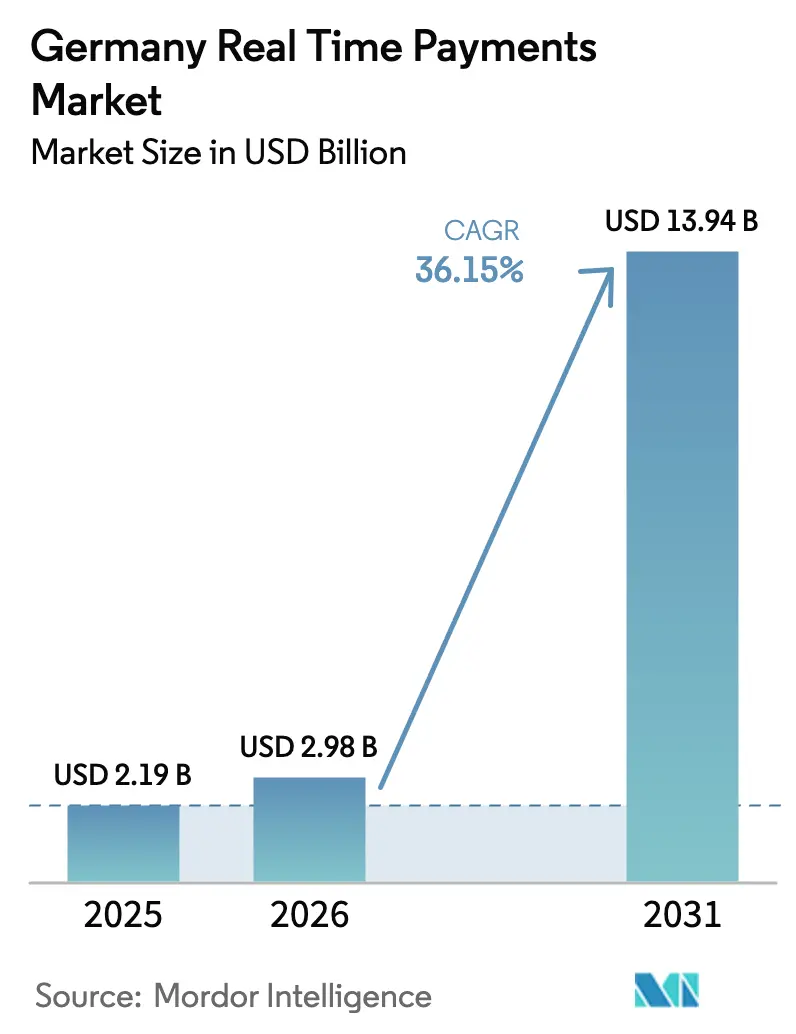
| Base Year Market Size (2025) | USD 2.19 Billion |
| Market Size (2026) | USD 2.98 Billion |
| Market Size (2031) | USD 13.94 Billion |
| Growth Rate (2026 - 2031) | 36.15% CAGR |
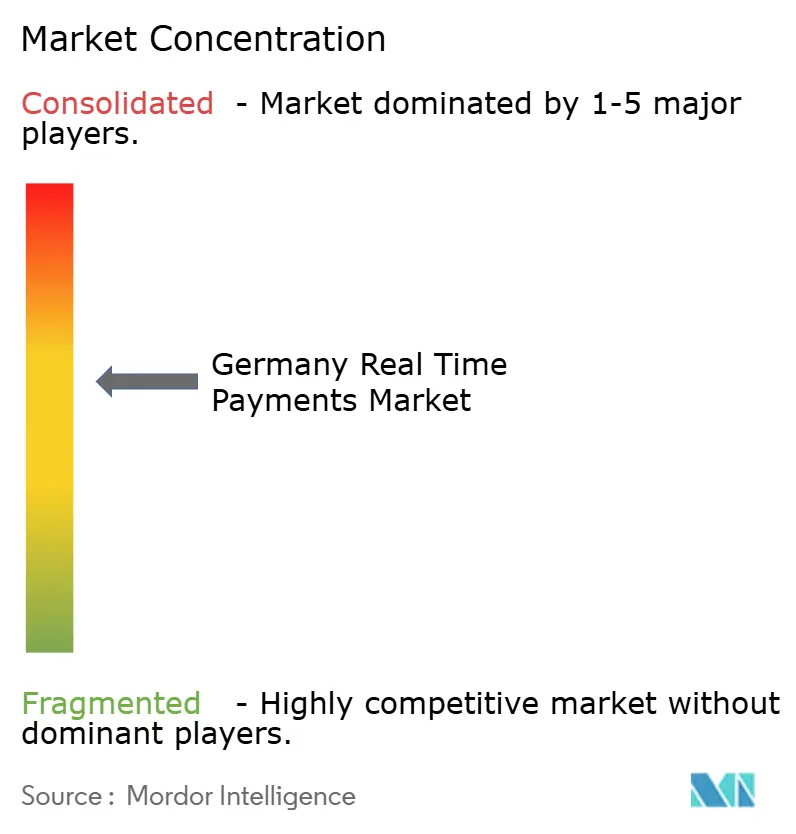
| Market Concentration | Medium |
Major Players *Disclaimer: Major Players sorted in no particular order Image © Mordor Intelligence. Reuse requires attribution under CC BY 4.0. | |
Germany Real Time Payments Market Analysis by Mordor Intelligence
The Germany real time payments market size is expected to grow from USD 2.19 billion in 2025 to USD 2.98 billion in 2026 and is forecast to reach USD 13.94 billion by 2031 at 36.15% CAGR over 2026-2031. The growth trajectory reflects the European Union’s Instant Payments Regulation, which compels every payment service provider to process incoming funds in 10 seconds by January 2025 and outgoing funds by October 2025.[1]European Central Bank, “Instant Payments Regulation,” European Central Bank, ecb.europa.eu. Price-parity rules remove fee barriers, while higher SEPA Instant Credit Transfer limits up to EUR 100,000 (USD 110,000) unlock high-value B2B flows.[2]European Payments Council, “2025 SEPA Rulebook Updates,” European Payments Council, europeanpaymentscouncil.eu. Large banks accelerate ISO 20022 migration, enabling richer data exchange and smoother interoperability, whereas fintechs deploy buy-now-pay-instantly models to tap retail demand. These combined forces are steering Germany real time payments market toward value-added services focused on liquidity, cash-flow visibility, and contextual checkout conversion.
Key Report Takeaways
- By transaction type: Peer-to-Peer transfers held 59.20% of Germany real time payments market share in 2025, while Peer-to-Business transactions are forecast to post a 38.71% CAGR through 2031.
- By component: Platforms/Solutions controlled 67.40% revenue in 2025; Services are set to grow at 32.37% CAGR to 2031.
- By deployment mode: On-premise captured 67.10% of Germany real time payments market size in 2025, yet cloud implementation is expected to log a 33.84% CAGR during 2026–2031.
- By enterprise size: Large enterprises contributed 64.30% revenue in 2025; SMEs will advance fastest at 30.69% CAGR.
- By end-user industry: Retail & e-commerce commanded 33.40% share of Germany real time payments market size in 2025, while Government & Public Sector is projected to accelerate at 35.60% CAGR to 2031.
Note: Market size and forecast figures in this report are generated using Mordor Intelligence’s proprietary estimation framework, updated with the latest available data and insights as of 2026.
Germany Real Time Payments Market Trends and Insights
Drivers Impact Analysis*
| Driver | (~) % Impact on CAGR Forecast | Geographic Relevance | Impact Timeline |
|---|---|---|---|
| SEPA Instant Credit Transfer (SCT Inst) limit increase to USD 110 k stimulating high-value B2B flows | +9.3% | EU-wide, with strong impact in Germany | Medium term (2-4 years) |
| Federal e-invoicing mandate (2025) accelerating instant settlement for corporates | +8.7% | Germany, with potential spillover to other EU markets | Short term (≤ 2 years) |
| Request-to-Pay (R2P) roll-out boosting instant checkout conversion in e-commerce | +7.4% | Germany, France, Benelux | Medium term (2-4 years) |
| Fintech "Buy Now Pay Instantly" propositions leveraging Giropay rails | +6.5% | Germany, with focus on urban centers | Short term (≤ 2 years) |
| Core-bank migration to ISO 20022 enabling ubiquity of instant rails in Sparkassen & Volksbanken | +5.9% | Germany, with emphasis on regional banks | Medium term (2-4 years) |
| Source: Mordor Intelligence | |||
SEPA Instant Credit Transfer Limit Expansion Transforms B2B Payments
The elevated EUR 100,000 (USD 115602.93) threshold is pushing corporates to switch from batch wires to instant rails, improving intraday liquidity management and reconciling high-value invoices in seconds. German treasurers now integrate real-time balances into cash-pooling dashboards, curbing overdraft costs and enhancing counterparty confidence. Banks that enable automated high-value SCT Inst flows win entrenched positions in corporate wallets. Technology spend concentrates on straight-through processing, fraud analytics, and ISO 20022 enrichment to accommodate richer remittance data. Over the medium term, the new ceiling is expected to blur boundaries between domestic high-value systems and retail instant rails, underpinning broader Germany real time payments market adoption. [4]European Payments Council, “SEPA Instant Credit Transfer Scheme,” European Payments Council, europeanpaymentscouncil.eu.
E-Invoicing Mandate Drives Corporate Instant Payment Adoption
Germany’s January 2025 mandate compels every enterprise to receive e-invoices in structured formats, fostering auto-triggered payment initiation. Seamless data hand-over from invoice to payment removes manual reconciliation and supplier chasing. Early adopters in manufacturing and automotive supply chains report faster days-sales-outstanding and lower dispute overheads. Fintech integrators bundle e-invoice parsing with embedded SCT Inst initiation, selling subscription APIs to accounting software providers. The regulation therefore fortifies Germany real time payments market as corporates re-engineer procure-to-pay cycles.[3]European Commission, “Payment Services Overview,” European Commission, finance.ec.europa.eu.
Request-to-Pay Revolutionizes E-Commerce Checkout Experience
R2P empowers merchants to push invoice-like requests into buyers’ mobile banking apps, allowing confirmation with biometric authentication and eliminating card fees. German fashion and electronics retailers trial R2P to reduce drop-outs at payment pages. Settlement in under 10 seconds unlocks instant shipping and same-day refunds. PSPs monetize R2P through value-adds such as partial payments, loyalty integration, and chargeback-free settlement assurances. Wider roll-out across France and Benelux spreads network effects that feed back into Germany real time payments market momentum.
Fintech Innovation Sparks ‘Buy Now Pay Instantly’ Services
Urban-focused fintechs overlay Giropay’s SCT Inst rails with proprietary scoring engines to offer immediate merchant settlement alongside installment plans for consumers. This hybrid of BNPL and instant transfer widens acceptance among younger demographics who prefer account-to-account flows. Retailers gain higher conversion and lower payment cost than traditional interchange-based models. Banks partner with fintechs to supply credit lines, creating joint products that deepen customer engagement. These services enlarge Germany real time payments market beyond low-value P2P use cases.
Restraints Impact Analysis*
| Restraint | (~) % Impact on CAGR Forecast | Geographic Relevance | Impact Timeline |
|---|---|---|---|
| IBAN-name-mismatch false positives raising abandonment rates | - 4.2% | Germany, with greater impact in cross-border scenarios | Short term (≤ 2 years) |
| Fragmented merchant surcharge rules limiting adoption in micro-ticket segments | - 3.5% | Germany, with regional variations | Medium term (2-4 years) |
| Limited evening & weekend liquidity windows for smaller PSPs | - 2.8% | Germany, with emphasis on regional banks | Short term (≤ 2 years) |
| Value-added-service monetisation uncertainty for banks | - 2.3% | Germany, EU-wide | Medium term (2-4 years) |
| Source: Mordor Intelligence | |||
IBAN-Name Verification Challenges Impede Transaction Completion
Mandatory name-match checks, though effective against APP fraud, currently flag numerous legitimate transfers because of abbreviations or legal entity variants. End-users abort journeys when repeated failures appear, eroding trust. Cross-border payments suffer higher drop-rates as character sets and trading names diverge. PSPs invest in fuzzy-matching engines and customer education to mitigate attrition. Until algorithms mature, false positives will cap short-term growth in Germany real time payments market.
Fragmented Surcharge Rules Limit Micro-Ticket Uptake
German merchants apply mixed approaches to passing fees on sub-EUR 5 transactions, deterring uniform rollout of instant transfers at kiosks, transit, and quick-serve restaurants. Regional interpretations of fee caps create compliance ambiguity. PSPs hesitate to promote SCT Inst for micro-ticket verticals without clear revenue logic, hampering broader Germany real time payments industry penetration. Harmonized guidance from Bundesbank and merchant associations is needed to unlock this long-tail volume.
*Our forecasts treat driver/restraint impacts as directional, not additive. The impact forecasts reflect baseline growth, mix effects, and variable interactions.
Segment Analysis
By Transaction Type: P2B Growth Outpaces P2P Dominance
Peer-to-Business volumes are projected to register a 38.71% CAGR through 2031, reflecting corporate alignment with e-invoicing and Request-to-Pay integration. P2P still accounts for 59.20% of Germany real time payments market share in 2025, yet its growth normalizes as the user base nears ubiquity. Germany real time payments market size for P2B is forecast to broaden materially as retailers, utilities, and professional services embed instant pay links into billing workflows. Fintech wallets like wero lower friction by alias-based payments, encouraging further P2P stickiness.
Businesses benefit from real-time cash positioning and reduced interchange when accepting P2B transfers. Government incentives such as public-sector acceptance for tax remittances will reinforce momentum. P2P innovation now concentrates on value-added layers including split-bill and social commerce. Collectively, these vectors diversify Germany real time payments market avenues and help achieve scale.


By Component: Services Segment Accelerates as Platforms Mature
Platform investments delivered 67.40% revenue in 2025 as banks raced to achieve basic SCT Inst capability. Now that core connectivity stabilizes, Services are forecast to contribute most incremental revenue, expanding at 32.37% CAGR. Germany real time payments market size for professional services covers integration, compliance consulting, fraud mitigation, and liquidity optimization.
Smaller PSPs outsource rulebook updates, VoP connectivity, and ISO 20022 enrichment to managed-service specialists. Treasury advisory firms package instant payments with cash-forecast modules. Competitive differentiation therefore shifts from speed of settlement to depth of data analytics and contextual value. Vendors that orchestrate multi-rail routing, combine R2P, and wrap reconciliation dashboards will capture higher margins in Germany real time payments market.
By Deployment Mode: Cloud Adoption Accelerates Despite On-Premise Dominance
On-premise solutions retained 67.10% share in 2025 as German banks prioritized sovereignty and direct oversight. However, cloud deployments are rising at a 33.84% CAGR, driven by compressed IPR deadlines and elastic scaling requirements. Smaller cooperative banks leverage payment-as-a-service offerings to comply without major capex, expanding Germany real time payments market size within regional networks.
Regulators permit cloud usage provided data residence stays within the European Economic Area. Vendors respond with in-country data centers and shared compliance certifications. Hybrid architectures, in which clearing gateways run on-premise while analytics and fraud engines sit in cloud, offer a transition path. This balanced model keeps sensitive customer data internal while exploiting external compute for surge events in Germany real time payments market.
By Enterprise Size: SMEs Embrace Digital Payment Innovation
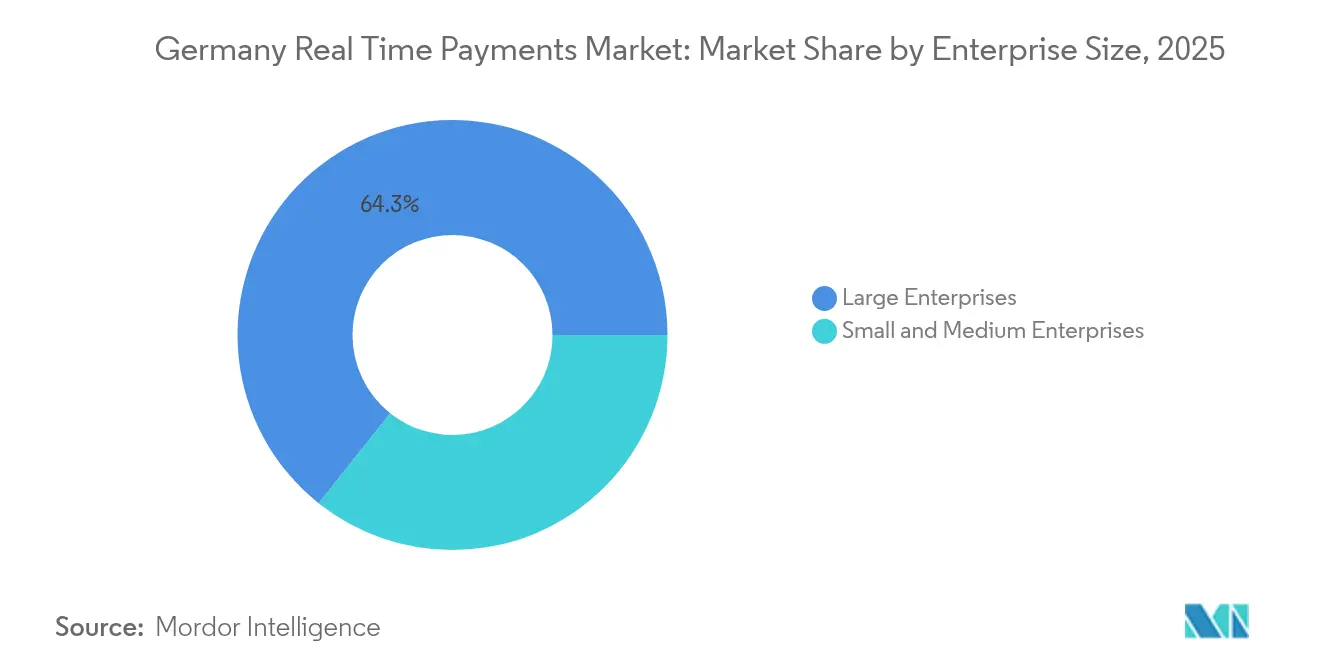
Large enterprises generated 64.30% of 2025 revenue, but SMEs now record the highest 30.69% CAGR. Instant settlement tightens cash-conversion cycles, enabling SMEs to fund inventory without bridging loans. Open-banking payment initiation lowers onboarding complexity and cost, democratizing access to Germany real time payments industry solutions.
Fintech aggregators bundle accounting plugins, simple QR invoicing, and automated reconciliation, removing the need for internal IT. SME adoption nurtures network effects as suppliers and buyers converge on the same rails, drawing further volume into Germany real time payments market. Banks that craft tiered pricing and educational outreach stand to capture this under-served segment.
By End-User Industry: Government Sector Emerges as Growth Leader
Retail & e-commerce still drives 33.40% of Germany real time payments market size, exploiting instant settlement to reduce cart abandonment. Nevertheless, Government & Public Sector advances at 35.60% CAGR as the digital euro roadmap accelerates. Municipalities pilot instant tax disbursements and welfare payments to improve citizen experience. Public-sector involvement legitimizes instant rails and boosts trust, supporting broader Germany real time payments market expansion.
Utilities and telecom firms adopt SCT Inst for late-bill recovery, while healthcare insurers test instant claim payouts. BFSI players refine internal high-value transfers to streamline liquidity between subsidiaries. Cross-sector diversification stabilizes transaction mix and underpins sustained Germany real time payments market growth.
Geography Analysis
Germany real time payments market has uneven regional momentum. Urban conurbations such as Berlin, Munich, Hamburg, and Frankfurt dominate volume because of high fintech density and digitally savvy consumers. Bundesbank data show that cash usage fell to 51% in 2023 while mobile payments hit 6%, demonstrating readiness for account-to-account instant flows. Card or smartphone acceptance is available at 80% of point-of-sale outlets, creating fertile ground for instant transfers.
The Sparkassen and Volksbanken networks extend reach into rural areas. Their migration to ISO 20022 by end-2025 will enable universal instant capability, leveling service parity with large city banks. Cross-border commerce with France and Benelux accelerates adoption of multi-currency aliases through the EPI-backed wero wallet, positioning Germany as a pan-European hub.
Participation in European clearing schemes such as RT1 and TIPS strengthens Germany real time payments market resilience and capacity. German PSPs push for low-latency connections to neighboring economies, reducing settlement friction for exporters in automotive and machinery sectors. Overall, regional initiatives integrate previously siloed payment infrastructures, elevating Germany real time payments market competitiveness within the single market.
Regulatory Landscape
Germanys real-time payments framework is anchored in Regulation (EU) 2024/886 (Instant Payments Regulation), effective from 9 April 2025, which amended SEPA Regulation (EU) 260/2012 and applies to PSPs offering standard euro credit transfers. Euro-area PSPs must support receipt of SCT Inst from 9 January 2025 and sending from 9 October 2025, execute payments within 10 seconds at any time (24/7/365), and apply price-parity requirements that restrict higher fees for instant transfers than for standard credit transfers.
Operational compliance requirements tightened alongside availability mandates. From 9 October 2025, PSPs must provide Verification of Payee (name-IBAN match) for instant transfers, and BaFin is positioned as a key national authority for supervisory guidance and reporting in Germany, including a first reporting deadline on fees and restricted transactions by 9 April 2026. On the scheme and messaging side, the EPCs SCT Inst rulebook (v1.1 for 2025) codifies scheme-level obligations aligned to the regulation, and a further data-quality step takes effect on 15 November 2026, when unstructured address formats are no longer permitted in EPC payment messages, requiring PSPs to complete ISO 20022 data readiness and processing changes.
Value Chain Analysis
Germanys real-time payments value chain begins with payer and payee channels (mobile and online banking, merchant checkout, invoicing and accounting software) that route payment initiation through bank and non-bank PSP layers. PSPs depend on core banking and payment hubs for ISO 20022 processing, liquidity and 24/7 operations, fraud and sanctions screening, and Verification of Payee services that have become baseline for SCT Inst. Connectivity and clearing are delivered through European instant payment infrastructures, notably TARGET Instant Payment Settlement (TIPS) and pan-European clearing services, with the Deutsche Bundesbank supporting TIPS participation operations and reachability in Germany.
Downstream, merchants and billers (retail and e-commerce, utilities, and public-sector use cases) integrate acceptance via PSP APIs and orchestration platforms, then use real-time confirmation to update order management, shipping, refunds, and reconciliation workflows. Regulatory timelines are reshaping bottlenecks and spend: mandatory receive (9 January 2025) and send (9 October 2025) obligations, plus the removal of the EUR 100,000 cap on 5 October 2025, are pushing upgrades to straight-through processing, IBAN-name verification, and always-on liquidity management. Message-data compliance milestones also drive further ISO 20022 enrichment and validation across gateway providers, scheme participants, and corporate ERP integrations, including the 15 November 2026 ban on unstructured address formats.
Competitive Landscape
The market is indicating a moderately consolidated. Incumbent banks—Deutsche Bank, Commerzbank, and the Sparkassen/Volksbanken groups—retain entrenched customer relationships and deliver trusted clearing. Yet specialist PSPs such as Worldline, Adyen, and Stripe compete with agile API platforms that integrate effortlessly into merchant checkouts. Fintech entrants, exploiting open-banking mandates, layer contextual finance on top of instant rails, forcing incumbents to modernize.
Commerzbank’s partnership with PPI to deploy the TRAVIC-Payment Hub and shift all flows to ISO 20022 by 2025 exemplifies a defensive-innovation strategy aimed at sustaining relevance while complying with IPR requirements. German banks also co-invest in the European Payments Initiative, launching the wero digital wallet to pre-empt big-tech encroachment.
Opportunities remain in niche vertical propositions, cross-border optimizations, and data-driven fraud mitigation services. Players that orchestrate comprehensive ecosystems across R2P, BNPI, and digital-euro readiness are best placed to capture incremental share in Germany real time payments market. Competitive intensity is forecast to tighten as regulatory parity in basic processing shifts rivalry toward differentiated user experience and ancillary analytics.
Germany Real Time Payments Industry Leaders
ACI Worldwide, Inc.
Mastercard Inc.
Visa Inc.
PayPal Holdings, Inc.
Finastra International GmbH
- *Disclaimer: Major Players sorted in no particular order

Market Opportunities and Future Outlook
Merchant acceptance expansion around account-to-account wallets and instant rails represents a clear whitespace as Germany shifts further toward digital payments. Wero launched in Germany for P2P in July 2024 and expanded to e-commerce in late 2025, with named merchants such as Eventim, Decathlon, Lidl, Rossmann, CEWE, Cineplex, Zooplus, Hornbach, and Air Europa already referenced as acceptors. This gives PSPs and gateways room to package Wero acceptance, R2P-style checkout flows, and instant refunds into merchant propositions.
Another execution lever is deployment by acquirers and payment platforms. Nexi Germany integrating Wero into its eCommerce platform in April 2026 broadens merchant connectivity and shifts competition toward orchestration, reconciliation, and fraud controls, rather than basic instant reachability. Separate upgrade windows in 2026 also create monetizable compliance and data-program cycles. The EPC requirement prohibiting unstructured address formats from 15 November 2026, combined with the ongoing VoP operating model, sustains demand for ISO 20022 data enrichment, directory and matching services, and workflow tooling that reduces false-positive abandonments without weakening fraud defenses. Cross-border and multi-market enablement remains adjacent within the Germany scope through shared European rails and wallets, supported by EPI confirmation of additional Wero integration steps tied to iDEAL migration progress in July 2026, reinforcing a pathway for German PSPs serving cross-border merchants to standardize acceptance and routing across neighboring European markets on the same instant-payment foundation.
Recent Industry Developments
- June 2026: ACI Worldwide joined the European Payments Initiative (EPI) as a technical service provider and announced integration of the wero digital wallet into its Payments Orchestration Platform. The move strengthens the supplier ecosystem around account-to-account instant payments and expands enterprise-grade orchestration options for PSPs and merchants operating on SEPA Instant rails.
- May 2025: PayPal announced plans to launch a contactless mobile wallet in Germany, linking online and in-store payments and adding Pay Later installments for in-store transactions. This product direction increases competitive pressure at physical checkout and encourages local PSPs and banks to differentiate instant account-to-account flows with better consumer UX and merchant acceptance tooling.
- November 2024: Deutsche Bundesbank completed Trigger Solution trials linking DLT platforms with TARGET to achieve real-time finality. The milestone highlights ongoing work on programmable settlement concepts that can connect emerging asset and tokenization workflows to central bank settlement infrastructure.


Research Methodology Framework and Report Scope
Market Definition and Coverage
For this report, the Germany real-time payments market is measured as the value of domestic credit transfer transactions that are cleared and confirmed in seconds, using SEPA Instant Credit Transfer rails or equivalent instant clearing schemes used in Germany.
Scope exclusions: The market value excludes card-based deferred settlement flows, chargebacks, crypto token transfers, and cross-border transfers settled outside German clearing houses.
Segmentation Overview
- By Transaction Type
- Peer-to-Peer (P2P)
- Peer-to-Business (P2B)
- By Component
- Platform / Solution
- Services
- By Deployment Mode
- Cloud
- On-Premise
- By Enterprise Size
- Large Enterprises
- Small and Medium Enterprises
- By End-User Industry
- Retail and E-Commerce
- BFSI
- Utilities and Telecom
- Healthcare
- Government and Public Sector
- Other End-user Industries
Data Sources, Market Sizing, and Validation
Desk Research
Desk research was used to build the market frame and keep assumptions anchored to public signals. We mainly relied on official and industry sources such as Deutsche Bundesbank publications, European Central Bank payments statistics, European Commission and EPC rulebooks for SEPA Instant Credit Transfers, and BIS CPMI materials for payment-system definitions.
In parallel, we reviewed annual reports, investor presentations, and product disclosures from relevant banks, payment service providers, and clearing infrastructure participants to understand rollout pace and how pricing is presented to customers. We also used a paid subscription for company financials and intelligence, and a patent database where it helped confirm the direction of instant payment capabilities. These sources are illustrative and not exhaustive, and other public materials were used for data collection, cross-checking, and clarifying open questions.
Primary Interviews and Surveys
Primary work focused on validating what portion of German credit transfers are actually being routed via instant rails, and how pricing, liquidity costs, and use case mix are evolving. We spoke with a mix of banks, payment infrastructure participants, and merchant-facing PSP roles, and we also checked perspectives from Germany-focused teams on wider EU instant payments regulation and adoption patterns.
Distribution of primary research fieldwork respondents
| Company type | Respondent position | Region |
|---|---|---|
| Top tier: 28% | CXOs: 13% | |
| Mid tier: 50% | Functional/Unit leaders: 33% | |
| Smaller Players: 22% | Managers: 54% |
Market-Sizing & Forecasting
Sizing was built using a top-down and bottom-up blend, where the main path starts from the total credit transfer activity pool in Germany and then applies an instant-eligible and instant-routed share to reconstruct real-time payment value. The totals were then corroborated using selective bottom-up checks, such as sampled price schedules for instant transfer services, channel checks on adoption by customer type, and volume-to-value conversions where reliable ranges were available.
Key model inputs included the rollout timing of instant payment reachability, SEPA Instant scheme adherence and rule changes, adoption by payer type (consumer versus business), typical transaction value ranges for instant transfers, and indicators linked to the EU Instant Payments Regulation impact on mandatory availability. For forecasting, we used scenario analysis supported by expert feedback, since regulation-led adoption can move faster than simple trend lines. Where granular inputs were missing for smaller institutions, we filled gaps using peer-group averages adjusted for reachability, customer mix, and observed pricing behavior.
Data Validation & Update Cycle
Outputs were checked against independent signals such as public payment statistics, known infrastructure milestones, and the consistency between volume, value, and pricing ranges. Any sharp jumps were reviewed for timing effects, currency conversion assumptions, and one-off policy changes, and then re-tested with follow-up calls where needed.
Before sign-off, a second analyst reviews the full chain of assumptions, calculations, and year-to-year movements so the logic can be repeated by another person. The report is refreshed annually, and interim updates are made when there are material events such as rulebook changes or major regulatory deadlines. Right before delivery, we do a fresh review pass so the final numbers reflect the latest information available.
Mordor Intelligence's Germany Real Time Payments Market Estimate Compared With Other Published Estimates
Published market numbers for real-time payments in Germany can look far apart because the underlying definition is not always consistent, and some studies mix transaction value with wider digital payments revenue. Differences also come from how authors treat instant payment reachability versus actual usage, and whether values are reported at retail prices, bank fee revenue, or the underlying transfer value.
Card-based deferred settlement flows sit outside Mordor Intelligence's scope, so estimates that fold card rails or wallet checkout value into the instant payment bucket will naturally come out larger even if adoption is still ramping. Other gaps typically show up in how cross-border instant transfers are counted, how currency timing is handled when converting EUR-denominated series into USD, and how quickly regulation-led rollout is assumed to translate into real usage.
Benchmark comparison
| Source | Market Size | Gaps in Research Methodology |
|---|---|---|
| Mordor Intelligence | USD 2.19 B (2025) | |
| Industry Blog A | USD 3.00 B (2025) | Often treats instant payments as a broader digital checkout value pool, which can unintentionally include card-led wallet transactions and inflate the addressable value versus instant credit transfers. |
| Regional Consultancy B | USD 1.70 B (2025) | Applies conservative adoption shares based on reachability alone, and may undercount corporate use cases and higher-value transfers that start scaling after regulatory deadlines. |
The comparison shows that most of the spread is explained by what is counted as an instant payment and how fast adoption is assumed to move from availability to routine use. By tying the model to observable transfer activity and then pressure-testing it with interviews on routing behavior and pricing, we keep a practical number that buyers can trace and update with clear steps.


Key Questions Answered in the Report
What is driving the rapid growth of Germany real time payments market?
Regulatory mandates such as the Instant Payments Regulation, higher SCT Inst limits, and compulsory e-invoicing combine with ISO 20022 migration and fintech innovation to propel a 36.15% CAGR through 2031.
How large will Germany real time payments market size become by 2031?
It is projected to reach USD 13.94 billion by 2031, up from USD 2.98 billion in 2026.
Which segment is expected to grow fastest?
Peer-to-Business transactions are forecast to rise at a 38.71% CAGR, fueled by Request-to-Pay and e-invoicing adoption.
Why are SMEs increasingly adopting instant payments?
Instant settlement enhances cash-flow management, reduces reliance on external financing, and is accessible via open-banking APIs that lower integration costs.
What role will the digital euro play?
The digital euro aims to provide a pan-eurozone retail payment instrument that complements existing instant rails, expanding acceptance and trust among public-sector users.
How are banks responding to competition from fintechs?
Traditional banks partner with technology vendors, migrate to ISO 20022, and invest in value-added services such as liquidity dashboards and fraud analytics to differentiate their offerings.
Page last updated on: