
Market Overview
| Study Period | 2020 - 2031 |
|---|---|
| Forecast Data Period | 2026 - 2031 |
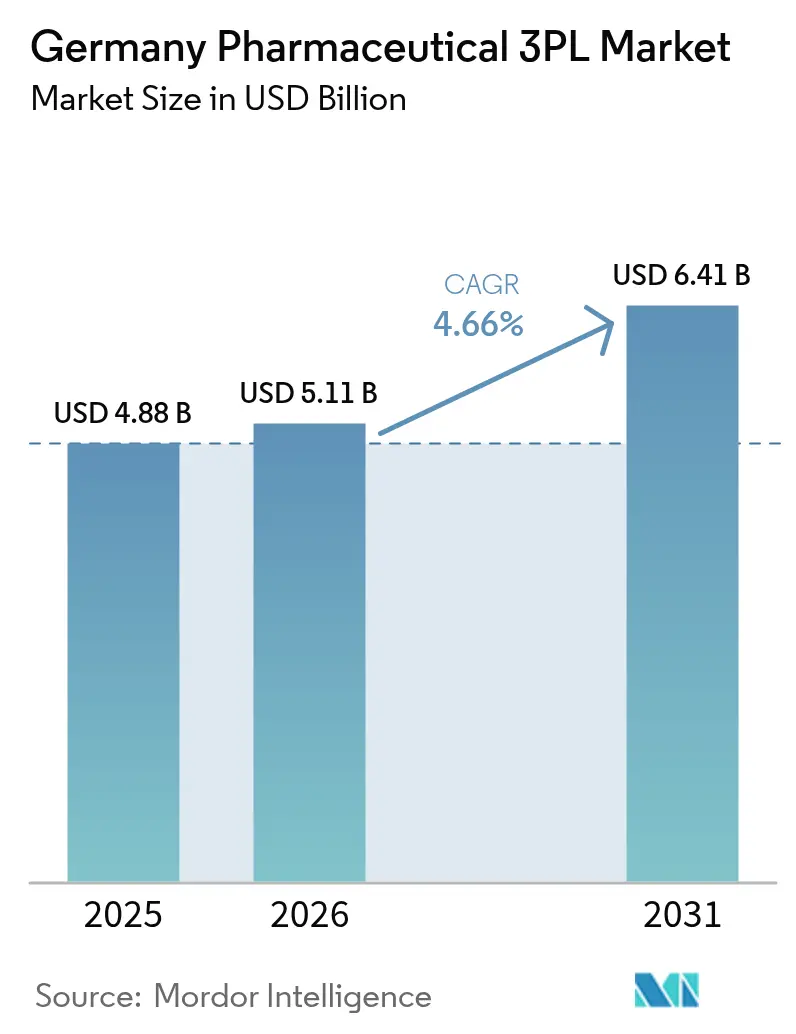
| Base Year Market Size (2025) | USD 4.88 Billion |
| Market Size (2026) | USD 5.11 Billion |
| Market Size (2031) | USD 6.41 Billion |
| Growth Rate (2026 - 2031) | 4.66 % |
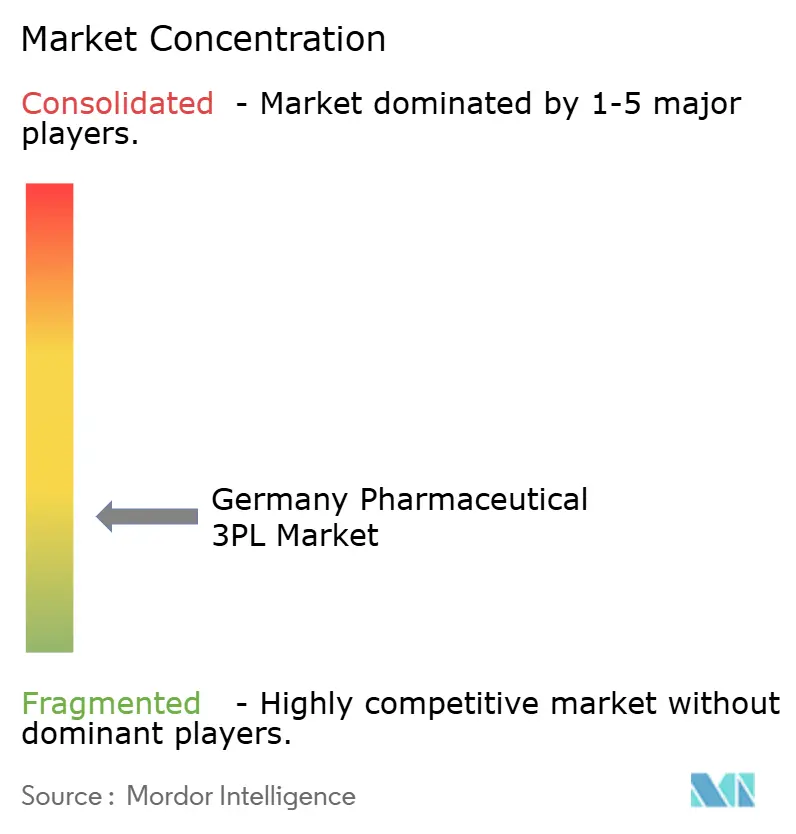
| Market Concentration | Low |
Major Players *Disclaimer: Major Players sorted in no particular order Image © Mordor Intelligence. Reuse requires attribution under CC BY 4.0. | |
Germany Pharmaceutical 3PL Market Analysis by Mordor Intelligence
The Germany Pharmaceutical 3PL Market size was valued at USD 4.88 billion in 2025 and estimated to grow from USD 5.11 billion in 2026 to reach USD 6.41 billion by 2031, at a CAGR of 4.66% during the forecast period (2026-2031).
The measured expansion signals a maturing logistics landscape shaped by stringent Good Distribution Practice (GDP) mandates, rising biologics volumes, and sustained domestic drug demand. Temperature-controlled services already represent 58% of all third-party pharmaceutical logistics activities, and providers that demonstrate best-in-class compliance command premium pricing. Strategic consolidation is accelerating as large integrators acquire cold-chain specialists to secure scale and end-to-end control, while automation and digital traceability tools are gaining traction as defenses against excursion risk and labor shortages. The German pharmaceutical 3PL market is also benefiting from government incentives to reshore manufacturing capacity, which are lengthening domestic supply chains and increasing inventory holding requirements.
Key Report Takeaways
- By service type, Domestic Transportation Management held 40.35% of the German pharmaceutical 3PL market share in 2025, while Value-Added Warehousing & Distribution is advancing at a 5.72% CAGR between 2026-2031.
- By temperature type, cold-chain services commanded 57.75% of the German pharmaceutical 3PL market size in 2025 and are expanding at a 5.76% CAGR between 2026-2031.
- By end user, pharmaceutical manufacturers led with 36.35% revenue share in 2025; e-pharmacies & direct-patient services record the highest projected CAGR at 5.92% between 2026-2031.
- By product type, prescription drugs accounted for 35.40% of the German pharmaceutical 3PL market size in 2025, whereas cell & gene therapies are forecast to grow at a 6.25% CAGR between 2026-2031.
Note: Market size and forecast figures in this report are generated using Mordor Intelligence’s proprietary estimation framework, updated with the latest available data and insights as of 2026.
Germany Pharmaceutical 3PL Market Trends and Insights
Drivers Impact Analysis*
| Driver | (≈) % Impact on CAGR Forecast | Geographic Relevance | Impact Timeline |
|---|---|---|---|
| Strong domestic pharmaceutical demand | +1.2% | Germany and wider EU | Medium term (2–4 years) |
| E-commerce channel acceleration for Rx & OTC drugs | +0.9% | Urban Germany | Short term (≤ 2 years) |
| Rising biologics & advanced-therapy volumes requiring GDP-compliant cold chain | +1.4% | Germany and Europe | Long term (≥ 4 years) |
| End-to-end digital visibility solutions lowering excursion risk | +0.7% | Germany and DACH | Medium term (2–4 years) |
| Sustainability-driven modal shift reducing carbon footprint | +0.6% | Germany within EU Green Deal | Long term (≥ 4 years) |
| Surge in decentralized/virtual clinical trials driving direct-to-patient logistics needs | +0.6% | Germany, with global clinical trial networks | Medium term (2-4 years) |
| Source: Mordor Intelligence | |||
Strong Domestic Pharmaceutical Demand
Prescription volumes are growing in line with an aging population, and Germany’s pharmaceutical industry generated more than EUR 200 billion in revenue in 2024, supporting 350,000 jobs. Capacity constraints inside manufacturers have triggered greater outsourcing of inventory management and distribution to compliant 3PL partners. Berlin’s 2023 Pharmaceutical Strategy introduced manufacturing incentives and faster clinical-trial approvals, further increasing logistics complexity that favors specialized providers.
E-commerce Channel Acceleration for Rx & OTC Drugs
Mail-order leaders such as DocMorris scaled aggressively after regulators cleared the apo-rot acquisition, underpinning a last-mile model that demands ambient and cooled fulfillment lines inside GDP-certified facilities. Four-month ERP integrations highlight the IT intensity of this segment, prompting 3PLs to invest in automated picking and serialized, item-level tracking. As consumers embrace home delivery, e-pharmacies need partners that combine wholesale shipping with direct-to-patient drop-offs.
Rising Biologics & Advanced-Therapy Volumes Requiring GDP-Compliant Cold Chain
Thermo Fisher Scientific opened Germany’s first dedicated cryocenter for cell & gene therapies, providing storage down to –196 °C and establishing new performance benchmarks. Marken expanded its Frankfurt site to add cryogenic capacity, while Panasonic’s vacuum-insulated boxes now hold –75 °C for 18 days without dry ice. These investments cement Germany as a European hub for ultra-low-temperature logistics, lifting demand for 3PLs that can guarantee an end-to-end chain of custody.
End-to-End Digital Visibility Solutions Lowering Excursion Risk
Pharma shippers spend roughly USD 14 billion a year worldwide on cold transport and storage, driving adoption of IoT sensors and blockchain authentication that cut annual product-loss costs of up to USD 35 billion. German providers use Testo’s real-time monitoring and automated deviation alerts to meet IATA CEIV Pharma certification standards, thereby lowering liability and audit costs.
Restraints Impact Analysis*
| Restraint | (≈) % Impact on CAGR Forecast | Geographic Relevance | Impact Timeline |
|---|---|---|---|
| High operating costs for GDP/GMP-compliant facilities | –0.8% | Germany & EU | Medium term (2–4 years) |
| Skilled labor shortages in temperature-controlled logistics | –1.1% | German pharma clusters | Short term (≤ 2 years) |
| Energy-price volatility inflating warehouse OPEX | –0.6% | Germany & Europe | Short term (≤ 2 years) |
| Scarcity of GDP-approved urban micro-fulfilment space limiting last-mile service expansion | -0.5% | Germany, concentrated in major urban centers | Medium term (2-4 years) |
| Source: Mordor Intelligence | |||
High Operating Costs for GDP/GMP-Compliant Facilities
Annual audit and documentation expenses can top EUR 1 million for large warehouses, and new in-transit verification rules require continuous monitoring in road freight as well. A Cologne distributor lost its license in July 2024 after repeated GDP breaches, underscoring the financial stakes of non-compliance.
Skilled Labor Shortages in Temperature-Controlled Logistics
Germany’s pharma supply chain lacks 176,000 qualified workers, with 70,000 unfilled truck-driver posts worsening last-mile bottlenecks. DACHSER responds by training 100 drivers a year, yet retirements mean the gap will persist. Expertise in cold-chain handling and sensor technology is especially scarce[1]European Compliance Academy, “GDP Guideline Update 2024,” ECA, eca.de.
*Our forecasts treat driver/restraint impacts as directional, not additive. The impact forecasts reflect baseline growth, mix effects, and variable interactions.
Segment Analysis
By Service Type: Warehousing Gains Momentum
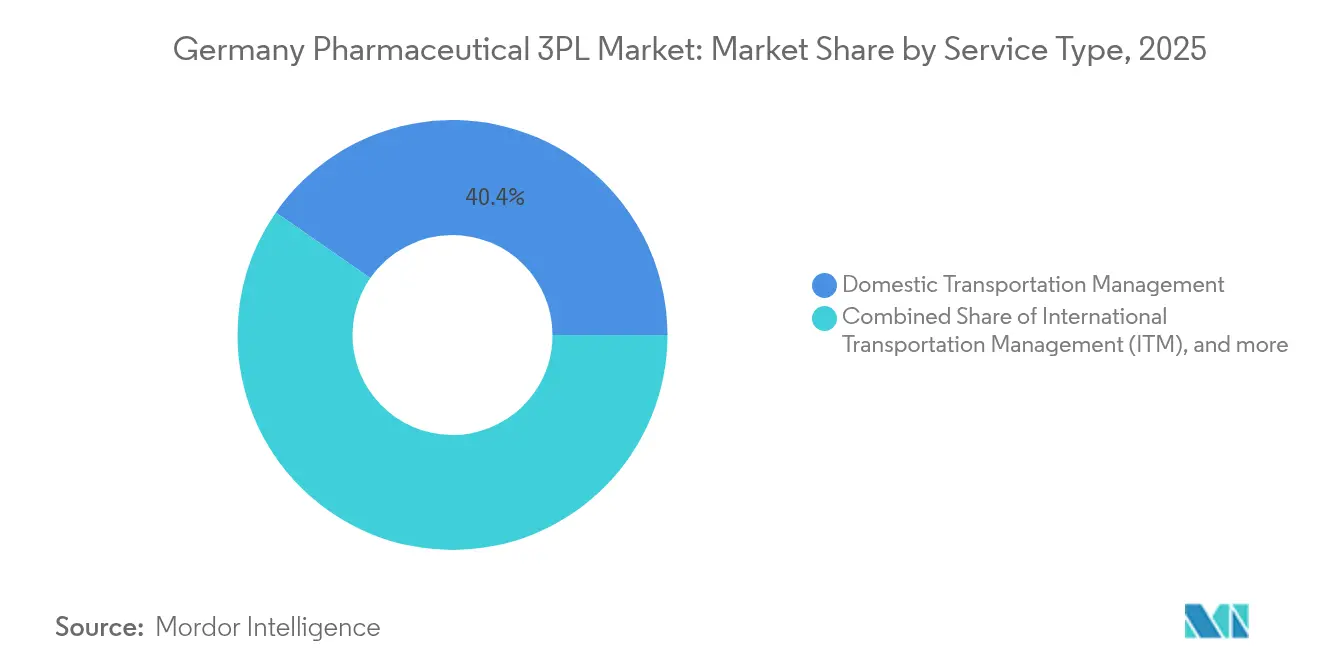
Domestic Transportation Management retained 40.35% of the German pharmaceutical 3PL market share in 2025, confirming the country’s status as a distribution bridge into Europe. Value-Added Warehousing & Distribution, the fastest-rising service, is growing at 5.72% CAGR as manufacturers outsource GDP-compliant storage, labeling, and serialization. The German pharmaceutical 3PL market size for warehousing is set to expand further as fully automated silos such as SSI SCHAEFER’s build for Losan Pharma go live in 2025. International air corridors stay vital for emergency biologics; Lufthansa Cargo’s Cool/td-Active network secures -20 °C to +30 °C moves across 89 stations.
The traditional divide between trucking and storage blurs as 3PLs package transport, inventory visibility, and regulatory filing into single contracts. DHL’s planned EUR 2 billion healthcare network and DSV’s acquisition of DB Schenker exemplify scale-seeking strategies that lock in captive volumes and higher asset utilization.


By Temperature Type: Cold Chain Dominance
Cold-chain operations cover 57.75% of 2025 revenue and expand at a 5.76% CAGR. Growth is fueled by vaccines, biologics, and cell therapies that lose efficacy once temperatures stray beyond narrow windows. The German pharmaceutical 3PL market share for ultra-low-temperature services keeps rising as Secop’s next-gen compressors cut energy draw inside -80 °C freezers by double-digit percentages. Ambient logistics face fee pressure because digital direct shipping reduces warehouse dwell time for OTC lines.
Regulatory scrutiny elevates barriers to entry; EU GDP demands validation of every transport lane, forcing smaller providers either to invest or exit. Automation offsets some operating costs: new warehouse management systems linked to predictive HVAC algorithms achieve 30% energy savings, a margin buffer amid volatile power prices.
By End User: E-Pharmacies Drive Growth
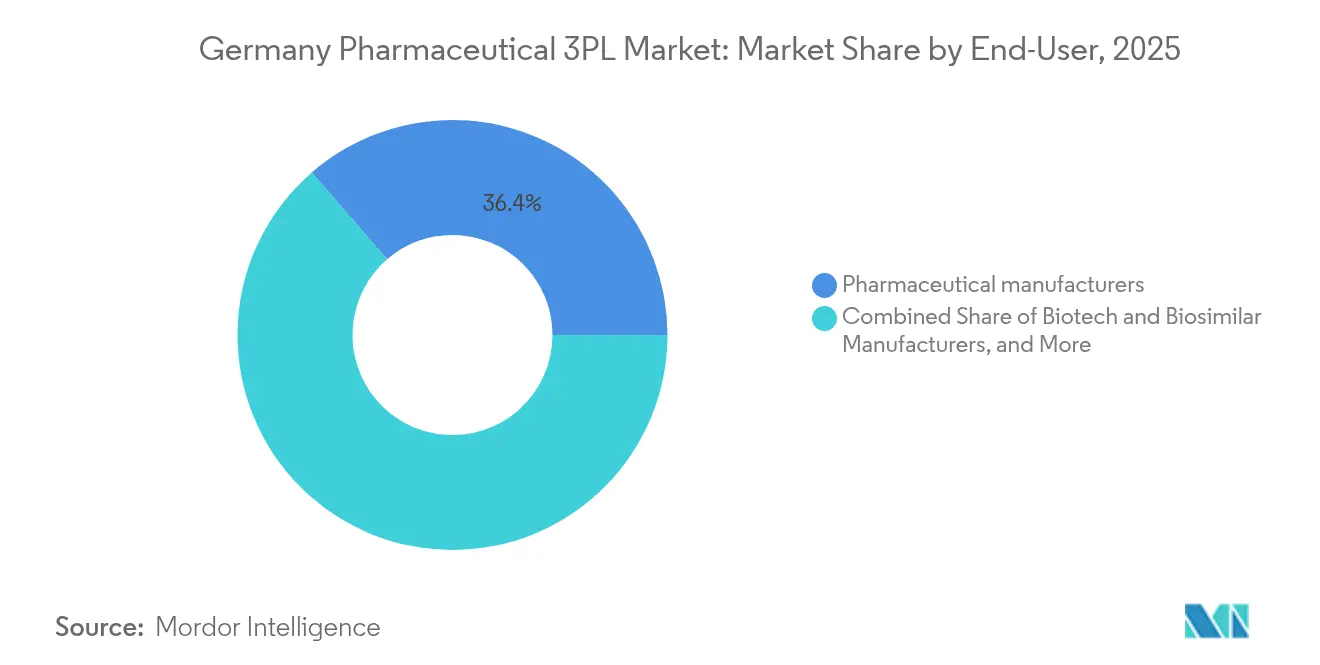
Pharmaceutical manufacturers generated the largest share at 36.35% in 2025, yet e-pharmacies & direct-to-patient services record the swiftest 5.92% CAGR. The German pharmaceutical 3PL market size for e-pharmacy fulfillment gains from higher prescription reimbursements and consumer preference for home delivery. Providers must integrate pick-by-light stations, tamper-evident packaging, and secure driver authentication to satisfy data-protection rules.
Biotech firms and clinical-trial sponsors require white-glove, validated lanes with a chain-of-identity, sustaining demand for higher-margin premium services. Hospitals and retail pharmacies still command large volumes, but consolidation keeps their growth moderate. WHO guidance on emergency stockpiling continues to anchor wholesaler relevance for pandemic-readiness.
By Product Type: Cell Therapies Lead Innovation
Prescription drugs ranked first with 35.40% revenue, yet cell & gene therapies accelerate fastest at 6.25% CAGR, lifting cold-chain revenue. The German pharmaceutical 3PL market size for cell therapy logistics is small but lucrative because each patient-specific lot can exceed USD 250,000 in value at release. Fraunhofer’s RNAuto project, aiming to automate mRNA manufacturing, underscores the technical hurdles that deepen reliance on specialist carriers.
Biopharmaceuticals and biosimilars retain steady expansion as European patent cliffs unlock competition, while vaccine volumes remain resilient following updated COVID-19 and RSV immunization campaigns. OTC products migrate toward parcel carriers and automated lockers, curbing traditional 3PL margins for this category.
Geography Analysis
Germany’s central location, dense highway network, and cargo-friendly airports give the German pharmaceutical 3PL market an unrivaled reach across continental Europe. Clusters in Rhein-Main, North Rhine-Westphalia, and Bavaria generate the bulk of cold-chain demand, prompting UPS Healthcare to commission a 27,200 m² Giessen hub that can reach 80% of Europe within 24 hours. Eastern states attract greenfield investments due to lower energy tariffs and abundant renewables, a hedge against power-cost volatility.
The ALBVVG act requires six-month inventory buffers for rebate drugs, spurring additional warehouse leasing across federal states. Pending EU regulation on critical medicines will assign shared-stock obligations across members, favoring 3PLs with pan-European facilities and standardized SOPs. Germany’s rail corridors into the Czech Republic and Poland offer cost-effective, low-carbon access to growth markets, while Rhine river congestion keeps waterway use limited to bulk APIs.
Energy prices diverge regionally, pushing network redesigns that blend renewable-powered campuses in the north with existing Frankfurt-based air gateways. Automation offsets higher labor costs in southern warehouses, ensuring service levels demanded by advanced therapies.
Regulatory Landscape
Germany's pharmaceutical 3PL operations sit under the Arzneimittelgesetz (AMG) as the core framework for manufacture and trade in medicinal products, with the Federal Ministry of Health (BMG) shaping policy and the Federal Institute for Drugs and Medical Devices (BfArM) serving as the central authority for medicinal products. Good Distribution Practice (GDP) obligations are implemented nationally through the Ordinance on Wholesale Distribution of Medicinal Products (AM-HandelsV), which embeds EU GDP requirements into day-to-day wholesaling, storage, and transport controls.
Enforcement is decentralized: the Laender authorities issue wholesale distribution authorizations (including under Section 52a AMG) and perform inspections (including under Section 64 AMG). Compliance readiness therefore has to be demonstrable at each operating site and lane. Inspector expectations are guided by the ZLG Aide-Memoire for transport process suitability, reinforcing documented qualification of transport routes, equipment, and service providers, and making quality management systems and responsible-person oversight central to 3PL contracting and audits.
Value Chain Analysis
The value chain starts with manufacturers and marketing authorization holders, then moves through primary and secondary packaging, qualified transport packaging providers (including passive and active temperature-control solutions), and GDP-controlled storage and transport executed by 3PLs and specialist carriers. In Germany, the chain commonly routes via GDP warehouses near pharma clusters and air gateways, notably Frankfurt, for import/export and time-critical biologics, with downstream distribution to wholesalers, hospitals, retail pharmacies, and fast-growing direct-to-patient channels that require tamper-evident handling, secure delivery, and IT integration.
Compliance and quality governance cut across each node, with wholesale licensing under Section 52a AMG and inspections under Section 64 AMG shaping supplier qualification, route validation, and deviation management. Recent infrastructure moves show where value accrues: DHL expanded its Life Sciences and Healthcare campus in Florstadt to 100,000 sqm (over 140,000 pallet capacity), and Frankfurt Cargo Services opened a 3,300 sqm CEIV- and GDP-certified Pharma Center at Frankfurt Airport. Together, these steps reinforce hub-centric networks that bundle storage, QA release support, and temperature-controlled handling into fewer, larger sites.
Competitive Landscape
The German pharmaceutical 3PL market balances global integrators with expert mid-caps. DHL, DSV, and Kuehne Nagel use global scale, multi-temperature fleets, and IT suites to win multi-year, multimillion-euro contracts. Niche players penetrate high-complexity niches—cell therapy transport, clinical trial returns, and hazardous substance handling—where expertise outweighs volume. Technology now separates leaders from laggards: 3PLs deploying blockchain traceability, AI excursion prediction, and autonomous mobile robots reduce spoilage, enhance audit readiness, and increase picking productivity.
M&A remains brisk. DSV’s EUR 14.3 billion purchases of DB Schenker vault it into the top tier, while Nippon Express’ full takeover of Simon Hegele expands Asian-European clinical logistics lanes[3]Simon Hegele Healthcare Solutions, “Integration into Nippon Express Group Completed,” Simon Hegele, simon-hegele.com. Capital-intensive cold-chain buildouts discourage new entrants, especially under Germany’s rigorous licensing regime. Yet white-space persists in direct-to-patient biologics, where only a few carriers combine GDP vans, trained nurses, and real-time, patient-level tracking.
Germany Pharmaceutical 3PL Industry Leaders
DHL Logistics
Rhenus Logistics
Ceva Logistics
MSK Pharma Logistics
- *Disclaimer: Major Players sorted in no particular order

Market Opportunities and Future Outlook
White space is concentrated in ultra-cold and high-integrity distribution models that combine GDP compliance with faster handoffs at major gateways and digitally verified chain-of-custody. The May 2026 opening of Frankfurt Cargo Services' new 3,300 sqm CEIV- and GDP-certified Pharma Center at Frankfurt Airport, which quadrupled temperature-controlled handling capacity, points to ongoing investment in airside pharma handling and creates room for 3PLs that can connect validated air corridors to GDP road networks and intermodal links without breaking temperature assurance.
Automation-led warehousing and direct distribution workflows are a second opportunity pocket as operators build larger, more technology-dense sites to manage cost pressure from GDP documentation and labor scarcity. PHOENIX Pharmahandel started a EUR 25 million expansion at its Neuhausen distribution center, targeting 80% automation by completion (2028). MSK Pharma Group's MSK Bensheim III project adds another modern, integrated logistics footprint, reinforcing demand for 3PL partners that can provide high-throughput, serialization-ready warehousing, qualified service-provider governance under AMG/EU GDP outsourcing rules, and controlled last-mile options for e-pharmacies and patient-specific therapies.
Recent Industry Developments
- July 2026: CEVA Logistics renewed a five-year agreement with GSK to manage the pharmaceutical distribution center in Robakowo, Poland, serving Central and Northern European flows. The contract renewal sustains a major regional control-tower style operation and reinforces CEVA's healthcare network capacity supporting Germany-adjacent supply chains.
- May 2025: DHL Group opened an additional 30,000 sqm warehouse at its Life Sciences and Healthcare campus in Florstadt, Germany, expanding the site to 100,000 sqm and more than 140,000 pallet positions. The expansion increases GDP-capable warehousing scale near the Frankfurt region and supports broader pharma hub consolidation into fewer, higher-compliance nodes.
- March 2024: Movianto extended its logistics partnership with TVM Tiergesundheit, adding cold-chain (2-8 degrees Celsius) capability and time-critical handling for stem cell products. The scope expansion underscores growing demand for specialty, temperature-controlled services and tighter process control for sensitive therapies.


Research Methodology Framework and Report Scope
Market Definition and Coverage
For this methodology, the Germany pharmaceutical 3PL market covers third-party logistics services used to move, store, and distribute pharmaceutical products within Germany, including GDP-aligned handling, temperature-controlled moves, and value-added warehouse activities tied to distribution.
Scope exclusions: Pure in-house logistics run by drug manufacturers and pharmacies, and generic non-pharma freight moved without pharma-grade handling requirements, are not counted.
Segmentation Overview
- By Service Type
- Domestic Transportation Management (DTM)
- Roadways
- Railways
- Airways
- Waterways
- International Transportation Management (ITM)
- Roadways
- Railways
- Airways
- Waterways
- Value-Added Warehousing & Distribution (VAWD)
- Domestic Transportation Management (DTM)
- By Temperature Type
- Cold Chain
- Non-cold Chain
- By End User
- Pharmaceutical Manufacturers
- Biotech & Biosimilar Manufacturers
- Clinical Research & Trial Sponsors
- Hospitals & Retail Pharmacies
- Healthcare Distributors & Wholesalers
- E-pharmacies & Direct-to-Patient Services
- Others
- By Product Type
- Prescription Drugs
- OTC & Consumer Health Products
- Biopharmaceuticals & Biosimilars (ex-CGT)
- Cell & Gene Therapies
- Vaccines & Blood-derived Products
- Veterinary Pharmaceuticals & Animal Health Products
- Medical Devices, Diagnostics & Combination Products
- Clinical-trial Materials (Investigational Medicinal Products)
- Others
Data Sources, Market Sizing, and Validation
Desk Research
Desk work starts by mapping the demand pool and the compliance rules that shape pharma outsourcing, since service definitions can get mixed up with general logistics. We refer to public sources such as the Federal Institute for Drugs and Medical Devices (BfArM) publications, the European Medicines Agency materials, and Germany trade and transport statistics that help us anchor shipment flows and distribution intensity.
We also use sources such as customs and trade data, German logistics and pharma association releases, and peer-reviewed articles on cold chain and GDP practices to understand typical service steps and cost drivers. To cross-check who is active and how revenue is reported, we review annual reports and investor presentations, along with reputable business press, and we selectively use paid subscriptions for company financials and news screening, plus shipment-level import and export visibility when needed. These examples are not exhaustive, and many other public and paid sources were also reviewed to collect, validate, and clarify the final dataset.
Primary Interviews and Surveys
Primary work focused on confirming what is truly outsourced in Germany pharma distribution, and how providers price GDP compliance, temperature control, and value-added warehouse steps. We spoke with a mix of 3PL operators, temperature-controlled warehouse specialists, freight coordinators, and pharma supply chain teams, and the questions were structured to validate assumptions like cold chain share, typical lane mix (domestic versus cross-border), and service attach rates for packaging, labeling, and serialization.
Distribution of primary research fieldwork respondents
| Company type | Respondent position |
|---|---|
| Top tier: 25% | CXOs: 14% |
| Mid tier: 57% | Functional/Unit leaders: 40% |
| Smaller Players: 18% | Managers: 46% |
Market-Sizing & Forecasting
Sizing starts with a top-down build that reconstructs the addressable outsourced pharma logistics spend in Germany by linking pharma distribution activity to the share handled by third parties, followed by service-level splits. After that, we corroborate totals using selective bottom-up checks, such as sampled provider revenue exposure to pharma logistics, lane-level price ranges, and volume by temperature band, and then the model is adjusted where the checks do not line up.
A few inputs that matter in this market include the mix of cold chain versus non-temperature-controlled movements, GDP compliance intensity (for example, validation steps and audit cadence), domestic versus international transportation management share, warehousing throughput linked to pharma manufacturing and import flows, and the typical value-added service attachment (labeling, packaging, serialization, and returns handling). Where a bottom-up proxy is incomplete, gaps are handled by scaling sampled observations to the known demand pool and then testing the result with interview-based sanity checks.
Forecasts rely mainly on scenario analysis supported by a light multivariate regression, where drivers like pharma output trends, biologics share, and cross-border movement intensity are stressed into conservative and base cases. Final growth assumptions are aligned to what operators and shippers expect for capacity use, service price movement, and compliance-driven cost changes over the forecast window.
Data Validation & Update Cycle
Model outputs are validated through multiple checks so the final numbers do not depend on one dataset. We compare results against independent signals like pharma trade volumes, warehouse activity indicators, and observed price ranges for GDP and temperature-controlled handling, and then any large variance is reviewed and reworked.
Before sign-off, the work goes through step-by-step analyst reviews that focus on outliers, unit consistency, and year-on-year movement that does not match real market events. Reports are refreshed annually, and interim updates are triggered when material changes occur, such as regulatory shifts, major capacity additions, or demand spikes in temperature-sensitive products. Right before delivery, we do a final pass to ensure the latest public updates and interview feedback are reflected.
Mordor Intelligence's Germany Pharmaceutical 3pl Market Size Compared With Other Published Estimates
Published market values for Germany pharmaceutical 3PL often differ because each publisher draws the line between true outsourced pharma-grade services and broader healthcare or general freight. The spread usually comes from what is counted as value-added warehousing, whether cross-border transportation management is fully included, and how cold chain pricing is treated.
The main gap comes from mixing pharma GDP-compliant logistics with wider healthcare distribution, where Mordor Intelligence counts 3PL revenue only when the service is contracted as a dedicated pharma logistics activity with temperature-control and compliance steps priced into the job.
Benchmark comparison
| Source | Market Size | Gaps in Research Methodology |
|---|---|---|
| Mordor Intelligence | USD 4.88 B (2025) | |
| Regional Consultancy A | USD 3.30 B (2024) | Uses an older base year and reports in EUR in the source, and the scope appears to emphasize cold chain and warehousing more than full transportation management, which reduces the addressable total. |
| Trade Journal B | USD 9.60 B (2024) | Looks closer to a broader biopharmaceutical logistics spend and can include in-house moves and non-3PL logistics activities, which inflates the value versus outsourced 3PL-only revenue. |
The table shows that year choice and scope discipline explain most of the range. When the model is tied to contracted 3PL services, service attach rates, and temperature-control share checks, the result stays traceable to clear demand and pricing drivers, and it can be repeated when new capacity or compliance changes occur.


Key Questions Answered in the Report
How large is the German pharmaceutical 3PL market in 2026?
The market is valued at USD 5.11 billion in 2026 and is forecast to reach USD 6.41 billion by 2031 at a 4.66% CAGR.
Which service type is growing fastest within Germany’s pharma logistics?
Value-Added Warehousing & Distribution is expanding at a 5.72% CAGR, reflecting demand for GDP-compliant inventory and packaging solutions.
Why is cold-chain logistics so dominant in Germany?
Cold-chain services hold 57.75% share because biologics, vaccines, and cell & gene therapies require strict temperature control, driving premium outsourced demand.
What is the biggest restraint facing Germany’s pharmaceutical logistics providers?
Acute labor shortages-176,000 open positions, including 70,000 truck drivers-are the largest drag, subtracting an estimated 1.1 percentage points from forecast CAGR.
How are sustainability goals influencing German pharma transport?
Shippers shift freight from air to sea and adopt alternative fuels, enabling CO₂ reductions such as Merck Healthcare’s 10,000-ton annual saving from modal shifts.
Which end-user segment will grow quickest to 2031?
E-pharmacies and direct-to-patient channels lead with a 5.92% CAGR as consumers increasingly order prescription and OTC drugs online.
Page last updated on:


 Your data is secure and never sold or shared.


