Germany Passenger Vehicles Lubricants Market Analysis by Mordor Intelligence
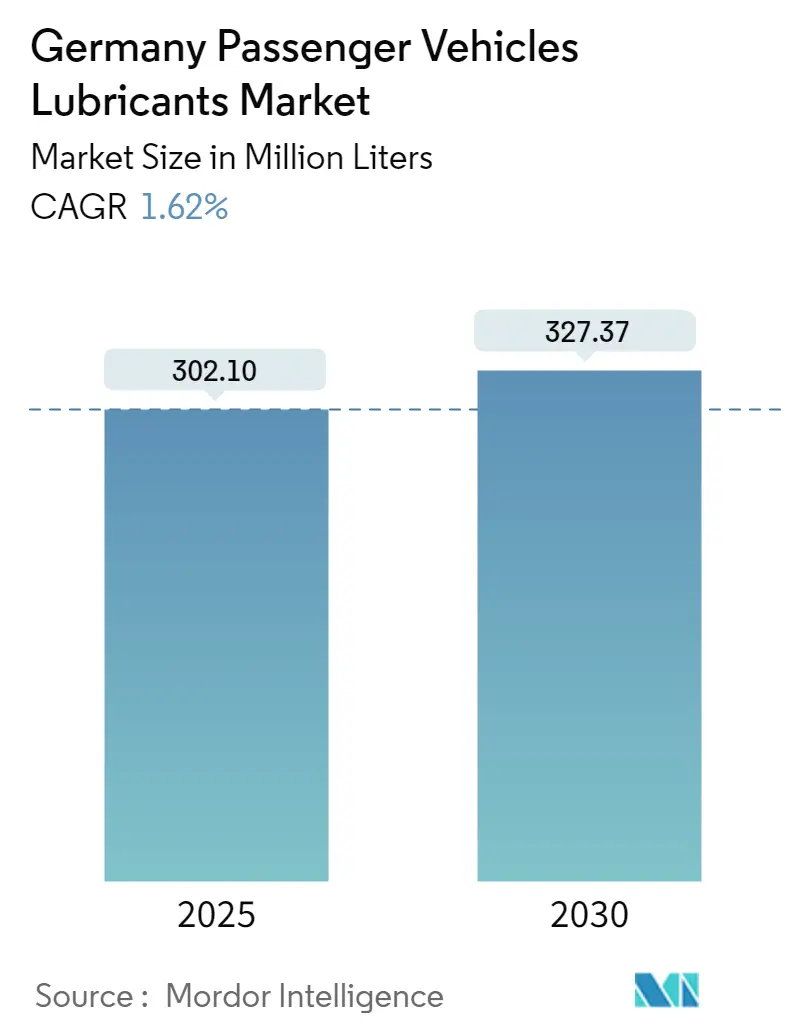
The Germany Passenger Vehicles Lubricants Market size is estimated at 302.10 million liters in 2025, and is expected to reach 327.37 million liters by 2030, at a CAGR of 1.62% during the forecast period (2025-2030).
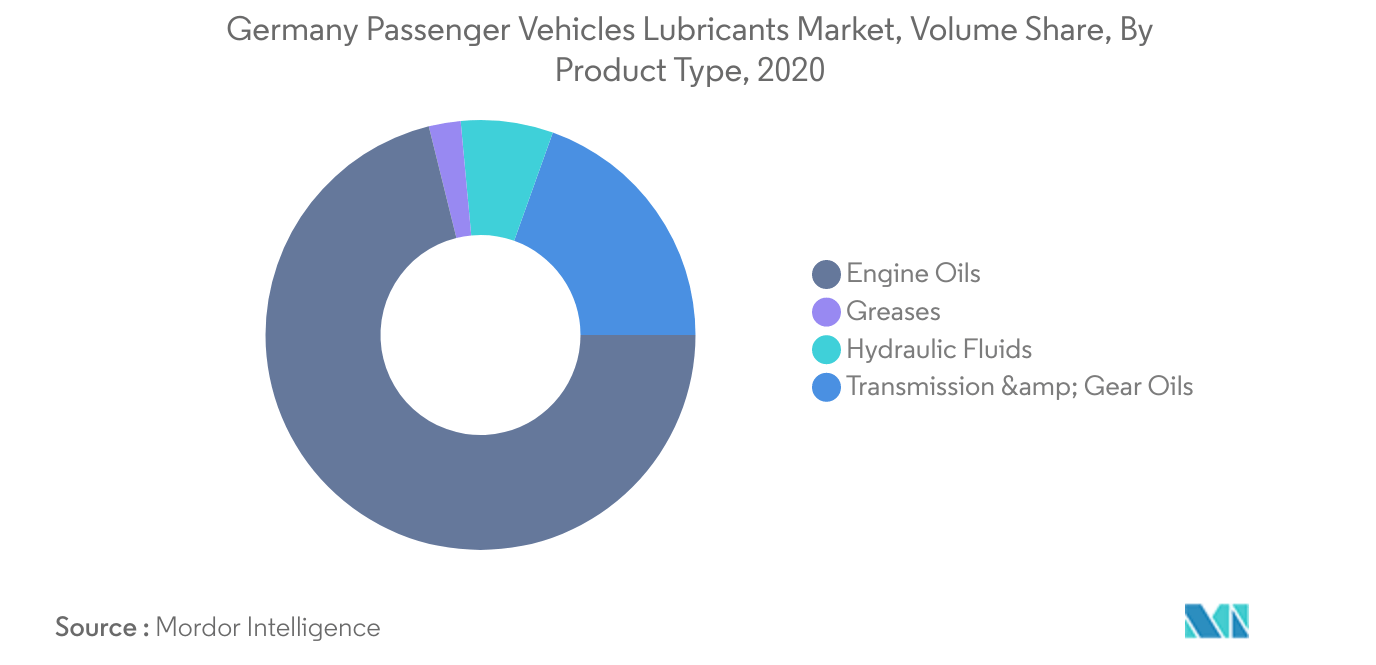
Largest Segment by Product Type - Engine Oils : Engine oil is the leading product type due to its high volume requirements and low drain interval. It is used for regular high-temperature and high-pressure applications.
Fastest Segment by Product Type - Transmission & Gear Oils : The expected recovery of passenger vehicle sales and production in the country from 2021 is likely to drive the demand for transmission oils during the forecast period.
Germany Passenger Vehicles Lubricants Market Trends and Insights
Largest Segment By Product Type : Engine Oils
Since 2016, engine oil consumption in passenger vehicles in Germany has been consistently declining. Despite growth in passenger vehicle parc, declining service intervals of passenger cars and growing penetration of electric cars have been the key factors causing this drop.
In 2020, post the COVID-19 outbreak, the usage of passenger cars significantly dropped due to restrictions imposed to curb the pandemic. Thus, lubricant consumption levels dropped by around 19% in 2020.
Although passenger vehicle sales in the country have been showing significant recovery, the second wave of the COVID-19 pandemic is likely to impact lubricant consumption. The shortage in semiconductor supply is also likely to restrict the production of major automotive OEMs in the country, and thereby impact lubricant consumption.
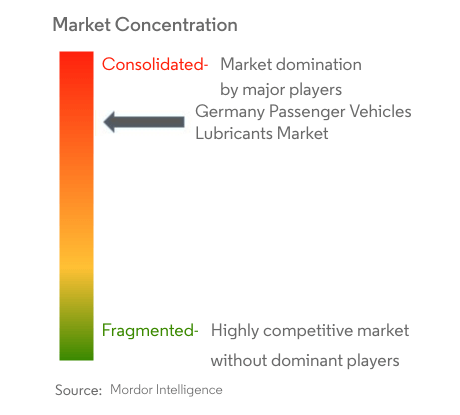
The Germany Passenger Vehicles Lubricants Market is fairly consolidated, with the top five companies occupying 71.69%. The major players in this market are BP PLC (Castrol), ExxonMobil Corporation, FUCHS, LIQUI MOLY and Royal Dutch Shell Plc (sorted alphabetically).
Germany Passenger Vehicles Lubricants Industry Leaders
BP PLC (Castrol)
ExxonMobil Corporation
FUCHS
LIQUI MOLY
Royal Dutch Shell Plc
*Disclaimer: Major Players sorted in no particular order
June 2021: TotalEnergies and Stellantis group renewed their partnership for cooperation across different segments. Along with the renewal of partnerships with Peugeot, Citroën, and DS Automobiles, the new collaboration extends to Opel, and Vauxhall as well. This partnership includes the development and innovation of lubricants, first-fill in Stellantis group vehicles, recommendation of Quartz lubricants, and shared usage of charging stations operated by TotalEnergies, among others.
May 2021: ExxonMobil and Innio entered a long-term partnership agreement for Innio's Jenbacher Series 2, 3, 4, 6, and 9 natural gas engines. This partnership is designed to expand Innio's involvement with ExxonMobil in the development of lubricants.
April 2021: FUCHS Lubricants unveiled TITAN GT1 FLEX C23 SAE 5W-30, a new high-performance engine oil for use in passenger cars and vans.
Table of Contents for Germany Passenger Vehicles Lubricants Industry Report
How big is the Germany Passenger Vehicles Lubricants Market?
The Germany Passenger Vehicles Lubricants Market size is expected to reach 302.10 million Liters in 2025 and grow at a CAGR of 1.62% to reach 327.37 million Liters by 2030.
What is the current Germany Passenger Vehicles Lubricants Market size?
In 2025, the Germany Passenger Vehicles Lubricants Market size is expected to reach 302.10 million Liters.
Who are the key players in Germany Passenger Vehicles Lubricants Market?
BP PLC (Castrol), ExxonMobil Corporation, FUCHS, LIQUI MOLY and Royal Dutch Shell Plc are the major companies operating in the Germany Passenger Vehicles Lubricants Market.
What years does this Germany Passenger Vehicles Lubricants Market cover, and what was the market size in 2024?
In 2024, the Germany Passenger Vehicles Lubricants Market size was estimated at 297.21 million Liters. The report covers the Germany Passenger Vehicles Lubricants Market historical market size for years: 2019, 2020, 2021, 2022, 2023 and 2024. The report also forecasts the Germany Passenger Vehicles Lubricants Market size for years: 2025, 2026, 2027, 2028, 2029 and 2030.
Statistics for the 2025 Germany Passenger Vehicles Lubricants market share, size and revenue growth rate, created by Mordor Intelligence™ Industry Reports. Germany Passenger Vehicles Lubricants analysis includes a market forecast outlook for 2025 to 2030) and historical overview. Get a sample of this industry analysis as a free report PDF download.