
Market Overview
| Study Period | 2020 - 2031 |
|---|---|
| Forecast Data Period | 2026 - 2031 |
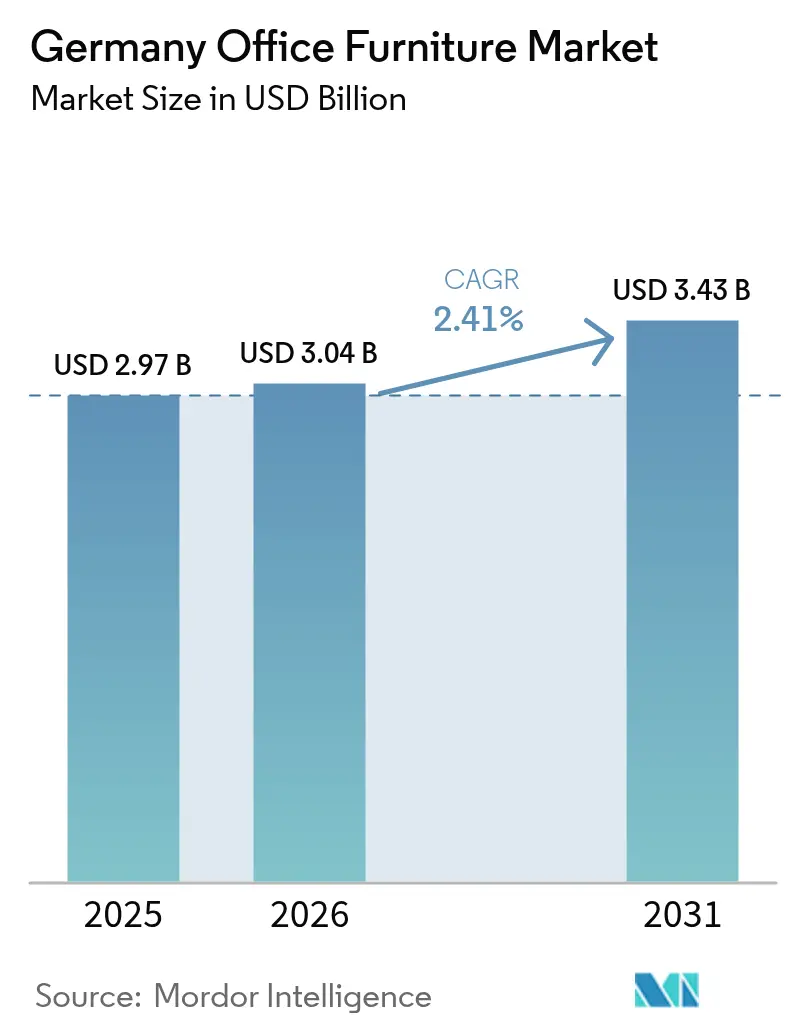
| Base Year Market Size (2025) | USD 2.97 Billion |
| Market Size (2026) | USD 3.04 Billion |
| Market Size (2031) | USD 3.43 Billion |
| Growth Rate (2026 - 2031) | 2.41 % |
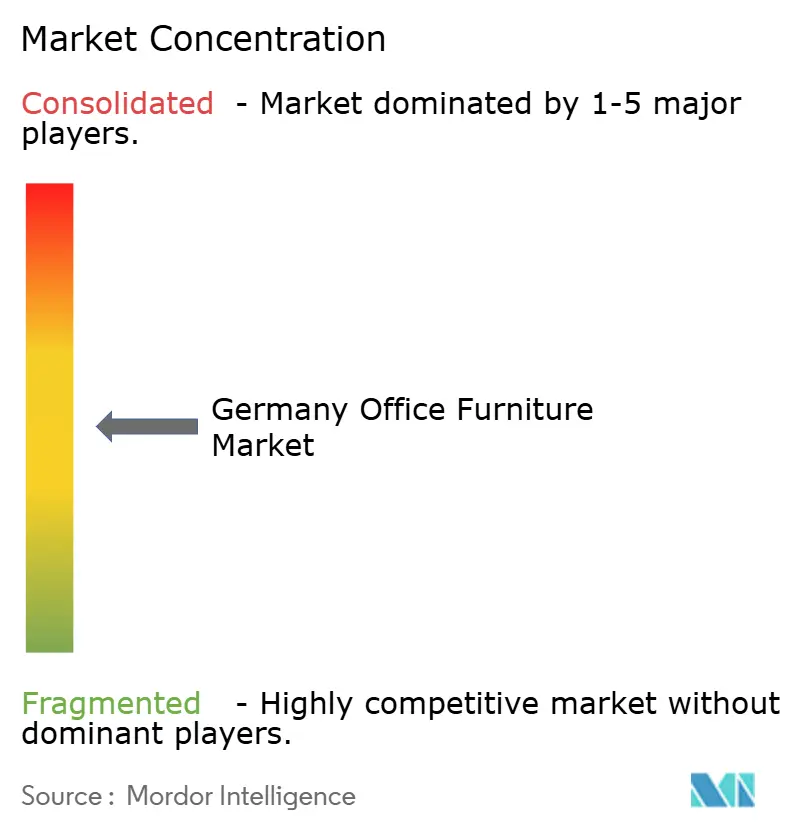
| Market Concentration | Medium |
Major Players *Disclaimer: Major Players sorted in no particular order Image © Mordor Intelligence. Reuse requires attribution under CC BY 4.0. | |
Germany Office Furniture Market Analysis by Mordor Intelligence
The Germany office furniture market size is expected to grow from USD 2.97 billion in 2025 to USD 3.04 billion in 2026 and is forecast to reach USD 3.43 billion by 2031 at 2.41% CAGR over 2026-2031. The market grows steadily because employers are re-planning spaces for hybrid work, investing in certified ergonomic seating, and favoring circular-economy procurement that supports corporate sustainability targets[1]“Toward a Circular Economy in the Furniture Industry,” Fraunhofer IPK, ipk.frahofer.de. Large redevelopment schemes in Munich, Berlin, and Frankfurt continue to open high-specification fit-out contracts, while mid-range products dominate corporate buying as firms reconcile quality expectations with cost controls. At the same time, recycled plastic and polymer innovations win share from traditional materials due to weight, design flexibility, and verified carbon reductions. Direct manufacturer sales flourish because professional buyers demand customization, project logistics, and long-term service agreements that retail formats seldom replicate.
Key Report Takeaways
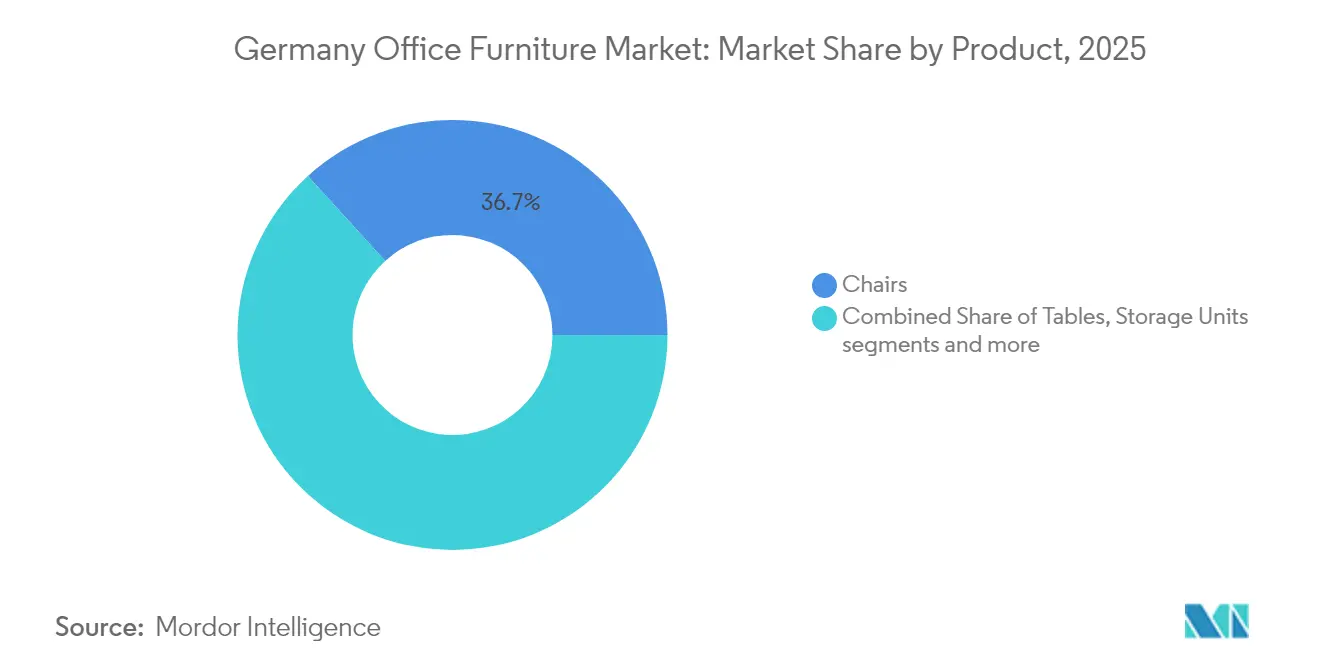
- By product category, chairs captured 36.74% revenue in 2025, while booths and office dividers are projected to register the fastest 3.69% CAGR through 2031.
- By material, wood represented 46.15% of total sales in 2025, but plastic and polymer materials will expand at a 3.59% CAGR to 2031.
- By price range, the mid-range segment controlled 58.22% revenue in 2025 and is set to grow at a 3.93% CAGR, outpacing both economy and premium tiers.
- By end-user, corporate offices commanded 42.31% of spending in 2025 and are forecast to advance at a 3.82% CAGR through 2031.
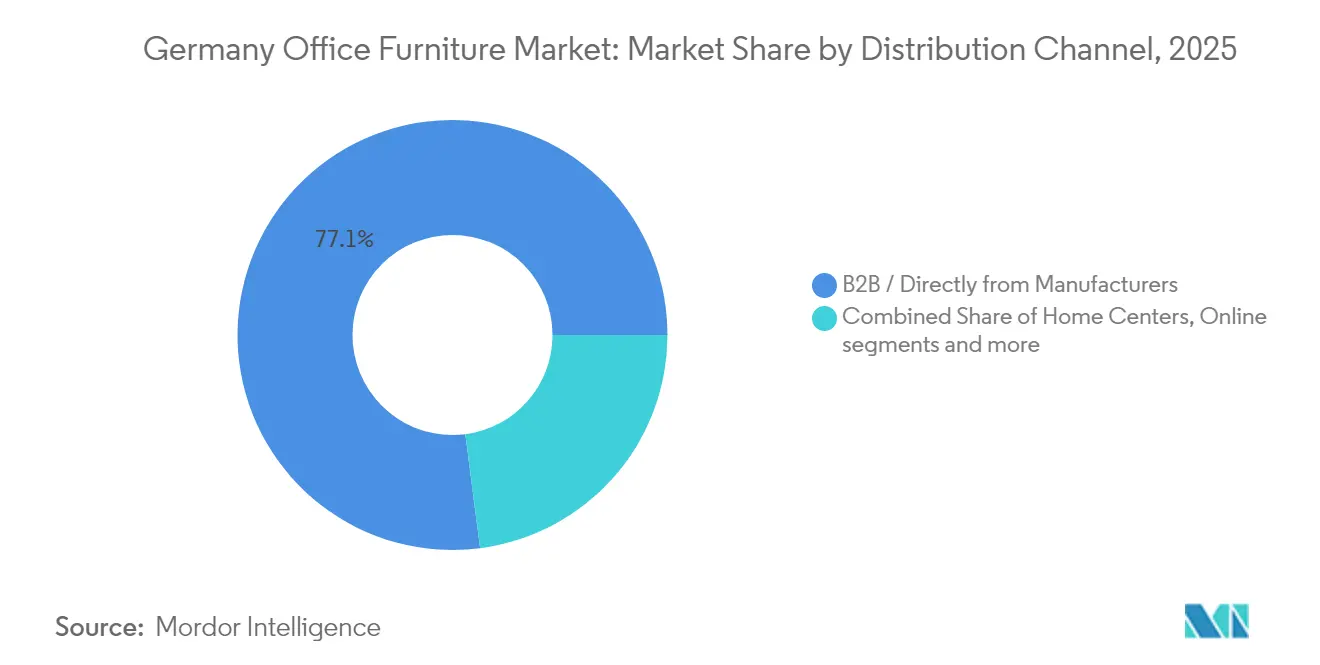
- By distribution channel, direct B2B sales from manufacturers constituted 77.05% of demand in 2025 and will rise at a 4.18% CAGR during the outlook period.
- By geography, Central Germany led with 25.11% value contribution in 2025, while Eastern Germany is set to record the fastest 3.44% CAGR.
Note: Market size and forecast figures in this report are generated using Mordor Intelligence’s proprietary estimation framework, updated with the latest available data and insights as of 2026.
Germany Office Furniture Market Trends and Insights
Drivers Impact Analysis*
| Driver | (~) % Impact on CAGR Forecast | Geographic Relevance | Impact Timeline |
|---|---|---|---|
| Ergonomic & health-focused seating boom | +0.8% | Munich and Frankfurt tech corridors | Medium term (2-4 years) |
| Workspace redesign for hybrid models | +0.7% | Berlin, Hamburg, Düsseldorf | Short term (≤2 years) |
| Commercial construction in tech hubs | +0.5% | Munich Parkstadt Schwabing, Berlin Mitte, Frankfurt CBD | Long term (≥4 years) |
| Sustainable procurement incentives | +0.4% | Baden-Württemberg, North Rhine-Westphalia | Medium term (2-4 years) |
| DIN-driven demand for acoustic micro-pods | +0.3% | Corporate headquarters nationwide | Short term (≤2 years) |
| Circular-economy leasing models | +0.2% | Startup ecosystems in Berlin and Munich | Long term (≥4 years) |
| Source: Mordor Intelligence | |||
Ergonomic & Health-Focused Seating Boom
German employers now treat seating as a risk-mitigation and talent-retention tool rather than a commodity purchase. DIN EN 1335 compliance underpins specification lists, and brands such as Sedus embed life-cycle analyses in early design to prove low environmental impact. Meanwhile, innovators like Aeris market “active-sitting” chairs that exceed DIN requirements by encouraging micro-movement, a feature popular with wellness-oriented firms[2]“Standards vs. health: Why innovative office chairs beyond the DIN standard are so important,” Aeris, aeris.de. Corporate buyers also weigh return-to-office targets; providing comfortable, height-adjustable seating is viewed as a tangible incentive that makes on-site work more appealing. Because occupational-health statutes require suitable equipment, even cost-conscious companies continue to refresh chair fleets on predictable cycles, ensuring baseline demand stability within the Germany office furniture market.
Workspace Redesign for Hybrid Models
Office utilization has fallen to 40-50% of pre-pandemic norms, prompting facilities managers to slash dedicated desks and introduce flexible “activity-based” zones[3]Spotlight: Die Hybridarbeitswelt und ihre Konsequenzen für die Büromärkte,” Savills, savills.co.uk. Hot-desking ratios of 1:1.25 become viable when paired with modular furniture that employees can roll, stack, or fold within minutes, reducing wasted floor area and trimming rental costs by as much as USD 750 per workstation each year. Vendors able to ship coordinated suites—tables with locking casters, stackable storage, lounge modules with integrated power—win the new-build tenders. IoT-ready desks that feed occupancy data into smart-building dashboards also enter shortlists, signaling a blend of furniture and prop-tech that is reshaping procurement criteria across the Germany office furniture market.
Commercial Construction in Tech Hubs
Munich’s Parkstadt Schwabing, Berlin Mitte, and Frankfurt’s banking district continue to attract global headquarters and R&D centers, each new lease triggering turnkey fit-out projects that demand complete furniture packages. Architects on these schemes specify recycled materials, cradle-to-cradle certificates, and acoustic solutions capable of achieving DGNB Platinum ratings. Because tenant mixes skew toward software and life-science firms, requests often include hacking rooms, maker spaces, and project zones furnished with mobile whiteboards and sit-stand benches. Suppliers that master project-coordination—aligning delivery windows with tight construction schedules—secure repeat contracts in these high-growth clusters, reinforcing regional revenue streams for the Germany office furniture market.
Sustainable Procurement Incentives
Blue Angel labels and FSC or PEFC chain-of-custody proofs have become standard bid requirements. Clients weigh carbon data down to kilogram-per-seat level, and furniture-as-a-service offerings such as NORNORM’s subscription model resonate because they cut embodied emissions and free cash flow for core investments. Manufacturers with domestic supply chains gain credibility as low-transport contenders, while those lacking verifiable traceability risk exclusion from public tenders. As ESG disclosures tighten, circularity metrics like repairability and take-back rates now influence corporate purchasing just as strongly as styling or price, steering revenue toward brands that embrace closed-loop design within the Germany office furniture market.
Restraints Impact Analysis*
| Restraint | (~) % Impact on CAGR Forecast | Geographic Relevance | Impact Timeline |
|---|---|---|---|
| Shrinking leased office footprints | -0.6% | Secondary business districts across Germany | Medium term (2-4 years) |
| Raw-material price volatility | -0.4% | Global sourcing hubs | Short term (≤2 years) |
| EU/German EPR compliance costs | -0.3% | Nationwide, with EU spill-over | Medium term (2-4 years) |
| Skilled upholsterer shortage | -0.2% | Highest in Eastern manufacturing clusters | Long term (≥4 years) |
| Source: Mordor Intelligence | |||
Shrinking Leased Office Footprints
Hybrid work cuts demand for rows of identical workstations and erodes order volumes tied to pure seat counts. While flagship downtown towers remain desirable, landlords in peripheral zones struggle with double-digit vacancy, and tenants opt for smaller, higher-quality suites. Furniture producers reliant on large-plateau projects, therefore, see bid lists shrink or fragment into phased-purchase tranches. Vendors who pivot toward leasing, refurbishment, or quick-turnaround retrofit packages cushion revenue shortfalls and continue to meet the evolving space needs of the Germany office furniture market.
Raw-Material Price Volatility
Oscillating prices for timber, metals, and engineered substrates complicate costing and quotation validity. Smaller workshops without hedging tools face margin compression, forcing them to raise list prices mid-year or accept lower profitability. To protect order pipelines, many now pre-quote alternate material specifications—offering solid beech, veneer, or recycled polymer options—so clients can adjust selections when spot prices spike. The turbulence accelerates R&D into bio-composites and post-consumer plastics, both viewed as buffers against commodity swings in the Germany office furniture market.
*Our forecasts treat driver/restraint impacts as directional, not additive. The impact forecasts reflect baseline growth, mix effects, and variable interactions.
Segment Analysis
By Product: Chairs Lead, Pods Accelerate
Chairs remain the cornerstone of the Germany office furniture market and hold 36.74% of total sales. Employers view ergonomically certified task seating as compulsory for compliance, and hot-desking pushes demand for models with intuitive adjustments that suit multiple users in a single day. Meeting and guest chairs experience renewal as companies convert static conference rooms into dynamic collaboration hubs outfitted with lightweight seating that can be rearranged at will.
A new center of gravity is emerging around acoustic booths and dividers, the fastest-growing niche at 3.69% CAGR. Open-plan offices and video meetings strain acoustics, driving interest in pods that temper noise and supply visual privacy. Brands like Mute-Labs package LED lighting, ventilation, and integrated power in turnkey modules, making pods a quick upgrade for landlords seeking to attract tenants without structural alterations. As work modes fragment, even small firms allocate budget for at least one phone booth to ensure distraction-free calls, reinforcing long-term momentum within the Germany office furniture market.


By Material: Wood Dominates, Plastics Rise
Wood furniture accounts for 46.15% of spending because German buyers equate natural surfaces with quality, and domestic forests supply certified inputs at scale. Vendors tout regional sourcing to lower transport emissions and emphasize repairability that extends product life. Oak and beech veneers remain mainstream, complemented by sustainable finishes free of formaldehyde and solvents.
Plastics and advanced polymers, however, post the quickest 3.59% CAGR. Manufacturers inject recycled content and color-through resins that reduce paint steps, thereby shrinking carbon footprints. Lightweight shells also lower shipping costs and simplify end-of-life separation for recycling. Composite hybrids—polymer skins over metal or wood cores—gain favor in chairs and pods where complex geometries enhance ergonomics or acoustics. This shift signals a gradual, innovation-led diversification of materials in the Germany office furniture market.

By Price Range: Mid-Range Strikes the Balance
Mid-range lines capture 58.22% of revenue because they deliver the sweet spot of robust engineering, DIN compliance, and competitive warranties at attainable price points. Procurement teams tasked with cost savings feel safe choosing brands that combine steel frames, melamine tops, and modest design flair. Bulk orders often bundle mid-range desks and storage with a select number of premium statement pieces for reception or executive areas.
Economy products serve startups and public agencies on tight budgets but face durability skepticism that limits large-enterprise uptake. Premium collections cater to law firms, consultancies, and tech unicorns where brand prestige justifies higher spend. Some premium demand now migrates into subscription models that offer high-spec items with lower upfront cash outlay, further blurring traditional tier boundaries inside the Germany office furniture market.
By End-User: Corporate Offices at the Core
Corporate offices generate 42.31% of overall demand because Germany hosts global automakers, banks, and software firms that constantly refresh work environments to attract talent. These buyers require synchronized installations across multiple floors or campuses and demand precise scheduling around move-in dates. Sustainability reporting has become a staple clause, compelling suppliers to deliver product passports and circularity metrics alongside CAD drawings.
Healthcare, education, and government place steady, specification-heavy orders that prioritize hygiene, robustness, and safety certifications. Growth in outpatient clinics and university research centers brings specialized needs such as antimicrobial surfaces and height-adjustable lab benches. Retail and hospitality back offices buy smaller volumes yet lean toward stylish, quick-ship collections that match front-of-house aesthetics. Each segment’s nuanced criteria enrich the solution landscape for the Germany office furniture market.
By Distribution Channel: B2B Direct Rules
Direct manufacturer relationships handle 77.05% of value because corporate clients need layout planning, customized finishes, and staged deliveries impossible to achieve through standard retail. Dealers integrated into these networks provide local measurement, installation, and service, ensuring that warranty terms are preserved. As a result, brands that invest in digital configurators and dealer training secure a higher share of wallet.
Retail remains relevant for SMEs and growing home-office demand, with showrooms allowing buyers to test ergonomics firsthand. Online platforms succeed at accessories and repeatable SKUs but rarely close six-figure fit-out contracts. Furniture-as-a-service operators occupy a middle ground, bundling products, logistics, and financing into subscriptions that lessen capex and appeal to agile companies—a model poised to expand within the Germany office furniture market.
Geography Analysis
Central Germany retains leadership thanks to Frankfurt’s finance cluster, where global banks fit out landmark towers with premium reception suites, executive boardrooms, and advanced trading-desk setups. Interior standards emphasize acoustic performance and secure cable management, pushing orders toward specialized suppliers able to integrate AV and compliance hardware seamlessly. The German office furniture market size attributable to Central Germany is reinforced by dense subcontractor networks that handle installation without cross-border logistics delays.
Eastern Germany delivers the fastest growth as Berlin’s startup ecosystem spawns co-working campuses and innovation labs needing modular, brand-worthy interiors. Medium-sized leases provide steady furniture orders spread across multiple project phases, allowing suppliers to refine agile manufacturing processes. Cities such as Leipzig and Dresden attract semiconductor and logistics investments, each new facility requiring administrative offices and training centers that expand regional demand within the German office furniture market.
Southern Germany benefits from Munich’s technology corridor and Stuttgart’s engineering excellence. Premium rents make space efficiency critical, so buyers favor compact sit-stand desks, stackable lounge modules, and integrated storage to maximize rentable area. Western Germany leverages dense population centers and an industrial heritage to sustain base-load demand, while Northern Germany’s Hamburg builds on media and maritime clusters and prefers coastal aesthetic finishes and recycled ocean plastics in furniture lines.
Regulatory Landscape
Office furniture placed on the German market is covered by product safety and workplace-use requirements, with the Product Safety Act (ProdSG) and the Ordinance on Workplaces (ArbStättV) setting the core framework. For workplace installations, the Federal Institute for Occupational Safety and Health (BAuA) publishes Technical Rules for Workplaces (ASR), which translate ArbStättV obligations into practical criteria that show up in specifications for desks, seating, and other spatial elements.
A key compliance milestone for suppliers and importers came on 19 February 2026, when a revised ProdSG entered into force to align German rules with the EU General Product Safety Regulation (GPSR 2023/988), which has been applicable since 13 December 2024. This alignment increases emphasis on documented risk assessment, German-language product information, and market-surveillance readiness. DGUV guidance, including DGUV principles for office furniture, continues to be used as a reference point for durability, stability, and safe functionality in professional procurement.
Value Chain Analysis
The value chain starts with raw materials and components, including certified wood panels and veneers, metals, and recycled plastics and polymers. It also depends on fittings such as hinges, drawer systems, and lifting columns supplied by specialist hardware providers. Manufacturing covers both large industrial producers and smaller regional workshops, with increasing use of digital planning and configuration standards (for example, OFML) to move product data into dealer tools, workplace planning software, and tender documentation.
Sales are led by direct B2B relationships and dealer networks that handle space planning, customization, installation, and after-sales service. Retail and online channels remain more relevant for standardized SKUs and smaller buyers. The chain is being reshaped by compliance and operational pressures, including Supply Chain Due Diligence requirements for larger employers (Lieferkettengesetz) and the EU Ecodesign for Sustainable Products Regulation (ESPR), in force since July 2024, which raises expectations for documentation around durability, repairability, and recyclability. On the operational side, industry-reported weak demand in 2025 and restructuring actions, including König + Neurath entering self-administration proceedings in late 2025, point to the value of working-capital discipline, shorter lead-time capabilities, and service-led offerings such as refurbishment and take-back to support throughput.
Competitive Landscape
Germany’s office furniture arena is best described as competitively balanced, with a handful of large industrial manufacturers sharing the stage with nimble specialists and strong retail chains. Retail consolidation—illustrated by XXXLutz absorbing Porta—has shifted bargaining power, yet many mid-sized producers counter by emphasizing design originality, bespoke finishes, and intimate dealer relationships that big-box operators cannot easily duplicate. Regional heritage brands also leverage “Made in Germany” cachet, which resonates with domestic buyers who value local employment and craftsmanship continuity.
Manufacturers increasingly differentiate on sustainability rather than pure aesthetics. Firms such as Sedus publish transparent supply-chain data and guarantee spare-part availability for over a decade, an assurance prized by facility managers aligning with circularity benchmarks. Acoustic-pod makers like Mute-Labs carve out profitable niches by coupling refined engineering with evidence-based productivity claims; their products appear in showrooms alongside classic desks and chairs, demonstrating how ancillary categories can evolve into primary purchase drivers. Meanwhile, component suppliers—hinge, glide, and lifting-column producers—shape downstream innovation by releasing lower-carbon alloys and smart actuators that enable sleek new furniture silhouettes.
The digital layer is the newest competitive frontier. Forward-looking brands equip desks with occupancy sensors and cloud dashboards, selling subscription software that reveals underused zones and guides space rightsizing. This advisory capability moves suppliers closer to consultancy territory, fostering long-term client intimacy and recurring revenue. Companies reluctant to embrace digitalization risk relegation to commodity status as the German office furniture market rewards holistic solutions that blend product, data, and service.
Germany Office Furniture Industry Leaders
Sedus
Steelcase Inc.
Haworth Inc.
MillerKnoll Inc.
König + Neurath AG
- *Disclaimer: Major Players sorted in no particular order

Market Opportunities and Future Outlook
Circular and service-based procurement is creating room for manufacturers that can scale take-back, refurbishment, and redeployment, especially as ESPR moves sustainability requirements from bid language into measurable product attributes and documentation. Sedus' move toward a circular system in Germany (S:ircle, covering rental, refurbished purchase, returns, and professional refurbishment) is one example of OEMs packaging products with lifecycle services that support corporate ESG reporting and space-rightsizing constraints.
A second opportunity is tied to fit-out delivery reliability for multi-phase projects, where component platforms and process upgrades reduce lead-time risk. In 2026, Demmelhuber Holz und Raum GmbH adopted Hettich AvanTech YOU to improve manufacturing efficiency and delivery reliability, while Febru expanded sales coverage and planned further investment in wood processing and edge finishing. These actions reinforce a shift toward supplier selection based on execution certainty, documented compliance, and the ability to deliver modular solutions for hybrid layouts, including privacy and acoustic elements aligned with DIN workplace expectations.
Recent Industry Developments
- July 2026: Sedus introduced S:ircle in Germany, a circular economy system spanning rental, refurbished purchases, product returns, and professional refurbishment services. The move operationalizes take-back and second-life workflows that align with tighter sustainability documentation in tenders and lowers barriers for customers shifting from capex-heavy fit-outs to lifecycle-based procurement.
- May 2026: MillerKnoll, via Knoll, launched the Konzert private office system at Clerkenwell Design Week, with availability across Europe and the Middle East through certified dealers. The launch targets demand for flexible, enclosed spaces within hybrid offices, reinforcing competitive focus on modular systems that support privacy and rapid reconfiguration.
- November 2025: Konig + Neurath filed for self-administration proceedings at the Frankfurt am Main District Court amid a liquidity crunch following a sharp order decline since mid-2025. The filing underscores how volatility in corporate fit-out timing can stress mid-market manufacturers and accelerates industry attention on cost control, portfolio rationalization, and service revenue such as refurbishment and leasing.


Research Methodology Framework and Report Scope
Market Definition and Coverage
For this study, the Germany office furniture market covers free standing furnishings used in office and workplace settings, such as desks, office chairs, storage cabinets, tables, and lounge seating, where installation is not required.
Scope exclusions: Built in or installation led fit out items, along with broader construction and interior contracting services, are kept outside this market boundary.
Segmentation Overview
- By Product
- Chairs
- Employee Chairs
- Meeting Chairs
- Guest Chairs
- Tables
- Conference Tables
- Desks
- Other Tables
- Storage Units
- Filing Cabinets
- Bookcases & Shelving
- Sofas / Soft Seating
- Booths & Office Dividers
- Other Office Furniture (Stools, Reception Furniture, Accessories, Others)
- Chairs
- By Material
- Wood
- Metal
- Plastic & Polymer
- Other Materials
- By Price Range
- Economy
- Mid-range
- Premium
- By End-user
- Corporate Offices
- Healthcare Offices
- Educational Institutions
- Government & Public Offices
- Hospitality & Retail Back-office
- Others
- By Distribution Channel
- B2C / Retail
- Home Centers
- Specialty Furniture Stores
- Online
- Other Distribution Channels
- B2B / Direct from Manufacturers
- B2C / Retail
- By Geography
- Northern Germany
- Western Germany
- Central Germany
- Eastern Germany
- Southern Germany
Data Sources, Market Sizing, and Validation
Desk Research
We first built the market frame using public statistics and sector signals that explain how much office furniture is being produced, traded, and consumed in Germany. Common references included sources such as Destatis, Eurostat, UN Comtrade, the European Commission trade database, and German customs style import export tables where available. These helped us set practical boundaries and spot step changes in office investment patterns.
Next, company disclosures and industry reporting were used to shape assumptions that are hard to observe in government tables, like typical selling channels and price movement by material. We reviewed annual reports, investor presentations, retailer catalog trends, and reputable business press, then cross checked them with paid subscriptions used for company financials, news screening, patent tracking, and shipment level trade reads when needed. The sources mentioned here are illustrative, and we also used other public and paid references to collect, verify, and clarify data points where there were inconsistencies.
Primary Interviews and Surveys
To close gaps left by public data, we spoke with manufacturers, distributors, large buyers, and trade side experts who track workplace refits and procurement cycles. These inputs helped validate pricing logic, including discounting, refine the online versus offline mix, and understand how demand differs between new office setups and replacement purchases across German regions.
Distribution of primary research fieldwork respondents
| Company type | Respondent position |
|---|---|
| Top tier: 36% | CXOs: 18% |
| Mid tier: 46% | Functional/Unit leaders: 40% |
| Smaller Players: 18% | Managers: 42% |
Market-Sizing & Forecasting
Our sizing starts with a top down build where production and trade data reconstruct the addressable office furniture pool for Germany, which is then adjusted for the portion that fits the defined free standing scope. To keep the totals realistic, we corroborated them with selective bottom up checks such as sampled price per unit multiplied by estimated unit volumes for desks, seating, and storage, plus distributor channel checks where information was available.
Key inputs that were used to shape the model included office employment and workplace utilization signals, new office starts and refurbishment activity, import versus domestic supply mix, and average selling price movement by material (wood, metal, plastics) and by product group. Because procurement is often project based, replacement cycles and tender timing were also used as practical indicators when demand swings looked unusual.
For forecasting, scenario analysis was used, supported by a light multivariate view that ties demand to macro indicators like services employment, corporate investment sentiment, and construction refurbishment momentum. Where bottom up views were thin for smaller regional sellers or online only channels, assumptions were filled using channel mix ranges validated in interviews, followed by rebalancing to the top line control totals.
Data Validation & Update Cycle
We validate estimates by comparing the model output against independent signals, including trade flows, production direction, and price movement seen in catalogs and procurement feedback. Variance checks are run at product and material level so spikes can be explained by a real shift, such as higher seating demand, rather than a modeling artifact.
Before sign off, the work is reviewed in multiple steps, and follow up calls are triggered when a key assumption shifts or when a data series breaks trend. Reports are refreshed annually, and interim updates are done when material events occur, after which a final pre delivery pass is completed so clients receive the latest updated view.
Mordor Intelligence's Germany Office Furniture Market Estimate Compared With Other Published Estimates
Published market values for Germany office furniture can vary even when the product names look similar, since the timing of currency conversion, the price logic behind average selling prices, and the freshness of the demand checks are not handled the same way. Differences also come from what gets counted as office furniture versus adjacent fit out spending, which can quietly expand the total.
When assumptions are refreshed more often, short term swings in procurement, discounting, and online channel share are captured sooner, which changes the current year size before any long range forecast is applied. In this study, exchange rates and ASP progression are rechecked close to publication and validated against trade and production signals, a refresh led step that keeps the 2025 value aligned with the defined free standing scope used by Mordor Intelligence.
Benchmark comparison
| Source | Market Size | Gaps in Research Methodology |
|---|---|---|
| Mordor Intelligence | USD 2.97 B (2025) | |
| Industry Association A | USD 2.30 B (2025) | Often aligns to domestic shipment value in local currency and may under count imported finished office furniture, while conversion timing and discount effects are handled differently. |
| Trade Journal B | USD 3.60 B (2025) | Can fold in installation led workplace fit out items or broader commercial furniture spend, and may apply higher blended prices without separating free standing products from adjacent categories. |
The spread across the table is mainly explained by scope boundaries and by how quickly pricing and currency assumptions are updated before publishing. By keeping the demand pool tied to free standing office furniture and then checking it against multiple external signals, the final number stays traceable to clear variables and repeatable steps.


Key Questions Answered in the Report
What is the current value of the Germany office furniture market?
It stands at USD 3.04 billion in 2026 and should reach USD 3.43 billion by 2031.
Which product category dominates spending?
Ergonomic chairs lead, representing 36.74% of 2025 revenue thanks to DIN-driven compliance needs.
Which region is growing fastest?
Eastern Germany, anchored by Berlin’s tech sector, is projected to expand at 3.44% CAGR.
How are firms adapting to hybrid work?
They spec modular desks, mobile storage, and acoustic pods that let teams reconfigure layouts in real time.
Why is sustainability a key purchase driver?
Buyers increasingly demand FSC-certified wood, recycled plastics, and subscription models that cut CO? emissions by up to 70%.
Who controls distribution?
Direct B2B channels dominate because corporate clients need customized design, staged deliveries, and long-term service.
Page last updated on:


 Your data is secure and never sold or shared.


