
Market Overview
| Study Period | 2020 - 2031 |
|---|---|
| Forecast Data Period | 2026 - 2031 |
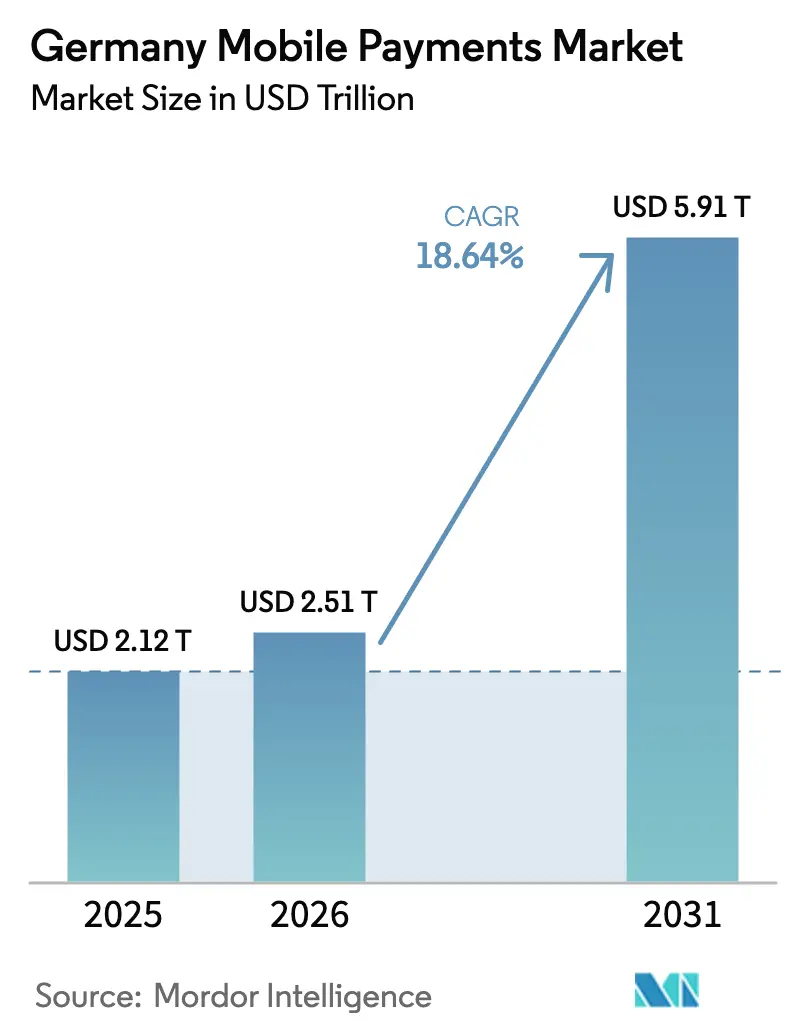
| Base Year Market Size (2025) | USD 2.12 Trillion |
| Market Size (2026) | USD 2.51 Trillion |
| Market Size (2031) | USD 5.91 Trillion |
| Growth Rate (2026 - 2031) | 18.64% CAGR |
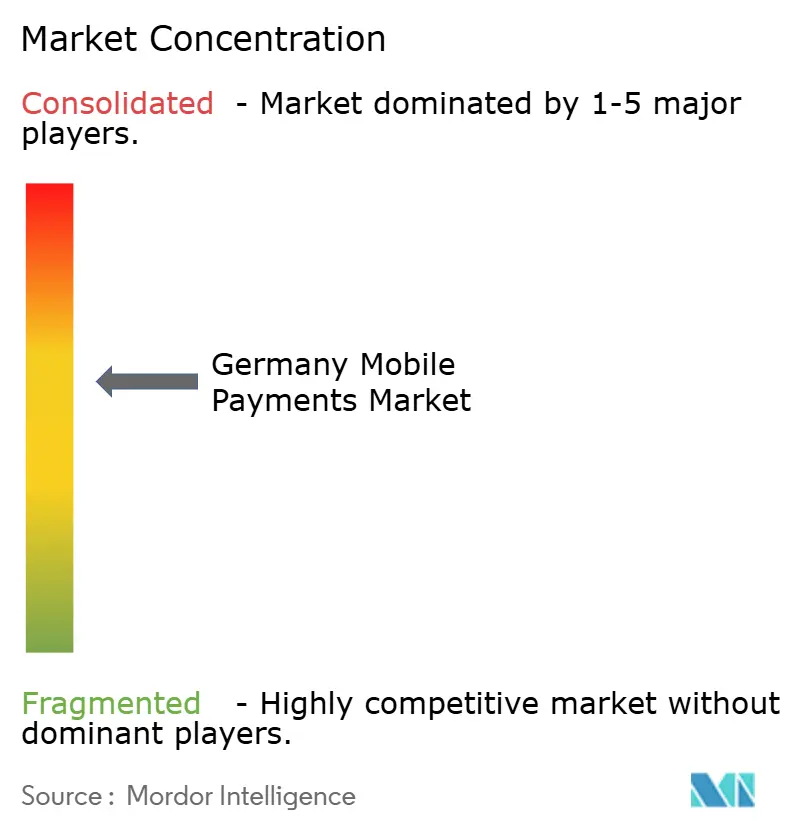
| Market Concentration | Medium |
Major Players *Disclaimer: Major Players sorted in no particular order Image © Mordor Intelligence. Reuse requires attribution under CC BY 4.0. | |
Germany Mobile Payments Market Analysis by Mordor Intelligence
Germany mobile payments market size in 2026 is estimated at USD 2.51 trillion, growing from 2025 value of USD 2.12 trillion with 2031 projections showing USD 5.91 trillion, growing at 18.64% CAGR over 2026-2031. Rapid infrastructure upgrades, strong regulatory momentum under PSD3 and eIDAS 2.0, and a decisive consumer shift from cash to digital channels underpin this growth.[1]European Central Bank, “Payments statistics: first half of 2024,” ecb.europa.eu Real-time settlement requirements, the nationwide retirement of Giropay, and large-scale retailer investments in contactless terminals create an environment where service reliability now outpaces mere acceptance as the primary competitive differentiator. Intensifying collaboration between banks and fintechs, coupled with record venture financing for payment start-ups, accelerates product innovation despite margin pressure from interchange-fee caps.[2]Global Payments Inc., “Global Payments and Commerzbank Announce Joint Venture in Germany,” investors.globalpayments.com Cybersecurity, demographic resistance among older users, and dependence on US mobile-OS ecosystems temper the upside, yet overall momentum positions Germany as a core test bed for European payment sovereignty initiatives.3Bundeskriminalamt, “Cybercrime,” bka.de
Key Report Takeaways
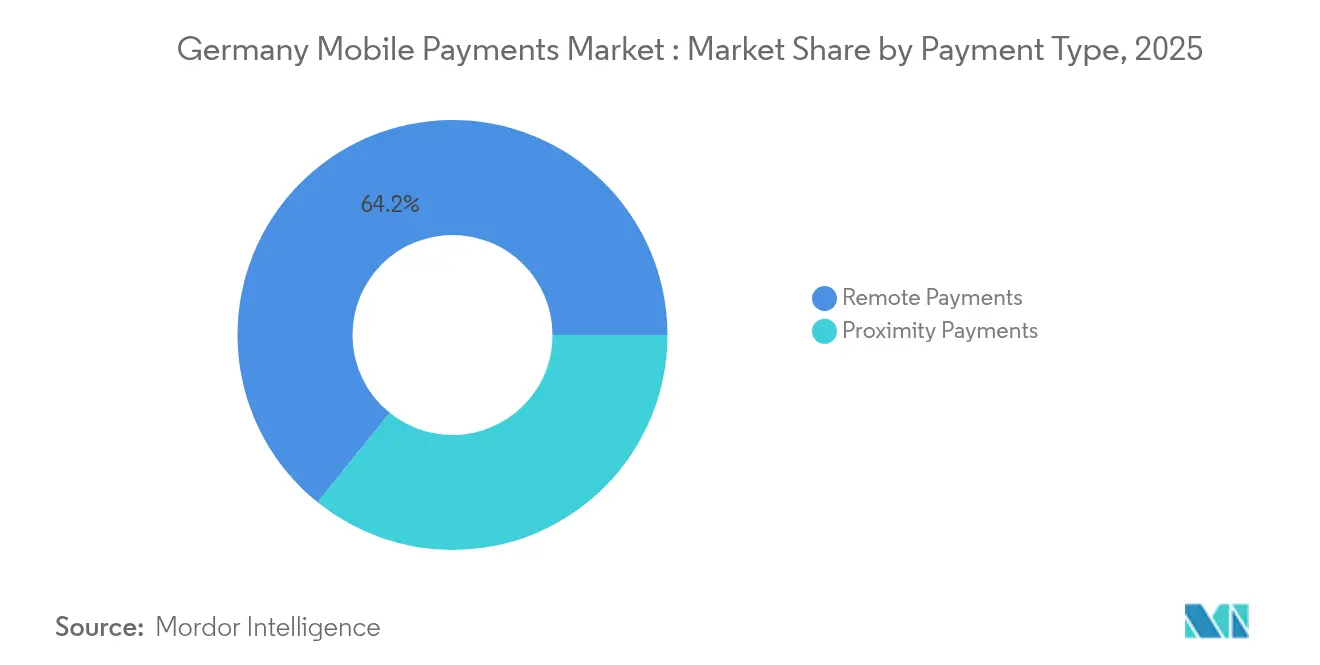
- By payment type, remote payments led with 64.20% of Germany mobile payments market share in 2025; proximity payments are projected to expand at a 20.5% CAGR through 2031.
- By transaction type, point-of-sale transactions accounted for 45.40% of Germany mobile payments market size in 2025, while other transaction categories are forecast to grow at 22.6% CAGR to 2031.
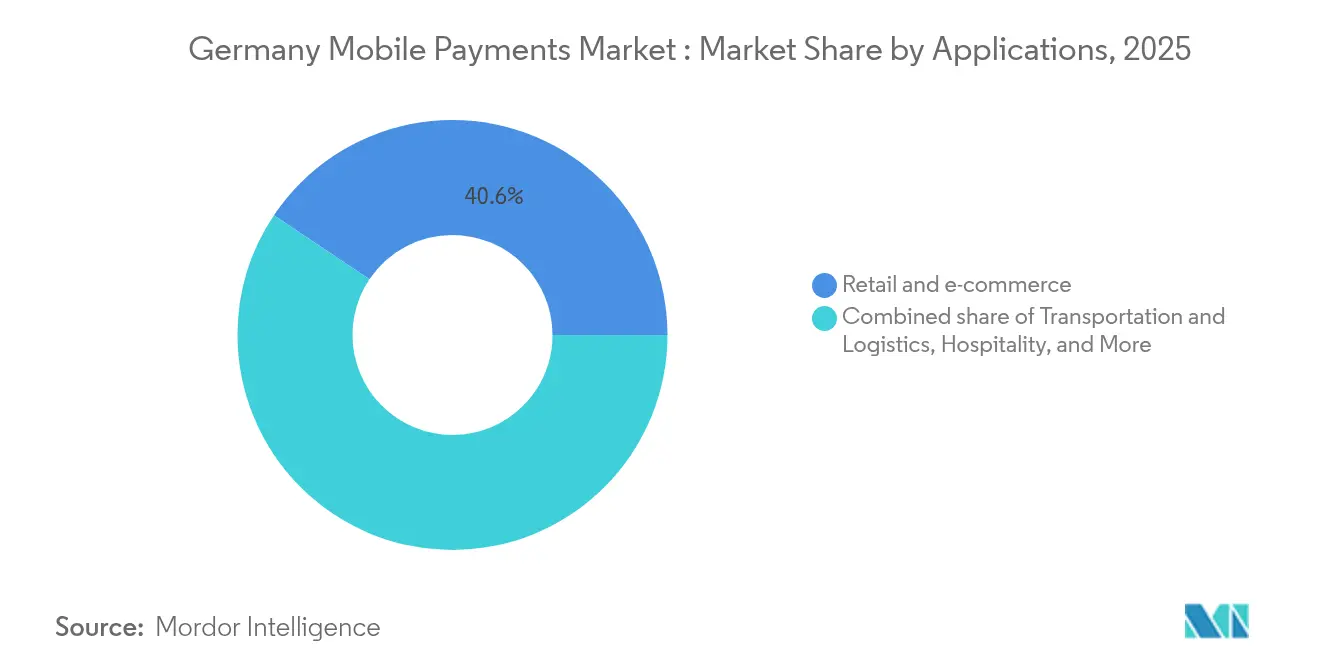
- By application, retail & e-commerce held 40.60% share of the Germany mobile payments market in 2025; transportation & logistics is advancing at a 23.9% CAGR between 2026-2031.
- By end-user, personal users commanded 87.30% of the Germany mobile payments market in 2025, whereas business adoption is rising at a 19.8% CAGR through 2031.
Note: Market size and forecast figures in this report are generated using Mordor Intelligence’s proprietary estimation framework, updated with the latest available data and insights as of 2026.
Germany Mobile Payments Market Trends and Insights
Drivers Impact Analysis*
| Driver | (~) % Impact on CAGR Forecast | Geographic Relevance | Impact Timeline |
|---|---|---|---|
| Surge in contactless POS infrastructure penetration | +4.2% | National, concentrated in urban centers | Medium term (2-4 years) |
| E-commerce expansion among SMEs adopting mobile checkout | +3.8% | National, stronger in Bavaria and North Rhine-Westphalia | Short term (≤ 2 years) |
| Real-time TIPS integration into mobile wallets | +3.1% | EU-wide, early adoption in Germany | Medium term (2-4 years) |
| Digital ID & eIDAS 2.0 wallet enabling frictionless KYC | +2.9% | EU-wide, pilot programs in Germany | Long term (≥ 4 years) |
| Retailer-led closed-loop wallets (e.g., Lidl Pay) | +2.3% | National, retail-concentrated regions | Short term (≤ 2 years) |
| Source: Mordor Intelligence | |||
Surge in Contactless POS Infrastructure Penetration
Nationwide terminal density has reached a point where availability no longer restricts proximity payments. Contactless card transactions rose 13.2% year-on-year during H1 2024, with Germany contributing a notable share of the 25.8 billion payments recorded. Retailers such as REWE use computer-vision formats that combine cashierless checkout with mobile apps, shifting competition toward user-experience optimisation.[4]Retail Technology Innovation Hub, “GenAI, computer vision, and new commerce platforms,” retailtechinnovationhub.com Sparkasse’s Alipay+ integration illustrates how established banks leverage upgraded terminals to capture cross-border flows during large events. Greater confidence in contactless reliability speeds merchant onboarding, strengthening the Germany mobile payments market.
E-commerce Expansion Among SMEs Adopting Mobile Checkout
SMEs account for 99% of German businesses and are central to domestic commerce digitisation. Government “go-digital” subsidies lower adoption barriers, allowing providers such as Stripe and Commerz Globalpay to package mobile checkout with value-added analytics for smaller merchants. Partnerships between incumbent banks and fintechs—exemplified by Commerzbank’s digital card launch—target cost reduction and working-capital optimisation for merchants with limited IT resources. The Germany mobile payments market therefore captures incremental volumes from previously cash-centric micro-merchants.
Real-time TIPS Integration into Mobile Wallets
Mandatory instant euro transfers within 10 seconds make speed and cost permanent differentiators. Wero’s multi-country wallet builds on TIPS rails to challenge US rivals, attracting early adopters among Germany’s digitally active consumers. Deutsche Bundesbank surveys show 80% of residents already have access to instant transfers, validating technical readiness for wallet integration. As execution risk on latency falls, competitive focus turns toward loyalty, budgeting tools, and embedded lending inside wallets.
Digital ID & eIDAS 2.0 Wallet Enabling Frictionless KYC
EU digital-identity pilots allow credential sharing across public and private services. Germany’s 2025 Coalition Agreement endorses EUDI-wallet usage for opening bank accounts and confirming payment authorisation. BaFin’s revised AML rules heighten onboarding diligence, positioning digital IDs as cost-saving compliance utilities. Frictionless KYC reduces abandonment rates during wallet sign-up, raising active-user conversion in the Germany mobile payments market.
Restraints Impact Analysis*
| Restraint | (~) % Impact on CAGR Forecast | Geographic Relevance | Impact Timeline |
|---|---|---|---|
| Security & privacy concerns under PSD3 | -2.8% | EU-wide, heightened in Germany | Short term (≤ 2 years) |
| Interchange-fee caps squeezing provider margins | -2.1% | EU-wide, affecting German operations | Medium term (2-4 years) |
| Ageing demographic's slower adoption | -1.7% | National, rural areas more affected | Long term (≥ 4 years) |
| Dependence on US mobile-OS vendors | -1.4% | National, strategic concern | Medium term (2-4 years) |
| Source: Mordor Intelligence | |||
Security & Privacy Concerns Under PSD3
Stronger authentication rules add friction if poorly implemented. Emerging social-engineering attacks generate consumer anxiety, especially while reimbursement frameworks remain patchy. Bundeskriminalamt highlights increased malware and phishing aimed at mobile devices, prompting providers to add biometric safeguards that can extend checkout times. Adoption may slow among older consumers who already prefer cash, though sustained education campaigns could soften the impact on the Germany mobile payments market.
Interchange-fee Caps Squeezing Provider Margins
Fee ceilings reduce merchant costs but compress revenue for non-bank payment intermediaries. Ecommerce Europe urges reopening the Interchange Fee Regulation to cover network fees as well as interchange, a move that could further erode provider economics. Smaller fintechs with limited scale may exit unprofitable segments or pursue consolidation, potentially limiting service diversity for merchants in the Germany mobile payments industry
*Our forecasts treat driver/restraint impacts as directional, not additive. The impact forecasts reflect baseline growth, mix effects, and variable interactions.
Segment Analysis
By Payment Type: Remote Dominance Faces Proximity Surge
Remote payments held 64.20% of Germany mobile payments market share in 2025, driven by entrenched e-commerce behaviour and strong digital banking penetration. Proximity transactions are catching up quickly, expanding at 20.5% CAGR as merchants deploy NFC-enabled terminals nationwide. Younger cohorts champion tap-to-pay convenience, while older groups still favour remote channels for online shopping. Contactless reliability, QR-code acceptance, and patent-led innovations that enable low-battery NFC transactions together stimulate proximity uptake. Domestic players integrate reward schemes into in-store apps, while global wallets leverage OS-level enrolment to scale at minimal marginal cost. The dual-track growth amplifies total Germany mobile payments market capacity rather than cannibalising existing remote volumes.
Proximity momentum is also reinforced by mandatory instant settlement, which reduces perceived risk for merchants accepting high-ticket face-to-face payments. Retailers bundle digital-receipt issuance and buy-now-pay-later options at POS, further enhancing perceived value. For remote channels, marketplace platforms focus on stored-credential optimisation and chargeback mitigation to maintain customer trust. Both modalities converge on a unified customer-identity layer, anchored by the eIDAS 2.0 wallet, that could blur distinctions over the long run within the Germany mobile payments market.


By Transaction Type: POS Leadership Amid Diversification
In-store point-of-sale retained 45.40% of Germany mobile payments market size in 2025, underscoring the resilience of physical retail. However, non-POS categories—peer-to-peer, subscription, and embedded-finance flows—are forecast to grow 22.6% CAGR as consumers adopt super-apps that package transfers, loyalty, and micro-investing. Real-time payments infrastructure incentivises billers and utilities to embed instant pay-by-link options, displacing legacy direct-debit norms. The rise of “invisible checkout” in quick-service formats further expands POS definitions to include sensor-based walk-out payments.
Financial-super-app roadmaps from N26 and Revolut target a broader service footprint, integrating salary advances and budgeting. This proliferation increases competitive intensity in adjacent verticals such as insurance and small-ticket credit, thereby enlarging the transaction universe for the Germany mobile payments market. Legacy acquirers respond by exposing API gateways that allow partners to initiate payments straight from bank accounts, avoiding card interchange entirely.
By Application: Transportation Logistics Acceleration
Retail and e-commerce contributed 40.60% of Germany mobile payments market in 2025, reflecting the sector’s mature web-shop ecosystem. Transportation and logistics now leads growth at 23.9% CAGR, catalysed by Deutsche Bahn’s Germany-Ticket, which onboards 11.2 million monthly riders into stored-value subscription models. Public-transport operators integrate real-time fraud screening and open-banking verification for pass renewal, broadening use cases. Logistics giants like DSV allocate USD 15.6 billion (EUR 14.3 billion) to acquisitions that enable cross-border invoice automation, raising B2B payment volumes. Hospitality, food service, and government services follow, benefiting from pandemic-era hygiene priorities and digital-ID pilots for administrative fees.
Clustered urban programmes—such as “Mobility as a Service” platforms that combine ticketing with bike-share credits—drive integrated checkout adoption. Embedded insurance for parcel delivery and on-demand warehousing create additional payment events. These synergies expand overall Germany mobile payments market size across consumer and enterprise spending streams.
By End-user: Business Segment Momentum
Personal users represented 87.30% of Germany mobile payments market in 2025, reflecting transaction-volume dominance from consumer-to-merchant and P2P flows. Business usage is growing 19.8% CAGR as SMEs embrace digital credit cards, softPOS, and embedded-finance invoicing. Corporates seek reconciliation efficiency, liquidity visibility, and real-time settlement to mitigate late-payment exposure revealed by Atradius surveys. Fintech-bank joint ventures deploy cloud-based POS platforms that bundle accounting integrations, accelerating B2B enrolment.
Corporates also adopt mobile wallets for employee travel spend and micro-purchases, reducing petty-cash management overhead. Supply-chain participants leverage tokenised payments for freight insurance disbursements and customs guarantees. These enterprise-grade use cases diversify revenue in the Germany mobile payments industry beyond purely consumer channels.
Geography Analysis
Germany remains the nucleus of the broader European transformation, with 83.8 million inhabitants and the continent’s third-largest e-commerce base delivering constant transaction throughput. Bavaria and North Rhine-Westphalia outperform national averages on SME mobile-checkout adoption, supported by local incubators and high terminal penetration. Urban centres like Berlin act as talent magnets for fintech venture capital, funnelling USD 1.1 billion in funding during 2024 that seeded payment-specific start-ups. Rural regions lag on fibre connectivity and older-age tech acceptance, impeding uniform proximity payment growth; yet government broadband targets aim to narrow this gap within three years.
European Union directives unify technical and compliance standards, allowing German providers to scale regionally with minimal localisation costs. The Instant Payments Regulation imposes a common service baseline across member states, positioning home-grown platforms to compete for cross-border merchant contracts. Germany’s heavy cross-border e-commerce volumes further pressure providers to optimise multi-currency and multi-lingual checkout experiences. The launch of Wero across Germany, France, and Belgium showcases coordinated efforts to build European payment sovereignty, potentially reducing dependency on US wallet ecosystems over time.
External geopolitical tensions highlight strategic vulnerabilities in relying on foreign mobile-OS vendors. Policymakers emphasise digital-euro readiness and secure element access to safeguard domestic transaction data. Overall, geography-driven policy harmonisation and funding flows collectively enlarge Germany mobile payments market potential while raising the bar for compliance agility.
Regulatory Landscape
Germany mobile payments regulation is anchored by the Payment Services Supervision Act (Zahlungsdiensteaufsichtsgesetz, ZAG), under which BaFin supervises payment institutions and e-money institutions, with the Deutsche Bundesbank supporting oversight and payment-systems operation. In March 2026, ZAG was amended (via BRUBEG-related changes) to clarify insolvency practitioner status and insolvency filing processes for supervised institutions, tightening governance expectations for payment providers and their outsourcing chains.
At the EU level, the payments rulebook is shifting through the PSD3 and PSR package, for which an EU compromise text was finalized in April 2026. This moves more requirements into a directly applicable regulation, reducing scope for national interpretation. In parallel, the EU Instant Payments Regulation (EU) 2024/886 is reshaping operational controls for SEPA Instant transfers, including Verification of Payee requirements from October 2025, which raises the baseline for fraud prevention and customer authentication flows in German mobile payment journeys.
Value Chain Analysis
The Germany mobile payments value chain starts with enabling infrastructure and standards, then moves through financial institutions, payment processors, wallets, merchants, and end users. Upstream, mobile device and OS ecosystems host wallets, POS terminal vendors and acquirers enable NFC and QR acceptance, and scheme and standards bodies drive interoperability, including Die Deutsche Kreditwirtschaft (DK) and DIN. DK's January 2025 launch of the giroAPI scheme and DIN EN 18184:2025-05 (published April 2025) for QR-code specifications are notable coordination points that support bank-grade, standardized mobile-initiated transfers.
In the midstream, issuing banks and payment institutions connect to SEPA and instant-payment rails, while processors and acquirers route transactions across card rails and account-to-account paths. This is increasingly shaped by the October 2025 euro-area capability deadline for sending instant payments (SCT Inst). Downstream, merchants, especially retail and e-commerce, integrate wallets and checkout options, including established international wallets and domestic debit infrastructure (girocard), as well as emerging European schemes such as Wero. Key bottlenecks concentrate on integration complexity across multiple rails, fraud and authentication tooling across channels, and compliance and reporting obligations under BaFin supervision.
Competitive Landscape
The Germany mobile payments market features a three-tier rivalry among incumbent banks, US tech giants, and European fintech challengers. Banks such as Deutsche Bank and Commerzbank leverage existing deposit relationships, embedding white-label payment processors like Fiserv or Global Payments to accelerate go-to-market for SME offerings. These incumbents retain regulatory credibility and customer trust but must modernise legacy IT to match fintech speed.
Apple, Google, and Samsung harness operating-system integration to secure default wallet positions, yet depend on local issuers for tokenisation and KYC. Their dominance in device ecosystems anchors significant proximity transaction volume, compelling regulators to monitor competitive fairness. European fintechs—Klarna, N26, Revolut—apply asset-light models to scale quickly, adding credit, investing, and budgeting to lock in users. Payment processors such as Adyen, Stripe, and Worldline compete on API flexibility, fraud analytics, and multi-rail routing that minimises interchange cost.
Patent filings in energy-efficient NFC and barcode-based payments signal continuous hardware-software co-innovation aimed at reliability under adverse device conditions. Competitive advantage increasingly resides in ecosystem design that fuses payments with loyalty, identity, and data analytics. Partnerships, rather than outright rivalry, dominate strategic agendas because banks need fintech agility while fintechs require balance-sheet support and licencing breadth. Consequently, the Germany mobile payments market leans toward coopetition, where mutual value creation overrides zero-sum positioning.
Germany Mobile Payments Industry Leaders
Google LLC
Apple Pay
PayPal Holdings, Inc.
Samsung Electronics Co. Ltd
Visa Inc.
- *Disclaimer: Major Players sorted in no particular order

Market Opportunities and Future Outlook
A clear whitespace is the migration of domestic debit and bank-account payments into online and in-app mobile checkout, reducing reliance on card-based rails that dominate many wallet implementations. Euro Kartensysteme GmbH published technical and process documentation for a pilot phase of girocard in-app payments in May 2026, then announced rollout activity in June 2026. Together, these steps create a concrete path for merchants and banks to test native in-app girocard checkout under Strong Customer Authentication, supporting opportunities for PSPs, gateway providers, and merchants to add domestic debit options inside apps. As these flows are paired with loyalty and returns workflows already optimized for mobile, they can strengthen the value proposition for app-based commerce.
Another opportunity area is scaling account-to-account mobile payments on instant-payment infrastructure alongside standardization. The EU Instant Payments Regulation entered into force in Germany on April 9, 2025 and adds requirements such as Verification of Payee from October 2025, pushing banks and PSPs to improve real-time risk controls and user messaging at checkout. Consumer-side evidence also supports merchant investment cases, with Deutsche Bundesbank reporting that in 2025, mobile payment methods accounted for 10% of all payments (up from 6% in 2023), and mobile devices represented 19.26% of cashless payments (up from 12.85% in 2024). These trends reinforce demand for smoother wallet onboarding, instant-settlement options, and fraud-safe pay-by-link experiences in e-commerce and mobility use cases.
Recent Industry Developments
- June 2026: ING Deutschland launched Wero for e-commerce payments (June 3, 2026), enabling current account holders to pay online directly from their bank accounts. This strengthens account-to-account checkout in German e-commerce and increases competitive pressure on card-funded wallets through bank-native payment initiation.
- May 2026: Euro Kartensysteme GmbH published technical and process documentation for a pilot phase of girocard in-app payments, allowing retailers and financial institutions to begin testing integration. The move extends girocard from physical POS strength into mobile in-app checkout, giving merchants a domestic debit alternative for app-based commerce.
- November 2024: German savings, cooperative, and commercial banks confirmed Wero integration for 2025, aligning major banking groups behind a shared European wallet approach. This coordination increased the addressable user base for a bank-led mobile payment option and improved the commercial case for merchants to add an additional wallet method at checkout.


Research Methodology Framework and Report Scope
Market Definition and Coverage
For this study, the Germany mobile payments market is measured as the value of payments that are initiated and confirmed through a mobile device or wearable, covering both proximity transactions (such as NFC or QR) and remote mobile transactions (such as in-app or mobile web) within Germany.
Scope exclusions: We exclude desktop-originated online payments and cross-border remittances that are routed and settled outside Germany.
Segmentation Overview
- By Payment Type
- Proximity Payments
- Remote Payments
- By Transaction Type
- Peer-to-Peer (P2P)
- In-store Point-of-Sale (POS)
- Person-to-Merchant (P2M/Checkout)
- Other Transaction Types
- By Application
- Retail and eCommerce
- Transportation and Logistics
- Hospitality and Food-Service
- Government and Public Sector
- Other Applications (Education, Healthcare)
- By End-user
- Personal
- Business
Data Sources, Market Sizing, and Validation
Desk Research
Desk research starts with mapping how mobile payments are being used in Germany, and what rails and rules shape that usage. We leaned on public sources such as Deutsche Bundesbank payments statistics, ECB payments and card data, the German Federal Statistical Office (Destatis) for retail and e-commerce context, and guidance from the European Commission and EBA on payments regulation and authentication practices. Where available, we also referenced BIS publications to keep terminology aligned for payment instruments and to sanity check long-run growth patterns.
After that foundation, we cross-checked the narrative using company filings, investor presentations, and reputable business press, focusing on wallet acceptance, merchant rollout pace, and shifts in consumer behavior. A paid subscription for company financials and news helped us track major announcements and financial direction without relying on paywalled market reports, and a patent database was used to spot where active development is happening, particularly around mobile authentication and tokenization related filings. The desk sources listed here are illustrative only, and many other public documents were reviewed to collect data points, validate assumptions, and clarify definitions.
Primary Interviews and Surveys
Primary work was used to confirm what is really counted as mobile payments in day to day operations, and where splits are needed between proximity and remote usage. We spoke with stakeholders across the payments chain, including issuers, acquirers, processors, merchants, and ecosystem specialists, and we kept coverage balanced across Germany to pressure-test inputs like average ticket size, fee pass-through, and growth constraints.
Distribution of primary research fieldwork respondents
| Company type | Respondent position | Region |
|---|---|---|
| Top tier: 33% | CXOs: 19% | |
| Mid tier: 47% | Functional/Unit leaders: 25% | |
| Smaller Players: 20% | Managers: 56% |
Market-Sizing & Forecasting
Sizing starts from a top-down build where we reconstruct the mobile-initiated payment value pool using Germany-specific payment instrument totals, then apply mobile-share and channel-share assumptions that are checked against interviews. The model is corroborated with selective bottom-up checks, such as sampled merchant acceptance rollups, wallet usage benchmarks from large merchant groups, and implied value per active user using realistic activity rates, so totals can be adjusted when they drift.
Key inputs used in the model include smartphone and mobile internet penetration, the share of contactless and wallet-enabled transactions at physical points of sale, the mix shift between in-store and e-commerce m-commerce, average transaction values by channel, and merchant acceptance growth for NFC and QR. We also track policy and infrastructure signals that can change adoption speed, such as strong customer authentication enforcement and digital identity progress, because they affect completion rates and consumer comfort. When direct splits are not available, gaps are handled by using bounded ranges from primary responses and reconciling them to known totals, which keeps the final number repeatable.
For forecasting, we rely mainly on scenario analysis because the market can move with regulation timing, merchant rollout, and consumer habit shifts. Assumptions for each scenario are anchored to the same drivers used in the historical build, then refined using expert views on how quickly acceptance, usage frequency, and ticket size can move over the forecast period.
Data Validation & Update Cycle
Outputs are validated through cross-checks against independent signals, including broader electronic payment value trends, contactless transaction growth, and retail and e-commerce activity direction. If a metric moves out of line with known adoption constraints, for example acceptance growth not matching merchant feedback, it is flagged, reworked, and then reviewed again before sign-off.
We run multi-step internal checks where assumptions, formulas, and unit consistency are reviewed by another analyst, followed by a final pass focused on outliers and year-to-year jumps. Reports are refreshed annually, and interim updates are made when material events occur, such as major regulatory changes or a visible shift in acceptance infrastructure. Right before delivery, the latest news and data releases are rechecked so clients receive an updated view that still matches the stated scope and definitions.
Mordor Intelligence's Germany Mobile Payments Market Sizing Compared With Other Published Estimates
Published market numbers for Germany mobile payments can vary widely because authors often mix different transaction types, count value in different ways, or use different base years and currency timing. Differences also show up when one estimate focuses on retail merchant payments, while another uses a wider set of transfers that are initiated on a phone.
International remittances routed outside Germany sit outside Mordor Intelligence's scope, and that single exclusion can swing totals when other estimates treat cross-border wallet transfers as part of mobile payments. Other gaps usually come from whether wallet funding and processing charges are included in the value, how mobile web checkout is treated versus app checkout, and whether growth is projected with an aggressive adoption curve instead of a driver-led scenario built from acceptance and usage constraints.
Benchmark comparison
| Source | Market Size | Gaps in Research Methodology |
|---|---|---|
| Mordor Intelligence | USD 2.12 T (2025) | |
| Trade Journal A | USD 1.65 T (2025) | Typically centers on in-store wallet and contactless spend and may exclude remote in-app and mobile web payments, which reduces the counted value pool. It can also net out certain transaction classes by focusing on card-present volumes only. |
| Industry Association B | USD 2.85 T (2025) | Often uses a broader digital payments lens where mobile is proxied from overall e-commerce and account-to-account growth, which can pull in cross-border wallet transfers and some desktop-led checkout that is later completed on mobile. Currency conversion timing and grossing-up of fees can further lift the headline number. |
The spread in the table is mostly explained by what gets counted as mobile initiated value and which transfers are treated as part of the domestic payments pool. By keeping the inputs tied to acceptance, usage frequency, channel mix, and average ticket size, we can explain each step and replicate the sizing logic when new data points arrive.


Key Questions Answered in the Report
What is the current size of the Germany mobile payments market?
The market is valued at USD 2.51 trillion in 2026 and is projected to reach USD 5.91 trillion by 2031.
Which payment type leads the Germany mobile payments market?
Remote payments currently lead with 64.20% market share, although proximity payments are the fastest-growing segment at 20.5% CAGR.
How will instant payments regulation affect providers?
From 2025, all euro transfers must settle in 10 seconds at no additional fee, compelling providers to invest in real-time infrastructure and reevaluate pricing.
Why is transportation the fastest-growing application?
The success of Deutsche Bahn’s Germany-Ticket and broader mobility-as-a-service initiatives are integrating digital passes with seamless mobile payments, driving 23.9% CAGR in the segment.
What are the primary risks for the Germany mobile payments industry?
Heightened cybersecurity threats, interchange-margin compression, and slower adoption among older demographics remain key challenges.
Page last updated on:






