
Market Overview
| Study Period | 2021 - 2031 |
|---|---|
| Forecast Data Period | 2026 - 2031 |
| Base Year Market Size (2025) | USD 15.31 Billion |
| Market Size (2026) | USD 15.87 Billion |
| Market Size (2031) | USD 18.99 Billion |
| Growth Rate (2026 - 2031) | 3.66 % |
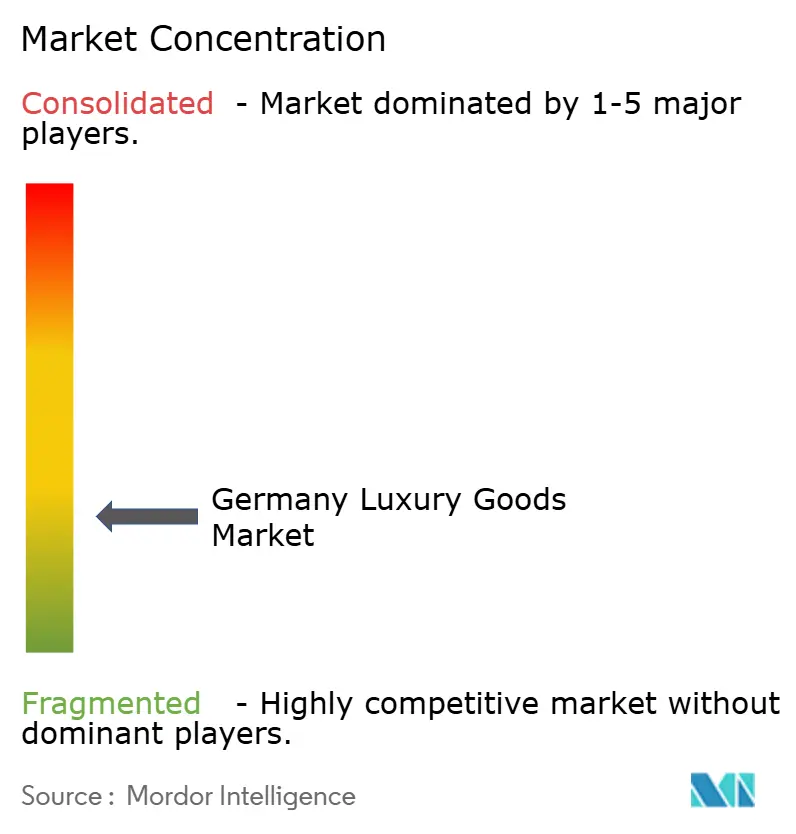
| Market Concentration | Low |
Major Players
*Disclaimer: Major Players sorted in no particular order Image © Mordor Intelligence. Reuse requires attribution under CC BY 4.0. |
|
Germany Luxury Goods Market Analysis by Mordor Intelligence
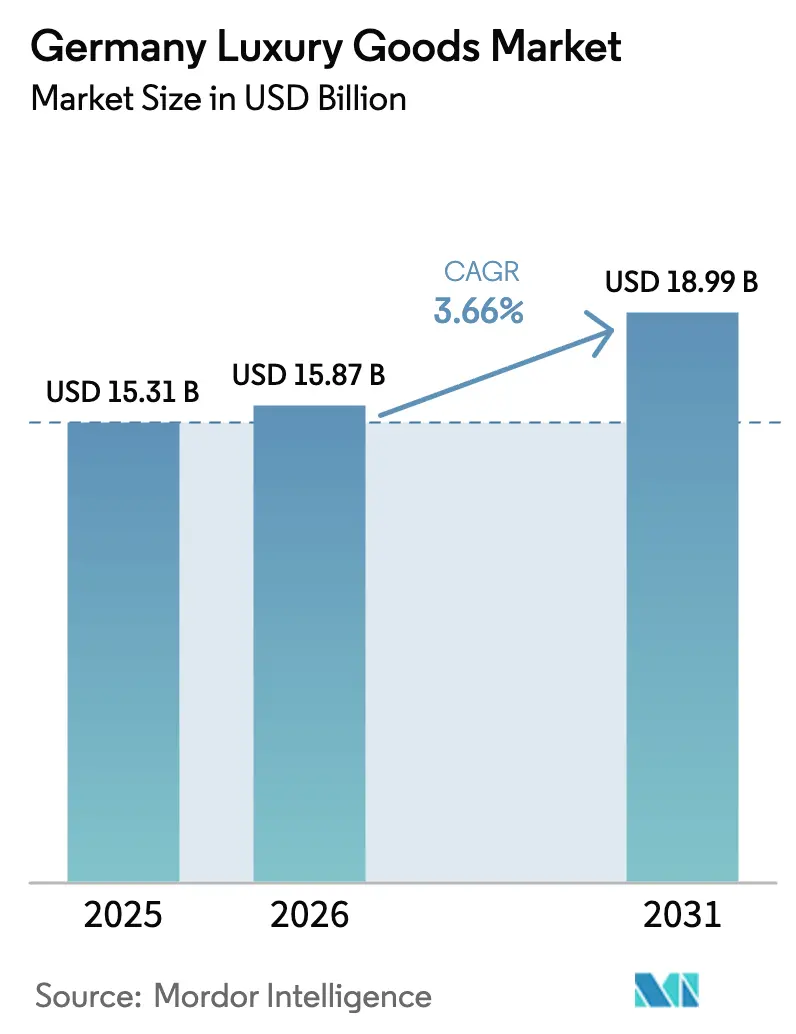
The German luxury goods market size is expected to grow from USD 15.31 billion in 2025 to USD 15.87 billion in 2026 and is forecast to reach USD 18.99 billion by 2031 at 3.66% CAGR over 2026-2031. As of 2024, apparel continues to be the top product category, though watches are becoming more popular with new designs and features. Women remain the main buyers, but interest among men is growing steadily. Additionally, the rise of online shopping is changing how luxury goods are sold, with digital platforms playing a major role in reaching customers. These trends show the market's ability to adapt while maintaining its focus on quality and exclusivity. The German luxury goods market is growing steadily as many consumers view luxury goods as valuable investments. This helps the market manage inflation while keeping prices high. Younger buyers are attracted to brands that emphasize digital-first strategies, sustainability, and exclusive limited-edition products. Meanwhile, older, wealthier consumers continue to appreciate the traditional craftsmanship and heritage offered by many luxury brands, ensuring broad appeal across different age groups. Luxury brands focus on creating high-quality and unique products by using careful design and production methods. This often includes handmade techniques, limited production, and premium materials like fine leather, precious metals, and gemstones.
Key Report Takeaways
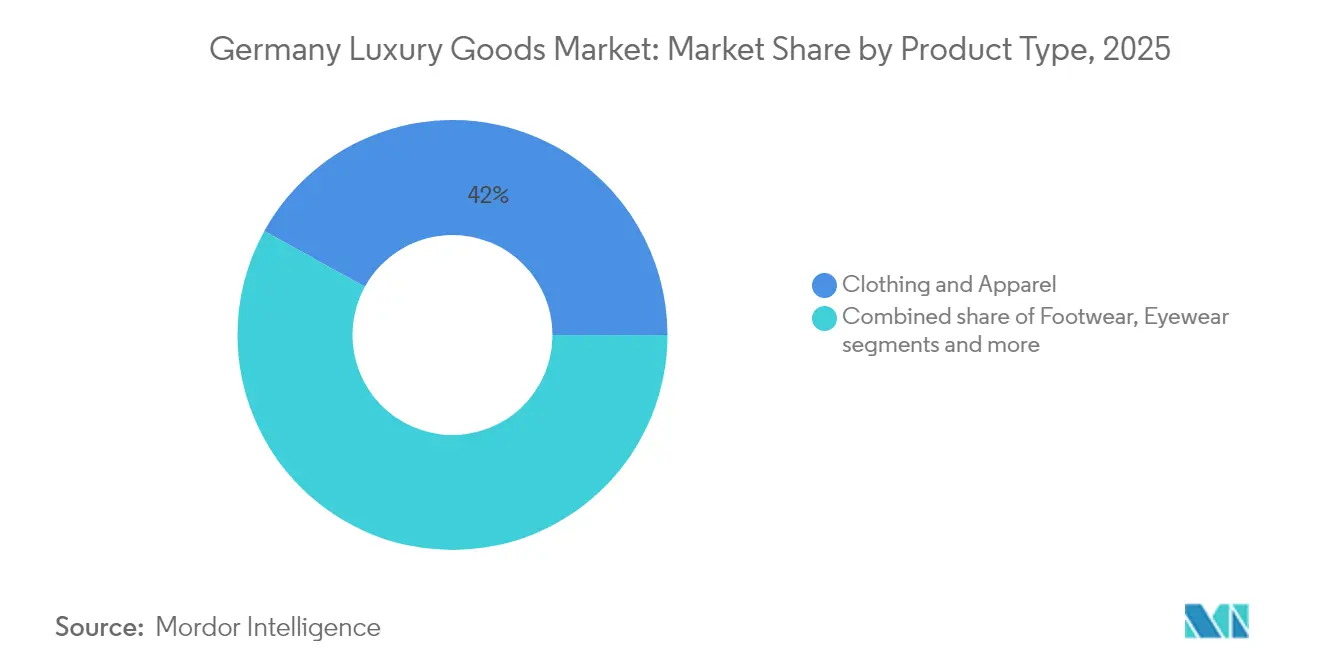
- By product type, clothing and apparel led with 41.97% of Germany luxury goods market share in 2025, while watches are forecast to advance at a 3.88% CAGR through 2031.
- By end user, women accounted for a 54.22% share of the Germany luxury goods market size in 2025, whereas the men’s segment is set to grow at 4.29% CAGR to 2031.
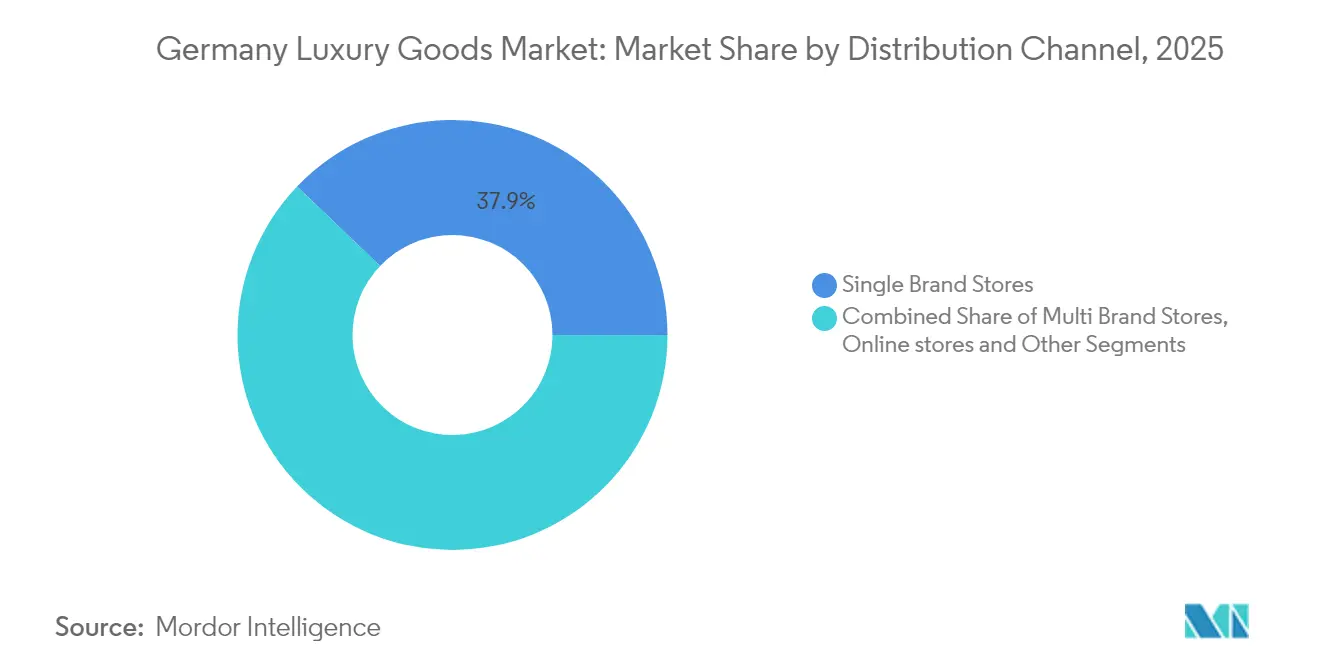
- By distribution channel, single brand stores held 37.86% revenue in 2025, yet online stores are advancing at a 4.77% CAGR over the same horizon.
Note: Market size and forecast figures in this report are generated using Mordor Intelligence’s proprietary estimation framework, updated with the latest available data and insights as of 2026.
Germany Luxury Goods Market Trends and Insights
Drivers Impact Table*
| Driver | (~) % Impact on CAGR Forecast | Geographic Relevance | Impact Timeline |
|---|---|---|---|
| Consumer shift toward sustainable and eco-certified luxury products | +0.8% | Germany, with spillover to DACH region | Medium term (2-4 years) |
| Influence of social media and celebrity endorsement | +0.6% | Strong resonance in German urban centers | Short term (≤ 2 years) |
| Consumers inclination towards limited edition products | +0.5% | Germany, particularly Berlin, Munich, Hamburg | Short term (≤ 2 years) |
| Product innovation in terms of raw material and design | +0.7% | Germany, leveraging engineering heritage | Medium term (2-4 years) |
| Rising disposable income and eealth accumulation in Germany | +0.4% | Germany, concentrated in Bavaria, Baden-Württemberg | Long term (≥ 4 years) |
| Growth of experience-based luxury and personalization services | +0.6% | Germany, with expansion to Austria, Switzerland | Medium term (2-4 years) |
| Source: Mordor Intelligence | |||
Consumer shift toward sustainable and eco-certified luxury products
German consumers are increasingly prioritizing environmentally friendly products when making purchasing decisions. They are willing to spend more on items that use sustainable and circular production methods, as they see eco-certifications as a symbol of genuine luxury. Chanel’s newly launched Nevold platform, in June 2025, which incorporates recycled materials, showcases how luxury brands can secure limited resources while meeting growing consumer demands for sustainability. Furthermore, stricter regulations, such as the Corporate Sustainability Due Diligence Directive, are driving companies to enhance transparency in their supply chains [1]Source: European Commission, “Corporate Sustainability Due Diligence,” europa.eu. Brands that adopt sustainable practices early are gaining a significant advantage in the market. As a result, sustainability is becoming just as important as brand logos in representing status, enabling these brands to capture a larger share of the German luxury goods market.
Influence of social media and celebrity endorsement
Digital storytelling is quickly changing how luxury brands connect with customers in Germany’s high-end market. Hugo Boss’s partnerships with famous celebrities have been very successful. For example, the long-term collaboration with David Beckham started in Q3 2024 with the Fall/Winter campaign, while the Spring/Summer 2024 collection featured Gisele Bündchen. These celebrity campaigns, along with exciting events in Berlin, doubled social media engagement and reached 40 million livestream views. This led to a 6% increase in digital sales in Q3 and made digital channels contribute 19% of the company’s total revenue in 2023, with a 26% growth in Q4. Younger luxury shoppers in Germany are using digital platforms more often. These efforts have reduced the cost of attracting new customers and strengthened social proof, as digital storytelling combines celebrity influence, advanced technology, and event-based engagement into a seamless luxury experience.
Consumers’ inclination toward limited-edition products
Exclusivity is becoming a major factor in increasing the value of luxury goods in Germany. In 2024, brands focused on releasing exclusive, limited-edition products to create excitement among buyers and raise their selling prices, particularly in the watches and jewelry segments. For instance, Nomos Glashütte launched its Tangente 38 Date “Colour Rush” series at Watches & Wonders 2024. This collection featured 31 unique dial designs, with each design limited to just 175 pieces, making them highly exclusive and desirable. Similarly, MeisterSinger celebrated its 20th anniversary by introducing the Enamel 1Z Edition, a rare and sought-after product limited to only 24 handcrafted units, further emphasizing its exclusivity. True rarity increases both the practical and social value of luxury items, while forced or fake scarcity can harm customer trust. German luxury buyers, who have a strong appreciation for craftsmanship and technical precision, are particularly attracted to limited-edition, collectible products. These items not only highlight exceptional artisanal skills but also carry a sense of heritage and exclusivity, making them even more appealing. This approach fits well with the preferences of German consumers and allows brands to maintain exclusivity, increase sales, and avoid problems like overproduction or excess inventory.
Product innovation in raw material and design
Material science is playing a key role in helping brands stand out in Germany’s luxury goods market. In 2024, Hugo Boss made significant progress in its sustainability journey by introducing HeiQ AeoniQ, a plant-based, high-performance fiber [2]Source: Hugo Boss AG, “Hugo Boss Invests in a Sustainable Apparel Technology,” Hugo Boss Group, group.hugoboss.com. This innovative material is designed to replace polyester by 2030 and is already being used in some of their sneakers, polo shirts, and outerwear. This development shows that it is possible to create eco-friendly materials without compromising on the quality and luxury that customers expect. Consumers today are increasingly looking for products that are not only high-quality but also environmentally responsible. By adopting such materials, brands are addressing this demand while maintaining the high standards of German craftsmanship and engineering. Additionally, by openly sharing these advancements, brands are reinforcing Germany’s reputation for precision and quality while aligning with the modern focus on sustainable luxury. This approach builds stronger trust with consumers in a market where sustainability and innovation are becoming critical factors in purchasing decisions.
Restraints Impact Analysis*
| Restraint | (~) % Impact on CAGR Forecast | Geographic Relevance | Impact Timeline |
|---|---|---|---|
| Availability of counterfeit products | -0.4% | Germany, with cross-border e-commerce challenges | Short term (≤ 2 years) |
| Lesser demand from price sensitive consumers | -0.6% | Germany, particularly affecting mid-luxury segments | Medium term (2-4 years) |
| Economic uncertainty and inflation impact on consumer spending | -0.5% | Germany, with broader European implications | Short term (≤ 2 years) |
| Stringent regulatory environment and compliance costs | -0.3% | Germany, setting precedent for EU-wide adoption | Long term (≥ 4 years) |
| Source: Mordor Intelligence | |||
Availability of counterfeit products
In Germany, counterfeit luxury goods are causing significant financial losses for brands, amounting to billions every year. Social media platforms like TikTok are making it easier for people to access fake luxury items, despite increased efforts by customs to seize these products. For instance, in late 2023, customs officials at Frankfurt Airport confiscated 2,164 counterfeit luxury watches from a shipment originating in Hong Kong. If these items had been genuine, their value would have been around EUR 170 million. Counterfeit goods not only harm the exclusivity of luxury brands but also confuse customers about pricing and reduce trust in authentic products. To tackle this issue, luxury brands in Germany are turning to advanced technologies. Hugo Boss, for example, introduced NFC tags in its 2024 ski-jacket collection. These tags are linked to blockchain-based digital authentication, allowing customers and officials to verify the product's authenticity instantly. These passports enhance traceability and make it harder for counterfeiters to tamper with products. While these technological solutions help protect brand reputation and reassure customers, they also come with challenges. Implementing such measures increases operational costs, adds complexity to processes, and can slow down the introduction of new products in Germany’s luxury market.
Economic uncertainty and inflation impact on consumer spending
In May 2025, Germany's inflation rate, as gauged by the year-on-year change in the consumer price index (CPI), rose to +2.1%, as reported by the German Federal Statistical Office [3]Source: Statistisches Bundesamt (Destatis), “Inflation Rate in May 2025 Remains at 2.4%," destatis.de. This inflationary rise has tightened household budgets, curbing discretionary spending and altering consumer priorities. Middle-income Germans are now adopting a more conservative financial stance, delaying non-essential purchases and leaning towards premium yet accessible alternatives. Their choices reflect a pragmatic adaptation to economic strains; luxury has shifted from being merely aspirational to a privilege contingent on financial stability. On the other hand, high-net-worth individuals, largely shielded from cost-of-living pressures, are intensifying their acquisitions, seeking both cultural significance and asset durability. Items like limited-edition timepieces, investment-grade jewelry, and heritage fashion are increasingly recognized as valuable assets. This trend is accentuating the divide in Germany’s luxury market: while price-sensitive buyers pull back, elite consumers are driving demand for rarity, craftsmanship, and long-term value appreciation.
*Our forecasts treat driver/restraint impacts as directional, not additive. The impact forecasts reflect baseline growth, mix effects, and variable interactions.
Segment Analysis
By Product Type: Apparel Dominance Faces Watch Innovation
In 2025, clothing and apparel dominated Germany's luxury goods market, claiming a 41.97% share. This was buoyed by a diverse price range and a consumer base known for its fashion-forward and quality-centric mindset. Demand prominently revolves around elevated wardrobe staples and everyday premium basics, emphasizing sustainability and sophisticated tailoring. Take, for example, Cologne's Armedangels. This label has carved a niche with its minimalist capsule collections, using organic cotton and recycled fabrics. Meanwhile, Berlin Fashion Week's high-impact couture not only amplifies brand desirability but also underscores cultural relevance. This is particularly true for maisons that collaborate with local artisans from Metzingen, Munich, and Berlin.
Furthermore, watches are carving out a prominent niche in Germany's luxury landscape, boasting a projected CAGR of 3.88% through 2031. Increasingly, consumers view these timepieces not just as accessories but as long-term value assets. This evolving perspective has led collectors to regard mechanical watches more as vehicles of tangible wealth than mere ornaments. A testament to this trend, Rolex has made a bold move with a CHF 1 billion investment in a new Swiss manufacturing facility, slated to commence operations by 2029. This decision highlights Rolex's strategic alignment with global demand, pressures from waitlists, and the imperative to boost capacity while maintaining its exclusivity. Meanwhile, German watchmakers in Glashütte, like A. Lange & Söhne and Glashütte Original, are capitalizing on this momentum. They're doubling down on their storied legacies, emphasizing limited annual outputs and intricate in-house movements. Such attributes continue to draw collectors who value rarity, craftsmanship, and lasting worth


By End User: Men Drive Growth in Women-Dominated Market
Women contributed 54.22% of the German luxury goods market size in 2025, driven by higher engagement with fashion, accessories, and experiential gifting. German women are driving the move toward sustainability and convenience. Brands are offering beauty subscriptions designed for eco-conscious customers. In-store strategies, such as styling lounges, wellness events, and mentorship dinners, help build loyalty by providing meaningful experiences along with product interaction. Collaborations with artists and designers, like the limited-edition beauty box launched in Berlin featuring designs by a local illustrator, have turned shopping into a culturally engaging experience.
Male demand is accelerating at a 4.29% CAGR, helped by evolving grooming standards and elevated casualwear. Hugo Boss has been at the forefront with sportswear partnerships that introduce tailored technical fabrics into hybrid work-leisure lines, such as its 2024 Hugo Blue denim-technical joggers collection and ski-inspired softshell shirts. Contemporary male consumers, particularly young professionals, view high-end sneakers, premium skincare routines, and even high-complication mechanical watches as markers of personal success. This upward trend is expanding category breadth and boosting average basket size in the Germany luxury goods market.
By Distribution Channel: Digital Transformation Accelerates
In 2025, single-brand stores captured 37.86% of Germany's luxury goods market, owing to their knack for offering immersive experiences and upholding high service standards. Flagship boutiques on Munich’s Maximilianstraße and Frankfurt’s Goethestraße transcend mere retail; they curate brand narratives steeped in heritage, artistry, and exclusivity. Brands such as Berluti, Cartier, and Louis Vuitton amplify in-store engagement with rotating exhibitions like Berluti’s leather craftsmanship showcase in Frankfurt and exclusive events, including designer meet-and-greets, invitation-only art shows, and cocktail evenings. Many flagship stores boast VIP salons and personalized styling lounges, enabling loyal clients to preview collections privately. This not only deepens emotional ties to the brand but also justifies their premium pricing.
Online luxury retail is on the rise, projected to grow at a 4.77% CAGR through 2031. To navigate this digital evolution, brands are pushing boundaries beyond conventional e-commerce. Take Hugo Boss: in mid-2024, they launched HUGO BOSS XP, a Web3-enabled loyalty program. Shoppers earn NFT-based tokens, HUGO XP and BOSS XP, through purchases or store visits. These tokens grant access to personalized styling, exclusive digital collectibles, luxury concierge services, and early peeks at limited-edition drops. By merging tangible experiences with digital perks, Hugo Boss is cultivating loyalty and community, catering to a new wave of digitally-savvy luxury consumers.
Geography Analysis
Southern Germany is a major contributor to luxury spending in the country, especially in regions like Bavaria and Baden-Württemberg. These areas are economically strong, with many automotive engineers, tech entrepreneurs, and owners of small and medium-sized businesses. Luxury retailers here benefit from customers who spend more on average, making it an attractive market for global luxury brands. Munich’s shopping streets are often compared to Milan’s high-end Quadrilatero district, while Stuttgart’s closeness to Porsche and Mercedes-Benz factories ensures a steady demand for premium leather goods and luxury watches.
Northern Germany, with cities like Hamburg and Berlin, adds creativity and innovation to the luxury market. Hamburg’s maritime history influences its fashion trends, attracting wealthy individuals from the shipping industry who invest in luxury yacht accessories and high-end Swiss watches. Berlin, on the other hand, is known for its cutting-edge fashion and focus on sustainability. Many brands test eco-friendly materials and circular business models, such as leasing luxury items, in Berlin’s concept stores. The city’s growing population of young professionals and digital nomads has also boosted demand for unique luxury experiences, including gourmet events and collaborations between streetwear and luxury brands.
Western Germany benefits from Frankfurt’s role as a financial hub, which drives demand for luxury goods. Bankers and consultants in the region often purchase high-value items like investment-grade jewelry and custom-tailored suits, with many making these purchases at Frankfurt Airport, a major hub for luxury travel retail. The region’s strong logistical connections to neighboring countries like Luxembourg, Belgium, and the Netherlands make it easier to deliver products quickly and efficiently. Additionally, Germany’s high e-commerce penetration, ranked third globally, supports the luxury market through urban click-and-collect centers and flexible return policies.
Regulatory Landscape
Germanys luxury goods market operates within a tightening EU and national sustainability compliance framework that raises requirements for traceability, supplier oversight, and reporting across fashion, leather goods, jewelry, and watches. The German Act on Corporate Due Diligence Obligations in Supply Chains (LkSG) is enforced by BAFA through a risk-based approach covering human-rights and environmental due diligence. This affects sourcing, manufacturing partners, and inbound logistics for premium materials.
In April 2025, the federal governments coalition agreement signaled an intention to replace the LkSG with a new international corporate responsibility law to transpose the EU Corporate Sustainability Due Diligence Directive (CSDDD), and the LkSG reporting obligation was abolished. In September 2025, the federal cabinet adopted amendments aimed at streamlining the LkSG to reduce bureaucracy, while CSDDD transposition in Germany is now anticipated for 2027. Large luxury groups and German-based brands are therefore focusing on auditability, grievance mechanisms, and supplier remediation readiness.
Competitive Landscape
The German luxury goods market is fragmented, with global giants, regional players, and innovative newcomers. Major global companies like LVMH, Kering, and Richemont focus on establishing a strong presence in key cities such as Munich, Düsseldorf, and Cologne by investing in high-street stores. At the same time, they are enhancing their online platforms to offer personalized shopping experiences, catering to the growing demand for convenience and customization. Regional brands like Hugo Boss leverage their rich German tailoring heritage to stand out in the market. They are also adopting sustainable practices, such as using circular fabrics and advanced 3D design tools, to align with strict environmental and social governance (ESG) standards. These efforts not only meet regulatory requirements but also appeal to environmentally conscious consumers who value sustainability in luxury products.
Hugo Boss builds on its German tailoring roots with sustainability-driven innovations such as circular fabrics and 3D digital design. Its Pre-Loved resale program also reflects the growing market demand for responsible luxury. Boutique German labels stand out with eco-conscious materials, artisan collaborations, and small-batch production models, offering consumers a rich blend of classic and contemporary luxury.
Technology and sustainability are now central forces shaping the market. Brands in Germany increasingly adopt digital product passports using QR codes and NFC to verify authenticity and product history, in line with the EU’s incoming 2026 digital passport requirements. Richemont’s German operations also use AI-enabled servicing reminders to enhance after-sales care for luxury watches. In parallel, German start-ups are pioneering innovative materials from bio-fabricated leathers to lab-grown diamonds, reflecting the younger generation’s growing demand for sustainable luxury. Partnerships with local universities and manufacturing hubs further support material innovation and environmental responsibility across the product lifecycle.
Germany Luxury Goods Industry Leaders
-
Kering SA
-
LVMH Moët Hennessy-Louis Vuitton SE
-
HUGO BOSS AG
-
Hermès International SA
-
Compagnie Financière Richemont SA
- *Disclaimer: Major Players sorted in no particular order

Market Opportunities and Future Outlook
Compliance-driven transparency and authentication are creating commercial room for luxury brands in Germany, particularly where brands can tie sustainability claims to verifiable product history. With BAFA oversight under the LkSG and preparation underway for EU CSDDD transposition (now anticipated for 2027), suppliers and brand owners that operationalize traceable sourcing, materials documentation, and risk-based supplier management have opportunities to win share with retailers and consumers who increasingly scrutinize provenance.
Two opportunity lanes stand out on the demand and go-to-market side. Premium physical retail expansion on prime streets remains anchored in mono-brand boutiques and curated experiences, with LVMH, Kering, and Richemont accounting for a large share of new luxury store openings on European premium retail streets during 2025. At the same time, Germany-based players are adjusting assortments and channels in 2026, and HUGO BOSS is executing its CLAIM 5 TOUCHDOWN strategy with a focus on brand realignment and operational quality. This combination opens whitespace for competitors and partners that can deliver faster replenishment, higher-quality fulfillment, and loyalty-led digital journeys aligned with premium positioning.
Recent Industry Developments
- July 2026: HUGO BOSS AG recommends shareholders reject Frasers Group takeover offer. The decision preserves the company independence and aligns with its long-term value creation and logistics expansion plans. It also reduces the risk of disruption from a bid while maintaining control over its premium store network.
- May 2026: HUGO BOSS AG reaffirmed full-year 2026 outlook amid currency-adjusted sales declines in EMEA. The update reflects the company's resilience plan within the Germany luxury segment. Reaffirmation is also aimed at maintaining investor confidence and clarifying how management intends to navigate macro headwinds in Europe.
- April 2026: HUGO BOSS AG inaugurated new office building at Metzingen campus. The expansion increases operational capacity in the premium German luxury hub. It signals continued commitment to the German HQ and supports future growth in design and logistics capabilities.


Research Methodology Framework and Report Scope
Market Definition and Coverage
For this report, the Germany luxury goods market is defined as the value of luxury products sold to consumers in Germany through retail and online channels, measured at final transaction value in USD and counted within the country.
Scope exclusions: Luxury services (such as hotels, premium travel, and fine dining) and secondhand resale are excluded from the market value.
Segmentation Overview
-
By Product Type
- Clothing and Apparel
- Footwear
- Eyewear
- Leather Goods
- Jewelry
- Watches
- Beauty and Personal Care
-
By End User
- Men
- Women
- Unisex
-
By Distribution Channel
- Single Brand Stores
- Multi Brand Stores
- Online Stores
- Other Distribution Channels
Data Sources, Market Sizing, and Validation
Desk Research
Desk research was used to map how luxury demand shows up in Germany and to set realistic input ranges before any fieldwork was run. We relied on public, non-paywalled sources such as Destatis (household spending and retail statistics), Eurostat (harmonized consumer and trade indicators), the European Central Bank (inflation and exchange rate series), the World Trade Organization and UN Comtrade (import and export patterns for relevant product groups), and OECD datasets (consumer confidence and macro context).
Along with that, we reviewed company annual reports, investor presentations, audited financial statements, and major retail and association websites to understand sales mixes, channel shifts, and pricing direction. Where available, we also used paid subscriptions for company financials and intelligence, news and financials, and shipment-level import and export data to cross-check trade intensity and to avoid double counting. The desk sources listed here are illustrative, and many other references were used to collect, validate, and clarify data points during the study.
Primary Interviews and Surveys
Primary work was carried out through expert interviews and structured surveys with brand-side leaders, specialty retailers, distributors, and industry advisors who track category movements and channel mix. We covered viewpoints across the main consuming hubs in Germany and then used follow-ups to tighten assumptions around discounting intensity, tourist-led purchases, and online conversion, which improved the triangulation before the model was finalized.
Distribution of primary research fieldwork respondents
| Company type | Respondent position |
|---|---|
| Top tier: 29% | CXOs: 12% |
| Mid tier: 57% | Functional/Unit leaders: 34% |
| Smaller Players: 14% | Managers: 54% |
Market-Sizing & Forecasting
Sizing starts with a top-down build that reconstructs the Germany demand pool using household spending signals, retail trade direction, and relevant product trade flows, which are then translated into luxury-only value using category-level penetration and price-premium logic. We then corroborate the totals with selective bottom-up checks, such as sampled price points multiplied by estimated unit volumes in key channels, plus supplier and retailer sense checks, so the number stays realistic and not overly model-driven.
Key model inputs include consumer price inflation and exchange-rate timing for USD conversion, shifts in discretionary spending, inbound tourism and tax-free shopping signals, online share changes, and observed price ladder movement (entry luxury versus high luxury) discussed in interviews. Forecasts were built using multivariate regression, where demand is linked to macro indicators and category price trends, and then adjusted through scenario analysis for periods where sentiment, travel flows, or promotional intensity changes quickly. Where inputs were incomplete for smaller niches, we used anchored ranges from interviews and public indicators, and then rebalanced shares so the total remains consistent with the full-country value.
Data Validation & Update Cycle
Validation is done in a few steps so the final output is easy to defend. We check the model against independent signals such as retail sales direction, inflation-adjusted spending trends, and trade movements, and then review any large variances by revisiting assumptions like premium mix, channel shares, and currency conversion timing.
Before sign-off, another analyst reviews the calculations and the logic chain, and outliers trigger re-contact with sources when the change cannot be explained by a known market event. The report is refreshed annually, with interim updates when material events occur that can move demand or pricing. Right before delivery, we run a fresh data pass so clients receive the latest updated view.
Mordor Intelligence's Germany Luxury Goods Market Size Compared Against Other Published Estimates
Published market values for luxury goods in Germany often differ because analysts do not always count the same products, the same buyer base, or the same type of price value. Differences also show up when one estimate leans more on brand revenue reporting, while another leans more on consumer spending, which changes what gets included in the final total.
The table shows a noticeable spread around the 2025 value, and in Mordor Intelligence's model the market is limited to luxury goods sales within Germany at final transaction value, while excluding luxury services and secondhand resale, which can lift other published totals when they are bundled in.
Benchmark comparison
| Source | Market Size | Gaps in Research Methodology |
|---|---|---|
| Mordor Intelligence | USD 15.31 B (2025) | |
| Global Consultancy A | USD 13.90 B (2025) | Uses a narrower product basket focused on personal luxury, and applies conservative assumptions on tourist-led purchases and full-price realization, which can pull down the total versus a broader goods-only view. |
| Industry Publisher B | USD 17.40 B (2025) | Appears to include adjacent premium services and parts of resale or duty-free uplift, and may apply faster price growth without validating it against inflation and channel discounting patterns in Germany. |
Overall, the benchmark comparison suggests the main differences come from what gets counted as luxury, how tourism and duty-free effects are treated, and how price growth is carried through the forecast. By keeping the logic tied to observable demand signals and then validating assumptions through interviews and reasonableness checks, we end up with a practical market value that can be repeated and updated with new data.


Key Questions Answered in the Report
What is the current size of the Germany luxury goods market in 2026?
The Germany luxury goods market is valued at USD 15.87 billion in 2026.
How fast is the Germany luxury goods market expected to grow?
The market is forecast to expand at a 3.66% CAGR and reach USD 18.99 billion by 2031.
Which product segment holds the largest Germany luxury goods market share?
Clothing and apparel led with 41.97% market share in 2025.
Which distribution channel is expanding quickest in the Germany luxury goods market?
Online stores are advancing at a 4.77% CAGR between 2026 and 2031, outpacing other channels.
Page last updated on:


 Your data is secure and never sold or shared.


