
Market Overview
| Study Period | 2020 - 2031 |
|---|---|
| Forecast Data Period | 2026 - 2031 |
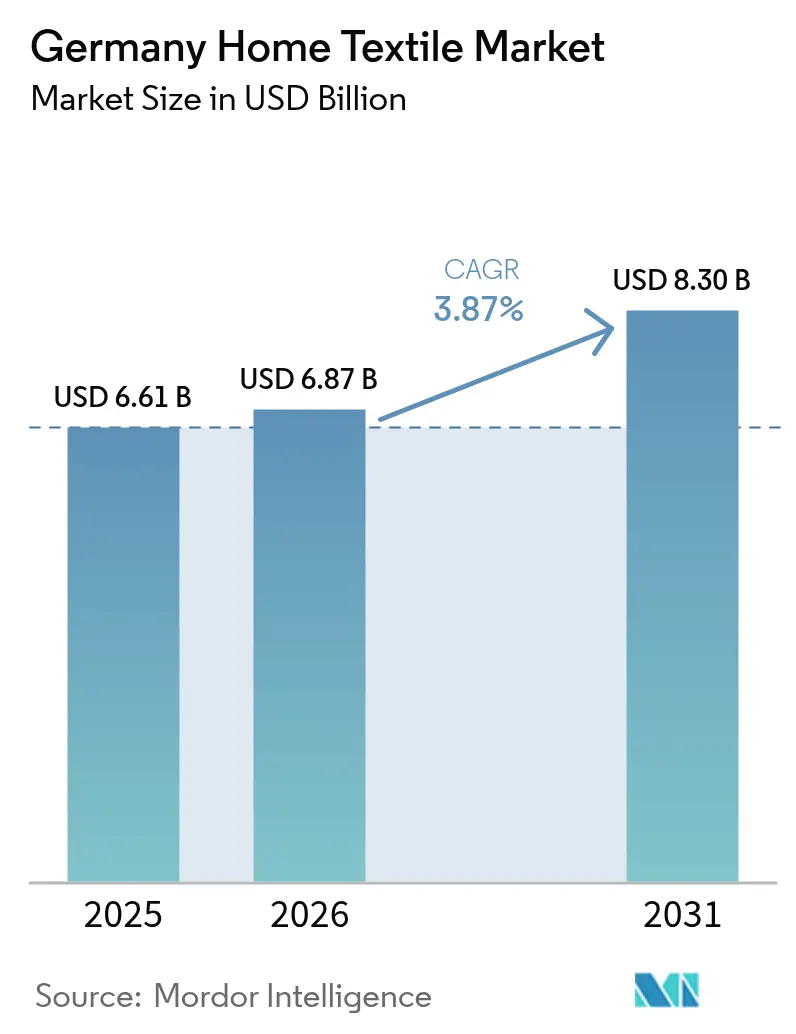
| Base Year Market Size (2025) | USD 6.61 Billion |
| Market Size (2026) | USD 6.87 Billion |
| Market Size (2031) | USD 8.3 Billion |
| Growth Rate (2026 - 2031) | 3.87 % |
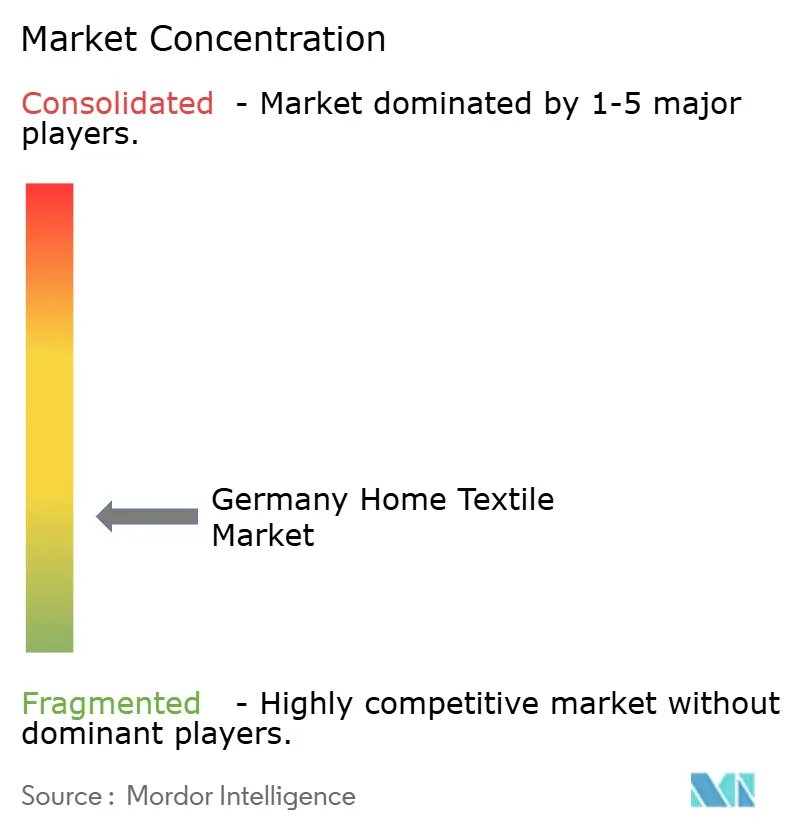
| Market Concentration | Low |
Major Players *Disclaimer: Major Players sorted in no particular order Image © Mordor Intelligence. Reuse requires attribution under CC BY 4.0. | |
Germany Home Textile Market Analysis by Mordor Intelligence
The Germany home textile market size is expected to grow from USD 6.61 billion in 2025 to USD 6.87 billion in 2026 and is forecast to reach USD 8.3 billion by 2031 at 3.87% CAGR over 2026-2031. Strong online buying habits, premiumization in household goods, and regulatory support for energy-efficient refurbishment keep the Germany home textile market on a firm upward path even as discretionary spending stays under pressure. E-commerce has effectively removed regional barriers, letting brands court 99% of connected German adults and turning digital storefronts into the main showcase for sustainable bed, bath, and window products. Consumer loyalty, however, now hinges on clear proof of origin; retailers that track fiber inputs through GOTS certification or Digital Product Passport pilots win repeat sales and soften inflation-related price fears. At the same time, commercial buyers, from hotels to senior-living operators, return to multi-year linen contracts in response to tourism recovery, ensuring the Germany home textile market captures gains on both the B2C and B2B sides.
Key Report Takeaways
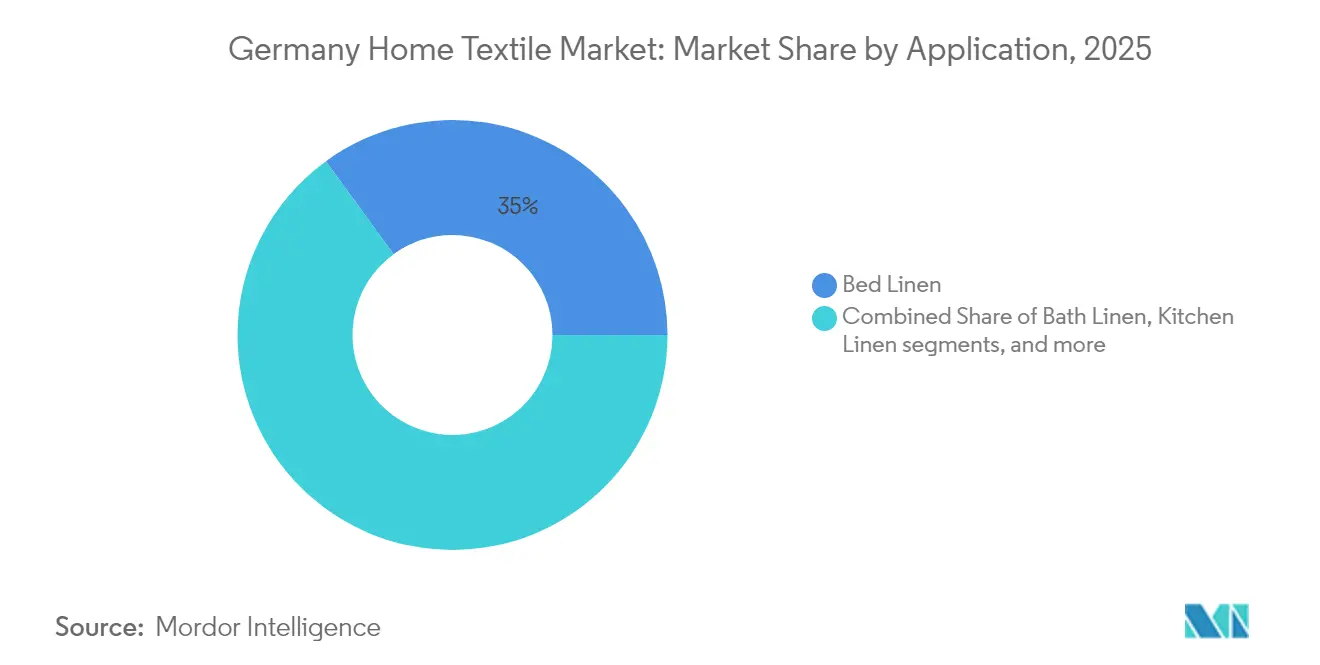
- By application, bed linen commanded 35.02% of Germany home textile market share in 2025; bath linen is projected to grow at a 4.48% CAGR through 2031.
- By material, cotton held 52.12% of the Germany home textile market size in 2025, while alternative fibers are forecast to advance at a 4.29% CAGR.
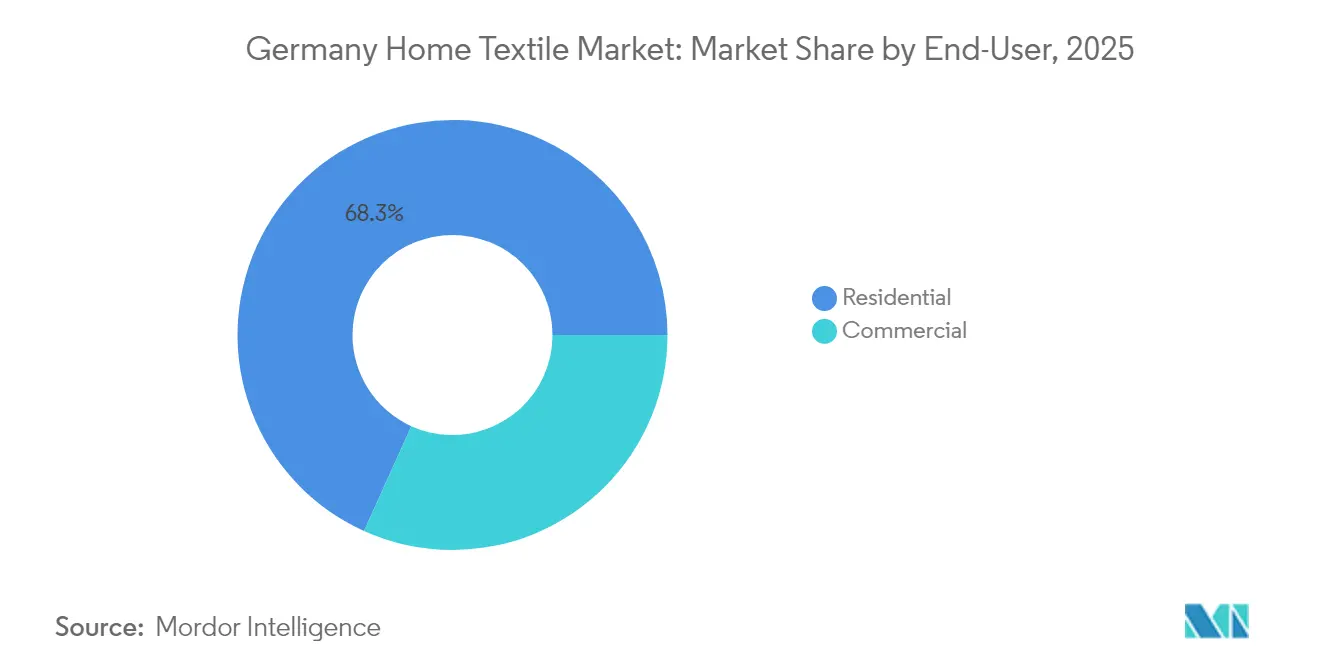
- By end-user, residential demand represented 68.25% of 2025 revenue, yet the commercial segment is on track for a 4.1% CAGR to 2031.
- By distribution channel, B2C retail retained 71.65% revenue share in 2025; direct B2B sales are poised for a 4.66% CAGR expansion.
- By region, South Germany led with a 30.88% 2025 share, but East Germany is primed for the fastest 5.05% CAGR over the outlook period.
Note: Market size and forecast figures in this report are generated using Mordor Intelligence’s proprietary estimation framework, updated with the latest available data and insights as of 2026.
Germany Home Textile Market Trends and Insights
Drivers Impact Analysis*
| Driver | (~) % Impact on CAGR Forecast | Geographic Relevance | Impact Timeline |
|---|---|---|---|
| E-commerce penetration & omnichannel retail acceleration | +0.8% | National, strongest in urban centers | Medium term (2-4 years) |
| Government-backed energy-saving subsidies for smart/shading textiles | +0.3% | National, focused on building efficient programs | Long term (≥ 4 years) |
| Hospitality & serviced-apartment pipeline rebound | +0.4% | Major metropolitan areas, tourism hubs | Short term (≤ 2 years) |
| Sustainability-driven demand for certified organic & recycled fibers | +0.6% | National premium segments | Medium term (2-4 years) |
| Ageing-in-place renovations boosting functional/anti-allergen bedding | +0.5% | National, aging demographics | Long term (≥ 4 years) |
| Adoption of smart/IoT-enabled blinds & curtains | +0.2% | Urban areas, new construction | Long term (≥ 4 years) |
| Source: Mordor Intelligence | |||
E-commerce Penetration & Omnichannel Retail Acceleration
Germany’s high-speed connectivity and mature logistics network allow retailers to serve almost every household within two days, a capability that underpins the Germany home textile market’s rising online conversion ratio. Weekly online shopping now involves 39% of adults, and furniture-focused portals report double-digit traffic spikes after livestream product launches [1]Eurostat, “Digital Economy and Society Statistics on E-commerce,” ec.europa.eu. Brick-and-click formats prove effective because shoppers prefer to compare textile hand-feel in stores yet check colorways or stock online, pushing chains to fund RFID-enabled showrooms that sync inventories in real time. Larger players absorb the tech outlay; small manufacturers without fulfillment software face visibility setbacks. As digital engagement broadens, differentiated storytelling around sustainable sourcing and smart-home integration keeps margins from eroding in a competitive pricing climate.
Government-backed Energy-saving Subsidies for Smart/Shading Textiles
Building regulations that mandate tighter energy envelopes encourage homeowners to add motorized blinds and thermally efficient draperies eligible for BEG rebates. BAFA reports that applications for shading system subsidies climbed 18% year over year, a trend that diverts spending toward value-added window coverings [2]BAFA, “Guidelines for Energy-Efficient Building Subsidies,” bafa.deSource: BAFA, “Guidelines for Energy-Efficient Building Subsidies,” bafa.de. Textile mills partner with motor drives and sensor firms, embedding conductive yarns to enable automatic daylight adjustment. Because these products qualify for both energy and ESG labels, retailers can justify premiums even during broader cost-of-living strains. The alignment with Germany’s 2045 carbon-neutrality target assures long-running support, creating a structural lift for the Germany home textile market beyond normal replacement cycles.
Hospitality & Serviced-apartment Pipeline Rebound
RevPAR in Berlin and Munich surpassed 2019 levels in early 2025, fueling linen replenishment orders from hotel groups restoring occupancy thresholds [STR-GLOBAL] [3]STR Global, “Germany Hotel Performance Review 2025,” str.com. Serviced-apartment operators extend demand by insisting on higher thread-count sheets and quick-dry towels that cut laundry cycles. Commercial laundry, under cost pressure from energy tariffs, favors textiles engineered for more than 250 wash turns, granting suppliers of reinforced cotton-poly blends an edge. As events such as Oktoberfest 2025 re-draw global travelers, procurement teams sign two-year bulk contracts to lock in unit prices, stabilizing revenue visibility. This commercial surge partially insulates the Germany home textile market from softer residential outlays.
Sustainability-driven Demand for Certified Organic & Recycled Fibres
German consumers increasingly equate textile quality with environmental credentials; 59% consult sustainability labels before clicking “buy now”. Retailers react by expanding shelf space for GOTS-certified organic cotton, TENCEL™ lyocell, hemp, and bamboo blends. Mills invests in blockchain traceability to pass EU Digital Product Passport audits, transforming compliance into a marketing asset. Certifications translate into a 12–15% unit price premium that shoppers accept, particularly in baby bedding and premium towel sets. In turn, supplier order books for undyed and low-water-print fabrics lengthen, underpinning the German home textile market’s value trajectory.
Restraints Impact Analysis*
| Restraint | (~) % Impact on CAGR Forecast | Geographic Relevance | Impact Timeline |
|---|---|---|---|
| Volatile cotton & energy prices are pressuring manufacturer margins | -0.9% | National, manufacturing regions | Short term (≤ 2 years) |
| Weak consumer furniture spend amid cost-of-living squeeze | -0.7% | National, middle-income households | Medium term (2-4 years) |
| Stricter EU traceability/DPP rules are raising compliance costs for SMEs | -0.4% | EU-wide, German SME manufacturers | Medium term (2-4 years) |
| Hotel sector’s below-EU ADR dampening short-term linen CAPEX | -0.3% | Tourism-dependent regions | Short term (≤ 2 years) |
| Source: Mordor Intelligence | |||
Volatile Cotton & Energy Prices Pressuring Manufacturer Margins
Spot cotton quotations swung 28% within six months of 2024, forcing mills to juggle hedging and surcharges that retailers often resist [4]Deutscher Textilreinigungs-Verband, “Cost Index for Textile Services 2024,” dtv-deutschland.org. Germany’s electricity tariffs, still among Europe’s highest, add another squeeze, especially for energy-heavy weaving and finishing lines. Producers accelerate photovoltaic rooftop projects and heat-recovery systems to blunt cost spikes, yet payback stretches beyond SME cash tolerances. Some resort to near-shoring in Czechia or Türkiye, altering supply chain geography and diluting domestic value capture for the Germany home textile market. Until input volatility stabilizes, mid-tier brands may trim SKU diversity to conserve working capital.
Weak Consumer Furniture Spend Amid Cost-of-living Squeeze
Real wages rose only 0.3% in 2024, and households trimmed non-essential décor budgets, delaying curtain or cushion refresh cycles. Promotion-led sales events still trigger volume lifts, but margins narrow as retailers absorb part of shipping surcharges. Top-line softness is most evident in mid-priced assortments, whereas discount stores and luxury boutiques maintain footfall, polarizing the Germany home textile industry. Firms respond with multi-pack pricing and loyalty-card points rather than blanket markdowns to protect perceived quality. Recovery hinges on broader macro stabilization expected post-2026.
*Our forecasts treat driver/restraint impacts as directional, not additive. The impact forecasts reflect baseline growth, mix effects, and variable interactions.
Segment Analysis
By Application: Bed Linen Leads, Bath Linen Accelerates
Bed linen retained leadership with 35.02% of Germany home textile market share in 2025, underpinning category stability through its essential-purchase status and wide price ladder. High-thread-count cotton and linen blends dominate premium tiers, while private-label microfiber sets cater to budget shoppers. Seasonal color refreshes and bundled pillowcase promotions sustain repeat sales, yet competitive saturation limits price hikes, prompting brands to upsell coordinated comforters and protectors.
Bath linen, meanwhile, is projected to expand at a 4.48% CAGR through 2031, the fastest among applications. German consumers equate plush towels and robes with wellness, and antimicrobial, quick-dry technologies justify double-digit price premiums. Online searches for “bamboo bath towel” climbed 23% between Q4 2024 and Q2 2025, signifying substitution potential. Hotels adopt heavier-grammage robes that endure 250 wash cycles, broadening commercial volume. Together, these dynamics keep both leading and fastest-growing segments pivotal to the Germany home textile market size trajectory.


By Material: Alternative Fibers Challenge Cotton Dominance
Cotton supplied 52.12% of the Germany home textile market size in 2025, yet modal, hemp, and recycled polyester fabrics collectively register greater momentum. Fiber innovators promote TENCEL™ Lyocell bedding that repels bacteria better than conventional cotton, winning favor among allergy-prone households. GOTS-certified organic cotton still outperforms conventional cotton in value terms because traceability justifies a premium, cushioning producers from raw-cotton volatility. Smart-textile research institutes, including TITV Greiz, embed conductive yarns into wool blends, expanding use into climate-adaptive curtains. Altogether, material choice becomes a key brand differentiator rather than a behind-the-label detail.
Cotton mills respond by adopting regenerative agriculture contracts to maintain relevance, integrating rain-fed farming claims into marketing narratives. Blended fabrics exploiting hemp’s tensile strength and bamboo’s softness appear in bathrobes and nursery textiles, widening the eco-luxury offering. European Commission draft rules promoting recycled content lend further weight to synthetics that incorporate post-consumer PET bottles. The Germany home textile market thus evolves from single-fiber dominance to a portfolio of specialized materials, each mapped to health or environmental gains.
By End-User: Commercial Segment Accelerates Despite Residential Dominance
Residential demand captured 68.25% of 2025 revenue, anchored in routine bedding and window coverings that households replace every three to five years. Commercial orders, however, are on a 4.1% CAGR trajectory as hotels, healthcare, and corporate offices prioritize antimicrobial and durable textiles.. Hospitals gravitate toward antimicrobial sheets certified under DIN EN 13795, recognizing infection-control dividends. Corporate offices, redesigning workspaces for hybrid schedules, installing acoustic textile panels and blackout roller blinds, and broadening the Germany home textile market beyond traditional décor. Although residential replacement cycles slow in inflationary periods, commercial tenders contract on three-year horizons, smoothing revenue curves.
Specialized distributors invest in digital portals that let hotel managers model lifetime cost per wash, an approach that converts on sustainability and budget criteria simultaneously. Residential retailers, conversely, emphasize narrative, carbon-neutral shipping, artisan-made stories, to differentiate. The parallel trajectories ensure the Germany home textile market enjoys both volume resilience and value upside.
By Distribution Channel: B2B Direct Sales Gain Momentum
B2C retail still channels 71.65% of turnover, spanning supermarkets, décor chains, department stores, and online marketplaces. Yet direct B2B commerce climbs by a CAGR of 4.66% because institutional buyers value bespoke specifications and immediate factory contact. Manufacturers integrate ERP systems with client dashboards, enabling just-in-sequence deliveries and predictive reorder notices. Energy-cost volatility motivates laundries to negotiate directly with mills for long-life towel specs, bypassing wholesalers. Digital showrooms, featuring 3D fabric drape simulations, help exporters court overseas clients without trade-fair travel, boosting the Germany home textile market’s international profile.
In B2C, discount grocers expand premium private labels after seeing Stiftung Warentest awards lift foot traffic; ALDI’s eco-detergent-paired towel bundles sold out within days. Pure-play e-tailers deploy AI-powered fit advisors to cut return rates on sheets and mattress protectors. The omnichannel reality means brands must sync inventory across store aisles, web carts, and B2B order portals, an operational complexity that favors scale players.
Geography Analysis
South Germany retained a 30.88% stake of the Germany home textile market in 2025. South Germany’s dominance traces to Bavaria and Baden-Württemberg, where gross household earnings surpass USD 60,000 per year and sustain an appetite for premium décor. Cross-border shopping from Austria and Switzerland bolsters weekend footfall, while robust automotive job security maintains consumer confidence. Retailers curate alpine-inspired bedding lines and climate-adaptive draperies suited to the region’s continental weather shifts. Still, elevated property prices compress living spaces, nudging consumers toward minimalist textile collections and pushing sales volumes into higher value, not wider quantity.
East Germany, by contrast, posts a 5.05% CAGR thanks to factory expansions in Saxony and Brandenburg backed by regional grants. The East’s trajectory reflects its reinvention from legacy textile hub to innovation corridor. Public-private clusters around Chemnitz and Greiz funnel EU funds into smart-fabric prototyping, drawing OEM contracts from automotive seat-cover suppliers. Rising wages raise regional purchasing capacity, and the Germany home textile market benefits as first-time homeowners invest in full bedroom and bath setups. Smaller city centers deploy pop-up “fabric experience” stores to test demand before permanent lease commitments, a low-risk format that large chains now replicate.
North, West, and Central regions preserve mid-single-digit growth on the back of logistics prowess and demographic diversity. Ports in Hamburg ease import of Asian fabric inputs, lowering landed cost for discount retailers headquartered nearby. Ruhr-area urban renewal grants fuel rental-apartment renovations that require blackout curtains and allergy-safe mattress encasements. Frankfurt’s expatriate population lifts demand for internationally sized bedding, prompting retailers to stock both EU and U.S. dimensions. Collectively, these metropolitan nodes keep the Germany home textile market balanced against regional slowdowns.
Regulatory Landscape
Home textile products placed on the German market are governed by EU textile labeling rules (Regulation (EU) No 1007/2011) and enforced domestically through Germany's Textilkennzeichnungsgesetz (TextilKennzG), making correct fiber-composition labeling a non-negotiable market-access requirement for bed, bath, kitchen, and window textiles. Product safety obligations also apply via Germany's Produktsicherheitsgesetz (ProdSG) and the EU General Product Safety Regulation (GPSR, EU 2023/988), which tightens requirements around risk assessment and corrective actions for non-food consumer goods.
Sustainability and public procurement provide a parallel compliance lever. Federal procurement guidance for textiles, linked to the government's sustainable textile purchasing approach (Stufenplan), sets expectations for certified products and recognizes schemes such as GOTS, OEKO-TEX STANDARD 100, and Blauer Engel. In performance and safety, Germany does not impose a single, residential-specific legal fire safety regime for home textiles, but test standards (for example, DIN EN ISO 6940/6941 for burning behavior) remain relevant for product liability management under the broader product safety framework.
Value Chain Analysis
Germany's home textile value chain starts with fiber inputs, with cotton and man-made fibers often imported, followed by spinning, weaving/knitting, dyeing, printing, and finishing, then cut-make-trim and assembly into bed linen, bath linen, kitchen textiles, upholstery fabrics, and window coverings. Germany retains capabilities in design, technical textiles, and specialty finishing, while a meaningful share of volume production is sourced from nearby European manufacturing bases (for example, Poland and the Czech Republic) and Asia, reflecting both import dependence and the need to balance cost, lead times, and compliance.
Downstream, products move through wholesalers, specialty retailers, mass merchants, and a fast-growing online channel, alongside direct B2B supply to hospitality, healthcare, and commercial laundries. E-commerce and omnichannel operations increase the importance of fulfillment, returns handling, and real-time inventory, while EU traceability direction, including Digital Product Passport preparations, pushes brands and suppliers to invest in data capture across tiers. Industry bodies such as Heimtex and Textile Raeume support standardization engagement and help align member companies with evolving requirements on chemicals (REACH), labeling, and sustainability claims.
Competitive Landscape
Competition sits at a fragmented level. IKEA Deutschland maintains traffic by trimming starting price points on staple textiles while upselling coordinated accessory lines. Otto Group leans on data-driven inventory planning that lifted EBITDA margins even when topline inched down, proving that digital prowess now rivals square footage as a scale lever. Westwing’s curated collections clocked 6% year-over-year revenue growth in Q1 2024, illustrating how lifestyle storytelling converts premium shoppers. Pure-play D2C labels use micro-influencer campaigns to nibble at category niches such as linen pillowcases or thermo-regulating duvets.
M&A continues as a route to functional depth: Freudenberg’s September 2024 acquisition of Heytex augments its portfolio with coated fabrics for architecture and industry, signaling convergence between home and technical segments. Start-ups leverage crowdfunding to pre-sell recycled-polyester sheet sets, thereby funding initial production runs without bank loans. Yet scale challenges loom; compliance with Digital Product Passports favors capital-rich incumbents. Overall, the Germany home textile market rewards companies that pair transparent sourcing with digital customer engagement, a dual capability still scarce among smaller regional mills.
Technological differentiation intensifies. Mills adopts digital pigment printing to reduce water use by 95%, an eco-claim that resonates with local ordinances restricting wastewater discharge. IoT integration arrives via Bluetooth-enabled curtain rails that sync with apartment management systems, a feature that wins bids in build-to-rent developments. Players that lag on either environmental or tech criteria risk margin erosion as procurement scorecards become stricter.
Germany Home Textile Industry Leaders
IKEA Deutschland
Otto Group
ALDI (Süd & Nord)
Westwing Group SE
Jysk Germany
- *Disclaimer: Major Players sorted in no particular order

Market Opportunities and Future Outlook
Circularity is becoming a concrete product and sourcing opportunity as design-for-recyclability requirements tighten under the EU Ecodesign for Sustainable Products Regulation (ESPR), in force since July 2024. In Germany, this is reinforced by government-funded programs such as the Zirkulaere Textilien initiative under the FONA strategy, which supports pilots in textile recycling technology and digital product tracking, linking home textile suppliers to practical pathways for Digital Product Passport readiness and post-consumer fiber use.
Commercially, closed-loop and mechanically recycled towel and linen concepts are moving from demonstrator stages into broader assortment expansion. Gebr. Otto completed its Eco Yarn research project in February 2026 with partners including the Technical University of Augsburg, Schwob AG, and Weseta, demonstrating mechanical recycling of post-consumer rental towels into yarn for new towels. Kushel expanded its closed-loop recycling towel collection in May 2026. These proof points create space for German brands and contract suppliers to build differentiated bath and hospitality lines around recycled content, verified traceability, and durability, while retailers and marketplaces widen their assortment breadth and visibility for certified, circular, and premium home textiles.
Recent Industry Developments
- June 2026: IKEA Deutschland opened its first site in a new compact store format in Ingolstadt on June 25, 2026, with a curated home furnishing assortment. The smaller-footprint concept increases physical touchpoints for categories like bedding, towels, and curtains while using digital ordering for an extended range, supporting omnichannel conversion.
- April 2026: Otto Group began expanding the OTTO marketplace to onboard third-party retailers from the Netherlands, with additional European partners planned to follow. The expansion broadens cross-border assortment availability for home and living categories, increasing competitive pressure on incumbent home textile retailers to differentiate through sustainability credentials and faster delivery.
- September 2024: Freudenberg Performance Materials completed the acquisition of major Heytex units, adding coated-fabric capabilities used across architectural and technical applications. The deal strengthens high-performance textile know-how that can spill over into functional home textile use cases such as durable window coverings and specialized upholstery fabrics.


Research Methodology Framework and Report Scope
Market Definition and Coverage
This market covers the value of home textile products sold in Germany for residential and commercial use, measured at the point of sale across offline and online channels, and reported in USD for a consistent time series.
Scope exclusions: We exclude non-textile home decor items, apparel textiles, and raw fiber trading that is not sold as a finished home textile product.
Segmentation Overview
- By Application
- Bed Linen
- Bath Linen
- Kitchen Linen
- Upholstery
- Carpets & Area Rugs
- By Material
- Cotton
- Linen
- Synthetic Fibres
- Other Materials (Wool, Hemp, Silk, Jute, Bamboo)
- By End-User
- Residential
- Commercial
- By Distribution Channel
- B2C/Retail Channels
- Mass Merchandisers (Hypermarkets/Supermarkets)
- Home Centers
- Specialty Stores
- Local Mom and Pop Stores
- Online
- Other Distribution Channels
- B2B/Direct from the Manufacturers
- B2C/Retail Channels
- By Region
- North Germany
- South Germany
- East Germany
- West Germany
- Central Germany
Data Sources, Market Sizing, and Validation
Desk Research
Desk work starts with building a clean demand and supply picture for Germany, before numbers are modeled. We refer to public sources such as Destatis for household spending and retail indicators, Eurostat for trade and price series, UN Comtrade for import and export direction checks, and the European Commission for textile policy signals that can influence sourcing and labeling.
To keep the scope grounded, we also review sources such as industry association updates (for example, textiles and retail bodies), peer reviewed studies on textile consumption and durability, and company annual reports and investor decks that describe category trends and channel mix. In addition, a paid company financials and intelligence subscription is used selectively to fill ownership structures, revenue splits, and historical timelines where public disclosures are thin. These desk sources are not exhaustive, and many other references are used to clarify data points, validate assumptions, and resolve gaps.
Primary Interviews and Surveys
Primary conversations are used to test what desk data cannot confirm on its own, such as the split between replacement and new demand, realistic price movement by category, and how much online selling is shifting margins. We speak with manufacturers, brand owners, retailers, distributors, and commercial buyers so the model reflects how products actually move through the market across Germany.
Distribution of primary research fieldwork respondents
| Company type | Respondent position |
|---|---|
| Top tier: 36% | CXOs: 12% |
| Mid tier: 50% | Functional/Unit leaders: 42% |
| Smaller Players: 14% | Managers: 46% |
Market-Sizing & Forecasting
Sizing is built using a top-down approach where retail value is reconstructed from Germany specific consumption signals, category participation, and channel mix, and then the totals are checked with selective bottom-up approximations. Those checks include sampled price times volume builds by product groups, supplier and retailer revenue ranges, and channel level sanity tests, which then help adjust totals when gaps appear.
The market model uses practical inputs such as household formation and housing turnover, home furnishing and textile retail sales trends, import intensity for finished textiles, observed discounting patterns in major channels, and typical replacement cycles for bed linen, bath linen, and floor textiles. When a data series is not directly available, proxies are used, such as trade value and unit trends to infer pricing pressure, and then validated through expert feedback.
Forecasting is run mainly through scenario analysis supported by short time series smoothing, because category demand tends to be influenced by consumer confidence, inflation, and housing activity rather than one single driver. Key assumptions, including category level average selling price progression and online share shift, are reviewed with interviewees and then carried through into the forward view.
Data Validation & Update Cycle
Outputs are validated through multiple checks so the final number is not dependent on one source or one assumption. We compare results against independent signals like trade movements, retail performance indicators, and category level pricing direction, and then investigate outliers before sign-off.
A second analyst review is completed for formula logic, currency handling, and year alignment, followed by a final consistency pass across all sections. Reports are refreshed annually, and interim updates are triggered when there are material events such as sharp inflation changes, major retail disruptions, or policy shifts that affect sourcing and labeling. Before delivery, a fresh update pass is completed so clients receive the latest updated view.
Mordor Intelligence's Germany Home Textile Market Size Compared Against Other Published Estimates
Published market sizes for Germany home textiles can look far apart even when they talk about similar products, because the timing and the conversion choices are not always handled the same way. Differences also come from what is counted as a home textile, how commercial demand is treated, and how price change is carried through the forecast period.
When estimates are refreshed at different times, the same year can be priced with different inflation assumptions, discounting levels, and exchange rate timing, which then shifts USD values even before volumes are debated. The table also points to scope boundaries, where some figures lean more toward broad household textiles or include adjacent decor categories, and some rely on a single year snapshot without re-checking category level ASP movement through retailer and supplier feedback, a refresh-led discipline applied by Mordor Intelligence.
Benchmark comparison
| Source | Market Size | Gaps in Research Methodology |
|---|---|---|
| Mordor Intelligence | USD 6.61 B (2025) | |
| Industry Publisher A | USD 8.58 B (2025) | Often uses a broader revenue perimeter that can pull in adjacent household textile and decor spending, and the price path can be applied more aggressively without repeated channel checks on discounting and mix shift. |
| Retail Research Body B | USD 9.51 B (2025) | Reported in EUR (8.7 B) and then converted, so the USD value depends heavily on exchange rate timing, and the scope can align closer to total household textiles rather than finished home textile categories only. |
Across the three figures, the spread is mainly explained by refresh timing, currency conversion choices, and how wide the product boundary is drawn. By keeping assumptions traceable to a few observable signals and re-checking pricing logic with market participants, the final market value stays practical to reproduce and easier to defend in planning discussions.


Key Questions Answered in the Report
What is the current value of the Germany home textile market?
The Germany home textile market stands at USD 6.87 billion in 2026 and is projected to reach USD 8.3 billion by 2031.
Which application is growing the fastest in German home textiles?
Bath linen leads growth with a forecast 4.48% CAGR, benefiting from wellness-oriented consumer spending.
How dominant is cotton in German home textiles?
Cotton accounts for 52.12% of 2025 revenue, yet alternative fibers such as hemp and recycled polyester are closing the gap.
Why are B2B channels expanding in GermanyÕs home textile sector?
Institutional buyers prefer direct sourcing to secure tailored specifications and mitigate supply-chain volatility, driving B2B sales to a 4.66% CAGR outlook.
Which German region shows the highest growth potential?
East Germany posts the fastest 5.05% CAGR through 2031, supported by new manufacturing investments and rising household incomes.
What major regulation will affect German textile suppliers after 2026?
EU Digital Product Passports will obligate each textile item to carry a detailed traceability QR code, raising compliance stakes for SMEs.
Page last updated on:


 Your data is secure and never sold or shared.


