
Market Overview
| Study Period | 2020 - 2031 |
|---|---|
| Forecast Data Period | 2026 - 2031 |
| Base Year Market Size (2025) | USD 53.75 Billion |
| Market Size (2026) | USD 57.01 Billion |
| Market Size (2031) | USD 76.52 Billion |
| Growth Rate (2026 - 2031) | 6.06 % |
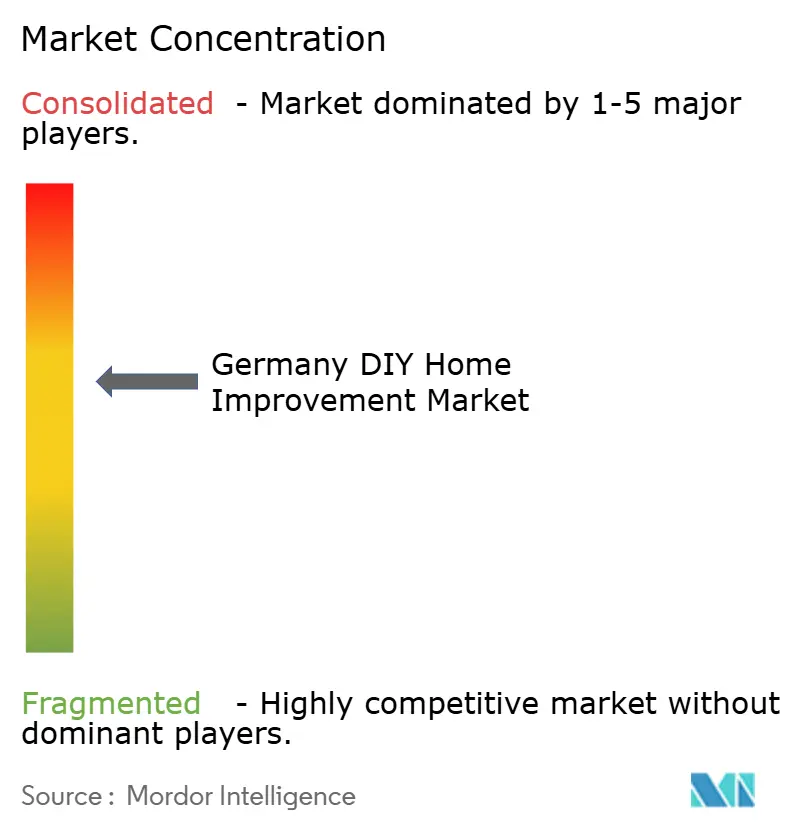
| Market Concentration | Medium |
Major Players *Disclaimer: Major Players sorted in no particular order Image © Mordor Intelligence. Reuse requires attribution under CC BY 4.0. | |
Germany DIY Home Improvement Market Analysis by Mordor Intelligence
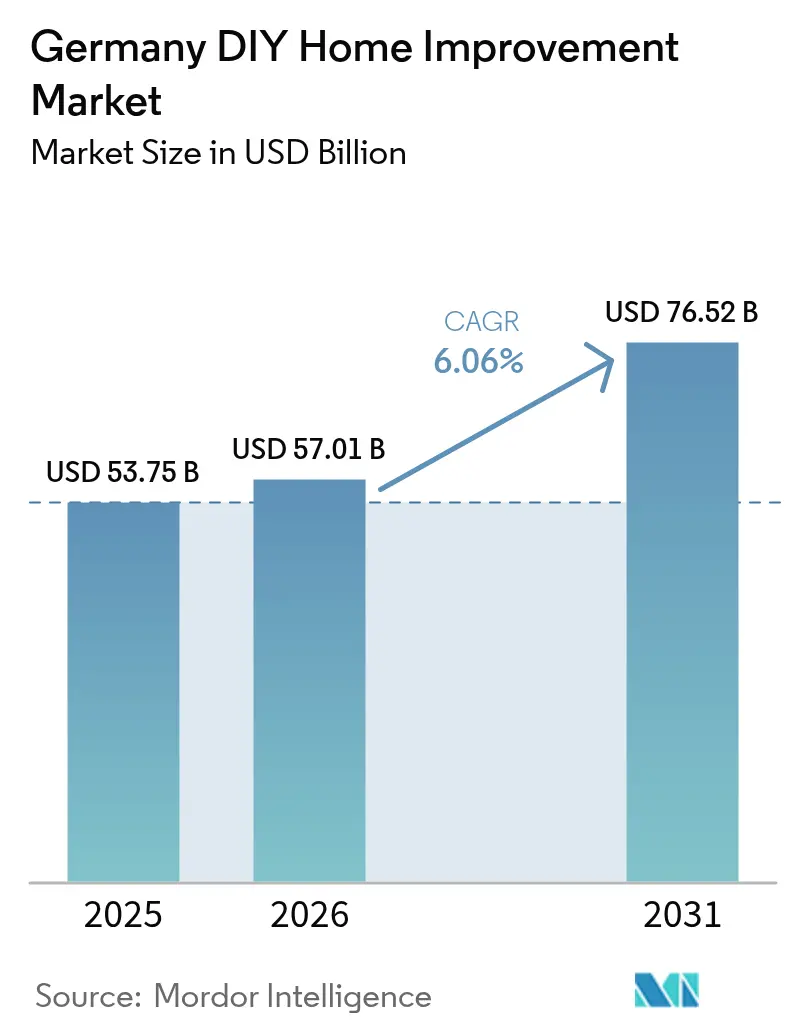
The Germany DIY home improvement market size was valued at USD 53.75 billion in 2025 and estimated to grow from USD 57.01 billion in 2026 to reach USD 76.52 billion by 2031, at a CAGR of 6.06% during the forecast period (2026-2031). Demand is buoyed by structural trends such as an aging housing stock, energy-efficiency mandates, and a nationwide shift toward cost-saving self-help projects. Digital disruption is intensifying competitive pressure because online channels grow faster than stores, despite accounting for only a small revenue share today. Energy retrofits that target heating systems and insulation upgrades contribute steadily to basket sizes, while garden and outdoor lines outperform on the back of lifestyle shifts toward sustainable living. Retailers respond by broadening assortments to include heat-pump kits, solar accessories,s and low-skill installation aids, anchoring future revenue streams on regulatory requirements rather than discretionary décor projects. Regional performance diverges: populous North Rhine-Westphalia supplies the largest revenue base, whereas Bavaria sets the pace on growth thanks to stronger incomes and proactive climate-policy subsidies.
Key Report Takeaways
- By product category, Building Materials led with 23.65% of Germany DIY home improvement market share in 2025; Garden and Outdoor products are forecast to expand at a 6.82% CAGR through 2031.
- By project type, Renovation held 41.05% of the Germany DIY home improvement market size in 2025, while Remodeling is advancing at a 6.35% CAGR through 2031.
- By distribution channel, DIY Superstores controlled 48.10% revenue in 2025; Online Pure-Play platforms register the highest projected CAGR at 7.98% to 2031.
- By region, North Rhine-Westphalia commanded 20.05% share of the Germany DIY home improvement market size in 2025 and Bavaria is set to post the fastest CAGR of 6.65% between 2026-2031.
Note: Market size and forecast figures in this report are generated using Mordor Intelligence’s proprietary estimation framework, updated with the latest available data and insights as of 2026.
Germany DIY Home Improvement Market Trends and Insights
Drivers Impact Analysis*
| Driver | (~) % Impact on CAGR Forecast | Geographic Relevance | Impact Timeline |
|---|---|---|---|
| Aging housing stock requiring renovation | +1.8% | National, with concentration in North Rhine-Westphalia, Bavaria | Long term (≥ 4 years) |
| Rising DIY culture among cost-conscious consumers | +1.2% | National, stronger in urban areas | Medium term (2-4 years) |
| Accelerating e-commerce and omnichannel penetration | +0.9% | National, led by metropolitan regions | Short term (≤ 2 years) |
| Sustainability rules driving energy-efficient retrofits | +1.5% | National, EU-wide regulatory alignment | Long term (≥ 4 years) |
| Rental-deposit insurance freeing cash for tenant upgrades | +0.4% | Urban centers, particularly Berlin, Munich, Hamburg | Medium term (2-4 years) |
| Maker-space partnerships with municipalities | +0.2% | Urban municipalities, pilot programs expanding | Long term (≥ 4 years) |
| Source: Mordor Intelligence | |||
Aging Housing Stock Requiring Renovation
About 30% of the country’s 21 million buildings carry poor G or H energy ratings, producing a large backlog of mandatory upgrades that expands the Germany DIY home improvement market. Annual refurbishment targets remain unmet, and cost-constrained owners increasingly opt for self-installation kits to comply with the Gebäudeenergiegesetz. Housing transactions trigger compulsory energy improvements, further lifting demand for insulation boards, roofing membranes, and heat-pump accessories. Rising construction costs of roughly 30% during 2021-2024 amplify the substitution of professional contractors with homeowner efforts. Low home-ownership rates mean landlords, too, are turning to budget DIY approaches to keep dwellings rentable under tighter efficiency rules.
Rising DIY Culture Among Cost-conscious Consumers
A broad shift toward frugal home projects is evident as household budgets tighten yet leisure time preferences favor practical creativity. Tool ownership is rising evenly across genders, and battery-powered devices simplify tasks that once demanded professional skill. Stable inflation forecasts around 2.2% for 2025 give planners confidence to allocate funds to weekend projects rather than postpone maintenance. The household tools segment benefits because cordless innovation makes drilling, sanding and sawing easier within apartments that restrict power outlets. Retailers respond with modular workshops and curated starter bundles, anchoring customer loyalty through instructional content and rental add-ons.
Accelerating E-commerce and Omnichannel Penetration
Digital commerce still represents only the low-teens share of Germany DIY home improvement market turnover, yet it is the fastest mover. Amazon.de illustrates the scale of opportunity with USD 1.3 billion in category sales. Brick-and-mortar leaders integrate click-and-collect, dynamic pricing, and artificial-intelligence inventory tools to protect their share. Hornbach’s real-time stock visibility system exemplifies this change and reduces out-of-stock rates, boosting both online conversion and in-store traffic. Current shopper behavior combines in-store advice with online research, so winning propositions blend wide assortments, transparent availability, and convenient fulfilment rather than pure online intensity.
Sustainability Rules Driving Energy-efficient Retrofits
The updated Gebäudeenergiegesetz obliges new heating systems to source 65% renewable energy from 2024, catalyzing sales of insulation materials, smart thermostats and solar kits[1]Source: Bundesministerium für Wohnen, Stadtentwicklung und Bauwesen, “Gebäudeenergiegesetz 2024,” bmwsb.bund.de. Heat pumps already appear in 76% of newly approved residential buildings. Federal and state subsidy schemes refund up to 70% of qualifying upgrade costs, turning energy retrofits from discretionary to economically compulsory. Two-thirds of homeowners plan photovoltaic installs by 2029, feeding demand for mounting hardware, inverters and wiring solutions. Retailers allocate extra aisle space to eco lines and supply QR-code tutorials that help customers navigate eligibility paperwork.
Restraints Impact Analysis*
| Restraint | (~) % Impact on CAGR Forecast | Geographic Relevance | Impact Timeline |
|---|---|---|---|
| Skilled-labour shortages inflating input prices | -0.7% | National, acute in construction-heavy regions | Medium term (2-4 years) |
| High interest rates suppressing big-ticket remodels | -1.0% | National, stronger impact in high-cost regions | Short term (≤ 2 years) |
| Inflation in building-material costs | -0.6% | National, with regional variations in supply chains | Short term (≤ 2 years) |
| EU product-safety revisions raising sourcing overheads | -0.3% | EU-wide, with compliance costs varying by product category | Medium term (2-4 years) |
| Source: Mordor Intelligence | |||
Skilled-labour Shortages Inflating Input Prices
One-quarter of construction firms report that limited worker availability constrains order intake, pushing up wages and delaying projects[2]Source: Hauptverband der Deutschen Bauindustrie, “Krise im Wohnungsbau,” bauindustrie.de. Scarcity spills into retail channels because manufacturers ration supply to higher-margin professional outlets, sending price lists upward for items like specialty insulation foams. Prefabricated panels and plug-and-play retrofit kits appear as partial solutions because they shorten installation time and reduce skill needs. Municipal pilot programs test maker-spaces where citizens can borrow tools and attend workshops, easing reliance on trade professionals and sustaining the Germany DIY home improvement market despite capacity bottlenecks.
High Interest Rates Suppressing Big-ticket Remodels
Elevated financing costs weigh on new mortgages and equity-financed renovations, as reflected in a construction PMI trough of 36.3 during 2024. Consumers shift toward phased projects below EUR 5,000 that can be cash-funded, stretching improvement cycles but preserving volume in core ranges such as paint, sealants and fittings. Retailers adjust marketing to emphasize cost-splitting, modular tool hire and energy-savings calculators that translate upfront spending into lower utility bills. While the drag on the Germany DIY home improvement market persists through 2026, policy signals pointing to rate stability gradually restore confidence for larger undertakings.
*Our forecasts treat driver/restraint impacts as directional, not additive. The impact forecasts reflect baseline growth, mix effects, and variable interactions.
Segment Analysis
By Product Category: Building Materials Lead as Garden and Outdoor Accelerate
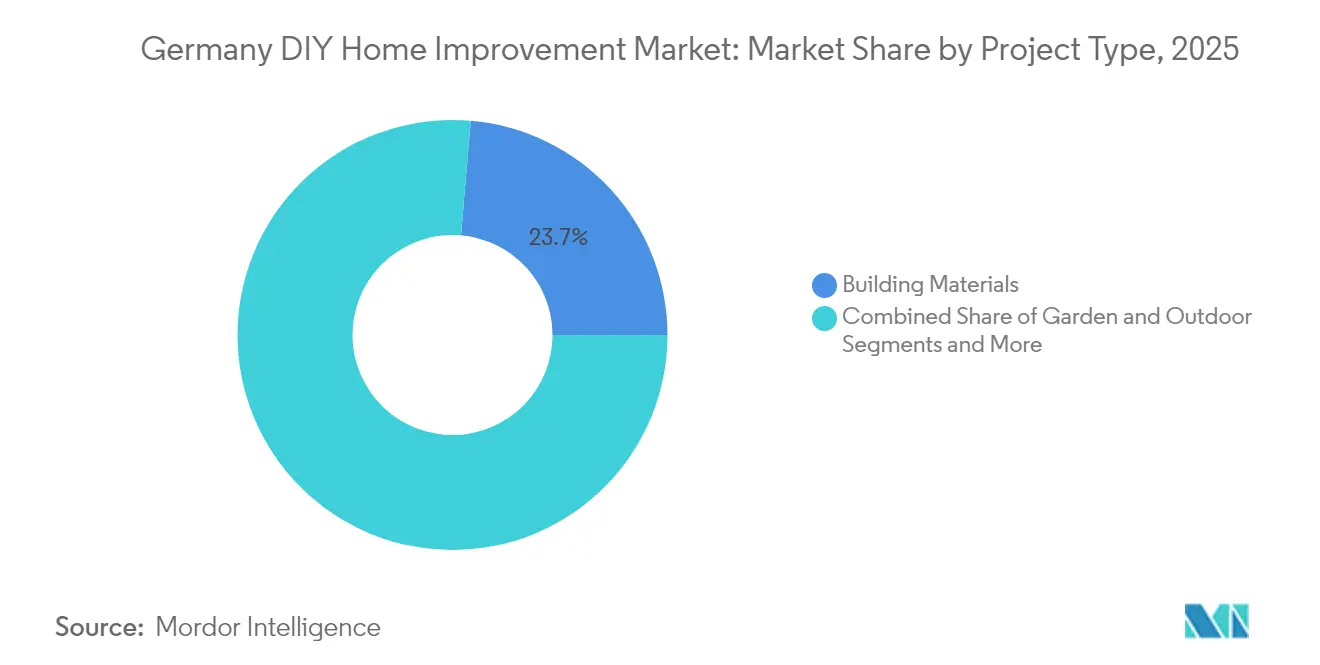
Building Materials captured 23.65% of the Germany DIY home improvement market in 2025, reflecting the dominance of insulation boards, roofing membranes and structural lumber in energy-driven retrofits. Garden and Outdoor ranges post the quickest climb at 6.82% CAGR through 2031 as households seek self-sufficiency and curb-appeal upgrades. The tools segment continues to benefit from cordless innovation, while decorative paints hold resilient because cosmetic refreshes remain affordable entry points for novice do-it-yourselfers.
Many Building Material purchases connect directly to subsidy-qualified projects, lifting average basket values and reinforcing loyalty to full-line superstores offering certified product assortments. Garden demand thrives on a cultural turn toward balcony vegetable patches and pollinator-friendly landscaping kits. Tools enjoy cross-category pull-through because consumers value versatilities such as drilling anchor holes for photovoltaic brackets. Décor and Furniture feel budget pressure, yet specialty lighting tied to smart-home integration partially offsets softness in impulse furnishings.


By Project Type: Renovation Dominance with Remodeling Momentum
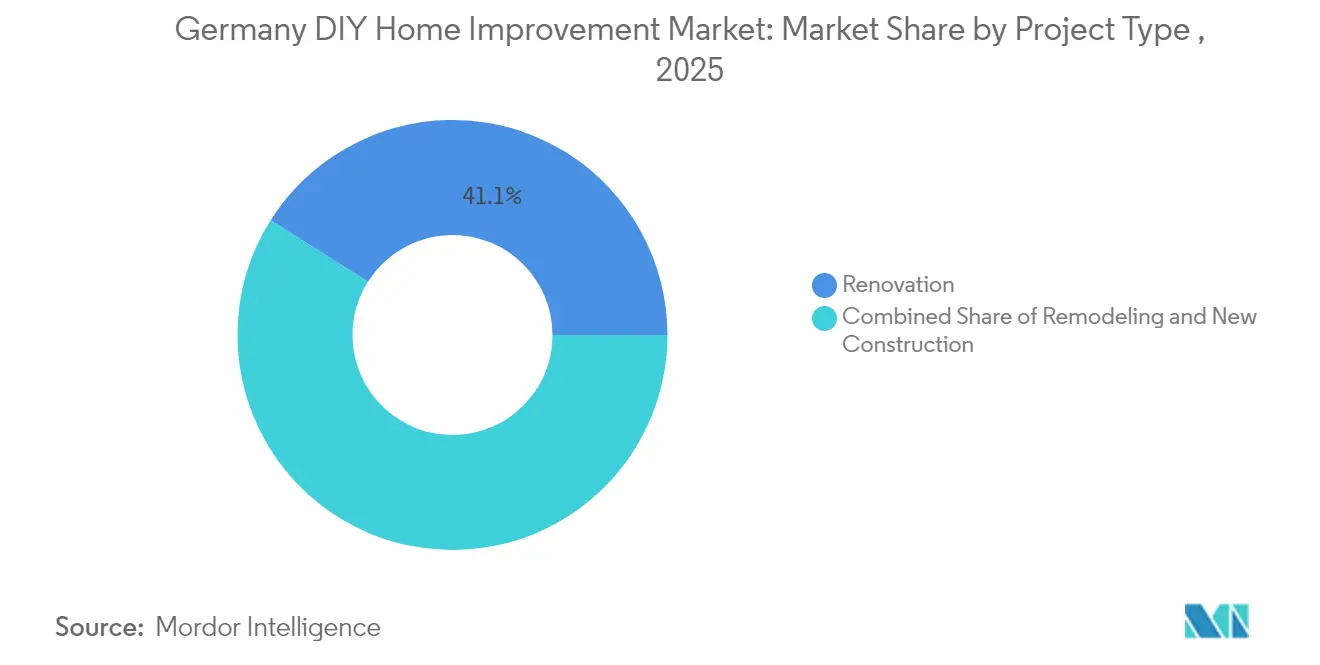
Renovations retained 41.05% of the Germany DIY home improvement market size in 2025 as households tackled essential maintenance and incremental energy upgrades. Remodeling shows a faster 6.35% CAGR to 2031 because regulatory changes push simple fixes toward comprehensive system overhauls that integrate insulation, heat pumps, and solar power.
Subsidy programs enable homeowners to pursue larger scopes in single projects, and retailers curate bundled material lists that match funding criteria to ease compliance. The incremental migration from renovation to remodeling also stems from improved access to how-to content, encouraging confident multitasking rather than isolated repairs. While new-construction demand remains soft amid broader building sector weakness, self-build and prefabricated cabin kits offer a niche that retailers exploit through value-added logistics and on-site consultation services.
By Distribution Channel: Superstores Hold Share as Online Gains Momentum
DIY Superstores accounted for 48.10% revenue in 2025, preserving their leadership through immediate product availability, advisory services, and showroom displays. Online pure-play platforms grow at an 7.98% CAGR, helped by marketplace breadth and fast last-mile delivery that attracts digitally native customers.
Store-based players are doubling down on omnichannel capabilities: click-and-collect orders, AI-driven demand planning, and augmented-reality store navigation. Autonomous micro-stores piloted in commuter locations extend opening hours with minimal staffing and may help counter labor scarcity in retail operations. Specialty hardware outlets face squeeze pressures but defend niches through expert guidance in plumbing or electrical lines that remain trust-critical for safety compliance.
Geography Analysis
Regional performance highlights the heterogeneous nature of the Germany DIY home improvement market. North Rhine-Westphalia generated 20.05% of national revenue in 2025 thanks to its dense urban corridors, mature logistics networks, and concentration of large-format outlets. However, operating costs and softer consumer sentiment caused selected store closures, underlining the importance of efficiency upgrades and inventory rationalization.
Bavaria leads growth at a 6.65% CAGR through 2031. Higher disposable incomes, strong technology industry employment, and proactive state subsidy programs foster willingness to invest in premium insulation solutions, smart-home integrations, and garden upgrades. Rural Bavarian districts amplify potential because detached housing stock is larger, giving scope for exterior improvements and rooftop solar arrays.
Baden-Württemberg confronts GDP contraction and a 5.5% fall in construction output, but its engineering culture sustains demand for technically advanced DIY kits as households look to self-install efficiency measures. Lower Saxony, Hesse, and the remaining Bundesländer offer expansion possibilities where digital infrastructure enables retailers to reach scattered communities with tailored omnichannel services. Rental market diversity also shapes spending: urban tenancy dominates Berlin and Hamburg, creating demand for reversible décor products and portable solar balconies, whereas higher ownership ratios in eastern regions support more extensive structural renovations.
Regulatory Landscape
Germany's DIY home improvement market sits within a layered regulatory system that combines EU construction product rules with state-level building oversight. Building permits and enforcement are decentralized across 16 Laender via Landesbauordnungen, while construction products are governed by EU rules and national conformity practices coordinated through the Deutsches Institut fuer Bautechnik (DIBt) and the Technische Baubestimmungen framework, including markings where CE marking is not applicable.
Two EU-wide changes tighten compliance for DIY relevant categories. Regulation (EU) 2024/3110, the Construction Products Regulation, entered into force in 2024 and its core provisions take effect from January 8, 2026, adding obligations such as expanded product information and digitalization requirements for manufacturers, importers, and distributors supplying building materials and retrofit components. In parallel, Regulation (EU) 2024/1781, the Ecodesign for Sustainable Products Regulation (ESPR), has applied since July 18, 2024, establishing a framework for environmental performance, circularity requirements, and digital product passports that affect data traceability for higher-impact DIY products.
Value Chain Analysis
The value chain runs from raw-material suppliers and manufacturers of building materials, tools, and home and garden products, through importers and branded distributors, into centralized retail distribution networks and last-mile fulfillment. Warehouse-format chains (Bauhaus, OBI, Hornbach, and Toom Baumarkt) anchor procurement through national DC networks, while cooperative structures such as hagebau coordinate purchasing, private-label programs, and logistics for affiliated independent and franchise outlets. Industry bodies such as BHB (retail) and Herstellerverband Haus & Garten (manufacturers) reflect how organized the sector is around coordinated standards, category management, and joint initiatives.
Compliance and documentation increasingly shape upstream and midstream operations, especially for construction products covered by EU construction product requirements and German implementation via the Bauproduktengesetz (BauPG), alongside technical building rules and required markings where applicable. This pushes suppliers and retailers toward stronger product data management (declarations, conformity, and sustainability attributes), and it reinforces the advantage of larger retailers and cooperatives that can spread compliance, quality assurance, and omni-channel logistics investment across high SKU counts and complex categories such as insulation, roofing membranes, and energy retrofit accessories.
Competitive Landscape
Market concentration is moderate: Bauhaus captured EUR 4.31 billion sales in 2024, edging past OBI at EUR 4.19 billion and consolidating top-line leadership. Hornbach maintains strong positions in central and southern states and differentiates through technology investments that deliver real-time inventory accuracy. Amazon.de’s USD 1.3 billion DIY turnover signals a structural digital competitor able to scale assortments rapidly without fixed-store capital.
Strategic responses emphasize ecosystem building. Bauhaus operates a marketplace that hosts 2,000+ categories and draws more than 150 million annual visits, creating platform-fee revenue in addition to product margin. OBI’s April 2025 purchase of Migros’ Swiss chain broadens geographic presence and procurement leverage[3]Source: OBI Group, “OBI Expands into Switzerland,” obi-group.com. Category specialists step into white-space opportunities such as heat-pump accessories, EV-charging kits and smart-watering systems, partnering with utilities and municipalities for co-marketing campaigns.
Competitive intensity is further shaped by supply chain digitization. Leaders deploy predictive analytics to minimize stock-outs in subsidy-relevant products, an edge when homeowners face regulatory deadlines. Smaller regional chains cooperate through joint buying groups yet still grapple with technology capital needs. Overall success hinges on blending physical experience, digital convenience and value-added service packages that support complex installation projects without inflating total cost of ownership for customers.
Germany DIY Home Improvement Industry Leaders
OBI
Bauhaus
Hornbach
Toom Baumarkt
Hagebau
- *Disclaimer: Major Players sorted in no particular order

Market Opportunities and Future Outlook
Energy and modernization led demand creates opportunities for retailers that simplify compliant renovation choices for consumers. In July 2026 the Building Modernization Act (Gebaeudemodernisierungsgesetz, GModG) introduced a defined transition path for green fuels from 2029 and broadened retrofit routes that DIY customers consider when upgrading homes. That supports bundled project baskets across insulation, controls, and installation aids backed by consistent product information.
Digital product information and sustainability requirements are also turning into a practical commercial lever. With the EU Construction Products Regulation core provisions applying from January 2026 and the ESPR framework already in place since July 2024, retailers that invest in product data readiness and traceability can differentiate assortment quality while reducing friction for customers tackling complex upgrades. Channel shift toward online and omni-channel journeys is reinforced as major chains invest in inventory visibility and store expansion to defend share while online penetration accelerates.
Recent Industry Developments
- July 2026: OBI opened a new franchise store in Ettlingen, rebranding a former hagebau location, operated by Auer Handels- und Beteiligungs GmbH & Co. KG. The opening expands OBIs local footprint through franchise integration and increases competitive pressure in catchment areas overlapped with cooperative networks and big-box chains.
- April 2025: OBI Group completed the acquisition of Migros OBI stores in Switzerland along with two Do it + Garden outlets. The deal broadened OBIs regional presence and strengthened procurement scale across a larger store base. That added leverage supports sharper pricing and faster assortment rollouts across the broader home and garden portfolio.
- July 2024: Bosch announced the acquisition of Johnson Controls' global HVAC solutions business for USD 8 billion, adding significant scale to Bosch's Home Comfort activities. The transaction strengthened Bosch capabilities in heating and cooling categories connected to home retrofits, shaping downstream availability and product innovation in DIY-adjacent retrofit components and accessories sold through German retail channels.


Research Methodology Framework and Report Scope
Market Definition and Coverage
For this study, the Germany DIY home improvement market is defined as consumer spending on products used for repair, maintenance, minor construction, and aesthetic upgrades that people plan and execute themselves in residential settings, across in-store and online purchases.
Scope exclusions: We exclude paid contractor labor, wholesale-only building material flows, and large appliances.
Segmentation Overview
- By Product Category
- Building Materials
- Tools and Equipment
- Paints, Coatings and Adhesives
- Lighting and Electrical
- Decor and Furniture
- Garden and Outdoor
- Plumbing Materials
- Flooring
- By Project Type
- Renovation
- Remodeling
- New Construction
- By Distribution Channel
- DIY Superstores
- Specialty Hardware Stores
- Online Pure-Play
- Retailer Click-and-Collect
- By Region - Germany
- Bavaria
- Baden-Wurttemberg
- North Rhine-Westphalia
- Lower Saxony
- Hesse
- Remaining Bundeslander
Data Sources, Market Sizing, and Validation
Desk Research
We first mapped the demand and supply context using public statistics and sector references, and then aligned them to how DIY spending shows up in retail and household budgets. Public sources such as Destatis household consumption tables, Eurostat construction and dwelling indicators, the German Federal Ministry for Housing, Urban Development and Building reports, and European Commission macro series were used to anchor the economic and housing cycle.
To keep the scope tied to DIY goods (not labor), we also reviewed sources such as customs and trade statistics, relevant product standards and building code publications, and association publications covering home improvement retail and renovation trends. Company annual reports, investor presentations, and reputable press were used to understand category momentum and pricing behavior, and then cross-checked with paid subscriptions that consolidate company financials, patent activity, and shipment-level import or export signals where relevant. These examples are not exhaustive, and many other sources were also used for data collection, validation, and clarification during analysis.
Primary Interviews and Surveys
Primary work was used to verify what DIY means in day-to-day buying, and to stress test category shares and price progression assumptions. We spoke with a mix of retailers, distributors, brand-side managers, and industry experts to confirm which products are typically purchased for self-executed projects and which tend to shift to professional installation. Inputs were also used to validate channel splits between store-based sales and e-commerce, along with promotion intensity and seasonality patterns, especially for garden and outdoor items.
Distribution of primary research fieldwork respondents
| Company type | Respondent position |
|---|---|
| Top tier: 31% | CXOs: 14% |
| Mid tier: 55% | Functional/Unit leaders: 32% |
| Smaller Players: 14% | Managers: 54% |
Market-Sizing & Forecasting
Sizing was built using a top-down and bottom-up approach. On the top-down side, household spend patterns, housing repair and renovation activity, and category-level retail indicators were used to reconstruct the addressable DIY goods pool in Germany, and then converted into value through observed pricing and mix. To keep the totals realistic, selective bottom-up checks were added, such as rolling up sampled SKU baskets for key categories, applying typical sales-per-store bands for major formats, and sanity-checking volumes against trade flows for imported DIY goods.
A few practical model inputs were tracked closely because they explain most of the year-to-year swing in DIY buying. These included residential renovation and repair intensity (as proxied by housing and construction indicators), home price and mortgage-rate direction, seasonal garden demand, paint and building materials price inflation, and the online share of category sales. Where bottom-up data was thin for niche items, we used conservative gap-fills based on adjacent category ratios that were validated in interviews.
Forecasts were built using scenario analysis supported by simple regression checks. The main drivers were housing activity, real disposable income, and material price trends, and then the results were adjusted based on what industry participants expected for promotion depth and project frequency. Assumptions were kept consistent across the time series, so changes in the forecast are driven by inputs and not by shifting definitions.
Data Validation & Update Cycle
We validated outputs through multiple cross-checks, first by comparing implied per-household DIY spending against independent household consumption signals, and then by checking whether category growth patterns matched known demand triggers like renovation cycles and seasonal peaks. Any large variance versus secondary indicators was reviewed, followed by a re-check of key assumptions such as online share, price pass-through, and the split between DIY and professional-led projects.
Before sign-off, the model and narratives go through a multi-step internal review so the logic, math, and scope stay consistent across sections. Reports are refreshed annually, and interim updates are made when major events materially change demand or pricing. Right before delivery, we perform a final pass to make sure the latest available statistics and market signals are reflected.
Mordor Intelligence's Germany Diy Home Improvement Market Sizing Compared With Other Published Estimates
Published market values for Germany DIY home improvement can vary widely, mainly because each publisher draws the line differently between DIY goods, professional renovation spend, and adjacent household categories. Differences also come from whether the estimate is built from retail sales, household budgets, or construction proxies, and from how the numbers are converted across currencies and years.
The main gap comes from whether contractor-led projects and installed categories are blended into the total. Mordor Intelligence counts only DIY product purchases for self-executed residential projects and excludes paid labor, wholesale-only flows, and large appliances, which keeps the estimate tied to a repeatable retail-demand pool.
Benchmark comparison
| Source | Market Size | Gaps in Research Methodology |
|---|---|---|
| Mordor Intelligence | USD 53.75 B (2025) | |
| Global Consultancy A | USD 46.20 B (2024) | Uses a narrower retail-only view and applies conservative housing turnover linkages, which can undercount categories that sell through mixed formats and online. |
| Industry Association B | USD 68.50 B (2024) | Bundles contractor-supported DIY kits and other adjacent spend into one total, and category definitions can drift across years, which inflates the market value. |
The spread is explained mostly by scope, not by math. When DIY goods are separated from professional labor and adjacent household spend, the market value is easier to reconcile with retail and household indicators, and the steps can be repeated consistently year after year.


Key Questions Answered in the Report
What is the current size of the Germany DIY home improvement market?
The market stands at USD 57.01 billion in 2026 and is projected to reach USD 76.52 billion by 2031.
Which product category leads sales in Germany’s DIY sector?
Building Materials leads with 23.65% revenue share in 2025, reflecting strong demand for insulation, roofing and structural upgrades.
How fast are online DIY sales growing in Germany?
Online pure-play channels grow at an 7.98% CAGR through 2031, faster than any other distribution format.
Why is Bavaria the fastest-growing region?
Higher disposable incomes, strong employment and generous energy-efficiency subsidies propel Bavarian growth at a 6.65% CAGR.
Who is the largest DIY retailer in Germany?
Bauhaus became the market leader in 2024 with EUR 4.31 billion in sales, surpassing OBI.
Page last updated on:


 Your data is secure and never sold or shared.


