
Market Overview
| Study Period | 2020 - 2031 |
|---|---|
| Forecast Data Period | 2026 - 2031 |
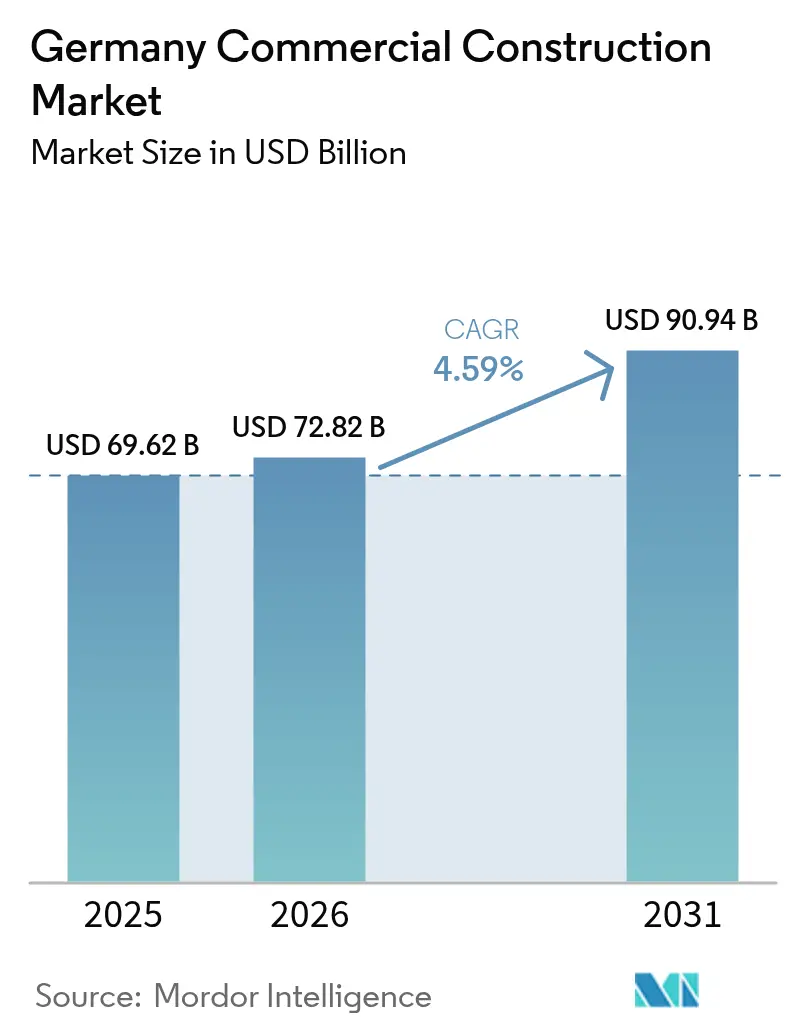
| Base Year Market Size (2025) | USD 69.62 Billion |
| Market Size (2026) | USD 72.82 Billion |
| Market Size (2031) | USD 90.94 Billion |
| Growth Rate (2026 - 2031) | 4.59 % |
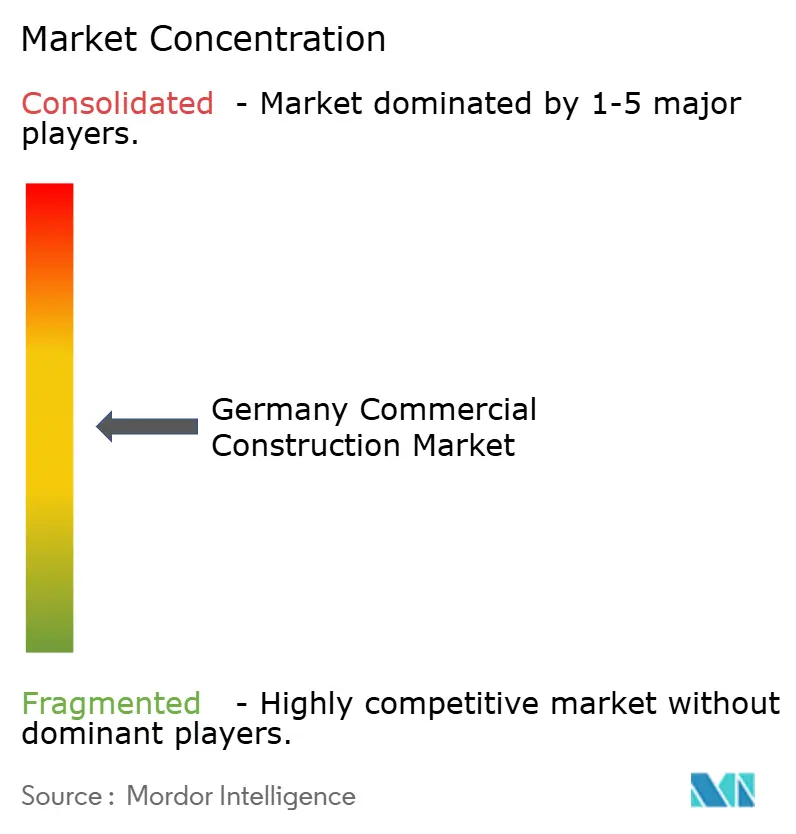
| Market Concentration | Medium |
Major Players *Disclaimer: Major Players sorted in no particular order Image © Mordor Intelligence. Reuse requires attribution under CC BY 4.0. | |
Germany Commercial Construction Market Analysis by Mordor Intelligence
Germany Commercial Construction Market size in 2026 is estimated at USD 72.82 billion, growing from 2025 value of USD 69.62 billion with 2031 projections showing USD 90.94 billion, growing at 4.59% CAGR over 2026-2031. Rising public spending, led by a USD 550 billion climate and infrastructure fund, anchors the sector’s steady outlook. Private investors remain active in logistics assets, while international technology firms channel fresh capital into hyperscale data-center projects. Legislative incentives for energy-efficient buildings strengthen renovation pipelines, even as volatile material prices and persistent labor shortages weigh on project margins. Strategic shifts toward modular building and digital project controls help large contractors contain costs and improve delivery speed, positioning the Germany commercial construction market for balanced, resilience-driven expansion.
Key Report Takeaways
- By commercial sector type, office construction held 22.12% of the Germany commercial construction market share in 2025; industrial and logistics facilities are forecast to expand at a 5.02% CAGR through 2031.
- By construction type, new projects accounted for 71.55% share of the Germany commercial construction market size in 2025 and renovation work is advancing at a 4.78% CAGR to 2031.
- By investment source, private funding captured 64.70% share of the Germany commercial construction market size in 2025, while public sector outlays are projected to rise at a 5.12% CAGR over the forecast period.
- By city, Berlin led with 23.55% revenue share in 2025; Frankfurt is projected to record a 4.86% CAGR through 2031.
Note: Market size and forecast figures in this report are generated using Mordor Intelligence’s proprietary estimation framework, updated with the latest available data and insights as of 2026.
Germany Commercial Construction Market Trends and Insights
Drivers Impact Analysis*
| Driver | (~) % Impact on CAGR Forecast | Geographic Relevance | Impact Timeline |
|---|---|---|---|
| Energy-efficiency retrofit incentives (BEG & related schemes) | +0.8% | National, urban centers | Medium term (2-4 years) |
| Rapid growth in data-center construction for cloud and AI workloads | +0.7% | Frankfurt, Berlin, Munich corridors | Short term (≤ 2 years) |
| Expansion of last-mile logistics and urban warehousing | +0.6% | Berlin, Hamburg, Frankfurt metros | Short term (≤ 2 years) |
| Increasing institutional capital allocation to German commercial real estate | +0.4% | National, tier-1 cities | Medium term (2-4 years) |
| Industrialised building methods gaining traction | +0.3% | National, early social-housing uptake | Long term (≥ 4 years) |
| Corporate shift to flexible workspace driving adaptive-reuse projects | +0.2% | Berlin, Munich, Hamburg districts | Medium term (2-4 years) |
| Source: Mordor Intelligence | |||
Energy-efficiency retrofit incentives drive market transformation
Germany’s streamlined BEG grant scheme now covers up to 45% of eligible renovation costs, lowering capital hurdles for mid-sized property owners. Contractors with HVAC, façade, and smart-building expertise see fuller backlogs as compliance becomes a tenant-attraction tool in tight urban sub-markets. Building owners prioritize envelope upgrades and heat-pump integration to lock in lower operating costs. The retrofit wave supports a nationwide shift toward net-zero goals and improves the Germany commercial construction market’s earnings visibility. Momentum is expected to persist through 2028, when stricter EU taxonomy rules take effect[1]Bundesamt für Wirtschaft und Ausfuhrkontrolle Staff, “BEG Investment Grant Guidelines 2024,” BAFA, bafa.de.
Rapid growth in data-center construction reshapes infrastructure priorities
Microsoft earmarked USD 3.52 billion for German AI infrastructure, while Amazon committed USD 8.58 billion to its sovereign-cloud region near Berlin. Frankfurt’s power-dense corridor remains the nucleus, yet secondary sites in Berlin and Munich are scaling. Projects demand redundant grids, liquid-cooling, and renewable energy tie-ins to meet the 2027 100% clean-power mandate. Specialized contractors with mission-critical credentials gain a pricing premium, reinforcing the Germany commercial construction market’s pivot toward technology-centric assets.
Expansion of last-mile logistics and urban warehousing fuels new builds
E-commerce penetration above 20% and consumer expectations for same-day delivery push developers toward infill hubs around Berlin and Hamburg. DACHSER’s USD 48.4 million warehouse in Unna illustrates a typical facility that blends rooftop solar arrays with high-bay automation. Demand stability helps offset softer retail-mall pipelines, and the quick-turn profile of logistics buildings smooths cashflows for mid-tier contractors. The segment’s scalability sustains the Germany commercial construction market’s base load of activity over the next two years.
Industrialised building methods gain institutional acceptance
Manufacturers such as Goldbeck deploy factory-finished modules that cut site hours by 70% and trim costs 25%, easing labor-pressure points. Early uptake centers on standardized offices and logistics sheds. Banks now finance modular projects on par with conventional builds, signalling mainstream credibility. Over the long term, wider adoption will moderate schedule risk and improve margins, underpinning steady growth in the Germany commercial construction market.
Restraints Impact Analysis*
| Restraint | (~) % Impact on CAGR Forecast | Geographic Relevance | Impact Timeline |
|---|---|---|---|
| Volatile construction-material prices tied to energy markets | −0.5% | Nationwide, energy-intensive regions | Short term (≤ 2 years) |
| Acute skilled-labour shortage and wage inflation | −0.4% | Nationwide, severe in Bavaria and Baden-Württemberg | Medium term (2-4 years) |
| EU taxonomy carbon-intensity limits raising financing hurdles | −0.3% | Nationwide, large developments | Medium term (2-4 years) |
| Lengthy permitting timelines in smaller municipalities | −0.2% | Rural and secondary cities | Long term (≥ 4 years) |
| Source: Mordor Intelligence | |||
Construction-material price volatility constrains project economics
Germany’s materials index climbed 3.2% year over year in February 2025 as energy costs remained elevated. Developers struggle to lock in lump-sum contracts, adding contingency allowances that push some projects beyond feasibility thresholds. Roofing and electrical packages show the steepest inflation, prompting substitution toward prefabricated elements where possible. Although hedging strategies soften the blow, persistent volatility pressures the Germany commercial construction market’s near-term margin outlook.
Labor shortage intensifies despite wage increases
Despite April 2025 wage hikes—4.2 % in the west and 5.0 % in the east—covering 930,000 workers, Germany’s commercial construction sector still faces 183,000 unfilled positions. Acute shortages of BIM- and energy-system technicians are delaying critical path tasks, forcing contractors to stagger start dates or walk away from bids to stay within capacity. The market, therefore, cannot accelerate even when demand is strong. Automation and international talent pipelines offer relief, but only over the medium term.
*Our forecasts treat driver/restraint impacts as directional, not additive. The impact forecasts reflect baseline growth, mix effects, and variable interactions.
Segment Analysis
By Commercial Sector Type: Logistics facilities outpace traditional offices
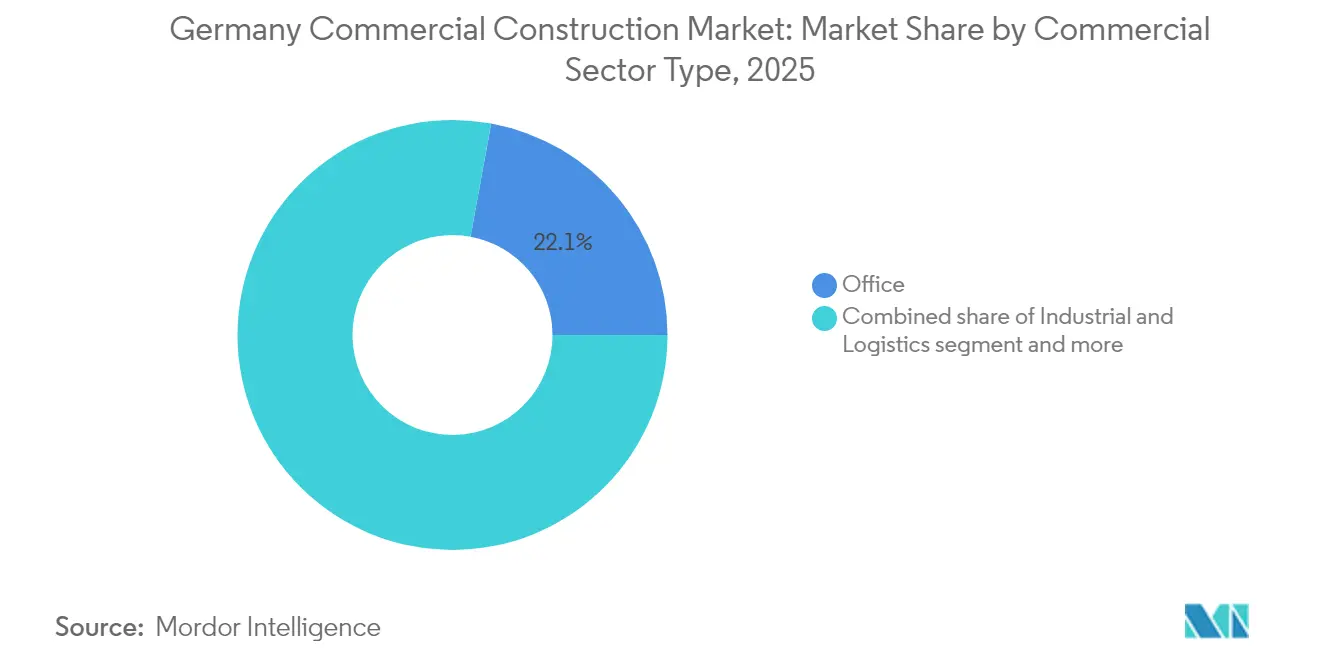
Office construction held 22.12% of the Germany commercial construction market share in 2025, yet demand is evolving as hybrid work models reduce average floor-space needs and intensify expectations for energy-efficient buildings. At the same time, industrial and logistics facilities are on track for a 5.02% CAGR to 2031, reflecting the surge in e-commerce fulfilment and the re-design of supply chains that now favor last-mile hubs close to consumers. These projects call for automated racking, low-carbon materials, and on-site renewable power, moving the segment well beyond conventional warehouse design. Smaller segments—healthcare, education, and mixed-use schemes—benefit from demographic shifts and public spending but expand at a slower pace than logistics, underscoring Germany’s growing role as a European distribution node.
DACHSER’s USD 48.4 million facility in Unna, equipped for 22,000 pallets and slated to create 290 jobs, shows the scale and complexity that new logistics builds now demand. Photovoltaic roofs and recyclable construction materials are standard specifications, making environmental certification a baseline rather than a premium feature. Retail construction faces structural headwinds as shoppers migrate online, prompting developers to rethink malls as experience-led destinations or repurpose them for alternative commercial uses. Contractors that master smart-building integration and energy-retrofit skills are best positioned to capture the shifting mix of work, keeping the Germany commercial construction market resilient even as traditional office and retail pipelines adjust.


By Construction Type: Renovation gathers speed alongside data-center green-field work
New builds retained 71.55% of total spending in 2025, yet renovation activity posts a brisk 4.78% CAGR to 2031 as owners chase BEG grants. The Germany commercial construction market size for retrofit projects now aligns with regulatory deadlines that require EPC level A by 2033 for many commercial properties. Contractors skilled in envelope insulation, HVAC retrofits, and smart metering enjoy repeat workstreams. Data-center green-field projects remain capital-heavy and technologically demanding, keeping new-build volumes elevated despite carbon-budget scrutiny.
Renovations also support adaptive-reuse plays, especially in city cores where land prices limit green-field feasibility. Investors convert ageing offices into mixed-use blocks that blend co-working, retail, and micro-fulfilment. Circular construction practices reclaim steel and façade elements, lowering scope 3 emissions and reinforcing sustainability credentials within the Germany commercial construction market.
By Investment Source: Public spending accelerates yet private capital dominates
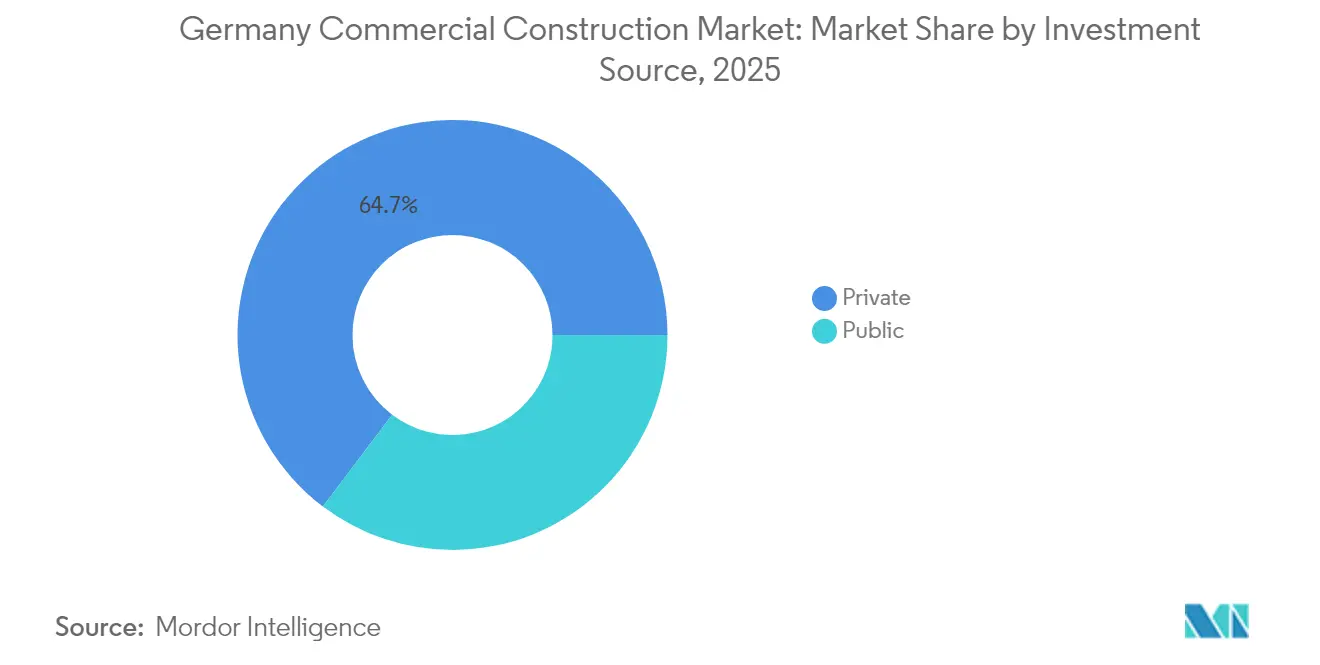
Private funding supplied 64.70% of project value in 2025, maintaining its primacy as the Germany commercial construction market’s main engine. The federal USD 110 billion allocation for climate-centric builds, however, propels public outlays at a forecast 5.12% CAGR to 2031. Public tenders favor low-carbon concrete and lifecycle-cost metrics, nudging contractors toward ESG-aligned supply chains. Large-scale rail upgrades, such as the Munich line, awarded to ACS, drain specialised resources, tightening the supply in smaller projects.
Private investors target logistics and data-center segments where rental escalations and covenant strength support valuations. Sale-and-leaseback deals free corporate capital while securing long-term income for funds. Public-private partnerships surface in social-infrastructure builds, merging government credit with private construction agility, an emerging hallmark of the Germany commercial construction market.
Geography Analysis
Berlin accounted for 23.55% of the Germany commercial construction market in 2025, underpinned by government complexes and a vibrant technology ecosystem. The city’s pipeline increasingly involves adaptive reuse as investors reposition outdated stock into ESG-ready space. Vacancy at 7% suggests supply absorption risk, yet prime rents hold firm because tenants prize efficient buildings.
Frankfurt, although smaller, is on track for a 4.86% CAGR to 2031. Hyperscale data-center clusters leverage the city’s low-latency fiber backbone and robust power grids. Financial institutions refurbish towers to meet strict carbon ceilings, boosting high-value retrofit demand. The Germany commercial construction market responds with a widening cadre of mission-critical contractors that specialise in concurrent engineering and off-site fabrication.
Munich and Hamburg sustain mature, diversified project flows. Munich channels automotive and semiconductor expansions into high-tech labs and clean rooms, while Hamburg’s port logistics drive large sheds with rail inter-modal links. The USD 12.1 billion SuedLink transmission project, crossing multiple regions, injects civil works demand along its route. Smaller cities absorb spill-over as firms search for lower land costs, demonstrating the Germany commercial construction market’s polycentric spread.
Regulatory Landscape
Germany commercial construction is shaped by federal planning and procurement rules, with the Baugesetzbuch (BauGB) providing the core framework for land-use planning and the VOB (as maintained by the Deutscher Vergabe- und Vertragsausschuss fuer Bauleistungen, DVA) anchoring public works contracting. In May 2026, the Federal Ministry for Housing, Urban Development and Building (BMWSB) reported Federal Cabinet approval of the draft BauGB-Upgrade package, which targets streamlined planning procedures, more digitized processes, and faster timelines for plan preparation (the package is in parliamentary procedure rather than in force). Product compliance also tightened in early 2026 as the Construction Products Act was adjusted to align with Regulation (EU) 2024/3110, increasing documentation and conformity expectations for construction products placed on the German market.
Alongside planning and product rules, site execution continues to be governed by established federal provisions such as the Construction Site Ordinance (Baustellenverordnung, BaustellV), which sets coordination and safety obligations that affect contractor staffing and site logistics. In practice, the near-term impact centers on permitting workflow digitization, standardized environmental assessment handling, and more traceable product documentation, shaping bid preparation and supplier qualification for commercial projects and public-sector adjacent commercial assets (such as research facilities and mission-critical buildings).
Value Chain Analysis
The Germany commercial construction value chain runs from project origination (corporate occupiers, developers, and public landlords) through design (architectural and engineering consultancies), general contracting and specialist trades (MEP, facade, fit-out, and mission-critical integrators), to upstream building materials and equipment suppliers (cement and concrete products, steel, insulation, HVAC, electrical, controls), followed by commissioning and facilities operations. Large contractors such as STRABAG SE and HOCHTIEF AG coordinate multi-discipline delivery for complex packages, while modular and prefabrication players (for example, Goldbeck) reduce onsite labor requirements by shifting work into factories. This changes logistics patterns toward just-in-time module transport and increases coordination with permitting and fire-safety approvals.
Recent operating conditions point to two constraints in the chain: input-cost volatility and labor availability. Industry PMI reporting in 2026 showed continued contraction in activity, with an easing rate of decline in new orders, while record input-cost inflation was reported around end-Q1 2026. Contractors therefore face a stronger need for escalation clauses, earlier procurement, and material substitution (especially for energy-intensive inputs). Labor tightness remains a binding bottleneck in scheduling and commissioning, pushing contractors toward digital project controls (BIM-based quantity takeoff and 4D/5D planning), tighter subcontractor frameworks, and prefabricated assemblies to protect delivery certainty for fast-cycle logistics assets and high-spec data centers.
Competitive Landscape
The Germany commercial construction market features moderate concentration where two multinational groups, STRABAG SE and HOCHTIEF AG, anchor bidding on complex schemes. STRABAG’s record backlog and 2,643 BIM 5D seats spotlight its digital-delivery edge, while its pledge to reach climate neutrality by 2040 secures eligibility for green public tenders. HOCHTIEF integrates North American affiliates Flatiron and Dragados to access mega-project know-how, reinforcing risk diversification across geographies.
Mid-tier firms such as Goldbeck and BAM Deutschland exploit agility in modular builds and design-build contracts. Goldbeck’s factory network underwrites short lead times that appeal to logistics developers on tight schedules. Regional specialists thrive in façade engineering, smart-building systems, and timber-hybrid structures, areas where incumbents still scale capabilities. The resulting ecosystem keeps pricing competitive yet encourages collaboration when bespoke skills are required.
Strategic moves focus on vertical integration and carbon footprint reduction. Contractors source green cement, lock in long-term power-purchase agreements for renewable electricity, and deploy AI-enabled scheduling software to trim idle time. Joint ventures form around data-center and rail packages that combine civil, MEP, and digital controls. Continuous upskilling in energy-modelling widens service scope, ensuring the Germany commercial construction market adapts to regulatory and client demands.
Germany Commercial Construction Industry Leaders
Strabag SE
HOCHTIEF
Ed. Züblin AG
GOLDBECK GmbH
BAM Deutschland AG
- *Disclaimer: Major Players sorted in no particular order

Market Opportunities and Future Outlook
Energy-efficiency renovations remain a primary opportunity lane inside commercial construction because grant-backed retrofit economics are already shaping owner decisions, and compliance requirements increasingly sit within tenant and lender expectations. Programs such as the BEG framework (administered through BAFA guidelines) support high-value scopes like envelope upgrades, HVAC modernization, and smart metering, aligning with the report segmentation where renovation is the faster-moving workstream versus new build. Contractors that combine building physics, MEP integration, and digital commissioning are positioned to support multi-site portfolios, particularly in tier-1 cities where adaptive reuse is displacing some greenfield office starts.
Mission-critical digital infrastructure is a second clear opportunity area, evidenced by hyperscale and colocation investment and by contractor awards tied to new capacity. In July 2026, HOCHTIEF won an NTT Global Data Centers contract for a 36 MW data center in Berlin, reinforcing ongoing demand for power-dense shells, resilient MEP, and advanced cooling buildouts beyond the traditional office and retail pipeline. At the same time, public programs linked to the Special Fund for Infrastructure and Climate Neutrality (SVIK) and related acceleration initiatives are pulling resources toward transport and public-institution projects, which creates openings for commercial-adjacent buildings such as research facilities, logistics hubs, and mixed-use schemes that can be delivered through partnering and PPP models where owners prioritize lifecycle cost, ESG criteria, and schedule reliability.
Recent Industry Developments
- July 2026: HOCHTIEF won a contract from NTT Global Data Centers to build a 36 MW data center in Berlin, with construction scheduled to start in summer 2026. The award reinforces the shift of commercial building activity toward mission-critical assets that require specialized MEP capability, commissioning discipline, and power and cooling integration.
- May 2026: STRABAG, via its ZUeBLIN unit, secured a EUR 380 million contract (90% share) for the new construction of the Erlangen lock on the Main-Danube Canal. Large, technically complex packages of this type tighten availability of experienced project teams and key trades, influencing pricing and delivery capacity across the broader commercial market.
- June 2025: Amazon announced a major expansion in Germany, including substantial investment in AWS facilities near Frankfurt. The move supports a larger pipeline of data-center related construction work, spanning high-spec shells, electrical systems, and resilient site infrastructure in the Frankfurt corridor.


Research Methodology Framework and Report Scope
Market Definition and Coverage
For this study, the market covers the value of commercial building work completed in Germany, including new builds and major renovations for income generating properties like offices, retail, hospitality, private healthcare and education, logistics, and mixed use sites.
Scope exclusions: Public infrastructure projects and purely residential housing are excluded from this market sizing.
Segmentation Overview
- By Commercial Sector Type
- Office
- Retail
- Industrial and Logistics
- Others
- By Construction Type
- New Construction
- Renovation
- By Investment Source
- Public
- Private
- By City
- Berlin
- Munich
- Frankfurt
- Hamburg
- Rest of Germany
Data Sources, Market Sizing, and Validation
Desk Research
Desk research started by establishing commercial activity levels in Germany and translating them into value pools that match work put in place. We relied on Destatis construction output and permit signals, which helped us see where the pipeline was expanding or contracting before we finalized assumptions.
We used sources such as Destatis construction statistics, Deutsche Bundesbank macro series, Eurostat construction indicators, and EU publications tied to building energy and renovation, since they help map cycles and cost pressure. Supporting checks came from listed company filings, investor presentations, trade press coverage, and curated news and financials services. Where needed, we referenced company financials intelligence, an import and export shipment level database, and a patent database to pressure test equipment cycle assumptions, materials exposure, and technology adoption. These sources are illustrative, and we also used other public and paid references for data collection, validation, and clarification.
Primary Interviews and Surveys
Primary work focused on validating how contractors and developers in Germany are viewing project starts, tendering behavior, and pricing movement across the main commercial end uses. We spoke with a mix of builders, specialist subcontractors, materials distributors, consultants, and asset owners, then used the input to refine renovation shares, fit out intensity, and the timing of cost pass through.
Distribution of primary research fieldwork respondents
| Company type | Respondent position |
|---|---|
| Top tier: 27% | CXOs: 12% |
| Mid tier: 59% | Functional/Unit leaders: 43% |
| Smaller Players: 14% | Managers: 45% |
Market-Sizing & Forecasting
Sizing was built with a top down approach where construction output series, building permits, and a demand pool view of commercial floor space additions were used to reconstruct annual work put in place for commercial buildings. The totals were then corroborated using selective bottom up checks, such as sampled project ticket sizes by building type, channel checks on fit out spend, and contractor revenue mix splits, and then adjusted where the checks consistently pointed to a gap.
Inputs that mattered most in Germany included nonresidential permits and starts momentum, renovation intensity (especially energy upgrades), labor availability and wage inflation, key material price movements, and the split between core shell and interior fit out activity. Forecasting was completed using scenario analysis supported by a lighter multivariate regression layer, where macro drivers like interest rates, business investment, and vacancy trends were linked to permitting and starts, and then translated to value using cost indices. When bottom up information was patchy for smaller renovation jobs, we used ratio based infill from primary feedback and public renovation program signals, and then kept the result within plausible ranges through sensitivity checks.
Data Validation & Update Cycle
Outputs were cross checked against independent signals, including permitting trends, construction cost indices, and reported backlog commentary from the sector, so the model did not drift away from real activity. Large jumps were flagged, and the assumptions behind pricing, renovation share, and timing were re worked until the movement looked consistent with the same external indicators.
Before sign off, the numbers move through multi step analyst reviews, including variance checks at the year level and logic checks on the implied spend per project type. When a material event occurs, such as a major policy change, a sharp rate shift, or a visible cost shock, the team re contacts sources and updates key inputs. Reports are refreshed annually, and a final pre delivery pass is completed so clients receive the latest view available at that time.
Mordor Intelligence's Germany Commercial Construction Market Estimate Compared With Other Published Estimates
Published market sizes for Germany commercial construction can look far apart, even when they appear to talk about similar buildings, because the underlying scope and the way value is counted often differ. The biggest drivers are what gets treated as commercial, whether renovations and fit out are counted, and how inflation and currency timing are handled.
Another common gap comes from mixing public infrastructure or housing adjacent activity into the same total, and then applying broad growth rates without checking permits, starts, and cost indices together. Some estimates also use aggressive or conservative scenarios without stating what changed in the inputs, such as the assumed renovation wave, labor constraints, or the pace of cost pass through.
Benchmark comparison
| Source | Market Size | Gaps in Research Methodology |
|---|---|---|
| Mordor Intelligence | USD 69.62 B (2025) | |
| Industry Association A | USD 63.10 B (2025) | Tends to emphasize new build structural work and may under count interior fit out and major renovation value, which reduces the total in service heavy commercial projects. |
| Global Consultancy B | USD 78.40 B (2025) | Often uses a broader construction basket where mixed use and adjacent categories can be folded in, and pricing uplift can be applied with less explicit cost index alignment. |
The table shows the spread is mostly explained by what is counted as commercial work and how renovation and fit out value is treated, rather than by a single growth assumption. Keeping the scope tied to work put in place across new builds and major renovations, and then checking pricing against construction cost indices and permit led activity, is what anchors the estimate shared by Mordor Intelligence.


Key Questions Answered in the Report
What is the current size of the Germany commercial construction market?
The market generated USD 72.82 billion in 2026 and is projected to reach USD 90.94 billion by 2031.
Which commercial sector type leads in market share?
Office construction remains the largest segment, holding 22.12% of sector spending in 2025.
Where is the fastest growth expected geographically?
Frankfurt is forecast to expand at a 4.86% CAGR through 2031, outpacing other major German cities.
What public funding is driving future projects?
A federal climate-and-infrastructure fund worth about USD 550 billion is earmarking at least USD 110 billion for climate-related construction.
How significant are renovation projects versus new builds?
New construction still dominates with 71.55% share, but renovation work is growing at a 4.78% CAGR as owners pursue energy-efficiency upgrades.
Which constraint most threatens near-term growth?
Volatile material prices, already adding 3.2% to building costs year over year, pose the sharpest risk to project margins.
Page last updated on:


 Your data is secure and never sold or shared.


