
Germany Bathroom Furniture Market Size and Share
Market Overview
| Study Period | 2020 - 2031 |
|---|---|
| Forecast Data Period | 2026 - 2031 |
| Base Year Market Size (2025) | USD 4.20 Billion |
| Market Size (2026) | USD 4.42 Billion |
| Market Size (2031) | USD 5.74 Billion |
| Growth Rate (2026 - 2031) | 5.33% CAGR |
| Market Concentration | Medium |
Major Players
*Disclaimer: Major Players sorted in no particular order Image © Mordor Intelligence. Reuse requires attribution under CC BY 4.0. |
|
Germany Bathroom Furniture Market Analysis by Mordor Intelligence
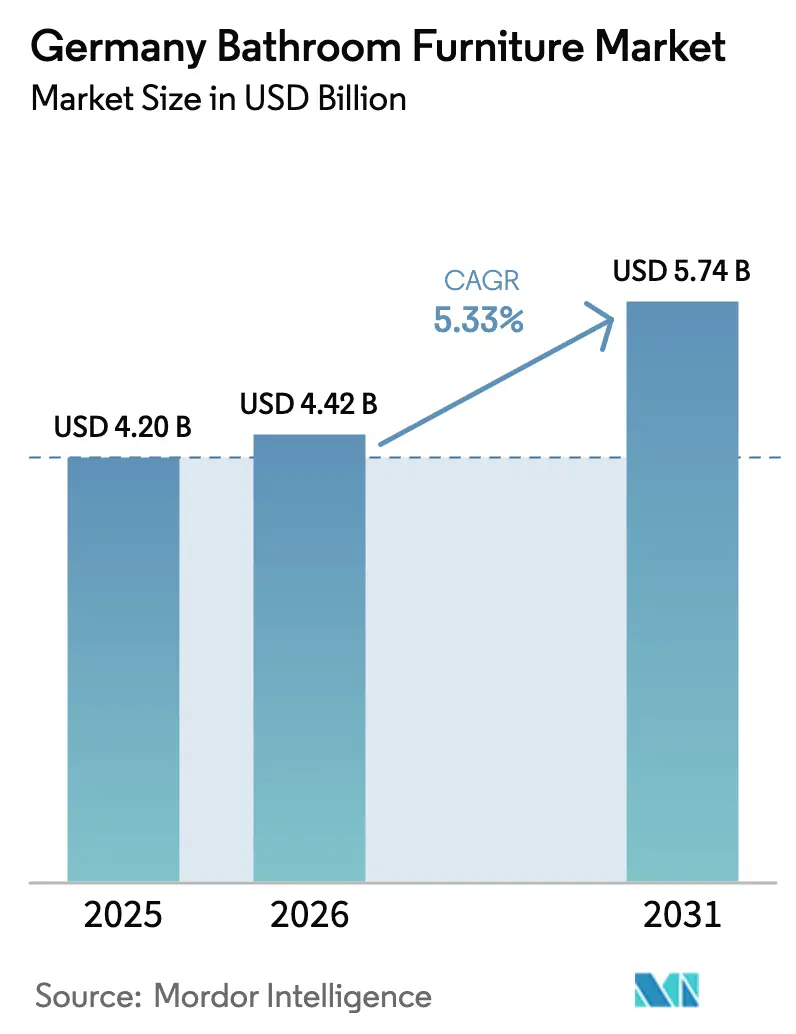
Germany's bathroom furniture market size in 2026 is estimated at USD 4.42 billion, growing from 2025 value of USD 4.20 billion with 2031 projections showing USD 5.74 billion, growing at 5.33% CAGR over 2026-2031. Momentum is anchored in premiumization, sustainability, and technology, even as the broader construction sector wrestles with permitting delays and a 7.4% revenue dip at the start of 2024. Bath vanities remain the largest product category, while the commercial end-user segment outpaces residential growth due to hospitality refurbishments. Certified wood and recycled composites reinforce green credentials, and IoT-enabled mirrors or drawers recalibrate what constitutes “furniture,” keeping average selling prices resilient. Established brands such as Hansgrohe, Duravit, and Villeroy & Boch leverage design heritage and international distribution to defend their share, yet digital-first challengers chip away online, forcing incumbents to sharpen direct-to-consumer strategies.
Key Report Takeaways
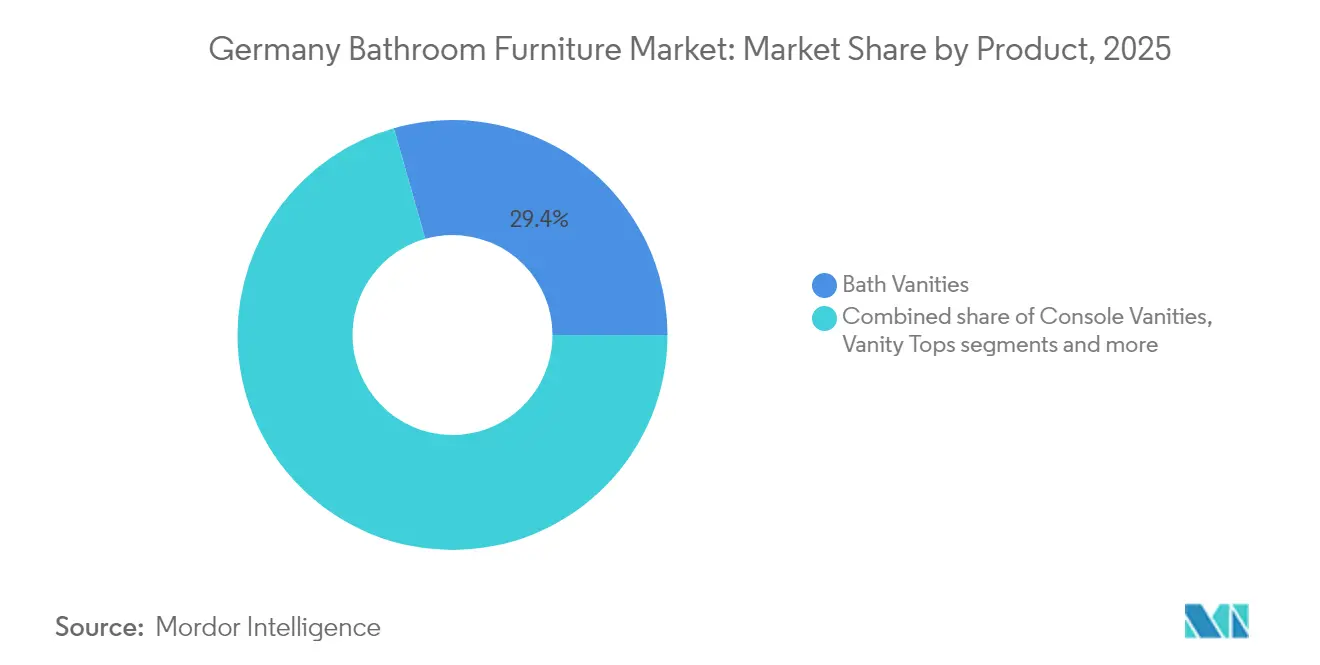
- By product, bath vanities led with 29.40% of Germany bathroom furniture market share in 2025; storage furniture & accessories are projected to grow at a 6.07% CAGR between 2026-2031.
- By material, wood captured 31.30% of Germany bathroom furniture market size in 2025; plastics and polymers are tracking a 5.72% CAGR through 2031.
- By price range, the mid-range tier represented 39.20% of Germany bathroom furniture market size in 2025, whereas premium lines expanded at a 6.24% CAGR.
- By end user, residential controlled 74.20% of Germany's bathroom furniture market size in 2025, while the commercial sector posts a 6.61% CAGR through 2031.
- By distribution, B2C/retail retained 59.10% value in 2025; direct B2B channels record the highest 6.14% CAGR on stronger manufacturer–specifier ties.
- By geography, North Rhine-Westphalia commanded 29.50% value in 2025, and Bavaria is the fastest-growing region with a 5.86% CAGR.
Note: Market size and forecast figures in this report are generated using Mordor Intelligence’s proprietary estimation framework, updated with the latest available data and insights as of 2026.
Germany Bathroom Furniture Market Trends and Insights
Drivers Impact Analysis*
| Driver | (~) % Impact on CAGR Forecast | Geographic Relevance | Impact Timeline |
|---|---|---|---|
| Ageing housing stock renovations backed by federal subsidies | +1.8% | National; urban focal points | Medium term (2-4 years) |
| Adoption of smart IoT-enabled bathroom furniture with integrated lighting | +1.2% | Metropolitan areas first | Long term (≥4 years) |
| Premium sustainable design preference & eco certification influence | +1.0% | Affluent regions | Medium term (2-4 years) |
| Urban multifamily construction fueling compact modular solutions | +0.7% | Berlin, Munich, Hamburg | Medium term (2-4 years) |
| Rising e-commerce penetration enhancing product accessibility | +0.6% | Nationwide | Short term (≤2 years) |
| Source: Mordor Intelligence | |||
Ageing Housing Stock Renovations Backed by German Federal Subsidies
Federal housing programs allotting EUR 8 billion between 2018 and 2024 stimulate demand for retrofit-friendly vanities and storage kits that blend accessibility with aesthetics.[1]European Commission, “Supporting housing renovation in Germany,” ec.europa.eu Roughly one-quarter of Germany’s citizens are 60 +; yet only 2% of homes offer age-appropriate bathrooms, driving suppliers such as Duravit and Burgbad to pioneer grab-free drawer profiles and height-adjustable mirrors. Product specs increasingly match barrier-free guidelines without evoking institutional styling, supporting willingness to pay in the premium tier. Municipal subsidy portals further shorten payback periods for homeowners, keeping renovation pipelines active despite labor shortages.
Adoption of Smart IoT-Enabled Bathroom Furniture with Integrated Lighting
Voice- or app-controlled mirrors, LED-framed cabinets, and motion-triggered drawers reposition bathrooms as wellness hubs rather than functional volumes. Early uptake clusters in Berlin loft conversions, where tech-savvy professionals demand personalization and remote diagnostics. Manufacturers interlink faucets, lighting, and vanities to gather water-consumption data, aligning with ESG targets of hotel operators. Brand ecosystems—Duravit’s D-Neo platform, Hansgrohe’s RainTunes lighting sync—lock customers into upgrade paths and help defend margin dilution from commodity imports.
Premium Sustainable Design Preference & Eco Certification Influence
PEFC-certified oak, water-based lacquers, and take-back schemes now decide brand choice for Gen-Y buyers who equate durability with environmental stewardship. Duravit’s cradle-to-cradle DuraCeram washbasins and Hansgrohe’s 98% raw-material recycling pilot testify to industry’s shift from compliance to proactive leadership.
Urban Multifamily Construction Fueling Compact Modular Solutions
Urban apartment construction is stretching every square meter, especially in cities such as Berlin and Hamburg, where housing shortages remain acute. Builders and renovators now favor wall-mounted vanities, slim storage towers, and other modular pieces that keep the floor clear and visually enlarge tight bathrooms while still offering generous shelving. Although Germany completed only about 270,000 of its 400,000-unit annual housing goal in 2024, the ongoing pipeline keeps demand high for furniture that packs multiple functions into a single body—think vanity bases that conceal a washer-dryer or mirror cabinets with discreet ventilation fans to cut down on steam [2]FIEC. "Germany - FIEC Statistical Report." fiec-statistical-report.eu/germany..
Restraints Impact Analysis*
| Restraint | (~) % Impact on CAGR Forecast | Geographic Relevance | Impact Timeline |
|---|---|---|---|
| Labour shortages & long permitting delaying renovation cycles | -0.9% | More acute in rural zones | Medium term (2-4 years) |
| Escalating raw-material costs compressing manufacturer margins | -0.7% | Nationwide | Short term (≤2 years) |
| Price pressure from DIY chains on branded furniture vendors | -0.5% | Nationwide | Medium term (2-4 years) |
| Source: Mordor Intelligence | |||
Labour Shortages & Long Permitting Delaying Renovation Cycles
Planning permissions for new homes slumped by 24.2% year-over-year in May 2024, extending project lead times and inflating subcontractor rates. Multitrade coordination—plumbers, tilers, electricians—makes bathrooms especially vulnerable, pushing some consumers to defer upgrades. Industry responds with prefab panel systems and tool-free fittings that shave labor hours, yet cannot fully offset structural shortages.
Escalating Raw-Material Costs Compressing Manufacturer Margins
Rising raw material costs are squeezing profit margins across the bathroom furniture value chain, forcing manufacturers to choose between absorbing costs or risking market share through price increases. After a 7.4% jump in 2023, construction inputs moderated to a 2.6% rise in 2024 but still squeeze mid-tier makers lacking brand-led price power. Proprietary composites such as Duravit’s DuroCast allow partial substitution of costlier resins, while group purchasing with faucet divisions hedges steel contracts.
*Our forecasts treat driver/restraint impacts as directional, not additive. The impact forecasts reflect baseline growth, mix effects, and variable interactions.
Segment Analysis
By Product: Smart Integration Drives Storage Growth
Storage furniture is forecasted to climb at a 6.07% CAGR, outstripping the overall category pace. Wi-Fi-enabled drawers that log cosmetics expiry dates and humidity-resistant shelving target compact urban bathrooms. Bath vanities retained a commanding 29.40% German bathroom furniture market share in 2025 and anchor renovation budgets because countertop and basin selection set the aesthetic tone. Console variants and mirrors adopt LED backlighting, defogging films, and Bluetooth speakers, weaving technology into traditional silhouettes. Competition pivots from raw volume to software interoperability that locks users into brand ecosystems.
Demand for modular storage also benefits from demographic aging: slide-out laundry hampers mitigate bending, while adjustable shelving adapts to children's growth. Premium lines such as Duravit’s Aurena collection introduce porcelain-clad dividers that merge hygienic surfaces with high-design cues. As adoption broadens, suppliers experiment with subscription-based filter replacements for mirror-integrated air purifiers, crystallizing annuity revenue.


By Material: Sustainability Reshapes Material Choices
Wood’s warm tactility and carbon-sink narrative underpin its 31.30% share of Germany bathroom furniture market size in 2025. FSC- or PEFC-certified oak and walnut remain hero finishes, yet veneer thicknesses shrink to reduce material intensity without visual compromise. Cross-laminated panels with bio-based adhesives improve moisture resilience, extending warranty periods. Plastics and advanced polymers trail but clock the highest 5.72% CAGR. WPC blends, commercialized by the LIMOWOOD consortium, divert landfill waste while achieving Class B fire ratings, attracting hospitality specifiers. Hybrid assemblies—oak drawer fronts on recycled-PET carcasses carry aesthetics with resource efficiency and facilitate easier disassembly at the end of life.
Metal frames re-emerge as accents, allowing thinner carcass walls and floating effects. Powder-coated aluminum in matte pastel tones answers pastel design trends forecasted for 2026 interiors. Ceramic or solid-surface tops integrate overflow-free drains to reduce water use, echoing broader German plumbing codes.
By Price Range: Premium Segment Defies Economic Headwinds
Premium models hold niche volume but deliver disproportionate profit, growing at 6.24% CAGR. Partnerships with global design icons—e.g., Philippe Starck for Duravit—elevate brand stories, enabling average gross margins beyond 40%. Mid-range units represent the workhorse 39.20% share of the German bathroom furniture market. Economy SKUs cater to do-it-yourself remodeling but face stagnation as inflation hits discretionary spending.
Product mix is tilting toward “affordable luxury,” where mid-tier carcasses pair with premium handles or smart mirrors offered as upsell modules. Such micro-segmenting lets brands defend price ladders without alienating value hunters.
By End User: Commercial Sector Accelerates Modernization
Corporate wellness programs and hotel pipeline refurbishments propel the commercial tier at 6.61% CAGR, versus modest residential expansion. Occupancy-driven ROI models prioritize durable laminates, anti-fingerprint coatings, and IoT sensors that count traffic for cleaning schedules. Public restrooms in airports integrate vanities with concealed paper-towel bins and maintenance alerts, trimming facility costs. Residential buyers, still 74.20% of volume, oscillate between minimalistic Scandinavian influences and maximalist color blocking. Aging-in-place retrofits introduce grab bars disguised as towel rails and vanities with knee clearance for seated use, blurring disability and mainstream design language.

By Distribution Channel: Digital Transformation Reshapes Buying Journey
B2B/direct sales outpace at 6.14% CAGR as architects request factory-configured sets and BIM files directly from manufacturers’ portals. Project dashboards synchronize logistics for multi-floor hotel rollouts, compressing lead times. Conversely, B2C/retail retains 59.10% share by virtue of foot-traffic visibility and hands-on evaluation. Omnichannel is no longer optional: QR codes on showroom tags open AR overlays showing color variants, then route to e-cart checkout. Returns logistics, once a deterrent, now mirror apparel industry efficiency, further lifting online penetration.
Geography Analysis
North Rhine-Westphalia commands a 29.50% value share thanks to dense urban demand from Cologne, Düsseldorf, and Dortmund. A sizeable ageing housing stock intersects with high disposable income, supporting uptake of premium, accessibility-friendly vanities. Concentration of showrooms and logistics hubs shortens delivery lead times, enticing consumers toward larger, customized solutions.
Bavaria earns fastest-growing status at a 5.86% CAGR as Munich and Nuremberg sustain robust construction pipelines. Tourism inflow prompts hotel bathroom refurbishments that ripple to residential aspirations, particularly for eco-labelled furniture, given Bavarian environmental sensibilities. Regional proximity to Baden-Württemberg manufacturing clusters streamlines supply chains and facilitates showroom inventory rotation.
Eastern Länder retrofit Soviet-era flats, favoring budget-aware mid-range lines, while Hamburg’s micro-apartments push ultra-compact modular vanities. National targets of 400,000 new homes annually, though under-delivered, still buoy region-wide demand for space-efficient and sustainable furniture .
Regulatory Landscape
Bathroom furniture and sanitary products in Germany are governed by federal state building codes (MBO/Musterbauordnung) and construction-related technical rules (MVV TB). EN 14749 applies to domestic storage furniture, requiring stability tests and tip-over performance that shape wall-mounting hardware, anchoring kits, and installation instructions used by brands and retailers.
Sustainability-related rules and voluntary quality schemes also influence material selection and product documentation. The Ecodesign for Sustainable Products Regulation (ESPR), effective July 2024, pushes design for durability, repairability, and recyclability. Emissions and material controls for wood-based panels, including formaldehyde limits aligned with E1 classification, remain relevant, while the Golden M quality seal (RAL-GZ 430) continues to be used as a procurement and premium-positioning benchmark administered through Deutsche Gütegemeinschaft Möbel (DGM).
Value Chain Analysis
The Germany bathroom furniture value chain is anchored by manufacturers such as Duravit AG, Villeroy & Boch AG, and Geberit AG, which are increasingly incorporating double materiality assessments in line with ESRS. Supply chains depend on EU Timber Regulation (EUTR) compliance and certification such as FSC or PEFC, supporting sustainable sourcing across key inputs. Digital data exchange is also progressing, with guidance such as OFML shaping configuration and sales management, while the go-to-market approach combines B2C retail and B2B direct channels supported by industry bodies and networks like VDM that coordinate standardization and supplier alignment.
Competitive Landscape
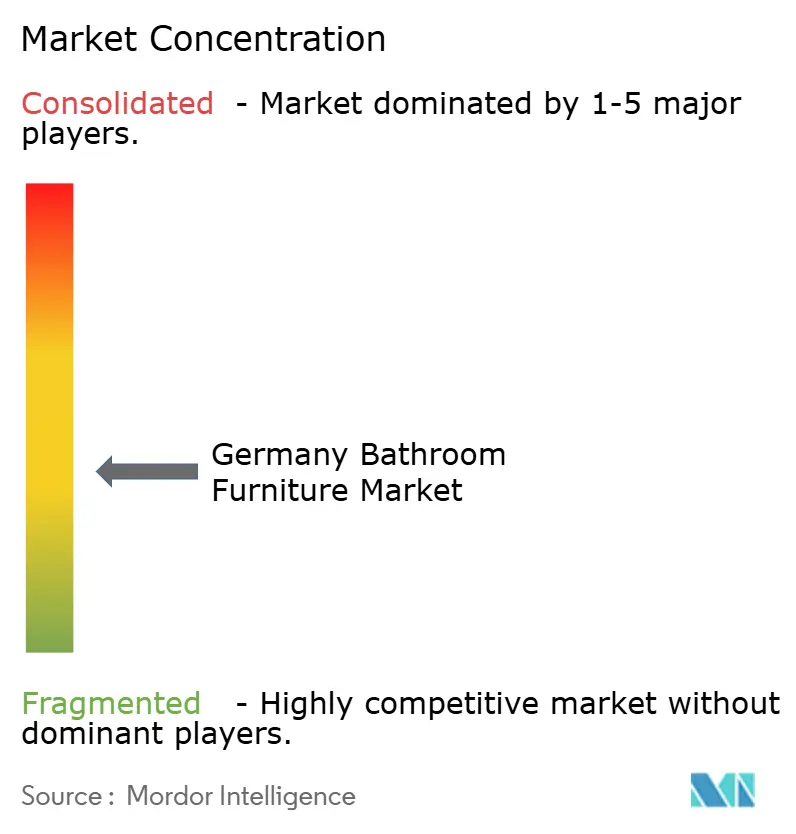
Germany bathroom furniture market features a moderately concentrated structure. Duravit sustains brand equity through frequent collaborations and its climate-neutral pledge targeting Scope 1 & 2 emissions by 2045. Hansgrohe expands beyond brassware by releasing vanity lines co-designed with Phoenix Design, seeking to cross-sell into its faucet install base. Villeroy & Boch leverages its ceramics heritage to market integrated countertop-basin slabs that dovetail with its tile business.
Nimble entrants like VALLONE differentiate through direct-to-architect models and mass-customization, while DIY private labels nibble low-end volume. Innovation races beyond materials toward service layers: augmented-reality apps, five-day custom color lead times, and post-purchase maintenance analytics. Sustainability remains a showdown arena; Hansgrohe’s zero-plastic packaging pledge by 2025 and Duravit’s post-consumer take-back program set benchmarks competitors must meet or exceed. Strategy convergence around full-suite bathroom solutions intensifies, with faucet, lighting, and furniture bundles promoting upselling synergies and supply-chain leverage.
Germany Bathroom Furniture Industry Leaders
-
Burgbad
-
Duravit AG
-
IKEA
-
Villeroy & Boch AG
-
Geberit AG
- *Disclaimer: Major Players sorted in no particular order

Market Opportunities and Future Outlook
Circular economy and refurbishment models are increasingly central to how firms address ESPR requirements, for example through take-back, refurbishment, and resale programs for bathroom furniture that include cabinet carcasses and mirror cabinets, alongside modular configurations that make component swaps easier, as seen in initiatives such as COR CORever.
Digitalization and product intelligence also expand the feasible range of space-saving configurations and premium service offerings. Duravit’s climate-neutrality target for 2045, alongside investments in automated manufacturing powered by greener energy, including a 35,000 m2 project initiated in July 2023, supports higher-value assortments and ESG-backed claims in procurement and retail. Investment in digital sales channels and 3D configuration tools further tightens the customer journey and improves manufacturer-specifier collaboration.
Recent Industry Developments
- June 2026: Burgbad launches Uomo bathroom furniture collection with varied materials and finishes (melamine, matt lacquers, oak veneers). The new lineup expands premium product range and SKU variety in the German market. It strengthens premium segment positioning and distribution footprint through material-led design.
- May 2026: Duravit AG promotional campaign for D-Code bathroom furniture sets with trade partner exhibition discounts through 2026. Direct marketing ties the promotion to furniture series and runs via exhibition offerings. The discount structure supports partner-led sales and end-customer adoption.
- May 2026: Duravit AG design guide release on tactile, vertically structured furniture fronts for Balcoon, Zencha, Aurena series. The guide supports premium, tactile aesthetics in the furniture segment. It reinforces Duravit’s design-led positioning and helps enable cross-sell across series.


Research Methodology Framework and Report Scope
Market Definition and Coverage
For this study, the Germany bathroom furniture market covers revenue earned from bathroom furniture products sold and installed in Germany across residential and commercial settings, counted at the price paid by the immediate buyer.
Scope exclusions: Excludes sanitary ceramics, faucets, showers, plumbing installation components, and standalone renovation labor that is not bundled with furniture supply.
Segmentation Overview
-
By Product
- Bath Vanities
- Console Vanities
- Vanity Tops
- Bathroom Mirrors
- Storage Furniture & Accessories
-
By Material
- Wood
- Metal
- Plastic & Polymer
- Other Material
-
By Price Range
- Economy
- Mid-range
- Premium / Luxury
-
By End User
- Residential
- Commercial
-
By Distribution Channel
-
B2C/Retail
- Home Centers
- Specialty Furniture Stores (including exclusive brand outlets)
- Online
- Other Distribution Channels (includes hypermarkets, supermarkets, teleshopping, warehouse clubs, departmental stores, etc.)
- B2B/Directly from Manufacturers
-
B2C/Retail
-
By Geography
- Bavaria
- Baden-Württemberg
- North Rhine-Westphalia
- Lower Saxony
- Hesse
- Rest of Germany
Data Sources, Market Sizing, and Validation
Desk Research
Desk research was used to frame the demand environment and to anchor the market to observable signals that can be checked year to year. We reviewed Germany building and renovation indicators, import and export flows for relevant furniture categories, and price and consumer sentiment context that helps explain short-term swings.
Public sources were used as starting points, such as Germany's Federal Statistical Office (Destatis) for construction and housing series, Eurostat for harmonized trade and price data, and German and European sanitary or building trade bodies for industry direction and renovation trends. We also referenced company annual reports, investor presentations, and reputable press coverage for channel shifts and product mix commentary. In addition, paid subscriptions were used selectively for company financials and intelligence, patent databases, and shipment-level import/export checks where a public series was too aggregated. This list is illustrative and not exhaustive, and many other sources were consulted for data collection, validation, and clarification.
Primary Interviews and Surveys
Primary work focused on validating what actually moved the market in Germany, especially renovation-driven volumes, channel margins, and mix shifts between economy and premium bathroom furniture. We spoke with manufacturers, distributors, retailers, installers, and commercial buyers across major German states to pressure-test assumptions, fill gaps left by public data, and align pricing logic with what buyers are currently accepting.
Distribution of primary research fieldwork respondents
| Company type | Respondent position | Region |
|---|---|---|
| Top tier: 34% | CXOs: 15% | |
| Mid tier: 51% | Functional/Unit leaders: 28% | |
| Smaller Players: 15% | Managers: 57% |
Market-Sizing & Forecasting
The core sizing starts with a top-down approach where housing completion and renovation activity, together with channel sell-through patterns, are used to reconstruct the addressable demand pool for bathroom furniture in Germany. That demand pool is then translated into value by applying average selling prices (ASPs) that vary by product type and price positioning, followed by adjustments for commercial project share and online versus offline mix.
To keep the model grounded, we corroborate results with selective bottom-up approximations, including supplier and retailer revenue cross-checks, sampled ASP times unit volume checks, and sanity checks against import/export signals for relevant furniture categories. Inputs used in the model include bathroom renovation cycles, new housing completions, household spending on home improvement, tender and refurbishment activity in hospitality or offices, and observed ASP progression tied to material costs and premiumization. Where direct unit visibility is weak, gaps are handled through range assumptions that are tightened using primary feedback on conversion rates, typical basket sizes, and discounting behavior.
Forecasts are built using scenario analysis layered on short leading indicators, and the scenarios are then aligned to expert expectations on construction pipelines, renovation willingness, and price normalization. A short list of variables is projected separately first, and then rolled into the market model so the final growth path stays explainable and repeatable.
Data Validation & Update Cycle
Validation is done through a stepwise triangulation process where modeled totals are compared against independent signals, and then reviewed for inconsistencies before sign-off. We run variance checks across years to spot unusual jumps in implied volumes, ASPs, or channel mix, and we re-check any outliers against the original sources and the interview notes.
Before publishing, assumptions are challenged in an internal review, and follow-up outreach is triggered when a key input moves materially, such as a sharp change in renovation demand or a sudden pricing shift. Reports are refreshed annually, with interim updates when major events affect construction activity, trade flows, or pricing. Right before delivery, a fresh analyst pass is completed so clients receive the latest updated view.
Mordor Intelligence's Germany Bathroom Furniture Market Estimate Compared With Other Published Estimates
Published market values for Germany bathroom furniture can differ because the refresh timing, currency conversion window, and the way ASPs are carried forward are not consistent across publishers. Even when the product label looks similar, the included items and the point in the value chain where revenue is counted can quietly change the final number.
In our work, recent price movements and discounting behavior are re-validated close to the base year and converted using a consistent USD timing assumption, which is one reason the figure can look different in Mordor Intelligence. Differences also show up when some estimates blend adjacent categories like sanitaryware or installation content, or when they use a single broad furniture price index that does not fully capture premium mix growth in vanities and mirrors.
Benchmark comparison
| Source | Market Size | Gaps in Research Methodology |
|---|---|---|
| Mordor Intelligence | USD 4.20 B (2025) | |
| Industry Association A | USD 3.85 B (2025) | Often aligns bathroom-related revenue to broader sanitary industry turnover, which can undercount furniture sold via general furniture retail and online channels, and may apply conservative pricing carry-forward during weaker construction periods. |
| Trade Journal B | USD 4.75 B (2026) | Tends to report a forward-looking value that can embed an optimistic renovation rebound, and it may include furniture-adjacent items like cabinets bundled with fixtures, which lifts ASPs and inflates the furniture-only boundary. |
The spread in published numbers is mostly explained by timing and what gets counted as bathroom furniture versus bundled bathroom packages. By keeping the model tied to renovation and completion signals, and then stress-testing ASP changes through repeated channel checks, we end up with a market value that is easier to trace back to clear drivers and to update consistently.


Key Questions Answered in the Report
How big is the Germany bathroom furniture market in 2026?
Germany bathroom furniture market stands at USD 4.42 billion in 2026, with a projected CAGR of 5.33% to 2031.
Which product segment leads the Germany bathroom furniture market?
Bath vanities lead with 29.40% market share in 2025, while storage furniture shows the strongest 6.07% CAGR outlook.
What role does sustainability play in purchasing decisions?
Eco-certified materials and circular design now rank among the primary purchase criteria, lifting premium products that offer PEFC-certified wood or recycled composites.
Why is the commercial end-user segment growing faster than residential?
Hospitality renovations and corporate wellness investments push commercial demand to a 6.61% CAGR, outpacing residential upgrades.
How are manufacturers mitigating raw-material cost inflation?
They innovate with proprietary composites, expand vertical integration, and pass through selective price increases, especially in premium tiers.
Which sales channel is expanding most rapidly?
Direct B2B relationships with developers and architects are rising at 6.14% CAGR, supported by digital configurators and BIM integration.
Page last updated on:






