
Market Overview
| Study Period | 2021 - 2031 |
|---|---|
| Forecast Data Period | 2026 - 2031 |
| Base Year Market Size (2025) | USD 2.30 Billion |
| Market Size (2026) | USD 2.41 Billion |
| Market Size (2031) | USD 3.01 Billion |
| Growth Rate (2026 - 2031) | 4.58 % |
| Market Concentration | Medium |
Major Players *Disclaimer: Major Players sorted in no particular order Image © Mordor Intelligence. Reuse requires attribution under CC BY 4.0. | |
Germany Agricultural Tractor Machinery Market Analysis by Mordor Intelligence
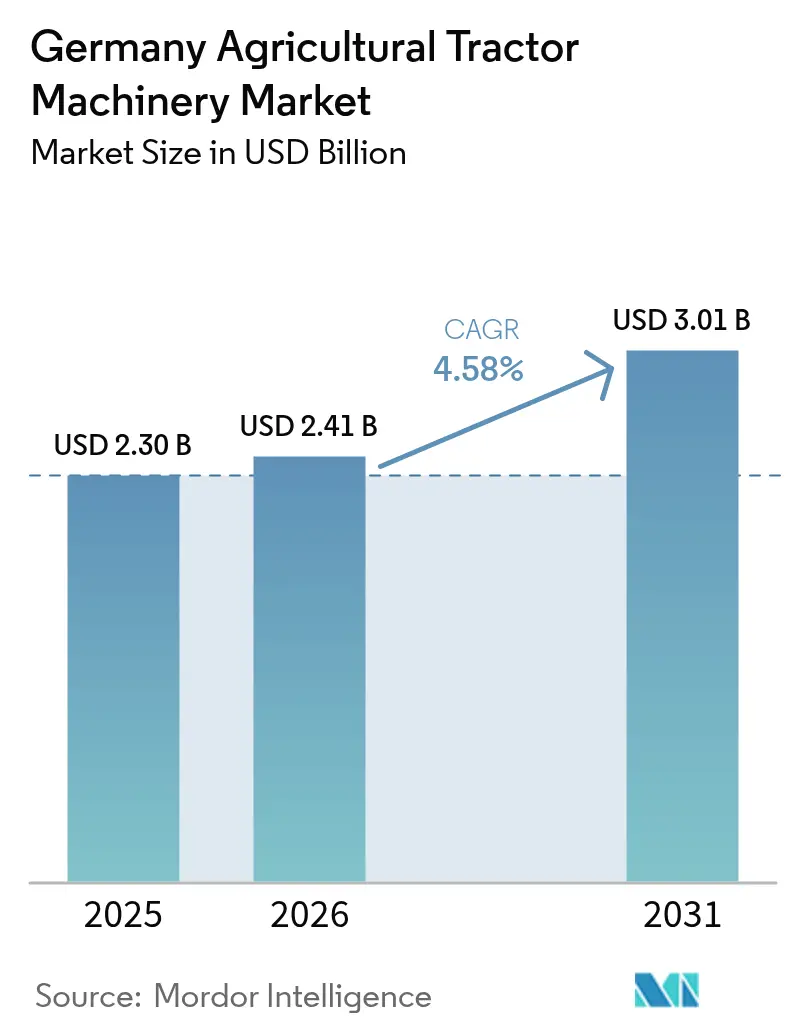
Germany agricultural tractor machinery market size in 2026 is estimated at USD 2.41 billion, growing from 2025 value of USD 2.30 billion with 2031 projections showing USD 3.01 billion, growing at 4.58% CAGR over 2026-2031. This steady trajectory conceals a strategic shift toward premium implements, Stage V-compliant powertrains, and data-driven retrofits that lift average selling prices, even as total tractor registrations slipped to 27,595 units in 2024 [1]Source: CEMA, “Tractor Registrations 2024,” cema-agri.org. Policy-induced replacement cycles, underwritten by USD 5.1 billion in annual Common Agricultural Policy (CAP) direct payments and targeted Agri-Investment Program grants, continue to anchor demand for technology-rich assets. High biogas-plant density, tightening emissions rules, and dealer-subsidized financing at rates below 3% catalyze the uptake of connectivity-ready machinery across various farm sizes [2].Source: Renewable Energy Agency, “Biogas in Germany 2025,” renewable-energy.de In parallel, the European Union Carbon Border Adjustment Mechanism adds cost pressure on steel and aluminum components, reinforcing the Original equipment manufacturer (OEM) moves toward domestic sourcing and design modularity.
Key Report Takeaways
- By product type, plowing and cultivating machinery accounted for 36.85% of Germany agricultural tractor machinery market size in 2025, and sprayers are forecast to expand at a 7.62% CAGR through 2031.
Note: Market size and forecast figures in this report are generated using Mordor Intelligence’s proprietary estimation framework, updated with the latest available data and insights as of 2026.
Germany Agricultural Tractor Machinery Market Trends and Insights
Drivers Impact Analysis*
| Driver | (~) % Impact on CAGR Forecast | Geographic Relevance | Impact Timeline |
|---|---|---|---|
| Subsidy boost from German Agri-Investment Program | +1.20% | Bavaria, Lower Saxony, and North Rhine-Westphalia | Medium term (2-4 years) |
| Expansion of biogas maize acreage | +0.80% | Bavaria, Baden-Württemberg, and Lower Saxony | Long term (≥ 4 years) |
| Demand for low-HP tractors from smallholdings | +0.60% | Southern mixed-farm regions | Short term (≤ 2 years) |
| Original Equipment Manufacturer (OEM) financing below 3% interest | +0.90% | National, and dealer network dependent | Short term (≤ 2 years) |
| Edge-Artificial Intelligence (AI) retrofits for autonomous tillage | +0.70% | Brandenburg, Saxony-Anhalt, and Mecklenburg-Vorpommern | Medium term (2-4 years) |
| Soil-health-linked insurance rebates | +0.50% | North Rhine-Westphalia, and Schleswig-Holstein | Long term (≥ 4 years) |
| Source: Mordor Intelligence | |||
Subsidy Boost from German Agri-Investment Program
Germany’s Agri-Investment Program channels part of the USD 5.1 billion the Common Agricultural Policy (CAP) payments into Stage V tractors, precision sprayers, and reduced-tillage implements, linking reimbursements to telemetry-verified environmental performance through the Farm Sustainability Data Network [3].Source: European Commission, “Farm Sustainability Data Network Overview,” AGRICULTURE.EC.EUROPA.EU Co-funding rates reach 75% for climate-smart machinery, shortening depreciation cycles and steering buying criteria toward connectivity rather than horsepower. The program’s data-reporting mandate accelerates platform adoption, such as AGCO Fuse and Deere & Company Operations Center, shifting competitive advantage to ecosystem interoperability. European Investment Bank credit lines, worth USD 3.2 billion between 2024 and 2027, further reduce borrowing costs for machinery rings and cooperatives, reinforcing group purchasing power.
Expansion of Biogas Maize Acreage
Germany operates 9,500 biogas plants, totaling 6.2 GW, half of the feedstock comes from 2 million hectares of maize silage. Despite lower feed-in tariffs, repowering of legacy units secures steady forage demand through 2030. Contractors servicing these plants purchase high-throughput harvesters with kernel processors capable of processing over 400 metric tons per hour, along with precision slurry injectors that recycle digestate. Grandfathered tariffs ensure stable cash flow, allowing equipment investment to focus on uptime and payload efficiency rather than fleet size. Consequently, haying and forage implements remain a stable anchor within Germany agricultural tractor machinery market even as new plant construction slows.
Demand for Low-HP Implements from Smallholdings
Farms under 50 hectares represent 68.5% of holdings but rely on 30 to 75 horsepower power units for daily work. Compact plows, rotovators, and modular planters allow diversified operations to mechanize irregular fields while complying with Stage V emission mandates. Lease-to-own programs from AGCO Finance and CNH Capital, offering interest rates below 3%, reduce monthly payments to less than the cost of seasonal labor. This affordability catalyzes the uptake of ISOBUS-ready implements, driving incremental gains in the Germany agricultural tractor machinery market through 2027.
Original Equipment Manufacturer (OEM) Financing below 3% Interest
Manufacturer-backed loans tie reduced rates to sustainability covenants, which are financed via European Investment Bank credit lines. Bundled telematics, extended warranties, and carbon-credit facilitation transform credit offers into service platforms. Preferential pricing steers buyers toward precision-enabled equipment whose verified savings meet policy metrics, thereby strengthening attachment rates and reducing default risk for lenders.
Restraints Impact Analysis*
| Restraint | (~) % Impact on CAGR Forecast | Geographic Relevance | Impact Timeline |
|---|---|---|---|
| Declining average farm size | -0.60% | Bavaria and Baden-Württemberg | Long term (≥ 4 years) |
| Volatile commodity prices | -0.80% | Lower Saxony and Saxony-Anhalt grain belt | Short term (≤ 2 years) |
| High procurement cost of Stage V engines | -1.10% | National | Medium term (2-4 years) |
| Battery-raw-material sourcing risks | -0.40% | National,and electric-powered equipment initiatives | Long term (≥ 4 years) |
| Source: Mordor Intelligence | |||
Declining Average Farm Size
The average German holding is approximately 18 hectares, and 62% of the land is leased, which discourages capital-intensive equipment purchases by tenant farmers [4]Source: Federal Ministry of Food and Agriculture, “Guidelines for Autonomous Field Operations 2024,” BMEL.DE. Small plots favor multi-purpose or shared implements over dedicated fleets, limiting unit volumes for high-capacity machinery. While modular platforms and leasing soften the blow, persistent fragmentation subtracts momentum from Germany agricultural tractor machinery market.
High Procurement Cost of Stage V Engines
Stage V rules require diesel particulate filters and selective catalytic reduction, which increases the prices of compliant power units and any implements that must integrate electronically. Farmers often must replace both the tractor and the implement simultaneously to secure subsidy eligibility, pushing expenditures beyond their immediate budgets. Carbon Border Adjustment compliance raises steel and aluminum costs by USD 1.1-1.7 million for the Original equipment manufacturers (OEMs), further inflating retail prices.
*Our forecasts treat driver/restraint impacts as directional, not additive. The impact forecasts reflect baseline growth, mix effects, and variable interactions.
Segment Analysis
By Product Type: Precision Sprayers Outpace Traditional Tillage Equipment
Plowing and cultivating machinery accounted for 36.85% of the Germany agricultural tractor machinery market size in 2025, reflecting broad interest in strip-till and no-till practices that qualify for soil-health insurance rebates. Sprayers are forecast to expand at a 7.62% CAGR to 2031, outstripping every other product category. Variable-rate nozzles and camera-based weed detection allow users to cut herbicide usage by 66% while meeting European Union pesticide reduction targets.
The sprayer segment’s acceleration hinges on forthcoming record-keeping mandates under the Sustainable Use of Pesticides Regulation, projected to require telemetry audits for commercial field work. The Original equipment manufacturers (OEMs) position themselves accordingly, AGCO’s PTx Trimble leverages a mixed-fleet retrofit library covering more than 10,000 models, while German specialists Amazone and Horsch roll out modular sprayers that accept third-party sensor kits. With regulatory drivers and demonstrable input savings converging, precision spraying remains the brightest growth pocket within Germany agricultural tractor machinery market.


Geography Analysis
The Germany agricultural tractor machinery market exhibits significant regional disparities, driven by variations in farm structure, cropping patterns, and policy priorities. Southern states such as Bavaria and Baden-Württemberg are characterized by small, fragmented farms, many of which operate on hilly terrain. This structure sustains demand for lower-horsepower tractors and compact implements, including plows and planters designed for maneuverability and slope stability.
In contrast, northern and eastern regions, such as Lower Saxony, Saxony-Anhalt, and Brandenburg, are characterized by large-scale grain and energy crop farming. These areas host a high concentration of biogas-linked operations, driving demand for high-capacity forage harvesters, slurry management equipment, and other heavy-duty machinery. Farmers in these regions are also among the earliest adopters of autonomous and semi-autonomous implements due to field size and labor efficiency requirements.
The western and northern coastal regions, including North Rhine-Westphalia and Schleswig-Holstein, are more heavily oriented toward dairy farming. Dense livestock populations and growing emphasis on soil health and nutrient management are encouraging investment in precision slurry applicators and conservation tillage equipment. At the same time, subsidy-supported income stability sustains machinery replacement cycles, although recent market conditions indicate farmers are prioritizing essential upgrades while postponing non-critical purchases. Regulatory intensity further amplifies regional segmentation. States with a strong focus on organic and environmentally regulated farming are accelerating the adoption of digitally enabled sprayers and compliance-oriented equipment. Meanwhile, regions with expansive field structures continue to favor high-horsepower, four-wheel-drive, and automation-ready machinery, reinforcing differentiated demand patterns across Germany agricultural tractor machinery market.
Regulatory Landscape
Germany agricultural tractor machinery sits within the EU approval and safety framework for agricultural and forestry vehicles (Regulation (EU) No 167/2013), along with German enforcement bodies and requirements for road use and operator safety. Type-approval and market surveillance increasingly overlap with on-road operation for some machine categories, and Regulation (EU) 2025/14 sets out updated technical and administrative procedures for EU type-approval and market surveillance of non-road mobile machinery intended for public road use.
Compliance expectations for connected and high-power equipment also tighten around functional safety and braking. Commission Delegated Regulation (EU) 2025/1117 adds technical requirements for braking devices and functional safety for agricultural and forestry vehicles, reinforcing OEM redesign and retrofit demand around braking architectures. For crop-protection equipment, Germanys Plant Protection Equipment Ordinance (PflSchGerätV), overseen through the Julius Kuehn-Institut framework, specifies testing requirements for plant protection devices, supporting the shift toward audited, compliance-ready precision sprayers. Diesel-powered agricultural machinery used in road contexts is further influenced by measurement and exhaust pollutant procedures referenced in StVZO Anlage XVI, which raises the bar for integrated powertrain and aftertreatment compatibility in tractor-implement combinations.
Competitive Landscape
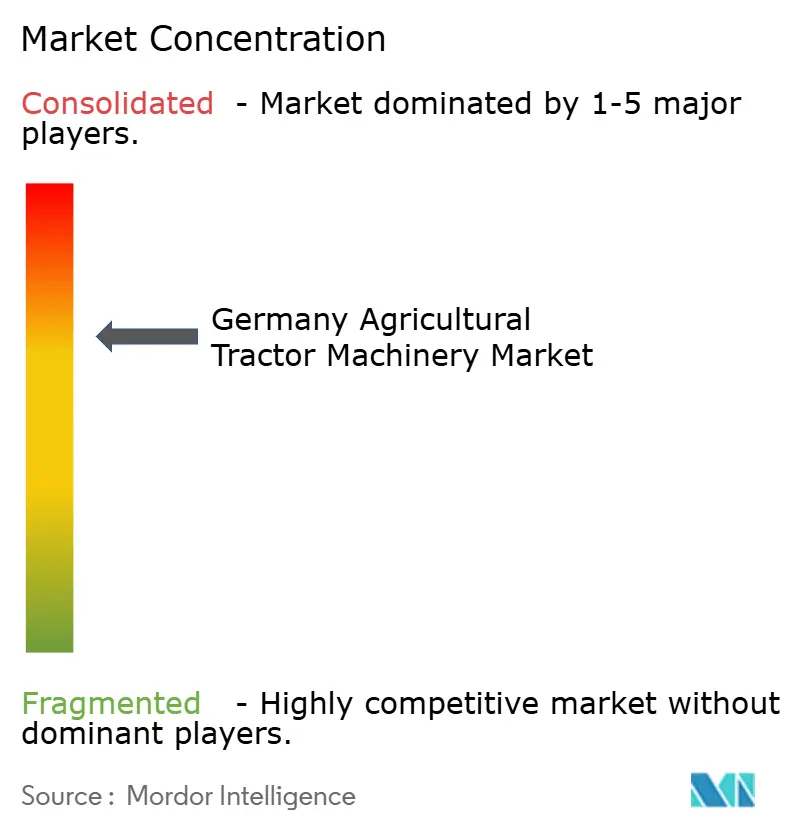
The Germany agricultural tractor machinery market operates as a moderately concentrated market, with the top five companies collectively holding a significant market share. This high level of concentration highlights significant scale advantages in manufacturing, distribution, financing, and technology integration, while still fostering intense competitive rivalry.
AGCO Corporation secures a leading position through its extensive implement portfolio and robust digital strategy, bolstered by its PTx Trimble joint venture. This collaboration enhances mixed-fleet compatibility and accelerates the adoption of precision agriculture. Deere & Company competes vigorously with advanced automation, autonomous tillage solutions, and integrated digital platforms that prioritize continuous operation and input efficiency. CNH Industrial N.V. differentiates itself by integrating agronomic data, soil testing, and risk-management tools with its equipment sales, offering a comprehensive value proposition beyond machinery. Claas KGaA mbH maintains a strong foothold in high-capacity harvesting and forage equipment, leveraging long-standing relationships with professional German farmers. Kubota Corporation remains competitive in the compact and mid-horsepower segments, catering particularly to smaller and mixed-use farms.
Outside the top tier, companies such as SDF Group S.p.A., Yanmar Co., Ltd., Argo Tractors S.p.A., Iseki & Co., Ltd., Lindner Traktorenwerk GmbH, JC Bamford Excavators Ltd., and HTC Holdings a.s., Daedong Corporation play significant niche or regional roles. These companies often compete based on price, specialization, or compact equipment offerings. Competitive dynamics in the market are increasingly influenced by digital ecosystems rather than mechanical differentiation. Factors such as open ISOBUS compatibility, data monetization, and autonomous readiness are becoming critical purchase considerations, particularly among younger farmers. Additionally, regulatory compliance costs related to emissions and carbon policies favor well-capitalized incumbents, further consolidating the market. However, these dynamics also raise churn risks as brand loyalty diminishes in favor of technological flexibility.
Germany Agricultural Tractor Machinery Industry Leaders
Deere & Company
CLAAS KGaA mbH
Kubota Corporation
AGCO Corporation
CNH Industrial N.V.
- *Disclaimer: Major Players sorted in no particular order

Market Opportunities and Future Outlook
Digitally verified compliance and interoperability are increasingly used as a buying criterion, which creates room for retrofit kits, mixed-fleet connectivity, and telemetry-ready implements that can help farms document environmental performance. Public programs are reinforcing this direction: the Investment and Future Program (Investitions- und Zukunftsprogramm) provided EUR 816 million during 2021-2024 to support adoption of digital and sustainable machinery technologies, and in January 2026 the Federal Ministry of Food, Agriculture and Consumer Protection (BMLEH) announced EUR 10 million in new funding for experimental fields focused on AI and digital technologies in agriculture. These field-test networks lower adoption barriers for camera-based spraying, automation-assist, and data capture on implements, which supports suppliers offering modular sensor architectures and upgradeable control units.
Standardization and data-sovereignty initiatives also create opportunities for OEMs and specialists to compete on open interfaces and manufacturer-independent data exchange, beyond mechanical differentiation. BMLEH also supported DIN e.V. with EUR 172,000 for the Smart Farming project to advance international standardization of data-based agrarian systems, and government policy points to a common European agricultural data space linked with the National Research Data Infrastructure (NFDI) and Gaia-X. As connectivity ties into subsidy workflows and auditability, demand rises for ISOBUS-compatible implements, precision sprayers aligned with pesticide record-keeping, and dealer-delivered digital services (setup, calibration, and support) that reduce downtime for contractors and machinery rings.
Recent Industry Developments
- July 2026: Deere introduced upgraded 6R and 6M Series tractors with updates aimed at improving operator comfort and productivity in a compact footprint. The refresh supports higher attachment rates for precision-ready implements and reinforces the brands focus on incremental upgrades outside traditional trade fair cycles.
- April 2026: Claas launched enhancements to its XERION 12 large tractor range, including updated TERRA TRAC running gear focused on durability and operating efficiency. Claas also communicated the planned integration of an AgXeed vehicle control unit for driver-monitored autonomy starting in the second half of 2026, strengthening the pathway toward automation-ready high-horsepower platforms used by contractors and large farms.
- November 2025: Horsch unveiled sensor-enabled precision tillage tools at Agritechnica 2025. The launch adds momentum to data-driven tillage and supports equipment strategies that combine soil-management outcomes with digital documentation for program and compliance reporting.


Research Methodology Framework and Report Scope
Market Definition and Coverage
For this study, the market is defined as the value of agricultural tractors sold for farm use in Germany, counted at the equipment level and captured in USD for the study period. The sizing reflects demand for new tractors across common power bands used on German farms.
Scope exclusions: Used tractor resale, parts and servicing revenue, and non-tractor farm machines are not included in this market value.
Segmentation Overview
- Plowing and Cultivating Machinery
- Plows
- Harrows
- Rotovators and Cultivators
- Other Plowing and Cultivating Machinery
- Planting Machinery
- Seed Drills
- Planters
- Spreaders
- Other Planting Machinery
- Sprayers
- Haying and Forage Machinery
- Mowers and Conditioners
- Balers
- Other Haying and Forage Machinery
- Other Types
Data Sources, Market Sizing, and Validation
Desk Research
Desk work starts with building a clean fact base on tractor demand and supply signals in Germany, and then making sure it matches how the industry reports volumes and values. We referenced public and official sources such as Eurostat (agriculture structure and macro series), the German Federal Statistical Office releases, EU emissions and type approval documents, and agricultural machinery association publications and registration summaries.
To turn these signals into a sizing model, we also reviewed company annual reports and investor presentations, product catalogs for horsepower and configuration mapping, and reputed news coverage for pricing moves and delivery lead time commentary. Where needed, we used paid subscriptions for company financials and intelligence to support revenue splits and recent developments, plus patent databases. We also used an import and export shipment-level database to cross-check trade exposure for tractor-related categories. These examples are not exhaustive, and many other public sources were used for data collection, validation, and research clarification.
Primary Interviews and Surveys
Primary work was used to confirm what the desk signals could not fully explain, mainly the real buying mix across power bands, typical discounting, and how financing or subsidy timing shifts purchases within a year. We spoke with stakeholders across OEM and distribution roles, fleet and large farm buyers, and service-side experts, and coverage was kept Germany-wide so regional cropping patterns and farm size differences were not missed.
Distribution of primary research fieldwork respondents
| Company type | Respondent position |
|---|---|
| Top tier: 34% | CXOs: 14% |
| Mid tier: 52% | Functional/Unit leaders: 26% |
| Smaller Players: 14% | Managers: 60% |
Market-Sizing & Forecasting
The core model is built using a top-down approach where tractor registrations, replacement cycles, and farm equipment investment capacity are used to reconstruct yearly demand in units, which is then translated into value using a mapped price ladder by horsepower band. Once that path is stable, we corroborate totals with selective bottom-up approximations, such as rolling up a sample of supplier and dealer sell-in signals, and then checking if the implied average selling prices remain consistent with observed German pricing.
Inputs that matter in this market include annual tractor registration levels, the split across horsepower categories, diesel and input cost pressure that affects capex appetite, subsidy and grant timing, and the pace of emission-driven product refresh (which can change pricing for newer engines). Forecasting is done through scenario analysis supported by expert judgment, because purchase decisions can swing with interest rates, harvest income, and policy changes. When data gaps show up, especially in discounting and optional feature uptake, we use interview-based ranges and apply them consistently across years before the results are normalized.
Data Validation & Update Cycle
Outputs are checked against independent signals such as unit registrations, trade direction, and observed price points from product lists and dealer feedback, and then any large variance is reviewed again before sign-off. If a number looks off, we re-open the assumptions behind horsepower mix, price progression, and timing effects, and then we re-contact sources when the change is material.
The report is refreshed on an annual schedule, and interim updates are made when major events shift demand, such as sudden financing changes or a regulatory milestone tied to emissions and type approval requirements. Before delivery, a final pass is completed to ensure the latest available data and market developments are reflected.
Mordor Intelligence's Germany Agricultural Tractor Machinery Market Size Versus Other Published Estimates
Different published market sizes for Germany tractors can look inconsistent even when they are trying to measure the same thing, because the boundary and the value capture point often change from one study to another. In our work, we focused on keeping the market definition tight, then testing it against real-world signals so it stays explainable.
Tractor registration trends and horsepower-mix checks are the evidence points that anchor Mordor Intelligence to a new-tractor, Germany-only value pool, rather than a broader equipment basket. Other estimates often expand scope by adding construction or multi-purpose tractors, counting used equipment turnover, or applying global average pricing curves to Germany without adjusting for local configuration and discount practices, which shifts the value upward.
Benchmark comparison
| Source | Market Size | Gaps in Research Methodology |
|---|---|---|
| Mordor Intelligence | USD 2.41 B (2026) | |
| Global Consultancy A | USD 3.80 B (2024) | Uses an earlier base year and may capture a wider tractor definition that can include broader distribution and sale activity, which can inflate value versus new-tractor demand measured from registration-led volume and Germany-specific pricing. |
| Industry Publisher B | USD 3.47 B (2024) | Likely applies revenue forecasting over a longer horizon with broad category assumptions, and it may not fully normalize Germany pricing by power band and discounting, which can lift the headline size when compared to a unit-and-ASP reconstruction. |
The spread in the table is mainly explained by year choice and what gets counted as part of the tractor market value. By tying unit demand to observable signals and then layering pricing in a transparent way, the resulting number stays traceable to clear steps and can be updated without reworking the full logic.


Key Questions Answered in the Report
How large is Germany agricultural tractor machinery market in 2026?
The Germany agricultural tractor machinery market size is USD 2.41 billion in 2026.
What is the projected growth rate for equipment sales through 2031?
The market value is projected to rise at a 4.58% CAGR, reaching USD 3.01 billion by 2031.
Which product segment is growing fastest?
Sprayers lead with a 7.62% CAGR on stronger regulatory push for pesticide reduction.
What role do subsidies play in equipment demand?
The German Agri-Investment Program can fund up to 75% of precision implement costs, stimulating rapid replacement cycles.
Page last updated on:


 Your data is secure and never sold or shared.


