
Market Overview
| Study Period | 2020 - 2031 |
|---|---|
| Forecast Data Period | 2026 - 2031 |
| Base Year Market Size (2025) | USD 19.99 Billion |
| Market Size (2026) | USD 21.43 Billion |
| Market Size (2031) | USD 30.36 Billion |
| Growth Rate (2026 - 2031) | 7.22 % |
| Market Concentration | Low |
Major Players *Disclaimer: Major Players sorted in no particular order Image © Mordor Intelligence. Reuse requires attribution under CC BY 4.0. | |
Germany Aerospace And Defense Market Analysis by Mordor Intelligence
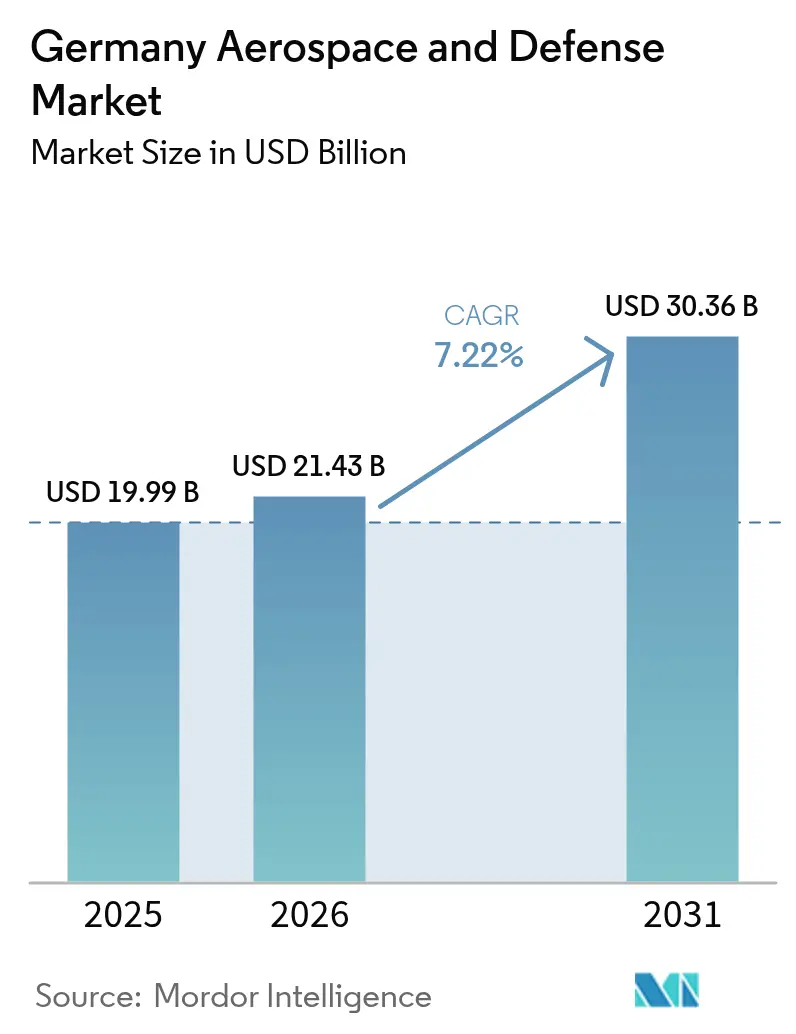
The Germany Aerospace And Defense Market size is expected to grow from USD 19.99 billion in 2025 to USD 21.43 billion in 2026 and is forecast to reach USD 30.36 billion by 2031 at 7.22% CAGR over 2026-2031.
The Germany aerospace and defense industry has undergone significant transformation, driven by heightened geopolitical tensions and evolving security requirements. The nation's commitment to defense modernization is reflected in its substantial defense budget, which reached USD 55.8 billion in 2022, positioning Germany as the third-largest defense spender in Europe. This increased focus on military capabilities has catalyzed extensive reforms in procurement processes, with the German government implementing measures to accelerate acquisition procedures and streamline defense equipment deployment. The industry's resilience is further demonstrated by the robust performance of the aerospace sector, which achieved sales of EUR 39 billion (USD 41.1 billion) in 2022, marking a significant 14.4% growth over the previous year.
The industry's export landscape has witnessed notable developments, with German weapon exports reaching USD 4.89 billion in the first half of 2023, representing a 12% increase compared to the same period in 2022. The government has taken progressive steps to optimize international trade relationships, including the simplification of export procedures for defense and dual-use goods to South Korea, effective from September 2023. This strategic approach to international trade has helped maintain Germany's position as a significant player in the global defense market, holding a 4.2% market share among major weapons suppliers in 2022.
The German defense industrial base is experiencing substantial transformation through strategic partnerships and modernization initiatives. In June 2023, the German government engaged in crucial discussions with India to strengthen bilateral defense cooperation, particularly focusing on defense manufacturing partnerships and potential investments in Indian defense industrial corridors. This approach to international collaboration has been complemented by domestic reforms, with top defense officials pledging to implement a dramatic "cultural change" to expedite weapons and ammunition procurement processes.
The industry's focus has shifted towards developing advanced capabilities in emerging technology domains, particularly in unmanned systems and cybersecurity. German companies are increasingly investing in artificial intelligence integration, autonomous systems development, and digital transformation of defense infrastructure. The emphasis on sustainability and environmental consciousness has also gained prominence, with significant investments in alternative propulsion technologies and energy-efficient aerospace systems. These developments are supported by a robust network of research institutions and industry partnerships, fostering innovation across the aerospace and defense spectrum.
Note: Market size and forecast figures in this report are generated using Mordor Intelligence’s proprietary estimation framework, updated with the latest available data and insights as of 2026.
Germany Aerospace And Defense Market Trends and Insights
Technological Innovation and Research Investments
Germany's aerospace and defense sector is experiencing substantial growth driven by significant investments in cutting-edge technologies and research initiatives. The German government has demonstrated its commitment to technological advancement by pledging USD 3.28 billion for artificial intelligence research and development through 2025, positioning the country at the forefront of AI integration in defense systems. This investment extends across various domains, from advanced avionics systems to sophisticated autonomous unmanned technologies, exemplified by the collaborative development of the Future Combat Air System (FCAS) between German aerospace companies and international partners. The focus on technological innovation is further evidenced by the integration of state-of-the-art C4ISR systems, as demonstrated by Saab's recent contract to upgrade radar warning equipment for the German Air Force's Tornado military aircraft with modern digital components.
The emphasis on research and development has led to breakthrough achievements in multiple areas, including cybersecurity solutions, space technology, and unmanned systems. In 2023, Germany showcased its technological prowess through various initiatives, including the successful deployment of advanced Urban Air Mobility systems and the development of sophisticated unmanned aerial systems technologies. The acquisition of 127 PackBot 525 unmanned ground vehicles (UGVs) for the German Army represents a significant advancement in autonomous system capabilities, while investments in space technology have resulted in the operation of multiple military satellites for reconnaissance, communications, and earth observation purposes. These technological innovations are complemented by substantial investments in energy-efficient propulsion systems and sustainable aerospace solutions, positioning Germany as a pioneer in green aerospace technologies while maintaining its competitive edge in the global market.
Global Collaboration and Export Opportunities
Germany's position in the international aerospace and defense market has been significantly strengthened through strategic global collaborations and expanding export opportunities. In the first half of 2023, German weapon exports reached a remarkable USD 4.89 billion, representing a 12% increase compared to the same period in 2022, with substantial military assistance provided to Ukraine and other strategic partners. This export growth is further exemplified by major international contracts, such as the USD 2.3 billion agreement secured by Airbus Helicopters in December 2023 for the delivery of 82 H145M twin-engine helicopters, demonstrating the global demand for German aerospace and defense capabilities. The country's commitment to international collaboration is also evident in its active participation in European defense initiatives and NATO programs, fostering standardized equipment development and enhanced interoperability among allied nations.
The expansion of global partnerships has led to numerous significant developments in 2023, including strategic agreements with Australia for combat reconnaissance vehicles and enhanced defense cooperation with India, particularly in defense industrial partnerships. Germany's role in international peacekeeping missions has strategically positioned its defense products for procurement by nations involved in these operations, while technology transfer agreements facilitated through institutions like the German Aerospace Center (DLR) continue to strengthen diplomatic ties and encourage shared innovation. Notable collaborative projects include the Belgian military intelligence service's access to the CSO-2 spy satellite, part of a joint project with France and Germany, demonstrating the country's commitment to fostering international technological partnerships and creating new avenues for market penetration and global recognition.
Segment Analysis
Manufacturing, Design, and Engineering Segment in Germany Aerospace and Defense Market
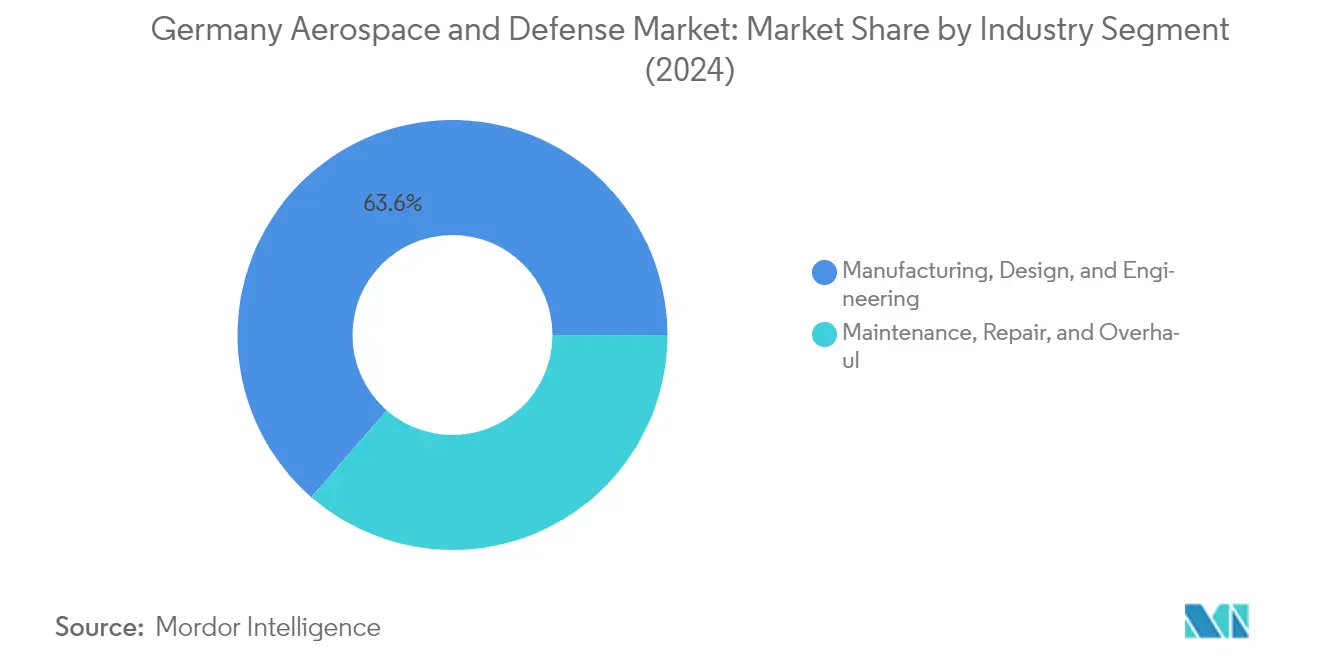
The Manufacturing, Design, and Engineering segment continues to dominate the German aerospace and defense market, commanding approximately 63.25% market share in 2025. This segment's prominence is largely attributed to Germany's robust industrial base and technological expertise in producing advanced aerospace and defense systems. The segment benefits from the presence of major manufacturers like Airbus, ThyssenKrupp, and Rheinmetall, each contributing significantly to Germany's technological dominance in aircraft manufacturing. The country's substantial investments in research and development drive the creation of cutting-edge technologies and products, positioning Germany at the forefront of global defense capabilities. The segment's strength is further reinforced by active participation in international collaborations for joint defense projects, establishing partnerships with other European nations and NATO allies. These initiatives are essential in developing shared capabilities, ensuring interoperability, and collectively fortifying the global defense network.
Maintenance, Repair, and Overhaul Segment in Germany Aerospace and Defense Market
The Maintenance, Repair, and Overhaul (MRO) segment is experiencing robust growth, projected to expand at approximately 3.92% CAGR from 2025 to 2031. This growth is driven by increasing demand for regular maintenance of military and commercial aircraft, as well as the rising complexity of modern aerospace systems. The adoption of cutting-edge technologies across the country's potential sectors has created significant opportunities for the MRO market. The backbone of Germany's industrial base, the Mittelstand mid-size manufacturers, plays a crucial role in this growth, with 90% operating in business-to-business markets. The segment's expansion is further supported by the government's Mittelstand-Digital Initiative, which creates networks between stakeholders through which SMEs and entrepreneurs can learn from each other. Additionally, the growth is bolstered by an increasing focus on naval vessel maintenance, active operations in new water bodies, and rising expenditure towards the procurement and upgrading of advanced armored vehicles.
Segment Analysis: By Type
Defense Segment in Germany Aerospace and Defense Market
The defense segment continues to dominate the German aerospace and defense market, commanding approximately 70% of the total market share in 2024. This substantial market position is primarily driven by Germany's increased focus on military modernization and strategic defense capabilities enhancement. The segment's strength is further reinforced by significant investments in various defense equipment technologies, including advanced combat systems, military vehicles, and naval capabilities. The German government's commitment to reaching NATO's defense spending target of 2% of GDP has led to increased procurement of military equipment and systems. Major defense contractors like Rheinmetall AG, Krauss-Maffei Wegmann, and Diehl Defense have secured significant contracts for developing and delivering cutting-edge defense equipment solutions, including advanced artillery systems, armored vehicles, and missile defense systems. The segment's robust performance is also supported by growing international defense collaborations and export opportunities, particularly with European and NATO allies.
Aerospace Segment in Germany Aerospace and Defense Market
The aerospace segment is experiencing remarkable growth in the German market, with an expected growth rate of approximately 4% during the forecast period 2024-2029. This growth trajectory is driven by several key factors, including significant investments in commercial aviation, space exploration initiatives, and unmanned aerial systems. The segment is witnessing substantial developments in sustainable aviation technologies, with German companies at the forefront of developing electric and hybrid propulsion systems. The space sector, in particular, has gained momentum with increased participation in European Space Agency (ESA) programs and the development of advanced satellite technologies. Companies like Airbus SE and MT Aerospace are leading innovations in aircraft manufacturing and space systems. The segment's growth is further supported by the rising demand for maintenance, repair, and overhaul (MRO) services, as well as the increasing adoption of advanced manufacturing technologies in aerospace production.
Competitive Landscape
Top Companies in Germany Aerospace and Defense Market
The Germany aerospace and defense market features prominent players like Rheinmetall AG, Diehl Stiftung & Co. KG, Airbus SE, and Krauss-Maffei Wegmann leading the industry through continuous innovation and strategic development. These companies demonstrate strong capabilities in product development across various segments, including aircraft systems, defense electronics, military vehicles, and weapons systems. The market is characterized by substantial investments in research and development, particularly in areas such as artificial intelligence, autonomous systems, and cybersecurity solutions. Companies are increasingly focusing on international collaborations and strategic partnerships to enhance their technological capabilities and market reach. The industry shows a clear trend toward digitalization and sustainability initiatives, with major players incorporating advanced manufacturing processes and environmentally conscious practices in their operations. Market leaders are also expanding their service offerings to include comprehensive maintenance, repair, and overhaul (MRO) capabilities, reflecting a shift toward integrated solution providers rather than pure equipment manufacturers.
Strong Market Consolidation with Global Integration
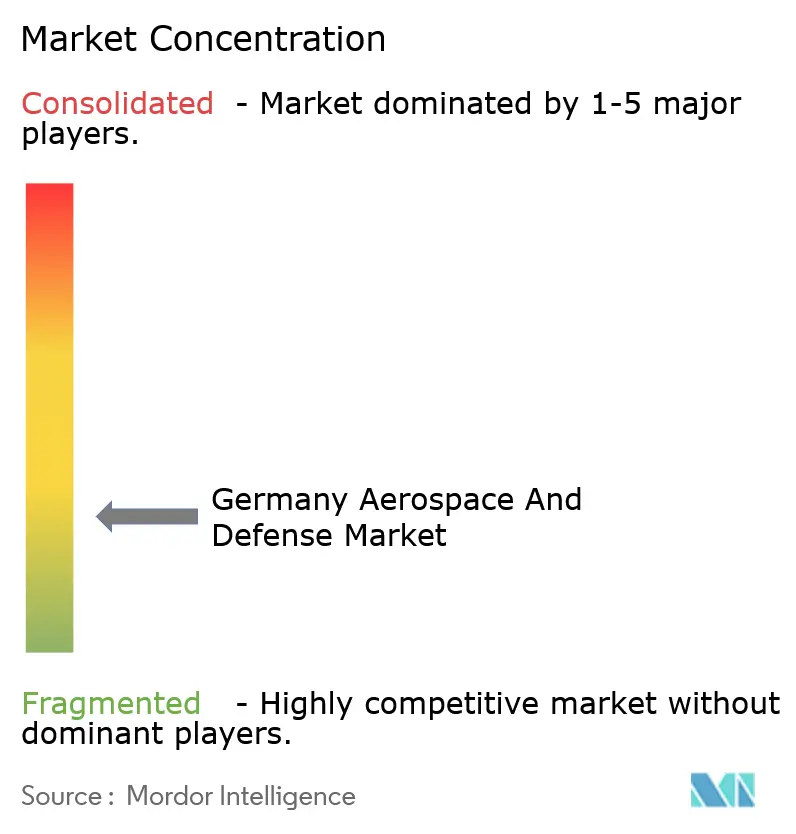
The Germany aerospace and defense market exhibits a complex structure dominated by both domestic powerhouses and international conglomerates, creating a highly integrated competitive landscape. Local companies maintain strong positions through their deep understanding of national defense requirements and established relationships with government agencies, while global players bring international expertise and advanced technological capabilities. The market shows significant vertical integration, with major players operating across multiple segments of the value chain, from research and development to manufacturing and aftermarket services. This integration has resulted in the formation of strategic alliances and joint ventures, particularly in major defense systems programs and aerospace initiatives.
The industry demonstrates a balanced mix of specialized firms focusing on niche technologies and large diversified groups offering comprehensive defense solutions. Market consolidation continues through strategic acquisitions and partnerships, particularly in emerging technology areas such as unmanned systems and electronic warfare. The competitive dynamics are shaped by long-term defense procurement cycles and the need for sustained investment in research and development. Companies are increasingly pursuing collaborative approaches to share development costs and risks, especially in large-scale defense projects and next-generation aviation programs. This collaboration extends beyond national borders, with German companies actively participating in European defense initiatives and international military programs.
Innovation and Adaptability Drive Market Success
Success in the German aerospace and defense market increasingly depends on companies' ability to innovate while maintaining operational efficiency and cost-effectiveness. Market leaders are strengthening their positions through investments in emerging technologies, particularly in areas such as artificial intelligence, autonomous systems, and cybersecurity. Companies are also focusing on developing modular and adaptable platforms that can be quickly modified to meet changing military requirements and operational needs. The ability to integrate commercial technologies into military applications while maintaining strict security standards has become a crucial differentiator for market success. Establishing strong relationships with research institutions and maintaining robust supply chain networks are becoming increasingly important for maintaining a competitive advantage.
For new entrants and smaller players, success lies in identifying and exploiting specialized market niches while building strategic partnerships with established companies. The market is showing an increasing emphasis on domestic production capabilities and supply chain resilience, creating opportunities for local suppliers and specialized technology providers. Companies must navigate complex regulatory requirements while maintaining flexibility to adapt to changing geopolitical situations and defense priorities. The industry's future success factors include the ability to manage long development cycles while remaining responsive to rapid technological changes and evolving threat scenarios. Environmental sustainability and energy efficiency are emerging as important considerations in product development and manufacturing processes, reflecting broader societal trends and regulatory requirements.
Germany Aerospace And Defense Industry Leaders
-
Rheinmetall AG
-
Lockheed Martin Corporation
-
RTX Corporation
-
Airbus SE
-
Leonardo S.p.A
- *Disclaimer: Major Players sorted in no particular order
Market Opportunities and Future Outlook
Germanys defense procurement acceleration and industrial policy create near-term whitespace for domestic capacity expansion, supply-chain localization, and faster fielding of mature systems across land, naval, air-defense, and space domains. A clear anchor is the German Bundestag Budget Committees approval for procuring four MEKO A-200 DEU (F128-class) frigates for EUR 6.3 billion (with options for additional vessels). This underpins opportunities for shipbuilding, combat systems integration, sensors, weapons, and through-life support delivered from within Germany.
Technology and sovereignty-driven programs also point to opportunities in integrated air and missile defense, space-based ISR, and emerging effectors. Airbus and Diehl Defence signing an agreement to intensify cooperation in integrated air and missile defence supports demand for interoperable IAMD architectures and systems integration. Separately, the Airbus, Rohde and Schwarz, constellr, Orbint, and HPS consortium focus on a sovereign satellite-based Earth observation and ISR solution points to work across payloads, ground segments, secure communications, and analytics. On the defense industrial side, the German government's stated intent to take a 40% stake in KNDS and BAAINBws commissioning of Rheinmetall and MBDA Deutschland to realize a high-energy laser weapon system for the German Navy reinforce opportunities tied to protected domestic production, critical subcomponents, qualification, and MRO for advanced munitions and directed-energy systems.
Recent Industry Developments
- July 2026: Lockheed Martin and Rheinmetall signed a memorandum of understanding to move forward with ATACMS co-production in Europe, centered on Germany. This step supports supply security and adds further workshare for German industry in missile manufacturing, testing, and sustainment.
- July 2026: BAAINBw commissioned Rheinmetall and MBDA Deutschland to realize a high-energy laser weapon system for the German Navy through their joint venture. The award advances directed-energy air defense for maritime platforms and expands domestic capability in high-power laser integration, control systems, and qualification.
- June 2026: Airbus and Diehl Defence signed an agreement to intensify cooperation in integrated air and missile defence. The cooperation aligns with demand for layered air defense and creates scope for joint development and integration of sensors, effectors, and command-and-control elements.
Research Methodology Framework and Report Scope
Market Definition and Coverage
This market is defined as the value of aerospace and defense activity generated within Germany, including commercial aviation, military aviation, and space. Coverage includes manufacturing, design and engineering work, and maintenance, repair, and overhaul services.
Scope exclusions: We do not count broader homeland security and public safety spending that sits outside aerospace platforms and defense equipment value chains.
Segmentation Overview
- By Industry
- Manufacturing, Design, and Engineering
- Maintenance, Repair, and Overhaul
- By Type
- Army
- Navy
- Airforce
- Space
Data Sources, Market Sizing, and Validation
Desk Research
Desk research helped set a clear fact base before building the market math, since aerospace and defense data can be spread across many public releases. We used reputable public and official sources such as Germany's Federal Ministry of Defence budget documents and procurement updates, Destatis industrial and employment series, Eurostat trade and production statistics, the European Defence Agency and NATO publications on defense expenditure, and EASA and ESA releases that help interpret aviation and space activity.
To translate those signals into a usable market view, we also reviewed company annual reports, statutory filings, and investor presentations, followed by association websites and established press reporting tied to orders, deliveries, and long-cycle service contracts. In a few places, paid subscriptions that compile company financials and aircraft and engine level fleet data were used to cross-check program footprints and timing. The sources listed above are not exhaustive, and many other public references were used for data collection, validation, and clarification during the research.
Primary Interviews and Surveys
Primary work was used to confirm how spending and deliveries translate into revenue within Germany, especially where public reporting is delayed or bundled into broader categories. We spoke with a mix of OEM and subsystem suppliers, MRO-focused participants, program advisors, and procurement-linked stakeholders across the country, and then used that input to validate demand drivers, pricing direction, and the timing of upgrades and deliveries.
Distribution of primary research fieldwork respondents
| Company type | Respondent position |
|---|---|
| Top tier: 33% | CXOs: 16% |
| Mid tier: 48% | Functional/Unit leaders: 38% |
| Smaller Players: 19% | Managers: 46% |
Market-Sizing & Forecasting
Sizing starts from a top-down build that reconstructs the Germany demand pool using defense budget and procurement signals, civil aviation production and service activity, and visible space program funding. Those inputs are converted into market value using realistic spend capture and timing assumptions. To keep totals grounded, we corroborated the result with selective bottom-up approximations, such as sampled program volumes multiplied by observed pricing ranges, and limited supplier roll-ups where public financials made it possible.
A few inputs that mattered in this market were Germany defense modernization priorities and contract timing, aircraft and engine fleets in service that drive MRO demand, commercial production ramps and delivery schedules, space mission indicators tied to industrial participation, and inflation and foreign exchange timing that shifts reported values in USD. Where bottom-up visibility was incomplete, gaps were handled by using conservative coverage ratios and then checking the implied per-platform and service intensity metrics with interview feedback.
For forecasting, scenario analysis was used so the model could reflect different paths for procurement pacing and delivery backlogs, while staying consistent with budgets and production capacity constraints. Before finalizing, the forward view was reviewed against expectations on program milestones, supply chain pressure points, and how quickly pricing tends to move in long-cycle aerospace and defense contracts.
Data Validation & Update Cycle
Outputs were checked through triangulation across demand signals, program announcements, and the implied split between new build and services. We also reviewed for unusual jumps that did not match known contract timing for Germany programs.
Variance checks were run across years so changes in procurement cycles or aircraft utilization were reflected smoothly unless a clear event explained the shift.
Before sign-off, a second analyst review is completed, and re-contacts are triggered when a key assumption like delivery timing, budget allocation, or MRO intensity looks inconsistent with interview feedback. Reports are refreshed annually, with interim updates when major events occur, and a final pre-delivery pass is done so clients receive the latest updated view.
Mordor Intelligence's Germany Aerospace and Defense Market Size Versus Other Published Estimates
Published numbers for Germany aerospace and defense do not always line up because different studies count different activities, and they do not always anchor to the same base year. The biggest drivers are usually what gets included alongside core aerospace and defense work, how services are treated, and whether values are converted to USD using the same currency timing.
The table below highlights that spreads can also come from how procurement and production are timed in the model, since program awards and deliveries do not move in a straight line. Some estimates lean on a production plus imports minus exports identity that can reflect broader aerospace industrial turnover, while others focus more narrowly on defense procurement or only a subset of aviation activity.
Benchmark comparison
| Source | Market Size | Gaps in Research Methodology |
|---|---|---|
| Mordor Intelligence | USD 19.99 B (2025) | |
| Government Trade Brief A | USD 50.15 B (2025) | Uses a production plus imports minus exports style construct for aerospace and defense that can pull in broader industry turnover, and the split between platform deliveries and service revenue is not always visible in the totals. |
| Industry Data Note B | USD 31.54 B (2024) | Different base year and forecast window are used, and adjacent activities can be blended into the total, which can lift the figure versus a scope that gates revenue to commercial aviation, military aviation, and space activity. |
Under Mordor Intelligence's scope, only commercial aviation, military aviation, and space activity in Germany are counted when the revenue maps to manufacturing, design and engineering work, or MRO, rather than counting broader aerospace industrial turnover. Because the model is tied back to budgets, fleet-driven service demand, and program milestones, the market size can be traced to clear variables and then updated in a repeatable way.
Key Questions Answered in the Report
How big is the Germany Aerospace And Defense Market?
The Germany Aerospace And Defense Market size is expected to reach USD 21.43 billion in 2026 and grow at a CAGR of 7.22% to reach USD 30.36 billion by 2031.
What is the current Germany Aerospace And Defense Market size?
In 2026, the Germany Aerospace And Defense Market size is expected to reach USD 21.43 billion.
Who are the key players in Germany Aerospace And Defense Market?
Rheinmetall AG, Lockheed Martin Corporation, RTX Corporation, Airbus SE and Leonardo S.p.A are the major companies operating in the Germany Aerospace And Defense Market.
What years does this Germany Aerospace And Defense Market cover, and what was the market size in 2025?
In 2025, the Germany Aerospace And Defense Market size was estimated at USD 19.99 billion. The report covers the Germany Aerospace And Defense Market historical market size for years: 2020, 2021, 2022, 2023, 2024 and 2025. The report also forecasts the Germany Aerospace And Defense Market size for years: 2026, 2027, 2028, 2029, 2030 and 2031.