
Market Overview
| Study Period | 2020 - 2031 |
|---|---|
| Forecast Data Period | 2026 - 2031 |
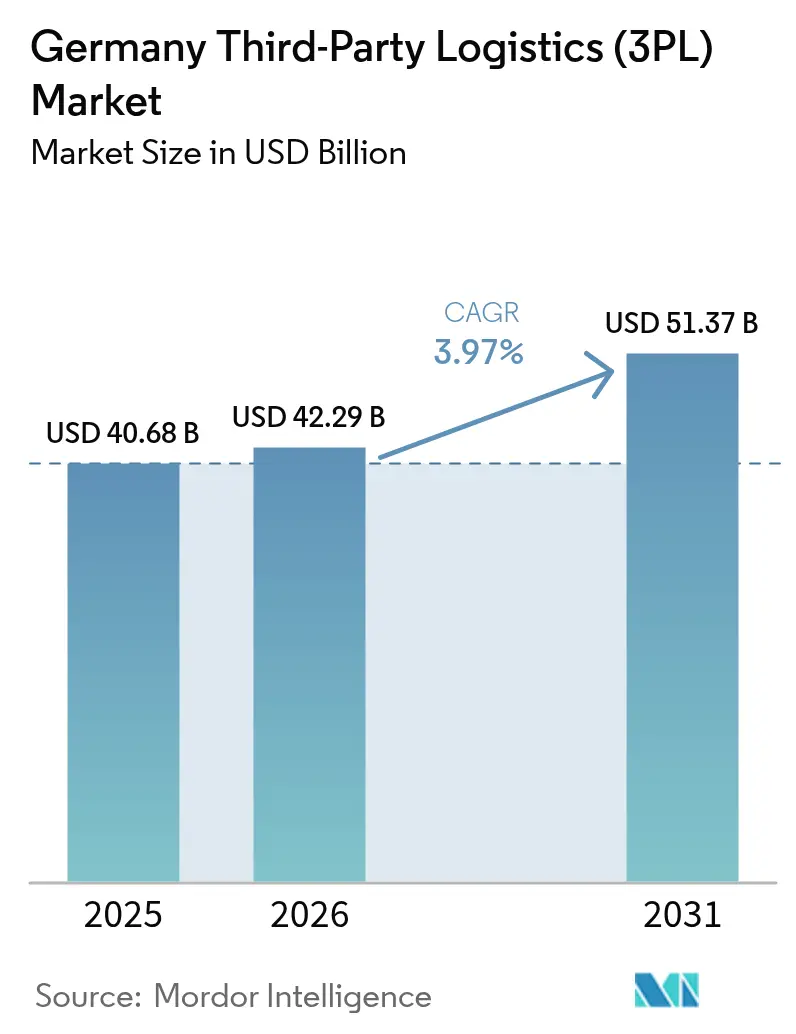
| Base Year Market Size (2025) | USD 40.68 Billion |
| Market Size (2026) | USD 42.29 Billion |
| Market Size (2031) | USD 51.37 Billion |
| Growth Rate (2026 - 2031) | 3.97 % |
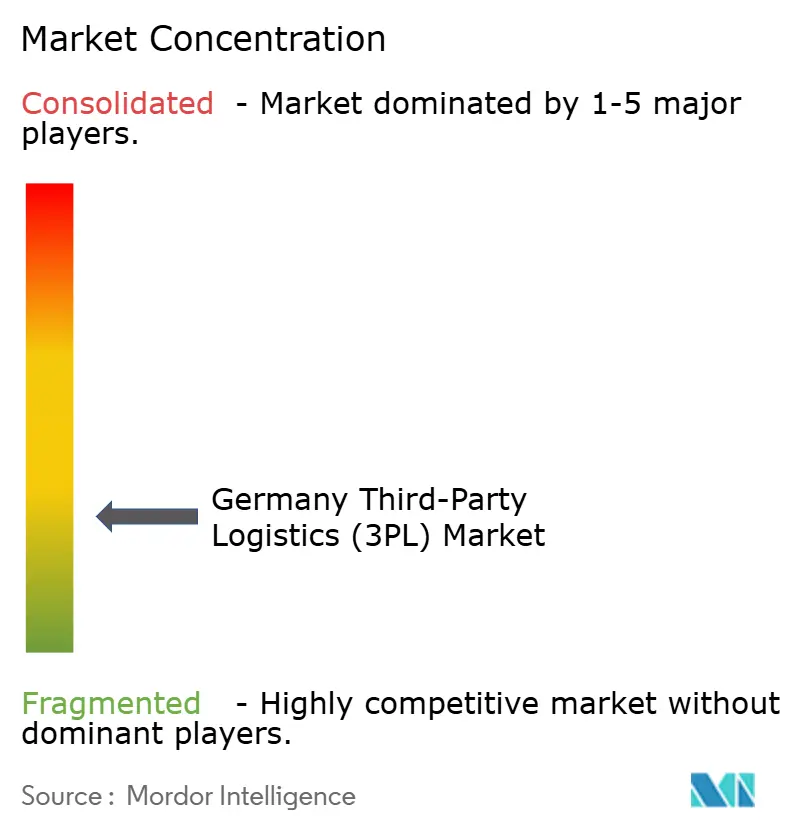
| Market Concentration | Low |
Major Players *Disclaimer: Major Players sorted in no particular order Image © Mordor Intelligence. Reuse requires attribution under CC BY 4.0. | |
Germany Third-Party Logistics (3PL) Market Analysis by Mordor Intelligence
The Germany Third-Party Logistics Market size was valued at USD 40.68 billion in 2025 and estimated to grow from USD 42.29 billion in 2026 to reach USD 51.37 billion by 2031, at a CAGR of 3.97% during the forecast period (2026-2031).
Structural shifts favoring outsourced logistics, the nation’s central role in European trade, and rising defense spending combine with e-commerce momentum to sustain demand. Post-Brexit route realignments move cross-border volumes toward German hubs, while labor cost pressures accelerate warehouse automation. State support for green transport and ESG-linked financing further strengthens long-term opportunities for providers that can blend sustainability with technology leadership.
Key Report Takeaways
- By service, Domestic Transportation Management held 38.45% of the Germany third-party logistics market share in 2025; Value-Added Warehousing & Distribution is projected to post a 6.55% CAGR through 2031.
- By end user, E-commerce accounted for 20.65% of the Germany third-party logistics market size in 2025, whereas Automotive is on track for a 4.12% CAGR to 2031.
- By logistics model, Asset-Light solutions commanded 41.35% of 2025 revenue, while Hybrid models are set to rise at 4.96% CAGR.
- By region, North Rhine-Westphalia led with 22.60% revenue in 2025; Baden-Württemberg is the fastest-growing state at a 4.18% CAGR.
Note: Market size and forecast figures in this report are generated using Mordor Intelligence’s proprietary estimation framework, updated with the latest available data and insights as of 2026.
Germany Third-Party Logistics (3PL) Market Trends and Insights
Drivers Impact Analysis*
| Driver | (%) Impact on CAGR Forecast | Geographic Relevance | Impact Timeline |
|---|---|---|---|
| E-commerce parcel volumes surge beyond pre-pandemic baseline | +0.8% | Nationwide; peaks in NRW, Bavaria, Baden-Württemberg | Medium term (2-4 years) |
| Omnichannel retail drives inventory decentralization | +0.6% | Urban centers and major hubs | Medium term (2-4 years) |
| Rising cross-border B2C flows after Brexit rerouting | +0.4% | Western corridors, chiefly NRW & Hamburg | Short term (≤ 2 years) |
| Automation ROI improves with USD 13.2 minimum wage | +0.7% | Nationwide; strongest in high-wage regions | Long term (≥ 4 years) |
| ESG-linked loans spur green warehousing retrofits | +0.3% | Major industrial clusters | Long term (≥ 4 years) |
| Bundeswehr re-armament lifts defense-logistics spend | +0.5% | Defense-manufacturing regions | Medium term (2-4 years) |
| Source: Mordor Intelligence | |||
E-commerce Parcel Volumes Surge Beyond Pre-Pandemic Baseline
Parcel demand continues to outpace 2019 benchmarks as consumers shift more discretionary purchases online. Smartphones drive 57% of checkouts, forcing fulfillment networks to accommodate smaller, faster deliveries. Germany’s average 1.44-day transit time and 94.39% first-attempt delivery success entrench the country as a preferred distribution base. DHL processes 6.7 million domestic parcels daily and targets over 5% annual e-commerce revenue growth, illustrating how incumbent operators redirect resources from declining mail toward parcel logistics[1]Frank Appel, “Deutsche Post DHL Group FY 2024 Presentation,” DHL Group, dhl.com]. Scalability in last-mile capacity remains a decisive competitive lever as parcel density spreads across suburban and rural zones.
Omnichannel Retail Drives Inventory Decentralization
Retailers now split stock across multiple micro-fulfillment locations to meet next-day commitments. REWE’s USD 275 million Magdeburg center embodies this pivot, operating 49,500 m² with 50% automation and throughput of 286,000 daily packages. Distributed nodes shorten lead times but multiply planning complexity, pushing merchants to outsource visibility and allocation tasks. Asset-Light 3PLs gain traction by layering advanced WMS and analytics over shared facilities, enabling retailers to flex capacity without owning warehouses.
Rising Cross-Border B2C Flows Post-Brexit Rerouting
UK-EU barriers have rerouted many parcels through German consolidation points. Logistics costs along the German-British corridor climbed 13%, yet providers recoup volume by handling onward EU shipments that previously traveled direct. Custom brokerage, carbon border rules, and VAT administration add value-added revenue streams. German hubs thus serve as gateways for non-EU retailers seeking single-point access to the Schengen area, reinforcing the Germany third-party logistics market as Europe’s distribution backbone.
Automation ROI Improves with USD 13.2 Minimum Wage
The nationwide wage floor uplifts pay scales and narrows payback periods for robotics. DHL plans to add 1,000 Boston Dynamics units on top of 7,500 existing robots, achieving unloading speeds of 700 cases per hour. Tele-operated yard trucks from FERNRIDE, piloted with DB Schenker, let one operator manage several vehicles, alleviating labor shortages while enhancing safety. Over the long term, automation diffuses beyond flagship hubs into midsize facilities, altering workforce profiles toward maintenance, analytics, and remote operations[2]Silke Reinhardt, “German Minimum Wage Commission Report 2024,” Federal Ministry of Labor and Social Affairs, bmrs.bund.de.
Restraints Impact Analysis*
| Restraint | (%) Impact on CAGR Forecast | Geographic Relevance | Impact Timeline |
|---|---|---|---|
| Structural truck-driver shortage (>80,000 vacancies) | -0.9% | Nationwide; acute in eastern & rural areas | Short term (≤ 2 years) |
| High electricity tariffs limit cold-chain expansion | -0.4% | Nationwide; energy-intensive sites | Medium term (2-4 years) |
| Strict Sunday truck ban complicates planning | -0.2% | Nationwide | Long term (≥ 4 years) |
| Near-shoring to CEE shifts volume outward | -0.6% | Border regions | Medium term (2-4 years) |
| Source: Mordor Intelligence | |||
Structural Truck-Driver Shortage (More than 80,000 Vacancies)
With fewer than 3% of drivers under 25, retirements outpace recruits, leaving fleets short of capacity. Annual economic drag hits USD 11 billion as routes are deferred or priced higher. Regulatory hurdles for non-EU drivers and lifestyle concerns depress new entries, forcing 3PLs to increase wages and invest in retention amenities. Larger operators buffer the impact with autonomous yard tractors and optimized routing, whereas small firms face margin compression and the risk of exit[3]Dirk Engelhardt, “Driver Shortage Position Paper 2025,” Federal Association of Road Haulage, bgl-ev.de.
High Electricity Tariffs Limit Cold-Chain Capacity Expansion
Germany’s layered taxes and levies keep industrial power prices among Europe’s highest. Cold-storage operators, where refrigeration can account for 40% of costs, hesitate to build new space without long-term tariff clarity. Exemptions favor very large power consumers, leaving midsize 3PLs at a disadvantage. Solar and battery retrofits mitigate some exposure, yet capital outlays raise barriers to entry, constraining cold-chain growth until energy policy stabilizes.
*Our forecasts treat driver/restraint impacts as directional, not additive. The impact forecasts reflect baseline growth, mix effects, and variable interactions.
Segment Analysis
By Service: Domestic Transportation Dominates Amid Warehousing Acceleration
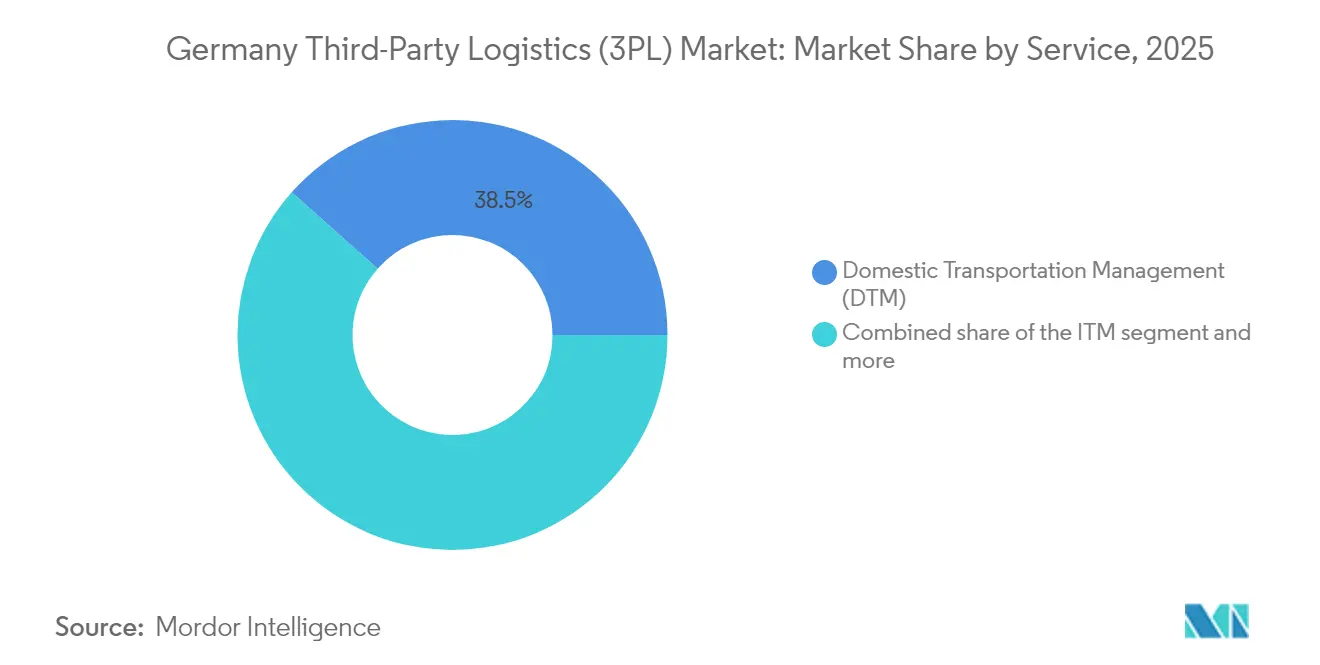
Domestic Transportation Management contributed 38.45% to 2025 revenue, underlining the Germany third-party logistics market size derived from the country’s 13,000-km Autobahn grid and dense industrial clusters. Regular groupage and full-truckload moves support export production and intra-EU supply chains. Meanwhile, Value-Added Warehousing & Distribution is projected to grow 6.55% annually through 2031 as retailers decentralize inventory and manufacturers demand postponement services. This shift raises the Germany third-party logistics market share of facility-based offerings, encouraging providers to retrofit space with shuttle systems, voice-directed picking, and temperature-controlled zones.
Automation and real-time visibility reshape service boundaries. Carriers such as Rhenus trimmed network transit times by 34% after redesigning hub flows, proving that IT-enabled routing can unlock capacity without expanding fleets. Clients increasingly request transport-related warehousing, expecting single-invoice, end-to-end solutions. Consequently, 3PLs bundle consolidation, cross-dock, and final-mile under unified contracts, blurring the lines between legacy transport and storage segments.


By End User: Retail Leads While Automotive Accelerates
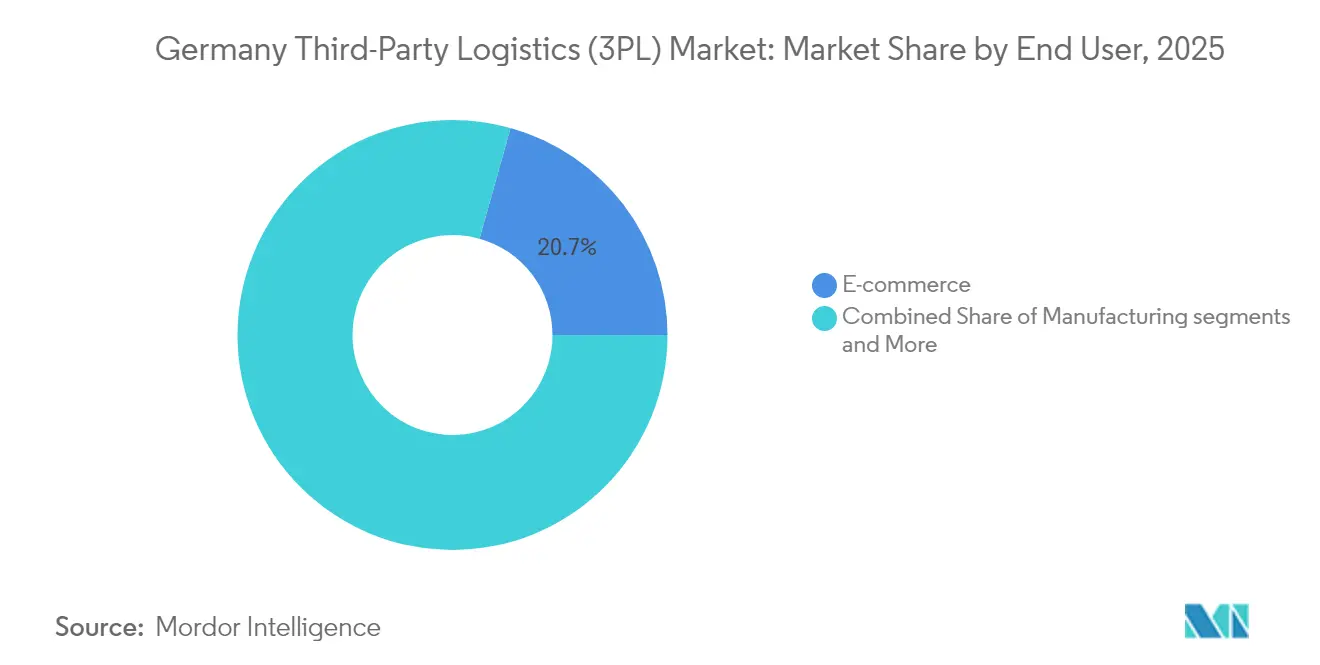
E-commerce retained a 20.65% revenue share in 2025 thanks to robust parcel demand, same-day delivery pledges, and returns processing complexity. The segment’s scale cements the Germany third-party logistics market size foundation for high-throughput sortation centers. Automotive, however, is poised for a 4.12% CAGR as electrification, battery import logistics, and just-in-sequence delivery of lightweight components intensify outsourcing. Battery pack regulations favor certified 3PL warehouses that meet stringent fire-safety norms, providing a premium niche.
Partnerships evidence the trend: DHL Supply Chain now orchestrates 100,000 annual moves for Vitesco Technologies across 12 European plants, centralizing control-tower functions to trim emissions and cost. Automotive volume volatility drives demand for flexible contracts with surge capacity, pushing 3PLs to invest in shared, modular spaces rather than dedicated warehouses. Across manufacturing, life-sciences cold-chain, and tech-electronics high-value cargo sustain steady bookings, even as energy & utilities clients grapple with commodity cycles.
By Logistics Model: Asset-Light Preference Amid Hybrid Growth
Customers gravitate toward Asset-Light offerings, which claimed 41.35% of 2025 turnover, to avoid capital lock-in and leverage 3PL technology stacks. Yet, Hybrid models will lead growth at 4.96% CAGR as shippers co-locate dedicated fleets with variable 3PL capacity. Germany’s third-party logistics market rewards providers that can orchestrate outsourced and owned assets through API-connected platforms, delivering cost and service transparency.
Truck-as-a-Service solutions accelerate the Asset-Light shift, particularly for zero-emission vehicles where acquisition costs remain high. Subscription bundles covering vehicles, charging, and maintenance de-risk electric adoption, allowing shippers to pilot clean transport without balance-sheet strain. Simultaneously, sectors with irregular demand—notably FMCG promotions—adopt Hybrid setups, expanding private fleets for peak season while maintaining spot access to third-party carriers.
Geography Analysis
North Rhine-Westphalia (NRW) secured 22.60% of 2025 revenue, the largest share within the Germany third-party logistics market, anchored by Duisburg’s inland port and Cologne’s multimodal nodes. The region funnels goods to 500 million consumers within three driving hours and hosts Germany’s second-largest air cargo hub at Cologne/Bonn airport. NRW’s smart-logistics clusters leverage 5G corridors and university partnerships, positioning the state for continued supremacy as digital-control-tower adoption spreads.
Baden-Württemberg shows the fastest trajectory at a 4.18% CAGR to 2031. Its USD 223.3 billion export base, 5.6% R&D intensity, and concentration of automotive innovators such as Bosch and Daimler sustain demand for high-spec warehousing. The Northern Black Forest’s combined rail-road terminal enhances intra-European reach, while lower land costs around Augsburg attract new fulfillment investments. The state’s 3.2% unemployment rate signals labor tightness that heightens interest in automation partnerships with logistics providers.
Bavaria maintains a solid share through Munich’s economic heft and proximity to Alpine borders, capturing Austrian and CEE flows. Hamburg capitalizes on early adoption of shore power and hydrogen bunkering to position its port for carbon-neutral freight, offering shippers ESG-compliant gateway options. Eastern states, benefitting from lower real estate prices and EU funds, woo e-commerce operators seeking lower total landed cost to Poland and the Czech Republic. Germany’s polycentric structure, backed by seamless highway and rail links, enables multi-hub network design where inventory placement follows real-time demand.
Regulatory Landscape
Germanys 3PL operations sit under a mix of EU road-transport rules and national enforcement led by the Federal Logistics and Mobility Office (BALM), which monitors compliance and implements national and international transport law. A key compliance step is the intelligent tachograph requirement: from July 1, 2026, light commercial vehicles in the 2.5t to 3.5t band used for cross-border freight or cabotage must be equipped with intelligent tachograph version 2, which raises digital compliance needs for courier and light-freight fleets.
Decarbonization policy is increasingly anchored in federal programs administered by the Federal Ministry for Transport (BMV). In 2026, the ministry launched a EUR 1 billion, four-year funding program for charging infrastructure for heavy battery-electric commercial vehicles, aimed at supporting fleet transition roadmaps and depot charging build-outs. On the legal framework side, the Road Haulage Act (Gueterkraftverkehrsgesetz, GuKG) was most recently updated by an act dated February 23, 2026, reinforcing the need for 3PLs to track permitting, market-access, and social compliance requirements as rules evolve.
Value Chain Analysis
The Germany 3PL value chain begins with shipper demand (retail and e-commerce, automotive, industrial manufacturing, life sciences) and moves into planning and execution layers, including freight forwarding, brokerage and documentation, domestic linehaul and distribution, and contract logistics (warehousing, picking/packing, returns). Core enablers include transport capacity (carriers and subcontractors), warehouse real estate and automation integrators, IT platforms (TMS/WMS/control towers), and multimodal infrastructure (ports, airports, rail terminals, and inland nodes such as North Rhine-Westphalia hubs). Constraints in motorway and rail capacity, together with long planning and approval cycles for logistics sites and alternative-fuel infrastructure, create friction costs that increase the importance of network design, slot management, and productivity tools.
Recent network and capability actions show how participants move along the chain to secure density and resilience. Kuehne+Nagel strengthened domestic road-freight reach by acquiring the road logistics activities of LSL-Lohmoeller Spedition und Logistik GmbH, integrating staff and trucks into its network and reinforcing groupage participation. Investment-led capacity additions by large operators, such as Dachser announcing more than EUR 350 million of investments in 2026 alongside continued expansion of large logistics-center footprints, support warehousing and cross-dock throughput. At the same time, competitive moves such as FM Logistics agreement to acquire a majority stake in Schaflein reflect efforts to secure industrial-logistics access and customer contracts inside Germany.
Competitive Landscape
The market is fragmented. In April 2025 when DSV closed its USD 15.73 billion purchase of DB Schenker, forming a USD 45.76 billion revenue leader spanning 90 countries. Scale affords the merged group bargaining power in air and ocean procurement and funds R&D in robotics and visibility platforms. The deal signals a pivot from pure volume growth toward high-tech, asset-optimized service models across the Germany third-party logistics market.
Automation remains a differentiator. DHL Group’s additional 1,000 robots complement 7,500 deployed units, with capex earmarked at USD 1.1 billion for automation between 2025-2027. Early pilots generated 25% productivity gains and 80% incident reduction. Smaller providers specialize in staying relevant—offering EV battery storage compliant with ADR regulations or catering to defense supply chains requiring security accreditation.
Sustainability shapes bidding criteria. Tender documents increasingly stipulate carbon reporting and renewable-power sourcing. Operators able to guarantee solar-backed warehousing and HVO-powered trucking win multi-year contracts at premium rates. Those lagging in green upgrades confront potential customer attrition as Scope 3 targets tighten from 2026 onward.
Germany Third-Party Logistics (3PL) Industry Leaders
Deutsche Post DHL
Dachser
Kuehne + Nagel
DSV
Hellmann Worldwide Logistics
- *Disclaimer: Major Players sorted in no particular order

Market Opportunities and Future Outlook
Intermodal and hub-capacity upgrades create space for 3PLs that can bundle transport management with terminal-adjacent warehousing, customs, and time-critical distribution. In February 2026, APM Terminals (Maersk) and Eurogate announced a EUR 1 billion modernization program for the Bremerhaven container terminal, with a stated goal to raise capacity by 1 million TEUs to 4 million units. This expands the addressable volume for drayage, container logistics, and value-added services around the port. Rail-linked growth opportunities also extend into inland corridors: CargoBeamer took over operations at the Kaldenkirchen rail terminal and launched a multi-phase expansion to more than 200,000 loading units, while Deutsche Bahn commissioned a 38,000 m2 container-depot expansion at Ulm-Dornstadt in July 2026, supporting additional intermodal handling and local distribution legs.
Facility modernization and green-compliance capabilities are increasingly treated as tender qualifiers, which lifts demand for providers that can pair automation with certified buildings and carbon reporting. Lufthansa Cargo completed the first construction phase of its EUR 600 million LCCevo project at Frankfurt Airport (June 2026), and Kuehne+Nagel signed a lease with Fraport for a 7,600 m2 air cargo facility in CargoCity South, strengthening time-definite and high-value supply chains that often require specialized handling and tight cut-off management. On the road-freight side, the regulatory and funding mix also supports investable opportunities in electrified operations: the federal EUR 1 billion program for heavy-vehicle charging infrastructure provides a pathway for depot charging rollouts. Cross-dock investments such as Rhenus Road Freights Dortmund project (11,000 m2, 100 loading gates, BREEAM Excellent target) also point to demand for energy-efficient, high-throughput nodes that support e-commerce and industrial groupage networks.
Recent Industry Developments
- May 2026: DHL Group shareholders approved transferring Post and Parcel Germany into a separate legal entity and renaming the listed parent company to DHL AG, with implementation targeted for the second half of 2026. The restructuring clarifies legal boundaries between domestic postal operations and global logistics activities, supporting sharper management focus and governance for large-scale 3PL investments.
- May 2026: Dachser began a EUR 30 million expansion of its largest logistics center in southern Germany. The added capacity and modernized handling space strengthens Dachsers domestic distribution and contract-logistics throughput, improving service flexibility for industrial and retail shippers facing tighter lead-time requirements.
- February 2026: Kuehne+Nagel announced the acquisition of the road transport activities of LSL-Lohmoeller Spedition und Logistik GmbH in Rheine, integrating 142 logistics specialists and 50 trucks into its network. The acquisition increases density in domestic road freight and groupage, supporting more competitive linehaul utilization and broader coverage for shipper contracts in Germany.


Research Methodology Framework and Report Scope
Market Definition and Coverage
The Germany 3PL market is defined as revenues earned by third-party logistics providers for outsourced logistics work carried out for customers within Germany, across transportation management and warehousing and distribution services.
Scope exclusions: In-house (captive) logistics performed by shippers themselves, and pure parcel and courier revenues that are not contracted as 3PL, are excluded where they cannot be cleanly separated.
Segmentation Overview
- By Service
- Domestic Transportation Management (DTM)
- Roadways
- Railways
- Airways
- Waterways
- International Transportation Management (ITM)
- Roadways
- Railways
- Airways
- Waterways
- Value-Added Warehousing & Distribution (VAWD)
- Domestic Transportation Management (DTM)
- By End User
- Automotive
- Energy & Utilities
- Manufacturing
- Life Sciences & Healthcare
- Technology & Electronics
- E-commerce
- Consumer Goods & FMCG
- Food & Beverages
- Others
- By Logistics Model
- Asset-Light (Management-Based)
- Asset-Heavy (Own Fleet & Warehouses)
- Hybrid
- By States – Germany (Value)
- North Rhine-Westphalia
- Bavaria (Bayern)
- Baden-Württemberg
- Rest of States
Data Sources, Market Sizing, and Validation
Desk Research
Desk work starts by mapping the Germany logistics demand pool and the service mix that typically sits inside outsourced 3PL. We reference public datasets such as Germany Federal Statistical Office (Destatis) series on transport and warehousing activity, Eurostat transport statistics, and customs and trade releases that signal import and export flows.
To keep assumptions grounded, we also review sources such as the Deutsche Bundesbank for macro and price indicators, the European Commission transport and mobility publications for policy and modal context, and peer reviewed logistics and supply chain journals to sense-check structural trends (for example around e-commerce fulfillment intensity). Company annual reports, investor decks, and reputable press coverage are used to verify service lines and exposure to Germany. Where needed, we also use paid subscriptions for company financials and news and financials, and an import and export shipment-level database to validate trade-linked volume shifts. These sources are illustrative, and many other references were reviewed for data collection, validation, and clarification.
Primary Interviews and Surveys
Primary work is used to translate activity signals into 3PL revenue logic, including how contracts are priced, which services are bundled, and how capacity tightness shows up in rates. We speak with logistics providers, freight and warehouse operators, and large shipper logistics teams to confirm service splits, spot versus contract share, and near-term demand expectations inside Germany.
Distribution of primary research fieldwork respondents
| Company type | Respondent position |
|---|---|
| Top tier: 27% | CXOs: 15% |
| Mid tier: 57% | Functional/Unit leaders: 40% |
| Smaller Players: 16% | Managers: 45% |
Market-Sizing & Forecasting
For sizing, the top-down approach is built by reconstructing Germany's outsourced logistics revenue pool using transport and warehousing activity indicators and then applying 3PL penetration assumptions by service type. The output is then corroborated with selective bottom-up approximations, such as sampled provider revenue splits for Germany operations, channel checks on typical rate cards, and volume times average selling price logic for core lanes and warehouse throughput, which helps adjust totals where the first pass looks stretched.
Key inputs that feed the model include Germany industrial output and retail trade direction, cross-border trade volumes that influence international transportation management, road freight performance signals, warehousing occupancy and storage turnover expectations, and contract price movement expectations discussed in calls. Forecasting is done using scenario analysis supported by a light multivariate regression on a small set of demand drivers (industrial production, retail sales, and trade flows), and then refined using interview-based views on contract renewals and rate resets. When a bottom-up check has gaps, we use conservative fill rates based on comparable service lines and clearly document the assumption before it is accepted.
Data Validation & Update Cycle
Validation happens in layers so that a single assumption does not drive the outcome. We compare model totals against independent signals such as transport activity series, trade movement direction, and publicly discussed provider performance in Germany, and then investigate variances before sign-off.
Outliers are flagged for review, followed by a second analyst check on calculations, currency treatment, and year alignment. If a major variance is found or a material event occurs (policy shifts, sharp rate swings, or demand shocks), respondents are re-contacted to confirm what changed and whether the model needs re-weighting. Reports are refreshed annually, with interim updates for material events, and a final pre-delivery pass is done so clients receive the latest updated view.
Mordor Intelligence's Germany 3pl Market Size Measured Against Other Published Estimates
Published market sizes for Germany 3PL do not always line up, and the differences usually come from what each study counts as 3PL revenue, which year is treated as the anchor, and how pricing and volume are carried into the forecast.
The main gap comes from service-scope choices, where Mordor Intelligence counts domestic transportation management, international transportation management, and value-added warehousing and distribution as core 3PL, and then keeps parcel-like activity out unless it is clearly contracted as part of a 3PL bundle.
Benchmark comparison
| Source | Market Size | Gaps in Research Methodology |
|---|---|---|
| Mordor Intelligence | USD 40.68 B (2025) | |
| Regional Consultancy A | USD 41.13 B (2024) | Uses a 2024 anchor and may reflect a different rate environment and currency timing, and the service mix appears broader by mode and end user without clearly separating bundled 3PL revenue from adjacent logistics spend. |
| Industry Publisher B | USD 20.18 B (2025) | Likely applies a narrower revenue perimeter, which can happen when parts of warehousing and distribution or certain transportation management revenues are treated as outside 3PL, and when smaller contracted services are not fully captured. |
The spread in the table is mainly explained by scope and year treatment, and then by how pricing is trended through the forecast period. By tying the model to observable Germany activity indicators and then cross-checking with provider and shipper interviews, the final number stays traceable to clear inputs and repeatable steps rather than one-off assumptions.


Key Questions Answered in the Report
What is the 2026 value of the Germany third-party logistics market?
The sector is worth USD 42.29 billion in 2026.
How fast will third-party logistics in Germany grow through 2031?
Revenue is forecast to expand at a 3.97% CAGR, reaching USD 51.37 billion.
Which service dominates outsourced logistics demand in Germany?
Domestic Transportation Management leads with 38.45% of 2025 revenue.
Which German state shows the quickest logistics growth outlook?
Baden-Württemberg is projected to post a 4.18% CAGR between 2026-2031.
Page last updated on:


 Your data is secure and never sold or shared.


