Gear Pumps Market Size and Share
Market Overview
| Study Period | 2020 - 2031 |
|---|---|
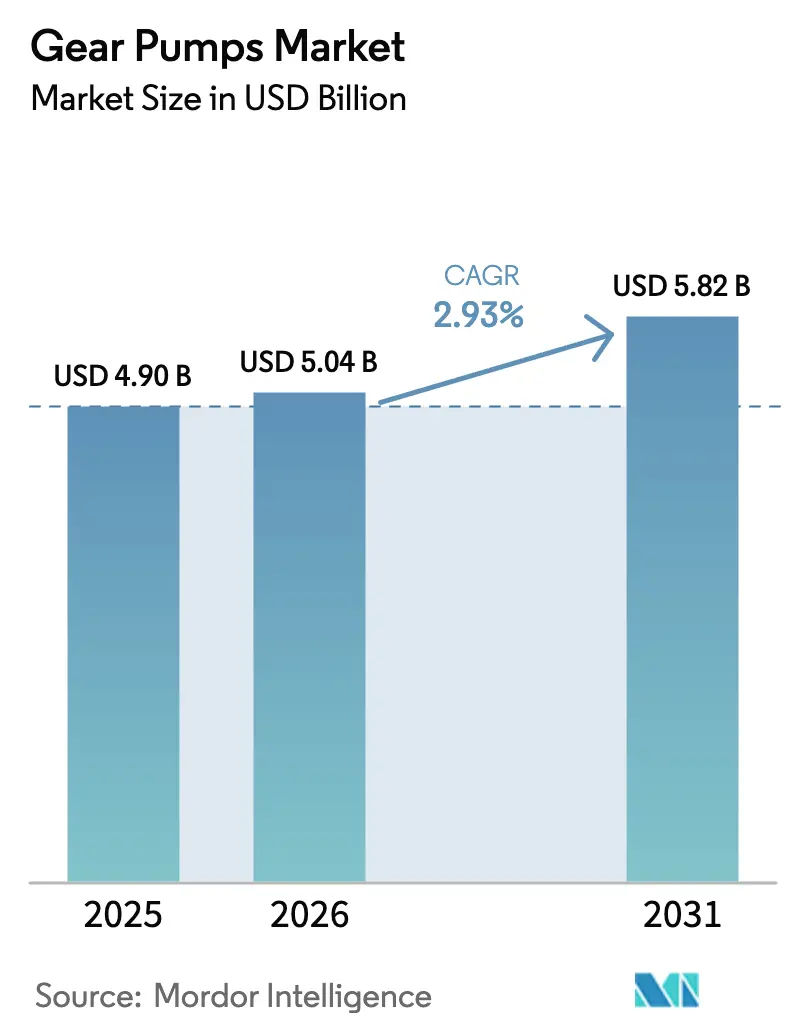
| Market Size (2026) | USD 5.04 Billion |
| Market Size (2031) | USD 5.82 Billion |
| Growth Rate (2026 - 2031) | 2.93% CAGR |
| Fastest Growing Market | Middle East |
| Largest Market | Asia-Pacific |
| Market Concentration | Medium |
Major Players *Disclaimer: Major Players sorted in no particular order Image © Mordor Intelligence. Reuse requires attribution under CC BY 4.0. | |
Gear Pumps Market Analysis by Mordor Intelligence
The gear pumps market size is expected to grow from USD 4.9 billion in 2025 to USD 5.04 billion in 2026 and is forecast to reach USD 5.82 billion by 2031 at 2.93% CAGR over 2026-2031. This growth indicates a mature yet resilient market that continues to benefit from essential industrial demand even as energy-efficiency rules and specialty alloy shortages introduce headwinds. Strong capital spending in the upstream oil and gas sector, rapid petrochemical build-outs in the Asia-Pacific region, and the adoption of modular hydraulics in mobile machinery underpin steady order inflows. Simultaneously, product development centers on low-noise, variable-displacement systems that complement electrified off-highway equipment and comply with sustainability mandates. Ongoing shifts toward bio-based hydraulic fluids also drive innovation in materials for seals, bearings, and coatings, aiming to preserve performance while supporting environmental goals.
Key Report Takeaways
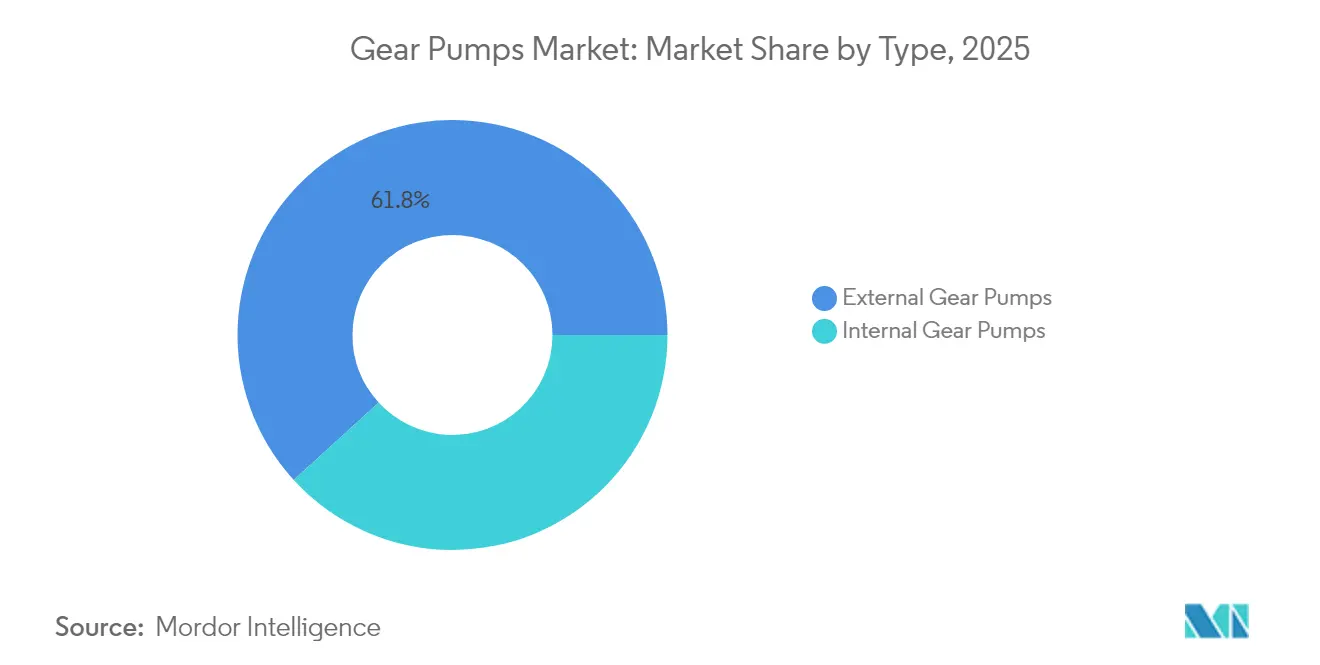
- By type, external gear pumps accounted for 61.78% of the gear pump market share in 2025, while Internal Gear Pumps are projected to rise at a 4.55% CAGR.
- By displacement, fixed displacement accounted for 71.45% of the gear pump market share in 2025, while variable displacement units are forecast to expand at a 4.39% CAGR through 2031.
- By material, cast iron captured 50.88% of revenue in 2025, while stainless steel is projected to rise at a 4.01% CAGR.
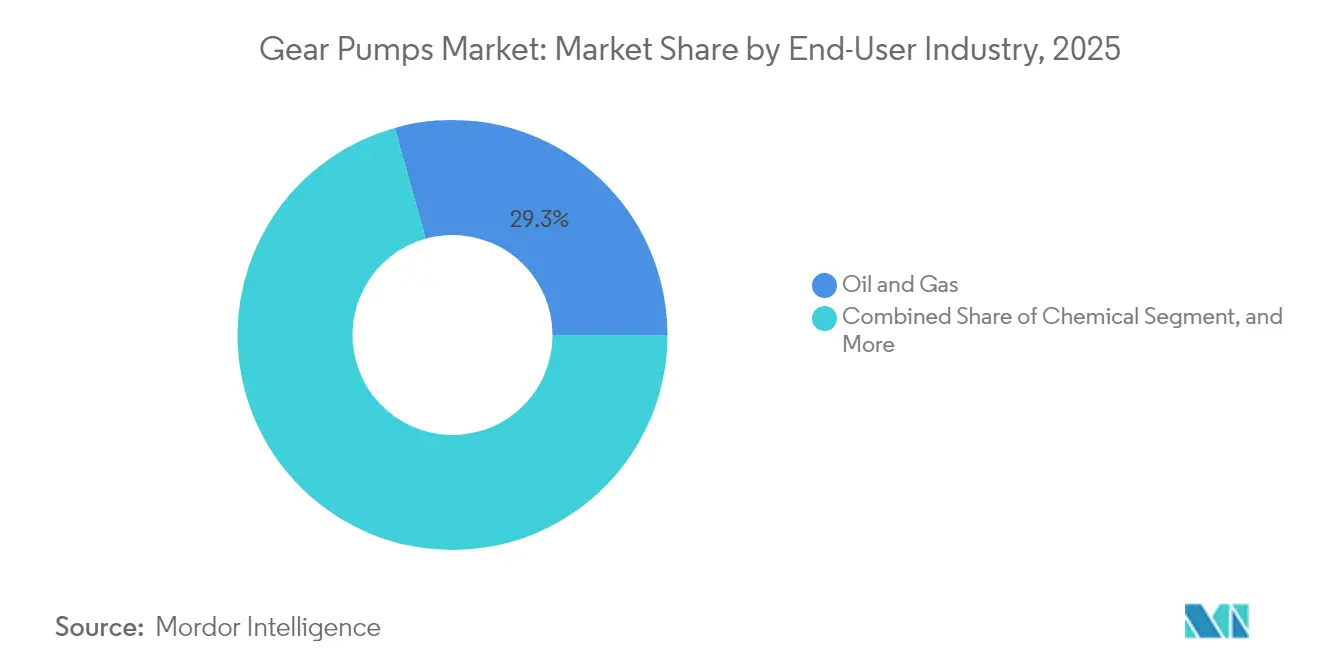
- By end-user, the oil and gas sector accounted for 29.33% of the gear pumps market size in 2025, while the pharmaceuticals sector recorded the highest growth at a 3.34% CAGR.
- By geography, the Asia-Pacific region led with a 35.29% revenue share in 2025, whereas the Middle East posted the fastest regional CAGR at 3.41% through 2031.
Note: Market size and forecast figures in this report are generated using Mordor Intelligence’s proprietary estimation framework, updated with the latest available data and insights as of 2026.
Global Gear Pumps Market Trends and Insights
Drivers Impact Analysis*
| Driver | (~) % Impact on CAGR Forecast | Geographic Relevance | Impact Timeline |
|---|---|---|---|
| Increasing demand from oil and gas upstream projects | +0.8% | North America, Middle East, offshore basins | Medium term (2-4 years) |
| Rapid capacity expansion in petrochemical complexes | +0.6% | Asia-Pacific core, spill-over to Middle East and North America | Long term (≥ 4 years) |
| Shift toward modular hydraulic systems in mobile machinery | +0.4% | Europe and North America leading, global spread | Short term (≤ 2 years) |
| Electrification of off-highway equipment requires silent hydraulic sources | +0.3% | Europe and North America front-runner, Asia-Pacific following | Medium term (2-4 years) |
| Smart factory adoption driving predictive-maintenance retrofit pumps | +0.2% | Developed manufacturing regions worldwide | Long term (≥ 4 years) |
| Transition to bio-based hydraulic fluids necessitates compatible gear pumps | +0.2% | Europe leadership, global adoption later | Long term (≥ 4 years) |
| Source: Mordor Intelligence | |||
Increasing Demand from Oil and Gas Upstream Projects
Rebounding capital spending across unconventional shale and offshore plays is driving orders for high-pressure external gear pumps that can withstand abrasive drilling muds and aggressive fracturing fluids. Floating production, storage, and offloading vessels rely on robust hydraulic packages, which maintain high reliability requirements.[1]Schlumberger, “Technology and Innovation Report,” slb.com Drillers specify advanced surface treatments and tighter tolerances to prolong service life in corrosive, high-temperature wells, driving continued design upgrades.
Rapid Capacity Expansion in Petrochemical Complexes
Asia-Pacific’s multi-billion-dollar cracker and polymer projects dominate global capacity additions, each requiring hundreds of specialty gear pumps for catalyst circulation, polymer transfer, and metering duties.[2]China Petroleum and Chemical Industry Federation, “Industry Development Report 2024,” cpcia.org.cn Local content policies in China and preferential financing in the Middle East further stimulate demand, while U.S. Gulf Coast debottlenecking secures a secondary growth stream.
Shift Toward Modular Hydraulic Systems in Mobile Machinery
Agricultural and construction OEMs now build equipment around standardized hydraulic modules that simplify maintenance, cut inventory, and shorten model changeovers. Interchangeable gear pumps slot into these modules, boosting volume repeatability and lowering unit cost. Deere’s latest tractor family leverages this architecture to streamline assembly and field service.[3]Deere and Company, “Annual Report 2024,” deere.com
Electrification of Off-Highway Equipment Requires Silent Hydraulic Sources
Electric excavators, loaders, and drills need quiet, energy-efficient hydraulics to preserve overall acoustic and efficiency benefits. New helical-tooth external gear pumps, paired with vibration-damped housings, reduce noise to below 70 dB while limiting parasitic losses that drain battery packs.
Restraints Impact Analysis*
| Restraint | (~) % Impact on CAGR Forecast | Geographic Relevance | Impact Timeline |
|---|---|---|---|
| Volatility in industrial capex cycles | -0.5% | Global, peaked in cyclical resource segments | Short term (≤ 2 years) |
| Growing penetration of screw and vane pumps in high-viscosity duties | -0.3% | Chemical and food processing hubs worldwide | Medium term (2-4 years) |
| Price sensitivity in commodity end-markets | -0.2% | Emerging regions and small-scale fabricators | Short term (≤ 2 years) |
| Compliance costs linked to tightening efficiency standards | -0.1% | Europe and North America | Long term (≥ 4 years) |
| Source: Mordor Intelligence | |||
Volatility in Industrial Capex Cycles
Boom-and-bust investment patterns in energy, mining, and chemicals result in uneven project backlogs, which tax production planning and cash-flow management. Inflationary raw material spikes and lengthening lead times add further uncertainty, prompting suppliers to hold larger inventories and offer more flexible delivery schedules.
Growing Penetration of Screw and Vane Pumps in High-Viscosity Duties
Alternative rotary technologies are gaining market share in viscous media due to their smoother flow, lower shear, and broader controllability. Progressive cavity designs supply chocolate, resins, and slurries more gently, eroding legacy gear pump positions in the specialty food and chemical industries. Gear pump makers respond with niche formulations and variable displacement designs to defend incumbency.
*Our forecasts treat driver/restraint impacts as directional, not additive. The impact forecasts reflect baseline growth, mix effects, and variable interactions.
Segment Analysis
By Type: External Gear Pumps Dominate Industrial Applications
External gear pumps accounted for 61.78% of the gear pumps market in 2025, reflecting superior pressure capability above 3,000 psi and robust tolerance of contaminated fluids. Fixed-tooth geometry simplifies machining and lowers service costs, sustaining dominance in drilling, fracturing, and heavy manufacturing. Internal gear pumps, although smaller in share, advance at a 4.55% CAGR due to their higher volumetric efficiency and quiet, pulse-free delivery. The gear pumps market size for internal variants is set to widen as food, pharma, and fine-chemical operators demand sanitary, low-noise performance.
Pharmaceutical facilities are increasingly specifying crevice-free internal designs in 316L stainless steel to comply with hygiene regulations. Parker Hannifin’s FDA-compliant series exemplifies this pivot, pairing magnetic drives with polished internals for CIP-compatible transfer duties. External units retain primacy in the oil and gas industry, where rugged metallurgy and field-service familiarity often trump noise or efficiency. Aerospace OEMs, however, are exploring compact internal pumps to reduce weight and power draw in next-generation flight control systems.


By Material: Cast Iron Leads Despite Stainless Steel Growth
Cast iron accounted for 50.88% of 2025 revenue due to its low cost, proven machinability, and ample mechanical strength in non-corrosive applications. The gear pumps market size derived from cast iron applications spans industrial hydraulics, drilling mud circulation, and general factory service. Stainless steel, projected to grow at a 4.01% annual rate, is capturing adoption across bioprocess, dairy, and specialty chemicals, where corrosion or hygiene drives total cost of ownership. Duplex alloys are gaining a foothold in offshore topside packages, striking a balance between resistance and price.
Material upgrades track stricter validation demands, especially FDA 21 CFR Part 11 electronic record requirements that favor stainless units to reduce cleaning protocol complexity. Cast iron’s share endures in rugged mobile machines, where abrasion and impact, not corrosion, govern lifecycle economics. Hybrid assemblies that combine cast iron housings with stainless gears offer a compromise for mid-tier chemical plants pursuing incremental upgrades.
By End-User Industry: Oil and Gas Leads Amid Diversification
Oil and gas contributed 29.33% of gear pumps market share in 2025, spanning upstream blow-out preventer hydraulics, midstream pipeline boosters, and downstream lube skids. However, pharma emerges as the fastest-expanding customer vertical, with a 3.34% CAGR through 2031, as global biologics and vaccine capacity scales. Food and beverage processors similarly pivot to hygienic gear units to move sugars, syrups, and dairy concentrates without foaming or contamination.
Biopharma single-use reactors rely on low-shear pumps that integrate gamma-irradiated disposable wet ends to safeguard sterility. Chemical plants remain a large installed base, yet many lines now favor screw pumps for viscous monomers, requiring gear pump suppliers to reposition toward catalyst injection and utility tasks. Power generation maintains a steady demand for lubrication oil and fuel handling circuits in combined-cycle and nuclear power stations.
By Displacement: Fixed Displacement Dominates with Variable Gaining Ground
Fixed displacement models accounted for 71.45% of the 2025 turnover, prized for their simplicity, reliability, and ease of troubleshooting. Nevertheless, energy-focused regulations push OEMs toward variable displacement units that modulate flow on demand, supporting a 4.39% CAGR. The gear pumps market size tied to variable technology is buoyed by smart electronics that link pump output to telematics, trimming idle losses in excavators and harvesters.
Caterpillar’s latest excavators feature load-sensing variable displacement pumps, which reduce fuel consumption by 15% compared to legacy fixed designs. Factory automation platforms integrate servo-controlled gear pumps that sync with PLCs, balancing inertia with speed to save kilowatt-hours and lower Scope 2 emissions. Fixed pumps still dominate small skid-steer loaders and shop presses where ruggedness outweighs efficiency.
Geography Analysis
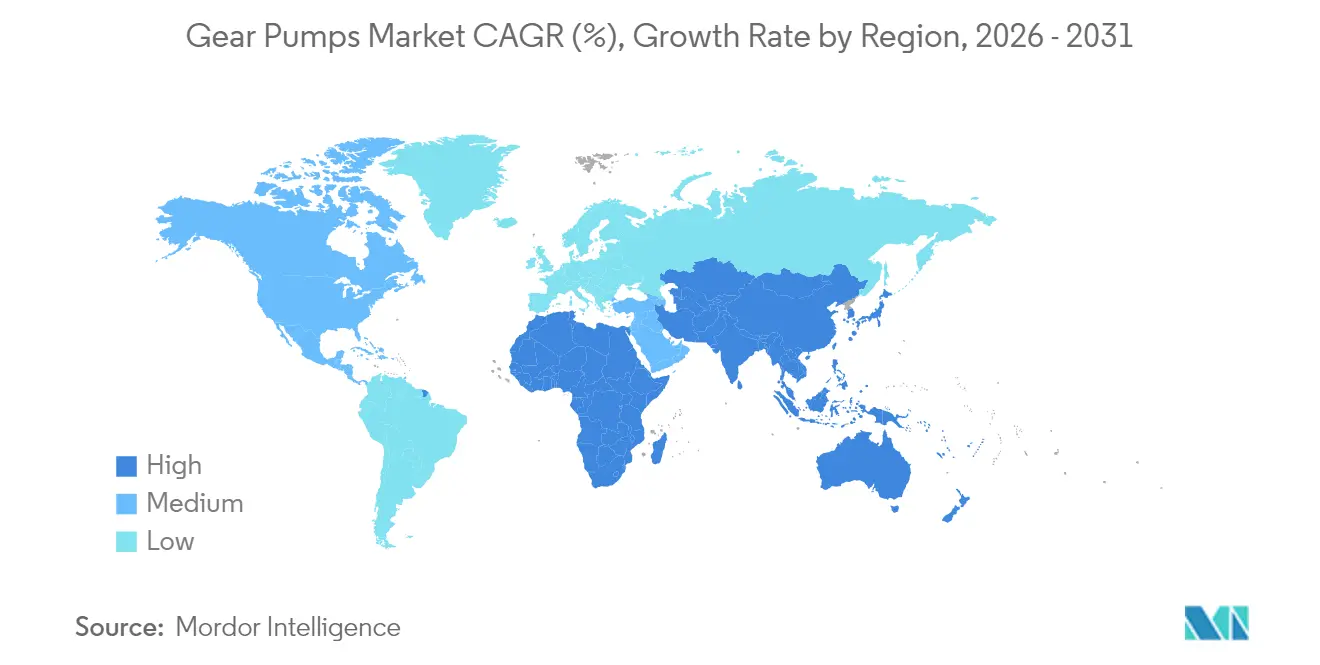
Asia-Pacific’s 35.29% share underscores its role as the center of gravity for petrochemical, electronics, and heavy equipment manufacturing. Large-scale projects in China’s coastal industrial zones and India’s new dedicated freight corridors underpin a steady pipeline of hydraulic installations. Southeast Asian nations attract factory relocations from higher-cost locales, further expanding the installed base of smaller gear pumps. Government incentives for clean energy, including solar wafer fabs and battery plants, introduce new hygienic and chemical-resistant pump requirements.
The Middle East is projected to record a 3.41% CAGR, driven by USD 20 billion in petrochemical investments under Saudi Vision 2030, which will demand corrosion-resistant gear pumps for ethylene, polyethylene, and specialty chemical units. The UAE aims to establish itself as a regional manufacturing hub, commissioning aluminum, steel, and modular housing factories that utilize decentralized hydraulic networks. Qatar’s harbor expansions and industrial cities require robust construction machinery equipped with high-pressure external pumps.
North America and Europe remain mature yet innovative. U.S. shale drillers order abrasion-tolerant pumping packages while embracing predictive maintenance sensors that feed real-time data to cloud platforms. European regulations on noise and efficiency are pushing OEMs toward variable, low-decibel designs, thereby bolstering R&D. Germany’s machine builders are embedding smart gear pumps into automated lines, aligning with the country’s Industry 4.0 blueprint.

Regulatory Landscape
Gear pump design, integration, and site operation sit within machinery-safety and worker-safety regimes, where compliance increasingly depends on documented risk assessment and guarding of rotating power-transmission parts. In the European Union, Machinery Regulation (EU) 2023/1230 replaces the Machinery Directive 2006/42/EC and applies from January 20, 2027, pushing OEMs and pump suppliers to update technical files, conformity assessment workflows, and control-system related safety documentation as hydraulic packages become more electronically integrated.
In the United States, OSHA requirements under 29 CFR 1910 Subpart O, including 29 CFR 1910.219 for mechanical power-transmission apparatus and 29 CFR 1910.212 for machine guarding, continue to shape enclosure, guarding, and installation practices for gears and rotating components in gear-pump-driven equipment. Across global deployments, widely used safety frameworks such as EN ISO 12100 for risk assessment and harmonized pump safety standards such as EN 809 remain key reference points for equipment builders specifying pumps and for end users validating safe integration into industrial skids, mobile hydraulics, and automated production lines.
Value Chain Analysis
The gear pumps value chain starts with ferrous and specialty alloy inputs, including cast iron, stainless steels, and wear-resistant materials, then moves into precision casting and high-tolerance machining of housings, gears, and shafts. Component sub-suppliers provide bearings, seals, coatings, and increasingly electronics for sensing and monitoring, which pump OEMs integrate and test into external and internal gear pump platforms. Downstream, systems integrators and hydraulic power-unit builders package gear pumps with motors, manifolds, valves, and controls for mobile machinery and industrial skids, while process-industry customers use gear pumps in metering and transfer duties across chemicals, polymers, food, and pharmaceuticals.
Distribution and service typically combine direct OEM sales, specialized fluid power distributors, and aftermarket networks for spares and field support, which matters for uptime-sensitive users standardizing modular hydraulics to simplify maintenance. Value-chain pressure points align with the report context on specialty alloy casting availability and lead-time volatility, pushing suppliers toward dual sourcing and regional machining capacity, and toward design approaches that preserve performance under material substitution. The chain is also shifting toward digitally enabled products as pumps add electronic interfaces for PLC connectivity and predictive maintenance, increasing the importance of firmware, calibration, and validation alongside traditional mechanical quality control.
Competitive Landscape
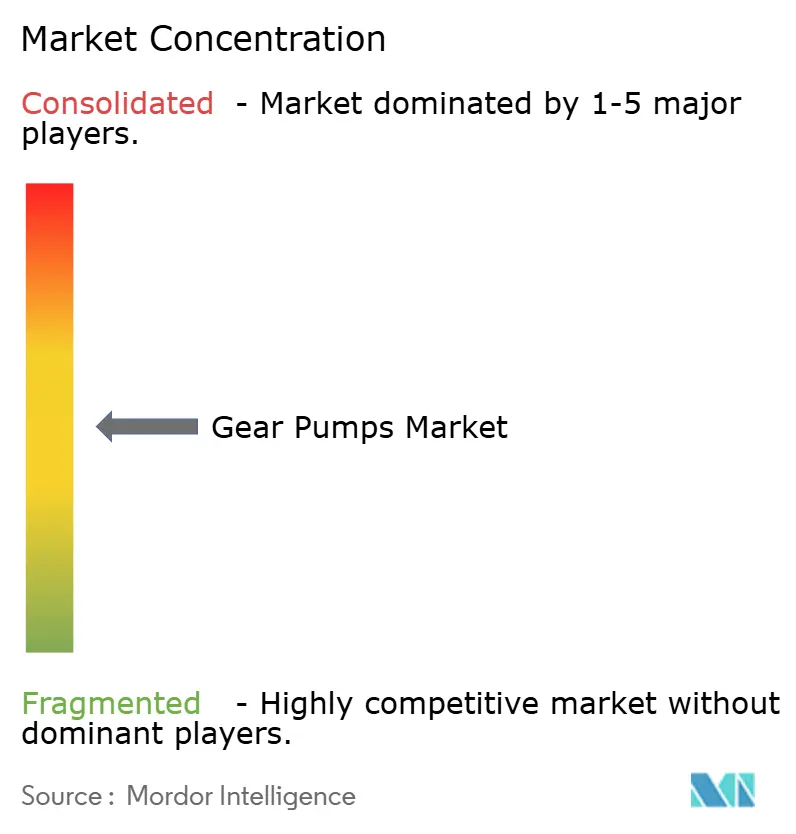
The gear pumps market exhibits moderate concentration as global players pursue scale and technology leadership through acquisitions. Bosch Rexroth’s EUR 1.2 billion (USD 1.3 billion) purchase of Hawe Hydraulik extends its mobile hydraulics reach, exemplifying the strategic imperative to control a full systems portfolio. Parker Hannifin and Eaton deploy integrated electronics and IoT-ready sensors to differentiate on performance monitoring and predictive uptime.
Digital transformation shapes competition: embedded vibration sensors, edge analytics, and cloud dashboards convert pumps from commodity components to data-rich assets. Vendors invest in additive manufacturing to speed prototype cycles and in wear-resistant surface coatings for bio-fluid compatibility. Niche entrants target biopharma and aerospace, where stringent quality factors allow premium pricing and protect against volume-driven rivalry. Meanwhile, large incumbents partner with lubricant formulators to validate seal materials for bio-based fluids, locking in future compatibility contracts.
The fragmentation index sits in the mid-range as top suppliers hold notable but not dominant shares across diverse end-markets. Continuous consolidation is expected as regional specialists seek global distribution while majors plug product gaps and secure local content credentials in emerging clusters.
Gear Pumps Industry Leaders
Bosch Rexroth AG
Parker-Hannifin Corporation
Hydac International GmbH
Viking Pump, Inc.
IDEX Corporation
- *Disclaimer: Major Players sorted in no particular order

Market Opportunities and Future Outlook
Near-term whitespace is emerging for suppliers that can offer broader gear-pump coverage across high-viscosity and specialty-duty niches while keeping supply consistency. A clear signal is CIRCOR International's October 2025 acquisition of Flowserve's herringbone gear pump product line (GAX, GR, and Gearex series) and the planned shift of production to CIRCOR's Columbia, Kentucky facility, which points to active portfolio reshaping and manufacturing moves aimed at securing capacity and shortening delivery cycles.
Buying criteria in mobile equipment are also shifting toward electronically controllable, quieter, and more energy-efficient hydraulic sources. This increases demand for variable displacement architectures and integrated sensing that support PLC, SCADA, and predictive maintenance workflows. Manufacturer capacity and efficiency investments reflect this operating model: Marzocchi Pompe referenced a 2,500 square metre real estate acquisition completed February 2024 to unify and expand production at Zola Predosa, while NETZSCH Technologies India started construction of a new manufacturing facility in Goa in April 2025 to expand regional pumping output. Taken together with the report context on modular hydraulics adoption and bio-based hydraulic fluid compatibility needs, these moves create room for suppliers that combine materials validation (seals, bearings, coatings) with electronics-enabled condition monitoring and standardized modules that fit OEM integration and aftermarket service.
Recent Industry Developments
- April 2026: Bosch Rexroth and HydraForce highlighted their Compact Hydraulics portfolio at Agrishow 2026 in Ribeirao Preto, Brazil (April 27 to May 1). The focus on integrated compact hydraulics supports OEM demand for standardized hydraulic modules in agricultural and off-highway equipment, reinforcing competitive differentiation beyond standalone pump components.
- October 2025: CIRCOR International acquired Flowserve Corporation's herringbone gear pump product line, including the GAX, GR, and Gearex series. The transaction broadens CIRCOR's gear pump offering in specialty and high-viscosity applications, and the planned production transfer to Columbia, Kentucky tightens control over manufacturing capacity and lead times.
- February 2024: Marzocchi Pompe completed a 2,500 square metre real estate acquisition to unify and expand production capacity at its Zola Predosa plant. Consolidating the manufacturing footprint supports higher throughput and operational efficiency, which is relevant as OEMs and distributors prioritize reliable supply and repeatable quality in standardized hydraulic modules.


Research Methodology Framework and Report Scope
Market Definition and Coverage
For this study, the gear pumps market covers revenue generated from internal and external gear pumps sold for moving fluids in industrial and mobile equipment, counted at the manufacturer level across major regions.
Scope exclusions: We exclude installation labor, downstream maintenance services, and complete hydraulic power packs where the pump value cannot be separated cleanly.
Segmentation Overview
- By Type
- External Gear Pumps
- Internal Gear Pumps
- By Material
- Cast Iron
- Stainless Steel
- Other Materials
- By End-User Industry
- Oil and Gas
- Chemical
- Food and Beverage
- Pharmaceutical
- Power Generation
- Other End-User Industries
- By Displacement
- Fixed Displacement
- Variable Displacement
- By Geography
- North America
- United States
- Canada
- Mexico
- Europe
- Germany
- United Kingdom
- France
- Russia
- Rest of Europe
- Asia-Pacific
- China
- Japan
- India
- South Korea
- Australia
- Rest of Asia-Pacific
- Middle East and Africa
- Middle East
- Saudi Arabia
- United Arab Emirates
- Rest of Middle East
- Africa
- South Africa
- Egypt
- Rest of Africa
- Middle East
- South America
- Brazil
- Argentina
- Rest of South America
- North America
Data Sources, Market Sizing, and Validation
Desk Research
Desk research was used to set the market boundary and build an initial demand logic before interviews narrowed assumptions. We referenced public and official sources such as US Census Bureau trade and manufacturing series, Eurostat industrial statistics, UN Comtrade customs data, and International Energy Agency industry indicators to understand where fluid-handling demand is expanding or slowing.
We also reviewed manufacturer annual reports, investor presentations, product catalogs, and reputable industrial press to map typical use cases such as lubrication systems, fuel transfer, hydraulic circuits, and chemical handling. Where disclosures were limited, we relied on paid subscriptions for company financials and news intelligence, plus patent databases to spot product change signals like materials used, efficiency cues, and pressure-handling updates. These desk sources are illustrative only, and additional references were used for data collection, validation, and clarification across the work.
Primary Interviews and Surveys
Primary work was completed through expert interviews and short surveys with pump manufacturers, distributors, integrators, and large end users in process industries and mobile hydraulics. We used these discussions to validate how gear pumps are selected, what drives replacement cycles, and how pricing moves with materials and certifications, then we checked differences across APAC, EMEA, and the Americas.
Distribution of primary research fieldwork respondents
| Company type | Respondent position | Region |
|---|---|---|
| Top tier: 35% | CXOs: 19% | APAC: 45% |
| Mid tier: 45% | Functional/Unit leaders: 37% | EMEA: 37% |
| Smaller Players: 20% | Managers: 44% | Americas: 18% |
Market-Sizing & Forecasting
Sizing was built mainly using a top-down approach where industrial output and equipment activity indicators are translated into a realistic demand pool for gear pumps, then converted into value using price bands and replacement behavior. To keep the output grounded, we corroborated totals with selective bottom-up checks, including sample supplier revenue splits, channel feedback on shipments, and a simple ASP-by-application times volume calculation when interview data was strong.
A few market fingerprints were treated as core inputs because they explain most of the year-to-year movement. These include machinery and manufacturing output trends, oil and gas capex and midstream maintenance activity, chemical processing utilization, the share of applications needing fixed versus variable displacement, and material mix shifts (cast iron versus stainless steel) that change average selling prices. When direct volume signals were missing for a niche application, we proxied from the closest end-use activity series and then re-tested using distributor feedback.
For forecasting, we relied on scenario analysis supported by simple regression relationships between demand drivers and historical market behavior, followed by expert adjustments where lead times, energy-efficiency upgrades, or substitution toward other pump types could bend the curve. Assumptions on pricing were refreshed each cycle using interview feedback on cost pass-through and typical annual repricing cadence in key regions.
Data Validation & Update Cycle
Validation was done through multiple checks so the final numbers do not depend on a single dataset. We compared model output against independent signals such as industrial production direction, major end-user spending tone, and whether implied unit demand matched what channels reported, then investigated outliers before sign-off.
A second analyst review is used to re-check calculations, scope alignment, and year-to-year movements, and follow-up calls are triggered when a key assumption changes or a region shows an unusual swing. Reports are refreshed annually, and interim updates are made when material events occur, such as sharp commodity moves that affect stainless steel pump pricing or a step change in capex at major end users. Before delivery, the analyst completes a fresh pass to align the narrative and numbers with the latest available releases.
Mordor Intelligence's Gear Pumps Market Size Compared Against Other Published Estimates
Published market sizes for gear pumps often vary because the boundary is not the same across studies, and the conversion from activity to revenue depends heavily on pricing logic and what gets counted as a gear pump sale. We also see differences when one estimate leans more on broad pump spend ratios, while another builds from end-use equipment pools and replacement cycles.
By tracking application-level ASP bands and refresh timing, Mordor Intelligence keeps the 2026 total tied to gear pumps sold as standalone components, instead of blending in adjacent pump families or complete power units that inflate the value. Gaps also come from how stainless steel and specialty designs are priced, whether hydraulic-only demand is counted or all viscous-fluid transfer uses are included, and how currency conversion timing is handled when regional revenues are added up.
Benchmark comparison
| Source | Market Size | Gaps in Research Methodology |
|---|---|---|
| Mordor Intelligence | USD 5.04 B (2026) | |
| Industry Publisher A | USD 11.22 B (2024) | Uses a wider product boundary that appears to fold gear-pump demand across more pump categories and pressure classes, and it may apply higher blended ASPs from industrial machinery uses that are not isolated to gear pumps only. |
| Regional Consultancy B | USD 4.60 B (2024) | Anchors the base year earlier and can undercount specialty and stainless steel demand if the model leans on generalized end-use splits without fully adjusting for higher price bands and replacement intensity in process industries. |
The spread in the table is mainly explained by what is included around the gear pump core, and by the way pricing and currency timing are handled when regional demand is added up. When scope is kept consistent and checked against end-use activity, shipments feedback, and realistic ASP bands, the market size becomes easier to reproduce and to use for planning.


Key Questions Answered in the Report
How large is the gear pumps market in 2026?
The market is valued at USD 5.04 billion in 2026 with a projected 2.93% CAGR to 2031.
Which segment holds the highest gear pumps market share today?
External gear pumps lead with 61.78% revenue share in 2025.
What drives faster growth in stainless steel gear pumps?
Rising pharmaceutical and food processing demand for corrosion-resistant, hygienic pumping solutions is lifting stainless steel sales at a 4.01% CAGR.
Why are variable displacement gear pumps gaining popularity?
Energy-efficiency mandates and the need for precise flow control in mobile and industrial equipment boost adoption, supporting a 4.39% CAGR through 2031.
Which region is the fastest growing for gear pumps?
The Middle East shows the highest regional growth at a 3.41% CAGR, supported by massive petrochemical investments and diversification programs.
How are gear pump makers addressing the shift to bio-based hydraulic fluids?
Manufacturers develop compatible seals and coatings, validate materials with lubricant suppliers, and launch product lines expressly certified for bio-fluid use.
Page last updated on: