
GCC Juice Market Size and Share
Market Overview
| Study Period | 2021 - 2031 |
|---|---|
| Forecast Data Period | 2026 - 2031 |
| Base Year Market Size (2025) | USD 6.13 Billion |
| Market Size (2026) | USD 6.5 Billion |
| Market Size (2031) | USD 8.69 Billion |
| Growth Rate (2026 - 2031) | 5.98 % |
| Market Concentration | Medium |
Major Players *Disclaimer: Major Players sorted in no particular order Image © Mordor Intelligence. Reuse requires attribution under CC BY 4.0. | |
GCC Juice Market Analysis by Mordor Intelligence
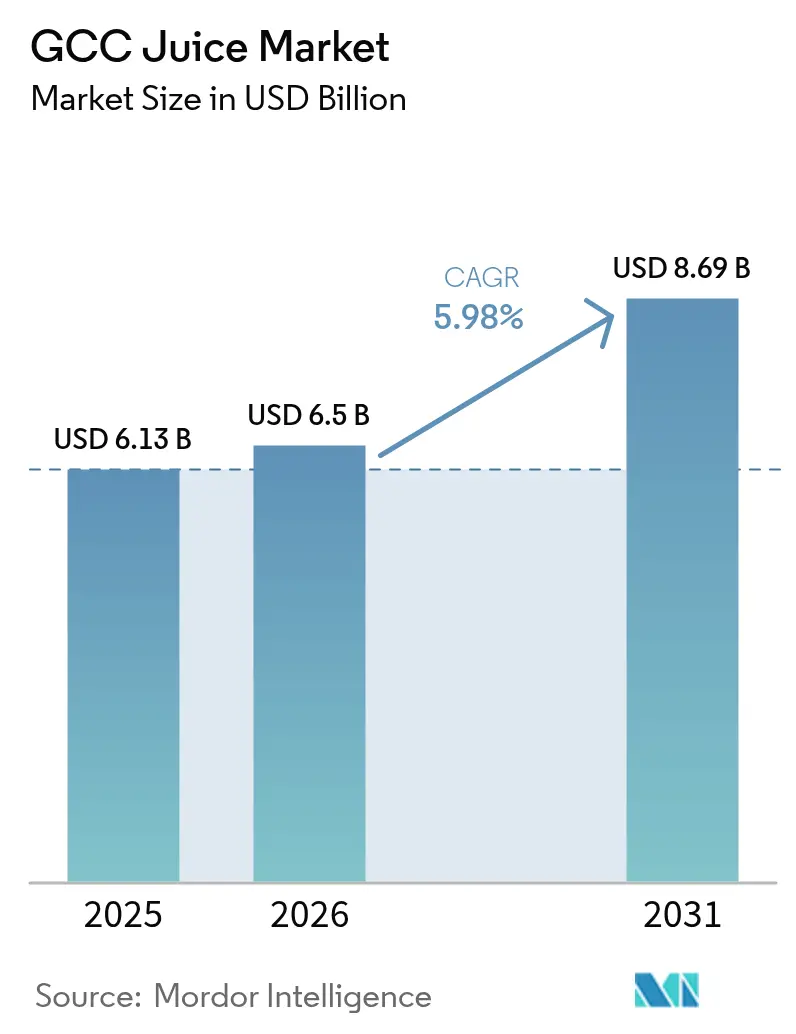
The Gulf Cooperation Council (GCC) juice market size in 2026 is estimated at USD 6.5 billion, growing from 2025 value of USD 6.13 billion with 2031 projections showing USD 8.69 billion, growing at 5.98% CAGR over 2026-2031. This growth is primarily driven by the rising demand for premium juices and functional beverages and the increasing popularity of fortified and natural juices. Saudi Arabia remains the largest market in the region, while the United Arab Emirates is experiencing the fastest growth. The introduction of sugar excise taxes has led manufacturers to reformulate their products. Many companies are now focusing on launching functional, fortified, and natural juice options, particularly in urban retail stores and on-trade outlets. Regulatory measures, such as the 50% excise tax on sugar-sweetened beverages, are pushing manufacturers to expand their non-sugar product portfolios and invest in improving cold chain infrastructure to address the challenges posed by the region's hot climate. The Gulf Cooperation Council juice market is moderately concentrated, but there are signs of increasing competition. In 2024, major players like Almarai and Al Rabie Saudi Foods, along with other diversified beverage companies, continued to hold a significant share of the market.
Key Report Takeaways
- By product category, fruit juice accounted for 77.62% revenue share in 2025; vegetable juice is projected to rise at a 7.31% CAGR to 2031.
- By type, 100% juice held 51.55% of the Gulf Cooperation Council (GCC) juice market share in 2025, while nectar is projected to grow at a 7.52% CAGR through 2031.
- By packaging, Tetra Pak cartons controlled 54.88% of the Gulf Cooperation Council (GCC) juice market size in 2025; PET bottles are poised for a 6.05% CAGR over 2026-2031.
- By distribution channel, off-trade captured 84.63% of the Gulf Cooperation Council (GCC) juice market share in 2025, yet on-trade is expanding at a 7.12% CAGR between 2026-2031.
- By geography, Saudi Arabia dominated with a 49.15% share in 2025, while the United Arab Emirates is forecast to post the highest 7.46% CAGR to 2031.
Note: Market size and forecast figures in this report are generated using Mordor Intelligence’s proprietary estimation framework, updated with the latest available data and insights as of 2026.
Market Trends and Insights
Drivers Impact Table of GCC Juice Market*
| DRIVERS | (~) % IMPACT ON CAGR FORECAST | GEOGRAPHIC RELEVANCE | IMPACT TIMELINE |
|---|---|---|---|
| Premiumization and demand for functional juices | +1.2 | United Arab Emirates , Saudi Arabia, Qatar | Medium term (2-4 years) |
| Increasing popularity of fortified and functional juices | +0.9 | United Arab Emirates, Saudi Arabia | Medium term (2-4 years) |
| Growing Demand for natural and organic juices | +0.8 | United Arab Emirates, Saudi Arabia, Kuwait | Long term (≥ 4 years) |
| Rising preference for convenient, ready-to-drink (RTD) formats | +0.7 | Saudi Arabia, United Arab Emirates, Oman | Short term (≤ 2 years) |
| Tourism and the HoReCa sector growth | +0.6 | United Arab Emirates, Qatar, Saudi Arabia | Medium term (2-4 years) |
| Health and wellness trends | +0.5 | All Gulf Cooperation Council (GCC) countries | Long term (≥ 4 years) |
| Source: Mordor Intelligence | |||
Increasing popularity of fortified and functional juices
Urban consumers in cities like Dubai, Abu Dhabi, and Riyadh are increasingly viewing juice as more than just a refreshing drink; it is now seen as a functional wellness product. According to the United Nations Development Programme (UNDP), the urban population in the Gulf Cooperation Council (GCC) region is steadily growing and is expected to reach 54.6 million by 2030 [1]. This growing urbanization is driving demand for healthier and more functional beverages. In 2024, there was a noticeable rise in interest in fortified juices enriched with nutrients like vitamin C, zinc, probiotics, and omega-3s, which performed exceptionally well across the region. For instance, Almarai introduced its “Super Juice” range, which includes 100% not-from-concentrate pomegranate and berry juices. These juices are processed using ultra-heat treatment to retain nutrients and are packaged in premium, shelf-stable containers. The company also reported significant growth in its “Better for You” product portfolio during the year.
Tourism and HoReCa sector growth
The tourism and hospitality sector in the Gulf Cooperation Council (GCC) is growing rapidly, creating new opportunities for juice products, especially in the United Arab Emirates and Qatar, where significant investments are being made in tourism infrastructure. For example, Dubai welcomed 8.68 million overnight visitors between January and May 2025, marking a 7% increase compared to the same period in 2024, according to the Dubai Department of Economy and Tourism [2]. The Dubai Gastronomy Industry Report, published in April 2025, highlighted that nearly 1,200 new restaurant licenses were issued in the city, showcasing the sector's remarkable growth [3]. This expansion is driving demand for high-quality juice products that cater to the hospitality industry's focus on premium experiences. Juice manufacturers are responding by creating specialized products and packaging formats designed for food service needs. For example, Barakat Quality Plus in the United Arab Emirates offers freshly squeezed juices in 2-liter and 5-liter foodservice packs specifically tailored for hotels, restaurants, and catering outlets.
Rising preference for convenient, ready-to-drink (RTD) formats
The rapid urbanization and increasingly busy lifestyles in Saudi Arabia and the United Arab Emirates are driving a growing preference for convenient, ready-to-drink (RTD) juice options. These products cater to consumers who are constantly on the move and looking for quick, hassle-free refreshment. According to the International Labour Organization, the United Arab Emirates' employment rate is projected to reach approximately 76.42% in 2024, with a labor force of around 7,076,637 people [4]. This highlights the growing number of working individuals who often seek convenient food and beverage solutions. To meet this demand, juice manufacturers are focusing on creating portable and easy-to-use products. For example, in 2024, Almarai launched a 180 ml single-serve juice pack designed for commuters, office workers, and students who need a quick and nutritious drink during their busy schedules, along with better value for money. This shift reflects a broader trend where consumers value both functionality and convenience.
Health and wellness trends
The growing focus on health and wellness in the Gulf Cooperation Council (GCC) region is significantly influencing the juice market, as consumers increasingly look for beverages that offer clear health benefits. This trend is evident across all age groups and income levels, driven by a rising awareness of nutrition and the need to prevent chronic diseases. People are paying closer attention to juice labels, seeking information about vitamin content, antioxidants, and the absence of added sugars or artificial ingredients. To support this shift, regional health authorities have introduced initiatives aimed at reducing sugar consumption and promoting healthier eating habits. For instance, Saudi Arabia’s Ministry of Health actively promotes the Saudi Sugar Reduction Strategy, which aligns with global efforts like the FDI World Dental Federation's Declaration on Sugar [5]. These initiatives encourage manufacturers to create beverages with lower sugar content. In this environment, juice brands that focus on health and wellness, supported by clean labels, certifications, and transparent nutrient information, are gaining a competitive edge and building stronger connections with health-conscious consumers in the Gulf Cooperation Council (GCC).
Restraints Impact Analysis of GCC Juice Market*
| RESTRAINTS | (~) % IMPACT ON CAGR FORECAST | GEOGRAPHIC RELEVANCE | IMPACT TIMELINE |
|---|---|---|---|
| High sugar taxes and regulatory challenges | -0.9 | Saudi Arabia, United Arab Emirates, All Gulf Cooperation Council | Short term (≤ 2 years) |
| Increasing prevalence of overweight and obesity among children and adults | -0.7 | Saudi Arabia, United Arab Emirates, Kuwait | Long term(≥ 4 years) |
| Short shelf life of fresh and cold-pressed juices | -0.4 | United Arab Emirates, Saudi Arabia, Qatar | Medium term (2-4 years) |
| Packaging waste and environmental concerns | -0.3 | United Arab Emirates, Saudi Arabia | Long term(≥ 4 years) |
| Source: Mordor Intelligence | |||
High sugar taxes and regulatory challenges
The introduction of high excise taxes on sugar-sweetened beverages in Gulf Cooperation Council (GCC) countries has created significant challenges for juice manufacturers. Both Saudi Arabia and the United Arab Emirates have implemented a 50% excise tax on drinks with added sugars, which includes many juice products. This tax has directly increased retail prices, leading to changes in consumer buying habits. For instance, in Saudi Arabia, soft drink consumption dropped by 19% after the tax was introduced, as reported by a study conducted by Jallouna and Qurban. To adapt, some companies have focused on developing juices with reduced sugar or no added sugar, leveraging their research and development capabilities. However, smaller manufacturers or those with limited resources are struggling with the high costs and complexities of reformulating their products. The World Health Organization (WHO) has highlighted that these tax rates are among the highest in the world, making the Gulf Cooperation Council (GCC) a particularly challenging region for juice producers.
Increasing prevalence of overweight and obesity among children and adults
The increasing rates of overweight and obesity among both children and adults in the Gulf Cooperation Council (GCC) region are putting fruit juice products, especially those with high natural or added sugar content, under more scrutiny from both regulators and consumers. In Saudi Arabia and the United Arab Emirates (UAE), obesity is a growing public health issue. A survey conducted by PMC NCBI NLM on 522 adolescents (aged 11–18) found that, as of January 2025, 13.2% were overweight and 26.1% were obese in Saudi Arabia. This is partly due to government efforts to reduce sugar consumption, including in beverages. While 100% fruit juices provide important nutrients, their natural sugars are being reconsidered by health-conscious consumers. Public health campaigns, like the Saudi Arabia Declaration on Sugar, supported by the Saudi Dental Society and the FDI World Dental Federation, have highlighted sugar-sweetened drinks as contributors to obesity and dental problems.
*Our forecasts treat driver/restraint impacts as directional, not additive. The impact forecasts reflect baseline growth, mix effects, and variable interactions.
GCC Juice Market Segment Analysis
By Category:
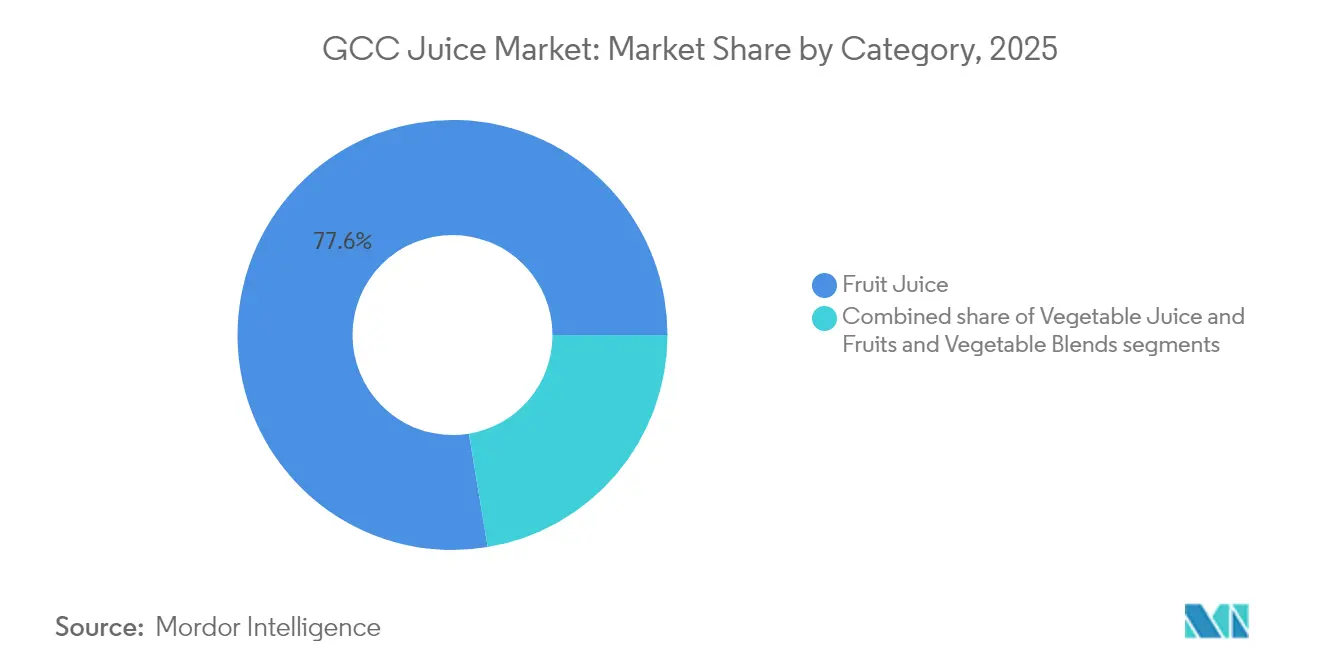
Fruit Maintains Leadership while Vegetables AccelerateIn 2025, the Gulf Cooperation Council (GCC) juice market saw fruit juice dominate, claiming a substantial 77.62% of total revenue. This stronghold can be attributed to consumers' familiarity with the product, a diverse range of flavors, and its prominent presence in both traditional and modern retail formats. Mainstream retailers are actively promoting popular flavors, notably mango and orange, often through multipack deals aimed at family consumption. Leading brands, including Al Rabie and Del Monte, boast extensive portfolios tailored to both value-conscious and brand-loyal consumers. The category's robustness is further enhanced by its adaptability to ambient and long-life packaging formats, which not only ensure cost-efficient storage but also facilitate broad regional distribution.
While vegetable juice currently occupies a smaller niche, it's poised for rapid growth, outpacing its fruit counterpart with a projected CAGR of 7.31%. This momentum is driven by a burgeoning demand for low-sugar and nutrient-rich options, particularly among health-conscious consumers. Responding to this trend, companies like Almarai are introducing blended products, such as beet-carrot juice, prominently showcased in premium outlets and wellness sections. These blends, perceived for their functional benefits like enhanced digestion and antioxidant properties, command a premium price. As retailers allocate more refrigerated shelf space, suppliers who effectively highlight the nutritional advantages and vitamin retention of their vegetable juices stand to gain significantly in this expanding market.

By Type:
Nectar Outpaces Conventional VariantsIn 2025, the 100% juice category captured 51.55% of the Gulf Cooperation Council (GCC) juice market share, bolstered by its strong reputation as a natural and healthy choice. As consumers increasingly opt for juices devoid of added sugars and artificial ingredients, this segment has surged in popularity across both mainstream and premium retail channels. For example, Almarai’s 100% juice range boasts robust sales in supermarkets throughout Saudi Arabia and the United Arab Emirates, underscoring the trust consumers place in established regional brands. This trend underscores a wider movement towards clean-label, minimally processed beverages, resonating with today's wellness-oriented consumption habits.
Meanwhile, the nectar segment is rapidly gaining traction within the GCC juice market, projected to achieve a strong CAGR of 7.52% starting in 2026. This growth is primarily driven by increasing consumer health awareness and continuous product innovation. Key players, such as Al Rawabi, are introducing cocktail nectar blends featuring tropical flavors like pineapple, mango, and orange, which cater to urban consumers seeking fruit-based refreshment. With its moderate fruit content, nectar is strategically positioned between juice drinks and pure juice, offering a flavorful and convenient option for daily consumption. The demand is particularly robust for premium, organic, and blended nectar formats, distributed through established supermarket chains and expanding online retail platforms.
By Packaging Type:
Cartons Retain Scale as PET RisesIn 2025, cartons captured 54.88% of the market share, largely due to their affordability, ease of storage, and extended shelf life at room temperature. These attributes have made cartons the go-to choice for manufacturers and consumers alike in the Gulf Cooperation Council (GCC). Furthermore, the rising adoption of bio-based materials in carton production enhances their eco-friendliness, resonating with the region's sustainability objectives. For instance, in response to the surging demand for eco-friendly packaging, Al Rawabi has rolled out recyclable cartons for its juice lineup. Additionally, in a bid to bolster national sustainability initiatives like Vision 2030, juice producers are teaming up with local municipalities to elevate recycling rates for carton packaging.
PET bottles are witnessing a robust growth trajectory, expanding at a CAGR of 6.05%. Their transparent design, which showcases the product, coupled with a resealable feature, caters perfectly to today's fast-paced lifestyles. The industry is also pivoting towards innovations such as recycled PET (rPET) and tethered caps, ensuring compliance with stringent environmental regulations. Meanwhile, glass packaging, though holding a modest share in the premium segment, is strategically favored by cold-pressed juice brands to exude an aura of quality and luxury. Cans find their niche appeal in sectors like airlines and convenience stores, prized for their compactness and portability. Collectively, these varied packaging formats not only enhance functional convenience but also bolster brand positioning across diverse consumer demographics.

By Distribution Channel:
On-Trade Adds Velocity to a Mature Off-Trade BaseIn 2025, off-trade channels, such as supermarkets, hypermarkets, and e-commerce platforms, accounted for 84.63% of total juice revenue, buoyed by robust consumer footfall and a diverse range of juice offerings. Quick-commerce apps, including Talabat and Instashop, have spurred off-trade growth in cities like Dubai and Riyadh, delivering orders in under 20 minutes and fueling impulse buys of single-serve juices. Retailers are enhancing shelf placements and bundling strategies to spotlight value packs, while e-commerce platforms utilize search-based targeting to amplify juice promotions. The extensive accessibility and variety in off-trade venues solidify their status as the go-to channel for both daily and bulk juice purchases.
On-trade channels, encompassing hotels and cafés, are rapidly gaining traction, boasting a projected CAGR of 7.12%. Urban centers like Dubai, Doha, and Riyadh are witnessing beverage menu upgrades, with establishments introducing cold-pressed juices and immunity-boosting blends to cater to the premium wellness market. In a nod to the growing emphasis on health and personalization, juice brands are partnering with café chains to craft exclusive ready-to-drink (RTD) flavors. Convenience stores situated at transport hubs and petrol stations are seeing a surge in single-serve juice sales, driven by consumer demand for portability. To capitalize on this trend, manufacturers are rolling out durable, easy-to-carry packaging and introducing limited-time offers and cross-promotions, aiming to boost impulse purchases and trials in urban and travel-centric locales.
Geography Analysis
Saudi Arabia Juice Market
Saudi Arabia accounted for 49.15% of the juice market volume in 2025, driven by its strong domestic supply chain and widespread modern trade networks. The country's Vision 2030 health initiatives are pushing manufacturers to reduce sugar content in their products. For instance, Almarai’s “Better for You” product line has seen significant growth due to this shift. Retailers in Saudi Arabia continue to prioritize popular 1-liter mango and orange juice products, while also gradually introducing more functional and health-focused juice options to meet changing consumer preferences.
United Arab Emirates Juice Market
The United Arab Emirates is expected to grow at a CAGR of 7.46%, fueled by its large tourist population, diverse consumer tastes, and advanced logistics infrastructure. Airports and luxury hotels in the United Arab Emirates often test exclusive juice concepts, which, if successful, are later introduced to retail stores. This trend allows the United Arab Emirates to play a key role in shaping regional flavor preferences and driving innovation in the juice market.
GCC Juice Market
Qatar, Kuwait, and Oman collectively contribute a smaller but strategically important share to the Gulf Cooperation Council (GCC) juice market. Qatar benefits from the high purchasing power of its expatriate population, which supports the demand for premium chilled juice products. Kuwait has seen a rise in demand for vitamin-enriched juices targeted at children, reflecting a focus on health and nutrition. Meanwhile, Oman is transitioning from economy cartons to mid-tier PET packaging, supported by the modernization of its supermarket infrastructure. The implementation of consistent sugar-tax policies across all Gulf Cooperation Council (GCC) countries is encouraging manufacturers to adopt uniform labeling and reformulate their products to meet regional standards.
Regulatory Landscape
The GCC juice market operates under a layered framework combining Gulf Standardization Organization (GSO) standards with country-level enforcement. GSO 1820:2021 sets the core technical baseline for fruit juices, fruit drinks, and nectars across member states, while category-specific updates continue, including GSO 2830:2026 for flavored concentrated drinks (approved by the GSO on 30 April 2026), which tightens technical requirements for concentrates and related beverage formats.
On implementation, Saudi Arabia uses the Saudi Food and Drug Authority (SFDA) for import and domestic compliance, with food clearance workflows and label and ingredient verification executed through Fasah-linked processes. In the United Arab Emirates, conformity assessment requirements apply to beverages through Cabinet Decree No. 30 of 2018, administered via MoIAT and ECAS procedures, while Dubai Municipality food safety controls include mandatory product registration and label assessment prior to import clearance using Dubai systems such as FIRS and ZADI. This split between regional standards and national clearance systems keeps product registration, labeling accuracy, and documentation readiness central to market access and on-shelf continuity.
Value Chain Analysis
The GCC juice value chain starts with raw material sourcing that is import-heavy for fruit concentrates and puree (commonly linked to origins such as Brazil for orange, Thailand for mango, and Turkey for mixed concentrates), alongside selected domestic agricultural inputs (for example, Saudi produce in regions such as Al-Qassim for dates and citrus). Midstream processing centers on blending or reconstitution, pasteurization or UHT treatment, and aseptic filling, with packaging inputs (cartons and other aseptic materials) typically sourced from established international suppliers. Downstream investment is also visible in plant modernization programs, including Tetra Pak's multi-year upgrade with Al Rabie.
Distribution depends on the split between ambient long-life packs and chilled, short-shelf-life offerings, which makes cold chain capacity and route discipline important in a region with persistently high temperatures. Large manufacturers leverage integrated cold chain networks originally built for dairy to support juice distribution, and trade and re-export flows benefit from logistics hubs such as Jebel Ali Port. Common friction points include customs and clearance documentation, national-level compliance checks (SFDA in Saudi Arabia and MoIAT/Dubai Municipality procedures in the UAE), and limited refrigerated availability outside major metropolitan clusters, which in turn shapes SKU choices, pack formats, and the economics of fresh and cold-pressed lines.
Competitive Landscape
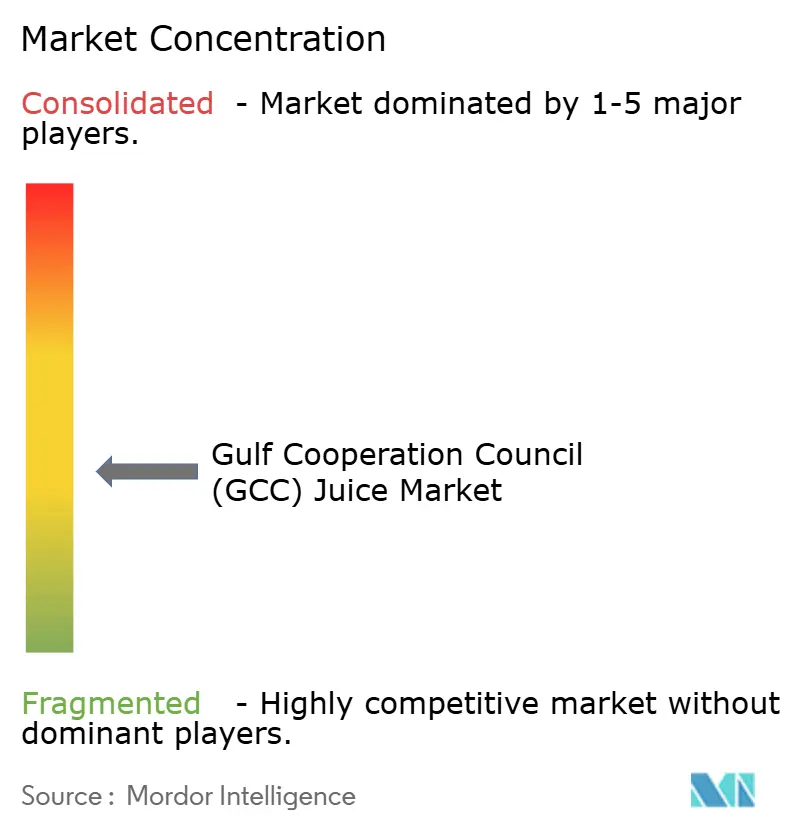
The Gulf Cooperation Council (GCC) juice market is moderately fragmented but is gradually becoming more fragmented. Major players include Almarai, Al Rabie, and other niche brands are gaining traction in premium chilled sections and e-commerce platforms, reducing the market share of the top players. This shift indicates a growing preference for diverse and specialized juice offerings among consumers, leading to increased competition in the market.
Strategic collaborations are becoming a key trend in the competitive landscape. For instance, iPRO’s partnership with Al Rabie in 2025 combines local production capabilities with expertise in functional beverages. Similarly, Almarai’s USD 4.8 billion investment plan over five years focuses on advanced processing technologies and innovative packaging to maintain its position in premium segments. On the other hand, smaller cold-pressed juice brands are leveraging unique selling points like limited-batch production, authenticity through QR codes, and direct-to-consumer sales channels. These strategies help them compete effectively despite their smaller scale.
Technology and sustainability are emerging as critical factors in the market. Gulf Union, for example, uses QR codes on packaging to promote recycling and offer personalized deals, ensuring customer engagement even with lower sales volumes. Larger companies are adopting AI-driven tools for demand forecasting to minimize waste from short-shelf-life products. As regulations around digital traceability and eco-friendly practices become stricter, both large corporations and smaller brands are focusing on proving their sustainability credentials.
GCC Juice Industry Leaders
-
Almarai Company
-
The Coco Cola Company
-
Al Rabie Saudi Foods Co
-
Del Monte Pacific Limited
-
PepsiCo Inc.
- *Disclaimer: Major Players sorted in no particular order
GCC Juice Market Companies Covered in this Report
- Almarai Company
- Al Rabie Saudi Foods Co.
- Del Monte Pacific Limited
- The Coca-Cola Company
- The Berry Company, LLC
- National Agricultural Development Co.
- National Food Products Co.
- PepsiCo Inc.
- Barakat Group
- Masafi Co. LLC
- Al Ain National for Juice
- Aujan Coca-Cola Beverages Company
- Co-Ro
- Unikai Foods PJSC
- Alokozay Group of Companies (AGC)
- Alesayi Beverages Co. Ltd.
- Juhayna Food Industries
- Union Beverages Factory
- Arrow Juice Factory (AJF)
- Al Rawabi Dairy Company
Market Opportunities and Future Outlook
Localized manufacturing and packaging in dedicated industrial hubs stands out as a practical whitespace for suppliers that currently rely on imported finished packs or concentrates with long lead times. In the UAE, facility announcements reinforce this direction: Solico Group opened an AED 130 million production facility in Jebel Ali Free Zone (Jafza) in January 2026, Barakat Group started work in February 2026 on an AED 150 million food and juice processing facility in KEZAD with a design capacity of 90 million units annually, and Abu Dhabi Refreshment Company signed a long-term land lease in May 2026 to develop a 32,500 square meter beverage production and distribution facility in KEZAD (around AED 300 million investment). For juice manufacturers, this infrastructure supports more in-market blending, shorter replenishment cycles for modern trade and foodservice, and tighter quality control for chilled and functional propositions.
On the demand side, opportunities cluster where regulation and channel dynamics intersect. Reduced-sugar and clearly labeled no-added-sugar products can fit into excise-tax-sensitive price bands, and functional or fortified ranges align with urban retail formats and on-trade menus. Foodservice-specific bulk packs also match the tourism and HoReCa buildout. Saudi Arabia's National Industrial Strategy and programs such as SIDF support pathways for capacity additions and localization initiatives that can be paired with aseptic processing upgrades, recycling-aligned packaging choices, and compliant labeling systems for multi-country GCC distribution.
Recent Industry Developments in GCC Juice Market
- July 2026: Almarai reported its Q2 2026 update, highlighting that the juice category regained market leadership with a 48% share. The disclosure reinforces the competitive importance of scale, brand strength, and portfolio execution in the region's dominant off-trade channels.
- March 2025: Tetra Pak began a three-year project to upgrade and digitize Al Rabie Saudi Foods' production facilities in Saudi Arabia, following an agreement signed in November 2024. The program supports higher efficiency and traceability, raising the operational bar for carton-packed juice and nectar suppliers.
- June 2024: Boost Juice expanded its UAE operations with three new locations across Abu Dhabi and Dubai after establishing stores in Sharjah through its partnership with Arada (master franchise agreement holder). The rollout adds points of consumption for smoothies and juice-based offerings, supporting the on-trade channel's premium and fresh-positioned segments.
GCC Juice Market Report Scope and Research Methodology
Market Definition and Coverage
For this report, the GCC juice market means the value of packaged juice and juice-based drinks sold for consumption across GCC countries, counted at the point of sale into retail and foodservice channels.
Scope exclusions: This scope does not include carbonated soft drinks, dairy-based beverages, or hot drinks, even if fruit flavored.
Segments Covered in This Report
- By Category
- Fruit Juice
- Vegetable Juice
- Fruit and Vegetable Blends
- By Type
- 100% Juice
- Juice Drinks (25–99% juice content)
- Nectar
- By Packaging Type
- Tetra Pak Cartons
- PET Bottles
- Glass Bottles
- Cans
- Others
- By Distribution Channel
- On-Trade
- Off-Trade
- Supermarkets/Hypermarkets
- Convenience/Grocery Stores
- Online Retailers
- Other Off-Trade Channel
- By Geography
- Saudi Arabia
- United Arab Emirates
- Qatar
- Kuwait
- Oman
Data Sources, Market Sizing, and Validation
Desk Research
Desk work starts with building a clean demand picture for juice in the GCC by using public, repeatable data points. We referenced sources such as UN Comtrade trade statistics, FAOSTAT supply and crop outputs, national statistics portals in GCC countries, World Bank macro indicators, and Codex Alimentarius standards for product definitions.
After that, we used company annual reports, investor presentations, retailer announcements, and trusted press coverage to understand brand moves, pack formats, and pricing direction. Where needed, paid subscriptions that cover company financials and news, patent databases, and shipment-level import export records were used to cross-check claims and fill gaps in timing. The sources listed here are illustrative only, and many other public and paid references were used to validate and clarify the analysis.
Primary Interviews and Surveys
We use expert interviews and surveys with producers, distributors, retailers, and foodservice buyers across the five GCC countries covered by the study. Their feedback helps close country-level data gaps, test price and channel assumptions, and clarify how sugar-tax pass-through, pack formats, and modern retail affect the final GCC analysis.
Distribution of primary research fieldwork respondents
| Company type | Respondent position |
|---|---|
| Top tier: 24% | CXOs: 15% |
| Mid tier: 56% | Functional/Unit leaders: 31% |
| Smaller Players: 20% | Managers: 54% |
Market-Sizing & Forecasting
Sizing starts from a top-down build where beverage demand pools are reconstructed using GCC consumption signals, trade inflows for juice and concentrates, and country-level spend trends, which are then converted into value using observed retail price bands. To keep the totals realistic, we also run selective bottom-up checks using sampled price per liter by pack type, channel checks on promotion intensity, and a light supplier and distributor roll-up for key categories.
Key inputs used in the model include per capita beverage intake direction, share shift between 100% juice and juice drinks, packaging mix (cartons versus PET), the on-trade versus off-trade split, and excise tax related reformulation that changes average sugar content and pricing. Forecasts are primarily built using scenario analysis, where volume growth and price progression are stressed under base, conservative, and faster-trade-up cases, and then aligned to what interviewees expect on shopper budgets and retail shelf space. When gaps show up in smaller countries or niche types, proxy ratios are applied from similar GCC markets and later corrected through interviews and import patterns.
Data Validation & Update Cycle
Validation is handled through a set of cross-checks so the final number is not driven by one data stream. We compare outputs against independent signals like reported beverage category growth, import and re-export movements, and whether implied liters per person look reasonable for the GCC.
If a country shows an unusual jump in value or price, the assumptions are re-checked and respondents are re-contacted when needed before sign-off. Each report is refreshed annually, and interim updates are made when there are material events such as major tax changes, sharp currency moves, or large pricing resets. Before delivery, an analyst completes a fresh pass so clients receive the latest updated view.
Mordor Intelligence's Gcc Juice Market Size Compared Against Other Published Estimates
Published numbers for the GCC juice market often do not match because the product boundary is drawn differently, and the pricing method is not always stated clearly. Differences also come from whether on-trade is counted, how juice drinks and nectar are treated, and what year currency conversion is anchored to.
The benchmark table shows a wide spread mainly because some estimates fold in a broader soft drinks basket or count only fruit juice, which changes the liters and the average price in one step. The table also points to mix assumptions as a big driver and in Mordor Intelligence's model, juice drinks and nectar are counted within the juice family only when they meet the stated juice-content definition, and pricing is built from pack and channel level checks that reflect excise driven reformulation.
Benchmark comparison
| Source | Market Size | Gaps in Research Methodology |
|---|---|---|
| Mordor Intelligence | USD 6.13 B (2025) | |
| Industry Bulletin A | USD 5.10 B (2025) | Uses a narrower scope closer to fruit-only packaged juice and excludes part of juice drinks and nectar, which lowers both volume coverage and the implied blended price. |
| Trade Journal B | USD 3.04 B (2024) | Base year timing differs and currency conversions appear to be taken from an earlier period, and the scope reads as retail-only which can undercount foodservice and wholesale flows. |
Once scope and timing are lined up, most of the gap becomes explainable through what is counted as juice, where it is sold, and how the average selling price is constructed. Our approach keeps the total traceable to demand signals, pack mix, and channel pricing, so the estimate can be repeated and updated with new inputs.
Key Questions Answered in the Report
What is the current Gulf Cooperation Council (GCC) juice market size?
The Gulf Cooperation Council (GCC) juice market size is USD 6.5 billion in 2026.
How fast is the Gulf Cooperation Council (GCC) juice market expected to grow?
The market is projected to advance at a 5.98% CAGR, taking the market to USD 8.69 billion by 2031.
Which country holds the largest Gulf Cooperation Council (GCC) juice market share today?
Saudi Arabia leads with 49.15% share of regional sales.
Which segment is growing the fastest within the Gulf Cooperation Council (GCC) juice market?
Nectar show the highest momentum with an 7.52% CAGR forecast for 2026-2031.