
Market Overview
| Study Period | 2019 - 2031 |
|---|---|
| Forecast Data Period | 2026 - 2031 |
| Base Year Market Size (2025) | USD 6.91 Billion |
| Market Size (2026) | USD 7.30 Billion |
| Market Size (2031) | USD 9.62 Billion |
| Growth Rate (2026 - 2031) | 5.67 % |
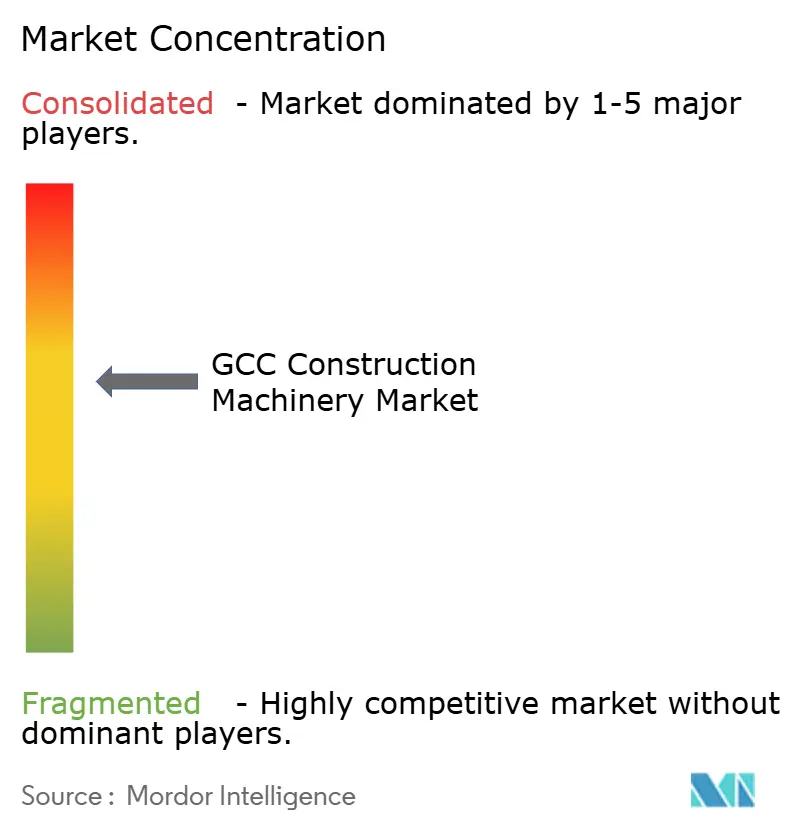
| Market Concentration | Medium |
Major Players *Disclaimer: Major Players sorted in no particular order Image © Mordor Intelligence. Reuse requires attribution under CC BY 4.0. | |
GCC Construction Machinery Market Analysis by Mordor Intelligence
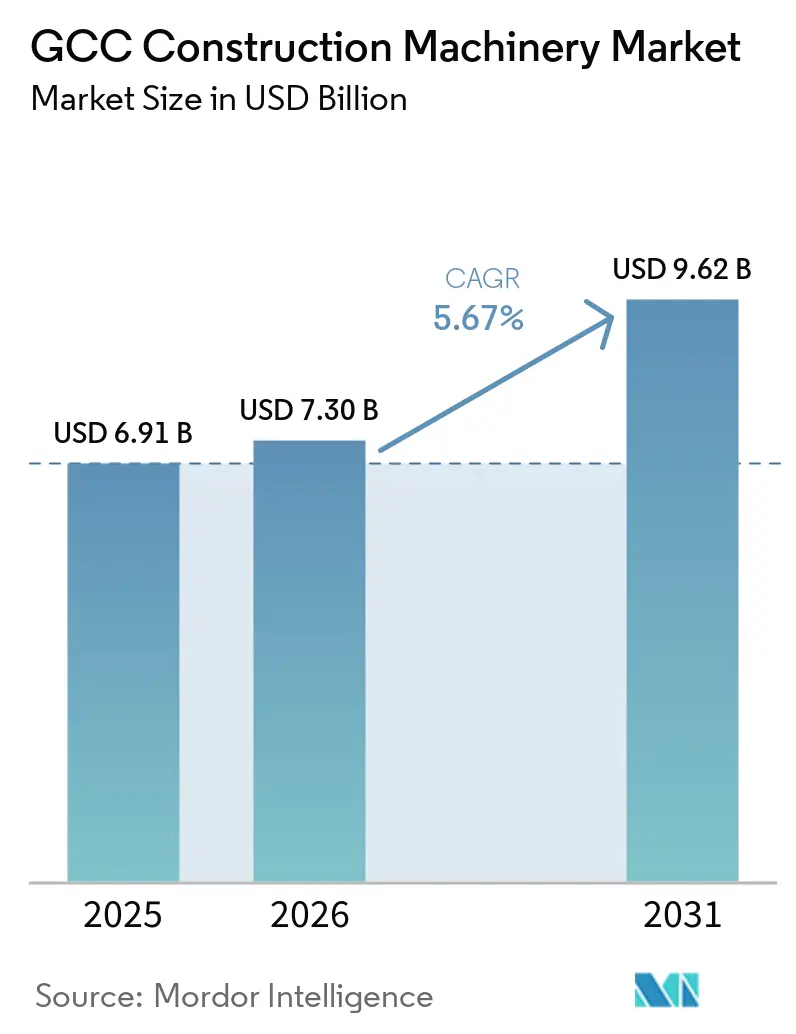
The GCC construction machinery market size was valued at USD 6.91 billion in 2025 and is expected to increase to USD 7.30 billion in 2026 and reach USD 9.62 billion by 2031, growing at a CAGR of 5.67% over 2026-2031. Strong public spending on transformational projects, widening private-sector participation in industrial complexes, and a gradual shift toward smart-city requirements are sustaining the demand cycle, yet equipment purchases are increasingly balanced by long-term rental contracts that preserve contractor liquidity. Saudi Arabia remains the anchor of the GCC construction machinery market, but Oman, the United Arab Emirates, and Qatar are closing the gap as each channels capital into ports, rail, and energy transition assets. Electrification pilots in NEOM, Masdar City, and Abu Dhabi signal an emerging appetite for zero-emission fleets, although high ambient temperatures and limited charging infrastructure temper large-scale roll-outs. Heightened localization incentives across Saudi Arabia and the United Arab Emirates are also redrawing supply chains, encouraging global OEMs to blend assembly activity with regional content targets that can unlock preferential access to government tenders.
Key Report Takeaways
- By machinery type, excavators led with 55.02% of GCC construction machinery market share in 2025, while motor graders are forecast to expand at a 7.24% CAGR to 2031.
- By propulsion type, internal combustion platforms accounted for 96.25% of the GCC construction machinery market size in 2025, yet electric and hybrid variants are projected to climb at a 25.13% CAGR through 2031.
- By application type, earth-moving equipment captured 50.24% of the GCC construction machinery market size in 2025 and is advancing at a 6.12% CAGR through 2031.
- By end-user, infrastructure projects commanded 53.16% of the GCC construction machinery market size in 2025, whereas industrial complexes are the fastest-growing segment at 8.45% CAGR to 2031.
- By country, Saudi Arabia absorbed 46.11% of the GCC construction machinery market in 2025; Oman is the fastest-rising geography with a 7.65% CAGR forecast over 2026-2031.
Note: Market size and forecast figures in this report are generated using Mordor Intelligence’s proprietary estimation framework, updated with the latest available data and insights as of 2026.
Market Trends and Insights
Drivers Impact Analysis of GCC Construction Machinery Market*
| Driver | (~) % Impact on CAGR Forecast | Geographic Relevance | Impact Timeline |
|---|---|---|---|
| Vision-2030 Sustains Equipment Demand | +1.5% | Saudi Arabia, spillover to United Arab Emirates and Qatar | Long term (≥ 4 years) |
| Urban Growth Drives Infrastructure | +1.0% | Region-wide, highest in Riyadh, Dubai, Doha | Medium term (2-4 years) |
| Smart-City Electrification Mandates | +0.8% | NEOM, Masdar City | Medium term (2-4 years) |
| Localization Incentives Spur Investment | +0.7% | Saudi Arabia, United Arab Emirates | Medium term (2-4 years) |
| BIM Boosts Connected Machinery | +0.6% | Saudi Arabia, United Arab Emirates, early gains in Kuwait | Short term (≤ 2 years) |
| Green Hydrogen Heavy-Lift Needs | +0.5% | Saudi Arabia, Oman | Long term (≥ 4 years) |
| Source: Mordor Intelligence | |||


Vision-2030 Megaproject Pipeline Sustains Equipment Demand
Saudi Arabia's ambitious projects, including the NEOM development, The Line's 170 km linear city, and the Red Sea Project's islands, are ramping up labor demands. Starting in 2025, projections indicated significant growth over the following years. While The Line's modular construction curtails on-site concrete pours, it amplifies the need for telescopic handlers for vertical placements. Qiddiya's entertainment venues are spurring a surge in demand for seismic-compliant piling rigs. Environmental regulations, especially near coral reefs, are nudging contractors towards low-emission equipment. Meanwhile, heritage redevelopment at Diriyah Gate is bolstering the demand for graders in the adjacent road networks. However, a decline in project awards for 2025 hints at fiscal tightening. In response, OEMs are pivoting, bolstering aftermarket services and short-term rental programs to ensure steady revenue streams [1]“The Line Project Milestones,” NEOM, neom.com.
Rapid Urban Population Growth Intensifies Infrastructure Spend
Urban areas in the GCC are witnessing steady annual growth, with Riyadh, Dubai, and Doha set to welcome a significant number of additional residents between 2024 and 2026. This surge intensifies the strain on housing, transportation, and utility services. In response, Dubai has ramped up its construction activities, issuing more permits in 2024 compared to the previous year. Similarly, Abu Dhabi's construction permits have increased in the first half of 2024, driving a surge in heavy earth-moving and tunneling activities for metro extensions. In Saudi Arabia, an expansion of industrial zones is underway, part of a broader ambition to triple the manufacturing GDP by 2030. This expansion is fueling heightened equipment demand in Jubail, Yanbu, and Jazan. Concurrently, as Qatar gears up for the 2030 Asian Games, there's a renewed demand for machinery, particularly for stadium upgrades and metro extensions. Despite facing tighter fiscal balances due to declining oil prices, project sponsors are leaning towards equipment rentals as a strategy to conserve capital. This shift not only sustains equipment utilization but also curtails outright purchases.
Electrification Mandates in Flagship Smart-City Projects (e.g., NEOM)
NEOM requires zero-emission machinery on-site by 2026, accelerating trials of battery-electric excavators, loaders, and compactors, such as Volvo CE’s 282 kWh L120H Electric wheel loader that delivered an 8-hour urban shift during a 2024 Abu Dhabi pilot. Battery life diminishes significantly in extremely high ambient temperatures. High charging costs hinder rural deployment. While Masdar City and King Abdullah Economic City test solar-powered charging hubs, the total cost of ownership remains considerably higher than that of diesel counterparts. This disparity delays achieving parity until battery prices decrease further. As a result, while electrification garners considerable attention, its impact on absolute volumes is expected to be modest until 2030.
Localization Incentives Spur Regional Assembly Investments
Saudi Arabia's iktva program, aiming for significant local content by 2030, alongside the Saudi Industrial Development Fund's financing covering a substantial portion of project costs, is luring industry giants like Caterpillar, Volvo CE, XCMG, and Sany. These companies are entering joint ventures to assemble excavators and cranes in Jubail and Yanbu. Localized kits shorten import lead times from 90 to 30 days, and shave landed costs by 20-30%, bolstering competitiveness in state tenders. The UAE’s mirrored In-Country Value framework layers fast-track licensing and labor-quota incentives on top of tax holidays, but higher wage bills complicate business cases. Fragmented local-content definitions across the six states require OEMs to craft country-specific partnerships, tempering scale economies yet locking in long-term demand windows.
Restraints Impact Analysis of GCC Construction Machinery Market*
| Restraint | (~) % Impact on CAGR Forecast | Geographic Relevance | Impact Timeline |
|---|---|---|---|
| Rental Boom Suppresses New Sales | -1.0% | United Arab Emirates and Saudi Arabia, spreading to Qatar | Medium term (2-4 years) |
| Oil Volatility Curbs Public Capex | -0.7% | Region-wide, acute in Kuwait and Oman | Short term (≤ 2 years) |
| Operator Shortages Delay Fleet Expansion | -0.5% | Region-wide, highest in United Arab Emirates and Qatar | Short term (≤ 2 years) |
| Water Regulations Raise Operating Costs | -0.2% | Saudi Arabia, United Arab Emirates, Kuwait | Long term (≥ 4 years) |
| Source: Mordor Intelligence | |||
Equipment-Rental Boom Suppresses New-Unit Sales
By 2026, regional rental turnover is expected to grow steadily, driven by contractors shifting toward variable costs over fixed ones. Market frontrunners, like Al Marwan Machinery, have significantly increased their reliance on rentals over the past five years. They're also securing substantial bulk OEM discounts. Meanwhile, digital exchanges are optimizing idle inventories and improving utilization rates. This improvement enables aggressive rate under-cutting, putting pressure on dealer margins. In response, OEMs are introducing captive rental divisions and certified pre-owned programs. However, their internal forecasts indicate a consistent annual decline in new-unit shipments throughout the forecast period.
Oil-Price Volatility Curbs Public Sector Capex Cycles
In 2026, forecast prices are expected to remain below Saudi Arabia's fiscal breakeven point. This shortfall is prompting ministries to elongate megaproject timelines and extend contractor payment terms. During this period, project awards in the GCC experienced a significant decline, with construction contracts particularly affected. This downturn highlights the GCC construction machinery market's vulnerability to fluctuations in sovereign revenues. Although sovereign wealth buffers remain substantial, there's a noticeable shift in their allocation. These funds are increasingly funneled into selective high-impact sectors, such as tourism and green energy. As a result, traditional sectors like road and housing, which typically see heavy machinery use, are facing delays in awards. Concurrently, rising mortgage rates are dampening speculative private developments. This shift has led to an uptick in rental demand, but a corresponding decline in the volume of new units being introduced to the market.
*Our forecasts treat driver/restraint impacts as directional, not additive. The impact forecasts reflect baseline growth, mix effects, and variable interactions.
GCC Construction Machinery Market Segment Analysis
By Machinery Type:
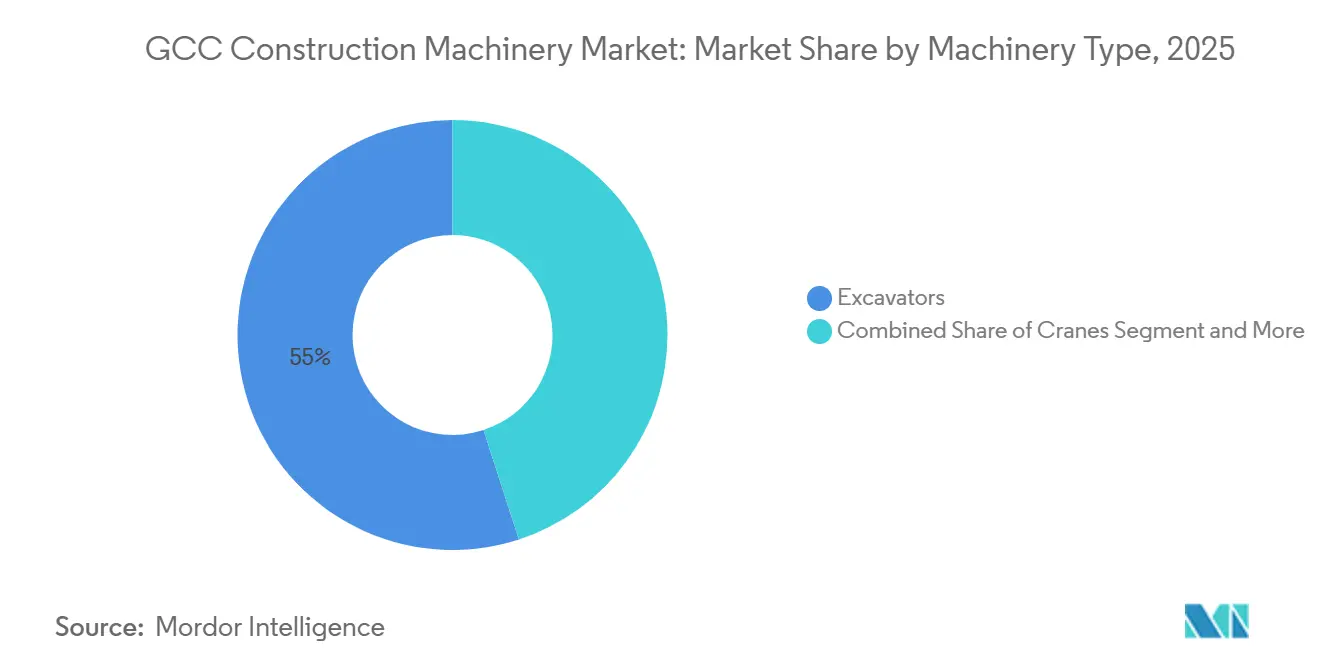
Excavators Anchor Demand, Motor Graders AccelerateExcavators held 55.02% of the GCC construction machinery market share in 2025 and will stay dominant through 2031 as giga-projects emphasize large-scale earth-moving. Loaders and backhoes follow, especially in urban infill zones, yet telescopic handlers are eroding their niche for high-rise assembly. Motor graders’ 7.24% CAGR outpaces every other category, guided by rail and highway corridors that adopt GPS-controlled slope management to shave rework by one-fifth. Specialty amphibious excavators, winner of a 2025 regional innovation prize, extend workable terrain into coastal and dredging sites, a rising theme as Saudi and Omani ports expand. Crane volumes remain stable at roughly one-eighth of demand but skew heavily toward tower and mobile units rated above 100 tonnes for renewable component lifts[2]“Amphibious Excavator Deployment in NEOM Coastal Zone,” Al Marwan Machinery, almarwan.com.
A widening technology gap defines competitive positioning. Onboard telematics provide bucket-level output metrics that channel directly into BIM dashboards, and hybrid drivetrains lower fuel burn by 20-30% on stop-start urban cycles. Meanwhile, 3D-printed concrete pilots hint at a distant threat to traditional mixers and pumps, though code harmonization remains several years away. Rental fleets rotate core earth-moving models every three to five years, feeding a lucrative export pipeline into Africa and South Asia, where well-maintained GCC units command premium resale values. Continuous localization of undercarriage fabrication and cab assembly inside Saudi Arabia promises shorter lead times and tighter integration between after-sales and parts distribution networks.


By Propulsion Type:
ICE Dominance Persists, Electric Surge BeginsDiesel still powers 96.25% of the GCC construction machinery market in 2025, thanks to high energy density, ubiquitous fuel logistics, and comparatively low capex. Yet electric and hybrid options are scaling from a small base at a 25.13% CAGR—the fastest within any segmentation—as flagship smart cities impose zero-emission mandates. Early adopters focus on wheel loaders and mini excavators where 8-hour cycles align with daytime grid availability, while hybrids that capture brake energy deliver a swift 20-30% fuel reduction without range anxiety.
Cost, battery-life degradation under extreme heat, and sparse charging topologies constrain widescale replacement until prices approach parity around 2030. OEMs and local utilities are piloting solar-plus-storage hubs that double as fleet depots, smoothing load on overstretched grids. Hydrogen remains experimental pending scale economics that can compress production significantly. In the interim, diesel-electric hybrids emerge as a bridge technology, helping end users meet tightening emissions codes without overhauling site logistics.
By Application Type:
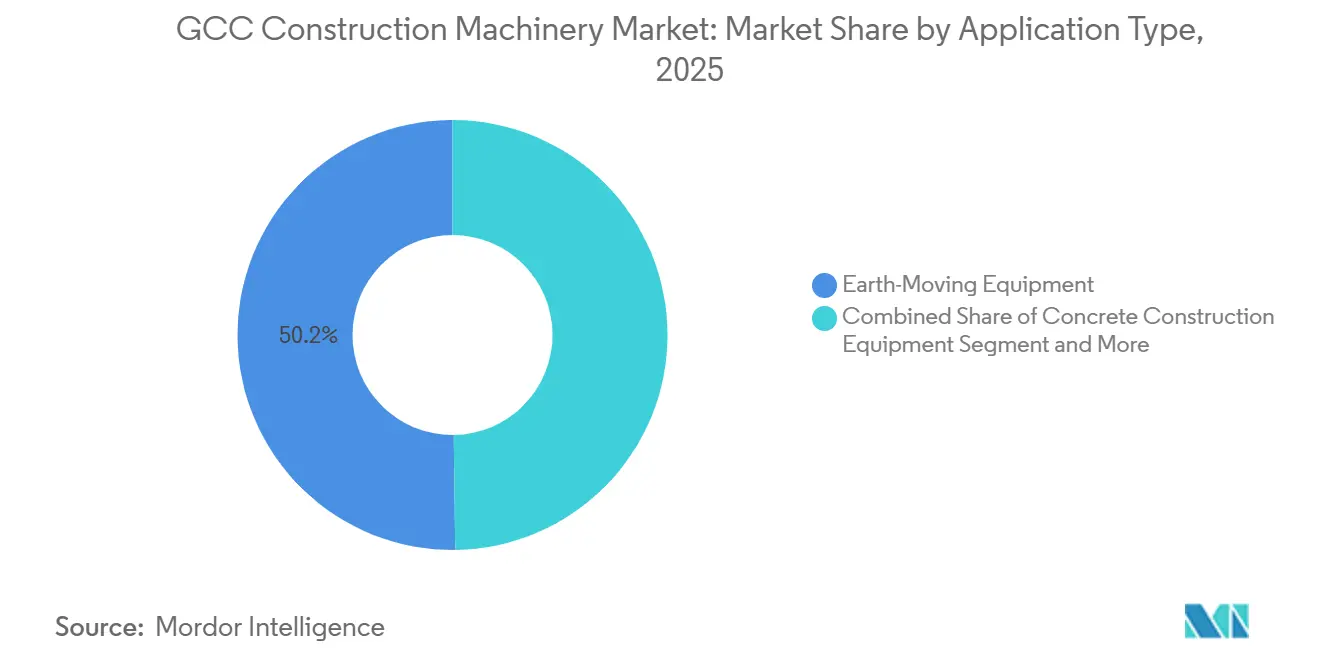
Earth-Moving Leads, Concrete Faces DisruptionEarth-moving accounted for 50.24% of the GCC construction machinery market size in 2025 and will expand at a 6.12% CAGR through 2031, lifted by coastal reclamation, greenfield industrial zones, and solar farm grading. High-horsepower dozers and 40 m³ bucket excavators dominate this space, while scrapers resurface for long-haul desert corridors. Road-building contributes a notable share of volumes, supported by motor graders and asphalt pavers equipped with polymer-modified mixes that extend pavement life to 15 years. Material-handling gear in ports and logistics parks makes up roughly one-fifth of equipment demand and is trending toward autonomous reach stackers that raise container moves per hour by 20%.
Concrete machinery captures a significant share of demand yet confronts the rise of 3D-printed structural elements that claim notable time savings on pilot jobs. Regulatory frameworks, however, lag technology, and high-rise pours still require conventional pumps capable of 150 m vertical delivery. Early adoption of 3D sand printers for complex formwork reduces waste but remains ancillary. Expect earth-moving to retain primacy as governments prioritize land development over vertical density to absorb notable annual urban population growth and to prepare extensive utility corridors for hydrogen and renewables.
By End-User:
Infrastructure Dominates, Industrial SurgesInfrastructure clients represented 53.16% of the GCC construction machinery market size in 2025, driven by rail, metro, and highway agendas, yet industrial zones—petrochemicals, green hydrogen, and data centers—posted the fastest expansion at 8.45% CAGR. Green hydrogen megaprojects alone demand crawler cranes rated above 1,000 tonnes, while petrochemical complexes in Jubail and Yanbu order deep-foundation rigs and high-capacity concrete pumps. Commercial real estate remains robust in Dubai and Riyadh, lifting telescopic handler volumes, whereas affordable housing schemes sustain baseline excavator needs despite higher mortgage costs.
Industrial momentum benefits from diversification mandates that shield capital budgets from oil-price swings, anchoring a steadier procurement pipeline for specialized heavy equipment. Infrastructure stays sizeable but gradually cedes percentage share as completed highway loops shift focus toward maintenance, a profile well suited to the rental fleets now embedded across the region.
Geography Analysis
Saudi Arabia Construction Machinery Market
In 2025, Saudi Arabia seized a commanding 46.11% share of the GCC construction machinery market, buoyed by a notable pipeline that includes ambitious projects like NEOM, Qiddiya, Diriyah Gate, and New Murabba. While fiscal deficits, influenced by oil price swings, have pushed back some project completion dates, Saudi Arabia's localization rules have successfully attracted global OEMs. These firms are now setting up domestic assembly lines, leading to quicker project turnarounds and a stronger local value chain.
United Arab Emirates and Qatar Construction Machinery Market
The United Arab Emirates, accounting for a notable share of the region's demand, enjoys a budget surplus in 2025. Coupled with robust private capital, this financial cushion supports key projects like Dubai’s Metro Blue Line, segments of the Etihad Rail freight, and a burgeoning cluster of data centers. Meanwhile, Qatar is ramping up equipment demand in preparation for its infrastructure needs for the 2030 Asian Games, and the expansion of Hamad Port is driving a need for additional lifts and reach stackers.
GCC Construction Machinery Market
Oman is on a growth trajectory, boasting the highest rate at a 7.65% CAGR projected to 2031. This surge is anchored by significant investments, including the Duqm Special Economic Zone, a sprawling 2,135 km national railway plan, and two ambitious green hydrogen hubs with a combined capacity exceeding 3.2 GW. While Kuwait and Bahrain are smaller players in the market, Kuwait’s Al Zour Refinery and Bahrain’s King Hamad Causeway are ensuring a steady demand for excavators and cranes, even amidst tighter fiscal constraints. A grand vision of a pan-regional GCC Railway, stretching 2,177 km, promises to weave these national markets into a cohesive unit. However, challenges like financing gaps and delays in securing right-of-ways mean that much of the machinery procurement is likely to be pushed beyond 2027.
Regulatory Landscape
Across the GCC, construction machinery compliance is shaped by a mix of harmonized Gulf standards and country-specific market-access systems. A key anchor is the GCC Standardization Organization publication of GSO ISO 20474-1:2023, which sets safety requirements for earth-moving machinery and provides a common baseline for OEM design and documentation across member states.
Saudi Arabia applies SASO technical regulations for machinery safety and routes many imported products through the SABER conformity pathway, tightening documentation and conformity-certificate workflows for suppliers and importers. Saudi Arabia also operates a Heavy Equipment Regulatory Center within SASO (established April 2021) focused on inspection, licensing, and safety oversight. In the UAE, federal conformity certificates managed by MoIAT and local emirate-level operating and permitting requirements (for example, Dubai RTA and Abu Dhabi DMT processes) combine to form a multi-layer compliance model for fleets and dealers operating across borders.
Value / Supply-Chain Analysis
The GCC construction machinery value chain begins with global OEM engineering and component sourcing, then moves into regional importation and, in selected cases, localized final assembly to align with local-content programs (for example, Saudi IKTVA and UAE ICV) referenced in the report context. Execution typically runs through regional dealers and service specialists (such as Kanoo Machinery) and large rental operators, with demand shaped by infrastructure and industrial project owners and EPC contractors across Saudi Arabia, the UAE, and Oman.
Logistics and after-sales capacity matter more in the region due to long transport distances to megaproject sites and high utilization in rental fleets. Port and corridor infrastructure (for example, Jebel Ali in the UAE and King Abdulaziz Port in Saudi Arabia) serves as entry nodes for heavy equipment, while project-driven service hubs, parts depots, and field maintenance networks support lifecycle revenues as machines rack up high engine hours. As connected machinery adoption rises alongside telematics tied to BIM workflows, digital platforms and dealer-led monitoring services gain weight next to traditional parts, consumables, and rebuild activities.
Competitive Landscape
In the GCC construction machinery market, Caterpillar, Komatsu, and Volvo Construction Equipment collectively hold a notable market share. Their dominance is underpinned by extensive dealer networks, in-house financing options, and a well-established parts ecosystem, all of which contribute to enhancing long-term customer loyalty and lifetime value. These companies have successfully created a strong foothold by addressing key customer needs and ensuring reliable after-sales support. On the other hand, Chinese competitors such as XCMG, Sany, and Zoomlion are leveraging localized assembly operations that comply with Saudi Arabia's iktva thresholds [3]“iktva Program Supplier Guide,” Saudi Aramco, aramco.com. This strategic approach not only provides them with a competitive pricing advantage but also positions them favorably to secure cost-sensitive government tenders. Liebherr has differentiated itself by focusing on a niche segment, introducing 150-ton harbor cranes that have become integral to NEOM’s renewable logistics infrastructure.
Technological advancements are driving significant changes in the competitive landscape, creating new opportunities and challenges for market players. Caterpillar’s Command for Hauling and Komatsu’s Intelligent Machine Control systems have successfully reduced operator requirements by 40%, addressing a critical skills shortage that contractors view as a major challenge to project execution. These innovations not only improve operational efficiency but also reduce dependency on skilled labor, which is increasingly scarce in the region. Additionally, WakeCap’s IoT suite integrates utilization analytics with cloud-based BIM feeds, enhancing predictive maintenance capabilities and steering demand away from traditional machinery toward blended hardware-software solutions. This shift reflects a broader trend in the industry toward digitalization and smarter equipment management.
Furthermore, the importance of cyber-resilience has grown significantly following a ransomware attack in 2024 that exposed vulnerabilities in connected fleets. As a result, ISO 27001 accreditation has become a critical factor in tender pre-qualifications, subtly raising the entry barriers for late entrants and emphasizing the need for robust cybersecurity measures in modern machinery. These developments highlight the evolving priorities of the GCC construction machinery market and the increasing role of technology in shaping its future.
GCC Construction Machinery Industry Leaders
Caterpillar Inc.
Komatsu Ltd.
Liebherr International AG
Xuzhou Construction Machinery Group Co., Ltd.
AB Volvo (Volvo Construction Equipment)
- *Disclaimer: Major Players sorted in no particular order
GCC Construction Machinery Market Companies Covered in this Report
- Caterpillar Inc.
- Komatsu Ltd.
- AB Volvo (Volvo Construction Equipment)
- Xuzhou Construction Machinery Group Co., Ltd.
- Liebherr International AG
- Hitachi Construction Machinery Co. Ltd.
- Hyundai Construction Equipment Co.,Ltd.
- J.C. Bamford Excavators Ltd (JCB)
- Sany Heavy Industry Co. Ltd
- Deere & Company
- CNH Industrial N.V.(Case Construction)
- Kobelco Construction Machinery Co. Ltd
- Sumitomo Construction Machinery
- Doosan Bobcat (Develon)
- Terex Corporation
- Manitou Group
- Zoomlion Heavy Industry Science and Technology Co., Ltd
- Yanmar Holdings Co. Ltd
- Wacker Neuson SE

Market Opportunities and Future Outlook
Opportunities are clustering around technology-enabled roadbuilding, connected fleets, and lifecycle services that fit the region's megaproject execution model. A tangible proof point is the June 2026 deployment of seven intelligent road construction machines by XCMG on Oman's Sultan Said bin Taimur Road dualisation project, which is positioned as an AI-enabled autonomous asphalt paving application. It points to addressable demand for machine control, autonomous compaction/paving packages, operator enablement, and site digitization that OEMs and dealers can productize beyond one-off equipment sales.
Local-content and industrialization programs also provide a route for OEMs and distributors to broaden regional footprints through assembly, parts localization, and remanufacturing capability. Saudi Arabia's National Industrial Development and Logistics Program (NIDLP) target of SAR 1.4 trillion in private-sector investment by 2030, together with the report's stated giga-project pipeline (for example, NEOM), supports demand for localized service hubs, field workshops near remote sites, and structured maintenance contracts aimed at reducing downtime in extreme heat and dust conditions. Electrification pilots in controlled zones (for example, NEOM zero-emission construction rules and Dubai's RTA battery-swap initiative cited in the report context) open a near-term equipment and infrastructure bundle opportunity spanning electric compact machines, energy storage, and jobsite charging solutions, with financing and uptime guarantees as key packaging levers.
Recent Industry Developments in GCC Construction Machinery Market
- June 2026: XCMG deployed seven intelligent road construction machines on Oman's Sultan Said bin Taimur Road Dualisation Project, introducing an AI-enabled autonomous asphalt paving application on an active highway program. The deployment raises competitive benchmarks for road construction equipment in the GCC from unit performance to digital workflows and machine-control capability delivered with local contracting partners.
- March 2026: Volvo Construction Equipment highlighted Middle East jobsite results for the new generation of excavators, including a 15% fuel-efficiency improvement and the integration of Volvo Smart View monitoring, supported through the regional dealer network. The update focused on performance and connected monitoring for contractors operating in the region.
- May 2025: Dubai RTA battery-swap initiative expanded to additional depots, supporting electrification pilots for construction equipment and enabling new uptime and charging solutions. The expansion builds out the early refueling network referenced in the report context.


GCC Construction Machinery Market Report Scope and Research Methodology
Market Definition and Coverage
This market covers demand and supply of construction machinery sold for use in building, infrastructure, and related earthworks across GCC countries, expressed in value terms and tied to equipment delivered into active projects and fleet replacements.
Scope exclusions: we exclude equipment rental revenue, aftersales service contracts, operator staffing, and general construction materials from this market sizing.
Segments Covered in This Report
- By Machinery Type
- Cranes
- Excavators
- Loaders and Backhoes
- Motor Graders
- Telescopic Handlers
- Other Machinery
- By Propulsion Type
- Internal Combustion Engine (ICE)
- Electric / Hybrid
- By Application Type
- Concrete Construction Equipment
- Road Construction Equipment
- Earth-Moving Equipment
- Material Handling Equipment
- By End-User
- Infrastructure
- Commercial
- Residential
- Industrial
- By Country
- Saudi Arabia
- United Arab Emirates
- Kuwait
- Qatar
- Oman
- Bahrain
Data Sources, Market Sizing, and Validation
Desk Research
Desk research was used to build the factual base for the model and to keep country-level demand logic grounded in visible construction activity. We referenced public and official sources such as national statistics offices and central banks in GCC countries, ministries that publish infrastructure and housing updates, and customs and trade portals for import trends on machinery categories. Where project pipeline timing was needed, we also used tender portals and public procurement notices, supported by regulator and municipality releases.
To translate construction activity into equipment demand, we reviewed annual reports, investor presentations, and audited filings of relevant ecosystem participants, then cross-checked project awards and timelines using reputable regional business press. Select paid subscriptions were used only where they help normalize company financials and cross-check trade and shipment signals, without relying on single reports. The desk sources listed here are illustrative, and other public references were reviewed for data collection, validation, and clarification.
Primary Interviews and Surveys
Primary work focused on validating what drives buying cycles in the GCC, including how contractors and project owners time fleet additions and replacements across equipment classes. We spoke with a mix of OEM-facing stakeholders, fleet owners, and large contractor procurement teams across the region, then used follow-up checks to confirm pricing direction, lead times, and the portion of demand that is linked to government-related megaprojects.
Distribution of primary research fieldwork respondents
| Company type | Respondent position |
|---|---|
| Top tier: 30% | CXOs: 14% |
| Mid tier: 55% | Functional/Unit leaders: 31% |
| Smaller Players: 15% | Managers: 55% |
Market-Sizing & Forecasting
Sizing starts with a top-down build where project activity and trade-linked machinery flows are reconstructed for the GCC, then allocated into equipment demand using observed replacement cycles and utilization patterns. This is cross-checked with selective bottom-up approximations, where sampled unit volumes by machinery class are multiplied by typical price bands, and then adjusted based on channel feedback and procurement timing.
Key drivers that materially shape the totals include the pace of infrastructure awards, housing starts and completions, road and rail work intensity, equipment import momentum by country, and fleet replacement behavior for large contractors (including how frequently high-hour machines are rotated). We also track practical pricing drivers such as diesel versus electric adoption for certain use cases, and the shift between earthmoving and material handling when megaproject schedules move from early groundwork into vertical builds.
For forecasting, scenario analysis is used to reflect how sensitive equipment demand is to project execution speed, public capex cycles, and contractor cash flow conditions. Where data gaps appear for smaller countries or niche categories, the model uses proxy relationships from similar GCC markets and then refines them through interview-led checks on penetration and typical fleet composition.
Data Validation & Update Cycle
Validation is done by comparing model outputs against independent signals such as import trends, known project award totals, and directionally consistent equipment pricing movement. When large variances show up, the assumptions are re-checked, outliers are reviewed by a second analyst, and respondents are re-contacted if a swing appears tied to a real market event rather than a modeling artifact.
The report is refreshed annually, and interim updates are made when material events occur, such as sudden changes in public infrastructure spending, major project delays, or noticeable shifts in trade flows. Before delivery, we run a final pass to confirm that the latest macro, project, and pricing indicators have been reflected in the numbers.
Mordor Intelligence's Gcc Construction Machinery Market Size Compared Against Other Published Estimates
Published numbers for the GCC construction machinery market can look far apart because the market boundary is not always identical across studies, even when the titles sound similar. Differences usually come from what is counted as market value, which countries are fully covered, and whether the stated year is a base year, a current year, or a forward estimate.
The benchmark table shows a wide spread that is mainly explained by scope and timing choices. In Mordor Intelligence's model, the value is tied to machinery sales in the GCC (equipment such as excavators, loaders, rollers, bulldozers, cranes, and graders) rather than bundling rental and ongoing service revenue into the same total. In addition, currency timing, whether price progression follows an aggressive versus base case, and how quickly megaproject demand is assumed to convert into deliveries can change the reported market size for the same calendar year.
Benchmark comparison
| Source | Market Size | Gaps in Research Methodology |
|---|---|---|
| Mordor Intelligence | USD 6.91 B (2025) | |
| Global Consultancy A | USD 8.50 B (2024) | Uses an earlier base year and may apply a broader price uplift and faster demand conversion assumptions, which can inflate the stated value when project awards are translated into equipment purchases. |
| Industry Publisher B | USD 4.80 B (2024) | Often blends equipment scope differently (for example, mixing heavy and compact categories and service elements) and can undercount large project-linked deliveries if imports and contractor fleet additions are not fully reflected. |
Taken together, the differences are most traceable to what is included in the market boundary, which year is being referenced, and how pricing and delivery timing are handled. Our approach keeps the total linked to observable construction activity and trade signals, then stress-tests it through interviews so the final number remains explainable and repeatable.


Key Questions Answered in the Report
What is the current value of the GCC construction machinery market and its expected size by 2031?
It is valued at USD 7.30 billion in 2026 and is projected to reach USD 9.62 billion by 2031 at a 5.67% CAGR.
Which equipment category holds the largest share of spending?
Excavators lead with 55.02% of 2025 demand due to intensive earth-moving across megaprojects.
How fast is electric construction equipment growing in the region?
Electric and hybrid models are expanding at a 25.13% CAGR, though they still account for less than 4% of shipments.
Why is Oman the fastest-growing national market?
Duqm Special Economic Zone, large-scale rail, and green hydrogen projects drive a 7.65% CAGR through 2031.
Page last updated on:


 Your data is secure and never sold or shared.


