
GCC Concrete Blocks Market Size and Share
Market Overview
| Study Period | 2021 - 2031 |
|---|---|
| Forecast Data Period | 2026 - 2031 |
| Base Year Market Size (2025) | 2.44 Billion units |
| Market Volume (2026) | 2.58 Billion units |
| Market Volume (2031) | 3.44 Billion units |
| Growth Rate (2026 - 2031) | 5.94 % |
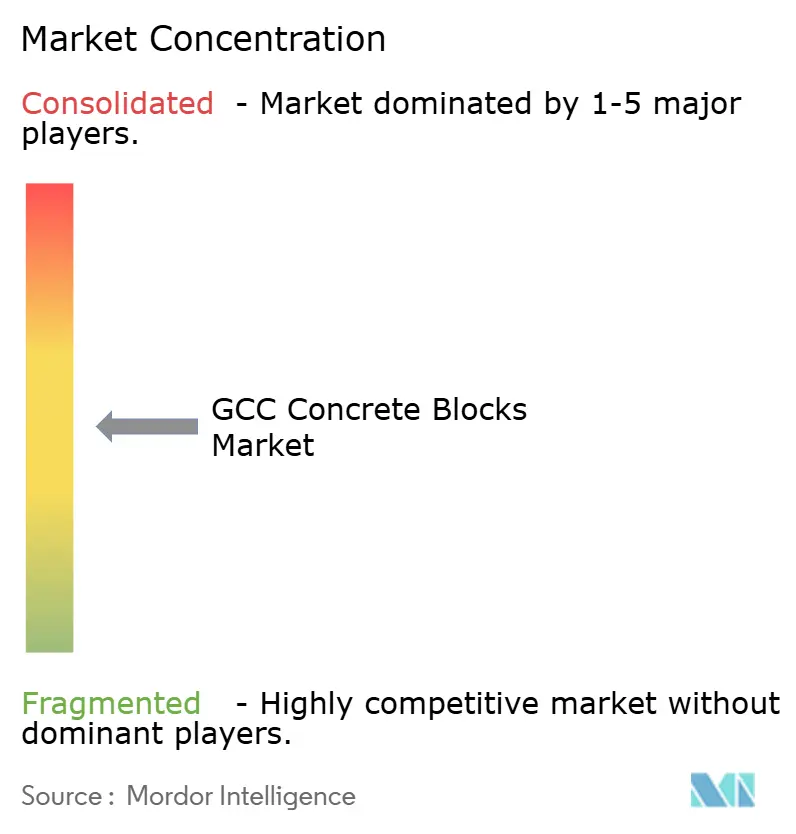
| Market Concentration | Medium |
Major Players *Disclaimer: Major Players sorted in no particular order Image © Mordor Intelligence. Reuse requires attribution under CC BY 4.0. | |
GCC Concrete Blocks Market Analysis by Mordor Intelligence
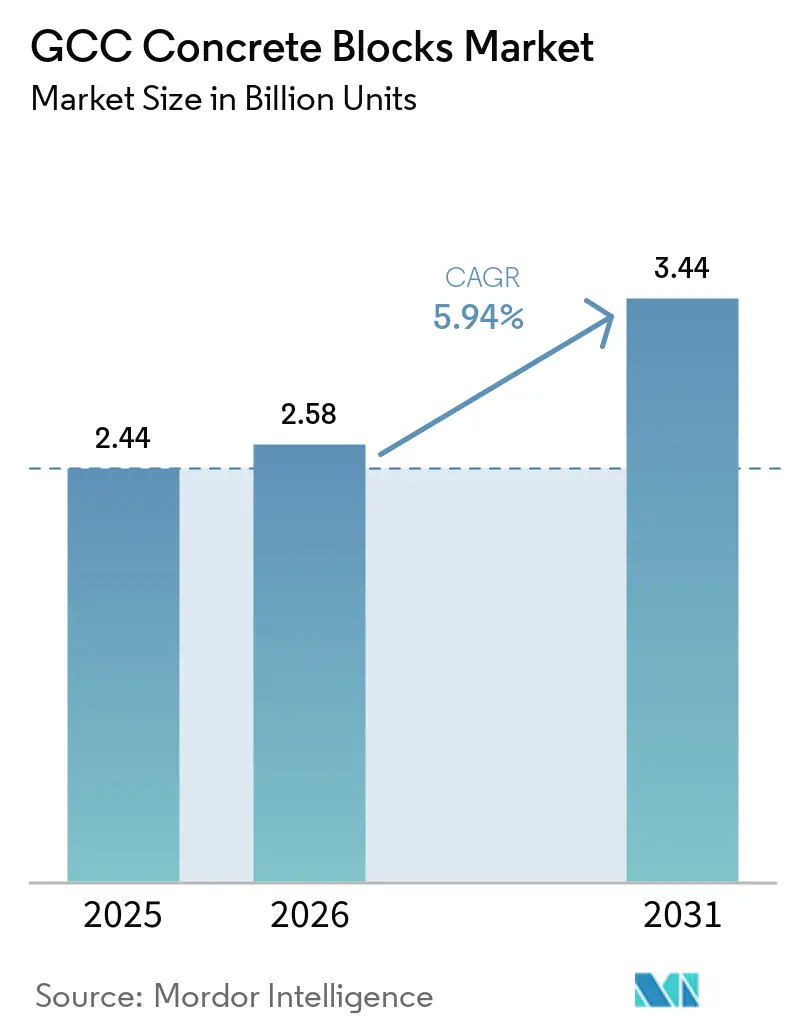
The GCC Concrete Blocks Market size was estimated at 2.44 billion units in 2025 and is estimated to grow from 2.58 billion units in 2026 to reach 3.44 billion units by 2031, at a CAGR of 5.94% during the forecast period (2026-2031). This expansion mirrors the region’s commitment to Vision-linked megaprojects, rapid urban migration, and stricter sustainability codes that elevate demand for energy-efficient masonry solutions. Saudi Arabia’s USD 181.5 billion near-term infrastructure outlay, the UAE’s post-Expo airport and logistics expansions, and Qatar’s LNG-driven civil works together anchor a steady order pipeline for hollow and solid units. Simultaneously, government mandates that cap wall U-values and require carbon disclosure are steering producers toward lightweight, recycled-aggregate, and thermally insulated blocks, even as cement price volatility trims margins. Competitive pressures from autoclaved aerated concrete (AAC), light-steel framing, and early 3D-printing pilots are forcing incumbents to modernize curing systems, automate batching, and secure alternate raw materials to protect share in the GCC concrete blocks market.
Key Report Takeaways
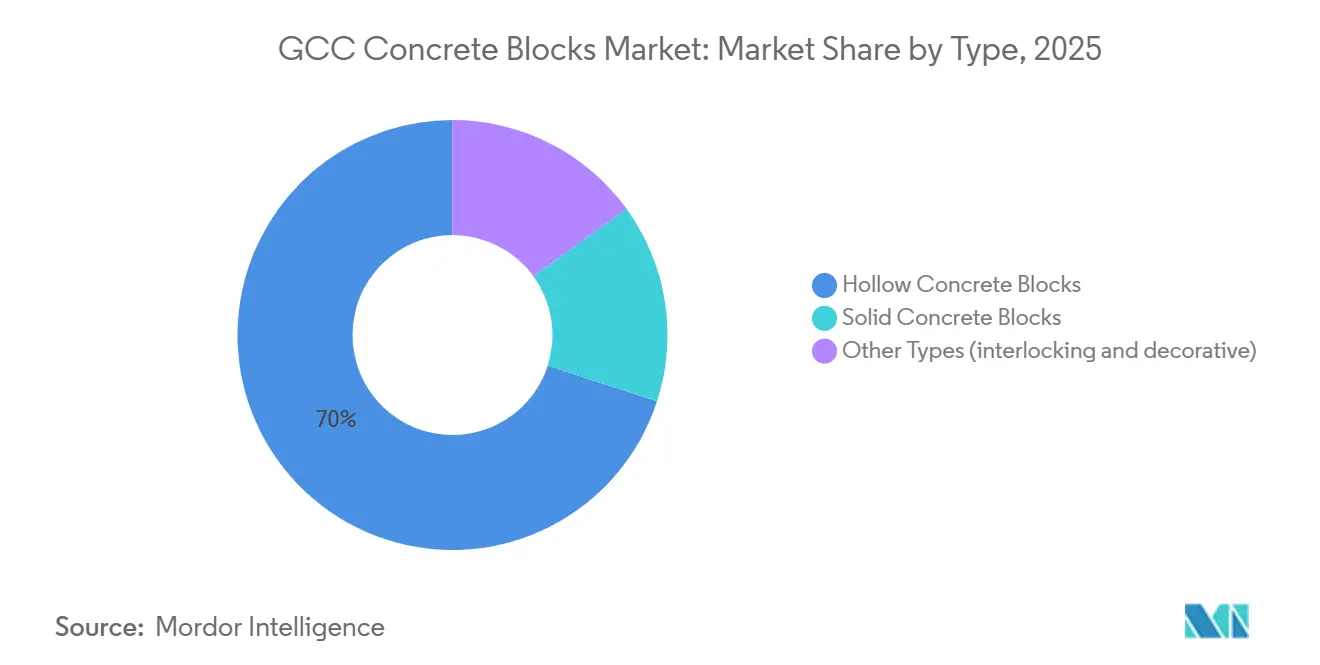
- By type, hollow concrete blocks commanded 70.01% GCC concrete blocks market share in 2025 and are forecast to post a 6.31% CAGR through 2031.
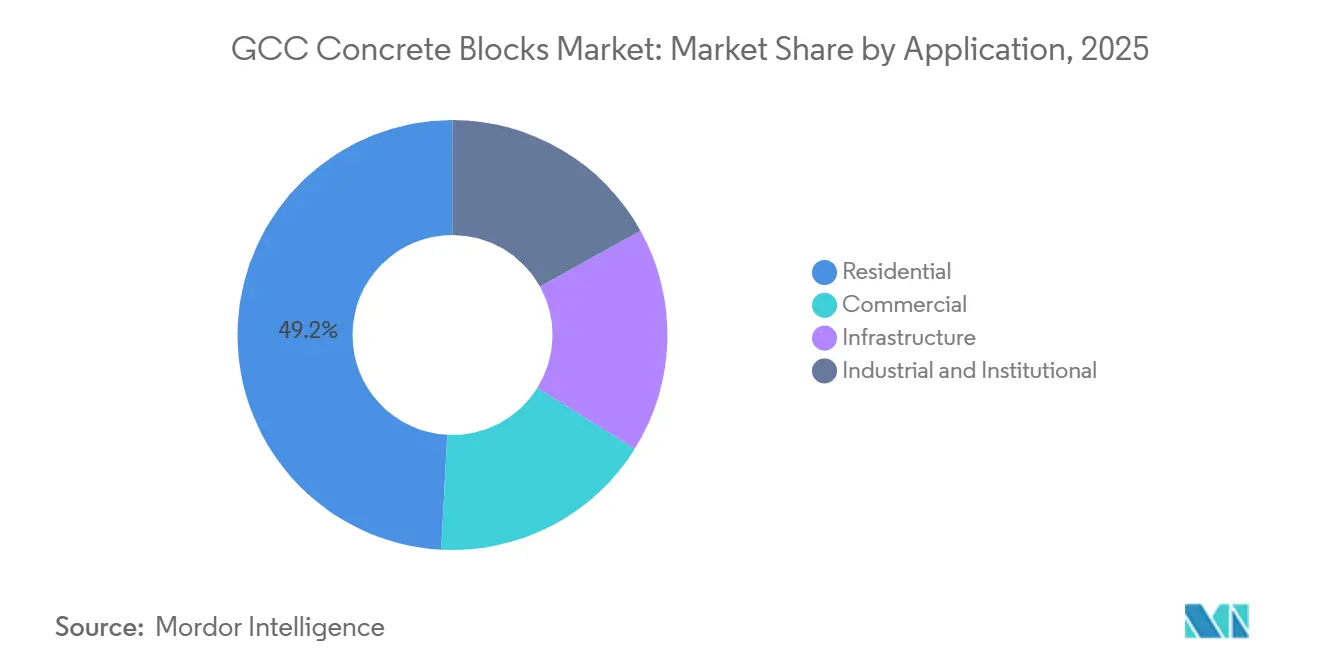
- By application, the residential segment accounted for 49.17% of the GCC concrete blocks market size in 2025 and is projected to expand at a 6.39% CAGR over the same period.
- By geography, Saudi Arabia dominated with 71.21% GCC concrete blocks market share in 2025, while it is also slated to register a 6.27% CAGR through 2031.
Note: Market size and forecast figures in this report are generated using Mordor Intelligence’s proprietary estimation framework, updated with the latest available data and insights as of January 2026.
Market Trends and Insights
Drivers Impact Analysis of GCC Concrete Blocks Market*
| Driver | (~) % Impact on CAGR Forecast | Geographic Relevance | Impact Timeline |
|---|---|---|---|
| Vision-linked infrastructure megaproject pipeline | +1.5% | Saudi Arabia, UAE, Qatar (core); spillover to Oman | Long term (≥ 4 years) |
| Housing demand from rapid urbanization and population growth | +1.3% | Saudi Arabia, UAE (primary); Qatar, Oman (secondary) | Medium term (2-4 years) |
| Shift toward prefabricated and modular construction | +0.9% | UAE, Saudi Arabia (early adopters); Qatar, Oman (followers) | Medium term (2-4 years) |
| Sustainability push for energy-efficient green blocks | +0.8% | UAE (Estidama), Saudi Arabia (SGBC), Qatar (GSAS) | Long term (≥ 4 years) |
| Early adoption of 3D-printed concrete elements | +0.4% | UAE (Dubai), Qatar (pilot projects), Saudi Arabia (NEOM) | Long term (≥ 4 years) |
| Source: Mordor Intelligence | |||
Vision-Linked Infrastructure Megaproject Pipeline
Vision-aligned public spending underpins a durable demand floor in the GCC concrete blocks market. Saudi Arabia earmarked USD 181.5 billion for delivery by 2028, with NEOM’s The Line alone expected to absorb 500 million block equivalents. Qiddiya and Red Sea tourism zones require decorative and interlocking variants that satisfy both aesthetics and durability standards. In the UAE, the Al Maktoum International Airport expansion and Dubai South logistics district continue to draw hollow unit volumes even as residential activity normalizes. Qatar’s North Field East LNG build-out uses non-structural hollow blocks for worker accommodation, peaking near 15 million units annually through 2027[1]. Oman’s USD 100 billion Vision 2040 project list favors precast and modular solutions that compress timelines on transport corridors and industrial zones.
Housing Demand from Rapid Urbanization and Population Growth
Regional population expands 1.8% each year, keeping residential demand atop the GCC concrete blocks market hierarchy. Saudi Arabia’s Sakani program handed over 220,000 homes in 2025, pulling an estimated 450 million hollow and solid units. The UAE approved 85,000 new dwellings in 2025 as expatriate inflows lifted Dubai and Abu Dhabi occupancy rates, with lightweight blocks preferred on reclaimed coastal plots where soil bearing capacities are low. Qatar targets 10,000 homes per year through 2030 under its National Housing Program, specifying thermal-insulated masonry that satisfies its GSAS energy benchmarks. Oman’s social housing scheme seeks 25,000 units by 2028 and mandates hollow units that comply with updated seismic codes.
Shift Toward Prefabricated and Modular Construction
Labor scarcity and wage inflation—construction wages climbed 12% in 2025—are accelerating modular adoption in the GCC concrete blocks market. The UAE’s Consent Group used prefab block panels to deliver a 500-unit Sharjah project six months ahead of traditional schedules. Saudi Arabia approved modular systems for 15% of Sakani units in 2025, citing improved quality control and cost certainty. EMSTEEL logged a 25% jump in prefab orders, while Qatar’s Barwa Real Estate trimmed material waste by 18% on LNG worker housing through precision panel manufacturing.
Sustainability Push for Energy-Efficient Green Blocks
Abu Dhabi’s Estidama and the Saudi Green Building Code cap exterior wall U-values at 0.57 W/m²K, steering demand toward hollow units with integrated insulation[2]. ACICO’s 30% recycled-aggregate hollow block, launched in 2025, registers thermal conductivity of 0.45 W/m²K and meets LEED Gold and Estidama 2 Pearl thresholds. The UAE’s carbon labeling rule obliges disclosure of embodied CO₂ per cubic meter, encouraging clinker replacement at Saudi Readymix plants to cut emissions by 20%. Qatar’s 2025 code revision mandates 15% post-consumer recycled input in non-structural units, accelerating the adoption of reclaimed aggregate blends. ISO 16757 compliance is now a prerequisite for public tenders, widening the moat for certified producers.
Restraints Impact Analysis of GCC Concrete Blocks Market*
| Restraint | (~) % Impact on CAGR Forecast | Geographic Relevance | Impact Timeline |
|---|---|---|---|
| Cement and aggregate price volatility | -0.6% | Saudi Arabia, UAE, Qatar (high exposure); Oman (moderate) | Short term (≤ 2 years) |
| Competition from AAC and light-steel framing systems | -0.5% | UAE, Saudi Arabia (high-rise residential and commercial) | Medium term (2-4 years) |
| Water-scarcity constraints on block production | -0.4% | UAE, Qatar (acute); Saudi Arabia, Oman (emerging) | Long term (≥ 4 years) |
| Source: Mordor Intelligence | |||
Cement and Aggregate Price Volatility
Cement traded between SAR 200 and SAR 250 per tonne in 2025, shaving 8-12% off producer margins in the GCC concrete blocks market. Heidelberg Materials noted a 15% hike in clinker costs as natural gas and carbon levies rose in the UAE, prompting investment in waste-heat recovery. Aggregate scarcity in coastal sites forces reliance on recycled concrete that carries a 20-30% premium yet slices embodied carbon by 25%. Qatar’s limestone imports bear freight volatility; shipping rates advanced 18% in 2025 amid Red Sea route disruptions. Oman tightened domestic supply via a 5% export duty that further inflated input costs for regional buyers.
Competition from AAC and Light-Steel Framing Systems
AAC blocks marketed by ACICO and Xella weigh 20% less than hollow units, trimming steel tonnage and foundation loads. Saudi authorities authorized AAC for 8% of Sakani homes in 2025, citing superior thermal and fire ratings. EMSTEEL’s light-steel panels deliver 35% faster installation in the UAE’s villa segment, though they carry a 15% upfront premium. The UAE’s 2024 fire code mandates 2-hour resistance for mid-rise walls, a benchmark AAC meets more readily than standard hollow blocks. Traditional producers now invest in fire-retardant additives and testing to defend their share in the GCC concrete blocks market.
*Our forecasts treat driver/restraint impacts as directional, not additive. The impact forecasts reflect baseline growth, mix effects, and variable interactions.
GCC Concrete Blocks Market Segment Analysis
By Type:
Hollow Blocks Retain Leadership Through Thermal AdvantageHollow units captured 70.01% GCC concrete blocks market share in 2025 and are forecast to record a 6.31% CAGR to 2031, a lead cemented by their 0.45-0.55 W/m²K thermal range that satisfies Estidama and Saudi code thresholds. This dominance secures a steady 2026-2031 cumulative demand exceeding 11 billion units, anchoring the GCC concrete blocks market. Developers benefit from lower HVAC loads, realizing energy savings of 18% in Saudi Arabia’s Sakani homes using ACICO’s recycled-aggregate hollow design. Solid blocks trail, serving low-rise load-bearing jobs where unit weight and seismic ratings take precedence. Niche interlocking and decorative offerings, while below 5% of the GCC concrete blocks market size, enjoy double-digit growth in premium landscape projects that value rapid, mortar-free assembly and customized textures.
Hollow units also give producers supply-chain flexibility. Lightweight formulations allow 25% clinker reduction, easing CO₂ disclosure under UAE labeling mandates. In parallel, modifiable core geometries help manufacturers tailor compressive strength from 7.5 MPa to 15 MPa without altering external dimensions, a trait valued in NEOM’s mixed-use zoning that spans high-rise, hospitality, and social infrastructure. As certification agencies tighten ISO 16757 verification, the testing pedigree of hollow units further extends their competitive moat. Interlocking products, though emerging, cut labor by 25% and appeal to disaster-response agencies in Oman and Bahrain, suggesting a small but resilient upside.

By Application:
Residential Builds Anchor Volume GrowthResidential construction accounted for 49.17% of the GCC concrete blocks market size in 2025 and is on track for a 6.39% CAGR through 2031 as housing programs tackle persistent deficits. Saudi Arabia alone could consume 2.8 billion units across the forecast window, reinforcing the GCC concrete blocks market’s residential backbone. The UAE and Qatar replicate this story at smaller scales, with developers adopting lightweight blocks to lower foundation loads on reclaimed land. Hollow units with integrated insulation permit code compliance without extra layers, trimming façade thickness, and expanding net sellable floor area.
Commercial builds are buoyed by post-Expo logistics hubs, retail expansions, and Vision-aligned tourism assets. Prefab block panels here reduce on-site crews by 40%, critical as regional visa reforms lift labor costs. Infrastructure and institutional segments, spanning utilities, schools, and hospitals, favor precast and modular solutions that slash schedules in public procurement where penalties for delay are steep. Omani industrial zones demand fire-resistant blocks that meet Eurocode EN 1996 equivalence, opening a specialty niche of blended-aggregate units incorporating basalt fibers for enhanced thermal shock resistance.
Geography Analysis
Saudi Arabia Concrete Blocks Market
Saudi Arabia leads the GCC concrete blocks market with 71.21% share in 2025 and is set to grow at 6.27% CAGR through 2031. The USD 1.7 trillion Vision 2030 capital plan and a 1.2 million-unit housing deficit guarantee sustained block orders, peaking at 1.8 billion units a year by 2028. Sakani delivered 220,000 dwellings in 2025 and continues to preference thermal hollow units for exterior envelopes. Although cement price swings compress margins, producers offset by adopting slag and fly-ash blends that lower clinker ratios by 20%. The Saudi Green Building Code’s U-value cap further cements demand for insulated hollow blocks, reinforcing local supply chains.
United Arab Emirates Concrete Blocks Market
The UAE ranks second and demonstrates faster technological shifts. Labor costs rose 12% in 2025, spurring the adoption of modular panels and AAC alternatives. Dubai South logistics district and Al Maktoum airport expansion sustain commercial block demand, while Abu Dhabi’s Estidama preserves hollow unit volume in residential sites. Water stress compels investment in closed-loop curing, with producers claiming 40% water savings. EMSTEEL’s light-steel frames gain villa traction, signaling competitive leakages the GCC concrete blocks market must monitor.
GCC Concrete Blocks Market
Qatar’s share benefits from North Field LNG phasing, which draws up to 15 million hollow units yearly for worker camps. Its 10,000-unit annual housing commitment specifies insulated blocks aligned with GSAS. The state piloted 3D-printed school walls that cut costs 22%, hinting at disruptive pathways. Oman pursues USD 100 billion of Vision 2040 infrastructure, with mandates on closed-loop water recycling potentially raising the cost floor yet securing long-term ecological compliance. Bahrain and Kuwait remain smaller contributors but deliver steady orders from national housing schemes and early works at Kuwait’s Silk City.
Value Chain Analysis
The GCC concrete blocks value chain starts with quarrying and beneficiation of aggregates, cement and clinker procurement, and admixtures and fibers or binders, before block manufacturing (automated batching, molding, curing, and palletizing) and distribution to contractors, developers, and public-project owners. Cement and aggregate price volatility in 2025, with cement trading between SAR 200 and SAR 250 per tonne in Saudi Arabia, has increased focus on securing alternate inputs such as slag and fly ash blends and recycled aggregates. At the same time, sustainability targets and code compliance are pushing producers toward performance-enhancing additives such as synthetic fibers, CNT-based solutions, and carbon-negative binders, including initiatives demonstrated in Saudi Readymix sites.
Compliance and approval steps are being built into procurement and production, which affects supplier qualification and tender eligibility across the region. Saudi Arabia tightened its operating context through amendments to the Saudi Building Code executive regulation in April 2026 (published May 2026). Manufacturers and upstream partners are aligning product QA/QC to national and GCC standards, including GSO EN 206:2022 and GSO 2809:2025. In the UAE, the Abu Dhabi Quality and Conformity Council technical approval scheme adds a gating layer for certain building materials, reinforcing the role of certified testing labs, documentation, and traceability alongside logistics. Since bulky, low-value units tend to keep competition local, demand is also favoring multi-plant networks such as ACICO and regional producers with distribution reach into giga-project corridors.
Competitive Landscape
The GCC Concrete Blocks market is moderately consolidated. ACICO runs 12 plants rated at more than 400 million units a year, specializing in recycled-aggregate hollow blocks that qualify for LEED Gold and Estidama 2 Pearl certifications. Saudi Readymix invested USD 15 million to dose slag and fly ash, curbing CO₂ by 20% to align with the UAE’s carbon labeling rule. EMSTEEL diversified into light-steel framing in response to villa-segment demand, advertising 35% faster build times. Technology differentiation widens as top-tier producers deploy automated batching and robotic palletizing that cut labor 15% and improve consistency.
GCC Concrete Blocks Industry Leaders
-
ESPAC
-
RAKNOR LLC
-
Saudi Readymix
-
KRB
-
Bucomac
- *Disclaimer: Major Players sorted in no particular order
GCC Concrete Blocks Market Companies Covered in this Report
- Aamal Cement
- ACICO Group
- Al Jazeera Factory For Construction Materials
- Al Mana Holding
- Al Rajhi Group
- Al RAYYAN Readymix Concrete and Cement Products W.L.L
- Bucomac
- Consent Group
- EMSTEEL
- ESPAC
- Khonaini International Company
- KRB
- MaCon LLC
- MJK Group
- Raknor LLC
- Saudi Readymix
Market Opportunities and Future Outlook
Opportunities in the GCC concrete blocks market are concentrating on low-carbon, code-compliant masonry systems that reduce embodied CO2 and make thermal compliance easier to document. Supplier actions already point in this direction. Saudi Readymix demonstrated CNT-enhanced, low-carbon concrete using locally sourced materials in Dammam (December 2025) and also ran a carbon-negative binder test-run with Partanna at its Jeddah facility, expanding cement-reduction pathways relevant to masonry units and related precast applications. These moves align with the market shift toward carbon disclosure and tighter wall U-value requirements highlighted in UAE and Saudi programs, which creates whitespace for producers that can supply documented EPD-style data, certified mixes, and insulated hollow units at scale.
Operational upgrades can also translate into differentiated supply for large project pipelines, where delivery reliability and compliance documentation run alongside price. Saudi Readymix deploying Saudi Arabia's first battery-electric wheel loader in July 2026 indicates continuing investment appetite in lower-emission materials handling that supports contractor procurement requirements on flagship developments. As modular and prefab adoption rises in the UAE and Saudi housing programs, suppliers that can provide panelized block systems, tighter dimensional tolerances, and faster curing cycles (without increasing water intensity) can gain traction. Smaller manufacturers in Oman, Bahrain, and Kuwait can still compete through niche offerings such as interlocking, decorative, and fire-rated blocks, tuned to updated building-code requirements and project-specific specifications.
Recent Industry Developments in GCC Concrete Blocks Market
- July 2026: Saudi Readymix deployed Saudi Arabia's first battery-electric wheel loader supplied by XCMG Saudi Arabia at its facilities. The move supports lower-emission materials handling and can reduce diesel exposure in quarry and yard operations. It also signals capex directed to decarbonizing the upstream portion of the concrete products supply chain serving large project pipelines.
- May 2026: Saudi Readymix launched Tuwaiq Crete synthetic fiber reinforced concrete solutions and performed a live mock-up pour at the Al Qiddiya City factory. This broadens the company's high-performance concrete offering for demanding job sites where crack control and placement productivity are critical. The introduction strengthens differentiation beyond standard block mixes and supports premium specifications tied to giga-project execution.
- December 2025: CHASM Advanced Materials and Saudi Readymix demonstrated low-carbon, CNT-enhanced concrete in Dammam using 100% locally sourced materials. The collaboration highlights a pathway to improve performance while targeting lower-carbon formulations, relevant to producers adapting to embodied-carbon disclosure and tighter building performance requirements. It also underscores growing supplier collaboration between materials technology firms and ready-mix and concrete product manufacturers in the GCC.
GCC Concrete Blocks Market Report Scope and Research Methodology
Market Definition and Coverage
For this report, the market covers concrete masonry blocks supplied and used across GCC construction activity, measured as the number of blocks (units) sold into end uses during the study period.
Scope exclusions: This sizing does not include clay bricks, cement, ready-mix concrete, or other walling systems that are not sold as concrete blocks.
Segments Covered in This Report
- By Type
- Solid Concrete Blocks
- Hollow Concrete Blocks
- Other Types (e.g., interlocking, decorative)
- By Application
- Residential
- Commercial
- Infrastructure
- Industrial and Institutional
- By Geography
- Saudi Arabia
- United Arab Emirates
- Qatar
- Oman
- Rest of GCC
Data Sources, Market Sizing, and Validation
Desk Research
Desk research sets the guardrails for the model, focusing on construction activity, materials demand, and the pace of project awards across GCC countries. Public sources were reviewed, including national statistics portals, central bank and ministry publications, and customs authorities that publish trade flows for building materials. We also used information from organizations such as the World Bank, UN Comtrade, and standards and code updates released by government bodies and municipal authorities.
To tighten assumptions, we checked annual reports, investor presentations, and press releases from producers and large construction groups, and then compared the direction with reputable business press coverage. Where public disclosure is thin, paid subscriptions for company financials and intelligence, patent databases, and shipment-level import and export tracking were used to sanity check capacity signals and cross-border flows. These desk sources are illustrative only, and many other references were used for data collection, clarification, and ongoing validation.
Primary Interviews and Surveys
Primary work focused on validating how block demand tracks with project mix, walling preferences, and local code requirements, then translating those inputs into practical volume assumptions. We spoke with manufacturers, distributors, contractors, and project-side professionals across GCC markets so gaps in secondary information could be filled, and then checked again with independent viewpoints.
Distribution of primary research fieldwork respondents
| Company type | Respondent position |
|---|---|
| Top tier: 27% | CXOs: 17% |
| Mid tier: 55% | Functional/Unit leaders: 35% |
| Smaller Players: 18% | Managers: 48% |
Market-Sizing & Forecasting
Sizing is built mainly through a top-down demand pool approach, where construction spending, project starts, and typical masonry intensity are translated into block consumption volumes by country and end use. For each country, the model is guided by indicators such as residential and non-residential project pipelines, infrastructure award momentum, typical wall area per built-up area, the share of block masonry in structural and partition walls, and the split between solid and hollow blocks that changes with thermal rules and design norms.
Once the demand side is constructed, we cross-check totals using selective bottom-up approximations, such as sampled plant capacity and utilization discussions, channel checks on typical truckload dispatch patterns, and a simple volume build using indicative blocks per square meter for common wall thicknesses. If a supplier or distributor input is incomplete, gaps are handled by using neighboring market benchmarks and then narrowing the range through follow-up calls. For forecasting, scenario analysis is used around the construction pipeline (base case plus slower and faster award conversion), and the final outlook is adjusted only after the assumptions match what respondents see for projects, pricing pressure, and substitution from adjacent walling options.
Data Validation & Update Cycle
Outputs are reviewed through multiple checks so the final numbers stay tied to real market signals. Our team compares computed unit demand with independent indicators like construction output trends, import patterns for related inputs, and capacity expansion announcements, and then investigates any sharp swings before sign-off. If a variance looks driven by one assumption, the assumption is reopened and the relevant interviewee set is re-contacted.
Reports are refreshed annually, and interim updates are made when major events materially change construction activity or supply availability. Before delivery, analysts run a fresh pass on key inputs so clients receive an updated view aligned with the latest public releases and verified field feedback.
Mordor Intelligence's Gcc Concrete Blocks Market Sizing Compared With Other Published Estimates
Published market values for GCC concrete blocks can look far apart because the unit of measure, the product boundary, and the timing of the base year are not always aligned. Some sources present revenue, others show units, and a few mix block types that behave differently in demand cycles.
Import and export checks, country-level construction pipeline signals, and manufacturer dispatch validation are the evidence points that anchor Mordor Intelligence to a unit-based demand pool for 2026, which reduces the chance of double counting blocks that shift through distributors before final use.
Benchmark comparison
| Source | Market Size | Gaps in Research Methodology |
|---|---|---|
| Mordor Intelligence | USD 2.58 B (2026) | |
| Global Consultancy A | USD 1.67 B (2026) | This figure is presented in revenue terms and also appears to widen the product scope to include adjacent walling blocks like AAC, which can shift totals depending on pricing and mix assumptions. |
| Industry Portal B | USD 3.44 B (2031) | The number aligns to an end-year forecast point and is not a current-year value, so it will look larger if compared directly without normalizing the year and the underlying volume versus value basis. |
Across the three figures, the spread is explained mainly by unit versus revenue reporting, differences in what is treated as a concrete block, and whether the value shown is a base-year estimate or a later forecast year. By keeping the scope tight to concrete masonry blocks in GCC end use demand and by tying assumptions back to observable construction and supply signals, the model stays repeatable and easier to audit when new information comes in.
Key Questions Answered in the Report
What is current market size of GCC Concrete Blocks Market?
The GCC Concrete Blocks Market size was estimated at 2.44 billion units in 2025 and is estimated to grow from 2.58 billion units in 2026 to reach 3.44 billion units by 2031, at a CAGR of 5.94% during the forecast period (2026-2031).
Which block type leads sales?
Hollow concrete blocks held 70.01% share in 2025 because their thermal efficiency meets regional green-building codes.
Why is residential construction so important?
Housing deficits, especially in Saudi Arabia, and population growth of 1.8% annually drive nearly half of total block consumption.
What are the main industry challenges?
Input-cost volatility, water scarcity, and competition from AAC, light-steel framing, and 3D-printing technologies weigh on margins and market share.