
Market Overview
| Study Period | 2020 - 2031 |
|---|---|
| Forecast Data Period | 2026 - 2031 |
| Base Year Market Size (2025) | USD 9.10 Billion |
| Market Size (2026) | USD 9.51 Billion |
| Market Size (2031) | USD 11.86 Billion |
| Growth Rate (2026 - 2031) | 4.52 % |
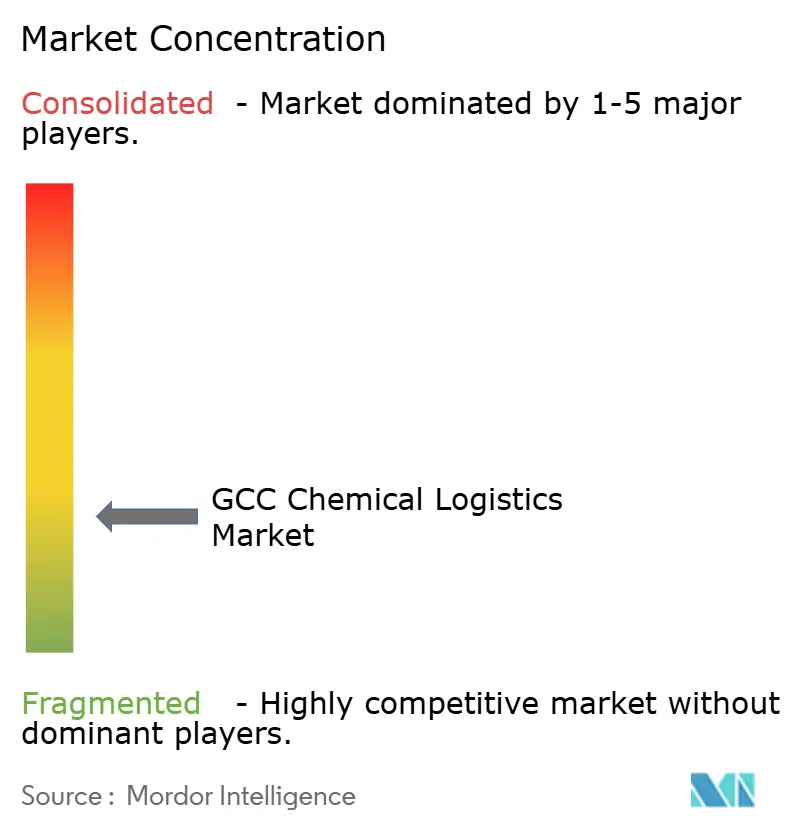
| Market Concentration | Low |
Major Players *Disclaimer: Major Players sorted in no particular order Image © Mordor Intelligence. Reuse requires attribution under CC BY 4.0. | |
GCC Chemical Logistics Market Analysis by Mordor Intelligence
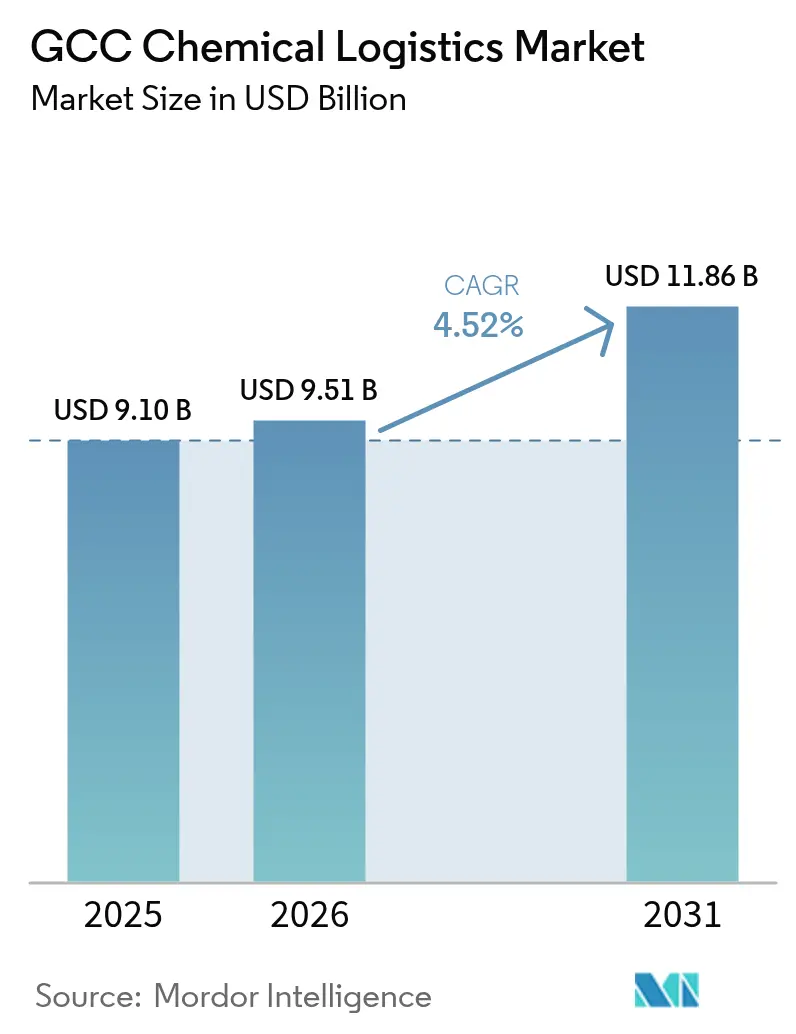
The GCC Chemical Logistics market size is expected to grow from USD 9.10 billion in 2025 to USD 9.51 billion in 2026 and is forecast to reach USD 11.86 billion by 2031 at 4.52% CAGR over 2026-2031.
The region’s positioning as a global petrochemical hub, combined with large‐scale capacity additions and integrated industrial zones, is stimulating long-term demand for multimodal logistics services. Continuous investment in ports, rail, and near-terminal clusters is improving connectivity, while tightening health, safety, and environmental (HSE) rules are pushing manufacturers toward specialist third-party providers. Demand for GDP-compliant cold-chain transport is accelerating as pharmaceutical imports rise, and digital platforms are gaining traction as operators pursue real-time visibility and predictive control of hazardous cargo flows. Geopolitical transit risks through the Strait of Hormuz and the Red Sea are simultaneously driving investment in alternative corridors and advanced contingency routing solutions.
Key Report Takeaways
- By service, transportation commanded 61.40% of GCC chemical logistics market share in 2025, whereas warehousing, distribution, and inventory management are advancing at a 4.05% CAGR through 2031.
- By end-user industry, oil & gas held 35.60% of the GCC chemical logistics market size in 2025, while pharmaceuticals is the fastest-growing segment at a 4.70% CAGR to 2031.
- By hazard class, hazardous chemicals captured 67.40% of the GCC chemical logistics market share in 2025; non-hazardous cargo is projected to expand at a 3.62% CAGR between 2026 and 2031.
- By temperature control, non-temperature-controlled cargo dominated with an 80.70% share in 2025 and is projected to expand at a 4.18% CAGR.
- By country, Saudi Arabia accounted for 40.70% of the GCC chemical logistics market size in 2025; the United Arab Emirates is set to rise at a 3.95% CAGR through 2031.
Note: Market size and forecast figures in this report are generated using Mordor Intelligence’s proprietary estimation framework, updated with the latest available data and insights as of 2026.
GCC Chemical Logistics Market Trends and Insights
Drivers Impact Analysis*
| Driver | (~) % Impact on CAGR Forecast | Geographic Relevance | Impact Timeline |
|---|---|---|---|
| Surge in petrochemical production capacity expansions | +1.8% | Saudi Arabia, Qatar, UAE with spillover to Kuwait, Oman | Medium term (2-4 years) |
| Massive multimodal-infrastructure investments (ports, rail & land-bridge) | +1.2% | Global GCC, concentrated in Saudi Arabia and UAE | Long term (≥ 4 years) |
| Tightening HSE regulations fuelling 3PL outsourcing | +0.9% | Global GCC with early adoption in UAE and Saudi Arabia | Short term (≤ 2 years) |
| Booming pharma & specialty-chemical imports needing GDP-compliant transport | +0.7% | Regional, with premium demand in UAE, Saudi Arabia, Qatar | Medium term (2-4 years) |
| SEZ-linked "near-terminal" chemical clusters driving onsite logistics demand | +0.5% | Saudi Arabia (Jubail, Yanbu), UAE (JAFZA), Qatar (Ras Laffan) | Long term (≥ 4 years) |
| Adoption of forward-hubbing & digital-twin control towers to bypass route shocks | +0.4% | Global GCC with technology leaders in UAE and Saudi Arabia | Short term (≤ 2 years) |
| Source: Mordor Intelligence | |||


Surge in Petrochemical Production Capacity Expansions
Major projects such as Saudi Aramco’s USD 7.7 billion Fadhili Gas Plant expansion will raise feedstock output and create new flows for ethane, naphtha, and mixed-feed cracker derivatives[1]Gulf Cooperation Council Standardization Organization, “Draft Technical Regulation on GHS Alignment,” gso.org.sa. Growing output diversity obliges logistics providers to manage multiple hazard classes and temperature bands within the same network. Integrated complexes located at Jubail, Yanbu, and Ras Laffan require synchronized inbound feedstock and outbound product scheduling, prompting investment in specialized tank fleets, vapor-recovery terminals, and port handling systems. The resulting jump in throughput volumes underpins steady growth in the GCC chemical logistics market as producers seek assured capacity and regulatory compliance.
Massive Multimodal Infrastructure Investments
Saudi Arabia’s Logisti 2 platform and DP World’s USD 2.5 billion regional program are improving modal shifts across road, rail, and sea. New community systems cut clearance times, while inland logistics parks bring storage closer to chemical clusters. Etihad Rail is enhancing inter-emirate connectivity, and the Gulf Railway concept promises cross-border block-train services for bulk liquids. Infrastructure upgrades expand corridor choices, lower handling costs, and support the scalability required by the GCC chemical logistics market.
Tightening HSE Regulations Fueling 3PL Outsourcing
The Gulf Cooperation Council’s alignment with UN GHS Rev. 5 obliges bilingual labeling, standardized pictograms, and harmonized emergency response rules. Compliance demands certified drivers, ADR-equipped fleets, and segregated storage. Many producers lack the time or scale to internalize these requirements and are increasingly outsourcing to specialist providers equipped with digital documentation systems and 24/7 control towers. Outsourcing supports the growth trajectory of the GCC chemical logistics market and lifts service-level benchmarks.
Booming Pharma & Specialty-Chemical Imports Needing GDP-Compliant Transport
Dubai Municipality’s 2024 guidelines mandate continuous temperature monitoring from 2-8 °C and 15-25 °C for healthcare products[2]Dubai Municipality Health & Safety Department, “Technical Guidelines for Consumer Products Storage Requirements,” dm.gov.ae. WHO guidelines reinforce end-to-end risk management. These standards are enlarging the footprint of GDP-ready warehouses and dedicated reefer fleets, fueling premium-rate demand and driving a distinct cold-chain sub-segment within the GCC chemical logistics market.
Restraints Impact Analysis*
| Restraint | (~) % Impact on CAGR Forecast | Geographic Relevance | Impact Timeline |
|---|---|---|---|
| High CAPEX for ADR-compliant fleets & warehouses | -1.1% | Global GCC with acute impact in Saudi Arabia and UAE | Medium term (2-4 years) |
| Geopolitical choke-points increasing transit-time risk | -0.8% | Global GCC with severe exposure via Strait of Hormuz and Red Sea routes | Short term (≤ 2 years) |
| Shortage of ADR/IMO-certified labour | -0.6% | Regional, most severe in Saudi Arabia and Qatar | Long term (≥ 4 years) |
| Energy-transition volatility in bulk chemical flows | -0.4% | Global GCC with transition leaders UAE and Saudi Arabia most affected | Long term (≥ 4 years) |
| Source: Mordor Intelligence | |||
High CAPEX for ADR-Compliant Fleets & Warehouses
Explosion-proof wiring, vapor-control systems, and specialized fire suppression raise fleet and facility costs well above general cargo benchmarks. Continuous recertification and crew training obligations add to operating expenditure and deter smaller entrants. Capital hurdles slow network expansion and temper competitive intensity in the GCC chemical logistics market.
Geopolitical Chokepoints Increasing Transit-Time Risk
More than 20% of global seaborne oil transits the Strait of Hormuz, yet bypass pipeline capacity is only 2.6 million b/d[3]U.S. Energy Information Administration, “World Oil Transit Chokepoints,” eia.gov. Red Sea diversions around the Cape of Good Hope lengthen voyages by 10–14 days. Longer voyage times escalate charter rates and product inventory costs, compelling operators to maintain buffer stocks and explore alternative rail or pipeline options. This risk weighs on growth prospects in the GCC chemical logistics market.
*Our forecasts treat driver/restraint impacts as directional, not additive. The impact forecasts reflect baseline growth, mix effects, and variable interactions.
Segment Analysis
By Service: Transportation Dominance Amid Digital Transformation
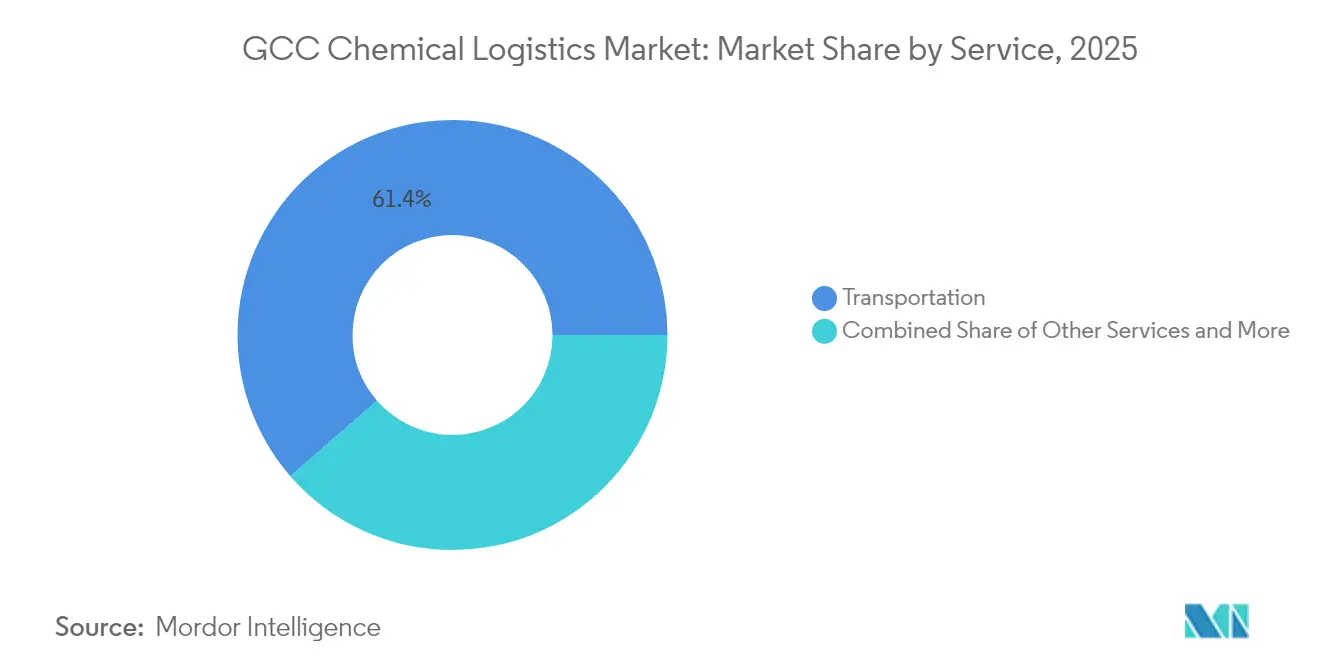
Transportation retained a 61.40% share of the GCC chemical logistics market in 2025, supported by extensive highway links from petrochemical clusters to export terminals. Road tankers remain the workhorse for regional moves, yet investments in Etihad Rail and proposed Gulf Railway corridors will gradually divert heavy bulk flows onto rail. Sea transport governs export revenue, and chemical tanker availability is a critical capacity lever. Airfreight caters to specialty and pharma cargo where transit time is critical.
Warehousing, distribution, and inventory management is the fastest-growing service at a 4.05% CAGR through 2031, buoyed by demand for digital-twin warehouses and pick-to-light systems that lift productivity. Continuous value-added services such as labeling and repackaging are also rising, reinforcing integrated solutions in the GCC chemical logistics market.


By End-User Industry: Oil & Gas Leadership with Pharmaceutical Acceleration
Oil & gas contributed 35.60% to the GCC chemical logistics market size in 2025, reflecting feedstock flows within vertically integrated complexes. Reliance on long-term contracts cushions volatility and provides stable base volumes for fleet deployment.
Pharmaceutical cargo, though smaller, is expanding at a 4.70% CAGR, propelled by regional health spending and mandatory GDP compliance. Specialty chemicals serve downstream conversion industries, and cosmetics retain a niche share yet benefit from rising disposable incomes. Diversification trends sustain demand diversity and underpin resilience in the GCC chemical logistics market.
By Hazard Class: Hazardous Cargo Challenges Dominate
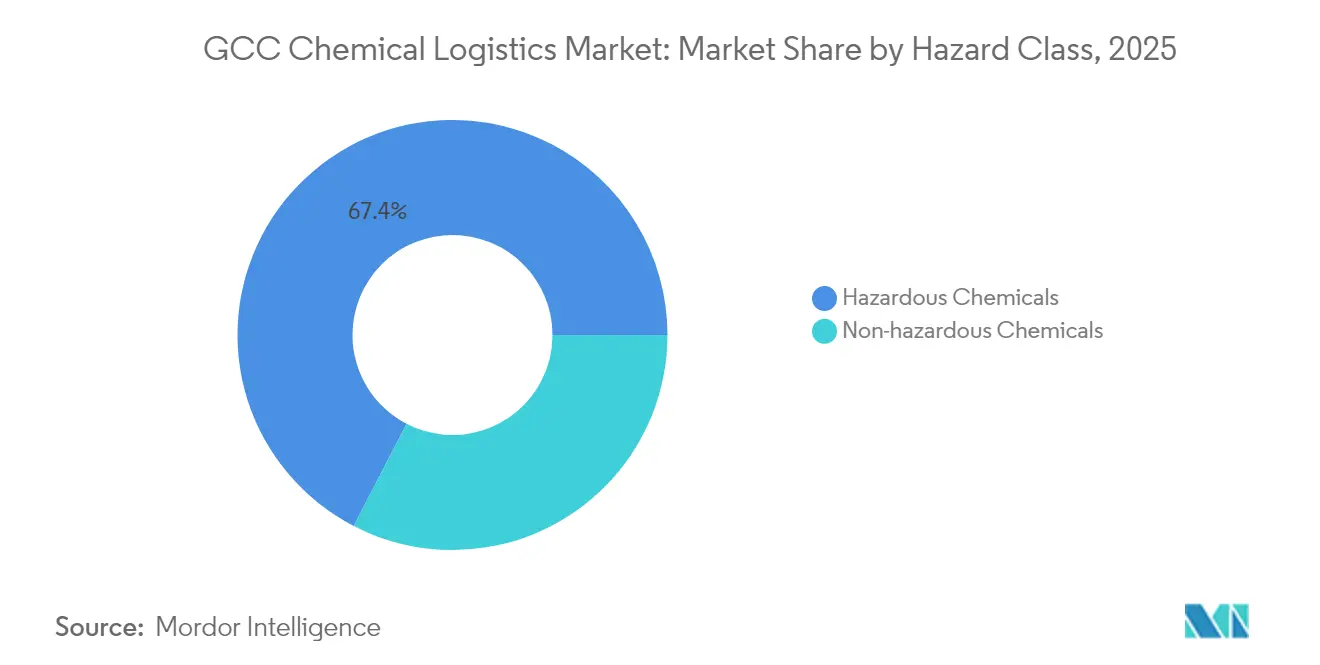
Hazardous chemicals controlled 67.40% of GCC chemical logistics market share in 2025, encompassing flammable liquids, corrosives, and toxics under ADR and IMO codes. High hazard concentration necessitates specialist assets, incident response protocols, and recurring safety audits.
Non-hazardous volumes, although lower at 32.60%, include temperature-sensitive pharmaceutical ingredients, driving premium yield opportunities. Balanced growth across both classes supports network optimization and capacity utilization within the GCC chemical logistics market.
By Temperature Control: Ambient Cargo Leads, Cold Chain Grows
Non-temperature-controlled flows accounted for 80.70% of the GCC chemical logistics market in 2025, mirroring the dominance of petrochemical commodities moved at ambient conditions.
Temperature-controlled cargo holds 19.30% but is growing due to pharmaceutical and specialty chemical inflows that demand 2-8 °C and 15-25 °C compliance. Cold-chain investments generate higher returns but require robust monitoring and validated processes, reinforcing barriers to entry and service differentiation across the GCC chemical logistics industry.
Geography Analysis
Saudi Arabia held 40.70% of the GCC chemical logistics market in 2025, anchored by integrated hubs at Jubail and Yanbu, which generate dense inbound and outbound flows. The USD 240 million Jeddah Logistics Park and multiple Special Economic Zones are broadening multimodal corridors and attracting foreign logistics operators. Vast domestic demand, coupled with upcoming green-hydrogen and ammonia projects, will widen service needs and sustain investment momentum in the GCC chemical logistics market.
The United Arab Emirates is the fastest-growing geography, advancing at a 3.95% CAGR to 2031. Jebel Ali Free Zone and Khalifa Port offer state-of-the-art tank farms, ADR warehouses, and automated clearance systems that reduce dwell time and attract re-export business. Tristar Group’s purchase of a Shell Chemicals terminal expanded capacity by 5,505 CBM and illustrates the ongoing private-sector commitment. The UAE’s position as an airfreight and transshipment hub amplifies its importance within the GCC chemical logistics market.
Regulatory Landscape
Chemical logistics compliance in the GCC is being shaped by regionwide alignment on dangerous-goods classification and labeling, alongside stricter governance for transport. GSO 2654:2026, approved on April 30, 2026, establishes a harmonized framework aligned with UN GHS Revision 10, supporting more consistent bilingual labels and Safety Data Sheet requirements across member states, while leaving country-level enforcement timelines to national authorities.
Modal-specific rules add further requirements for operators. In the UAE, the General Civil Aviation Authority requires dangerous goods compliance through CAR Part VI aligned to ICAO Annex 18 and IATA DGR for all handlers and carriers by air; in Saudi Arabia, air import permissions and chemical import permitting requirements increase documentation and pre-clearance needs. Across the region, GPCA's Gulf-SQAS program is used as a standardized assessment tool for safety, security, and environmental management in chemical logistics, helping shippers and 3PLs streamline audit expectations in multi-site, multi-country networks.
Value Chain Analysis
The GCC chemical logistics value chain begins with producers and importers (petrochemicals, industrial chemicals, and pharmaceuticals), then moves cargo through port and free-zone interfaces where it is received, inspected, and cleared before going into specialist storage and distribution. Near-terminal hubs such as Jebel Ali Free Zone (Jafza) and Ruwais connect tank farms, ADR-ready warehousing, and value-added handling (container stuffing/destuffing, relabeling, re-bagging, and sampling) with onward road, sea, and selected air links, creating high-frequency lanes between industrial zones and export/import gateways.
Specialist infrastructure, asset owners, and service providers make up the operational core, covering chemical 3PLs, shipping and terminal operators, and industrial-zone developers and investors. Recent chain build-outs show the flow of capital into midstream capacity, including an USD 11 million specialized temperature-controlled chemical warehouse opened in Jafza in January 2026 (leased to Safe Logistics), and an agreement by ADNOC Logistics and Services and TA'ZIZ for a dedicated chemicals port at the TA'ZIZ Industrial Chemicals Zone in Ruwais, with completion targeted for Q4 2026. Bottlenecks still appear at the seaborne interface, where shipping disruptions and congestion can raise lead-time variability and push shippers toward buffer storage, diversified routing, and control-tower coordination across carriers and terminals.
Competitive Landscape
The GCC chemical logistics market is moderately fragmented but trending toward consolidation. DHL Supply Chain and Saudi Aramco’s ASMO platform aggregates procurement and logistics spend across the energy value chain, creating a multi-billion-dollar buyer with negotiating leverage on assets and technology. CEVA Logistics and Almajdouie’s joint venture combines 2,000 assets and extensive local facilities, elevating service scale and geographic reach.
Strategic emphasis has shifted toward digital twins, control-tower visibility, and AI-assisted routing that anticipates port congestion and weather disruptions. Operators are also investing in cryogenic tanks and ISO containers designed for liquid hydrogen and ammonia, anticipating future export corridors.
White-space opportunities exist in pharma cold chain, onsite SEZ logistics, and last-mile hazardous waste retrieval, where current capacity is limited. Regional specialists such as RSA-TALKE, Den Hartogh, and Bahri Logistics defend market share through niche fleet configurations and local knowledge, while global players bring standardized processes and broader service portfolios. The resulting mix enriches the competitive dynamics of the GCC chemical logistics market.
GCC Chemical Logistics Industry Leaders
Al-Futtaim Logistics
RSA-TALKE
BDP International (PSA BDP)
Bahri Logistics
Kanoo Logistics
- *Disclaimer: Major Players sorted in no particular order

Market Opportunities and Future Outlook
Integrated chemicals investment and dedicated port capacity are creating identifiable whitespace for providers that can bundle compliant storage, multimodal transport, and plant-to-port orchestration. In the UAE, TA'ZIZ and Alpha Dhabi signed a strategic partnership in May 2026 for USD 10 billion of capital investment to expand the industrial chemicals ecosystem in Al Ruwais Industrial City, alongside TA'ZIZ securing long-term offtake and feedstock agreements with partners including ADNOC, Proman, Emirates Global Aluminium, and Mitsubishi Corporation. These steps add demand for berth access, tankage, ISO-tank positioning, and packaged-chemical handling that can scale as new product slates come online.
Opportunities also hinge on purpose-built storage and policy steps that reduce cross-border friction. In Saudi Arabia, Mawani and Arabian Chemical Terminals signed a contract exceeding SAR 500 million in December 2025 to build specialized chemical and petrochemical storage tanks with 70,000 cubic tons capacity at Jubail Commercial Port, expanding third-party tank storage options close to major production clusters. Alongside this, actions by the Saudi Ministry of Transport and Logistic Services in April 2026, including a 60-day storage fee exemption for GCC transit cargo at King Abdulaziz Port in Dammam, support corridor planning and can shift demand toward providers with strong customs, documentation, and transit-management capability. As route-risk management becomes more operational, investment in control towers, visibility platforms, and forward-hubbing around major ports and industrial zones remains a practical differentiation route, particularly for hazardous and temperature-sensitive shipments that require continuous monitoring and incident-ready processes.
Recent Industry Developments
- July 2026: Bahri Logistics signed an agreement with Grandweld Shipyard to build two advanced offshore support vessels, with delivery scheduled for August 2026. The move expands Bahri Logistics' offshore service capability and adds maritime capacity that can support energy-adjacent chemical logistics activities linked to Saudi industrial corridors.
- June 2025: DHL announced a EUR 500 million allocation for new gateways, warehouses, and fleet upgrades across Saudi Arabia and the UAE. This investment supports specialist warehousing and transportation capacity that chemical shippers use for compliant storage, documentation, and time-sensitive distribution in the GCC.
- October 2024: CEVA Logistics and Almajdouie finalized a joint venture forming a large integrated logistics platform in Saudi Arabia. The combined footprint and asset base increases the ability to offer end-to-end chemical logistics solutions, supporting outsourcing demand where HSE compliance and network coverage are decisive.


Research Methodology Framework and Report Scope
Market Definition and Coverage
For this report, the market covers third-party logistics services used to move, store, and handle chemical products across GCC countries, where compliance, safety requirements, and specialized assets (such as tankers and chemical warehouses) affect service pricing and demand.
Scope exclusions: It does not count in-house logistics done fully by chemical producers on their own fleet, terminals, or warehouses without a paid logistics service component.
Segmentation Overview
- By Service
- Transportation
- Road
- Rail
- Air
- Sea
- Warehousing, Distribution & Inventory Management
- Other Services
- Transportation
- By End-User Industry
- Pharmaceutical
- Cosmetic
- Oil & Gas
- Specialty Chemicals
- Other End-Users
- By Hazard Class
- Hazardous Chemicals
- Non-hazardous Chemicals
- By Temperature Control
- Temperature-Controlled (Refrigerated/Heated)
- Non-Temperature-Controlled
- By Country
- Saudi Arabia
- United Arab Emirates
- Qatar
- Kuwait
- Bahrain
- Oman
Data Sources, Market Sizing, and Validation
Desk Research
Desk research was used to map the demand pool and operating context for chemical logistics in the GCC before we built the model totals. We reviewed public trade and macro series, then linked them to chemical production and downstream activity signals that typically drive chemical freight and storage needs.
Sources referenced included official and open materials such as national statistics portals and transport ministries in GCC countries, UN Comtrade and national customs releases, OPEC and IEA energy data for petrochemical feedstock signals, port authority throughput publications, and safety and hazardous goods guidance from bodies such as UNECE. We also reviewed annual reports, investor presentations, and reputable press to cross-check capacity additions and corridor developments. Where needed, we used paid subscriptions for company financials and news intelligence plus an import export shipment level database to validate trade lane intensity. These examples are not exhaustive, and many other sources were used during data collection, validation, and follow-up clarification.
Primary Interviews and Surveys
Primary work focused on confirming what gets outsourced versus kept in-house, and on understanding how pricing changes with hazard class, temperature control needs, and storage time. We spoke with logistics managers, chemical shippers, terminal operators, and compliance-focused professionals across the GCC, so assumptions on utilization, service mix, and typical contract terms could be checked and refined.
Distribution of primary research fieldwork respondents
| Company type | Respondent position |
|---|---|
| Top tier: 37% | CXOs: 18% |
| Mid tier: 45% | Functional/Unit leaders: 32% |
| Smaller Players: 18% | Managers: 50% |
Market-Sizing & Forecasting
Sizing started from a top-down reconstruction of the GCC chemical logistics demand pool, where chemical output and trade flows were converted into likely transport and storage needs, then translated into logistics spend using service mix and average price assumptions. We corroborated results with selective bottom-up checks, including sampled shipper spend ranges, corridor-level activity checks, and small rollups of specialist service revenue to confirm directionally consistent totals.
Key inputs used in the model included chemical production and export volumes by country, port throughput and hinterland connectivity signals, hazardous versus non-hazardous handling share, temperature-controlled versus non-temperature-controlled requirements, typical warehousing dwell time, and changes in fuel and labor cost that affect pricing. Where direct observations were limited, gaps were handled by using proxy indicators such as trade lane intensity and expert-validated utilization ranges, followed by conservative normalization so one outlier did not distort the GCC total.
For forecasting, we used scenario analysis supported by simple trend models, and assumptions were anchored on expected chemical capacity additions, trade policy and corridor developments, and steady improvements in specialized storage and handling infrastructure. Final forecasts were stress-tested by checking whether implied logistics spend per ton remained within interview-supported ranges over the forecast period.
Data Validation & Update Cycle
We validate outputs by triangulating the model with independent signals such as port activity trends, chemical trade direction changes, and published capacity expansion timelines, then run variance checks at the country and service level. When a number looks inconsistent, it is rechecked against its inputs. Follow-up calls are triggered when the difference cannot be explained by seasonality, one-off projects, or timing effects.
Before sign-off, the work goes through a multi-step analyst review so assumptions, currency treatment, and growth drivers remain consistent across sections. Reports are refreshed annually, and interim updates are made when material events occur, such as a major capacity start-up, a regulation shift for hazardous transport, or a step change in freight conditions. Right before delivery, we perform a final review pass so clients receive the latest updated view.
Mordor Intelligence's Gcc Chemical Logistics Market Size Measured Against Other Published Estimates
Published market sizes for GCC chemical logistics can differ even when the same countries are discussed, because service boundaries and counted spend items are not always aligned. In practice, the biggest differences usually come from what is treated as outsourced logistics revenue, how hazardous and temperature-controlled services are priced, and how base-year currency timing is handled.
Inclusion and exclusion choices create most of the spread, followed by how quickly price per ton is assumed to move with fuel, labor, and compliance costs. Some models include in-house fleets and captive chemical storage in the total, which lifts the value quickly. Other models stay lower because only third-party logistics revenue is counted, then checked against trade and production signals. Captive producer-run transport and storage sit outside Mordor Intelligence's scope, which is one reason its 2025 value can look lower than estimates that blend outsourced and in-house activity.
Benchmark comparison
| Source | Market Size | Gaps in Research Methodology |
|---|---|---|
| Mordor Intelligence | USD 9.10 B (2025) | |
| Trade Journal A | USD 15.60 B (2023) | The estimate appears to use an earlier base year and a broader spend view that may include producer-owned logistics activity or wider supply chain services beyond paid third party chemical logistics. |
| Industry Publisher B | USD 42.70 B (2026) | The number is for dangerous goods logistics, which can pull in non-chemical hazardous cargo and wider hazardous handling services, making it structurally larger than chemical-only logistics in the GCC. |
The comparison shows that the main driver is not math, it is what gets counted as chemical logistics revenue and whether adjacent hazardous cargo or in-house operations are included. By keeping the scope tied to paid logistics services for chemical movements and storage, and then validating the result with production and trade related checks, the final market size stays traceable to clear inputs and can be repeated when assumptions need updating.


Key Questions Answered in the Report
What is the projected value of the GCC chemical logistics market by 2031?
The GCC chemical logistics market is forecast to reach USD 11.86 billion by 2031, growing at a 4.52% CAGR.
Which service segment is growing fastest within GCC chemical logistics?
Warehousing, distribution, and inventory management is expanding at a 4.05% CAGR through 2031 due to rising demand for value-added and digital-twin services.
How much market share does Saudi Arabia hold in GCC chemical logistics?
Saudi Arabia accounted for 40.70% of the GCC chemical logistics market in 2025, anchored by integrated petrochemical hubs.
Why is pharmaceutical logistics gaining traction in the GCC?
Stringent GDP rules and rising healthcare spending are driving a 4.70% CAGR in pharma cargo, boosting demand for temperature-controlled transport and storage.
What are the key risks affecting chemical cargo transit in the region?
Geopolitical chokepoints at the Strait of Hormuz and the Red Sea elevate transit-time risk and prompt contingency routing and buffer inventories.
Which technology trends are shaping competitive advantage?
Digital twins, real-time control towers, and cryogenic handling systems for emerging hydrogen and ammonia cargoes are differentiating leading providers.
Page last updated on:


 Your data is secure and never sold or shared.


