
Gauze Bandage Rolls Market Size and Share
Market Overview
| Study Period | 2020 - 2031 |
|---|---|
| Market Size (2026) | USD 2.13 Billion |
| Market Size (2031) | USD 2.78 Billion |
| Growth Rate (2026 - 2031) | 5.47 % |
| Fastest Growing Market | Asia Pacific |
| Largest Market | North America |
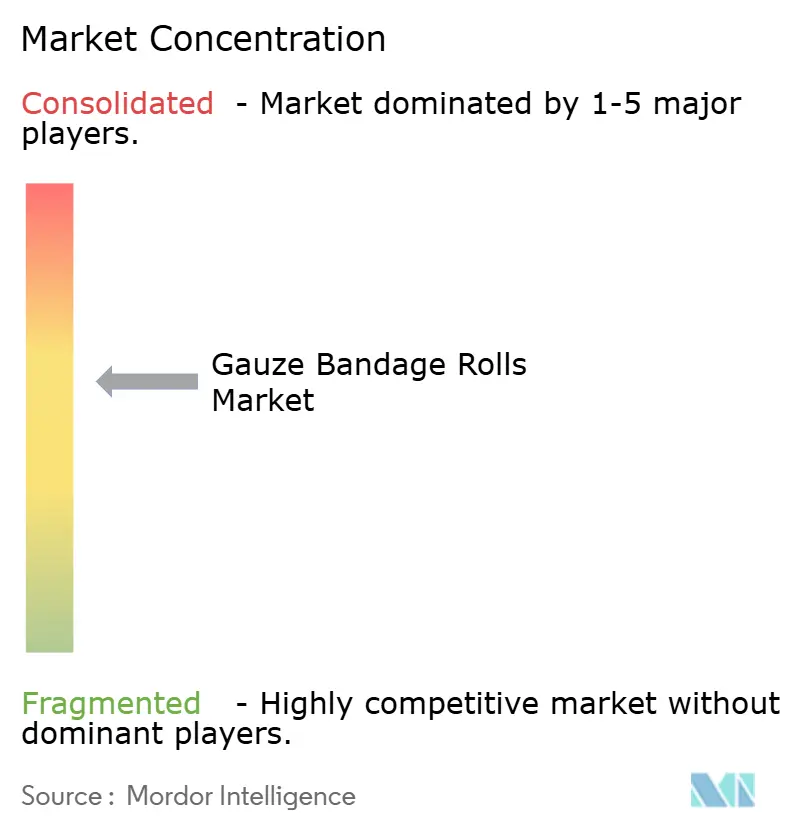
| Market Concentration | Medium |
Major Players *Disclaimer: Major Players sorted in no particular order Image © Mordor Intelligence. Reuse requires attribution under CC BY 4.0. | |
Gauze Bandage Rolls Market Analysis by Mordor Intelligence
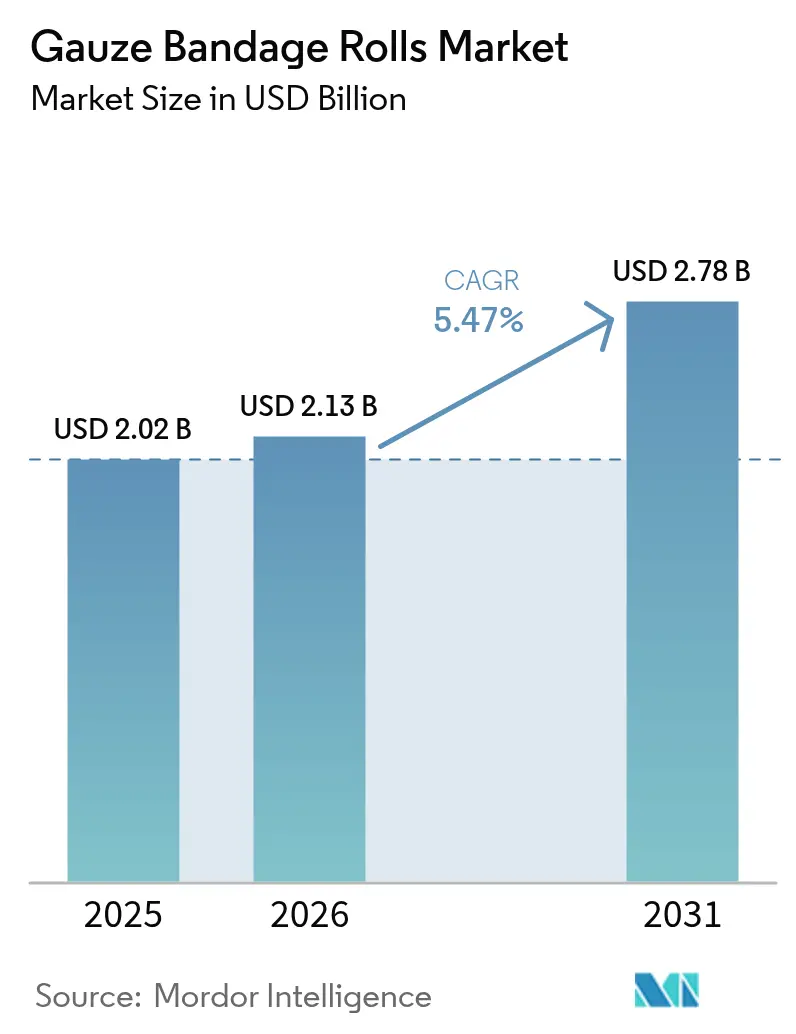
The Gauze Bandage Rolls was valued at USD 2.02 billion in 2025 and estimated to grow from USD 2.13 billion in 2026 to reach USD 2.78 billion by 2031, at a CAGR of 5.47% during the forecast period (2026-2031). Demand accelerates as minimally-invasive and robotic surgeries proliferate, outpatient volumes rise, and healthcare systems increasingly emphasize infection-prevention features in basic dressings. Providers favor gauze rolls engineered with radiopaque threads or antimicrobial agents that align with modern imaging and safety protocols. Meanwhile, the reshoring of medical-textile production in the United States and Europe elevates supply-chain security as a purchasing criterion. Digital procurement channels further reshape competition by enabling manufacturers to bypass intermediaries and engage directly with end users.
Key Report Takeaways
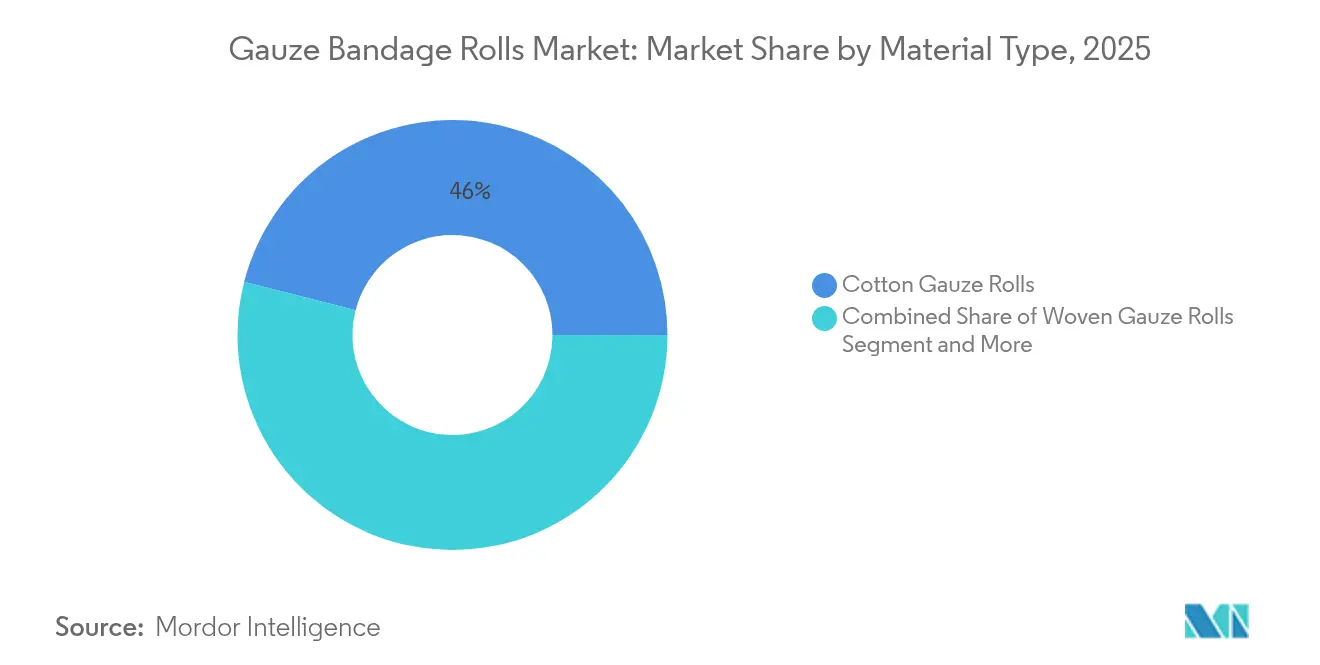
- By material, cotton gauze led with 46.02% revenue share in 2025, while antimicrobial and impregnated variants are advancing at a 9.05% CAGR through 2031.
- By application, surgical wounds commanded 51.12% of the Gauze Bandage Rolls market share in 2025, whereas chronic-wound care is expanding at a 7.42% CAGR to 2031.
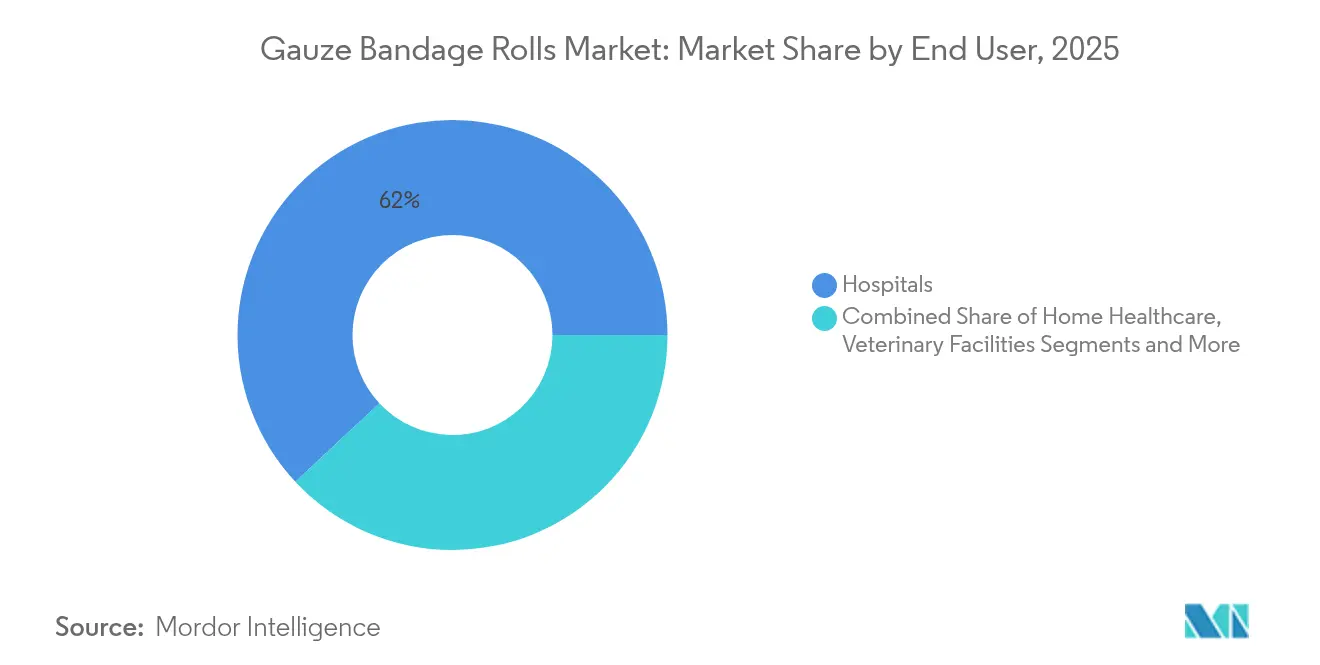
- By end user, hospitals accounted for 61.95% share of the Gauze Bandage Rolls market size in 2025; home healthcare is registering the fastest 7.28% CAGR through 2031.
- By distribution channel, direct tenders and GPOs held 41.88% in 2025, yet online pharmacies are forecast to grow at 10.78% CAGR to 2031.
- By geography, North America led with 37.25% share in 2025, whereas Asia-Pacific is projected to post the highest 10.1% CAGR between 2026 and 2031.
Note: Market size and forecast figures in this report are generated using Mordor Intelligence’s proprietary estimation framework, updated with the latest available data and insights as of 2026.
Market Trends and Insights
Drivers Impact Analysis of Gauze Bandage Rolls Market*
| Driver | (~) % Impact on CAGR Forecast | Geographic Relevance | Impact Timeline |
|---|---|---|---|
| Surging volume of minimally-invasive & robotic surgeries | +1.2% | North America, Europe, global spill-over | Medium term (2-4 years) |
| Rapid growth of outpatient/ASC wound closures | +0.8% | North America, Europe, expanding to APAC | Short term (≤ 2 years) |
| Government bulk-buy programs in China & India | +0.6% | APAC core, spill-over to MEA | Long term (≥ 4 years) |
| Re-shoring of U.S./EU medical-textile supply chains | +0.4% | North America & EU | Medium term (2-4 years) |
| Emergence of radiopaque gauze rolls for AI-enabled imaging | +0.3% | Developed markets first, global later | Long term (≥ 4 years) |
| Increasing battlefield trauma kits across NATO & QUAD forces | +0.2% | North America, Europe, APAC defense | Medium term (2-4 years) |
| Source: Mordor Intelligence | |||
Surging Volume of Minimally-Invasive & Robotic Surgeries
Robot-assisted procedures create small incisions that demand gauze with low fiber-shedding and heightened absorption to protect precision surgical fields. Radiopaque yarns enable surgeons and AI-driven imaging systems to confirm removal before closure, lowering retained-sponge events. Hospital supply managers now treat advanced gauze as a regulated device, requiring validated performance data before purchase. As more robotic cases migrate to outpatient centers, procurement teams favor premium formulations that accelerate recovery under limited clinical supervision. The result is sustained demand for specialty products across the Gauze Bandage Rolls market, even as surgical technology itself becomes more sophisticated.
Rapid Growth of Outpatient/ASC Wound Closures
Ambulatory surgical centers (ASCs) prioritize dressings that limit post-op visits and empower patient self-management. Gauze engineered for extended wear and moisture control therefore wins contracts when total cost of care—rather than acquisition price—guides purchasing. Clinical directors increasingly evaluate dressings on their ability to maintain comfort scores and reduce unplanned consultations, shifting gauze from a commodity to a quality-metric lever. Manufacturers that supply outcome data gain an edge in the Gauze Bandage Rolls market because many ASCs now include dressing performance in accreditation audits.
Government Bulk-Buy Programs in China & India Driving Tender Sizes
China’s centralized tenders bundle medical consumables into volume-price contracts that compress margins yet guarantee vast orders. India’s parallel procurement drives similar scale, compelling multinational suppliers to localize production or risk exclusion. Tender documents now stipulate basic antimicrobial performance, effectively raising the functional baseline of low-priced products. Companies with domestic plants or technology transfer agreements therefore gain priority status in the Gauze Bandage Rolls market across Asia-Pacific.
Re-Shoring of U.S./EU Medical-Textile Supply Chains Post-COVID
Pandemic-era shortages motivated policymakers to subsidize domestic gauze production, making supply security part of value analysis. Group purchasing organizations (GPOs) in the United States allocate preference points to vendors demonstrating regional manufacturing redundancy[1]U.S. Government Accountability Office, “Owens & Minor Distribution, Inc.; Cardinal Health 200, LLC; Concordance Healthcare Solutions,” gao.gov. European buyers apply similar criteria as new Medical Device Regulation amendments intensify traceability requirements. Premium pricing thus becomes attainable for firms able to show both compliance and proximity, offsetting higher labor costs while increasing market stickiness in the Gauze Bandage Rolls market.
Restraints Impact Analysis of Gauze Bandage Rolls Market*
| Restraint | (~) % Impact on CAGR Forecast | Geographic Relevance | Impact Timeline |
|---|---|---|---|
| Substitution By Advanced Hydrocolloid & Foam Dressings | -0.7% | Global, accelerated in developed markets | Short term (≤ 2 years) |
| Cotton Price Volatility Squeezing Margins | -0.5% | Global, particularly affecting cost-sensitive markets | Short term (≤ 2 years) |
| Single-Use-Plastic Clamp Downs Hitting Synthetic Woven Gauze Adoption | -0.3% | Europe & North America, expanding globally | Medium term (2-4 years) |
| Decentralised 3-D Printed Dressings In Large IDNs | -0.2% | North America & Europe, pilot programs in APAC | Long term (≥ 4 years) |
| Source: Mordor Intelligence | |||
Substitution by Advanced Hydrocolloid & Foam Dressings
Foam dressings achieve superior moisture balance and reduce change frequency, often shortening healing time versus traditional gauze. When nursing labor is accounted for, total cost can favor foam even at higher unit prices, prompting formulary switches in chronic-wound clinics. Manufacturers of gauze respond by adding antimicrobial coatings or hydrogel layers, yet the performance gap persists in heavily exuding wounds. Institutional shift toward value-based reimbursement therefore moderates volume expansion in the Gauze Bandage Rolls market.
Cotton Price Volatility Squeezing Margins
Fluctuating global cotton prices, now projected between 66–79 cents per pound for 2025, compress operating margins because tender-based buyers resist mid-contract price hikes[2]Yangxuan Liu, “2025 Cotton Outlook and Market Situation,” University of Georgia Extension, extension.uga.edu. Some producers hedge with synthetic blends, but hospital purchasers remain cautious about substituting unproven fibers. Longer-term contracts that lock pricing transfer commodity risk to manufacturers, challenging firms that lack diversified material portfolios within the Gauze Bandage Rolls market.
*Our forecasts treat driver/restraint impacts as directional, not additive. The impact forecasts reflect baseline growth, mix effects, and variable interactions.
Gauze Bandage Rolls Market Segment Analysis
By Material Type:
Functional Additives Redraw Competitive BoundariesCotton rolls held 46.02% of 2025 revenue, validating their entrenched clinical acceptance and low unit cost. Antimicrobial and impregnated gauze—often carrying silver, PHMB, or honey—are scaling fastest at 9.05% CAGR, reflecting infection-control mandates in acute and post-acute care. The Gauze Bandage Rolls market size for these enhanced products is expected to more than double by 2030, encouraging R&D investment. Non-woven viscose and polyester blends gain traction in orthopedic theaters because they shed fewer fibers, lowering risk of granuloma formation. Elastic rolls sustain niche demand in compression therapy, while X-ray detectable variants remain surgical staples.
Competitive differentiation now centers on absorption kinetics, bacterial-kill profiles, and imaging compatibility rather than mere thread count. Regulatory pathways have tightened accordingly: manufacturers must supply bench and in-vivo data to secure 510(k) clearances in the United States or CE marking in Europe. Smaller firms often out-license coating technologies to scale quickly, while multinationals vertically integrate cotton supply to mitigate raw-material risk. As a result, the Gauze Bandage Rolls market witnesses a convergence of textile engineering and pharmaceutical know-how.


By Application:
Surgical Dominance Meets Chronic-Care MomentumSurgical wounds generated 51.12% of 2025 revenue, maintained by standardized use across operating rooms worldwide. Meticulous count protocols and the need for radiopaque markers reinforce gauze consumption per procedure, sustaining high baseline volumes. Yet chronic wounds—diabetic foot ulcers, venous leg ulcers, pressure injuries—show the quickest expansion at 7.42% CAGR, as population aging and diabetes prevalence climb. The Gauze Bandage Rolls market size for chronic-care applications benefits from home-health expansion, where caregivers favor familiar, low-cost dressings augmented with antimicrobial agents.
Trauma and burn units continue to rely on high-absorbency gauze for rapid exudate management before specialized dressings are applied. Dental and ENT clinics require smaller, hemophilic sponges that conform to cavity shapes; these micro-niche formats spur custom manufacturing runs. Veterinary practitioners increasingly adopt human-grade gauze to treat companion animals, contributing incremental volume. Across applications, payer scrutiny pressures clinicians to document dressing impact on healing timelines, elevating the importance of published evidence within the Gauze Bandage Rolls market.
By End User:
Hospitals Still Rule, but Home Care SurgesHospitals accounted for 61.95% of 2025 shipments owing to concentrated surgical volumes and centralized procurement. They favor suppliers offering just-in-time delivery and bar-coded packs for inventory controls. Home-health agencies, however, represent the fastest-growing channel at 7.28% CAGR as care shifts to community settings. Patients managing post-operative incisions at home need clear instructions and easy-open packaging, steering manufacturers toward consumer-oriented design.
Ambulatory surgical centers (ASCs) demand cost-optimized yet performance-verified gauze, reflecting reimbursement pressures. Specialty wound clinics purchase higher-margin impregnated rolls for chronic ulcers, while military and veterinary buyers specify additional durability or clotting functionality. Serving this diverse customer base requires segmented sales forces and education programs, raising entry barriers inside the Gauze Bandage Rolls market.
By Distribution Channel:
Digital Platforms Challenge Legacy NetworksDirect tenders and GPOs retained 41.88% of 2025 revenue, cementing institutional influence over high-volume transactions. Contract cycles typically run three years and bundle gauze with other consumables, creating cross-selling leverage for large suppliers. Online pharmacies, though, are expanding at 10.78% CAGR, riding e-prescription adoption and consumer preference for doorstep delivery. Small clinics and home-care nurses purchase through these portals when bulk contracts are impractical, broadening the Gauze Bandage Rolls market reach.
Traditional distributors adapt by offering value-added logistics such as automatic stock replenishment and track-and-trace dashboards. Manufacturers investing in e-commerce sites capture higher margins and gain real-time consumption data, informing demand planning. Regulatory agencies now audit digital supply chains for authentication compliance, pressuring platforms to integrate serial-number verification tools. Consequently, distribution strategy evolves from pure volume to data-augmented service in the Gauze Bandage Rolls market.
Geography Analysis
North America Gauze Bandage Rolls Market
North America held 37.25% of 2025 revenue, reflecting robust surgical volumes, early adoption of robotic systems, and premium reimbursement for innovative dressings. Post-pandemic policies rewarding domestic production grant price premiums to U.S. plants, partially offsetting higher wages. Canada’s single-payer framework centralizes purchasing, pushing suppliers to show quality metrics alongside competitive pricing, while Mexico’s healthcare reform fosters new hospital builds that favor cost-efficient cotton-based products. Altogether these dynamics preserve the region’s central role in the Gauze Bandage Rolls market.
APAC Gauze Bandage Rolls Market
Asia-Pacific leads growth at a projected 10.1% CAGR to 2031 as China and India expand universal health coverage. China’s volume-price procurement contracts standardize antimicrobial criteria, driving scale in mid-tier product categories. Indian state tenders mirror the approach, but segment pricing tiers encourage separate SKUs for public and private buyers. Mature markets such as Japan and South Korea emphasize regulatory compliance and environmental packaging mandates, encouraging suppliers to invest in lifecycle assessments. ASEAN nations, meanwhile, prioritize affordability, creating a bifurcated Gauze Bandage Rolls market that rewards both global giants and agile domestic firms.
Europe Gauze Bandage Rolls Market
Europe records steady expansion anchored in sustainability mandates. The forthcoming EU Packaging and Packaging Waste Regulation compels gauze producers to incorporate recycled content and design recyclable wraps by 2026. Germany and the United Kingdom spearhead adoption of advanced dressings for chronic wounds, leveraging evidence-based guidelines. Southern European countries, operating under tighter fiscal constraints, continue to prioritize low-cost cotton rolls, sustaining volume in the Gauze Bandage Rolls market. East-European accession funds upgrade hospital infrastructure, producing incremental demand that global and regional suppliers court through joint-venture plants.


Competitive Landscape
The Gauze Bandage Rolls market remains moderately fragmented. Cardinal Health and Medline Industries anchor the multinational tier with diversified portfolios and vertically integrated manufacturing. Competitive focus shifts from price alone to proof of antimicrobial efficacy, radiopacity, and environmental compliance.
Strategic trends highlight vertical integration: Cardinal Health reports incremental capex for cotton processing lines to buffer raw-material swings. Solventum invests in automation to boost output predictability and comply with forthcoming FDA Quality System Regulation amendments. Medline, planning an IPO, channels proceeds toward expanding e-commerce logistics capabilities, seeking direct access to the fast-growing home-health segment. Mid-size Asian players scale production through government subsidies tied to localization mandates, intensifying price pressure in tender markets.
Technological disruption introduces smart-bandage start-ups that embed sensors to relay exudate levels or pH values via Bluetooth. While volumes remain small, multinationals forge licensing deals to avoid disintermediation. Defense contracts for hemostatic gauze, awarded after rigorous field trials, bolster credibility for suppliers that later cross-sell to civilian trauma units. Overall, the Gauze Bandage Rolls market rewards companies that blend textile science, antimicrobial chemistry, and digital supply-chain prowess.
Gauze Bandage Rolls Industry Leaders
Cardinal Health
Dynarex Corp.
Medline Industries
BSN medical (Essity)
TROGE Medical
- *Disclaimer: Major Players sorted in no particular order
Gauze Bandage Rolls Market Companies Covered in this Report
- Solventum Corporation
- Cardinal Health
- Medline Industries
- BSN medical (Essity)
- Johnson & Johnson
- Smiths Group
- Molnlycke Health Care
- McKesson Medical-Surgical
- Hartmann Group
- Dynarex Corp.
- Convatec
- Deroyal Industries
- Lohmann & Rauscher
- Winner Medical
- TROGE Medical
- Kuteks
- Integrity Medical Devices
- Neomedic Ltd.
- Fazzini
- Shandong Yuyun Sanhe
- Zhende Medical

Market Opportunities and Future Outlook
White space for gauze bandage roll suppliers is forming as buyers upgrade baseline dressings to incorporate infection-prevention, traceability, and outpatient self-care requirements, while still relying on gauze for cost and familiarity. Hospitals and ASCs increasingly assess gauze against performance attributes emphasized in this report, including antimicrobial activity, low linting, and radiopacity for surgical count safety, which supports demand for premium SKUs rather than commodity-only tender positions. Online pharmacies are also the fastest channel shift noted in the report, providing a direct route for home-healthcare packs and packaging that can carry additional patient-facing guidance.
The broader wound care pipeline is also moving toward hybrid and advanced materials, so gauze manufacturers can look to adjacent offerings and co-packaging strategies instead of competing only on unit price. In 2026, Molnlycke Health Care announced a EUR 40 million manufacturing investment in Finland and the UK to lift capacity by about 100 million units (roughly a 50% increase), and it also advanced localization with a new facility in Changshu, China, pointing to sustained buyer demand for regional supply resilience. Regulatory and reimbursement milestones around complex wound management, including FDA 510(k) clearances for antibacterial absorbable synthetic matrices (Kreate Medical, 2026) and Cuprina Holdings FDA 510(k) clearance for MEDIFLY Maggots (June 2026), align with the continuing clinical emphasis on infection control and debridement pathways, where gauze continues to function as a key secondary dressing, cover layer, and procedural consumable.
Recent Industry Developments in Gauze Bandage Rolls Market
- June 2026: Medline Industries, LP added new product entries, including gauze and related dressings, to the US FDA GUDID database. The updates strengthen device identification and supply-chain traceability, which is increasingly relevant for hospital inventory controls and tender documentation.
- June 2025: Cardinal Health launched the Kendall DL Multi System, a single-patient use cable and lead wire system designed for continuous monitoring of cardiac activity, blood oxygen, and temperature. While not a gauze product, the launch reinforces the shift toward single-use, workflow-oriented consumables that can shape bundled purchasing behavior across hospital medical-surgical portfolios.
- January 2024: Medline Industries, LP launched OptiView Transparent Dressing with HydroCore Technology for pressure injury prevention. The introduction highlights ongoing innovation in wound and skin-protection dressings that can substitute for gauze in some protocols, raising expectations for performance claims in basic dressing categories.


Gauze Bandage Rolls Market Report Scope and Research Methodology
Market Definition and Coverage
This market covers sales of gauze bandage rolls used to secure dressings, provide mild compression, and protect wounds across clinical and home care settings. Values reflect product revenue at the point of sale in the supply chain, tracked across major geographies.
Scope exclusions: We exclude non-roll gauze items such as pre-cut swabs/pads and adhesive bandages, and we also do not count unrelated wrap products that are not gauze-based rolls.
Segments Covered in This Report
- By Material Type
- Cotton Gauze Rolls
- Non-woven Viscose/Poly Gauze Rolls
- Woven Gauze Rolls
- Elastic Gauze Rolls
- Antimicrobial/Impregnated Gauze Rolls
- X-ray Detectable Gauze Rolls
- By Application
- Surgical Wounds
- Chronic Wounds
- Trauma & Burns
- Dental & ENT Procedures
- Veterinary Care
- By End User
- Hospitals
- Ambulatory Surgical Centers
- Clinics & Specialty Centres
- Home Healthcare
- Veterinary Facilities
- Military & Field Hospitals
- By Distribution Channel
- Direct Tenders & GPOs
- Distributor / Wholesaler
- Retail Pharmacies
- Online Pharmacies
- Geography
- North America
- United States
- Canada
- Mexico
- Europe
- Germany
- United Kingdom
- France
- Italy
- Spain
- Rest of Europe
- Asia-Pacific
- China
- Japan
- India
- South Korea
- Australia
- Rest of Asia-Pacific
- Middle East and Africa
- GCC
- South Africa
- Rest of Middle East and Africa
- South America
- Brazil
- Argentina
- Rest of South America
- North America
Data Sources, Market Sizing, and Validation
Desk Research
Desk work starts with understanding the demand pool for wound care and routine procedures where gauze rolls are commonly consumed, and then mapping how products move through hospital and retail channels. We refer to public health and utilization indicators from sources such as the World Health Organization, the US CDC, the World Bank, and OECD health statistics to anchor procedure volume and care-setting trends.
To sanity check supply and trade movement, we also review sources such as UN Comtrade, national customs statistics, and published tenders and procurement notices, followed by manufacturer investor materials and audited filings where they are available. Patent databases are used selectively to understand product direction (for example, antimicrobial or X-ray detectable features) and how quickly new formats get adopted. The sources listed here are illustrative only, and many other public references were also used for collection, validation, and clarification during the work.
Primary Interviews and Surveys
Primary inputs come from structured interviews and short surveys with participants across manufacturing, distribution, and care delivery, so gaps left by public statistics can be closed with practical checks. We used respondent input to confirm typical pack sizes, price movements, channel mix, and usage patterns across APAC, EMEA, and the Americas, and then re-tested the assumptions when any metric looked out of line.
Distribution of primary research fieldwork respondents
| Company type | Respondent position | Region |
|---|---|---|
| Top tier: 27% | CXOs: 19% | APAC: 45% |
| Mid tier: 51% | Functional/Unit leaders: 34% | EMEA: 29% |
| Smaller Players: 22% | Managers: 47% | Americas: 26% |
Market-Sizing & Forecasting
Sizing is built mainly using a top-down demand reconstruction, where procedure volumes and wound-care utilization are translated into gauze roll consumption, and then converted into value using observed pricing and channel mix. To keep the totals realistic, we corroborate the outcome using selective bottom-up approximations such as sampled average selling price times estimated volume by care setting, plus distributor and channel checks to adjust the final number.
A few inputs that matter a lot for gauze bandage rolls include inpatient and outpatient procedure trends, chronic wound incidence signals, burn and trauma caseload indicators, shifts in ambulatory and home care use, and the adoption rate of value-added rolls (for example, antimicrobial or radiopaque variants). When data is thin for a country, we use proxy indicators like hospital bed density, surgical rate benchmarks, and import reliance to fill gaps, and then we test those assumptions with interview feedback.
For forecasting, we typically rely on multivariate regression with scenario checks, since demand is influenced by more than one driver at a time. Expert feedback is used to keep the forward view grounded, especially for price progression and mix changes between standard cotton rolls and higher-spec formats.
Data Validation & Update Cycle
Outputs are validated through triangulation across demand signals, trade movement, and pricing expectations, and then checked for year-to-year jumps that do not align with healthcare utilization. If a region shows unusual movement, we re-check the input series, re-run sensitivity cases, and re-contact a small set of primary respondents to confirm whether the shift is real or model-driven.
Before sign-off, the model and assumptions go through multi-step internal reviews, including variance checks against adjacent wound care categories. Reports are refreshed annually, and interim updates are made when major policy, supply, or pricing events change the outlook. Right before delivery, we do a final pass so the numbers reflect the latest available information.
Mordor Intelligence's Gauze Bandage Rolls Market Size Measured Against Other Published Estimates
Published numbers for gauze bandage rolls can look far apart, even when they appear to discuss the same product, because the counted items and the year definitions are not always aligned. The differences usually come from what gets bundled into the market, how prices are treated across channels, and how quickly assumptions are refreshed.
Some external estimates appear to use a broader roll bandage basket that can drift into adjacent bandage formats, which pushes the value up, and Mordor Intelligence counts only gauze bandage rolls and keeps non-roll gauze and non-gauze wraps out of the total, with the year value tied to a defined study period and rechecked with channel pricing logic.
Benchmark comparison
| Source | Market Size | Gaps in Research Methodology |
|---|---|---|
| Mordor Intelligence | USD 2.13 B (2026) | |
| Global Research Publisher A | USD 5.82 B (2024) | Uses an earlier base year and appears to apply a wider product framing with more roll sizes and end uses counted together, which can inflate totals if adjacent roll bandage items are included beyond gauze-focused rolls. |
| Industry Publisher B | USD 2.00 B (2025) | Reports in mixed units across the page and uses a different base-year choice, and the scope language suggests a broader roll bandage set with multiple product-type splits that may not stay restricted to gauze-only rolls. |
Taken together, the spread is mainly explained by scope tightness, base-year alignment, and how channel pricing and mix are treated when converting usage into revenue. By keeping the inputs traceable to procedure and wound-care demand signals and then cross-checking with practical price and channel realities, the final value stays repeatable and easier to reconcile across regions and years.


Key Questions Answered in the Report
What is the current value of the Gauze Bandage Rolls market?
It was valued at USD 2.13 billion in 2026 and is projected to climb to USD 2.78 billion by 2031.
Which material category is growing fastest in gauze bandage rolls?
Antimicrobial and impregnated variants are expanding at a 9.05% CAGR, the highest among all material types.
Why are online pharmacies important for gauze roll suppliers?
They are the quickest-growing channel at an 10.78% CAGR, offering direct access to home-health buyers and small clinics.
Which region will add the most incremental demand by 2031?
Asia-Pacific, with a forecast 10.1% CAGR, will contribute the largest share of new volume.
How are regulatory changes affecting gauze manufacturers?
Tighter FDA and EU requirements on traceability, quality systems, and recyclable packaging are pushing companies to upgrade production and documentation processes.
Page last updated on:


 Your data is secure and never sold or shared.


