
Furnace Filters Market Size and Share
Market Overview
| Study Period | 2023 - 2031 |
|---|---|
| Market Size (2026) | USD 7.61 Billion |
| Market Size (2031) | USD 10.03 Billion |
| Growth Rate (2026 - 2031) | 5.67 % |
| Fastest Growing Market | Asia Pacific |
| Largest Market | North America |
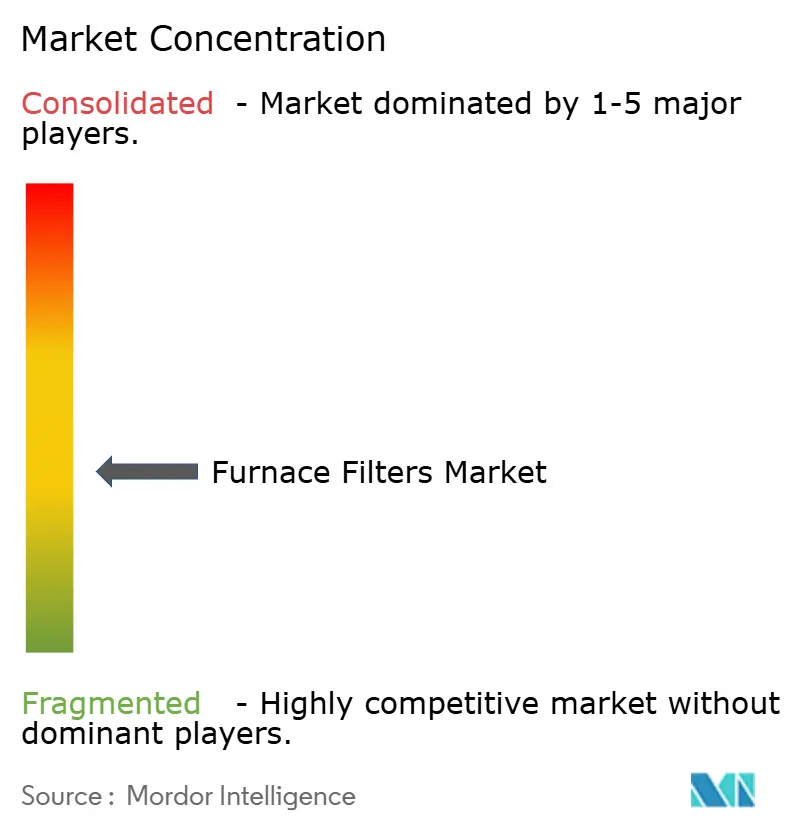
| Market Concentration | Medium |
Major Players *Disclaimer: Major Players sorted in no particular order Image © Mordor Intelligence. Reuse requires attribution under CC BY 4.0. | |
Furnace Filters Market Analysis by Mordor Intelligence
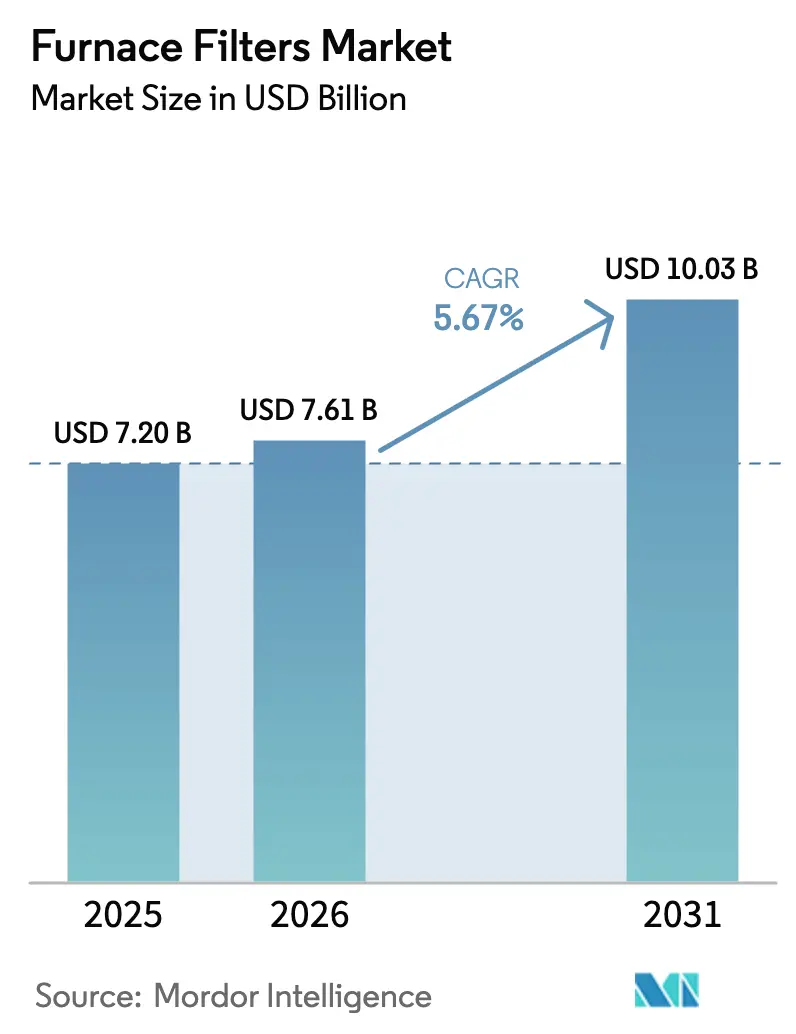
The furnace filters market size was valued at USD 7.2 billion in 2025 and estimated to grow from USD 7.61 billion in 2026 to reach USD 10.03 billion by 2031, at a CAGR of 5.67% during the forecast period (2026-2031). Heightened indoor-air-quality (IAQ) regulations, the rapid shift to MERV 13-plus standards, and heat-pump electrification programs anchor this expansion. Product demand also rises as wild-fire smoke events shorten replacement cycles, while subscription e-commerce models deepen consumer engagement. On the supply side, synthetic-media innovation supports higher efficiency at lower pressure drop, yet price volatility in petroleum-based inputs strains margins. Meanwhile, consolidation gathers pace as HVAC majors integrate filter specialists to secure technology, distribution, and recurring revenue streams.
Key Report Takeaways
- By furnace type, gas furnaces led with 45.38% of the furnace filters market share in 2025; heat pump/hybrid systems are projected to post the fastest 8.05% CAGR through 2031.
- By MERV rating, MERV 5-8 media captured 37.92% of the furnace filters market size in 2025, while the MERV 13-16 and HEPA tier is forecast to climb at a 9.42% CAGR to 2031.
- By end user, residential applications held 56.65% revenue share in 2025; industrial facilities are expanding at a 7.28% CAGR to 2031.
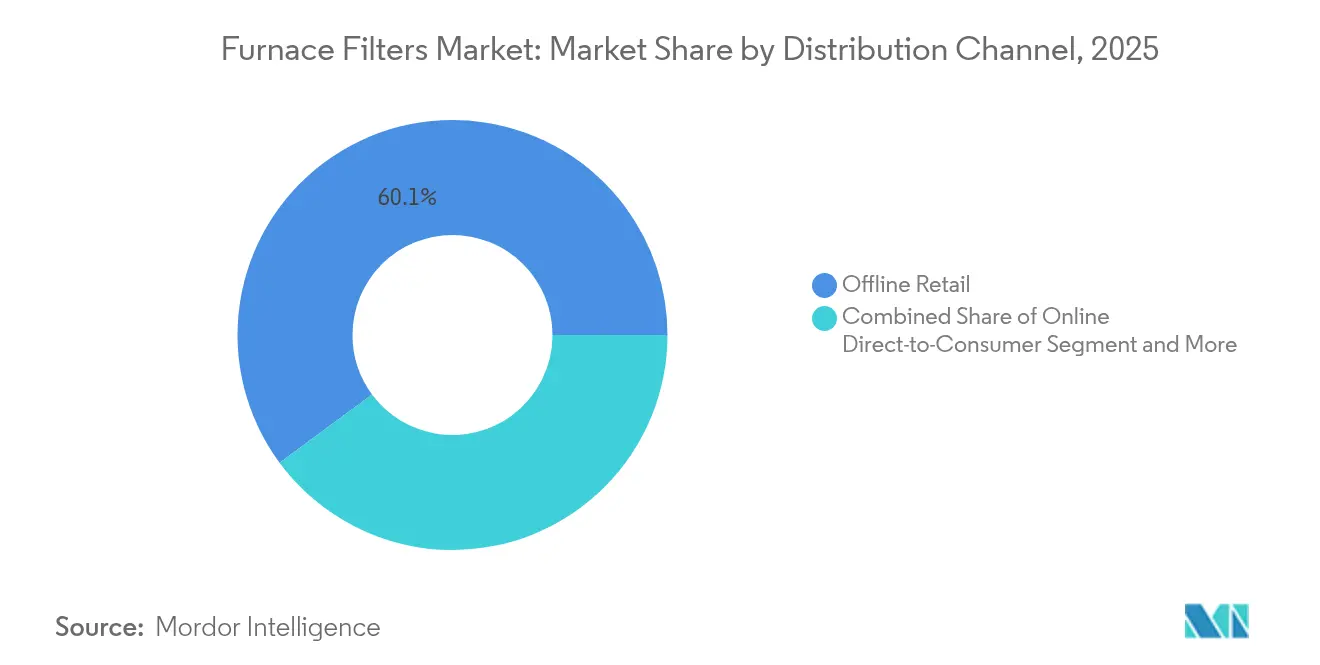
- By distribution channel, offline retail accounted for 60.12% of the furnace filters market size in 2025; subscription services record the highest 9.55% CAGR through 2031.
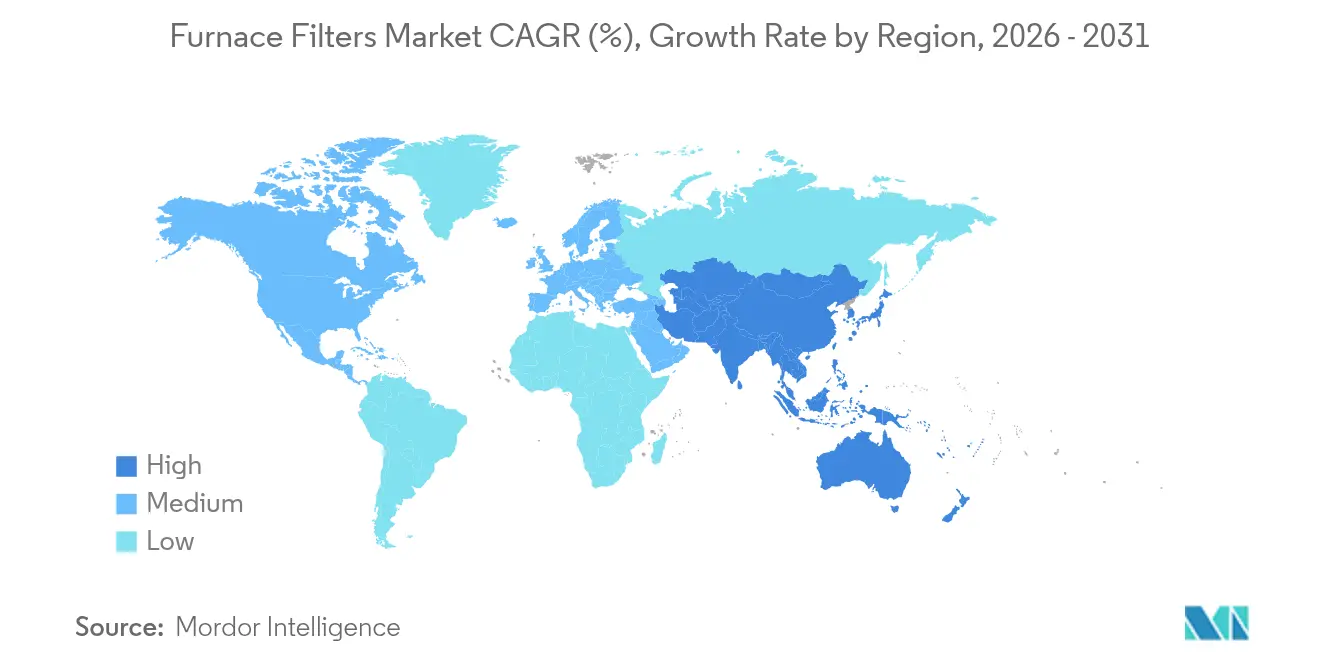
- By region, North America contributed 36.72% of 2025 revenue; Asia–Pacific is advancing at a 7.74% CAGR through 2031.
- Honeywell, 3M (Filtrete), and Nordic Pure collectively commanded a low-double-digit share of global sales in 2024, underscoring a moderately fragmented competitive field.
Note: Market size and forecast figures in this report are generated using Mordor Intelligence’s proprietary estimation framework, updated with the latest available data and insights as of 2026.
Market Trends and Insights
Drivers Impact Analysis of Furnace Filters Market*
| DRIVER | (~) % IMPACT ON CAGR FORECAST | GEOGRAPHIC RELEVANCE | IMPACT TIMELINE |
|---|---|---|---|
| Growing focus on indoor air quality (IAQ) | 1.8% | Global, with concentration in North America and EU | Medium term (2-4 years) |
| Surge in energy-efficient HVAC retrofits | 1.2% | North America and EU core, spill-over to APAC | Medium term (2-4 years) |
| Stricter IAQ and MERV mandates in building codes | 1.5% | North America and EU, emerging in APAC | Long term (≥ 4 years) |
| Heat-pump conversions requiring higher-grade filters | 0.9% | Global, led by North America and China | Long term (≥ 4 years) |
| Wild-fire smoke events boosting replacement frequency | 0.6% | North America West Coast, Australia, Southern Europe | Short term (≤ 2 years) |
| Subscription e-commerce filter services driving volume | 0.4% | North America and EU, expanding to APAC | Medium term (2-4 years) |
| Source: Mordor Intelligence | |||
Growing Focus on Indoor Air Quality (IAQ)
ASHRAE Standard 241 formalized pathogen-control benchmarks that compel commercial buildings to install MERV 13-plus filters capable of removing nearly 90% of sub-micron particles.[1] U.S. healthcare facilities already follow OSHA guidance that specifies MERV 13 or higher, a requirement now influencing residential buyers who increasingly link filtration to respiratory health. Wild-fire smoke episodes across the western United States further demonstrate the limitations of legacy MERV 8 products, prompting rapid upgrade cycles.[2] Pharmaceutical production in India and China also fuels demand for high-efficiency media that meet clean-room thresholds. As IAQ awareness rises, building owners view premium filters less as discretionary purchases and more as risk-mitigation tools.
Surge in Energy-Efficient HVAC Retrofits
Federal and state decarbonization incentives encourage property owners to swap dated packaged units for variable-refrigerant-flow and heat-pump systems. These retrofits specify deeper 4-inch media filters that retain MERV 13 performance without excessive pressure drop. Massachusetts regulations now require a 70% enthalpy-recovery ratio in ventilation systems, indirectly lifting demand for low-resistance filters that protect energy gains.[3] As older buildings align with new energy codes, contractors bundle premium filters into rebate-eligible upgrade kits, generating multi-year pull-through revenue for filter suppliers.
Stricter IAQ and MERV Mandates in Building Codes
California’s building code obliges all mechanically ventilated spaces to use a minimum MERV 13 filter and to ensure zero bypass through sealed racks, raising compliance hurdles. Similar directives surface in the European Union where LEED and BREEAM scoring weight filtration performance. Sweden’s shift from plastic to steel frames illustrates regulators’ attention to lifecycle waste, giving established brands with certified products a competitive edge. As multinational firms harmonize global facility standards, higher-efficiency filters become baseline specifications even in jurisdictions without formal mandates.
Heat-Pump Conversions Requiring Higher-Grade Filters
Heat pumps circulate larger air volumes year-round, making them sensitive to airflow restriction. Manufacturers therefore prescribe 4- or 5-inch pleated synthetic filters that hold more dust at MERV 13 efficiency than a thin fiberglass mat. China, which produces one-quarter of global heat pumps, sets filtration requirements that resonate worldwide as export brands standardize on these specifications. Electrification policies in California and the European Union accelerate heat-pump adoption, shortening replacement intervals and lifting consumable sales.
Restraints Impact Analysis of Furnace Filters Market*
| RESTRAINTS | (~) % IMPACT ON CAGR FORECAST | GEOGRAPHIC RELEVANCE | IMPACT TIMELINE |
|---|---|---|---|
| High life-cycle maintenance cost | -0.8% | Global, particularly price-sensitive residential markets | Medium term (2-4 years) |
| Raw-material price volatility (synthetic media) | -0.6% | Global manufacturing, acute in Asia-Pacific | Short term (≤ 2 years) |
| Mini-split adoption (filterless HVAC) | -0.4% | APAC core, expanding to North America and EU | Long term (≥ 4 years) |
| Sustainability push against disposable filters | -0.3% | EU and North America, emerging in APAC | Medium term (2-4 years) |
| Source: Mordor Intelligence | |||
High Life-Cycle Maintenance Cost
MERV 13 filters cost roughly three to four times more than fiberglass options and load faster, raising annual replacement outlays for households to beyond USD 200. In commercial towers with dozens of air handlers, filter procurement and labor fees reach thousands per year. Elevated energy draw—15-20% higher fan power at comparable airflow—further inflates operating budgets. While subscription platforms smooth monthly payments, total cost often rises versus retail channels, limiting upgrade rates in emerging economies where capital preservation outweighs IAQ priorities.
Raw-Material Price Volatility (Synthetic Media)
Polypropylene and polyester prices swing 30-40% year-on-year as crude-oil benchmarks and freight costs gyrate. The heavy concentration of melt-blown production in China magnifies exposure to regional outages. US tariffs on selected imports compound unpredictability, while steel and aluminum frame costs climb in tandem with global construction demand. Smaller filter makers lacking hedging programs see margin compression when raw-material inflation outpaces price increases, constraining product innovation.
*Our forecasts treat driver/restraint impacts as directional, not additive. The impact forecasts reflect baseline growth, mix effects, and variable interactions.
Furnace Filters Market Segment Analysis
By Furnace Type:
Gas Dominance Faces Heat Pump ChallengeGas furnaces accounted for 45.38% of the furnace filters market in 2025, underpinned by a vast installed base across North American homes. In contrast, the furnace filters market size linked to heat pump or hybrid systems is projected to grow at an 8.05% CAGR, reflecting electrification incentives that narrow operating-cost gaps. Oil furnaces persist only in geographies lacking pipeline gas, while electric resistance units occupy small niches.
Year-round heat pump operation mandates deeper MERV 13 media to avoid airflow penalties, raising unit revenue per install. Gas models retain standard 1-inch pleated filters, but regulatory convergence will gradually lift their efficiency requirements. As the EPA phases out R-410A, contractors stress system cleanliness, reinforcing demand for premium filters that capture installation debris and safeguard compressors.


By MERV Rating:
Regulatory Push Elevates Performance StandardsWith a 37.92% share in 2025, MERV 5-8 filters remain common in low-risk residential settings; however, the furnace filters market size for MERV 13-16 and HEPA products is advancing at a 9.42% CAGR through 2031. Smoke events and pandemic-era health messaging make higher ratings the de facto choice for new builds.
Wild-fire prone regions adopt specialty media engineered to maintain efficiency despite extreme particle loading. Healthcare and clean-manufacturing customers set procurement baselines at MERV 13, a threshold now filtering into retail offerings. Mid-range MERV 9-12 options serve cost-conscious users upgrading in steps, though policy tightening could compress this transitional category.
By End User:
Industrial Growth Outpaces Residential DemandResidential buyers represented 56.65% revenue in 2025, but industrial consumption is outpacing at a 7.28% CAGR as pharmaceutical, semiconductor, and food-processing plants tighten contamination controls. The furnace filters market share for institutional and commercial buildings also rises as ASHRAE 241 compliance becomes standard lease language.
Factories deploy differential-pressure sensors to trigger filter changeouts, creating predictable reorder schedules and supporting vendor-managed inventory programs. Residential demand shifts toward subscription deliveries that remind households to replace filters on time, reducing HVAC energy waste and premature fan failures.
By Distribution Channel:
Digital Transformation AcceleratesOffline DIY chains and HVAC wholesalers still moved 60.12% of units in 2025, yet e-commerce gains traction through detailed sizing tools and same-day shipping. Subscription portals post a 9.55% CAGR, the highest among channels, as homeowners embrace “set-and-forget” replenishment that arrives before filters clog.
Contractor portals bundle filters with coil cleaners and thermostats at negotiated rates, reinforcing wholesale relevance. Direct-to-consumer brands differentiate through educational content and MERV-rating explainers, nudging buyers toward premium tiers and enlarging average order value.
By Filter Media:
Synthetic Innovation Drives PerformanceManufacturers favor pleated synthetic media for its superior dust-holding capacity and bacterial resistance. Fiberglass retains a foothold where price sensitivity eclipses performance, notably in rental units. Electrostatic washable filters appeal to environmentally minded buyers despite higher upfront cost.
Innovations such as 3M’s metal-free frame reduce landfill waste by 3.5 million pounds annually while maintaining rigidity. Nanofiber overlays from MANN+HUMMEL boost capture efficiency at lower pressure drop but remain premium-priced. Biodegradable protein-based media research hints at future disposability breakthroughs that could redefine end-of-life protocols.
Geography Analysis
North America Furnace Filters Market
North America generated 36.72% of global revenue in 2025, buoyed by stringent energy codes that require MERV 13 filters in new construction and major retrofits. Wild-fire smoke across California, Oregon, and British Columbia shortens replacement cycles and lifts unit volumes. The region also leads subscription adoption, as brands like FilterBuy dominate automated delivery programs.
APAC Furnace Filters Market
Asia–Pacific is the fastest-growing territory with a 7.74% CAGR through 2031. India’s HVAC market is trending toward USD 30 billion by 2030, creating substantial downstream pull for filter suppliers aligned with the Production Linked Incentive scheme. China’s control of more than one-quarter of global heat-pump sales sets filtration standards that ripple worldwide. Japan and South Korea impose strict IAQ limits in dense urban high-rises, cementing MERV 13-plus adoption.
EMEA Furnace Filters Market
Europe posts steady gains on the back of Green Deal energy directives and escalating carbon tariffs. Sweden’s steel-frame mandate signals the bloc’s wider push for recyclable materials, while Germany advances subsidy programs for heat-pump retrofits. The Middle East and Africa begin to surface on supplier radars as Saudi Arabia’s Vision 2030 funds large-scale building projects requiring advanced HVAC systems.
Regulatory Landscape
Performance and compliance expectations for furnace filters are anchored by widely applied standards rather than a single global regulation. In North America, ASHRAE Standard 52.2-2017 underpins the Minimum Efficiency Reporting Value (MERV) scale (1-16) used in product labeling and specification. It is increasingly referenced as jurisdictions and owners standardize around MERV 13-plus filtration for indoor air quality (IAQ) and health-focused building operation. ASHRAE Standard 241 further raises filtration requirements in commercial and institutional settings by defining infection risk management requirements tied to equivalent clean airflow metrics, which pushes facility managers and designers toward higher-efficiency filters and tighter installation practices to reduce bypass.
Internationally, ISO 16890 is the primary framework for rating air filter efficiency (ePM1, ePM2.5, ePM10), and it has largely displaced the older EN 779 approach in Europe. That split means North America commonly relies on MERV-based specifications, while many other markets use ISO 16890 classes, keeping certification, testing, and documentation central to go-to-market strategy for global suppliers. It also affects how suppliers address sustainability scrutiny around materials and end-of-life handling for disposable filters.
Value Chain Analysis
The furnace filter value chain begins with upstream inputs such as synthetic nonwovens and resins (commonly polypropylene and polyester) for pleated media, along with frame materials (cardboard, plastic, or metal). Media formation and treatment, including melt-blown layers, electrostatic charging, and emerging bio-based formulations, add value by determining filtration efficiency versus pressure drop. That relationship influences HVAC energy use and replacement cadence. Petroleum-linked feedstock volatility and concentrated production for some nonwoven types also raise procurement risk, which makes multi-sourcing, specifications harmonization, and inventory buffering important for manufacturers and private-label programs.
Midstream steps include pleating, assembly, gasketing, packaging, and performance testing to support ASHRAE 52.2 or ISO 16890 claims. Larger filtration specialists and HVAC-aligned players often run more integrated models to protect quality and supply continuity, and scale plants support premium OE and aftermarket output, including for example MANN+HUMMEL's integrated production in Germany. Downstream channels include HVAC wholesalers, contractors, and DIY retail, as well as online direct-to-consumer and subscription replenishment programs. Those last two channels increasingly combine sizing tools and reorder reminders with fulfillment, shifting value capture toward brands that can pair compliant products with reliable logistics and consumer engagement.
Competitive Landscape
The furnace filters market features moderate fragmentation; the top ten suppliers hold well under half of global sales. Strategic acquisitions accelerate as OEMs seek vertical integration: Daikin’s USD 430 million purchase of Flanders Holdings bolstered its industrial-grade portfolio, and Rheem’s move for Fujitsu’s HVAC business extends its installed base. Private-equity interest rises, attracted by the sector’s recurring-replacement model and regulatory tailwinds.
Technology differentiation intensifies around smart filters that alert users to pressure thresholds. 3M’s refillable frame promises a 20-year lifespan, slashing waste and recurring frame cost. Metalmark addresses wild-fire smoke with the first purpose-built MERV 13 filter validated for extreme PM2.5 environments.
Subscription commerce has become a competitive battleground. Nordic Pure leverages direct customer education, while Honeywell experiments with bundled smart thermostats and filter-reorder capabilities. Smaller innovators target heat-pump airflow challenges and biodegradable media niches, compelling incumbents to accelerate R&D and sustainability pledges.
Furnace Filters Industry Leaders
-
Honeywell
-
3M Company
-
MANN+HUMMEL GmbH
-
Lennox International Inc.
-
AprilAire LLC
- *Disclaimer: Major Players sorted in no particular order
Furnace Filters Market Companies Covered in this Report
- Honeywell International Inc.
- 3M Company (Filtrete)
- Nordic Pure LLC
- Rheem Manufacturing Company
- FilterBuy Inc.
- Lennox International Inc.
- AprilAire LLC
- MANN+HUMMEL GmbH
- AAF International (Daikin)
- Camfil AB
- Parker-Hannifin Corp.
- Freudenberg Filtration Technologies SE
- Donaldson Company Inc.
- Koch Filter Corporation
- General Filters Inc.
- KOOL-IT Filtration
- Glasfloss Industries
- PureFilters Canada Inc.
Market Opportunities and Future Outlook
A key whitespace sits at the intersection of higher-efficiency filtration and sustainability. Building owners and consumers want MERV 13-plus performance without a proportional increase in pressure drop, waste, or total annual cost. Product platforms that reduce material use per changeout, such as refillable or longer-life concepts, align with the sustainability push against disposable filters while still meeting tightening IAQ expectations. One market signal is 3M expanding its Filtrete refillable air filter platform in 2025, combining waste reduction claims with third-party certification coverage for an expanded range of filters.
Asia-Pacific localization and circular-design capability building also offer a pathway for suppliers to reduce lead times and tailor products to regional HVAC mixes, including heat-pump and hybrid systems that run year-round. In May 2026, MANN+HUMMEL opened a Global Technology and Innovation Center in Tumkur, Karnataka, described as its largest development hub outside Germany, with a mandate that includes circular product design and energy-efficient filtration systems. The company also communicated continued investment in India across expansion projects, including Tumkur and Pune, reinforcing the availability of regional engineering and manufacturing capacity that can support faster product iteration, local standards alignment, and cost-competitive supply for both offline channels and rapidly scaling online and subscription programs.
Recent Industry Developments in Furnace Filters Market
- May 2026: MANN+HUMMEL GmbH launched Global Technology & Innovation Center in Tumkur, Karnataka, India. The launch expands global R&D capabilities for filtration technology. It strengthens regional engineering footprint and speed to market in Asia-Pacific.
- May 2026: MANN+HUMMEL GmbH announced investment in a new fully integrated manufacturing facility in Pune, India. The investment expands capacity for automotive and industrial filtration. It enhances regional supply chain and manufacturing integration in high-growth markets.
- April 2025: 3M Company launched Filtrete Refillable Air Filter Kit featuring a reusable frame and longer-life filter. The move supports life-cycle cost reduction and recurring revenue through a refillable platform.
Furnace Filters Market Report Scope and Research Methodology
Market Definition and Coverage
For this methodology, the furnace filters market counts the value of replacement and OEM filters used in forced air HVAC furnaces and air handlers, across residential and non-residential buildings. The scope includes filters purchased through retail, contractor, or online channels.
Scope exclusions: It excludes standalone portable air purifiers, industrial dust collection filters, and vehicle cabin air filters.
Segments Covered in This Report
- By Furnace Type
- Gas
- Oil
- Electric Resistance
- Heat-Pump / Hybrid
- By MERV Rating
- MERV 1-4
- MERV 5-8
- MERV 9-12
- MERV 13-16 and HEPA
- By End User
- Residential
- Commercial
- Industrial
- By Distribution Channel
- Offline Retail (DIY Stores, HVAC Wholesalers)
- Online Direct-to-Consumer
- Subscription Services
- By Filter Media
- Fiberglass
- Pleated Synthetic
- Electrostatic
- By Geography
- North America
- United States
- Canada
- Mexico
- Europe
- Germany
- France
- United Kingdom
- Italy
- Rest of Europe
- Asia-Pacific
- China
- Japan
- India
- South Korea
- Rest of Asia-Pacific
- South America
- Brazil
- Argentina
- Rest of South America
- Middle East and Africa
- Middle East
- Saudi Arabia
- UAE
- Turkey
- Africa
- South Africa
- Nigeria
- Rest of Africa
- Middle East
- North America
Data Sources, Market Sizing, and Validation
Desk Research
Desk research was used to anchor the demand pool and the operating context for furnace filtration, before assumptions were tested with real market participants. We relied on public sources such as U.S. Census Bureau construction and housing data, U.S. Energy Information Administration heating and energy-use statistics, EPA indoor air quality and guidance materials, and standards documents from ASHRAE and ISO that influence filtration efficiency targets.
To cross-check the demand and operating assumptions, we also reviewed company annual reports, investor presentations, earnings-call notes, and reputable industry press that tracks HVAC equipment shipments and replacement behavior. Where trade flows and media inputs were relevant, we referenced an import-export shipment-level database and a paid company financials and intelligence database. These desk research sources are illustrative, and many other public and subscription sources were also used to collect, validate, and clarify data.
Primary Interviews and Surveys
Primary work focused on turning broad filtration and HVAC signals into practical sizing inputs that can be defended on a client call. We interviewed and surveyed manufacturers, distributors, contractors, and facility stakeholders across major regions. This helped validate replacement cycles, the price ladder by efficiency class, and channel mix shifts.
Where answers varied by building type and climate, follow-up checks were done so assumptions stayed consistent across regions and end users. Final inputs were then aligned to what was observed in the wider desk evidence.
Distribution of primary research fieldwork respondents
| Company type | Respondent position | Region |
|---|---|---|
| Top tier: 33% | CXOs: 22% | APAC: 41% |
| Mid tier: 45% | Functional/Unit leaders: 33% | EMEA: 32% |
| Smaller Players: 22% | Managers: 45% | Americas: 27% |
Market-Sizing & Forecasting
Market sizing was built using a top-down and bottom-up model logic. The top-down view starts from the installed base of forced air HVAC systems and expected filter consumption per system, then adjusts for efficiency preference and channel coverage. After forming the demand pool, it was converted into value using realistic average selling prices by MERV band, filter media, and common thicknesses.
To make sure totals were not drifting, we applied selective bottom-up checks using supplier revenue disclosures, distributor and contractor channel checks, and sampled price points across offline and online channels. When data gaps appeared (for example, private brands or fragmented local distribution), we used proxies based on neighboring markets and then corrected them through expert feedback.
For forecasting, we used scenario analysis because replacement behavior can shift with indoor air quality awareness, wildfire smoke seasons, and rule-of-thumb upgrades (such as moving toward higher MERV targets). Key inputs tracked include housing starts and retrofit activity, HVAC equipment replacement rates, filter replacement frequency by building type, mix shift toward pleated and higher efficiency media, and regional price changes linked to input materials and freight.
Data Validation & Update Cycle
Outputs were validated through multiple checks so the final number stays tied to real demand and price behavior. We compared modeled value trends against independent signals such as HVAC equipment shipment momentum, construction activity direction, and visible shifts in filter efficiency preference, then investigated any large variance before sign-off.
A multi-step analyst review was followed, and respondents were re-contacted when a key assumption moved or when a new event could change replacement rates or pricing. Reports are refreshed annually, with interim updates if a material change occurs, and a final pre-delivery review is completed so clients receive the latest updated view.
Mordor Intelligence's Furnace Filters Market Size Compared With Other Published Estimates
Published market estimates for furnace filters often vary because the product boundary is not consistent, and because different models treat efficiency upgrades and replacement timing in different ways. The same market can look larger or smaller depending on whether adjacent HVAC filtration categories are blended in, and whether the estimate emphasizes OEM shipments or aftermarket replacement demand.
The table shows a wide spread around the 2026 starting point, and in Mordor Intelligence's model the value is counted only for filters used in forced air furnaces and air handlers. Pricing is built from MERV and media mix rather than applying one blended ASP across all channels.
Benchmark comparison
| Source | Market Size | Gaps in Research Methodology |
|---|---|---|
| Mordor Intelligence | USD 7.61 B (2026) | |
| Industry Association A | USD 6.90 B (2026) | Often leans on shipment-based volumes and may undercount aftermarket replacement purchased through online and retail channels, which can compress total value when higher MERV products are gaining share. |
| Trade Journal B | USD 8.30 B (2026) | Sometimes folds furnace filtration into broader HVAC air filtration, which can pull in adjacent applications and apply a single pricing assumption that inflates value in regions with faster mix upgrades. |
Taken together, the differences mostly come down to what gets included, how replacement frequency is treated, and how the price ladder is built as efficiency shifts upward. By keeping inputs traceable to the installed base, replacement cadence, and observable pricing by efficiency and channel, the estimate stays repeatable and easier to reconcile when new demand signals emerge.
Key Questions Answered in the Report
What is the current size of the furnace filters market?
The market is valued at USD 7.61 billion in 2026 and is forecast to reach USD 10.03 billion by 2031.
Which segment is growing fastest within the furnace filters market?
Heat pump/hybrid systems lead growth at an 8.05% CAGR, driven by electrification incentives and building-decarbonization policies.
Which is the fastest growing region in Furnace Filters Market?
Asia Pacific is estimated to grow at the highest CAGR over the forecast period (2026-2031).
How do MERV 13 filters differ from MERV 8 products?
MERV 13 filters capture nearly 90% of particles between 0.3 µm and 1 µm, compared with roughly 35% for MERV 8, offering superior IAQ but at higher cost and pressure drop.
Why are subscription services gaining traction?
Automated deliveries ensure on-time replacements, which improve HVAC efficiency and reduce energy bills, supporting the channel’s 9.55% CAGR.
Which region offers the highest growth potential?
Asia–Pacific shows the fastest expansion at a 7.74% CAGR through 2031, led by India’s HVAC build-out and China’s heat-pump leadership.
What impact do raw-material prices have on filter costs?
Volatility in polypropylene, polyester, and metal prices can swing input costs by 30–40%, compressing margins and influencing retail pricing cycles.