
Fumed Silica Market Size and Share
Market Overview
| Study Period | 2021 - 2031 |
|---|---|
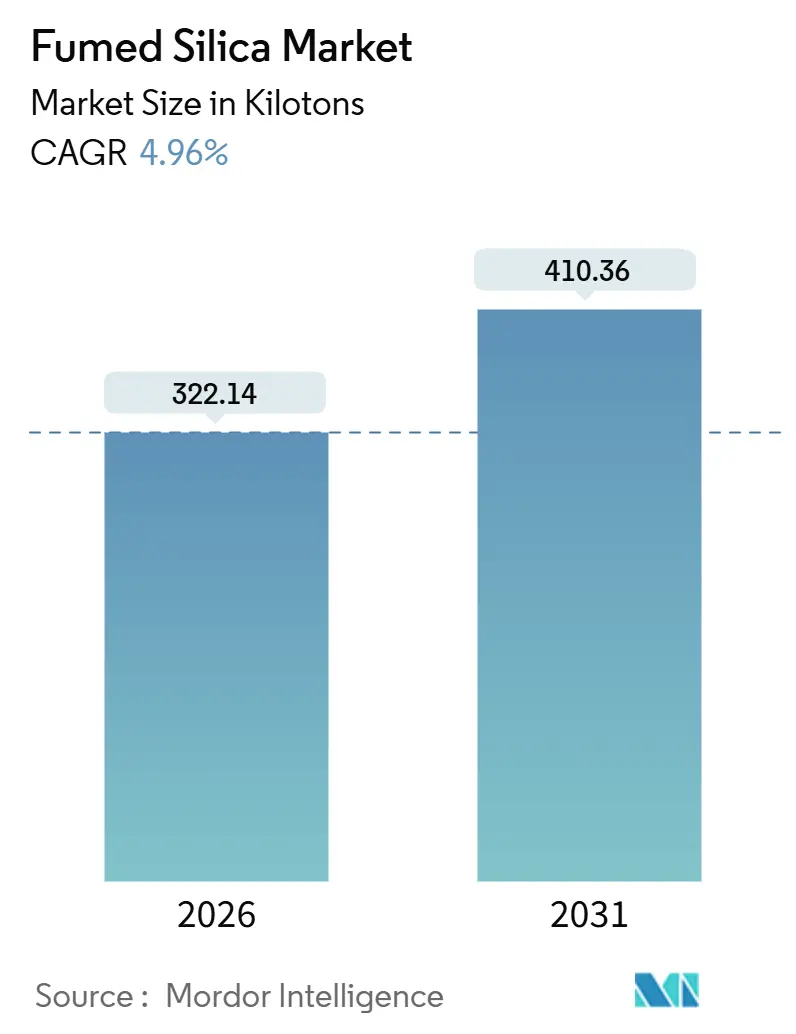
| Market Volume (2026) | 322.14 kilotons |
| Market Volume (2031) | 410.36 kilotons |
| Growth Rate (2026 - 2031) | 4.96 % |
| Fastest Growing Market | Asia Pacific |
| Largest Market | Asia Pacific |
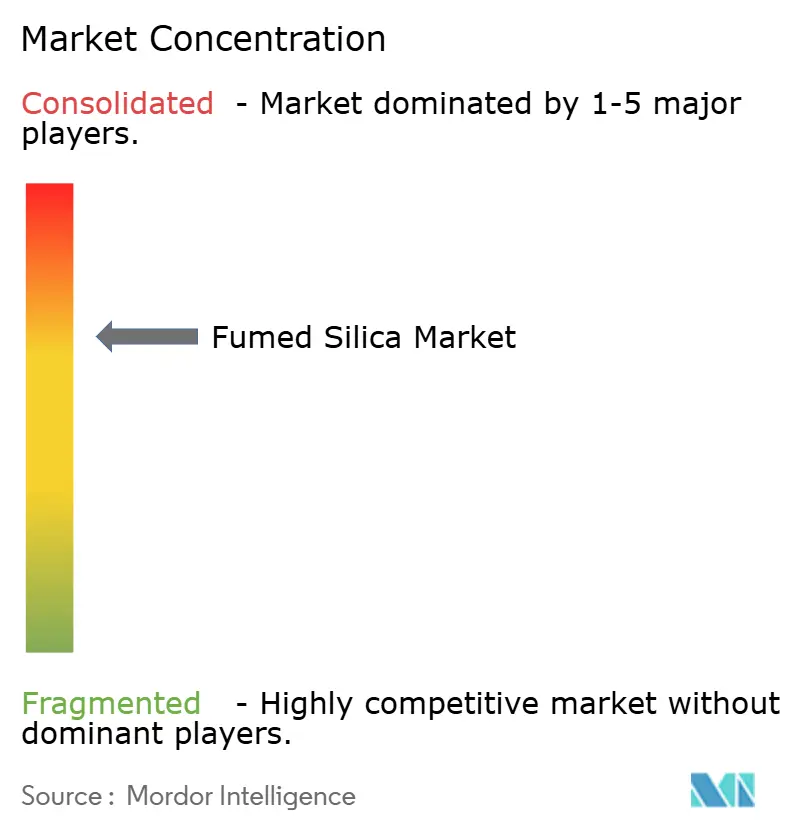
| Market Concentration | Medium |
Major Players *Disclaimer: Major Players sorted in no particular order Image © Mordor Intelligence. Reuse requires attribution under CC BY 4.0. | |
Fumed Silica Market Analysis by Mordor Intelligence
The Fumed Silica Market size is estimated at 322.14 kilotons in 2026, and is expected to reach 410.36 kilotons by 2031, at a CAGR of 4.96% during the forecast period (2026-2031). Momentum stems from rising silicone‐elastomer loading in consumer electronics, regulatory moves that favor waterborne coatings, and higher purity requirements across pharmaceutical and personal-care excipients. Flame hydrolysis keeps cost leadership in commodity grades, yet plasma and arc vapor oxidation are gaining traction in aerospace and semiconductor niches where impurity limits are tight. Asia-Pacific remains the demand epicenter thanks to electric-vehicle battery encapsulants and CMP slurries, while Europe wrestles with energy costs and looming carbon tariffs. Supply dynamics are shaped by Western consolidation in specialty grades, parallel capacity scale-ups in China, and persistent SiCl₄ feedstock volatility that compresses margins when polysilicon output stalls.
Key Report Takeaways
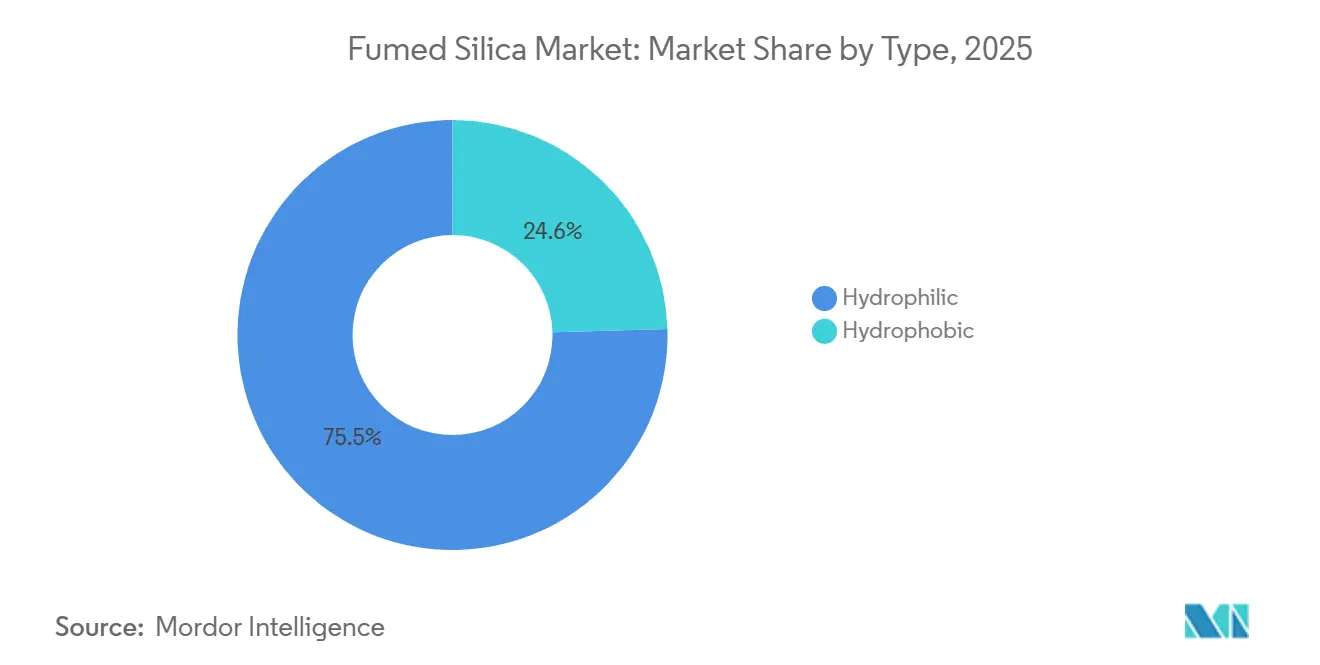
- By type, hydrophilic grades controlled 75.45% of 2025 volume and are forecast to advance at 5.45% annually through 2031.
- By production process, flame hydrolysis produced 72.36% of the 2025 output, yet plasma and arc vapor oxidation routes will post the fastest 5.92% CAGR to 2031.
- By function, rheology control and thickening functions captured 45.31% share in 2025 and are set to rise at 5.61% annually through 2031.
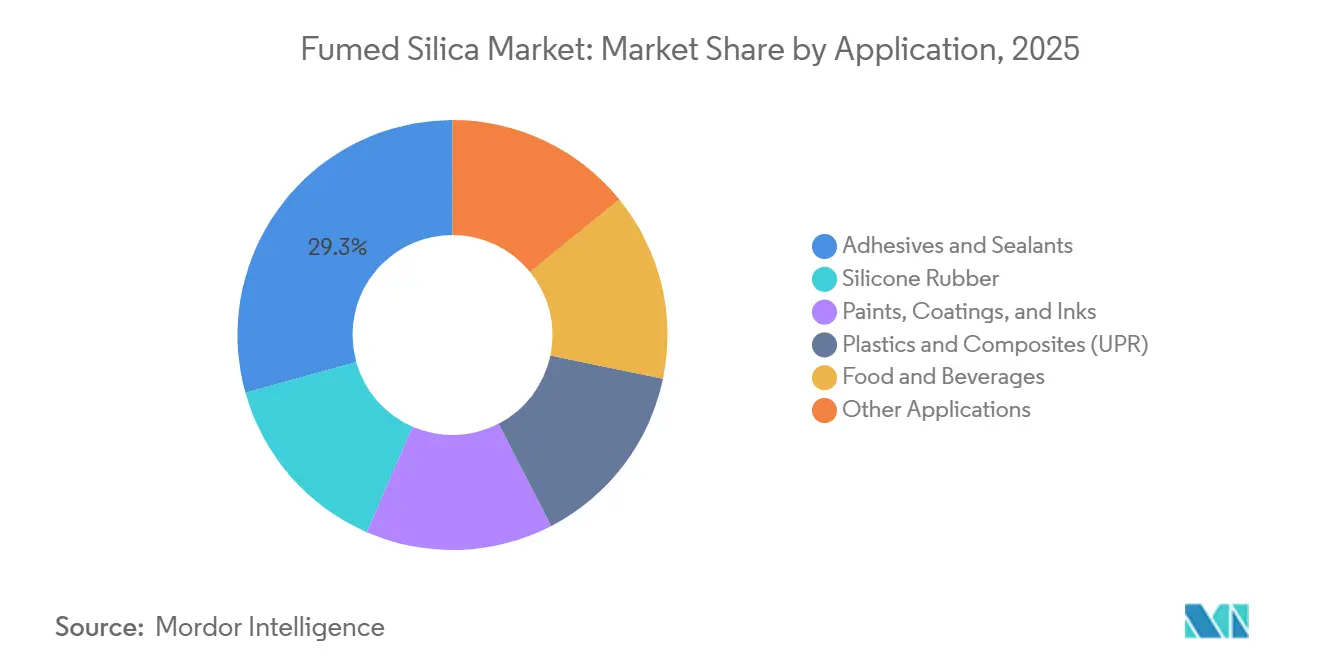
- By application, adhesives and sealants led absolute demand with a 29.33% share and a 5.78% CAGR outlook.
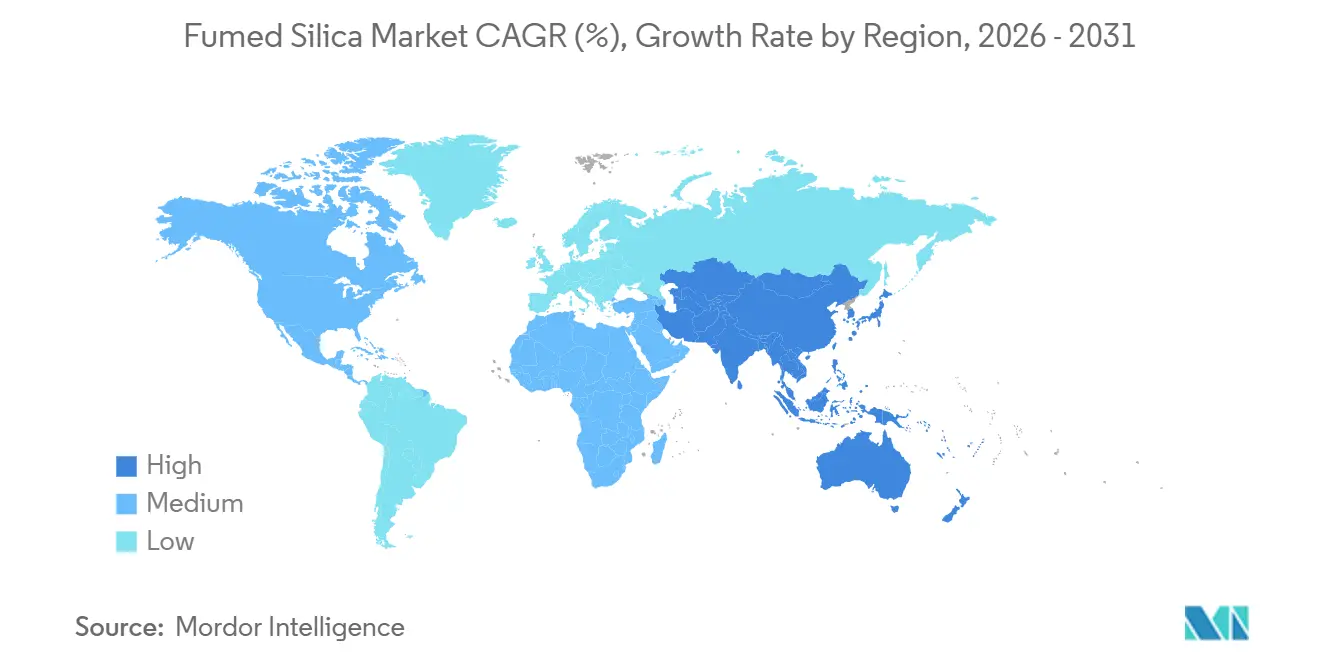
- Asia-Pacific accounted for 48.15% of the 2025 volume and is projected to grow at 5.18%.
Note: Market size and forecast figures in this report are generated using Mordor Intelligence’s proprietary estimation framework, updated with the latest available data and insights as of January 2026.
Market Trends and Insights
Drivers Impact Analysis of Fumed Silica Market*
| Drivers | (~) % Impact on CAGR Forecast | Geographic Relevance | Impact Timeline |
|---|---|---|---|
| Consumer-electronics–led boom in silicone elastomers (Asia) | +1.2% | Asia-Pacific core, spill-over to North America | Medium term (2-4 years) |
| Demand surge from paints and coatings reformulations | +0.9% | Global, with EU and North America leading regulatory adoption | Short term (≤ 2 years) |
| Rapid growth in pharmaceuticals and personal-care formulations | +0.8% | Global, concentrated in North America, Europe, and India | Medium term (2-4 years) |
| Penetration of 3-D-printed photopolymer resins | +0.5% | North America and Europe, early adoption in Asia-Pacific | Long term (≥ 4 years) |
| Aerospace-grade aerogel composites require ultra-pure silica | +0.4% | North America and Europe, limited to defense and space sectors | Long term (≥ 4 years) |
| Source: Mordor Intelligence | |||
Consumer Electronics Boom in Silicone Elastomers
As smartphones, wearables, and automotive infotainment modules shrink in size, the demand for silicone encapsulants, specifically those with fumed silica loading for enhanced thixotropy and reinforcement, has surged. In Asia, assembly lines for electric two- and three-wheelers are now utilizing hydrophobic-grade thermal gap fillers, effectively preventing phase separation during the curing process.[1] In 2023, Elkem activated a production line in Shanghai, aiming to localize the supply of electronics-grade silicone adhesives. The rise of flexible OLEDs in South Korea is propelling the demand for ultra-low-viscosity silicone gels, which require nano-silica to maintain optical clarity during repetitive bending. Each hinge assembly demands precise rheology tuning, a feat that precipitated silica falls short of, leading to a deeper penetration of fumed silica in consumer devices.
Demand Surge from Paint and Coating Reformulations
Architectural and industrial formulators are pivoting to waterborne systems that depend on fumed silica to retain brushability without high-VOC solvents, a switch hastened by South Coast AQMD Rule 1113 limits. Evonik’s AEROSIL E2D grades, commissioned in June 2024, enable faster mixing in waterborne coatings. Draft EU Ecolabel criteria released in February 2025 emphasize low-dust raw materials, indirectly favoring pyrogenic silica over coarse precipitated grades. Automotive OEM coatings in China and India are migrating to high-solids polyurethane systems reinforced with hydrophobic silica to prevent sag on vertical panels. The cumulative shift sustains growth in the fumed silica market through the forecast period.
Rapid Growth in Pharmaceuticals and Personal-Care Formulations
The United States FDA and EFSA reaffirmed silica’s safety limits in food and nutraceuticals during 2024, unlocking broader use in powder blends and controlled-release tablets. Cosmetic makers face a 2025 EU nano-ingredient notice mandate that intensifies scrutiny of particle size, steering formulators toward consistently produced hydrophilic grades. Indian generics manufacturers are upgrading excipient technology to meet export benchmarks, spurring robust local uptake. Microencapsulation of probiotics now blends nano-silica with lipophilic carriers to improve shelf life under tropical conditions. These factors combine to add nearly a percentage point to the global CAGR.
Penetration of 3D-Printed Photopolymer Resins
In 2024, academic tests revealed that dental resins infused with nano-silica achieved a flexural strength suitable for interim crowns. Nano-silica is pivotal in balancing viscosity and cure depth for products like dental prosthetics, hearing-aid shells, and aerospace jigs crafted through DLP and SLA. Evonik's AEROSIL FP series bolsters the strength of green parts without causing viscosity fluctuations during extended print sessions. Meanwhile, resin manufacturers across Europe are now opting for hydrophobic grades to prevent moisture absorption during storage, thereby prolonging pot life. As the realm of additive manufacturing transitions from mere prototypes to full-scale serial production, the demand for fumed silica is witnessing a robust and sustained upswing.
Restraints Impact Analysis of Fumed Silica Market*
| Restraints | (~) % Impact on CAGR Forecast | Geographic Relevance | Impact Timeline |
|---|---|---|---|
| Price volatility of SiCl₄ feedstock | -0.6% | Global, with Asia-Pacific most exposed due to polysilicon co-production cycles | Short term (≤ 2 years) |
| Low-cost precipitated silica capacity additions | -0.5% | Asia-Pacific and China specifically, limited impact in specialty grades | Medium term (2-4 years) |
| High energy intensity of flame hydrolysis vs plasma reactors | -0.3% | Global, concentrated in regions with high electricity costs (Europe, Japan) | Long term (≥ 4 years) |
| Source: Mordor Intelligence | |||
Price Volatility of SiCl₄ Feedstock
SiCl₄ supply hinges on polysilicon utilization cycles, so fumed silica producers endure margin pressure when solar demand softens, and chlorosilane by-product output falls, lifting spot prices[2]. Producers increasingly explore recycling loops that convert waste streams back into SiCl₄ to curb exposure. The absence of transparent benchmarks complicates long-term supply contracts, forcing many adhesive formulators onto quarterly adjustments that erode predictability.
Low-Cost Precipitated Silica Capacity Additions
Chinese plants, launching with lower capex, are bridging the cost-performance divide in basic rheology and anti-caking applications. Evonik is committed to a precipitated silica expansion in Charleston, South Carolina, starting operations in 2026 to serve tire rubber markets. While precipitated grades cannot replicate the reinforcement of hydrophobic fumed silica in high-performance silicone rubber, price-sensitive paint makers in Latin America blend both materials to reduce raw-material bills. The substitution risk is most visible in hydrophilic anti-settling uses where particle tolerances are broader.
*Our forecasts treat driver/restraint impacts as directional, not additive. The impact forecasts reflect baseline growth, mix effects, and variable interactions.
Fumed Silica Market Segment Analysis
By Type:
Hydrophilic Grades Dominate Pharma and FoodHydrophilic grades captured 75.45% of 2025 demand, and this share aligns with a robust 5.45% CAGR to 2031 as pharmaceutical and nutraceutical makers favor unmodified surfaces governed by FDA 21 CFR 172.480 and EFSA E 551 rules. Hydrophobic variants, treated with silanes, address moisture-sensitive silicone rubber and non-polar coatings but grow at a slower clip due to a higher cost per reinforcement unit.
Hydrophilic expansion is evident in India, where tablet makers specify fine-grade silica to stabilize active ingredients during export transit. Hydrophobic adoption surges in wind-turbine blade adhesives and 3D-printing resins, aided by Tokuyama’s 2024 capacity boost in Zhejiang. Evonik’s easier-dispersing hydrophilic E2D line lets waterborne paint formulators cut mixing time by one-fifth, tightening process economics. The fumed silica market size for hydrophobic grades in silicone rubber still commands premiums because precipitated substitutes cannot match tensile strength targets above 8 MPa.
By Production Process:
Plasma Routes Gain in Specialty NichesFlame hydrolysis generated 72.36% of the 2025 output, keeping it dominant in rheology control. Plasma and arc vapor oxidation will, however, outpace at 5.92% CAGR as aerospace aerogels and CMP slurries demand ultra-pure particles free of metallic contaminants. Plasma units meet sub-10 ppm impurity thresholds required by semiconductor fabs in South Korea and Taiwan, reinforcing a specialty moat.
Despite higher capex, plasma modules integrate with renewable power and lower carbon footprints, attributes attractive under Europe’s impending CBAM tariff. Flame operators in Germany trial green hydrogen burners but face limited electrolyzer supply. Arc vapor oxidation throughput lags by roughly threefold versus flame, so its commercial deployment remains confined to high-value defense composites. The fumed silica market size for plasma grades should therefore remain small in absolute tonnage, though strategically important.
By Function:
Rheology Control Leads Across ApplicationsRheology control and thickening led 2025 demand with 45.31% share, supported by waterborne coatings and high-solids adhesives that need shear-thinning flow. This slice advances at 5.61% through 2031 and accounts for the largest fumed silica market size by function in 2031. Anti-settling and anti-caking trail with a significant share, serving powder foods and agrochemicals in humid climates.
Silicone rubber reinforcements see tempered growth, yet they command a premium due to hydrophobic grades achieving high tensile strengths with appropriate loadings. Evonik's grades showcase a leap in innovation, enabling a reduction in silica dosage to hit viscosity benchmarks, thus slashing costs. While paint formulators are turning to precipitated silica in budget-conscious segments, hydrophobic fumed silica continues to reign supreme in automotive refinishing, where even a slight vertical sag is unacceptable.
By Application:
Adhesives and Sealants Lead Volume GrowthAdhesives and sealants absorbed 29.33% of the 2025 volume and will grow at 5.78%, underpinned by Asian construction and automotive lightweighting. In battery-electric vehicles, structural adhesives use silica to maintain bond-line thickness during robotic application. Silicone rubber is crucial for gaskets and medical tubing, ensuring biocompatibility at a continuous service temperature of 200 °C.
Paints and inks are poised for growth as European architectural formulators cut back on VOCs. While plastics and composites maintain their share, they grapple with competition from hollow glass microspheres. The food and beverage sector is gaining momentum, especially in instant drink mixes across Southeast Asia. Meanwhile, other lucrative segments like pharmaceuticals, personal care, and 3D printing are expanding rapidly, marking them as promising profit centers in the fumed silica market.

Geography Analysis
APAC Fumed Silica Market
Asia-Pacific owned 48.15% of the 2025 volume and grew at 5.18% through 2031, driven by CMP slurry demand for logic fabs, battery encapsulants in China, and rising nutraceutical production in India. Tokuyama’s Zhejiang plant powers localized supply of surface-treated grades for automotive coatings, while OCI’s Gunsan unit feeds South Korean sealant and secondary battery lines. Japan experiments with green hydrogen for flame hydrolysis, yet faces scale constraints.
North America Fumed Silica Market
North America carried growth on the back of NASA aerogel projects and stricter VOC caps in architectural paints. Wacker’s Charleston, Tennessee, plant supplies silicone rubber compounds, and Evonik’s new precipitated silica line in South Carolina hints at substitution pressure in low-tier segments. Canada and Mexico trail but log near 5% growth linked to automotive assembly.
Europe Fumed Silica Market
Energy costs and looming CBAM carbon tariffs limit Europe's growth. Evonik’s Rheinfelden E2D facility offers waterborne-friendly grades that cut mixing energy by one-fifth. Draft EU Ecolabel criteria and potential STOT RE 1 classification in the Netherlands raise compliance expenses for paint makers, yet aerospace aerogel funding under CORDIS keeps specialty demand resilient.
Value Chain Analysis
The upstream value chain centers on silicon tetrachloride (SiCl4) and chlorosilane infrastructure that supplies it, so feedstock integration and by-product management are key to cost stability. Core manufacturing converts SiCl4 to pyrogenic (fumed) silica mainly through flame hydrolysis for commodity hydrophilic grades, while plasma and arc vapor oxidation routes support ultra-pure niches that require tighter metallic-impurity control. Because the process is energy intensive, plant economics and supply reliability hinge on utilities and energy pricing, with volatility amplified when polysilicon utilization cycles disrupt SiCl4 availability.
Midstream steps include surface treatment to create hydrophobic grades, milling and de-dusting, and application-focused dispersion support, which has become a differentiator in waterborne coatings and electronics silicones. Producers sell via direct contracts to large adhesives, sealants, silicone rubber, coatings, and pharmaceutical formulators, and via specialty chemical distributors for smaller converters and compounders. Customers prioritize consistent BET surface area, low moisture, and dust handling to protect batch-to-batch performance. Downstream, fumed silica is compounded into silicone elastomers and sealants, formulated into coatings and inks for rheology and sag control, and used as a glidant in pharmaceuticals and personal care, where qualification requirements, regulatory documentation, and validated supply continuity raise switching costs.
Competitive Landscape
The fumed silica market is moderately consolidated. Western leaders double down on high-margin niches while Chinese firms scale commodity hydrophilic output for anti-caking and basic rheology uses. Plasma-route entrants pursue ultra-pure aerogel and semiconductor applications, threatening flame hydrolysis incumbents long-term. Handling SiCl₄ price swings becomes decisive; closed-loop chlorosilane recycling pilots aim to steady margins. Bio-based rice-husk silica emerges as a sustainability wildcard but still falls short on impurity control. Overall, technology differentiation and regional proximity to downstream users guide investment, shaping how the fumed silica market evolves through the decade.
Fumed Silica Industry Leaders
-
Evonik Industries AG
-
Cabot Corporation
-
Wacker Chemie AG
-
Tokuyama Corporation
-
OCI Ltd.
- *Disclaimer: Major Players sorted in no particular order
Fumed Silica Market Companies Covered in this Report
- AMS Applied Material Solutions
- Cabot Corporation
- China-Henan Huamei Chemical Co., Ltd.
- DONGYUE GROUP
- Evonik Industries AG
- Gelest Inc.
- Henan Xunyu Chemical Co., Ltd.
- Heraeus Group
- HPQ Silicon Inc.
- Kemipex
- Kemitura
- Ningbo Ruifeng Sealing Materials Co., Ltd.
- OCI Ltd.
- Orisil
- Redox
- Tokai Carbon Co., Ltd.
- Tokuyama Corporation
- Wacker Chemie AG
- Yichang CSG Polysilicon Co., Ltd.
- Zhejiang FuShiTe Group Co., Ltd.
Market Opportunities and Future Outlook
White-space is concentrated in specialty-grade differentiation and regional supply security where downstream users need tighter impurity limits, cleaner handling, and faster dispersion in waterborne systems. Evonik commissioning AEROSIL Easy-to-Disperse capability at Rheinfelden (June 2024) and its broader silica portfolio repositioning (Smart Effects formed in January 2025) show how suppliers are bundling fumed silica with application support to target coatings, electronics, and consumer health formulations where mixing time, dusting, and consistency are procurement and performance priorities. In parallel, semiconductor-linked uses that require sub-10 ppm impurity thresholds, along with Asia-Pacific CMP slurry demand, support an opportunity for plasma and arc vapor oxidation grades where commodity precipitated silica is not an interchangeable substitute.
Capacity and footprint moves are also shaping how buyers source and qualify vendors. Wacker commissioning a 13,000-ton fumed silica plant in Charleston, Tennessee (January 2024) expands North American availability. The Cabot Sanmar brownfield investment in Mettur, Tamil Nadu (announced April 2026) points to localization of supply for Indian adhesives, sealants, and battery-related demand. Meanwhile, network optimization such as Evonik announcing the planned mid-2025 closure of its fumed silica production in Waterford, New York, is prompting dual-sourcing and requalification efforts among formulators, creating room for suppliers that can provide validated continuity, tighter spec control, and logistics proximity to electronics and automotive manufacturing hubs.
Recent Industry Developments in Fumed Silica Market
- June 2026: Cabot Corporation highlighted CAB-O-SIL TS-720 fumed silica use in adhesive systems for electric vehicle battery packs, focusing on stability and application consistency under demanding bonding conditions. The emphasis on battery-pack adhesives underscores how fumed silica suppliers are positioning application-specific grades for fast-growing EV assembly workflows and higher-performance bonding requirements.
- January 2025: Evonik Industries AG announced a strategic repositioning of its silica network, including the planned mid-2025 closure of its fumed silica production facility in Waterford, New York, alongside further site actions in North America. The move changes regional supply options and can trigger customer requalification cycles, benefiting alternative suppliers with available capacity and comparable product documentation.
- June 2024: Evonik Industries AG commissioned a new plant at Rheinfelden, Germany, for AEROSIL Easy-to-Disperse (E2D) fumed silica technology aimed at improving efficiency for coatings customers. The added dispersion capability supports waterborne and low-VOC coating formulations where mixing time, dust reduction, and consistent rheology control are procurement and performance priorities.
Fumed Silica Market Report Scope and Research Methodology
Market Definition and Coverage
This market is defined as fumed silica supplied as a standalone material to be used as a rheology and reinforcement additive in downstream formulations across industrial and specialty applications. We treat the market as demand for fumed silica sold in primary form, counted in volume terms.
Scope exclusions: Excluded items include precipitated silica, silica gel, colloidal silica, and compound blends where fumed silica is already mixed into another chemical system.
Segments Covered in This Report
- By Type
- Hydrophilic
- Hydrophobic
- By Production Process
- Flame Hydrolysis
- Plasma/Arc Vapor Oxidation
- By Function
- Rheology Control/Thickening
- Anti-settling/Anti-caking
- Reinforcement/Filler
- By Application
- Silicone Rubber
- Adhesives and Sealants
- Paints, Coatings, and Inks
- Plastics and Composites (UPR)
- Food and Beverages
- Other Applications (Pharmaceuticals and Personal Care, etc.)
- By Geography
- Asia-Pacific
- China
- India
- Japan
- South Korea
- Rest of Asia-Pacific
- North America
- United States
- Canada
- Mexico
- Europe
- Germany
- United Kingdom
- France
- Italy
- Rest of Europe
- South America
- Brazil
- Argentina
- Rest of South America
- Middle-East and Africa
- Saudi Arabia
- South Africa
- Rest of Middle-East and Africa
- Asia-Pacific
Data Sources, Market Sizing, and Validation
Desk Research
Desk research starts by setting a clean fact base on silica chemistry, capacity, and regional industrial output so later assumptions do not drift. Public references used for the industrial minerals context include the US Geological Survey, UN Comtrade for trade flow direction, Eurostat for industry indicators, and government environment or workplace safety agencies for handling and compliance cues.
To keep end-use logic workable, we also review peer reviewed papers on coatings, silicone elastomers, and battery related formulations, plus patent databases that show how surface treatment and dispersion needs are changing. Company filings, annual reports, and investor presentations are used to verify plant starts, debottlenecks, and regional exposure, while a paid subscription for company financials and news helps track announcement timing. When needed, shipment level databases are used to cross-check trade behavior for relevant silica movements, and then reconciled back to the main model. These sources are not exhaustive, and many other public references were used to collect, validate, and clarify the data points used in the model.
Primary Interviews and Surveys
Primary inputs are used to confirm purchasing patterns for fumed silica, including how grades are specified, typical dosage ranges by application, and substitution limits when prices move. We speak with producers, distributors, formulators, and technical buyers across major consuming regions so secondary findings can be checked, gaps can be filled, and the final assumptions can be triangulated.
Distribution of primary research fieldwork respondents
| Company type | Respondent position | Region |
|---|---|---|
| Top tier: 37% | CXOs: 14% | APAC: 45% |
| Mid tier: 44% | Functional/Unit leaders: 27% | EMEA: 35% |
| Smaller Players: 19% | Managers: 59% | Americas: 20% |
Market-Sizing & Forecasting
The core sizing logic uses a top-down and bottom-up combination. First, regional availability is reconstructed from production and trade signals, then reconciled with downstream consumption patterns. Since fumed silica is selected for performance in formulations, our model uses practical demand drivers such as silicone elastomer output trends, paints and coatings activity, ink and adhesive consumption indicators, and battery manufacturing growth where gel systems are relevant.
Totals are then corroborated using selective bottom-up approximations, including sampled supplier volume roll ups, distributor channel checks in key importing markets, and a limited set of application dosage ranges applied to downstream volumes. When visibility is weak in smaller countries or niche applications, gap handling is done through conservative penetration assumptions that are validated through interviews, then rechecked against trade direction and capacity news.
For forecasting, scenario analysis is used and supported with simple regression checks on the main demand drivers, so the model stays explainable when variables shift. Assumptions on capacity additions, feedstock related volatility, and application mix changes are reviewed with expert feedback and applied consistently across the forecast horizon.
Data Validation & Update Cycle
Validation is completed through triangulation across independent indicators so one data series does not dominate the outcome. We run reasonableness checks by region, review year on year movements for abnormal jumps, and route the model through more than one analyst review before sign off.
If a mismatch appears, such as trade movement that is not supported by downstream production indicators, the related assumptions are revisited and targeted re contacts are triggered with experts. Reports are refreshed annually, and interim updates are made when material events occur, including capacity expansions, major outages, or policy changes that affect industrial demand. Before delivery, an analyst completes a fresh final pass so clients receive the latest updated view.
Mordor Intelligence's Fumed Silica Market Size Compared With Other Published Estimates
It is common to see different market values for fumed silica because publishers do not always count the same product set, the same time base for pricing, or the same conversion between volume and revenue. Differences also show up when some sources mix in nearby silica categories or treat downstream compounds as if they were primary material sales.
Some published figures lean heavily on broad average prices and do not show how grade mix changes across regions, which can shift the final revenue total even if demand is similar. Those broader scopes can fold in precipitated or colloidal silica, but Mordor Intelligence counts only fumed silica sold in primary form and anchors the sizing to volume checkpoints like 322.14 kilotons (2026) and 410.36 kilotons (2031) before any value translation is applied.
Benchmark comparison
| Source | Market Size | Gaps in Research Methodology |
|---|---|---|
| Mordor Intelligence | USD 1.74 B (2024) | |
| Industry Publisher A | USD 1.64 B (2025) | Uses a different base year and pricing window, and provides limited detail on how volume was converted to revenue across hydrophilic versus hydrophobic grades and across regions. |
| Market Publisher B | USD 1.74 B (2024) | Reports the same year but does not clearly state exclusion rules for adjacent silica products and formulated compounds, which can shift totals depending on how the basket is defined. |
The comparison mainly points to scope control and price conversion transparency as the reasons estimates spread apart. When volume anchors, application mapping, and trade or capacity signals are used together, the final sizing stays easier to audit and repeat across updates.
Key Questions Answered in the Report
How large is the fumed silica market in 2026?
It totaled 322.14 kilotons in 2026 and is forecast to reach 410.36 kilotons by 2031, registering a CAGR of 4.96%.
Which segment grows fastest through 2031?
Plasma and arc vapor oxidation, driven by aerospace and semiconductor purity needs, will post the highest 5.92% CAGR.
Why is Asia-Pacific the biggest consumer?
Regional electronics, battery, and CMP slurry demand give Asia-Pacific a 48.15% volume share in 2025 with a 5.18% growth trajectory.
What risk does SiCl₄ pricing pose?
Tight polysilicon cycles can raise SiCl₄ costs and shave as much as 0.6 percentage points off the global CAGR.
How will VOC regulations influence demand?
Tightening limits in coatings spur waterborne formulations that rely on fumed silica for sag control, adding 0.9 percentage points to forecast CAGR.