
Market Overview
| Study Period | 2021 - 2031 |
|---|---|
| Forecast Data Period | 2026 - 2031 |
| Base Year Market Size (2025) | USD 75.65 Billion |
| Market Size (2026) | USD 84.39 Billion |
| Market Size (2031) | USD 145.86 Billion |
| Growth Rate (2026 - 2031) | 11.56 % |
| Market Concentration | Medium |
Major Players *Disclaimer: Major Players sorted in no particular order Image © Mordor Intelligence. Reuse requires attribution under CC BY 4.0. | |
France Used Car Market Analysis by Mordor Intelligence
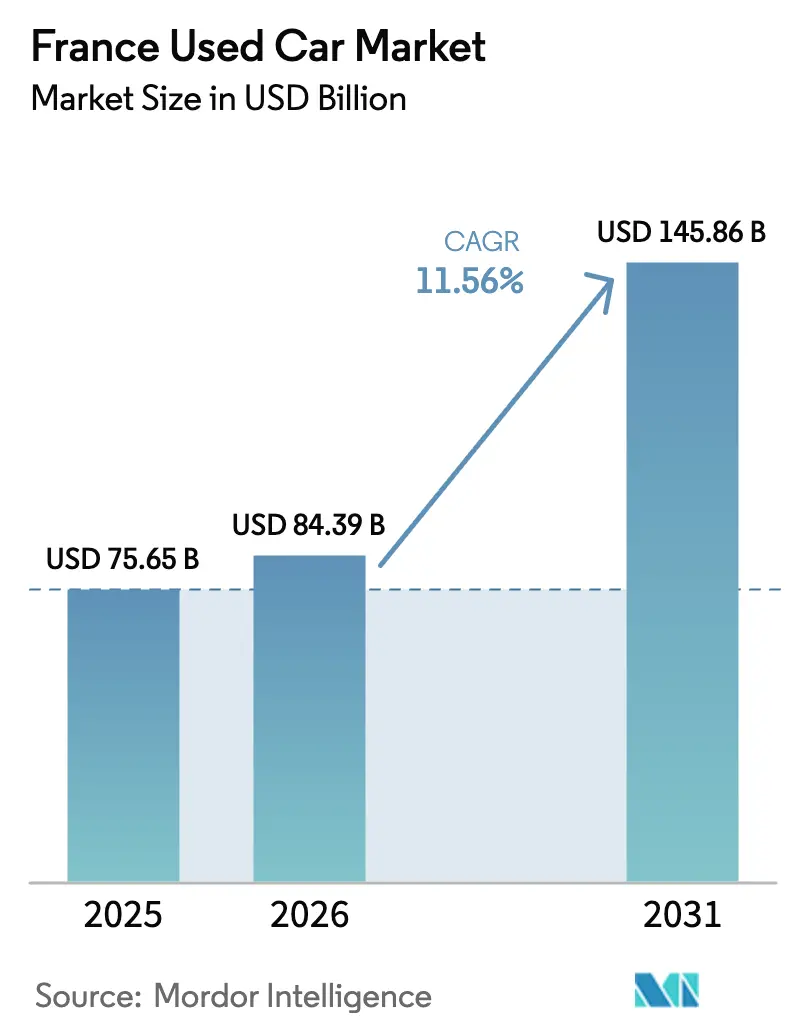
France used car market size in 2026 is estimated at USD 84.39 billion, growing from 2025 value of USD 75.65 billion with 2031 projections showing USD 145.86 billion, growing at 11.56% CAGR over 2026-2031.
France is now the second-largest pre-owned vehicle arena in Europe, trailing only Germany, because regulatory action, widening new-to-used price gaps, and rapid digital adoption are reshaping demand. New-car sticker prices have risen 15% faster than used-car values since 2024, pushing cost-conscious buyers toward the secondary channel and reinforcing the structural appeal of the France used car market. On the supply side, the coming wave of 2–3-year-old lease and subscription returns, especially electric compact SUVs, will refresh inventory depth while moderating price inflation. Parallel growth in certified-pre-owned (CPO) programmes enhances consumer confidence, allowing organised retail networks to monetise refurbishing know-how and warranty extensions. Finally, the roll-out of France’s CO₂/weight tax in 2026 tilts shopper preference toward lighter, lower-emission models, deepening the pivot to electrified powertrains and accelerating fleet turnover in the France used car market.
Key Report Takeaways
- By vehicle type, SUVs led with 38.10% of France used car market share in 2025.
- By vendor type, unorganised dealers controlled 56.40% of the France used car market size in 2025, while organised dealers delivered the fastest 13.35% CAGR through 2031.
- By fuel type, petrol retains 43.70% share of the France used car market size in 2025.
- By vehicle age, the 3-5-year bucket accounts for 48.00% of France used car market share in 2025.
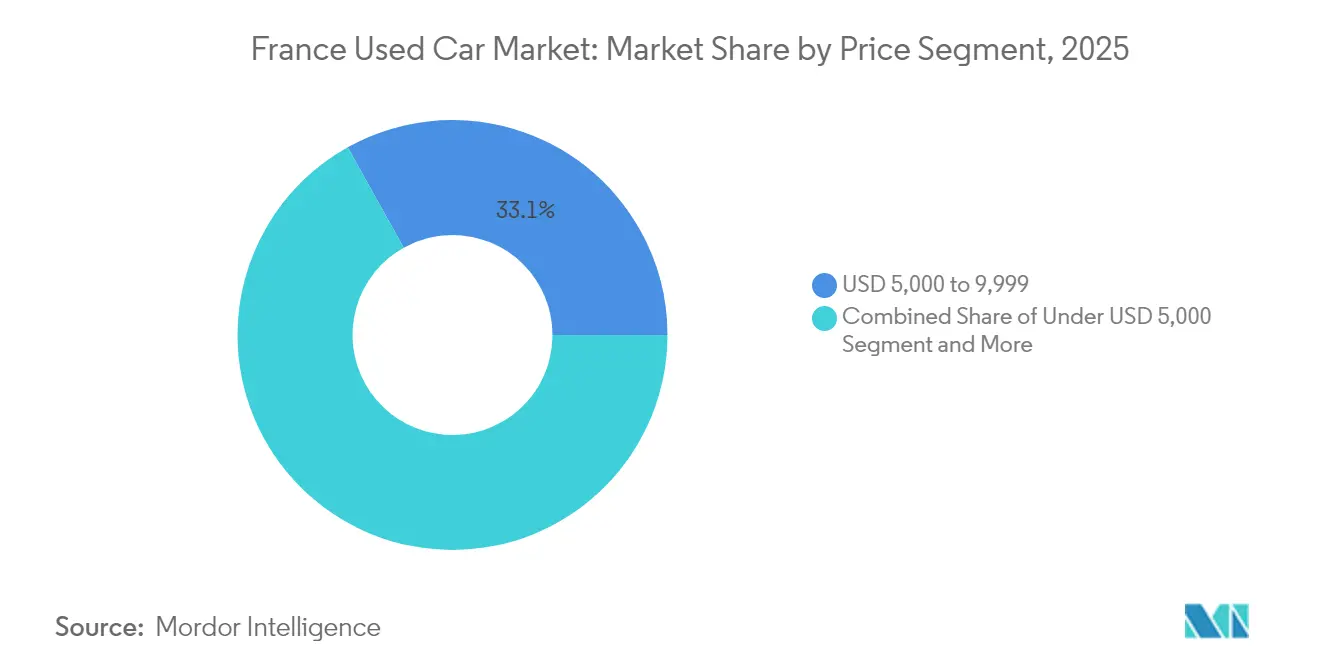
- By price band, the USD 5,000-9,999 bracket holds 33.10% of the France used car market size in 2025.
- By sales channel, online transactions grow at 17.30% CAGR while offline outlets keep an 86.20% revenue share in 2025.
Note: Market size and forecast figures in this report are generated using Mordor Intelligence’s proprietary estimation framework, updated with the latest available data and insights as of 2026.
Market Trends and Insights
Drivers Impact Analysis of France Used Car Market*
| Driver | Qualitative Impact | (~) % Impact on CAGR Forecast | Geographic Relevance | Impact Timeline |
|---|---|---|---|---|
| Rising new-car prices widening the value gap | Strong | +3.2% | Île-de-France, Provence-Alpes-Côte d'Azur, Auvergne-Rhône-Alpes | Short term (≤ 2 years) |
| Expansion of online used-car platforms | Strong | +2.8% | Île-de-France, Hauts-de-France, Grand Est | Medium term (2-4 years) |
| Short-term subscription & lease fleet returns surge | Strong | +2.1% | Île-de-France, Provence-Alpes-Côte d'Azur, Occitanie | Medium term (2-4 years) |
| Growth of certified-pre-owned (CPO) programmes | Moderate | +1.9% | Île-de-France, Auvergne-Rhône-Alpes, Nouvelle-Aquitaine | Medium term (2-4 years) |
| 2025 French CO₂/weight tax | Moderate | +1.4% | All French regions | Short term (≤ 2 years) |
| AI-driven reconditioning cuts refurb costs | Weak | +0.8% | Île-de-France, Auvergne-Rhône-Alpes, Hauts-de-France | Long term (≥ 4 years) |
| Source: Mordor Intelligence | ||||
Rising New-Car Prices Widen the Value Gap to Used Cars
New-car registrations fell 7% year-on-year through April 2025, while pre-owned transactions climbed 3.1%, underscoring a structural shift toward the France used car market. The average price premium for a new vehicle over a comparable three-year-old model widened from 45% in 2024 to 52% by December 2025. Dealers that scale sourcing and refurbishing pipelines capture this arbitrage, especially within warranty-backed CPO stock that still undercuts new-car outlays by roughly 30%.
Expansion of Online Used-Car Platforms & Digital Showrooms
Online channels, fuelled by AI inspection kiosks and end-to-end finance integration, are compounding at 17.75% through 2030 even though click-to-buy makes up only 13.11% of current turnover. Players deploying ProovStation’s automated scanning cut appraisal time to seconds and issue instant binding offers, lowering friction for urban millennials increasingly steering activity within the France used car market[1].
Short-Term Subscription & Lease Fleet Returns Surge From 2026
France’s social EV leasing scheme restarts in 2025 and is expected to dispatch tens of thousands of compact electric SUVs back into circulation by 2027, dovetailing with corporate fleet swaps initiated in 2024–2025. The resulting influx of 2–3-year-old, low-mileage units will extend model choice and ease price spikes, yet may compress dealer margins without agile pricing tools.
Growth of Certified-Pre-Owned (CPO) Programmes
CPO schemes bridge trust gaps by providing multi-point inspections, factory-grade refurbishment, and extended warranties of up to 10 years/175,000 km, as seen in Stellantis’ Spoticar roll-out. Such guarantees feed growing consumer appetite for reliability, allowing organised retailers to lift average selling price while sustaining faster stock turns.
Restraints Impact Analysis of France Used Car Market*
| Restraint | Qualitative Impact | (~) % Impact on CAGR Forecast | Geographic Relevance | Impact Timeline |
|---|---|---|---|---|
| Highly fragmented dealer landscape | Strong | -2.1% | All French regions | Short term (≤ 2 years) |
| Falling BEV residual values | Strong | -1.8% | Île-de-France, Provence-Alpes-Côte d'Azur, Auvergne-Rhône-Alpes | Medium term (2-4 years) |
| Extended 3-year statutory warranty | Moderate | -1.2% | All French regions | Medium term (2-4 years) |
| EU battery end-of-life rules add compliance cost | Weak | -0.7% | All French regions | Long term (≥ 4 years) |
| Source: Mordor Intelligence | ||||
Highly Fragmented Dealer Landscape Compresses Margins
More than 15,000 small-scale dealerships operate nationwide, limiting purchasing leverage and curtailing economies of scale. With unorganised vendors still commanding 57.08% share, pricing wars erode gross margins and delay technology upgrades critical for the next phase of growth in the France used car market.
Falling BEV Residual Values Create Stock-Value Risk
Five-year projected depreciation for battery-electric models averages 49.1%, outpacing ICE counterparts and forcing cautious stocking strategies. Dealers must adopt battery-health analytics to mitigate valuation errors, particularly as aggressive OEM price cuts can shock residual models mid-cycle[2].
*Our forecasts treat driver/restraint impacts as directional, not additive. The impact forecasts reflect baseline growth, mix effects, and variable interactions.
France Used Car Market Segment Analysis
By Vehicle Type:
SUVs Drive Market ExpansionSUVs held 38.10% of the French used car market share in 2025 and are expanding the French used car market size for this body style at a 12.05% CAGR to 2031, fuelled by consumer preference for elevated seating and the influx of compact electric crossovers from leasing schemes. The segment’s depth lets organised retailers optimise stocking plans, while hatchbacks retain inner-city loyalty but face weight-tax headwinds favouring lighter platforms. Rural territories lean toward larger SUVs for versatility, whereas Parisian districts gravitate to sub-compact variants apt for tight parking zones.
Higher transaction velocity in SUVs boosts data availability for dynamic pricing, supporting AI-assisted analytics that refine inventory turns. Conversely, sedans and MPVs cede mindshare, with sedan resale values dipping as buyers gravitate to multi-purpose silhouettes. MPVs still address family mobility but battle SUV substitutes offering comparable boot volume and better residuals. Lifestyle categories, convertibles, and coupes remain low in volume yet enjoy resilient margins driven by enthusiast appetite.


By Vendor Type:
Organised Players Gain GroundUnorganised outlets retained 56.40% of France used car market size in 2025, but organised networks are compounding at 13.35%, signalling a gradual re-balancing. Scale advantages allow nationwide chains to standardise refurbishment, extend warranties, and unify digital storefronts. Franchise groups employ centralised remarketing hubs to shave reconditioning cycles by double-digit percentages, reinforcing margin differential.
Small independents maintain agility through local rapport and lower overhead; yet opaque pricing is steadily penalised as comparison engines proliferate across the French used car market. Capital constraints limit their investment in omnichannel tech and battery diagnostics for EV stock, widening the capability gap. A coexistence equilibrium is likely, but shared drift favours branded networks leveraging CPO credibility.
By Fuel Type:
Electric Surge Reshapes DynamicsElectric vehicles are steering an 18.20% CAGR, outpacing all legacy fuels, while petrol units still own 43.70% of the French used car market share in 2025. Government weight-based malus exemptions and expanding fast-charge corridors underpin the pivot, particularly in Île-de-France, where EV penetration reached 19.4% in January 2025. Diesel inventory declines on looming urban access limits and residual value uncertainties.
Hybrid models serve risk-averse adopters who want combustion back-up but cleaner profiles, while LPG/CNG fleets cater to commercial mileage disciplines. Dealers adopting certified battery-health reports accelerate consumer trust and mitigate price haggling. Infrastructure gaps outside metro areas decelerate rural EV rotation, but 2026 lease-return surpluses will catalyse affordability.
By Vehicle Age:
Young Vehicles Command Premium GrowthUnits aged 0-2 years are advancing at 15.90% CAGR as buyers chase near-new tech with remaining factory cover. Yet the 3-5-year tranche retains 48.00% of France's used car market share, balancing affordability and quality in the French used car market. Lease maturities and corporate fleet renewals ensure a steady supply of both cohorts, sustaining broad inventory health.
Older categories-6-8 years and 9-12 years-anchor value-driven segments but attract stricter financing terms that can curb demand. Vehicles exceeding 12 years confront ever-tighter environmental controls, such as expanded technical inspection regimes legislated in 2022 that escalate compliance costs. Dealers segment inventory by age to align warranty packages and credit tenors to consumer affordability ceilings.
By Price Segment:
Mid-Market Drives GrowthThe USD15,000-19,999 bracket is the fastest-growing at 13.75% CAGR, appealing to middle-income households seeking modern safety tech without new-car premiums. Below USD 10,000, older stock still holds 33.10% of France used car market size as cash buyers and micro-enterprises look for budget transport. Premium tiers above USD 30,000 cater to aspirational or corporate perks, but account for limited volume.
Weight-related taxation from 2026 incentivises lighter configurations across all price bands, potentially compressing large-engine premium values. Financiers extend six- to seven-year loan durations on mid-market vehicles, supporting affordability and sustaining the French used car market’s resilience amid macro uncertainty.
By Sales Channel:
Digital Transformation AcceleratesAlthough offline showrooms commanded 86.20% revenue share in 2025, online channels are growing at 17.30% CAGR as millennials normalise click-to-buy behaviour. Digital classified portals funnel lead volume, while pure-play e-retailers differentiate through home delivery and money-back guarantees. OEM-branded sites integrate CPO warranties for brand loyalists.
Hybrid models are emerging: shoppers shortlist vehicles digitally, then finalise test drives and paperwork in satellite hubs. Offline incumbents retrofit augmented-reality walk-rounds and live-chat finance approvals to keep pace, cementing omnichannel expectations across the French used car market.
Geography Analysis
Île-de-France contributes roughly one-quarter of national pre-owned transactions and showcases the highest digital-purchase ratios, underpinned by superior broadband penetration and dense charging infrastructure. Only 33% of Paris households own a car versus 81.4% nationally, catalysing churn for shared-mobility-aligned compact EVs. Stringent low-emission zones fast-track ICE scrappage and lift residuals for compliant hybrids.
Provence-Alpes-Côte d’Azur and Auvergne-Rhône-Alpes form a second tier, combining tourism-driven seasonal spikes with proximity to manufacturing clusters that streamline stock sourcing. Warm coastal climates curb corrosion, preserving bodywork and elevating resale premiums. Lyon hosts multiple automotive tech start-ups, becoming a testbed for AI-assisted inspection rigs that ripple efficiency across the French used car market.
Rural corridors, Nouvelle-Aquitaine, Occitanie, Grand Est, display ownership ratios exceeding 90%, given sparse public transport. Demand skews toward SUVs and light commercials, while EV adoption lags amid limited charger density. The government’s social leasing incentives specifically target these regions, promising a future pipeline of used electric hatchbacks that will progressively diversify rural forecourts.
Regulatory Landscape
Regulation for used-vehicle trade in France combines taxation, consumer protection, and circular-economy obligations. A key commercial lever is the VAT margin scheme for used vehicles under Article 297 A of the Code General des Impots, which requires dealers to segregate stock bought with deductible VAT from stock bought without. This reshapes sourcing, invoicing, and audit readiness across organized and independent sellers.
Consumer-protection and sustainability requirements also add operational burden and push standardization. As of 2026, professional used-vehicle dealers face a mandatory minimum 6-month guarantee on professional sales, which raises refurbishment and documentation requirements versus informal "sold as seen" practices. On the end-of-life side, France's AGEC law strengthens traceability and recovery expectations for retired vehicles. EU work on an updated end-of-life vehicle framework, including parts removal requirements, plastic recycling targets, and restrictions on exporting non-roadworthy used vehicles, points to tighter compliance needs for salvage, dismantling, and cross-border remarketing flows.
Value Chain Analysis
Supply in the France used car market is anchored in trade-ins, lease and subscription returns, and fleet renewals, complemented by auction and wholesale sourcing. Inventory then moves through appraisal and compliance, including dealer registers used for traceability and tax controls, before refurbishment and recon activities that are increasingly centralized among organized networks and CPO operators. Stellantis illustrates vertical influence in the chain through its OEM-backed Spoticar network and its links to large-scale refurbishing and retail capabilities. At the demand-capture layer, digital platforms and classifieds, including Leboncoin and AutoScout24, drive lead generation.
Downstream, financing and insurance integration, warranty packaging, and last-mile fulfillment, either through home delivery or pickup hubs, shape conversion and margins, particularly for online and omnichannel sellers. Data and vehicle-history verification support pricing and risk management, with providers such as AAA Data (a CCFA subsidiary) supporting access to market and vehicle-history information. Trade associations including FNA, CCFA, and CSIAM coordinate operational standards and address circular-economy obligations that affect refurbishers, parts channels, and end-of-life operators.
Competitive Landscape
Leboncoin holds a significant share, leveraging high-traffic classifieds reach, while AutoScout24 gains via cross-border inventory draw. Aramis Group, through centralised refurb hubs, demonstrates the scalability of CPO-led e-commerce. Competitive levers are shifting from sheer stock volume to data analytics and omnichannel convenience.
AI pricing engines refine offer accuracy, and battery-health certificates reduce EV appraisal volatility. Stellantis’ Spoticar integrates factory warranties, boosting trust equity, whereas ProovStation kiosks truncate inspection time from 30 minutes to under 5. Partnerships with fintech lenders deliver instant credit decisions, bolstering consumer conversion.
Fragmentation nevertheless endures: thousands of independents sustain hyper-localised supply, especially in peri-urban belts where personal rapport still trumps digital clicks. Consolidation is expected to proceed steadily as capital-rich networks absorb under-invested peers, riding the scale economics vital to compete within the expanding France used car market.
France Used Car Industry Leaders
-
Leboncoin
-
Aramis Group
-
AutoScout24 (SMG Swiss Marketplace Group)
-
Stellantis Spoticar
-
Auto1 Group (Autohero)
- *Disclaimer: Major Players sorted in no particular order

France Used Car Market Companies Covered in this Report
- AutoScout24 (SMG Swiss Marketplace Group)
- Leboncoin
- Aramis Group (Aramisauto)
- La Centrale
- Reezocar
- Heycar
- BYmyCAR Group
- Stellantis N.V. (Spoticar)
- BNP Paribas (Arval AutoSelect)
- Autosphere
- ParuVendu
- Auto1 Group (Autohero)
- Cazoo Group
- Hiflow
- CAR Avenue
- Speedy France
- Feu Vert
- Emil Frey France
- GPA Motors
- Edenauto
Market Opportunities and Future Outlook
Scalability is increasingly tied to trust and transparency in a market still dominated by fragmented independents, with over 15,000 small dealerships nationwide. Expanded CPO-style offers, standardized inspections, and battery-health reporting help address the statutory guarantee burden and EV residual-value volatility, while also improving conversion during online journeys. The used-EV turnover trend gives a tangible demand-side anchor, with electric used-vehicle transactions reported at 180,000 in 2024, representing 68% growth. That scale increases the need for consistent EV appraisal, diagnostics, and warranty structures.
Digital retail, AI-assisted merchandising, and B2B remarketing ecosystems are also opening investable routes. Stellantis introduced SPOT.i in September 2025, and by May 2026 Spoticar reported over 3 million natural-language searches, indicating growing consumer reliance on guided discovery instead of static listings. On the supply and distribution side, multi-brand platforms targeting professional buyers are expanding, including Spoticar Trade, which reported a 30% increase in its B2B customer base over the two years preceding March 2026. Aramis Group's April 2026 rollout of a unified brand platform across multiple European markets underscores the push toward standardized refurbishment, pricing, and customer experience, which French operators can draw on to improve inventory turns and cross-border sourcing efficiency.
Recent Industry Developments in France Used Car Market
- July 2026: Auto1 Group priced its FinanceHero 3 ABS for consumer car loans totaling EUR 236.3 million in a six-tranche structure. The ABS financing expands capital-efficient funding for used-car platforms and dealer networks. This move strengthens liquidity channels for used-car ecosystems, enabling faster inventory turnover and expanded financing options for buyers.
- June 2026: Aramis Group filed its 2026 half-year financial report with the French Financial Markets Authority for the period ending March 31, 2026. The report provides EU/France used-car retail performance indicators. It signals H1 performance and regulatory reporting for a major French used-car platform, reinforcing transparency and benchmarking for the sector.
- May 2026: Spoticar reached 3 million natural language searches across Europe using Spot.i AI powered search engine. The AI driven remarketing and search capability enhances consumer discovery of pre-owned vehicles. It demonstrates AI enabled consumer journey enhancement in the European pre-owned market.
France Used Car Market Report Scope and Research Methodology
Market Definition and Coverage
For this report, the France used car market is counted as the value of used passenger and commercial vehicles sold within France through organized and unorganized sales channels, measured at transaction value and tracked in USD.
Scope exclusions: We exclude brand-new vehicle sales, spare parts, financing and insurance add-ons, and aftersales services that are not part of the vehicle transaction.
Segments Covered in This Report
- By Vehicle Type
- Hatchbacks
- Sedans
- SUVs
- MPVs
- Others (convertibles, coupes, crossovers, sports cars)
- By Vendor Type
- Organized
- Unorganized
- By Fuel Type
- Petrol
- Diesel
- Hybrid
- Electric
- LPG / CNG / Others
- By Vehicle Age
- 0 - 2 Years
- 3 - 5 Years
- 6 - 8 Years
- 9 - 12 Years
- Above 12 Years
- By Price Segment
- Under USD 5,000
- USD 5,000 - 9,999
- USD 10,000 - 14,999
- USD 15,000 - 19,999
- USD 20,000 - 29,999
- USD 30,000 and Above
- By Sales Channel
- Online
- Digital Classifieds Portals
- Pure-play e-Retailers
- OEM-Certified Online Stores
- Offline
- OEM-Franchised Dealers
- Multi-brand Independent Dealers
- Physical Auction Houses
- Online
Data Sources, Market Sizing, and Validation
Desk Research
Desk research started with building a clear demand and supply picture for used vehicles in France, and then converting that into a consistent market-value series. Public datasets and official publications were used to anchor the model, such as vehicle fleet and registration statistics from France's transport statistics bodies, Eurostat transport indicators, and road transport and vehicle stock releases.
To keep assumptions realistic, we also reviewed market signals such as used-vehicle transaction volumes and price indicators from reputable association and industry sources (including Mobilians publications), along with customs and trade statistics for cross-border used vehicle flows. Company filings, investor presentations, and trusted press were used to understand changes in channel mix and pricing behavior. Where needed, we used paid subscriptions for company financials and intelligence, an import-export shipment-level database, and patent databases to cross-check manufacturer and dealer activity. These sources are illustrative, and many other public and paid references were used for data collection, validation, and clarification.
Primary Interviews and Surveys
Primary work focused on validating how used-vehicle demand is forming in France and how prices are moving by vehicle type, age, and fuel mix. We spoke with market participants across dealer networks, online-led retailers, marketplaces, fleet remarketing entities, and service partners, and then used follow-up questions to close gaps in secondary data.
Because this is a single-country market, we balanced respondent coverage across major metro areas and smaller cities, so assumptions capture both high-turnover locations and slower-moving regions.
Distribution of primary research fieldwork respondents
| Company type | Respondent position |
|---|---|
| Top tier: 34% | CXOs: 17% |
| Mid tier: 44% | Functional/Unit leaders: 35% |
| Smaller Players: 22% | Managers: 48% |
Market-Sizing & Forecasting
Sizing uses a top-down and bottom-up mix, but the starting point is a France-specific demand pool rebuild. We begin with used-vehicle transaction and registration activity and then translate it into market value using observed price bands and channel mix, which are then adjusted for vehicle age, fuel share, and commercial versus passenger weighting.
Key inputs used in the model include used vehicle registrations and transfers, the active passenger car fleet and average vehicle age, used-to-new sales ratios, the share of dealer-led versus consumer-to-consumer sales, and the evolution of average transaction prices by major body types. Where public data is not available at the exact cut, we use primary inputs to set reasonable ranges and then keep the logic consistent across years. Results are corroborated through selective bottom-up checks, such as roll-ups from representative dealer and platform economics and sampled price x volume builds, and then the totals are corrected if any step creates an unrealistic jump.
For forecasting, we rely mainly on scenario analysis supported by a short multivariate regression check, using drivers such as fleet aging, new-car supply normalization, fuel-mix change, and price trend direction confirmed by interviews. When gaps show up in channel splits or price ladders, we fill them using conservative interpolation anchored to observed registration movements and then re-test using expert feedback.
Data Validation & Update Cycle
Validation is done through multiple checks so the final totals match real-world signals and do not depend on one dataset. We compare the modeled market value against independent indicators like registration and transfer patterns, reported used-to-new ratios, and observable price movements, and then we investigate any outliers before final sign-off.
A second analyst reviews key assumptions, calculation steps, and year-to-year changes, and we re-contact participants if a new data point creates a material variance. Reports are refreshed annually, and interim updates are made when a major policy change, supply shock, or pricing shift occurs. Before delivery, an analyst runs a fresh update pass so clients receive the latest adjusted view.
Mordor Intelligence's France Used Car Market Sizing Compared With Other Published Estimates
Published market values for France used cars can differ because the underlying count can be built from different signals, and because pricing and channel boundaries are not handled the same way. In this study, the core differences typically come from whether consumer-to-consumer transactions are included, how average transaction prices are constructed, and which currency timing is applied.
Used-vehicle registration and transfer volumes, together with observed price-band movement, are the evidence checks that keep Mordor Intelligence's estimate aligned to actual transaction activity rather than listings or inventory counts. Gaps usually appear when an estimate uses advertised prices instead of concluded prices, counts only professional dealers, or applies an aggressive price growth curve without re-validating it with recent year signals.
Benchmark comparison
| Source | Market Size | Gaps in Research Methodology |
|---|---|---|
| Mordor Intelligence | USD 84.39 B (2026) | |
| Industry Association A | USD 72.10 B (2026) | Often reflects only professional channel turnover and may leave out consumer-to-consumer transfers, which can reduce the counted value even if unit activity is high. |
| Trade Journal B | USD 93.60 B (2026) | Commonly uses advertised price averages and a broad vehicle set, which can inflate value if discounting, reconditioning impacts, and actual transaction prices are not adjusted. |
The spread in the table is mostly explained by what gets counted as a sale and how pricing is converted into market value. By tying the value build to transaction activity and re-checking price logic through primary feedback, our approach stays repeatable and easier to audit year over year.
Key Questions Answered in the Report
What is the current size of the France used car market?
The market stands at USD 84.39 billion in 2026 and is projected to reach USD 145.86 billion by 2031.
How fast is the market expected to grow?
It is forecast to expand at an 11.56% CAGR from 2026 to 2031.
Which vehicle type holds the largest share today?
SUVs lead with 38.10% France used car market share in 2025 and also post the fastest 12.05% CAGR.
Which fuel segment is growing quickest?
Electric vehicles record the highest 18.20% CAGR while petrol maintains the largest share.
How significant is online retail in this market?
Online channels currently capture 13.80% of sales but are growing at 17.30% CAGR, signalling a rapid digital shift.