Market Overview
| Study Period | 2020 - 2031 |
|---|---|
| Forecast Data Period | 2026 - 2031 |
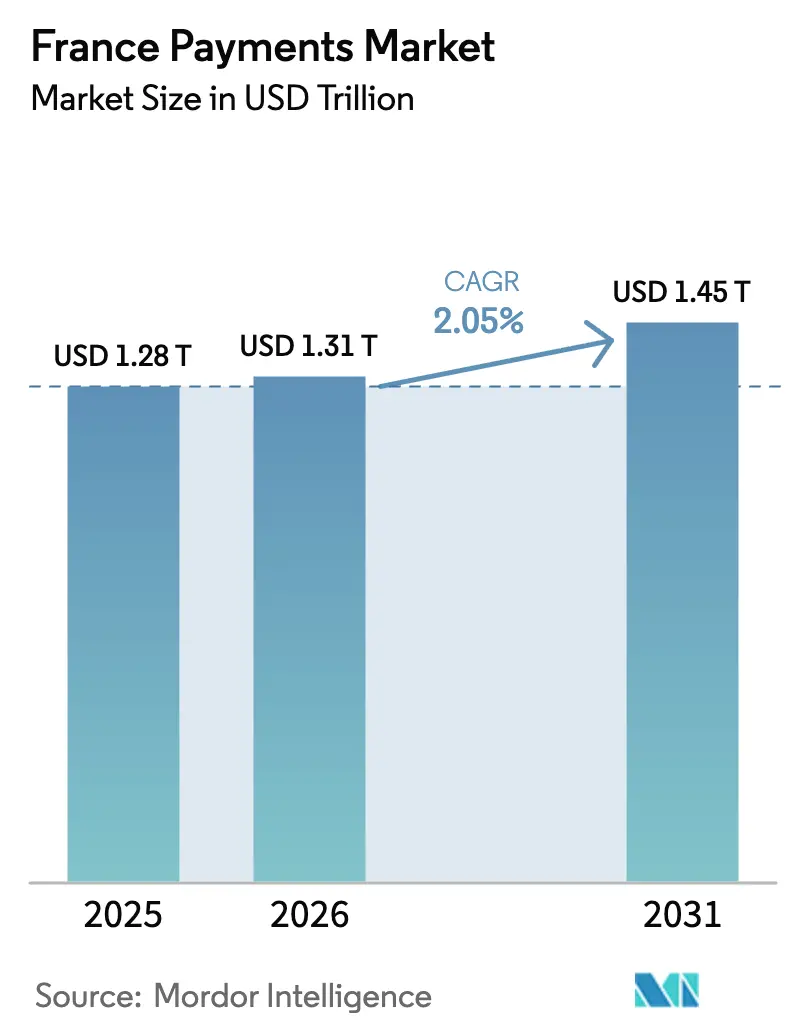
| Base Year Market Size (2025) | USD 1.28 Trillion |
| Market Size (2026) | USD 1.31 Trillion |
| Market Size (2031) | USD 1.45 Trillion |
| Growth Rate (2026 - 2031) | 2.05% CAGR |
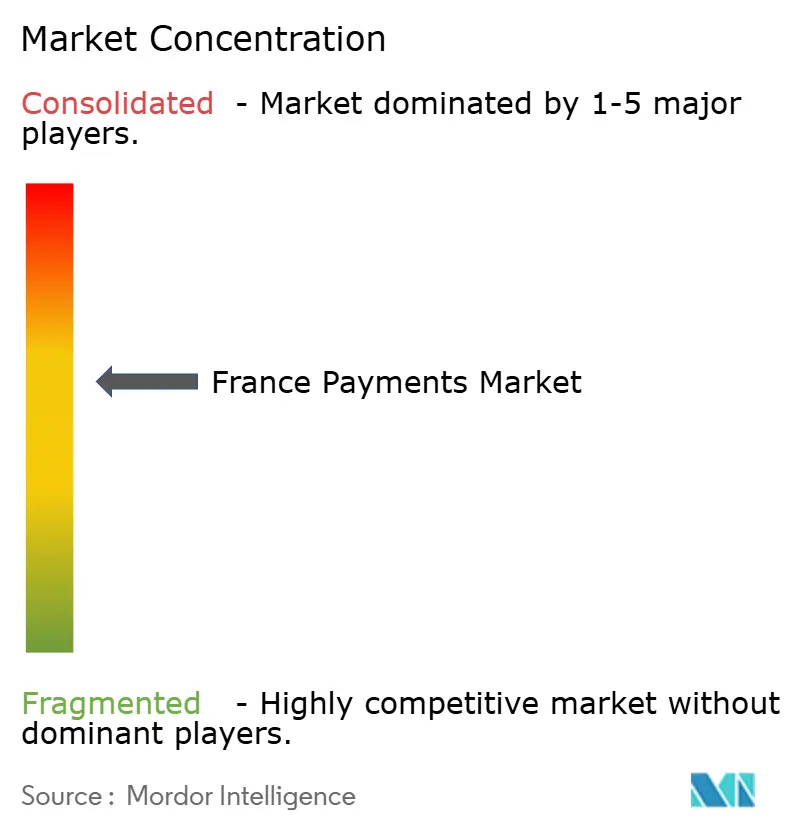
| Market Concentration | Medium |
Major Players *Disclaimer: Major Players sorted in no particular order Image © Mordor Intelligence. Reuse requires attribution under CC BY 4.0. | |
France Payments Market Analysis by Mordor Intelligence
The France payments market size is expected to increase from USD 1.28 trillion in 2025 to USD 1.31 trillion in 2026 and reach USD 1.45 trillion by 2031, growing at a CAGR of 2.05% over 2026-2031. Ongoing implementation of SEPA Instant settlement, rising digital-wallet penetration among Gen-Z shoppers, and bank-led alternatives to international card networks are redrawing competitive boundaries. Real-time rails now settle funds in under 10 seconds, eroding the historical advantage of card authorization and clearing cycles. Simultaneously, SoftPOS technology is lowering acceptance costs for micro-merchants, while artificial-intelligence fraud engines lift authorization rates and reduce chargebacks. These forces combine to give account-to-account (A2A) transactions a credible path to scale even as contactless cards maintain primacy at point of sale.
Key Report Takeaways
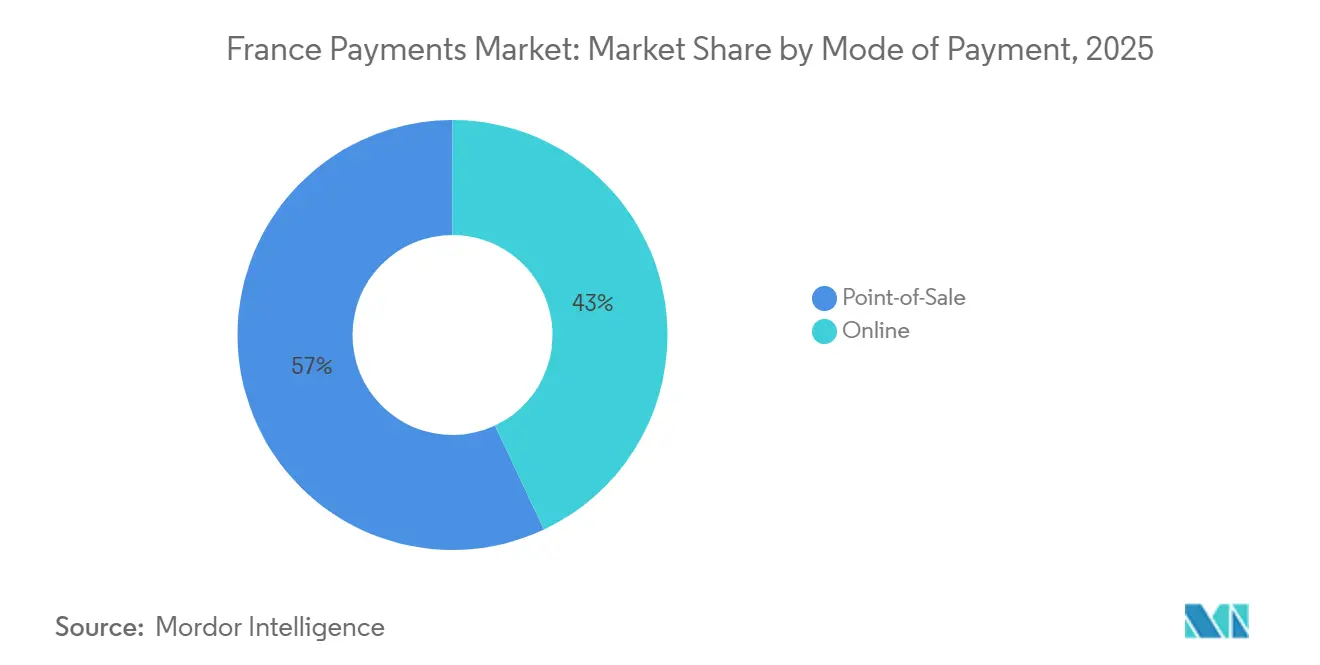
- By mode of payment, point-of-sale transactions led with 57.89% of France payments market share in 2025, whereas online channels are projected to post a 3.07% CAGR through 2031.
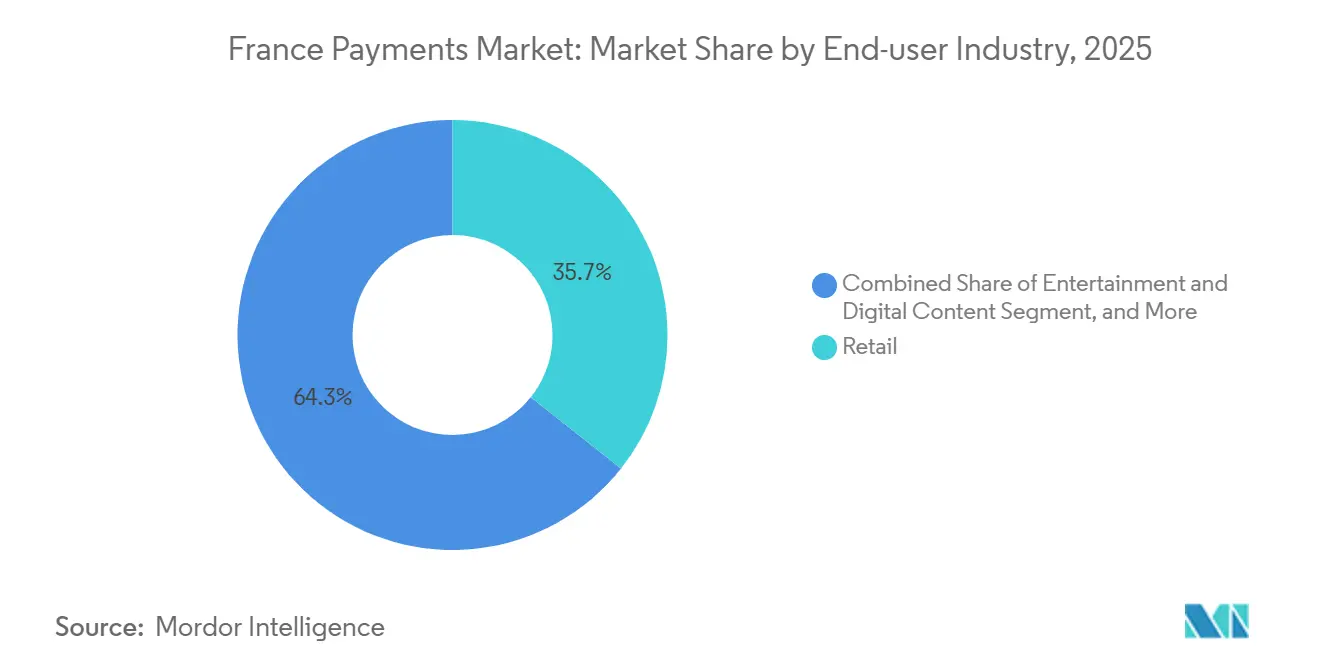
- By end-user industry, retail accounted for 35.67% of the France payments market size in 2025, while hospitality and travel are advancing at a 3.24% CAGR through 2031.
Note: Market size and forecast figures in this report are generated using Mordor Intelligence’s proprietary estimation framework, updated with the latest available data and insights as of January 2026.
France Payments Market Trends and Insights
Drivers Impact Analysis*
| Driver | (~) % Impact on CAGR Forecast | Geographic Relevance | Impact Timeline |
|---|---|---|---|
| PSD2-Enabled Open-Banking Fuels Instant Account-to-Account Payments | +0.6% | France, broader EU alignment with SEPA Instant mandate | Medium term (2-4 years) |
| E-Commerce and M-Commerce Boom Among Gen-Z Spurs Digital Wallet Uptake | +0.5% | National, concentrated in Paris, Lyon, Marseille metropolitan areas | Short term (≤ 2 years) |
| Regulatory Increase of Contactless-Spend Limit Accelerates Tap-and-Go Transactions | +0.3% | National, higher adoption in urban centers | Short term (≤ 2 years) |
| Merchant Adoption of SoftPOS Turns Smartphones into Acceptance Terminals | +0.2% | National, early gains in micro-merchant and service sectors | Medium term (2-4 years) |
| Wero Wallet Launch Catalyzes A2A Real-Time Retail Payments Adoption | +0.2% | France with spillover to Germany and Belgium | Medium term (2-4 years) |
| AI-Driven Risk Decisioning Lifts Authorization Rates While Reducing Chargebacks | +0.1% | Global, used by major French issuers and acquirers | Long term (≥ 4 years) |
| Source: Mordor Intelligence | |||
PSD2-Enabled Open-Banking Fuels Instant Account-to-Account Payments
Revised open-banking rules required French banks to expose application-programming interfaces, yet customer uptake remained limited until the SEPA Instant mandate took hold in 2025. The regulation now obliges every payment service provider to both receive and send real-time euro transfers, collapsing settlement windows from days to seconds.[1]European Central Bank, “SEPA Instant Payments Regulation Implementation,” ecb.europa.eu E-commerce platforms promptly embedded “Pay by Bank” buttons that authorize funds directly from current accounts, bypassing interchange altogether. Interoperability is assured because over 80% of French banks support the STET API framework.[2]STET, “French API Standardization Framework,” stet.eu Merchants enjoy lower costs and faster confirmation, while consumers gain a familiar, friction-free checkout that mirrors card tap-to-pay convenience.
E-Commerce and M-Commerce Boom Among Gen-Z Spurs Digital Wallet Uptake
French online spending reached EUR 150 billion (USD 160 billion) in 2024, with mobile devices capturing 43% of transactions.[3]Fédération du e-commerce et de la vente à distance, “E-commerce Statistics 2024,” fevad.com A 2025 survey found 62% of shoppers aged 18-25 store at least one credential in Apple Pay, Google Pay, Lydia, or Paylib. These wallets bundle loyalty IDs, transport passes, and tickets alongside payment instruments, trimming checkout to a single biometric confirmation. Lydia’s user base climbed to 8 million by late 2025, aided by QR acceptance and installment finance options. As Gen-Z purchasing power expands, merchants that optimize for mobile wallets record higher conversion and larger average order values.
Regulatory Increase of Contactless-Spend Limit Accelerates Tap-and-Go Transactions
Elimination of the EUR 50 (USD 54.4) ceiling in 2024 removed the last psychological hurdle to contactless adoption. Consumers now tap cards or NFC phones for everyday baskets without a second thought, and retailers report checkout-time reductions of roughly 15% after rolling out multi-purpose tap flows that combine payment with loyalty and e-receipt delivery.[4]NFC Forum, “Multi-Purpose Tap Specifications,” nfc-forum.org Compliance with tokenization mandates in PCI DSS 4.0 further reduces fraud risk, persuading risk-averse grocers and fuel stations to steer customers toward tap-and-go experiences.
Merchant Adoption of SoftPOS Turns Smartphones into Acceptance Terminals
Certification of Ingenico’s AXIUM platform under France’s FRv6 security standard in February 2026 lets any modern Android handset accept EMV contactless payments. Micro-merchants such as food-truck operators and tradespeople avoid hardware rental fees and onboard in minutes through their acquirer’s app. Worldline reported French SoftPOS activations expanded 34% quarter-on-quarter during 2025, signaling strong latent demand for low-cost acceptance. As acceptance fragments, competition among acquirers intensifies and legacy terminal vendors pivot toward software-as-a-service revenue.
Restraints Impact Analysis*
| Restraint | (~) % Impact on CAGR Forecast | Geographic Relevance | Impact Timeline |
|---|---|---|---|
| Escalating Card Interchange and Scheme Fees Pressure SME Margins | -0.4% | National, acute for small and medium enterprises | Short term (≤ 2 years) |
| Ageing and Rural Population’s Persistent Cash Preference | -0.3% | Rural departments, peripheral regions | Long term (≥ 4 years) |
| Dependency on Non-European Card Processors Heightens Sovereignty and Cost Risks | -0.2% | France, broader EU concern | Medium term (2-4 years) |
| Real-Time Authorized Push-Payment Fraud Undermines Consumer Trust in Instant Rails | -0.2% | National, cross-border implications | Medium term (2-4 years) |
| Source: Mordor Intelligence | |||
Escalating Card Interchange and Scheme Fees Pressure SME Margins
Although EU law caps interchange at 0.2% on debit and 0.3% on credit, unregulated scheme fees continue to rise and can lift the effective charge well above 1%. For a neighborhood bakery turning over EUR 200,000 (USD 237,440) annually, that difference erodes thin operating margins and discourages card acceptance. Many SMEs are experimenting with Wero or Carte Bancaires A2A options that levy flat-fee or subscription pricing, but cross-border reach remains limited, complicating e-commerce ambitions.
Ageing and Rural Population’s Persistent Cash Preference
One-fifth of France’s residents are 65 years or older, and surveys show 59% of consumers still rely on cash for at least some purchases. Rural communes, where broadband coverage and smartphone penetration trail urban averages, typically lag 18-24 months in adopting contactless or wallet payments. The Banque de France guarantees cash availability through 2030, obliging providers to run dual infrastructures even as digital volumes grow. This requirement inflates operating costs and dilutes the efficiency benefits of an all-electronic ecosystem.
*Our forecasts treat driver/restraint impacts as directional, not additive. The impact forecasts reflect baseline growth, mix effects, and variable interactions.
Segment Analysis
By Mode of Payment: Online Channels Gain Share as Instant Rails Mature
Online transactions represented 42.11% of total value in 2025 and are forecast to post a 3.07% CAGR through 2031, outpacing headline France payments market growth. Point-of-sale still leads, yet the share of tap-to-pay wallets inside physical stores climbed steadily as EMV acceptance reached 98% of terminals. Instant SEPA transfers embedded in checkout flows remove the need to enter 16-digit card numbers, trimming abandonment rates and lowering merchant costs.
Digital wallets aggregate debit cards, credit cards, and A2A mandates within a single interface, encouraging users to toggle between instruments without leaving the merchant page. Klarna’s installment pay option gained 22% more French merchants in 2025, illustrating consumer appetite for deferred settlement. As tokenization under EMVCo standards becomes ubiquitous, the France payments market size for online channels will continue to rise on the back of lower fraud and higher approval rates.


By End-User Industry: Hospitality Rebounds as Travel Normalizes
Retail maintained a 35.67% share of France payments market value in 2025, supported by high-frequency grocery and fuel baskets and broad contactless terminal penetration. Hospitality and travel, however, recorded the fastest growth at a 3.24% CAGR, buoyed by tourist inflows and the sector’s investment in tap-and-go experiences. Hotels and restaurants processed EUR 42 billion (USD 45 billion) in 2025, with mobile-wallet usage hitting 61%.
Entertainment, streaming, and gaming rely heavily on stored credentials and recurring billing, positioning tokenized cards and digital wallets as the default rails. Government agencies likewise accelerate digital adoption, with 78% of personal tax payments completed online in 2025. Healthcare is digitizing the Carte Vitale into a smartphone app, opening a new front in real-time copayment processing and broadening the addressable France payments industry opportunity.

Geography Analysis
France’s integration into SEPA provides a unified legal and technical framework for real-time euro payments across 36 countries. Domestic banks invested more than EUR 500 million (USD 535 million) during 2024-2025 to retrofit core systems for instant transfers and to embed Wero wallet functionality. These upgrades give French acquirers an early-mover advantage over peers in Southern Europe, where instant implementation lags.
Urban centers dominate digital adoption: Paris, Lyon, Marseille, and Toulouse account for nearly half of wallet-based transactions though they represent only one-third of the population. Younger demographics, higher smartphone penetration, and denser acceptance networks explain the outperformance. Rural departments such as Creuse and Lozère remain cash-centric, reflecting older demographics and patchy broadband.
Cross-border commerce benefits from Wero’s rollout into Germany, Belgium, and Luxembourg, offering 60 million consumers a pan-European A2A option that bypasses U.S. card networks. Draft PSD3 rules will add Confirmation of Payee checks on transfers above EUR 100 (USD 118.7), harmonizing fraud-control standards across SEPA and bolstering trust in instant rails.
Regulatory Landscape
France payments regulation is shaped by EU rules (PSD2 and the SEPA Instant regime) and supervised nationally by the Banque de France and the ACPR. In January 2026, the ACPR issued Instruction 2026-I-01, requiring payment service providers to report fee levels for credit transfers and instant transfers annually (via the regulator reporting channel). The move tightens transparency and comparability across providers as instant payments move toward a default-rail position.
Implementation is coordinated through the Banque de France and the Comité national des moyens de paiement (CNMP) under the National Retail Payments Strategy 2025-2030, which targets broader instant credit transfer adoption and sovereignty-oriented retail payment solutions. On the operational side, Banque de France Decision 2026-06 (15 June 2026) updated participation conditions linked to next-generation euro settlement infrastructure. In parallel, tax and commerce rules introduce payments-linked compliance obligations, including phased mandatory e-reporting for foreign companies without a permanent establishment starting 1 September 2026, and requirements for professional websites to display payment methods and late-payment penalties (with a stated EUR 15,000 fine for non-compliance).
Value Chain Analysis
The France payments value chain starts with payer instruments (cards, wallets, and account-to-account rails) and moves through acceptance and orchestration (merchant apps, gateways, and SoftPOS), then processing and clearing (CB, STET, and international card networks), followed by settlement, reconciliation, and dispute and fraud management. Domestic infrastructure remains central, with Cartes Bancaires (CB) as a key scheme and STET as a major clearing platform. Bank coverage for new A2A retail propositions is being expanded through the European Payments Initiative (EPI) Wero wallet, supported by major French banks including BNP Paribas, Credit Agricole, Societe Generale, BPCE, La Banque Postale, and others.
Recent platform moves show where value is shifting, especially toward direct connectivity and more data-rich risk layers. In April 2026, Adyen became a direct participant of STET and a principal member of Groupement des Cartes Bancaires, enabling direct clearing for French payment flows and reducing reliance on intermediaries. At the same time, processors and banks are embedding automation and fraud controls across authorization and checkout, including the June 2026 production agentic payment transaction completed by Worldline, Credit Agricole, and Mastercard. Merchant adoption of software-led acceptance, such as SoftPOS, is also compressing distribution and onboarding costs for micro-merchants.
Competitive Landscape
The France payments market balances concentrated global card schemes with a mosaic of domestic and regional challengers. Visa and Mastercard still clear the majority of transaction value, but Wero processed more than 200 million transfers in its first full year, proving bank-led initiatives can scale when aligned with regulation. Worldline’s 2025 acquisitions expanded its French merchant base beyond 1 million acceptance points, creating data scale that underpins machine-learning fraud models.
Stripe’s Radar analyzes hundreds of behavioral signals per transaction and lifted approval rates for domestic merchants by 3.2 percentage points in 2025. Ingenico responded by shifting from hardware sales to AXIUM subscription bundles after SoftPOS began to commoditize basic acceptance. Lydia leverages its eight-million-strong user base to pitch installment finance, QR payments, and loyalty integration, effectively unbundling traditional acquirer economics.
Regulation accelerates competitive churn. SEPA Instant settlement forces acquirers to build out 24×7 liquidity management, PSD2 APIs open account data to third parties, and upcoming PSD3 rules tighten fraud liability. Players unable to fund real-time risk engines or open-banking integrations risk ceding share to agile fintechs, especially in online and micro-merchant niches.
France Payments Industry Leaders
Apple Inc. (Apple Pay)
Paylib SAS
Samsung Electronics Co., Ltd. (Samsung Pay)
Carrefour S.A. (Carrefour Pay)
Google LLC (Google Pay)
- *Disclaimer: Major Players sorted in no particular order

Market Opportunities and Future Outlook
A near-term whitespace is opening around regulated digitization of B2B and government-adjacent payment workflows as France moves toward mandatory e-invoicing and e-reporting. In July 2026, DGFiP published practical guidance for the 1 September 2026 go-live phase, starting with large and intermediate-sized enterprises. This pushes companies to connect invoicing, reconciliation, and payment initiation in more automated ways, creating room for payment service providers, gateways, and software platforms to bundle compliant invoicing data exchange with embedded instant payment initiation (including SEPA Instant and bank-led A2A options) and value-added controls such as payee verification and fraud screening.
A second opportunity cluster is tied to sovereignty-led participation in real-time infrastructure, where control of routing, clearing, and economics can differentiate acquirers and payment processors. Adyen’s April 2026 move to become a direct STET participant and CB principal member illustrates how providers can reconfigure the chain to improve cost and speed. Separately, bank-backed Wero provides a distribution path to scale A2A at retail without card scheme fees. The June 2026 production agentic payment completed by Worldline, Credit Agricole, and Mastercard also points to merchant demand for AI-assisted purchasing flows that still rely on regulated authentication and existing rails, expanding product space for risk decisioning, consent management, and automated dispute handling across both online and point-of-sale scenarios.
Recent Industry Developments
- July 2026: The AMF reminded the market that the transitional period for Digital Asset Service Providers (DASPs) to operate in France without MiCA authorization ended on July 1, 2026. This tightened the compliance perimeter around crypto-asset payment-adjacent services and increased the importance of regulated onboarding, custody, and transaction monitoring for providers serving French users.
- May 2026: France’s Law n 2025-1058 (adopted November 6, 2025) became effective on May 6, 2026, strengthening anti-fraud measures for non-cash payment methods and establishing the Fichier national des comptes signales pour risque de fraude (FNC-RF). The change elevates the role of shared fraud intelligence and verification steps across issuers, acquirers, and payment institutions, influencing authorization policies and customer experience for higher-risk transactions.
- February 2026: La Banque Postale announced integration of the domestic Cartes Bancaires (CB) network into Samsung Pay, enabling CB transactions on Samsung devices. This broadened wallet choice while supporting domestic routing options, adding competitive pressure on international card network rails and on acceptance providers to optimize routing and tokenization for mobile contactless payments.


Research Methodology Framework and Report Scope
Market Definition and Coverage
For this report, the market is defined as the total value of payments executed in France across point of sale and online sale flows, covering card payments, digital wallets, and other common payment methods used by consumers and merchants.
Scope exclusions: We exclude pure cash circulation tracking and do not treat payment provider fee revenue as the market value unless it is part of the transaction value series being modeled.
Segmentation Overview
- By Mode of Payment
- By Point of Sale
- Card Payments
- Debit Cards
- Credit Cards
- Bank Financing Prepaid Cards
- Digital Wallets (includes Mobile Wallet)
- Other Point of Sale
- Card Payments
- By Online Sale
- Card Payments
- Debit Cards
- Credit Cards
- Bank Financing Prepaid Cards
- Digital Wallets
- Other Online Sales (includes Cash on Delivery, Bank Transfer, and Buy Now Pay Later)
- Card Payments
- Digital Wallets
- Other Online Sales (includes Cash on Delivery, Bank Transfer, and Buy Now Pay Later)
- By Point of Sale
- By End-user Industry
- Retail
- Entertainment and Digital Content
- Healthcare
- Hospitality and Travel
- Government and Utilities
- Other End-user Industries
Data Sources, Market Sizing, and Validation
Desk Research
Desk research was used to set the hard boundaries of what is counted, and to build consistent input series for payment value by instrument and channel. We relied on public and official sources such as Banque de France statistical releases, European Central Bank payments statistics, Eurostat household and retail indicators, and the European Commission pages on PSD2 and open banking direction.
To keep assumptions realistic, we also used materials like annual reports and investor decks from relevant ecosystem participants, association and scheme publications on card and contactless trends, and reputable press coverage of regulatory or infrastructure changes. Where needed, a paid subscription covering company financials and news helped cross check large moves in reported payment activity and to time major product rollouts without over-reading one quarter. This desk research list is illustrative, and many other sources were also referenced for collection, validation, and clarification.
Primary Interviews and Surveys
Primary work focused on validating what drives payment value in France, and on stress testing the channel split between POS and online in the most recent period. We spoke with stakeholders across issuing, acquiring, gateways, merchants, and payment infrastructure roles, and we used these inputs to confirm adoption curves, average ticket patterns, and the pace of migration toward digital wallets and account based methods across France.
Distribution of primary research fieldwork respondents
| Company type | Respondent position | Region |
|---|---|---|
| Top tier: 28% | CXOs: 14% | |
| Mid tier: 56% | Functional/Unit leaders: 34% | |
| Smaller Players: 16% | Managers: 52% |
Market-Sizing & Forecasting
Sizing starts with a top-down rebuild of the France payment value pool using published payments statistics and consumer spending signals, which are then mapped into POS and online flows and reconciled by instrument. After the first pass, we corroborate totals with selective bottom-up checks such as sampled merchant acceptance patterns, sanity checks on average transaction size by channel, and supplier side commentary on mix shifts.
The model uses a practical set of market fingerprints, including card payment value and growth, digital wallet share changes, e-commerce spending trends, contactless penetration, and the relative drag from cash and other offline methods. Where a data series is not fully available, the gap is handled through conservative interpolation that is then reviewed with expert feedback so the step is traceable and not hidden in the final number. Forecasting is primarily done through scenario analysis with a light regression style overlay, where the assumptions on consumer spending, online mix, and payment method substitution are aligned to what interviewees see as the most likely path in the next few years.
Data Validation & Update Cycle
Validation is done through multiple checks so the final value does not depend on one source or one assumption. We compare the modeled totals against independent signals like central bank payment aggregates, retail and e-commerce trend direction, and instrument level share shifts, and then investigate any variance that looks too large for the period.
Before sign-off, the numbers are reviewed in steps, with anomaly flags raised when growth rates, channel splits, or implied average transaction sizes move outside reasonable bounds. Reports are refreshed annually, and interim updates are made when a material event changes payment rails, regulation, or adoption patterns. Right before delivery, an analyst completes a final pass so the latest available data and currency timing are reflected consistently.
Mordor Intelligence's France Payments Market Size Versus Other Published Estimates
Published market sizes for France payments can look far apart because some sources measure transaction value, while others focus on provider revenue, and the instrument scope also shifts between card only and all payment methods. Differences in the base year, the currency conversion date, and how fast average ticket sizes are assumed to change can further widen the spread.
In this study, the most recent period is re-checked right before publication using the latest payments statistics and a consistent USD conversion window, and that refresh-led discipline is a key reason the 2025 value in Mordor Intelligence does not line up with figures that are either card-only or reported as ecosystem revenue.
Benchmark comparison
| Source | Market Size | Gaps in Research Methodology |
|---|---|---|
| Mordor Intelligence | USD 1.28 T (2025) | |
| Trade Journal A | USD 1.14 T (2028) | This figure is focused on card payment value only, and the year is different, so it will not capture non-card methods like bank transfers and buy now pay later that are included in the broader payments pool. |
| Regional Consultancy B | USD 276.20 B (2026) | This estimate appears to be framed as market revenue or a narrower monetized ecosystem view rather than total payment transaction value, which typically produces a much smaller number even when the country coverage matches. |
The table shows that the largest gaps are usually created by scope choice (card-only versus all methods) and by whether the metric is transaction value or monetized revenue. By keeping the unit of measure consistent and validating the latest year with multiple cross checks, we deliver a practical number that can be traced back to clear inputs and repeated when new data is released.


Key Questions Answered in the Report
What is the projected value of the France payments market in 2031?
It is expected to reach USD 1.45 trillion by 2031, reflecting a 2.05% CAGR over 2026-2031.
Which payment mode is expanding fastest?
Online channels are forecast to grow at a 3.07% CAGR to 2031, outpacing point-of-sale transactions.
How large is retail's share of transaction value?
Retail accounted for 35.67% of total value in 2025, the largest share among end-user industries.
Why are SoftPOS solutions important for micro-merchants?
They convert Android phones into terminals, eliminating hardware rental fees and broadening digital acceptance in cash-heavy segments.
What competitive threat do Wero and similar A2A wallets pose?
They bypass interchange-based card rails, offering real-time settlement and lower merchant costs that challenge Visa and Mastercard's dominance.
Page last updated on: