
Market Overview
| Study Period | 2020 - 2031 |
|---|---|
| Forecast Data Period | 2026 - 2031 |
| Historical Data Period | 2020 - 2024 |
| Market Size (2026) | USD 32.88 Billion |
| Market Size (2031) | USD 39.46 Billion |
| Growth Rate (2026 - 2031) | 3.72 % |
| Market Concentration | Low |
Major Players *Disclaimer: Major Players sorted in no particular order Image © Mordor Intelligence. Reuse requires attribution under CC BY 4.0. | |
France Packaging Market Analysis by Mordor Intelligence
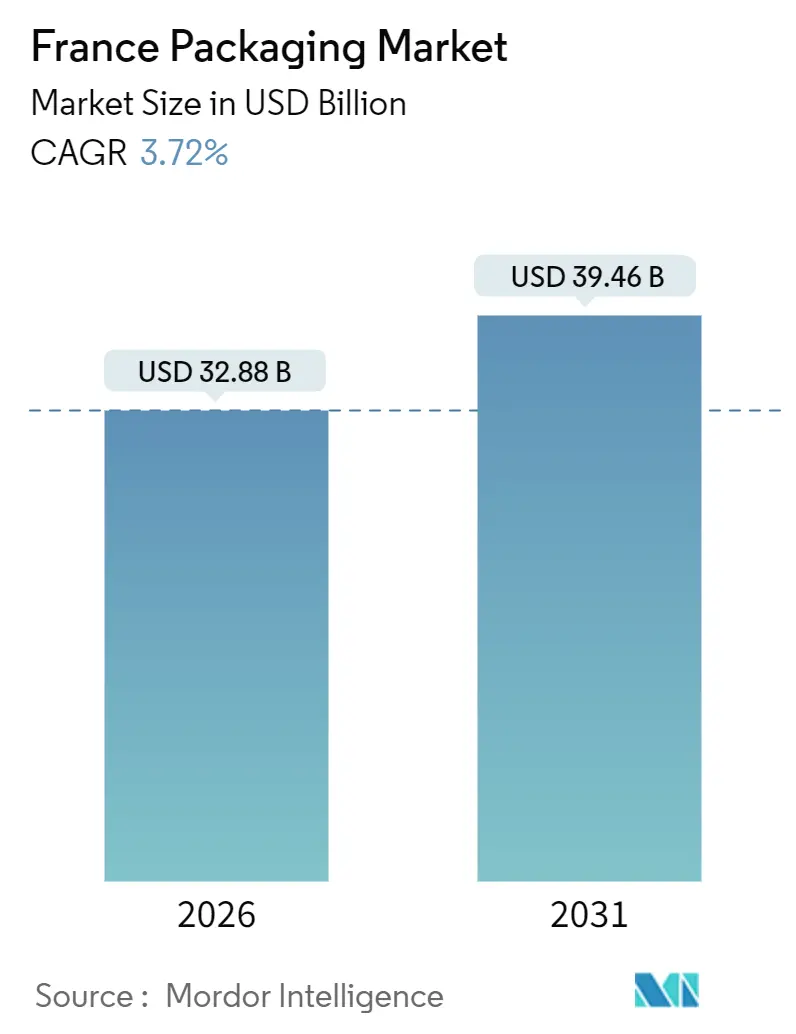
The France packaging market size is USD 32.88 billion in 2026 and it is projected to reach USD 39.46 billion by 2031, reflecting a 3.72% CAGR during the forecast period. This growth trajectory emerges despite higher Extended Producer Responsibility (EPR) fees, the single-use plastic curbs under the AGEC law, and the European Union Packaging and Packaging Waste Regulation (PPWR) that took effect in February 2025. Demand is anchored by France’s EUR 176.7 billion (USD 188.5 billion) food and beverage production base, strong e-commerce parcel volumes that surpassed 1 billion units in 2025, and steady brand investment in circular solutions such as Carrefour’s Loop refill network. At the same time, recycled polyethylene terephthalate (rPET) prices converged with virgin resin quotations in 2024, squeezing recycling economics and compelling converters to review compliance strategies. Corrugated-box manufacturers also face kraft-liner and energy prices that remain above pre-2021 norms, while talent shortages in packaging engineering slow innovation pipelines. Yet, continued government funding through ADEME’s Green Fund and France 2030 is catalyzing bio-based material scale-up and digital watermarking pilots for advanced sortation.
Key Report Takeaways
- By material type, plastic held 52.54% of the France packaging market share in 2025, while paper and paperboard are forecast to post the fastest 4.32% CAGR through 2031.
- By packaging format, flexible solutions led with 56.86% of the France packaging market size in 2025 and are projected to expand at a 4.75% CAGR to 2031.
- By product type, flexible plastics captured 38.92% of the France packaging market share in 2025; single-use paper items are on track for the highest 5.28% CAGR through 2031.
- By end user, the food segment dominated with 28.81% of 2025 revenue, whereas personal care and cosmetics are anticipated to register the quickest 5.18% CAGR up to 2031.
Note: Market size and forecast figures in this report are generated using Mordor Intelligence’s proprietary estimation framework, updated with the latest available data and insights as of January 2026.
France Packaging Market Trends and Insights
Drivers Impact Analysis*
| Driver | (~) % Impact on CAGR Forecast | Geographic Relevance | Impact Timeline |
|---|---|---|---|
| Rising Demand for Sustainable and Recyclable Packaging | +0.9% | National, led by Île-de-France and Auvergne-Rhône-Alpes | Medium term (2-4 years) |
| Growth of E-commerce and Parcel Logistics | +0.7% | Urban centers including Paris, Lyon, Marseille | Short term (≤ 2 years) |
| Robust Food and Beverage Production Base | +0.5% | Brittany, Pays de la Loire, Nouvelle-Aquitaine | Long term (≥ 4 years) |
| Expansion of Refill and Bulk Retail Stations | +0.4% | Paris, Lyon, Bordeaux metropolitan areas | Medium term (2-4 years) |
| Government-Led Funding for Smart Packaging R&D | +0.3% | Île-de-France, Grand Est pilot zones | Medium term (2-4 years) |
| Digital Watermarking Roll-out for Advanced Recycling | +0.3% | Citeo-affiliated material recovery facilities | Long term (≥ 4 years) |
| Source: Mordor Intelligence | |||
Rising Demand For Sustainable And Recyclable Packaging
Brand owners across dairy, personal care, and beverage categories are prioritizing recycled content and bio-based polymers to avoid surcharges on non-recyclable formats. Carrefour’s Loop network, active in 345 stores, targets removal of 15,000 tonnes of virgin plastic by 2030, pushing converters to design containers that tolerate 20-50 refill cycles without barrier loss.[1]Carrefour Group, “Loop Reusable Packaging System Expansion Announcement,” carrefour.com Polylactic acid capacity is projected to help lift global bioplastics output from 2.47 million tonnes in 2024 to 5.73 million tonnes in 2029, with 45% earmarked for packaging.[2]European Bioplastics, “Bioplastics Market Data 2024,” european-bioplastics.org Cost premiums and modest heat resistance confine polylactic acid to cold-fill and ambient goods, so hot-fill lines still rely on polyethylene terephthalate and polypropylene. EU recycled-content mandates tighten each review period, forcing even small converters to switch to mono-material structures. Early supply deals for bio-based resin therefore deliver strategic security in the France packaging market.
Growth of E-Commerce And Parcel Logistics
E-commerce accounted for 13% of French retail sales in 2025, generating more than 1 billion parcels that require corrugated outers, void fill, and tamper-evident tape. Each shipment endures extra handling, so packaging intensity per transaction exceeds in-store requirements by up to 60%. Kraft-liner mills still pay EUR 150-180 per megawatt-hour for power, about double the pre-2021 norm, lifting box costs. Integrated producers such as Smurfit WestRock leverage captive recycled-fiber loops to buffer volatility. Parcel carriers now specify lighter boxes, prompting converters to adopt micro-flute and high-performance adhesives that retain stacking strength at lower basis weight.
Robust Food And Beverage Production Base
France’s food and beverage sector generated EUR 176.7 billion (USD 188.5 billion) in 2025, anchoring steady demand for glass, metal, flexible, and rigid plastic formats. Wine and spirits bottlers have trimmed glass weight from 500 grams to 350 grams per bottle to cut freight emissions, requiring furnace adjustments to curb breakage. Dairy processors are switching to high-barrier polyethylene terephthalate for shelf-stable milk, displacing opaque high-density polyethylene. Aluminum can makers refine alloys and end-designs to reduce metal consumption while retaining carbonation safety margins. Retailer consolidation keeps price pressure high, so converters chase automation and material savings to protect margins.
Government-Led Funding For Smart Packaging R&D
ADEME’s Green Fund and France 2030 program awarded EUR 1.49 million in June 2024 to the ANR AgriBioPack project, supporting bio-based multilayer films aimed at matching the oxygen-barrier of ethylene vinyl alcohol copolymers. Horizon Europe calls in 2025 added grants for time-temperature indicators, freshness sensors, and digital product passports that trace packs from plant to shelf. Public funding reduces pilot risk, allowing converters to trial active labels and smart inks without full balance-sheet exposure. Pharmaceutical firms absorb the early cost premium, paving a path to wider food adoption as unit economics improve. These programs also stipulate open-data publication, accelerating cross-industry learning and shortening the innovation cycle in the France packaging market.
Restraints Impact Analysis*
| Restraint | (~) % Impact on CAGR Forecast | Geographic Relevance | Impact Timeline |
|---|---|---|---|
| Stringent Single-Use Plastic Bans and EPR Fees | -0.6% | Île-de-France, Provence-Alpes-Côte d’Azur | Short term (≤ 2 years) |
| Volatile Raw-Material and Energy Prices | -0.5% | National, acute in glass and aluminum | Short term (≤ 2 years) |
| Recycling Feedstock Bottlenecks (rPET, rHDPE) | -0.3% | Hauts-de-France, Grand Est | Medium term (2-4 years) |
| Packaging-Engineering Talent Shortage | -0.2% | Île-de-France, Auvergne-Rhône-Alpes innovation hubs | Long term (≥ 4 years) |
| Source: Mordor Intelligence | |||
Stringent Single-Use Plastic Bans And EPR Fees
France’s AGEC law prohibits polystyrene trays, single-use cutlery, and colored polyethylene terephthalate bottles, while the EU Packaging and Packaging Waste Regulation enforces minimum recycled-content thresholds and harmonized EPR fees. Eco-modulation penalties add up to 30% on non-recyclable formats, shrinking margins for converters that serve fresh produce and snack brands. Verallia saw Q3 2024 revenue fall 6.8% organically as beverage customers lightweighted bottles or shifted to aluminum cans to avoid glass surcharges. SMEs without R&D budgets struggle to reformulate adhesives and coatings quickly, fueling consolidation. Compliance spending crowds out growth capital, delaying new-line investments across the France packaging market.
Volatile Raw-Material And Energy Prices
rPET clear flakes traded at EUR 800-900 per tonne in 2024, overlapping virgin polyethylene terephthalate at EUR 900-1,000, erasing the cost edge once enjoyed by recycled feedstock. Food-grade rPET remains more expensive, fetching EUR 1,100-1,200, yet brand owners resist full price pass-through. Electricity averaged EUR 150-180 per megawatt-hour in 2024, doubling pre-2021 levels and squeezing energy-intensive glass furnaces and aluminum smelters. Crown Holdings reported lower European can volumes and unfavorable hedges, illustrating how input swings undermine profitability. Hedging and operational efficiency become defensive rather than offensive levers, slowing innovation spending in the France packaging market.
*Our forecasts treat driver/restraint impacts as directional, not additive. The impact forecasts reflect baseline growth, mix effects, and variable interactions.
Segment Analysis
By Material Type: Paper and Paperboard Gain Momentum While Plastics Lead
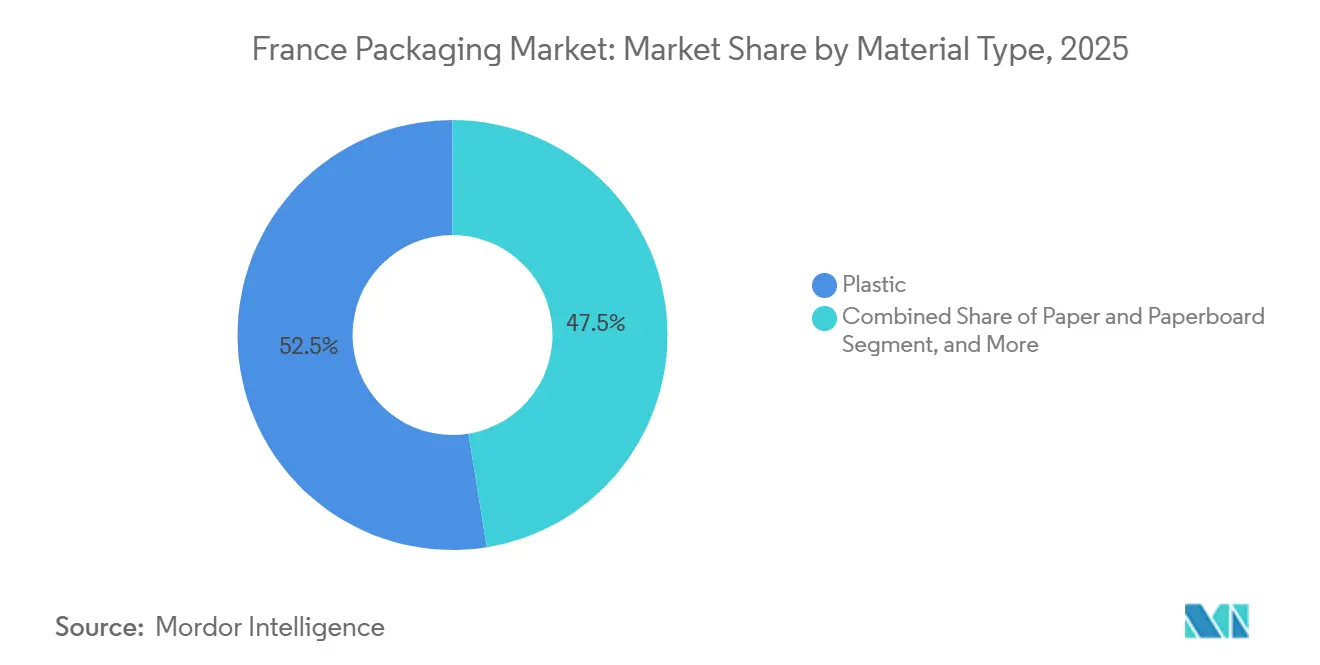
Plastic maintained a 52.54% share of the France packaging market in 2025, owing to versatile polyethylene, polypropylene, and PET containers across dairy, sauces, and personal-care SKUs. Paper and paperboard, however, are set to outpace all materials with a 4.32% CAGR through 2031 as e-commerce corrugated boxes, folding cartons, and molded-pulp trays unlock eco-modulation discounts. Container glass remains entrenched in the wine and premium beverage markets, but the lightweighting of bottles reduces tonnage demand. Metal cans continue to serve hermetic or retort categories, offering infinite recyclability messaging.
Cost visibility in kraft liner production remains challenging due to fiber scarcity and elevated energy tariffs; however, integrated mill-converter players can offset input swings through captive recyclate loops. PET dominates beverage packaging due to its clarity and ready food-contact approvals, and its mono-material thermoforms now qualify for higher EPR discounts. High-density polyethylene and low-density polyethylene retain a significant share of the detergent market and are used to produce films, while polypropylene excels in closures and microwaveable containers. In contrast, PVC and polystyrene experience demand declines under AGEC restrictions and risks to consumer perception.


By Packaging Format: Flexible Solutions Extend Leadership
Flexible formats captured 56.86% of the France packaging market in 2025 and are projected to grow at a 4.75% CAGR through 2031, driven by stand-up pouches, multi-layer films, and e-commerce mailers that achieve up to 50% material savings compared to their rigid counterparts. Rigid solutions, although heavier, remain indispensable for carbonated beverages, pharmaceuticals, and premium cosmetics that need drop resistance and shelf impact. Lightweighting in flexible substrates now leverages high-barrier polyethylene or polypropylene blends that pass new recyclability tests, enabling converters to avoid EPR penalties.
Digital watermarking trials achieved 88-94% detection accuracy, paving the way for flexible mono-material sortation at scale. Rigid bottles are increasingly paired with refill pouches in Carrefour’s Loop, reducing net virgin plastic use by up to 70%. E-commerce brands demand bubble mailers and air pillows that trim dimensional weight, which favors converters with in-line extrusion and pouch-forming capabilities. While rigid glass and metal keep a share in flavor-critical or regulatory niches, the relative cost advantage of flexible laminates secures their expansion.
By Product Type: Flexible Plastics Retain Dominance as Single-Use Paper Accelerates
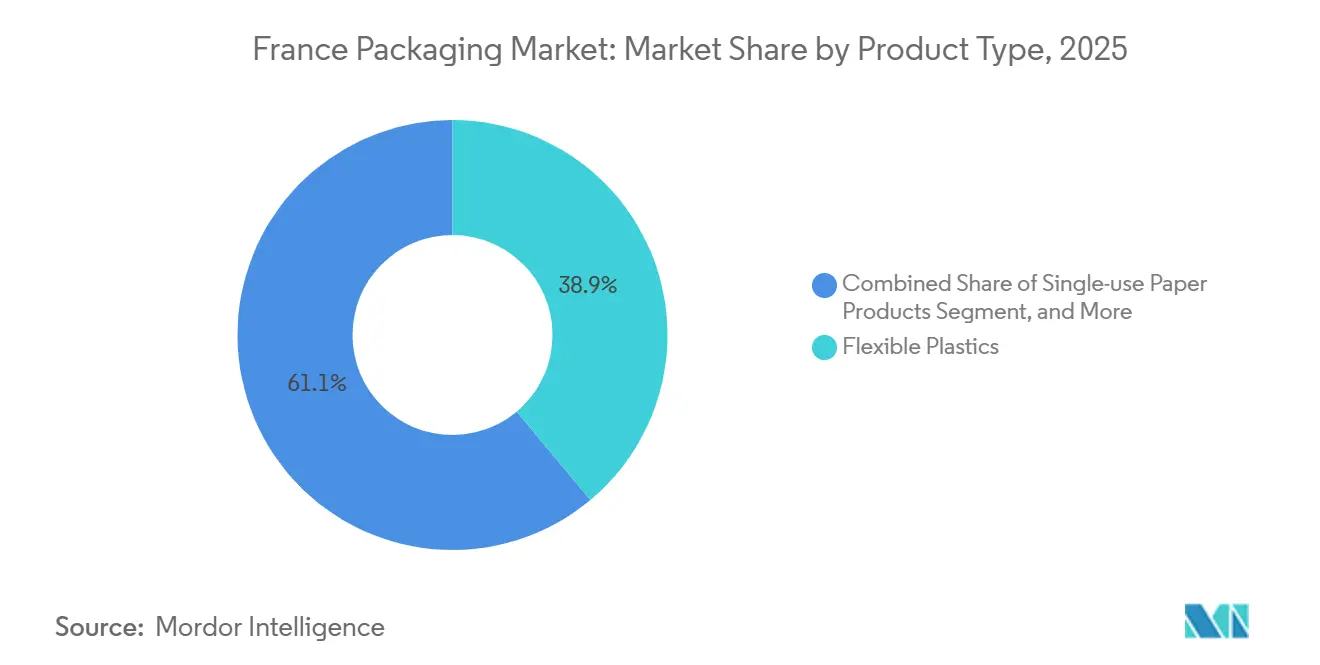
Flexible plastics held 38.92% of product demand in 2025 across snack pouches, produce films, and pet-food bags. France packaging market size for single-use paper plates, bowls, and wraps is forecast to post a 5.28% CAGR, benefiting from quick-service restaurant transitions away from polystyrene and foam. Rigid plastics, such as PET bottles and PP jars, provide clarity, tamper-evidence, and compatibility with hot-fill lines; yet, mono-material mandates push converters toward simplified structures.
Regulation-driven demand for paper straws and molded-fiber clamshells accelerates capital spending in specialized pulp-molding lines. Converters supplying flexible pouches are redesigning laminates to remove aluminum layers and increase polyethylene content, thereby enhancing recyclability without compromising the oxygen barrier. Metal cans and closures maintain niches where shelf life and hermetic sealing are paramount. Container glass maintains prestige branding but faces freight and EPR cost headwinds despite successful 30% weight-reduction programs.
By End User: Personal Care and Cosmetics Gain Pace Over Food
Food applications represented 28.81% of 2025 demand, driven by dairy, bakery, and fresh-produce packaging. However, personal care and cosmetics are set for the fastest growth, with a 5.18% CAGR through 2031. Premium brands now deploy refillable glass jars, aluminum tubes, and rPET bottles with tactile finishes that justify higher shelf prices and meet brand sustainability claims. Beverage brands focus on lightweight glass and aluminum innovations to reduce carbon footprints, while pharmaceuticals rely on blister packs and child-resistant closures governed by stringent traceability rules.
Advanced digital watermarks, rolled out across shampoo and lotion bottles, enable Citeo-affiliated facilities to sort by polymer and brand, facilitating higher-purity recycling and attracting lower EPR fees. Industrial and chemical users emphasize durability and hazard compliance, often selecting drums and intermediate bulk containers that resist corrosive loads. Agriculture remains a smaller but stable segment, consuming stretch-film for silage and woven sacks for feed.
Geography Analysis
France packaging market dynamics vary across regions. Île-de-France and Auvergne-Rhône-Alpes host research clusters funded by ADEME and France 2030, including the EUR 1.49 million AgriBioPack bio-based film program launched in June 2024. Brittany, Pays de la Loire, and Nouvelle-Aquitaine provide the bulk of food and beverage output, underpinning steady glass, flexible, and rigid-plastic demand. Paris, Lyon, and Marseille account for the highest parcel density, thereby increasing the consumption of corrugated and protective mailers.
Hauts-de-France and Grand Est report rPET feedstock shortages that hinder the achievement of the PPWR’s 50% recycling target for 2025, keeping France’s plastic recycling rate close to 25% in 2022. Provence-Alpes-Côte d’Azur imposes strict single-use bans, incentivizing the use of molded-fiber trays in tourism hotspots. Nationwide energy prices, although lower than 2022 peaks, remain double pre-crisis averages and weigh on energy-intensive glass and aluminum producers.
Digital watermarking pilots in Suez-operated and Wellman Verdun facilities proved scalable but will require EUR 50-100 million to retrofit France’s 100-plus material recovery facilities. Collectively, regional policy diversity and infrastructure gaps position France as a live laboratory for next-generation packaging solutions that balance cost, performance, and environmental impact.
Regulatory Landscape
France packaging regulations are shaped by the Anti-Waste for a Circular Economy (AGEC) law and Extended Producer Responsibility (EPR) frameworks implemented through accredited eco-organizations and ministry specifications. For household packaging and graphic paper, a consolidated specification (arrêté) dated 7 December 2023 structures compliance, and eco-organizations including Citeo, Adelphe, and Leko are accredited through 31 December 2029 (decree dated 23 December 2024). Eco-modulation mechanisms and product restrictions under AGEC (including curbs on certain single-use plastics and colored PET) continue to push design-for-recycling and mono-material packaging choices.
A notable expansion occurred with the creation of EPR for professional (industrial and commercial) packaging, established by Decree No. 2025-1081 dated 17 November 2025 and an associated order dated 2 December 2025, which entered into force on 1 January 2026. The Ministry of Ecological Transition also set incentive mechanics for incorporating recycled plastic via the IMPR scheme, with rates set by the order of 5 September 2025, and published supporting guidance in 2026. At the EU level, Regulation (EU) 2025/40 (PPWR), published in January 2025, adds harmonized requirements, including authorized-representative obligations applying from 12 August 2026, which tightens cross-border compliance for packaging placed on the French market.
Value Chain Analysis
The France packaging value chain starts with upstream feedstocks and utilities, where virgin polymers, recycled resins (notably rPET), paper fibers, glass batch inputs, and aluminum are converted into packaging substrates. This is followed by printing, coating, conversion, and filling-line integration. Converters and integrated groups supply brand owners across food, beverage, pharmaceuticals, and personal care, while downstream logistics and retail channels (including e-commerce) drive demand for corrugated, protective mailers, and flexible formats. Industry coordination and standard-setting are supported by associations such as Conseil National de l'Emballage, ELIPSO (plastic packaging), SNFBM (metal packaging), Carton Ondule de France (corrugated), and COFEPAC (paper and board), which provide a bridge for design-for-recycling guidance and regulatory consultation.
Circular flows increasingly shape midstream and downstream operations through EPR-linked sorting, collection, and recycling, and through reuse systems that require pooling, washing, and reverse logistics. In 2026, the EPR extension to professional packaging (Decree 2025-1081 and the 2 December 2025 order) broadened compliance and reporting requirements beyond household streams, and ADEME issued guidance in January 2026 for declaring reuse of industrial and commercial packaging aligned with the AGEC trajectory toward 10% reuse by 2027. Operational upgrades and logistics innovation also show up in the chain: CHEP France, Nestle Waters France, and Combronde implemented a rail and road loop for empty pallet movements in January 2026 (reducing truck journeys), while capability build-out includes Dry Molded Fiber scale-up at Hebert Group's Orgelet site with ANDRITZ and multi-site modernization and decarbonization investments announced by Smurfit WestRock in France.
Competitive Landscape
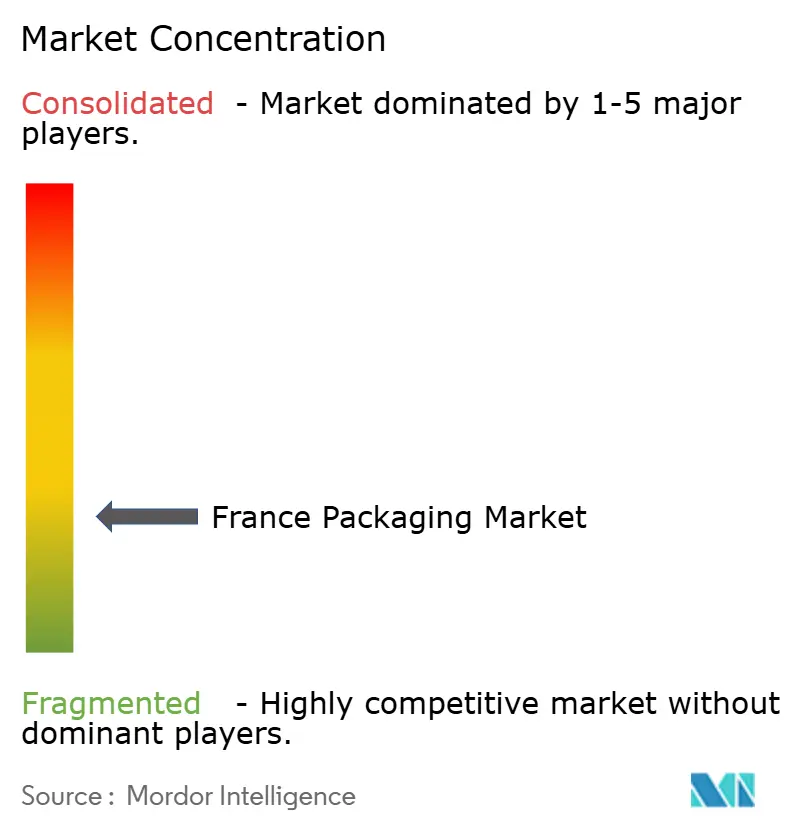
The France packaging market exhibits fragmentation. The July 2024 Smurfit Kappa-WestRock merger created Smurfit WestRock, a USD 34 billion revenue entity with a 40-country reach, enabling mill optimization and fiber procurement synergies that shelter margins from kraft-liner volatility.[3]Smurfit Kappa, “Smurfit WestRock Merger Completion Announcement,” smurfitkappa.com Amcor reported FY 2024 sales of USD 12.4 billion, a 5% decrease, yet achieved earnings growth by trimming costs and reinforcing its commitment to 30% recycled content. Verallia’s Q3 2024 revenue slipped 6.8% organically as clients lightweighted bottles or shifted to cans to avoid glass EPR fees, pressuring furnace utilization rates.
Regional specialists such as Groupe Guillin, Albea, and Sleever International occupy niches in thermoformed trays, cosmetics tubes, and shrink sleeves, respectively. Carrefour’s Loop initiative compels converters to supply durable, reusable containers, a capability that benefits injection molders with expertise in impact modifiers and scuff-resistant labeling.
Chemical recycling start-ups like Carbios and Loop Industries are piloting enzymatic depolymerization plants, positioning themselves as future feedstock providers once rPET economics tighten further. Talent shortages in barrier coatings, adhesive science, and life-cycle assessment add intangible entry barriers, solidifying incumbent advantage across the France packaging market.
France Packaging Industry Leaders
Tetra Pak International SA
Smurfit WestRock
Amcor plc
International Paper Company
Mondi plc
- *Disclaimer: Major Players sorted in no particular order

Market Opportunities and Future Outlook
Compliance-driven redesign and service layers create clear whitespace around professional packaging as the EPR perimeter expands. With Decree No. 2025-1081 (17 November 2025) and the 2 December 2025 order effective from 1 January 2026, producers and distributors of packaging used by professionals face new registration, reporting, and financing duties. That widens demand for compliance enablement, including authorized-representative services for non-EU suppliers under PPWR Article 45 from 12 August 2026, labeling support, and data systems that link pack SKUs to EPR declarations. Parallel policy instruments such as the IMPR incentive for recycled plastic incorporation (order dated 5 September 2025, with ministry guidance in 2026) also support business cases for higher recycled-content packaging when traceability and specification conformance can be demonstrated.
Reuse infrastructure and industrial modernization are tangible opportunity areas because they address both regulatory obligations and cost-to-serve. France's AGEC trajectory targets 10% of packaging placed on the market in reused form by 2027, and projects standardizing return, washing, and pooling for food-related formats have moved into broader field trials. This gives converters and service providers space to build scalable reusable packaging, transport, and cleaning networks. On the supply side, announced investments point to where capability is being built: Smurfit WestRock outlined a EUR 600 million program in June 2026 over three to five years for modernization, decarbonization, and sustainable packaging capabilities at French sites, including projects at Epernay, Vernon, and Facture. Newell Brands also announced a EUR 40 million investment in June 2026 focused on automation, digitization, and sustainability. Together, these moves reinforce a shift toward higher-efficiency manufacturing and lower-carbon packaging solutions, with room for partnering across material innovators, equipment providers, and recycling and reuse logistics operators active in France.
Recent Industry Developments
- July 2026: Citeo expanded its ReUse regional field trial for shared reusable food packaging infrastructure across four French regions after one year of operation, broadening the set of formats covered (including more bottle shapes and jars). The step-up supports standardization of return and washing loops, which is critical for scaling reuse models that reduce single-use packaging demand in retail.
- June 2026: Smurfit WestRock announced a EUR 600 million investment program in France to be deployed over three to five years, focusing on modernization and decarbonization across multiple industrial sites. The program includes defined allocations for facilities such as Epernay, Vernon, and the Facture paper mill, strengthening domestic capability for sustainable paper-based and corrugated packaging.
- June 2024: ADEME and the France 2030 framework awarded EUR 1.49 million to the ANR AgriBioPack project to develop bio-based multilayer films with improved barrier performance. Public funding at this stage lowers pilot-risk for converters and accelerates material substitution options as EPR fee modulation and single-use plastic restrictions tighten packaging specifications.


Research Methodology Framework and Report Scope
Market Definition and Coverage
For this study, the France packaging market is defined as the value of packaging materials and finished packaging formats sold for use in France across key end-use industries, covering both rigid and flexible formats across major material families.
Scope exclusions: We exclude packaging machinery, contract packing services, and standalone labeling or printing services that are sold separately from the packaging format.
Segmentation Overview
- By Material Type
- Paper and Paperboard
- Plastic
- Polyethylene Polypropylene (PP)
- High-density Polyethylene (HDPE) and Low-density Polyethylene (LDPE)
- Polyethylene Terephthalate (PET)
- Polyvinyl Chloride (PVC)
- Polystyrene (PS)
- Other Plastics
- Metal
- Container Glass
- By Product Type
- Paper and Paperboard Product Type
- Folding Carton and Rigid Boxes
- Corrugated Boxes and Containers
- Single-use Paper Products
- Other Paper and Paperboard Product Types
- Plastic Product Type
- Rigid Plastics
- Bottles and Jars
- Caps and Closures
- Bulk-Grade Products
- Other Rigid Plastics Product Types
- Flexible Plastics
- Pouches
- Bags
- Films and Wraps
- Other Flexible Plastics Product Types
- Rigid Plastics
- Metal Product Type
- Cans
- Aerosol Containers
- Caps and Closures
- Other Metal Product Types
- Container Glass Product Type
- Bottles
- Jars
- Paper and Paperboard Product Type
- By Packaging Format
- Rigid Packaging Format
- Flexible Packaging Format
- By End-user
- Food
- Beverage
- Pharmaceuticals and Medical
- Personal Care and Cosmetics
- Industrial and Chemical
- Agriculture
- Automotive
- Other End-users
Data Sources, Market Sizing, and Validation
Desk Research
Desk research was used to build the starting structure of the model and to set practical guardrails around volumes, material mix, and end-use demand. We relied on public statistics and policy sources such as INSEE industry output data, Eurostat structural business statistics and trade series, French Customs trade publications, and policy and recycling disclosures from ADEME and CITEO, which help interpret packaging use, recovery, and material substitution trends.
Along with these, we reviewed company annual reports, investor presentations, and reputable press coverage to spot capacity changes, major sustainability commitments, and price movements that can shift packaging value. Where available, we also used paid database subscriptions for company financials and intelligence, import and export shipment-level checks, and patent databases to confirm activity pockets. These desk research sources are not exhaustive, and we reviewed additional public references for data collection, validation, and clarification.
Primary Interviews and Surveys
Primary work was used to pressure-test what we saw in secondary sources and to fill gaps on pricing, material switching, and demand changes by end-use. We spoke with a mix of packaging producers, converters, distributors, recyclers, and large buyers across food, beverage, pharma, personal care, and industrial use cases inside France. We cross-checked inputs across the value chain, so assumptions on volume growth, recycled content adoption, and format shifts were not driven by a single viewpoint.
Distribution of primary research fieldwork respondents
| Company type | Respondent position |
|---|---|
| Top tier: 39% | CXOs: 13% |
| Mid tier: 41% | Functional/Unit leaders: 30% |
| Smaller Players: 20% | Managers: 57% |
Market-Sizing & Forecasting
The market size was developed using a top-down build that starts from France packaging demand pools by end-use, which are then reconstructed through material and format mix, and finally translated into value using observed price bands. To keep the totals realistic, the output was then corroborated with selective bottom-up approximations, including sampled supplier revenue roll-ups, channel checks, and a few volume times average selling price calculations for common packaging formats.
Key inputs that were used (as illustrative examples) include France food and beverage output trends, pharma and personal care production indicators, import and export movement for packaging materials and semi-finished packaging, recycled content uptake signals, and shifts between flexible and rigid formats. Pricing assumptions were not kept flat, since resin and paper pulp moves, energy costs, and recycled material availability can change the realized price mix in a given year.
Forecasting was carried out using scenario analysis supported by simple multivariate regression, where the demand drivers above were projected and then reviewed with interview feedback. When a bottom-up view was missing for smaller product pockets, we applied a proportion-based allocation using the closest comparable format and end-use intensity, and then rechecked that the implied per-unit values stayed within observed ranges.
Data Validation & Update Cycle
Model outputs were validated through multiple checks so that large swings could be explained before sign-off. We compared totals against independent signals such as trade direction, production trends in key consuming industries, and material share movements. We then reviewed any outliers at the segment and end-use level to confirm they were not caused by double counting or timing mismatches.
A second analyst review was completed for assumption logic, unit consistency, and currency handling, followed by targeted re-contacts when a key variable moved outside the expected range. Reports are refreshed annually, and interim updates are made when material events occur, such as regulatory changes, major capacity additions, or unusual raw material price shifts. Before delivery, a final pass is completed so clients receive the most current view available at that time.
Mordor Intelligence's France Packaging Market Size Compared Against Other Published Estimates
It is normal to see different market size numbers for France packaging because each publisher draws the market boundary in its own way and also picks different year cutoffs. Differences usually come from what is counted as packaging, how prices are averaged across materials, and whether the estimate is tied to end-use consumption or to broader industry revenue.
By tracking yearly material mix and end-use demand indicators and then refreshing conversion and pricing assumptions, Mordor Intelligence keeps the total tied to packaging formats sold into France, rather than expanding into adjacent packaging services or loosely defined container revenue pools.
Benchmark comparison
| Source | Market Size | Gaps in Research Methodology |
|---|---|---|
| Mordor Intelligence | USD 32.88 B (2026) | |
| Industry Portal A | USD 74.37 B (2024) | This estimate is framed as container packaging and appears to use a broader revenue umbrella, which can pull in categories outside the packaging formats counted here and can also reflect different pricing bases and boundary rules. |
| Market Publisher B | USD 31.60 B (2022) | The year is earlier and the base assumptions around price progression and material substitution are not clearly shown, which can understate the uplift from resin, paper, and energy cost cycles seen in later years. |
The spread across sources mainly comes down to scope boundaries and timing, and then secondarily to how pricing and mix shifts are treated. Our approach stays traceable to a defined France demand pool, and it can be re-run with updated drivers when conditions change, which helps keep the final number explainable and consistent year to year.


Key Questions Answered in the Report
What is the current size of the France packaging market?
The market is valued at USD 32.88 billion in 2026, with a forecast to reach USD 39.46 billion by 2031.
How fast is sustainable packaging demand growing in France?
Paper and paperboard packaging is expected to post a 4.32% CAGR through 2031 as brands switch from single-use plastics.
Which packaging format is expanding the quickest?
Flexible formats, led by stand-up pouches and e-commerce mailers, are projected to grow at a 4.75% CAGR through 2031.
What regional factors shape packaging demand most in France?
Île-de-France and Auvergne-Rhône-Alpes drive R&D investments, while Brittany and Nouvelle-Aquitaine sustain food-related demand.
How are EPR fees impacting packaging design choices?
Eco-modulation surcharges on non-recyclable or multilayer items are pushing converters toward mono-material structures and refill models.
Which end-user segment is set to outpace others?
Personal care and cosmetics should grow fastest at a 5.18% CAGR as premium brands adopt refillable and rPET solutions.
Page last updated on:


 Your data is secure and never sold or shared.


