
Market Overview
| Study Period | 2020 - 2031 |
|---|---|
| Forecast Data Period | 2026 - 2031 |
| Base Year Market Size (2025) | USD 2.53 Billion |
| Market Size (2026) | USD 2.71 Billion |
| Market Size (2031) | USD 3.95 Billion |
| Growth Rate (2026 - 2031) | 7.81 % |
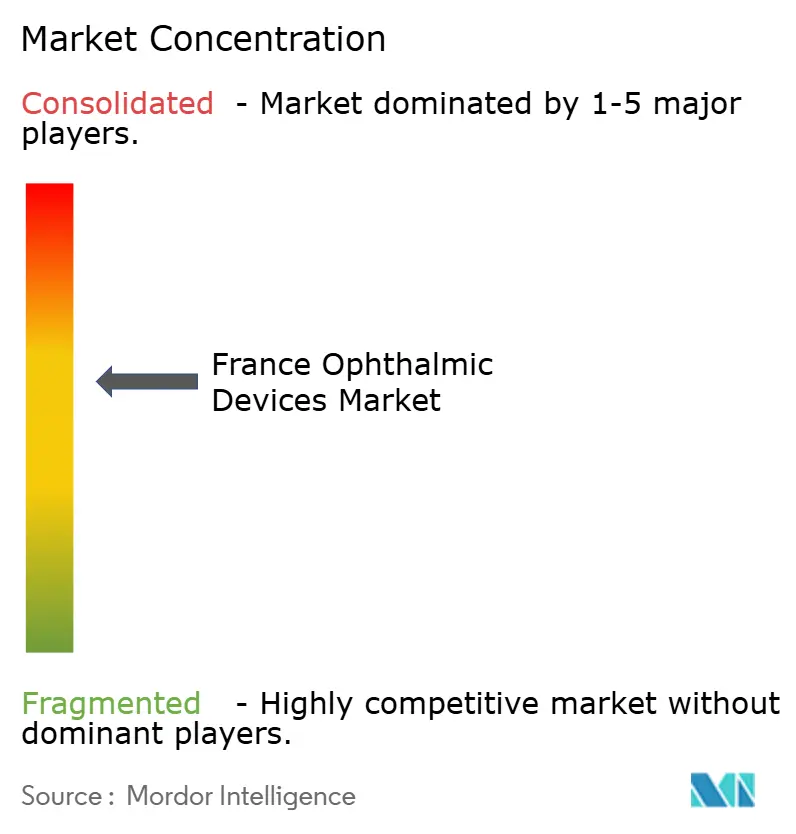
| Market Concentration | Medium |
Major Players *Disclaimer: Major Players sorted in no particular order Image © Mordor Intelligence. Reuse requires attribution under CC BY 4.0. | |
France Ophthalmic Devices Market Analysis by Mordor Intelligence
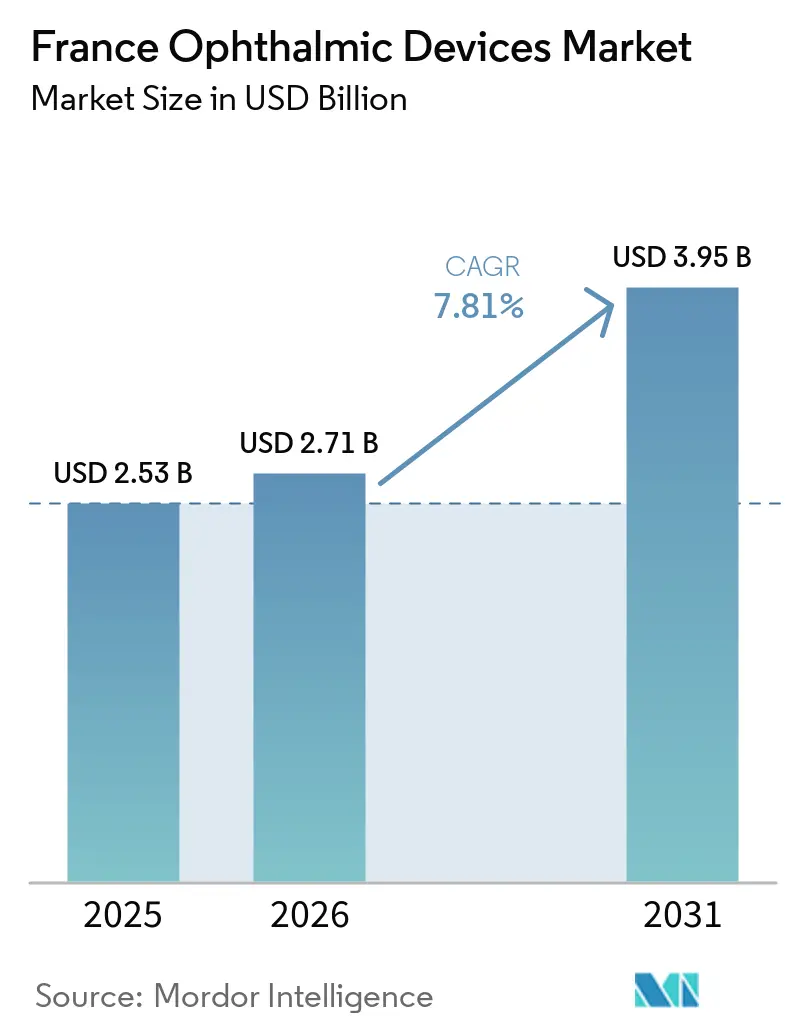
The France Ophthalmic Devices Market size is expected to increase from USD 2.53 billion in 2025 to USD 2.71 billion in 2026 and reach USD 3.95 billion by 2031, growing at a CAGR of 7.81% over 2026-2031.
A swelling population aged 65 years and above, which will account for 26% of citizens by 2030, is pushing cataract procedures beyond 850,000 per year, while premium intraocular lenses (IOLs) priced three to five times those of monofocal options are raising average selling prices. Government policy also fuels demand: the Health Innovation 2030 program earmarked EUR 670 million (USD 730 million) for digital health, of which EUR 9.8 million (USD 10.7 million) is allocated to medical imaging, accelerating the adoption of optical coherence tomography (OCT) and ultrawidefield retinal cameras. At the same time, ambulatory surgical centers (ASCs) capture routine cataract and glaucoma cases through reimbursement parity, enabling a shift to fast-turnover day surgery that compresses capital budgets and directs purchasing toward compact phacoemulsification and MIGS implants. Vendor strategy is evolving accordingly: EssilorLuxottica’s recent roll-up of Heidelberg Engineering and Cellview Imaging positions the group to bundle diagnostics with its 2,000-plus retail outlets, while Alcon leverages its installed base of Centurion, LenSx, and ORA systems to lock in higher-margin implantables revenue.
Key Report Takeaways
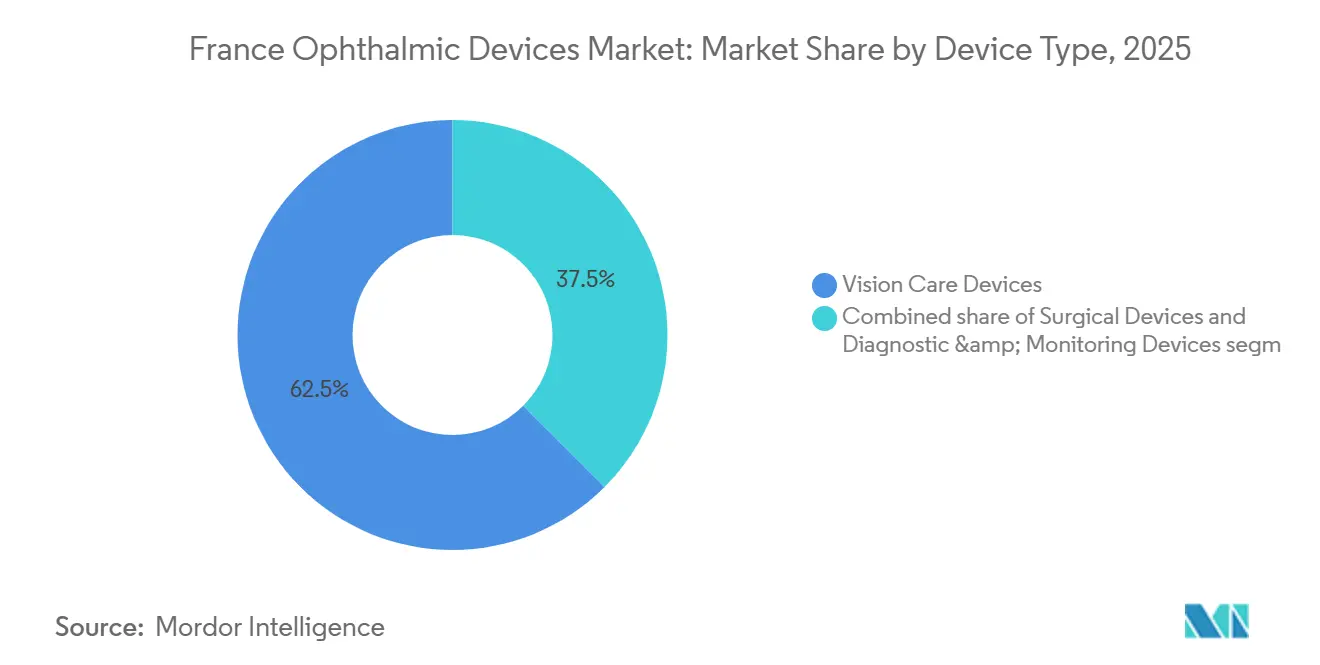
- By device type, vision care devices led with 62.49% revenue share in 2025, whereas diagnostic & monitoring devices are projected to expand at an 8.17% CAGR through 2031.
- By disease indication, cataract procedures captured 38.85% of the France ophthalmic devices market share in 2025, while diabetic retinopathy solutions are forecast to grow at a 9.63% CAGR to 2031.
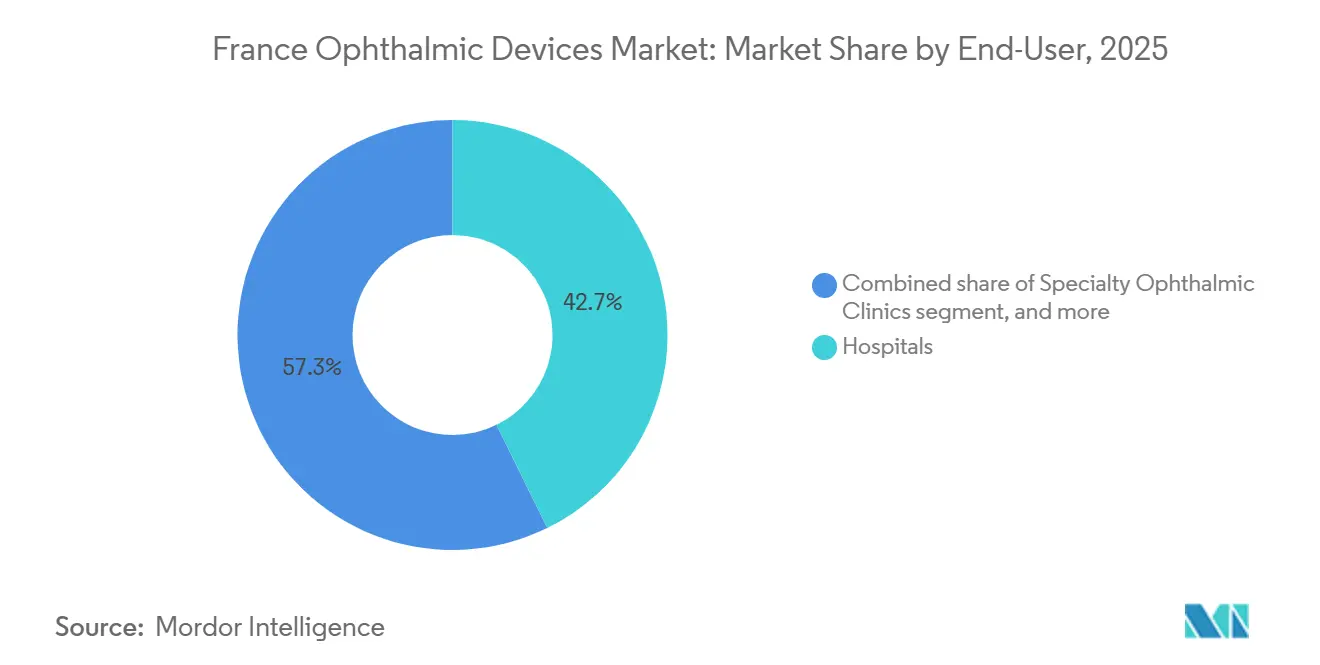
- By end user, hospitals retained a 42.75% share in 2025; ASCs recorded the fastest growth at a 10.25% CAGR over 2026-2031 as cataract and glaucoma surgeries migrate to day-care settings.
Note: Market size and forecast figures in this report are generated using Mordor Intelligence’s proprietary estimation framework, updated with the latest available data and insights as of January 2026.
France Ophthalmic Devices Market Trends and Insights
Drivers Impact Analysis*
| Driver | (~) % Impact on CAGR Forecast | Geographic Relevance | Impact Timeline |
|---|---|---|---|
| Aging Population & Rising Cataract Prevalence | +1.8% | National, concentrated in Île-de-France, Provence-Alpes-Côte d'Azur, Auvergne-Rhône-Alpes | Long term (≥ 4 years) |
| Technological Advances in Diagnostic Imaging | +1.5% | National, early adoption in university hospital centers (CHU) in Paris, Lyon, Marseille, Toulouse | Medium term (2-4 years) |
| Expansion of Premium IOL Reimbursement Pathways | +1.2% | National, with pilot programs in Île-de-France and Occitanie | Medium term (2-4 years) |
| Emergence of Tele-Ophthalmology Hubs Linked to Regional Hospitals | +0.9% | Rural departments (Normandy, Burgundy, Nouvelle-Aquitaine, Grand Est) | Short term (≤ 2 years) |
| Government-Backed Health Innovation 2030 Funds for Med-Tech Manufacturing | +0.8% | National, with R&D clusters in Île-de-France (Créteil, Wissous), Occitanie (Toulouse) | Long term (≥ 4 years) |
| Rising Diabetes & Glaucoma Comorbidity Burden | +1.3% | National, higher prevalence in overseas territories (Réunion, Guadeloupe, Martinique) | Long term (≥ 4 years) |
| Source: Mordor Intelligence | |||
Aging Population & Rising Cataract Prevalence
Citizens aged 75 years and older will swell by 40% between 2025 and 2035, ensuring a sustained upswing in lens-extraction demand that already exceeds 850,000 procedures annually.[1] Multifocal and extended-depth-of-focus lenses now account for 25% of private-clinic implants, tripling unit values compared with monofocal alternatives. Regional hot spots align with high-volume laser platforms, and Alcon’s international implantables revenue rose 9% currency in 2024 on the back of French premium-IOL adoption.
Technological Advances in Diagnostic Imaging
Swept-source OCT and OCT angiography achieve axial resolution below 5 µm, pushing early detection of macular edema, optic-nerve fiber loss, and micro-aneurysms past the limits of color fundus photography. The 5,000-patient EviRed study showed OCTA sensitivity above 92% for proliferative diabetic retinopathy, compared with 78% for fundus imaging. CNAM reimbursement codes granted in 2024 catalyzed private-clinic uptake, and EssilorLuxottica deepened the modality with its February 2025 acquisition of Cellview Imaging.
Expansion of Premium IOL Reimbursement Pathways
Following the 100 % Santé eyewear reform, regional agencies piloted 50% coverage for toric and multifocal IOLs in 2024, lifting premium penetration from 22% to 31% within a year. Scaling the pilots nationally awaits Haute Autorité de Santé appraisal, but early momentum already feeds Alcon’s 6% surgical revenue growth.
Emergence of Tele-Ophthalmology Hubs
OPHDIAT’s hub in Paris processes 15,000 retinopathy screens per year with 98% sensitivity, demonstrating that non-mydriatic cameras in pharmacies and GP offices can help offset specialist shortages.[2] Tilak Healthcare’s OdySight app and M2care’s EUR 26 million tele-consultation deployment extend the model into home monitoring, with ISO 13485-certified devices fulfilling ANSM oversight.
Restraints Impact Analysis*
| Restraint | (~) % Impact on CAGR Forecast | Geographic Relevance | Impact Timeline |
|---|---|---|---|
| High Capital Cost of Advanced Surgical Platforms | -0.7% | National, most acute in smaller ASCs and specialty clinics outside metro areas | Medium term (2-4 years) |
| Stringent EU MDR & ANSM Approval Timelines | -0.6% | Pan-European, with ANSM adding national-layer oversight in France | Long term (≥ 4 years) |
| Shortage of Ophthalmic Surgeons Outside Metro Regions | -0.5% | Rural departments (Normandy, Burgundy, Nouvelle-Aquitaine, Grand Est, Centre-Val de Loire) | Long term (≥ 4 years) |
| Growing ASC Price Pressure on Instrument Vendors | -0.4% | National, concentrated in private ASC networks negotiating bundled contracts | Short term (≤ 2 years) |
| Source: Mordor Intelligence | |||
High Capital Cost of Advanced Surgical Platforms
Femtosecond lasers priced at USD 400,000–600,000 plus USD 40,000-60,000 annual service fees deter clinics performing fewer than 1,000 cataract cases a year. Pay-per-procedure leasing shifts margin pressure to manufacturers and slows next-generation R&D despite vendor initiatives that cut per-case fees to EUR 150-200.
Stringent EU MDR & ANSM Approval Timelines
Under MDR, Class IIb and III ophthalmic devices face 12-18 month certification cycles, 20-30% higher pre-market costs, and ANSM post-market audits that narrow commercial windows, pushing small innovators to delay launches or exit product lines.[3]
*Our forecasts treat driver/restraint impacts as directional, not additive. The impact forecasts reflect baseline growth, mix effects, and variable interactions.
Segment Analysis
By Device Type: Diagnostic Upswing Against Vision-Care Dominance
Vision Care Devices accounted for 62.49% of the France ophthalmic devices market in 2025, underpinned by EssilorLuxottica’s 35-plant, 583-lab network which yielded roughly 550 million prescription lenses per year. The Diagnostic & Monitoring sub-category is forecast to outpace at an 8.17% CAGR, as OCT scanners, AI-ready fundus cameras, and remote-reading software equip community practices and tele-screening hubs. Heidelberg Engineering’s OCT line, now 80%-owned by EssilorLuxottica, anchors the surge. Surgical
Product-level differentiation hinges on bundled ecosystems: diagnostics feed surgical conversion, and vision-care chains cross-sell contact lenses and myopia-control spectacles. This closed-loop positioning allows vertical giants to defend margins, whereas standalone imaging firms pursue OEM alliances. Competitive spillover already sees vision-care cash-flows underwriting R&D for swept-source imaging, sustaining technology refreshes every 2-4 years.

By Disease Indication: Screening Turns Diabetic Retinopathy Into Fastest Riser
Cataract retained a 38.85% share in 2025 thanks to high procedure volumes and premium IOL upsell, but solutions for diabetic retinal diseases are projected to expand at a 9.63% CAGR through 2031. The France ophthalmic devices market for diabetic retinopathy hardware and software is accelerating as AI triage tools like OphtAI and IDx-DR secure CE marks and reimbursement codes. Tele-screening ecosystems cut wait times in rural pharmacies from 9 months to same-day referrals, increasing early-stage detection and funneling patients into OCT and laser-treatment workflows. Glaucoma commands around 20% share and benefits from the expanding MIGS toolkit, although procedure uptake remains slower than U.S. benchmarks despite favorable EUR 1,154 per QALY economics for iStent inject.
By End-User: ASC Shift Reshapes Purchasing
Hospitals captured 42.75% of the France ophthalmic devices market share in 2025, anchoring complex vitreoretinal and corneal work. Yet ASCs illustrate double-digit expansion, 10.25% CAGR, because bundled payments reward high-throughput cataract and glaucoma cases. Device makers increasingly consign inventory and offer outcomes-based contracts, compressing gross margins while protecting volume. The remaining demand arises from optical retail and tele-screening nodes, where diagnostic devices integrate into primary-care workstreams.
Geography Analysis
Île-de-France, Auvergne-Rhône-Alpes, and Provence-Alpes-Côte d’Azur had similar population density, higher disposable income, and the presence of university hospital centers that trial next-generation hardware. Ophthalmologist density peaks at 8 per 100,000 in Paris versus 3 per 100,000 in Normandy and Burgundy, spurring tele-ophthalmology rollouts such as OPHDIAT’s 15,000-exam annual network. Overseas territories show elevated diabetes prevalence, boosting demand for retina-imaging equipment but hampered by logistics and specialist shortages.
Policy instruments concentrate investment in urban R&D corridors. EssilorLuxottica’s Labex facility in Wissous adds automated surfacing lines and ISO 13485-compliant QC labs to support regional supply. France 2030 grants also fund PREMYOM, a consortium tackling pediatric myopia with Stellest and SightGlass DOT lenses. Meanwhile, Île-de-France and Occitanie pilots covering half of premium-IOL co-pays show that even limited reimbursement can shift implant mix by nine percentage points in a year.
Competitive intensity differs by region. Multinationals dominate surgical and diagnostic installs in metro hospitals, while French startups exploit telemedicine niches in sparsely populated departments. MDR compliance favors players with dedicated regulatory teams, further adding to incumbents' moat.
Regulatory Landscape
Ophthalmic devices marketed in France operate under the EU Medical Device Regulation (MDR) framework, with national-layer oversight led by the Agence nationale de securite du medicament et des produits de sante (ANSM) for market surveillance, inspections, and materiovigilance. In April 2026, Decree 2026-299 entered into force, finalizing the integration of MDR requirements into the French Public Health Code and clarifying operator obligations around activity declarations and vigilance processes. The change affects manufacturers of implantables (such as IOLs and MIGS) and diagnostic platforms.
For access and funding, reimbursement evaluation is centralized through Haute Autorite de Sante (HAS), including CNEDiMTS appraisal for listing on the LPPR, a key gate for broad adoption of devices used in hospital and ambulatory settings. Digital medical devices (including tele-ophthalmology software and remote monitoring tools) must also meet interoperability and security requirements set by the Agence du Numerique en Sante (ANS), especially where reimbursement routes depend on national digital health standards. ANSM additionally conducts case-by-case assessments for borderline drug-device and device-IVD configurations, and it has published guidance supporting combined clinical investigation approaches (COMBINE) to streamline certain study authorizations.
Competitive Landscape
The top five suppliers, EssilorLuxottica, Alcon, Carl Zeiss Meditec, Bausch + Lomb, and Johnson & Johnson Vision, command an estimated significant 2025 revenue, giving the French ophthalmic devices market a moderate-to-high concentration profile. EssilorLuxottica’s lens plants, 583 labs, and more than 1,000 retail stores across EMEA generate an integrated loop that smaller vendors struggle to match. Its acquisitions of Heidelberg Engineering and Cellview Imaging elevate diagnostic presence, while the Espansione deal adds dry-eye therapy to the portfolio.
White space persists in rural tele-screening and MIGS penetration. Evolucare’s OphtAI secured the CE mark in 2024 for automated diabetic-retinopathy grading, while Tilak Healthcare’s OdySight raised EUR 10 million to deliver home-monitoring, underscoring venture appetite for niche disruption. Yet scaling such models requires MDR-ready quality systems and notified-body access, hurdles that entrenched groups navigate more readily.
France Ophthalmic Devices Industry Leaders
-
EssilorLuxottica SA
-
Alcon Inc.
-
Carl Zeiss Meditec AG
-
Johnson & Johnson Vision Care
-
Topcon Corporation
- *Disclaimer: Major Players sorted in no particular order
Market Opportunities and Future Outlook
Reimbursement navigation and evidence generation remain recurring whitespace areas across France ophthalmology, particularly for diagnostic and digital pathways. HAS (via CNEDiMTS) appraisal for LPPR listing shapes adoption for many hospital and ASC device purchases, while digital medical devices can use dedicated routes such as PECAN (time-limited early access) and LATM for remote monitoring. These mechanisms align with the market shift toward tele-ophthalmology hubs and AI-enabled screening workflows referenced in the report, including pharmacy and primary-care linked screening models. On the commercial side, security of supply is built into French pricing and negotiation considerations, reinforcing the value of local manufacturing and robust distribution for high-volume categories like vision care and implantables.
France 2030 and related industrial policy add a further opportunity layer through domestic capability build-out in ophthalmic manufacturing and component ecosystems. Cristalens Industrie is a concrete example, as it received initial France 2030 funding (EUR 350,000, first stage, January 2025) for an intraocular lens moulding project aimed at reducing raw material usage and expanding production capacity, supporting localization efforts in premium and standard IOL supply chains. Combined with the report context on imaging adoption (OCT and ultrawidefield cameras) and ASC migration for cataract and glaucoma, vendors can pair reimbursement-ready clinical dossiers with cost-optimized, locally supported product configurations for outpatient settings and distributed screening networks.
Recent Industry Developments
- July 2026: Alcon and RxSight announced a non-exclusive collaboration to develop adjustable presbyopia-correcting intraocular lenses. The partnership points to faster iteration in premium implantables and supports differentiated cataract offerings that can compete on post-operative customization, a key lever as premium IOL penetration rises.
- June 2026: EssilorLuxottica and Meta launched a new collection of AI glasses, with availability across several European markets including France from June 23, 2026. This expands smart eyewear distribution through a scaled retail footprint and strengthens the convergence of vision care devices with connected consumer wearables.
- April 2024: The MEDITWIN consortium launched with governmental backing to build virtual twins that personalize ophthalmic treatment pathways and integrate with imaging devices. This program supports downstream demand for interoperable diagnostic systems and data-ready software layers used in screening and care pathway optimization.
Research Methodology Framework and Report Scope
Market Definition and Coverage
This market is defined as the value of ophthalmic devices sold in France that are mainly used to test, treat, or correct vision. It covers diagnostic systems, surgical devices, and vision care products.
Scope exclusions: The sizing excludes over-the-counter eye drops, pharmaceutical implants, and stand-alone service fees that are billed separately from device sales.
Segmentation Overview
- By Device Type
- Diagnostic & Monitoring Devices
- OCT Scanners
- Fundus & Retinal Cameras
- Autorefractors & Keratometers
- Corneal Topography Systems
- Ultrasound Imaging Systems
- Perimeters & Tonometers
- Other Diagnostic & Monitoring Devices
- Surgical Devices
- Cataract Surgical Devices
- Vitreoretinal Surgical Devices
- Refreactive Surgical Devices
- Glaucoma Surgical Devices
- Other Surgical Devices
- Vision Care Devices
- Spectacles Frames & Lenses
- Contact Lenses
- Diagnostic & Monitoring Devices
- By Disease Indication
- Cataract
- Glaucoma
- Diabetic Retinopathy
- Other Disease Indications
- By End-user
- Hospitals
- Specialty Ophthalmic Clinics
- Ambulatory Surgery Centers (ASCs)
- Other End-users
Data Sources, Market Sizing, and Validation
Desk Research
Desk research was used to set the fact base around demand signals and care delivery in France, before any assumptions were built into the model. We reviewed public health statistics and population aging indicators from sources such as the French Ministry of Health and national statistics releases, then used epidemiology and clinical practice references from peer-reviewed journals.
To keep the device scope grounded, we also checked guidance and product safety information from regulators such as the French medicines and health products authority and relevant EU-level medical device documentation, along with trade association publications and hospital procurement notes where available. Company annual reports, investor presentations, and reputable press were used to understand product mix shifts and typical pricing direction. A paid subscription for company financials and a patent database were used selectively to cross-check revenue exposure and technology focus. These desk sources are illustrative only, and many other references were used for data collection, validation, and clarification during the study.
Primary Interviews and Surveys
Primary work focused on validating how demand shows up in France across hospitals, specialty eye clinics, and optical retail channels, and then stress-testing pricing and adoption assumptions with people who see the market daily. We also used interviews to reconcile gaps between shipment signals, procedure activity, and replacement cycles, so the final totals are consistent with how devices are actually purchased and used.
Distribution of primary research fieldwork respondents
| Company type | Respondent position |
|---|---|
| Top tier: 35% | CXOs: 13% |
| Mid tier: 50% | Functional/Unit leaders: 29% |
| Smaller Players: 15% | Managers: 58% |
Market-Sizing & Forecasting
The core sizing was built using top-down demand reconstruction, where procedure volumes and diagnosed population pools were converted into device demand using penetration and replacement assumptions that fit France care pathways. Those outputs were then checked using selective bottom-up approximations, such as sample supplier revenue roll-ups, channel checks across hospitals and optical retail, and an ASP times volume build for key device categories. If the checks did not reconcile, we adjusted the model outputs.
Key inputs used in the model included cataract surgery activity and IOL usage patterns, glaucoma and diabetic retinopathy monitoring intensity, installation base and upgrade cycles for diagnostic imaging systems (such as OCT), contact lens and spectacle consumption trends, and typical public versus private setting price differences. Forecasting used scenario analysis supported by short-run time-series smoothing, with expert-led ranges applied to ASP progression, procedure backlogs, and replacement timing so the curve stays realistic even when one indicator temporarily moves faster than the others. Where bottom-up data was incomplete for smaller channels, we filled gaps using calibrated shares based on care setting mix and then re-tested them during validation calls.
Data Validation & Update Cycle
Outputs were triangulated against independent signals, including procedure trends, device installed-base logic, and reported revenue exposures. We then reviewed for outliers that could come from one-off hospital tenders or timing shifts in replacement cycles. A second analyst review was completed to confirm that assumptions are consistent across device types, and re-contacts were triggered when large variances appeared between modeled demand and interview feedback.
The study is refreshed on an annual cycle, and interim updates are made when material events occur that can change pricing, reimbursement direction, or purchasing patterns. Before delivery, the latest public indicators are checked again so the numbers reflect the most current view available at the time.
Mordor Intelligence's France Ophthalmic Devices Market Size Measured Against Other Published Estimates
Published market sizes for France ophthalmic devices often differ because sources do not always align on what gets counted as a device sale versus a related product category, and because the timing of currency conversion and price updates can shift the reported total. Differences also show up when one estimate emphasizes vision care products while another focuses more on diagnostic and surgical equipment.
A common gap driver is how average selling prices are handled. Some approaches keep a single price point across years, while others update prices with mix shifts toward premium lenses, imaging upgrades, and changing hospital purchasing patterns. In this study, the refresh pass re-tests price ladders and procedure-based demand checks close to publication, and the currency timing is kept consistent across the historical and forecast years, which is why Mordor Intelligence lands at a slightly different 2025 value than broader eye care estimates.
Benchmark comparison
| Source | Market Size | Gaps in Research Methodology |
|---|---|---|
| Mordor Intelligence | USD 2.53 B (2025) | |
| Industry Publisher A | USD 2.18 B (2024) | Uses a combined drugs and devices scope, which can dilute device-only totals, and the base year and pricing refresh assumptions appear to follow a longer forecast cycle with fewer interim price checks. |
| Databook Publisher B | USD 3.85 B (2030) | Represents an eye care basket that is organized around contact lenses, intraocular lenses, and ocular health products, which can differ from a full ophthalmic devices scope and relies on a different base year and endpoint year. |
Taken together, the spread is largely explained by scope boundaries and timing choices, not by a single right or wrong number. By keeping the device definition tight, updating ASP steps with observed mix change, and confirming totals against procedure and channel signals, the estimate stays traceable to clear demand drivers and repeatable checks.
Key Questions Answered in the Report
How fast is the France ophthalmic devices market expected to grow through 2031?
The market is projected to expand from USD 2.71 billion in 2026 to USD 3.95 billion by 2031 at a 7.81% CAGR.
Which product category leads revenue today?
Vision Care Devices command 62.49% of 2025 revenue, driven by EssilorLuxottica’s vast lens and retail network.
What segment is forecast to grow the quickest?
Diagnostic & Monitoring Devices, including OCT and AI-enabled fundus cameras, are set to rise at an 8.17% CAGR through 2031.
Why are ambulatory surgery centers important for suppliers?
ASCs are projected to post a 10.25% CAGR because reimbursement parity pushes cataract and glaucoma cases out of hospitals, reshaping purchasing toward compact, cost-efficient platforms.