
France Mining Equipment Market Size and Share
Market Overview
| Study Period | 2019 - 2031 |
|---|---|
| Forecast Data Period | 2026 - 2031 |
| Base Year Market Size (2025) | USD 0.94 Billion |
| Market Size (2026) | USD 0.97 Billion |
| Market Size (2031) | USD 1.13 Billion |
| Growth Rate (2026 - 2031) | 3.16 % |
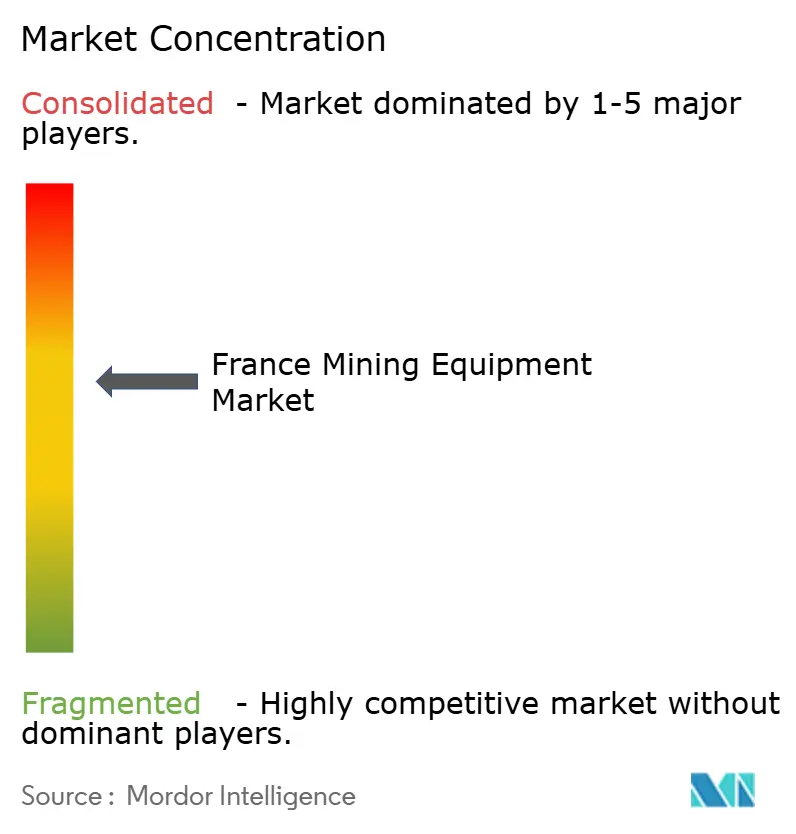
| Market Concentration | Medium |
Major Players *Disclaimer: Major Players sorted in no particular order Image © Mordor Intelligence. Reuse requires attribution under CC BY 4.0. | |
France Mining Equipment Market Analysis by Mordor Intelligence
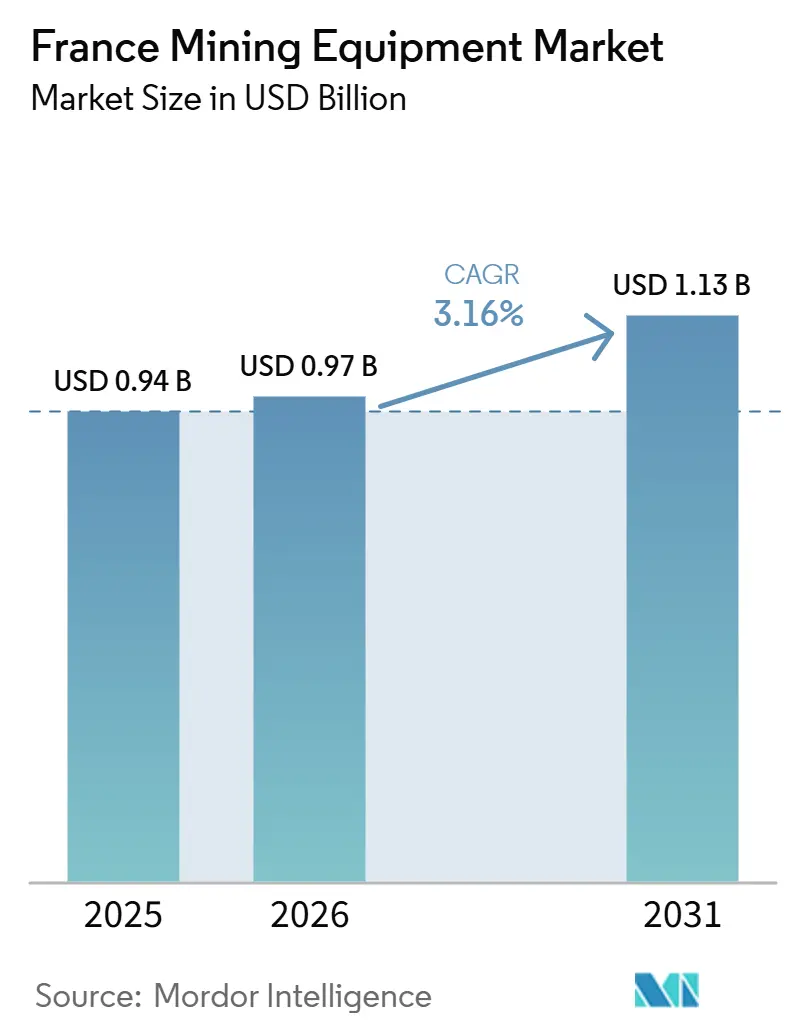
The France mining equipment market size is expected to increase from USD 0.94 billion in 2025 to USD 0.97 billion in 2026 and reach USD 1.13 billion by 2031, growing at a CAGR of 3.16% over 2026-2031. Operators are increasingly focusing on lithium, tungsten, and copper projects, driven more by policy revivals than by the usual commodity swings. These projects now require new fleets for drilling, hauling, and processing. With the backing of government co-investment funds and the push from emissions mandates, operators are being directed towards battery-electric and autonomous platforms. Meanwhile, OEMs are in a race to integrate telematics and predictive maintenance to safeguard their margins against encroachment by lower-cost Chinese competitors. While the permitting process remains protracted, the urgency surrounding critical raw materials is prompting a surge in equipment orders, particularly for underground and compact surface machines, within a specific timeframe.
Key Report Takeaways
- By equipment type, surface machines held 41.87% of the France mining equipment market share in 2025, while underground equipment is projected to expand at a 6.46% CAGR through 2031.
- By automation level, manual fleets accounted for 64.12% of the market in 2025; fully autonomous units are forecast to grow at a 7.43% CAGR by 2031.
- By powertrain, internal-combustion models accounted for 86.62% of the market in 2025, with battery-electric vehicles advancing at an 8.11% CAGR through 2031.
- By power output, the 500-1,000 HP class captured 43.74% of the France mining equipment market in 2025, while machines below 500 HP led growth with a 6.21% CAGR.
- By application, metal mining accounted for 52.53% in 2025; mineral mining is set to accelerate at a 6.19% CAGR over 2026-2031.
Note: Market size and forecast figures in this report are generated using Mordor Intelligence’s proprietary estimation framework, updated with the latest available data and insights as of January 2026.
France Mining Equipment Market Trends and Insights
Drivers Impact Analysis*
| Driver | (~) % Impact on CAGR Forecast | Geographic Relevance | Impact Timeline |
|---|---|---|---|
| CRMA Boosts Domestic Mining | +0.8% | National, with concentration in Allier, Alsace, Lorraine | Medium term (2-4 years) |
| France 2030 Fund Fuels Critical-Mineral Projects | +0.7% | National, focused on lithium and rare earth deposits | Medium term (2-4 years) |
| Automation and Electrification Lift Safety and Productivity | +0.5% | National, with early adoption in active mining regions | Long term (≥ 4 years) |
| Tight NRMM / Euro-VI Rules Spur Fleet Renewal | +0.4% | National, affecting all mining operations | Short term (≤ 2 years) |
| BRGM Subsurface Survey Drives Exploration Spend | +0.3% | National, with focus on 5 targeted regions | Long term (≥ 4 years) |
| Copper and Lithium Revival Raises Specialized-Equipment Need | +0.3% | Regional, concentrated in Brittany, Allier, Alsace | Medium term (2-4 years) |
| Source: Mordor Intelligence | |||
EU Critical Raw Materials Act Accelerates Domestic Mining Investment
The Act mandates 10% domestic extraction capacity by 2030, cutting permitting times by up to 50% and compressing equipment procurement cycles[1]. Equipment suppliers that meet traceability and low-emission criteria are gaining an edge, as operators increasingly align with EU sustainability disclosures. This alignment is driven by the growing emphasis on environmental, social, and governance (ESG) standards, which are becoming critical for businesses to maintain compliance and competitiveness in the market. Furthermore, the legislation spurs regional workforce programs to enhance local employment opportunities and skill development. These initiatives, in turn, are boosting the demand for after-sales services, as a skilled workforce is essential for maintaining and servicing equipment effectively, ensuring operational efficiency and customer satisfaction.
France 2030 Fund Spurs Critical-Minerals Projects
Imerys' EMILI lithium project has received an initial boost from a larger allocation. This funding marks the unlocking of the first tranche in a broader capital expenditure plan[2]. The plan encompasses a comprehensive array of equipment, including jumbos, battery-electric loaders, and automated trucks. By choosing equity stakes over traditional grants, the project aligns its incentives more effectively. This strategic move reduces risk premiums and accelerates procurement cycles. Furthermore, private entities, like InfraVia's critical-minerals fund, are broadening the scope of investment. They are focusing on a diverse array of small- to mid-scale projects, which often favor compact modular equipment.
Automation and Electrification Boost Safety-Productivity Economics
Hybrid powertrains, like Epiroc's PowerROC T45 MKII, achieve significant improvements in fuel efficiency. Meanwhile, Sandvik's battery-electric loaders not only eliminate diesel particulate emissions but also substantially reduce underground ventilation costs. Liebherr's major contract to deliver autonomous BEV trucks highlights a critical shift: OEMs are now integrating electrification and autonomy into a unified platform rather than treating them as separate strategies. For French lithium operations in confined drifts, removing diesel exhaust is not optional—it is a vital safety requirement, even if the financial return takes longer to materialize. Additionally, predictive maintenance in autonomous fleets minimizes unplanned downtime, enhancing the total cost of ownership benefits for early adopters.
Tight NRMM / Euro-VI Emissions Rules Drive Fleet Renewal
Operators, facing uneconomic retrofits due to stringent requirements, are opting for fleet replacements with compliant or zero-emission models. In anticipation of a significant replacement wave in France's mining equipment market, Volvo CE is ramping up production at its Sweden crawler-excavator plant to meet European demand, including in France. This plant will produce a mix of internal combustion engine (ICE) and electric units tailored for the European market [3]. Electric drivetrains not only sidestep the costs associated with diesel particulate filters and urea after-treatment but also enhance operating margins in both aggregate quarries and underground stopes.
Restraints Impact Analysis*
| Restraint | (~) % Impact on CAGR Forecast | Geographic Relevance | Impact Timeline |
|---|---|---|---|
| High CAPEX and Long ROI Slow Autonomous / BEV Uptake | -0.5% | National, affecting all mining operations | Medium term (2-4 years) |
| Skilled-Technician Shortage Hampers Advanced Systems | -0.3% | National, acute in mining basins | Long term (≥ 4 years) |
| Coal Phase-Out Reduces Demand for Legacy Machinery | -0.2% | National, concentrated in former coal regions | Long term (≥ 4 years) |
| Lengthy Consultations Delay Permits Under New Mining Code | -0.2% | National, with regional variations | Short term (≤ 2 years) |
| Source: Mordor Intelligence | |||
High CAPEX and Long ROI for Autonomous / BEV Fleets
Battery-electric loaders, priced notably higher than diesel models, see their costs surge further with the addition of autonomous features. These higher upfront costs, combined with operational challenges, extend the payback periods for mid-tier mines, making it difficult for them to justify the investment. Broader adoption remains hindered by financial risks, notably from unpredictable secondary-market values and battery degradation, which raise concerns about long-term economic viability.
Domestic Coal Decline Curbs Demand for Certain Machinery
France is on track to eliminate coal, aiming to phase out coal-fired power. This decline in coal consumption is largely attributed to government-led plant closures, facility conversions to biomass, and an increasing dependence on nuclear and renewable energy sources. The French government has implemented stringent policies to accelerate the transition, including subsidies for renewable energy projects and penalties for high-emission industries. Additionally, public awareness campaigns and international commitments to reduce carbon emissions have further supported the country's efforts to move away from coal.
*Our forecasts treat driver/restraint impacts as directional, not additive. The impact forecasts reflect baseline growth, mix effects, and variable interactions.
Segment Analysis
By Equipment Type: Surface Dominance Drives Underground Innovation
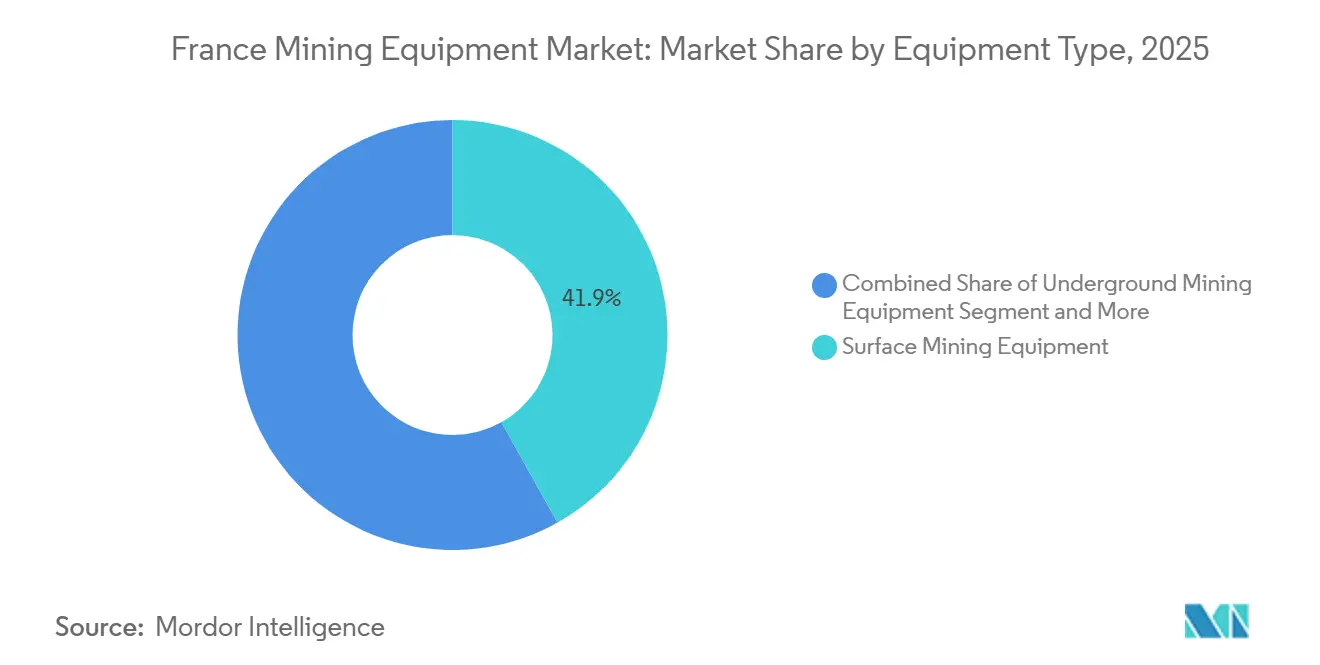
Surface mining equipment accounted for 41.87% of the France mining equipment market share in 2025. Underground equipment, while smaller in current value, is projected to record a 6.46% CAGR during 2026-2031, the fastest within the category. This differential stems from municipal resistance to new open pits and the need to protect rural landscapes above lithium and tungsten deposits.
As a result, operators are channeling capex into loaders, jumbos, and autonomous haul trucks designed for confined stopes, a shift that front-loads orders into the 2026-2028 window. Surface fleets remain essential for aggregates, yet their growth plateaus as quarry production levels off.

By Automation Level: Manual Operations Face Skilled-Labor Constraints
Manual fleets commanded 64.12% of the France mining equipment market share in 2025. Fully autonomous machines, however, are set to expand at a 7.43% CAGR through 2031, outpacing all other automation tiers. Large underground projects justify their higher upfront integration costs through significant improvements in asset utilization and notable labor savings.
Mid-tier operators favor semi-autonomous kits that deliver collision avoidance and tele-operation without requiring mine-wide 5G coverage. Ongoing government digital-skills programs are expected to ease the current technician bottleneck, smoothing adoption curves after 2027.
By Powertrain Type: ICE Dominance Faces Electrification Pressure
Internal-combustion equipment accounted for 86.62% of the France mining equipment market share in 2025. Battery-electric vehicles are forecast to grow at an 8.11% CAGR over 2026-2031, rapidly eroding diesel’s dominance. Ventilation savings of up to 30% in underground stopes and avoidance of Stage V after-treatment costs underpin the transition.
Hybrid rigs serve as an interim step, yet falling pack prices toward the €100/kWh parity mark keep full BEV adoption on a steep upward trajectory, especially for new underground projects commissioning at the end of the decade
By Power Output: Mid-Range Equipment Serves Diverse Applications
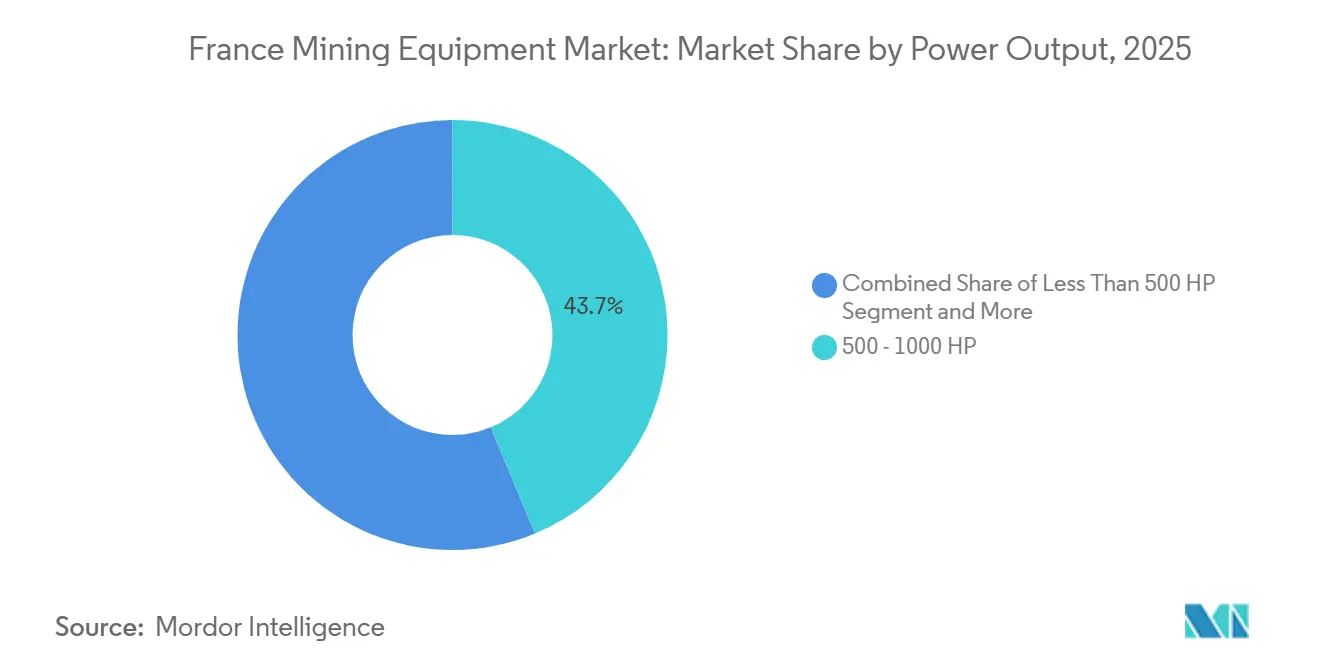
The 500-1,000 HP bracket captured 43.74% share of the France mining equipment market in 2025. Below-500 HP machines, however, lead growth with a 6.21% CAGR forecast to 2031. BRGM's nationwide subsurface inventory, driven by transportable drills with lower horsepower, is fueling growth in the compact class.
In Paris and Lyon, urban tunneling projects are increasingly opting for low-emission, low-noise machinery, spurring demand for battery-electric mini loaders and breakers. Original Equipment Manufacturers (OEMs) are downsizing autonomous stacks to align with this horsepower range, thereby expanding their customer base to include smaller contractors and exploration firms.
By Application: Metal Mining Leadership Drives Mineral Acceleration
Metal mining accounted for 52.53% of France's mining equipment market share in 2025. Mineral mining, serving ceramics, glass, and construction aggregates, is projected to post the segment’s quickest 6.19% CAGR during 2026-2031.
While lithium and tungsten projects anchor large underground orders, mineral producers benefit from shorter permitting times and lower capex, enabling faster fleet renewals. Diversified operators, therefore, balance volatile metal cycles with the steadier cash flows from industrial-mineral output, sustaining continuous equipment-refresh programs.
Geography Analysis
In the Massif Central and Pyrenees, underground investments are surging, led by Imerys' EMILI lithium project and Apollo Minerals' Couflens tungsten prospect. These projects are driving a demand for battery-electric loaders, jumbos, and high-capacity ventilation, prompting OEMs to shift their service footprints closer to central France.
Once-dominant coal regions in Lorraine and Nord-Pas-de-Calais are now transitioning to reclamation and geothermal projects, resulting in minimal demand for new mining machinery. In contrast, aggregate quarries in Île-de-France, Auvergne-Rhône-Alpes, and Provence-Alpes-Côte d’Azur continue to place consistent orders for surface excavators and crushers, with a notable preference for electrified models due to local noise regulations.
BRGM's subsurface inventory spans Brittany, Alsace, and the Pyrenees, leading to decentralized demand for electric drills with below-500 HP. In response, OEMs are setting up regional parts depots, exemplified by Aramine's new facility in southern France, significantly reducing technician response times for underground clients.
Competitive Landscape
Global giants like Caterpillar, Komatsu, Sandvik, Epiroc, and Liebherr dominate the French mining equipment market, collectively accounting for a significant share. They achieve this through robust investments in research and development and expansive dealer networks across the nation. Meanwhile, regional players such as Aramine and Manitou have carved out their own niches, focusing on compact underground loaders and retrofit electrification kits. However, Chinese firms are intensifying competition on both pricing and technological fronts. Notably, XCMG secured a substantial order in Europe during a major industry event, and SANY introduced its SY215E electric excavator in the Benelux region, with plans for a French rollout soon.
Electrification is at the heart of many strategic maneuvers. Sandvik secured a significant loan from a major European financial institution to bolster its research and development efforts in battery-electric vehicles (BEVs) and automation. Meanwhile, Liebherr's collaboration with Fortescue sets an ambitious target for autonomous trucks, showcasing the potential rewards of being an early adopter in large-scale electrification. There's also a growing trend towards retrofit and circular-economy models. For instance, Manitou has teamed up with Kiloutou to convert electric telehandlers, specifically targeting operators hesitant to prematurely discard their assets. Additionally, innovative solutions like Hitachi's LANDCROS battery-swap platform, which promises a swift energy replenishment, are emerging as game-changers, especially for remote sites constrained by grid access.
Technology is increasingly becoming the focal point of competition. Volvo CE's Smart View, equipped with Obstacle Detection, integrates AI vision with radar technology to enhance safety in underground operations. On a similar note, Epiroc's collaboration with ABB introduces a trolley assist feature, providing mid-tier mines with a notable reduction in haulage energy costs. As the industry evolves, consolidation appears inevitable, especially for smaller OEMs struggling to keep pace with the rising research and development demands of BEVs and autonomous technologies.
France Mining Equipment Industry Leaders
-
Caterpillar Inc.
-
Komatsu Ltd.
-
Sandvik AB
-
Epiroc AB
-
Liebherr-International AG
- *Disclaimer: Major Players sorted in no particular order
Recent Industry Developments
- March 2025: Imerys has made a significant investment to launch the EMILI lithium mica mining project at its Beauvoir site. The project aims to enhance the supply chain for lithium hydroxide, a key material in battery production. This initiative addresses the increasing demand for sustainable energy solutions and supports the transition to cleaner energy sources.
- March 2025: Under the Critical Raw Materials Act, the European Commission has committed EUR 22.5 billion to 47 Strategic Projects spanning extraction, processing, and recycling.
France Mining Equipment Market Report Scope
The France mining equipment market report is segmented by equipment type (surface mining equipment, underground mining equipment, mineral processing equipment, drills & breakers, crushing, pulverizing & screening equipment, loaders, and mining trucks), automation level (manual equipment, semi-autonomous equipment, and fully autonomous equipment), powertrain type (internal- combustion engine vehicles, battery-electric vehicles, and hybrid vehicles), power output (below 500 hp, 500-1,000 hp, and above 1,000 hp), and application (metal mining, mineral mining, and coal mining). The market forecasts are provided in terms of value (USD).
| Surface Mining Equipment |
| Underground Mining Equipment |
| Mineral Processing Equipment |
| Drills and Breakers |
| Crushing, Pulverizing and Screening |
| Loaders |
| Mining Trucks |
| Manual Equipment |
| Semi-Autonomous Equipment |
| Fully Autonomous Equipment |
| Internal-Combustion Engine Vehicles |
| Battery-Electric Vehicles |
| Hybrid Vehicles |
| Less than 500 HP |
| 500 - 1,000 HP |
| Above 1,000 HP |
| Metal Mining |
| Mineral Mining |
| Coal Mining |
| By Equipment Type | Surface Mining Equipment |
| Underground Mining Equipment | |
| Mineral Processing Equipment | |
| Drills and Breakers | |
| Crushing, Pulverizing and Screening | |
| Loaders | |
| Mining Trucks | |
| By Automation Level | Manual Equipment |
| Semi-Autonomous Equipment | |
| Fully Autonomous Equipment | |
| By Powertrain Type | Internal-Combustion Engine Vehicles |
| Battery-Electric Vehicles | |
| Hybrid Vehicles | |
| By Power Output | Less than 500 HP |
| 500 - 1,000 HP | |
| Above 1,000 HP | |
| By Application | Metal Mining |
| Mineral Mining | |
| Coal Mining |
Key Questions Answered in the Report
How large is France’s mining equipment segment in 2026?
The value stands at USD 0.97 billion in 2026.
What is the forecast CAGR for battery-electric vehicles between 2026 and 2031?
Battery-electric units are projected to advance at 8.11% CAGR over the period.
How do Stage V emissions rules influence equipment demand?
They accelerate fleet renewal toward new diesel models with particulate filters and stimulate interest in battery-electric alternatives to meet compliance.
Why is automation gaining momentum in French mines?
Labor shortages, with majority of the basin projects struggling to hire technicians, combined with safety and productivity gains, drive rapid autonomous adoption.
Which regions generate the most equipment demand?
Brittany, Allier and Alsace lead due to active andalusite production and large-scale lithium projects backed by national and EU funds.