
Market Overview
| Study Period | 2020 - 2031 |
|---|---|
| Forecast Data Period | 2026 - 2031 |
| Base Year Market Size (2025) | USD 119.36 Million |
| Market Size (2026) | USD 129.78 Million |
| Market Size (2031) | USD 197.16 Million |
| Growth Rate (2026 - 2031) | 8.73 % |
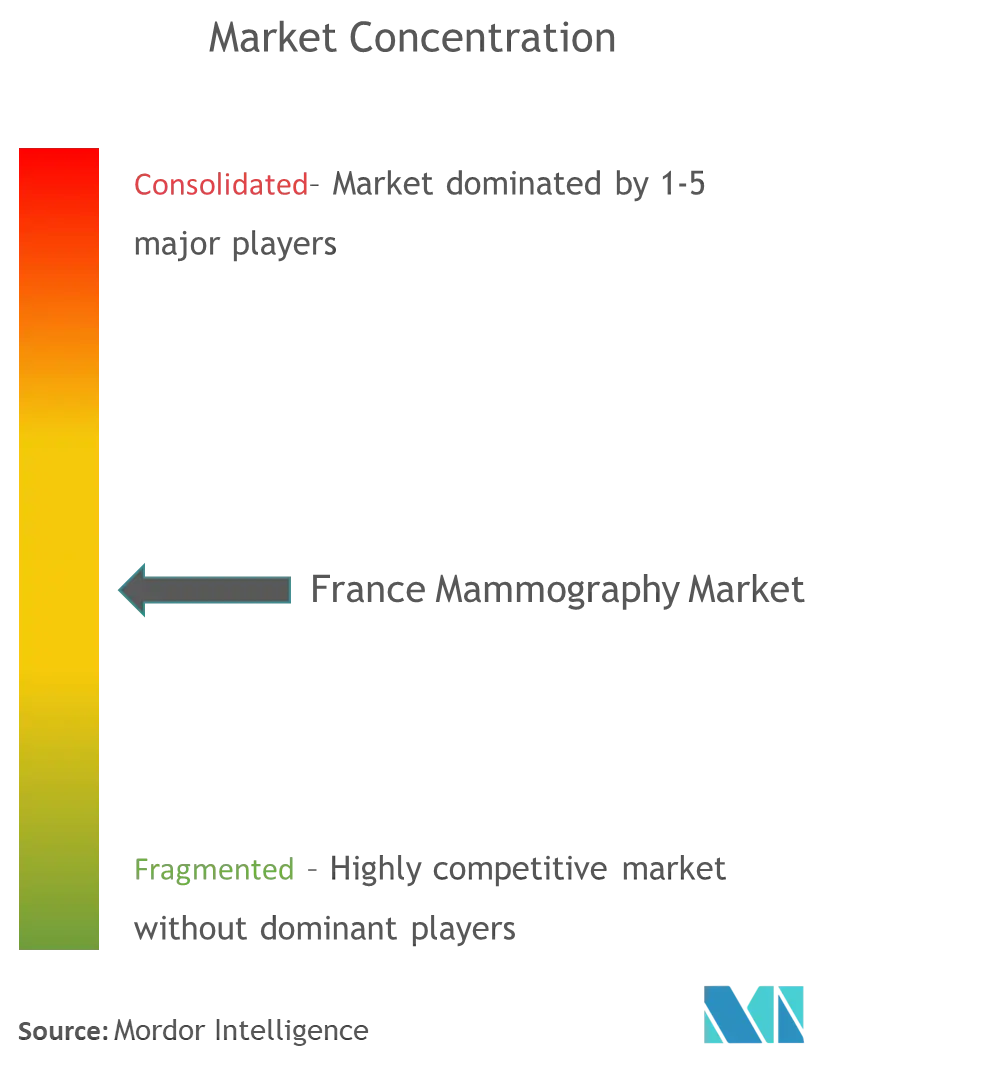
| Market Concentration | Medium |
Major Players *Disclaimer: Major Players sorted in no particular order Image © Mordor Intelligence. Reuse requires attribution under CC BY 4.0. | |
France Mammography Market Analysis by Mordor Intelligence
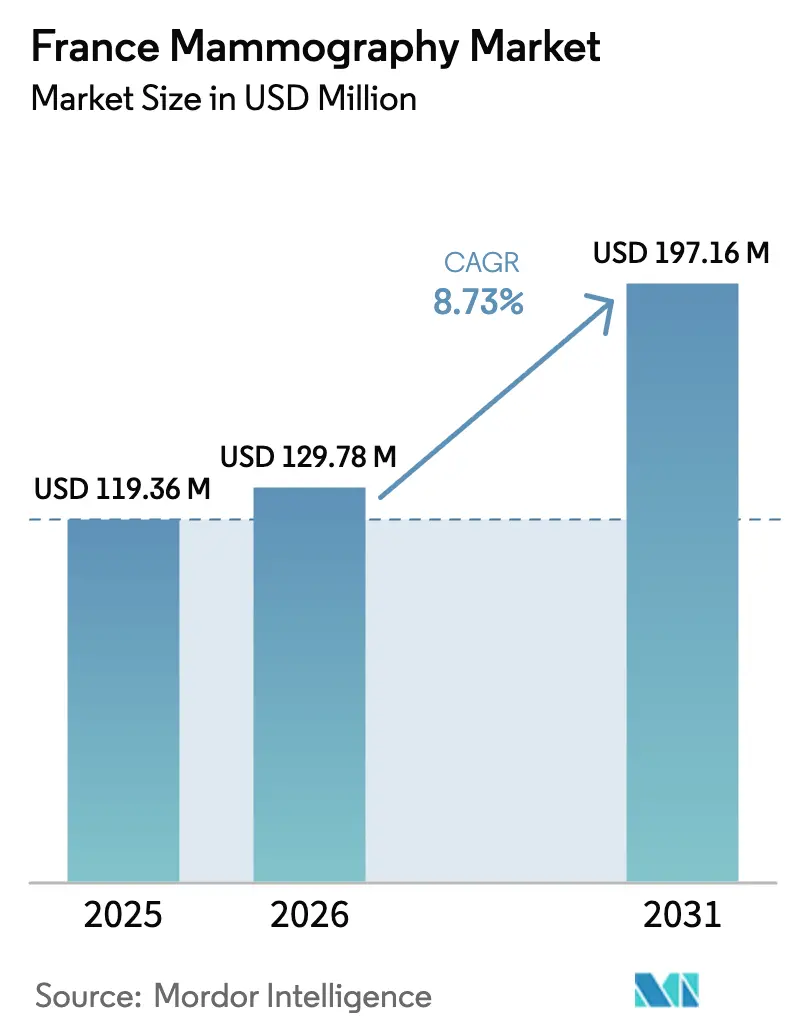
The France Mammography Market size is expected to grow from USD 119.36 million in 2025 to USD 129.78 million in 2026 and is forecast to reach USD 197.16 million by 2031 at 8.73% CAGR over 2026-2031. This expansion reflects the combined effect of a nationwide screening program that now covers 2.5 million women biennially, an aging population that pushes breast-cancer incidence above 61 000 new cases per year, and steady replacement of analog equipment by 2-D and 3-D digital systems. Uptake also benefits from the January 2024 transfer of invitation management to Assurance Maladie, a move designed to add 1 million extra examinations each year by 2025. On the supply side, the France Mammography Market gains momentum from the Haute Autorité de Santé’s endorsement of tomosynthesis for organized screening and the Agence nationale de sécurité du médicament’s stricter quality-control rules that compel facilities to modernize equipment. Vendor competition now focuses on workflow automation, embedded AI and value-based service contracts that mitigate capital-budget barriers. Simultaneously, radiologist shortages in rural departments, lingering patient anxiety over radiation exposure and the high cost of advanced systems create selective headwinds that modulate—but do not derail—the market’s upward trajectory.
Key Report Takeaways
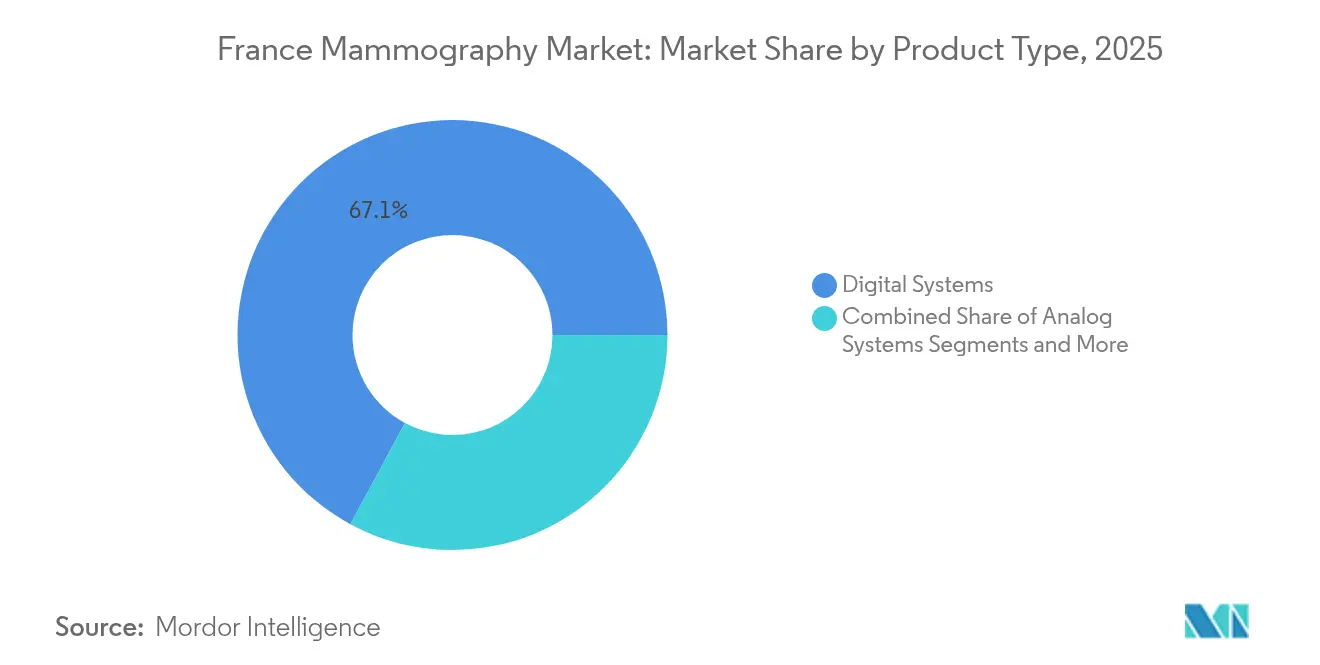
- By product type, Digital Systems captured 67.12% of the France Mammography market share in 2025 while Breast Tomosynthesis is projected to expand at a 9.03% CAGR through 2031.
- By end user, Hospitals held 53.42% of the France Mammography market size in 2025, whereas Diagnostic Centers are advancing at a 9.11% CAGR to 2031.
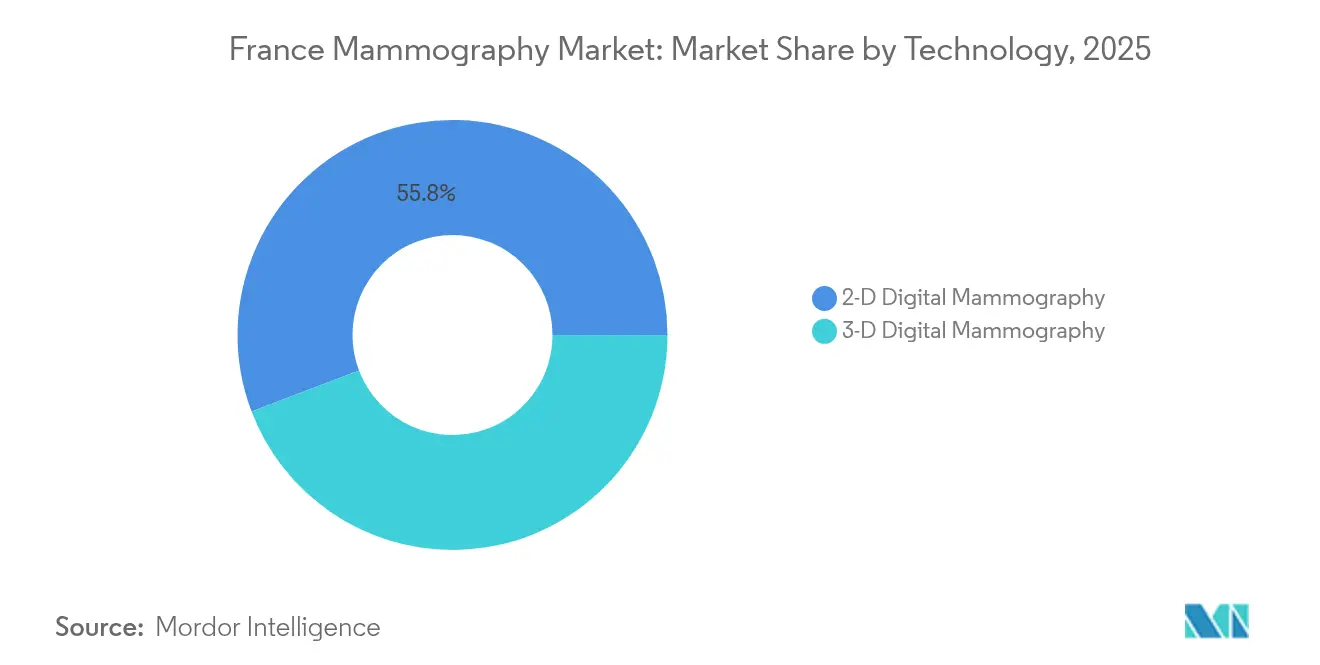
- By technology, 2-D Digital accounted for 55.78% of the France Mammography market size in 2025; 3-D Digital is set to grow at a 9.42% CAGR between 2026-2031.
Note: Market size and forecast figures in this report are generated using Mordor Intelligence’s proprietary estimation framework, updated with the latest available data and insights as of 2026.
France Mammography Market Trends and Insights
Drivers Impact Analysis*
| Driver | (~) % Impact on CAGR Forecast | Geographic Relevance | Impact Timeline |
|---|---|---|---|
| Rising breast-cancer incidence | +2.1% | National; highest in aging regions | Long term (≥ 4 years) |
| Shift from 2-D to 3-D tomosynthesis | +1.8% | University hospitals lead, cascading to regional centers | Medium term (2-4 years) |
| National screening expansion & reimbursement | +1.5% | All departments; priority to rural territories | Short term (≤ 2 years) |
| AI-enabled CAD adoption | +1.2% | Large urban hospitals and diagnostic hubs | Medium term (2-4 years) |
| Rising Public-Private Awareness Campaigns | +1.0% | National, with higher impact in low-participation regions | Short term (≤ 2 years) |
| Deployment of mobile units | +0.8% | Rural and overseas territories | Medium term (2-4 years) |
| Source: Mordor Intelligence | |||
Growing Incidence of Breast Cancer in France
More than 61 000 women received a breast-cancer diagnosis in 2024, keeping the disease France’s most common female malignancy [1]. Eight out of ten cases arise after age 50, perfectly aligning with the target age bracket of the organized screening program. Policymakers are now evaluating an age-threshold reduction as nearly 5 000 women under 40 receive a diagnosis each year, signaling potential expansion in screening volumes. Regional disparities are stark, with participation ranging from 35% in Corsica to 57% in Centre-Val-de-Loire. These participation gaps translate into equipment-density imbalances that vendors can exploit by focusing sales efforts on low-uptake departments. The Institut National du Cancer reported 38 000 cancers detected via screening in 2023, underscoring how capacity additions directly influence early-detection outcomes. Rising incidence therefore sustains a baseline demand curve for the France Mammography Market that is immune to macroeconomic volatility.
Technological Shift Toward 3-D Breast Tomosynthesis
In March 2023 the Haute Autorité de Santé validated tomosynthesis for organized screening after clinical evidence demonstrated superior lesion detection without exceeding acceptable radiation limits. Large centers, such as Hôpital d’Instruction des Armées Bégin, quickly installed new-generation 3-D units in 2024. Yet national rollout faces bottlenecks—mainly limited PACS bandwidth and the need for radiologist re-training. Vendors that bundle 3-D hardware with robust archiving and AI-triage software capture a competitive edge. Over 2025-2027, procurement frameworks managed by regional health agencies are expected to prioritize tomosynthesis-ready systems, accelerating replacement cycles. As a result, the France Mammography Market anticipates double-digit annual installations of 3-D units through the medium term.
Expansion of National Screening & Reimbursement Programs
Assurance Maladie’s takeover of invitation logistics in 2024 standardized messaging and data-capture processes, aiming to lift participation from 47% toward the European 70% benchmark. Full reimbursement of both the examination and second reading removes financial friction for patients and facilities. The D2LM platform now automates double reading nationwide, cutting administrative overhead by 25% and improving diagnostic concordance. Mobile screening projects like Mammobile in Normandy complement this push by physically reaching underserved areas. Collectively these initiatives expand procedure volumes and stabilize cash flows for equipment operators, giving lenders more confidence to finance new purchases.
AI-Enabled CAD Tools Boosting Diagnostic Throughput
AI vendors have proven in French multicenter trials that algorithmic triage reduces radiologist workload by roughly one-third while preserving sensitivity. Commercial adoption is rising: VIDI Group partnered with Lunit to deploy AI across 400 sites in 2024, a deal covering nearly one-quarter of France’s private radiology footprint. The Institut Curie’s ongoing collaboration with Galen and the Therapixel–Onsite Women’s Health alliance show that local and international actors alike view France as a fertile test bed for AI deployment. Regulatory hurdles remain—ANSM requires rigorous clinical validation—but once cleared, AI provides a scalable answer to workforce shortages, especially in the high-volume diagnostic-center segment.
Restraints Impact Analysis*
| Restraint | (~) % Impact on CAGR Forecast | Geographic Relevance | Impact Timeline |
|---|---|---|---|
| High capital cost of advanced systems | -1.8% | Smaller clinics and rural hospitals | Medium term (2-4 years) |
| Radiation-exposure concerns & anxiety | -1.3% | Educated urban populations | Long term (≥ 4 years) |
| Radiologist shortages in rural areas | -1.1% | Rural departments and overseas territories | Long term (≥ 4 years) |
| Legacy analog infrastructure | -0.9% | Older public hospitals | Short term (≤ 2 years) |
| Source: Mordor Intelligence | |||
High Capital Cost of Advanced Systems
Acquiring a tomosynthesis platform plus PACS integration can exceed EUR 450 000 (USD 490 000) for a mid-size public hospital, a price tag that strains budgets set under the national Objective de Dépenses d’Assurance Maladie framework. Smaller diagnostic centers often postpone upgrades or lease antiquated units, creating a technology gap. To mitigate sticker shock, Siemens Healthineers signed a 12-year, EUR 55 million value partnership with University Hospital Nantes that spreads costs across service years and guarantees technology refreshes. Such models are gaining traction, yet financing hurdles still slow overall adoption, dragging the France Mammography Market CAGR by an estimated 1.8 percentage points.
Risk of Radiation Exposure & Patient Anxiety
Surveys indicate 68.3% of women report mild to high anxiety ahead of mammography appointments. Fear of ionizing radiation amplifies this unease, despite doses falling well within safety thresholds set by the Autorité de sûreté nucléaire. Incidents of pediatric overexposure from unrelated mobile radiology units in 2024 received wide media coverage, reinforcing public skepticism. Manufacturers now tout low-dose innovations, such as Fujifilm’s AMULET SOPHINITY platform, which claims a 30% dose reduction while maintaining image quality. Education campaigns run by regional cancer agencies help neutralize misconceptions, yet lingering anxiety still deters some eligible women, marginally depressing equipment utilization rates.
*Our forecasts treat driver/restraint impacts as directional, not additive. The impact forecasts reflect baseline growth, mix effects, and variable interactions.
Segment Analysis
By Product Type: Digital Systems Anchor the Transition
Digital Systems generated 67.12% of 2025 revenue, cementing their role as the backbone of organized screening because ANSM quality-control rules effectively disqualify analog units from program participation. Hospitals typically renew digital hardware every 7-8 years, so a sizable installed base is now entering a replacement cycle that will buoy the France Mammography Market through 2031. Breast Tomosynthesis, though currently smaller, is growing at a 9.03% CAGR as facilities pivot toward 3-D imaging for its higher cancer-detection yield. Analog Systems command single-digit revenue shares and face imminent retirement, while Other Product Types—such as contrast-enhanced mammography—remain niche but could gain relevance for high-risk populations.
Procurement behavior illustrates two tiers: university hospitals purchase fully loaded tomosynthesis suites with integrated AI, whereas community clinics favor entry-level digital machines with upgrade paths. GE Healthcare’s Senographe Pristina and Hologic’s 3Dimensions exemplify vendor strategies that pair ergonomic design with workflow-friendly features like zero-click positioning. Fujifilm and IMS Giotto differentiate on dose-sparing technology, appealing to facilities eager to address patient-radiation concerns. These competitive nuances will shape market-share shifts within the Digital and Tomosynthesis subsegments over the forecast horizon.

By End User: Diagnostic Centers Accelerate While Hospitals Retain Scale
Hospitals controlled 53.42% of 2025 spending, driven by their integration into the national referral network and their access to public-sector capital budgets. Yet Diagnostic Centers are expanding faster at a 9.11% CAGR because they offer shorter wait times, extended hours and high equipment utilization that drives favorable economics in a fee-for-service landscape. Their growth also reflects rising outpatient care preferences among French consumers and the health ministry’s push to decongest hospitals. Specialty Clinics occupy a middle ground, focusing on high-risk or follow-up imaging that requires subspecialist expertise; they maintain stable but comparatively modest growth.
Mobile units, though representing less than 2% of the France Mammography market size, wield outsized strategic importance by servicing rural and overseas territories where fixed infrastructure is sparse. Projects like Mammobile, funded through regional health-agency grants, demonstrate public-private collaboration models that vendors can replicate across departments with participation rates below 40%. Overall, competition for new installations will intensify within the diagnostic-center channel, prompting manufacturers to craft leasing and pay-per-exam packages that accommodate facility cash-flow constraints.
By Technology: 3-D Digital Gains Momentum Over 2-D Mainstay
2-D Digital Mammography retained a 55.78% France Mammography market share in 2025, reflecting its entrenched status as the default screening modality and its cost-advantage over tomosynthesis. However, 3-D Digital Mammography is projected to outpace every other subsegment with a 9.42% CAGR through 2031, as clinical studies and regulatory endorsement validate its superior diagnostic yield in dense-breast populations. Facilities undergoing hardware refresh cycles increasingly opt for 3-D-capable systems even if immediate tomosynthesis use is deferred, effectively future-proofing their investments.
Workflow considerations influence purchasing decisions; tomosynthesis generates larger image sets, thus requiring higher-capacity servers and faster network links. Vendors that bundle storage, AI-powered triage and cloud-reading services ease this burden. Radiologist-training programs, often co-sponsored by manufacturers, further accelerate technology adoption by shortening learning curves. Consequently, the France Mammography Market is on the cusp of a technology-mix shift where 3-D installations will represent the majority of new units by 2028.
Geography Analysis
Regional uniformity in reimbursement policy masks pronounced geographic disparities in screening access and equipment density. Metropolitan regions such as Île-de-France, Auvergne-Rhône-Alpes and Provence-Alpes-Côte d’Azur concentrate tertiary hospitals and private diagnostic hubs, capturing more than half of annual mammography volumes. These areas are also the earliest adopters of AI-assisted and 3-D systems, helped by stronger capital budgets and robust radiologist pools. By contrast, rural departments in Grand Est, Bourgogne-Franche-Comté and parts of Nouvelle-Aquitaine experience radiologist vacancy rates exceeding 25% and average travel times to screening centers above 40 minutes. Mobile units funded through regional grants have proven effective stopgaps, yet fixed-site deployment lags because facilities struggle to recruit personnel and finance maintenance contracts.
Overseas departments—including Réunion and Martinique—face logistics costs that inflate equipment pricing by 12-18% relative to mainland quotes, while maintenance delays can stretch beyond 30 days because spare parts transit through Paris. The health ministry’s 2024 cancer-strategy circular earmarked EUR 16.7 million for equipment upgrades in these territories, signaling an avenue for vendors willing to provide localized service footprints. Meanwhile, participation-rate volatility continues: Corsica’s 35% remains the lowest in the republic, yet recent outreach campaigns lifted Hérault from 38% in 2022 to 46% in 2024, illustrating that targeted interventions can move the needle. Overall, geographic imbalances create a mosaic of high-growth pockets within an otherwise nationally orchestrated market landscape.
Regulatory Landscape
Mammography systems sold and used in France fall under the EU medical device framework and require CE marking through conformity assessment by notified bodies, with the Agence nationale de securite du medicament et des produits de sante (ANSM) acting as the national competent authority for market surveillance and post-market monitoring. In parallel, the Haute Autorite de Sante (HAS) issues clinical guidance that influences adoption in organized screening, including endorsement of tomosynthesis for screening when implemented with synthetic 2D reconstruction (3D + 2Ds).
Operational compliance is shaped by ANSM quality and safety controls for digital mammography installations, including the decision dated 13 January 2025 that sets internal and external quality-control requirements. External quality control must be performed by an accredited body (COFRAC or an equivalent European multilateral agreement signatory), and installations require an initial external quality control before clinical use. This approach reinforces replacement of non-compliant legacy equipment and tightens service, calibration, and documentation expectations for providers and OEMs.
Value Chain Analysis
The France mammography value chain starts with OEMs and their French distributors supplying 2D/3D systems, detectors, workstations, and service contracts. These are followed by installation, acceptance testing, and recurring quality-control activities aligned with ANSM requirements. Downstream, providers (public hospitals, private diagnostic centers, and mobile screening operators) integrate systems with PACS/IT, organize radiographer workflows, and maintain uptime through vendor service and accredited external QC bodies. Procurement increasingly favors multi-year service and technology-refresh models.
Demand is anchored by the organized breast cancer screening program (depistage organise), which invites women aged 50 to 74 for a mammogram every two years and is coordinated through Assurance Maladie structures (CPAM under CNAM). The program also structures reading capacity and quality through activity thresholds (first readers at least 500 mammographies per year, second readers at least 1,500 per year), pushing volume toward higher-throughput sites. This supports double-reading workflows and creates a pathway for AI-enabled CAD and workflow tools to plug into provider operations.
Competitive Landscape
The supplier ecosystem combines three multinational heavyweights—GE Healthcare, Siemens Healthineers and Hologic—alongside mid-size European specialists such as Fujifilm, IMS Giotto, Planmed and Metaltronica. Top-three combined share approached 48% in 2024, while the top-six surpassed 72%, yielding a moderately concentrated structure that rewards product differentiation over price wars. French procurement rules favor multi-year service contracts, prompting vendors to bundle hardware, software, training and uptime guarantees. Siemens Healthineers’ EUR 55 million, 12-year value partnership with University Hospital Nantes exemplifies the shift from transactional sales to capacity-as-a-service models [3].
Innovation pipelines spotlight AI integration and dose-reduction. GE Healthcare’s Senographe Pristina Via introduced zero-click positioning that trims exam times by 18%, an attractive feature for throughput-driven diagnostic centers. Hologic collaborates with Bayer to commercialize contrast-enhanced mammography that may complement tomosynthesis for high-risk patients. Meanwhile, local AI firms such as Therapixel leverage domestic clinical-data access to refine algorithms attuned to French population characteristics, forging partnerships with both public hospitals and private imaging chains.
Barriers to entry remain formidable: ANSM clinical-data requirements, ISO-13485 compliance and the need for nationwide service coverage deter smaller foreign entrants. Nonetheless, specialized providers find niches—Metaltronica targets budget-sensitive buyers with modular digital systems, and iCAD focuses on software that improves quality control. With replacement cycles accelerating, incumbents that deliver seamless AI workflows, competitive financing and credible low-dose performance are positioned to solidify or expand share within the France Mammography Market.
France Mammography Industry Leaders
-
Fujifilm Holdings Corporation
-
Siemens AG
-
Planmed OY
-
Hologic Inc.
-
GE Healthcare
- *Disclaimer: Major Players sorted in no particular order
Market Opportunities and Future Outlook
A key opportunity is upgrading installed bases to tomosynthesis-capable platforms aligned with HAS guidance, which integrates 3D mammography into organized screening when paired with synthetic 2D reconstruction (3D + 2Ds), while still supporting 2D digital pathways where appropriate. This creates space for vendors to sell modular upgrade paths, such as 3D-ready gantries, synthetic 2D software, and storage and network bundles, rather than relying only on full replacements. The fit is strongest for budget-constrained public facilities and high-utilization diagnostic centers where minimizing downtime and capital outlay is a practical constraint.
A second opportunity is scaling AI and workflow automation across both private and public pathways as workload pressure intersects with program scale and reading requirements. Evidence includes the January 2025 Lunit and VIDI Group alliance to deploy AI across more than 400 radiology sites and 1,200 physicians in private imaging, and the 2024 shift of screening invitation management to Assurance Maladie, designed to lift examination volumes through more standardized outreach and data capture. Suppliers that package AI triage with quality-control tooling, integration services, and long-term service commitments have clearer routes to enterprise and framework-style procurement, including for rural departments supported by mobile units.
Recent Industry Developments
- June 2026: Lunit secured a national framework agreement via UniHA to deploy its Lunit INSIGHT MMG and DBT breast-imaging AI software across more than 1,500 public hospitals in France, with Fujifilm positioned as the primary contractor. The deal shifts AI procurement toward centralized frameworks and broadens AI-assisted reading and triage capability across the public sector at scale.
- January 2025: Lunit and VIDI Group signed a strategic alliance to deploy the Lunit INSIGHT MMG AI suite across more than 400 radiology sites and 1,200 physicians in France. The agreement expands AI penetration in private imaging networks and strengthens competitive pressure on equipment and software suppliers to offer integrated, throughput-oriented workflows.
- October 2024: Siemens Healthineers entered a 12-year, EUR 55 million value partnership with University Hospital Nantes covering tomosynthesis hardware, AI analytics, and staff training. The long-term structure reinforces service-led procurement in France and provides a template for hospitals to modernize imaging fleets while smoothing capital-budget constraints.
Research Methodology Framework and Report Scope
Market Definition and Coverage
For this report, the market covers mammography systems and related hardware sold and installed in France for breast imaging in screening and diagnostic settings, measured in revenue terms for the period studied.
Scope exclusions: standalone breast ultrasound, breast MRI, biopsy needles, contrast media, and general PACS or radiology IT software are not counted in this market size.
Segmentation Overview
- By Product Type
- Digital Systems
- Analog Systems
- Breast Tomosynthesis
- Other Product Types
- By End User
- Hospitals
- Specialty Clinics
- Diagnostic Centers
- By Technology
- 2-D Digital Mammography
- 3-D Digital Mammography
Data Sources, Market Sizing, and Validation
Desk Research
Desk research helped us set the country context and build a practical demand picture before we spoke to industry participants. We used public sources such as INSEE for demographic trends, the French Ministry of Health and public health portals for screening program direction, and OECD and Eurostat for health expenditure and equipment context, then cross-checked these points with peer-reviewed radiology and oncology journals.
To keep the model grounded in supplier realities, we also reviewed manufacturer public disclosures, including annual reports and product brochures, plus regulatory or standards information that is publicly available. Where helpful, a paid subscription focused on company financials and news was used to map active suppliers and track major contract announcements. We also used a patent database to see where technology momentum was building, for example the shift between 2-D and 3-D systems. The desk sources mentioned here are illustrative, and we used additional references for data collection, validation, and clarification as follow-up questions came up.
Primary Interviews and Surveys
Primary work was used to pressure-test demand drivers and pricing, since public data rarely shows actual system mix and replacement timing clearly. We spoke with a mix of hospital imaging teams, diagnostic center operators, distributors, and service partners across France, then checked what we heard against procurement patterns and installed base replacement cycles, so the final assumptions were not based on a single viewpoint.
Distribution of primary research fieldwork respondents
| Company type | Respondent position |
|---|---|
| Top tier: 34% | CXOs: 12% |
| Mid tier: 51% | Functional/Unit leaders: 43% |
| Smaller Players: 15% | Managers: 45% |
Market-Sizing & Forecasting
Market sizing was built using a top-down approach, where screening and diagnostic activity, along with the equipment refresh cycle, were used to reconstruct the addressable demand for mammography systems in France. This view was then corroborated with selective bottom-up checks, such as sampling average selling prices by system type and validating shipment and installation momentum through channel conversations, before adjusting the totals.
In the model, a few inputs mattered more than long lists of minor variables, so we focused on indicators that can be defended and updated. These included the eligible screening-age population and participation trends, the shift from 2-D to 3-D digital mammography, the replacement cycle and utilization differences between public hospitals and diagnostic centers, and typical price bands by product class, including tomosynthesis. Where direct data was missing, we used conservative ranges that were confirmed during interviews, and we avoided forcing a full supplier roll-up when coverage was incomplete.
For forecasting, scenario analysis was applied around adoption and replacement timing, since capital budgets and screening throughput can move at different speeds across years. The forward view was checked with expert consensus on likely procurement pacing, technology mix changes, and inflation effects on equipment pricing. We carried the scenario that best matched observable signals into the final forecast.
Data Validation & Update Cycle
Validation was handled through repeat checks across independent signals so single-source bias did not creep into the final output. We compared model totals against screening program direction, expected installation capacity needs, and observed procurement activity, then investigated outliers such as sudden jumps in average price or unrealistic unit volumes.
Before sign-off, the work goes through a multi-step analyst review where assumptions, math, and year-to-year movements are checked for internal consistency. When a large variance appears, interviews are re-opened and the assumptions are re-tested until the driver is clearly explained. Reports are refreshed annually, with interim updates if material events occur, and a final pre-delivery pass is completed so clients receive the latest updated view.
Mordor Intelligence's France Mammography Market Size Compared With Other Published Estimates
Published market values for mammography in France can differ across sources, even when they appear to cover the same topic. The gaps usually come from what is counted as part of the market, the year used as the base, and how pricing and technology mix are carried forward.
Breast ultrasound and MRI often get bundled into some figures, which makes the total look larger, and service contracts are sometimes added on top of equipment revenue even when they are not consistently tracked. Some publishers also assume faster 3-D conversion and higher average selling prices without validating the replacement cycle using field inputs, and refresh cadence can matter when hospital tenders shift between years. Biopsy needles and general imaging software sit outside Mordor Intelligence's scope for this market, which is why the estimate stays tied to mammography system revenue rather than adjacent breast imaging spend.
Benchmark comparison
| Source | Market Size | Gaps in Research Methodology |
|---|---|---|
| Mordor Intelligence | USD 129.78 M (2026) | |
| Industry Association A | USD 150.40 M (2026) | Often treated as a broader breast imaging equipment number, where mammography is combined with adjacent modalities or bundled service revenue, which inflates the equipment-only total. |
| Healthcare Consultancy B | USD 112.60 M (2025) | Uses an earlier base year and typically applies conservative price progression and slower 3-D penetration, with fewer checks on tender-driven replacement waves in public facilities. |
The spread in the table mostly traces back to what gets included and how quickly the model assumes France shifts toward 3-D systems, which changes the blended price level. By keeping inputs tied to screening demand signals, replacement timing, and realistic price bands, the result stays easier to reconcile and repeat when new procurement or participation data becomes available.
Key Questions Answered in the Report
How big is the France Mammography Market?
The France Mammography Market size is expected to reach USD 129.78 million in 2026 and grow at a CAGR of 8.73% to reach USD 197.16 million by 2031.
Which product category holds the biggest share?
Digital Systems command 67.12% of 2025 revenue.
Who are the key players in France Mammography Market?
Fujifilm Holdings Corporation, Siemens AG, Planmed OY, Hologic Inc. and GE Healthcare are the major companies operating in the France Mammography Market.
Why is 3-D tomosynthesis adoption accelerating?
Regulatory endorsement and superior cancer-detection rates are driving hospitals to upgrade.