
Market Overview
| Study Period | 2021 - 2031 |
|---|---|
| Forecast Data Period | 2026 - 2031 |
| Base Year Market Size (2025) | USD 24.61 Billion |
| Market Size (2026) | USD 25.81 Billion |
| Market Size (2031) | USD 32.76 Billion |
| Growth Rate (2026 - 2031) | 4.89 % |
| Market Concentration | Medium |
Major Players *Disclaimer: Major Players sorted in no particular order Image © Mordor Intelligence. Reuse requires attribution under CC BY 4.0. | |
France Luxury Goods Market Analysis by Mordor Intelligence
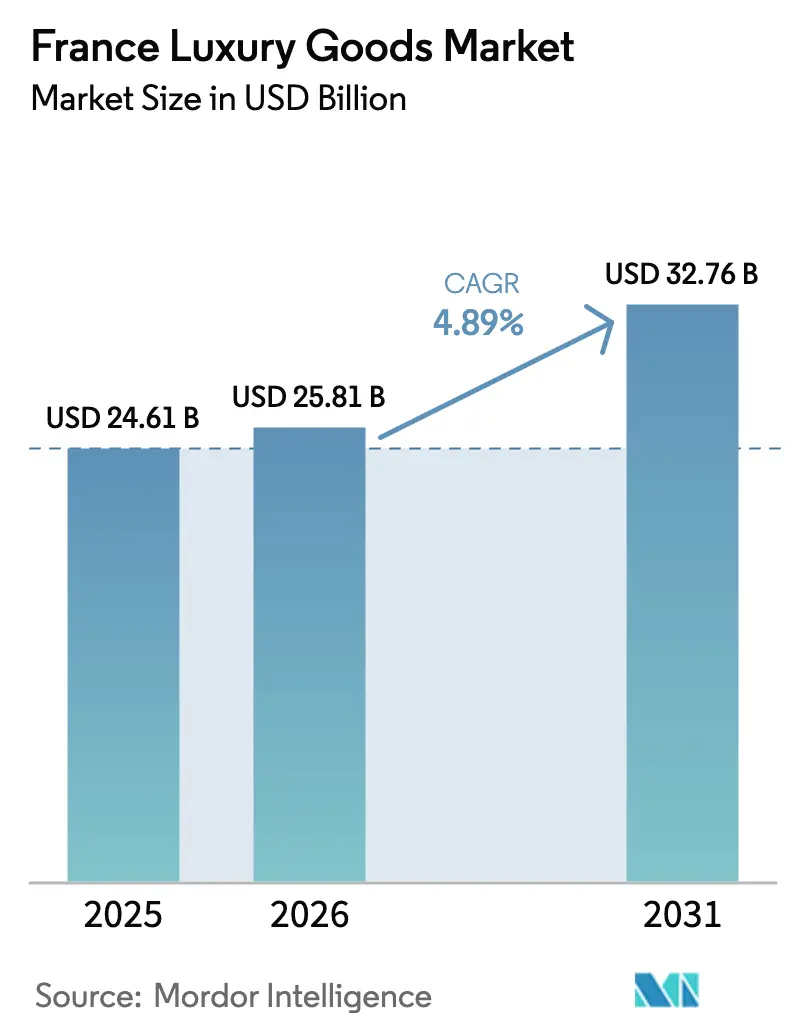
The France luxury goods market size was valued at USD 24.61 billion in 2025 and estimated to grow from USD 25.81 billion in 2026 to reach USD 32.76 billion by 2031, at a CAGR of 4.89% during the forecast period (2026-2031). This trajectory reflects France's enduring position as the birthplace of modern luxury, where heritage maisons continue to anchor global prestige even as digital channels and sustainability mandates reshape consumer expectations. The market's momentum stems from a confluence of forces: inbound tourism rebounded sharply in 2024 when France welcomed over 100 million visitors who generated EUR 71 billion in revenue, with Chinese arrivals surging 40% and Japanese tourists climbing 20% year-on-year, according to the French Republic. Meanwhile, the European Union's Digital Product Passport regulation, which took effect in 2024, compels every luxury item sold in France to carry verifiable provenance and circularity data, effectively turning transparency into a competitive weapon. Paris alone captured more than half of total tourist spending in 2025, and tourist receipts now exceed pre-pandemic peaks as long-haul travelers from China, Japan, and North America return at scale. Luxury houses are also capitalizing on the Digital Product Passport regime, turning provenance data into a storytelling asset that reinforces brand equity.
Key Report Takeaways
- By product type, clothing and apparel led with 43.03% revenue share in 2025, while leather goods are forecast to advance at a 4.96% CAGR through 2031.
- By end user, women accounted for 57.44% of the French luxury goods market share in 2025; however, the men's segment is projected to post the highest growth at 5.27% over the forecast period.
- By distribution channel, single-brand stores held 38.05% of sales in 2025, whereas online stores are expected to expand at a 5.66% CAGR to 2031.
Note: Market size and forecast figures in this report are generated using Mordor Intelligence’s proprietary estimation framework, updated with the latest available data and insights as of January 2026.
Market Trends and Insights
Drivers Impact Analysis of France Luxury Goods Market*
| Driver | (~) % Impact on CAGR Forecast | Geographic Relevance | Impact Timeline |
|---|---|---|---|
| Consumer emphasis on sustainability | +0.8% | Paris, Lyon, Premium paid for low-impact goods lifts sales | Medium term (2–4 years) |
| Influence of social media and celebrity endorsement | +0.6% | Paris, Nice, Influencer buzz converts younger shoppers quickly | Short term (≤ 2 years) |
| High demand from inbound tourists | +1.2% | Paris, Riviera, High-spend visitors boost flagship revenues | Medium term (2–4 years) |
| Product innovation in raw material and design | +0.7% | Paris, Auvergne-Rhône-Alpes, Recycled materials and tech add desirability | Long term (≥ 4 years) |
| Rising disposable income boosts luxury spending | +0.4% | Greater Paris, Bordeaux, Higher household earnings widen buyer pool | Short term (≤ 2 years) |
| Expansion of e-commerce channels enhances accessibility | +0.5% | Nationwide metro areas, Online access extends reach beyond boutiques | Medium term (2–4 years) |
| Source: Mordor Intelligence | |||
Consumer emphasis on sustainability
French luxury consumers increasingly prioritize circularity and traceability, reshaping product development and marketing narratives. Chanel launched its Nevold resale platform in 2024, enabling authenticated pre-owned handbag transactions that extend product lifecycles and capture secondary-market margin previously lost to third-party resellers. LVMH's LIFE 360 initiative, unveiled in 2024, commits the group to 100% renewable energy across European operations by 2026 and mandates that 70% of raw materials meet biodiversity-positive criteria by 2030. Kering's 2025 Environmental Profit and Loss statement quantified the house's EUR 400 million investment in regenerative agriculture for cashmere and leather, a move that signals a willingness to absorb near-term cost for long-term supply security. The EU's Digital Product Passport, effective from 2024, requires every luxury item to carry a scannable record of origin, materials, and repair history, effectively turning sustainability claims into auditable commitments. This regulatory backdrop favors incumbents with vertically integrated supply chains and penalizes brands reliant on opaque third-party sourcing.
Influence of social media and celebrity endorsement
Digital platforms and celebrity partnerships now drive discovery and conversion in ways that traditional advertising cannot replicate. Louis Vuitton's 2025 collaboration with makeup artist Pat McGrath generated over 500 million social media impressions within 72 hours of launch, demonstrating how influencer co-creation amplifies reach beyond paid media budgets. LVMH's 10-year partnership with Formula 1, announced in 2024, integrates TAG Heuer, Louis Vuitton, and Moët Hennessy into race-day activations that target affluent male audiences aged 25-45, a demographic historically underrepresented in luxury marketing. Hermès's entry into haute couture in 2024, led by creative director Nadège Vanhée-Cybulski, leveraged Instagram and TikTok teasers that generated 1.2 billion views before the first collection debuted, illustrating how heritage brands now embrace digital-first storytelling. This shift reflects a broader recognition that authenticity and niche credibility often outperform reach alone, particularly among Gen Z consumers who distrust overt sponsorship.
High demand from inbound tourist
France continues to reinforce its status as the world's leading tourist destination, a position that has significantly driven the growth of the luxury goods market. The 2024 Olympic Games acted as a major catalyst for tourism, with international visitors playing a critical role in boosting luxury retail sales. Luxury brands, renowned for their country-of-origin appeal, maintain a strong presence across both online and offline channels in France. As one of Europe’s most visited destinations, France attracts a substantial number of Asian tourists, particularly for fashion and leisure activities. In 2024, France attracted 100 million international visitors, generating an international revenue of EUR 71 billion [1]. In response to this heightened demand, luxury retailers have implemented strategic expansion plans to capitalize on the growing market. For instance, Phoebe Philo expanded into the French luxury retail market by opening her first physical store in Galeries Lafayette Haussmann, Paris, in February 2025. This marks a significant step for the brand, which had previously only been available through online sales and limited in-person events.
Product innovation in raw material and design
Material innovation increasingly differentiates luxury offerings as consumers demand both novelty and sustainability. Hermès invested EUR 50 million in 2024 to expand its tannery network in France, focusing on vegetable-tanned leathers that eliminate chromium, a toxic byproduct of conventional tanning, while maintaining the supple hand-feel that defines the house's aesthetic. Chanel's 2025 Métiers d'Art collection incorporated lab-grown diamonds from Diamond Foundry, a move that addresses ethical sourcing concerns while preserving the visual and physical properties of mined stones. Kering's partnership with Mylo, a mycelium-based leather alternative, yielded commercial-scale production in 2024; the material debuted in limited-edition Gucci handbags priced at EUR 3,500, testing consumer willingness to pay premiums for bio-fabricated inputs. Richemont's Cartier division launched a modular jewelry line in 2025 that allows wearers to reconfigure gemstone settings, effectively transforming a single purchase into multiple designs and extending product utility. These innovations reflect a strategic pivot: luxury houses now compete on material provenance and adaptability rather than static design alone, recognizing that younger consumers value versatility and traceability as much as heritage craftsmanship.
Restraints Impact Analysis of France Luxury Goods Market*
| Restraint | (~) % Impact on CAGR Forecast | Geographic Relevance | Impact Timeline |
|---|---|---|---|
| Availability of counterfeit products | -0.5% | Paris markets, Marseille port, Fakes erode brand trust and revenue | Medium term (2–4 years) |
| Lesser demand from price-sensitive consumers | -0.7% | Lille, Nantes, Inflation steers buyers to second-hand options | Short term (≤ 2 years) |
| Stringent government regulations | -0.4% | Nationwide, ESG and advertising rules raise compliance costs | Long term (≥ 4 years) |
| High import duties on luxury goods | -0.3% | Major ports, customs zones, Tariffs inflate input costs and retail prices | Medium term (2–4 years) |
| Source: Mordor Intelligence | |||
Availability of counterfeit products
The surge in counterfeiting poses a significant threat to the luxury market. French customs seized more than 20 million counterfeit items in 2023, representing a twofold increase from 2022, with luxury goods being the primary target [2]. The rise of e-commerce has intensified the problem, with counterfeit networks increasingly turning to online platforms for their distribution. The widespread availability of counterfeit products acts as a significant restraint on the market, as it undermines the exclusivity and perceived value of genuine luxury items. Counterfeit goods often attract price-sensitive consumers, diverting demand away from authentic luxury products and impacting the revenue streams of legitimate brands. In response to this escalating challenge, the French government rolled out the 2024–2026 National Anti-Counterfeiting Plan, bolstering enforcement ahead of the 2024 Olympics. Beyond mere economics, counterfeits tarnish brand reputation and diminish consumer trust. In a bid to safeguard their intellectual property, luxury brands are turning to cutting-edge authentication technologies, such as RFID (Radio-Frequency Identification) and NFC (Near Field Communication).
Lesser demand from price-sensitive consumers
Luxury price escalation outpaces wage growth, constraining access for aspirational buyers who historically fueled entry-level product sales. Chanel raised handbag prices in 2024, pushing the Classic Flap to EUR 10,000, a threshold that excludes younger professionals and first-time luxury purchasers. Louis Vuitton's Neverfull tote, long positioned as an accessible gateway product, now retails at EUR 1,800, up from EUR 1,200 in 2020, reflecting a cumulative increase that outstrips French inflation rates. This pricing strategy prioritizes margin over volume, a deliberate shift that insulates brands from discounting but alienates price-sensitive cohorts. Middle-income French consumers, facing stagnant real wages and elevated housing costs, increasingly defer luxury purchases or trade down to contemporary brands like Sandro and Maje that offer similar aesthetics at lower price points. The bifurcation creates strategic tension: brands must balance exclusivity, which demands high prices and limited availability, with the need to cultivate the next generation of loyal customers who may lack purchasing power in their 20s and 30s.
*Our forecasts treat driver/restraint impacts as directional, not additive. The impact forecasts reflect baseline growth, mix effects, and variable interactions.
France Luxury Goods Market Segment Analysis
By Product Type:
Apparel Dominates, Leather Goods AcceleratesClothing and Apparel held 43.03% of the market share in 2025, reflecting France's historical dominance in haute couture and ready-to-wear. However, leather goods are forecast to grow from 2026 to 2031, outpacing apparel's more modest trajectory. Hermès's scarcity-driven model exemplifies this dynamic: the house limits Birkin and Kelly bag production to preserve artisan craftsmanship, sustaining waitlists that span years and reinforcing the perception of unattainable luxury. Louis Vuitton's 2024 launch of the Twist bag in vegan leather, priced at EUR 2,500, tested consumer acceptance of bio-fabricated materials, with initial sell-through rates exceeding expectations. Footwear benefits from the casualization of luxury: Chanel's 2025 introduction of a EUR 1,200 sneaker line, blending heritage tweeds with technical soles, captured younger buyers who prioritize comfort without sacrificing brand signaling.
Eyewear and Watches cater to distinct buyer motivations; eyewear serves as an accessible entry point, while watches function as investment-grade collectibles. Cartier's 2024 launch of the Panthère de Cartier sunglasses, retailing at EUR 800, leveraged the house's jewelry heritage to command premium pricing in a category dominated by EssilorLuxottica's licensed brands. Rolex maintained production discipline in 2025, restricting supply to sustain secondary-market premiums that often exceed retail prices. Jewelry and Beauty and Personal Care segments benefit from gifting occasions and repeat purchase behavior. Chanel's integration of lab-grown diamonds in its 2025 Métiers d'Art collection addressed ethical sourcing concerns while preserving the visual properties of mined stones.


By End-User:
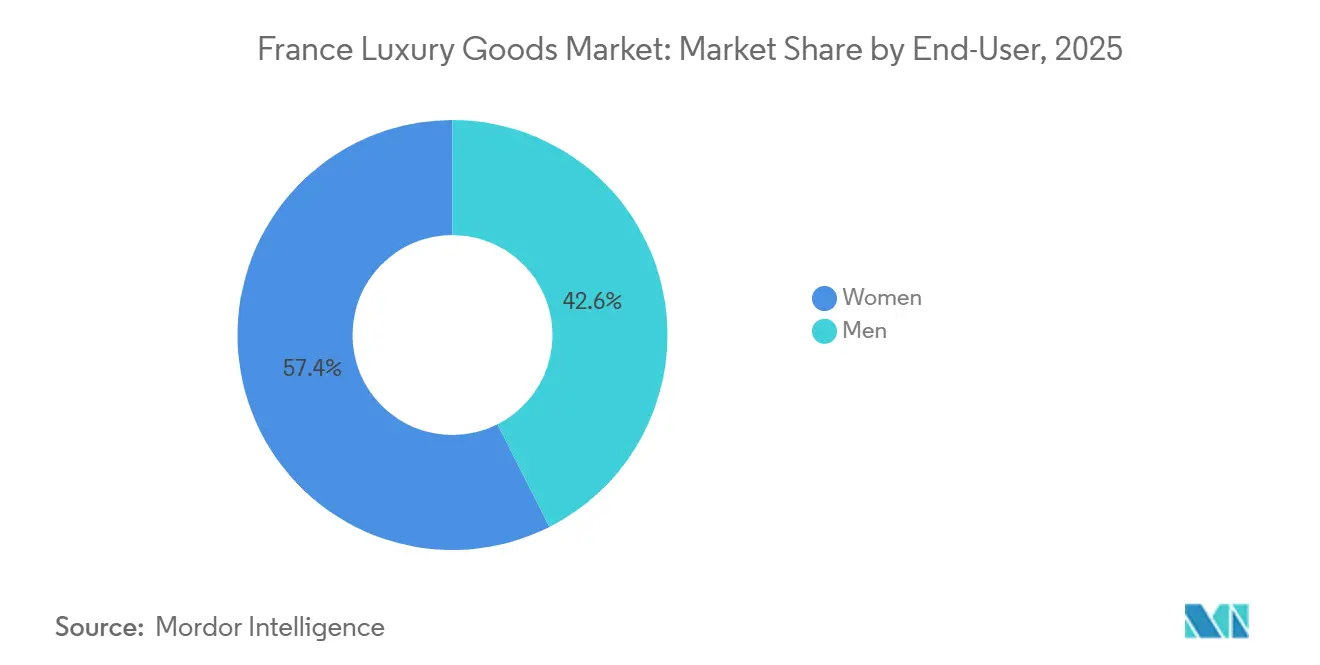
Women Lead, Men SurgeWomen accounted for 57.44% of market share in 2025, yet Men's luxury is projected to grow at 5.27% through 2031, reflecting shifting gender norms and the rise of male grooming and fashion consciousness. Hermès's 2024 expansion of its men's ready-to-wear line, including tailored suiting priced at EUR 5,000 per piece, targets professionals who view luxury as a career investment rather than discretionary spending. Louis Vuitton's men's fragrance line, launched in 2024, generated EUR 200 million in first-year sales, demonstrating latent demand for male-targeted luxury beyond apparel and accessories.
Younger men, particularly those aged 25-40, increasingly purchase luxury sneakers, watches, and grooming products as identity markers, with average transaction values rising year-on-year in 2024. Women's luxury remains anchored in handbags, ready-to-wear, and beauty, with Chanel, Dior, and Hermès commanding the highest brand loyalty. The Unisex segment, while smaller, benefits from gender-fluid design trends; brands like A.P.C. and Longchamp position core products, tote bags, outerwear, and accessories as non-gendered essentials that appeal across demographics. This segmentation reflects broader cultural shifts where luxury increasingly signals personal values and identity rather than conforming to traditional gender roles.
By Distribution Channel:
Single-Brand Stores Hold, Online SurgesSingle-brand stores maintain the largest market share at 38.05% in 2025, offering controlled brand experiences and direct consumer relationships. However, online stores are growing most rapidly at a 5.66% CAGR through 2031, reflecting the sector's digital transformation. This shift in channels mirrors broader retail trends, a change hastened by the pandemic. Consumers are now more at ease buying luxury goods online, sidestepping the need for in-store testing. This online surge is especially beneficial for brands, as it allows them to connect with specific consumer segments without a physical retail presence.
The penetration of e-commerce in the luxury market has accelerated, with digital platforms particularly appealing to millennials and Gen Z, who increasingly prefer purchasing high-value products online. For instance, as of January 2024, the fashion category accounted for the majority of online purchases in France, according to the Federation of E-commerce and Distance Selling [3]. Social media and influencer marketing have expanded the visibility and aspirational appeal of luxury brands to a broader audience. Multi-brand department stores remain key for discovery, especially among tourists who bundle purchases with tax-refund services. The France luxury goods market size attached to omnichannel services grows because clients now expect to reserve products online, try them offline and finalize payment on either channel.
Regulatory Landscape
France luxury goods players operate under a tightening EU and national compliance stack that increasingly links product claims, marketing, and end-of-life outcomes. At EU level, the Digital Product Passport regime in force since 2024 requires brands to maintain verifiable data on origin, materials, and repair/circularity attributes for items sold in France, raising the bar for traceability systems and supplier disclosure. On the national side, the DGCCRF remains a key enforcement body for consumer protection and labeling, including scrutiny around "Made in France" claims, which affects how maisons position local craftsmanship narratives in leather goods and apparel.
Regulatory direction is also moving toward environmental impacts and selling practices that shape competitive positioning in luxury fashion. In June 2026, the French Senate approved a law aimed at ultra-fast fashion, introducing environmental penalties and restrictions on advertising and influencer promotion, which can indirectly favor premium brands that already operate with lower-volume models and compliance-led marketing. Separately, an EU ban on the destruction of unsold textiles and footwear taking effect in July 2026 increases the importance of inventory discipline, repair, resale, and authenticated second-hand channels for luxury brands active in France.
Competitive Landscape
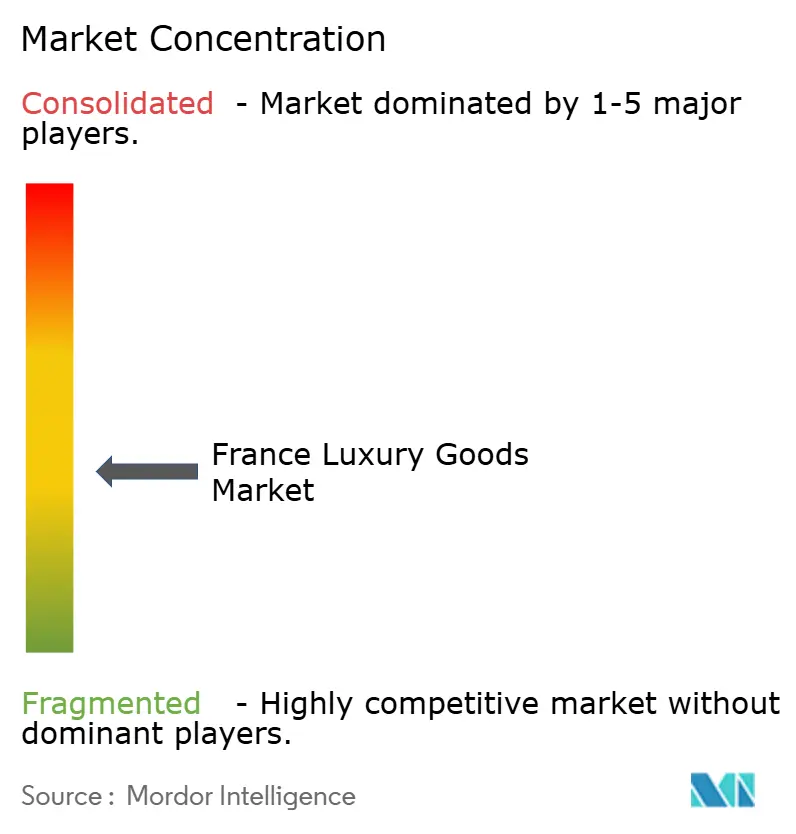
The French luxury goods market is moderately concentrated, with domestic and international players striving to capture significant market share. Prominent players dominating the market include Hermès International S.A., LVMH Moët Hennessy Louis Vuitton SE, L'Oreal SA, Compagnie Financière Richemont S.A., and Kering SA, among others. These brands compete by leveraging factors such as premium packaging, attractive offers, exceptional quality, comfort, and an extensive product portfolio. LVMH manages 75 brands across fashion, jewelry, cosmetics, wines, and hospitality, delivering billions of operating profit in 2024.
Competition has intensified in the area of sustainability, with Kering setting benchmarks through science-based targets and transparent reporting practices. Additionally, digital capabilities have become a critical competitive factor, prompting brands to invest significantly in omnichannel strategies and content development. To enhance their market positions, leading companies are also focusing on strategies such as collaborating with regional brands and introducing innovative luxury products.
The certified pre-owned programs play a pivotal role in safeguarding brand equity. By tagging serial numbers on a public blockchain, luxury houses can verify ownership transfers, a move that not only deters counterfeiting but also resonates with younger consumers. Brands maintain a disciplined approach to pricing, steering clear of widespread discounts. Instead, they opt for personalized clienteling, discreetly managing seasonal leftovers. Collectively, these strategies bolster the French luxury goods market against potential disruptors and heighten the switching costs for its loyal clientele.
France Luxury Goods Industry Leaders
-
Compagnie Financière Richemont S.A.
-
LVMH Moët Hennessy Louis Vuitton SE
-
Kering SA
-
L'Oreal SA
-
Hermès International S.A.
- *Disclaimer: Major Players sorted in no particular order
France Luxury Goods Market Companies Covered in this Report
- LVMH Moët Hennessy Louis Vuitton SE
- Kering SA
- Chanel SA
- Hermès International SA
- Compagnie Financière Richemont SA
- L’Oreal SA
- Moncler SpA
- Burberry Group plc
- Swatch Group AG
- Rolex SA
- Longchamp SAS
- Maison Goyard
- Sisley Paris
- A.P.C. SAS
- Clarins Group
- Puig SA
- Interparfums SA
- Barbara Bui SA
- S.T. Dupont SA
- PVH Corp.
Market Opportunities and Future Outlook
Compliance-led transparency and circularity create room for brands and enablers that can operationalize provenance, repair history, and authenticated resale at scale in France. With the EU Digital Product Passport in effect since 2024 and the EU ban on destroying unsold textiles and footwear effective July 2026, investment is shifting toward item-level identification (RFID/NFC), after-sales service capacity, and brand-controlled resale, aligning with market programs already in motion such as Chanel's Nevold resale platform (2024). These requirements also support opportunities around vertically integrated sourcing and local production footprints, including certified French workshops, specialized material suppliers, and traceability software partners able to meet audit-grade data needs.
Beauty and fragrance expansion, along with cross-border collaboration, offers additional pockets of opportunity for luxury groups operating in France. In July 2026, Gucci and L'Oréal entered into a long-term exclusive beauty license agreement (announced one year ahead of schedule), highlighting how prestige beauty scaling depends on specialist operators and distribution. Separately, the Italia-France Pact announced on June 25, 2026, frames collaboration to protect fashion know-how, which can translate into joint initiatives across materials, craftsmanship training, and supply-chain resilience for French luxury manufacturers and their upstream partners.
Recent Industry Developments in France Luxury Goods Market
- July 2026: Kering SA and its Gucci brand and LOréal have entered into a 50-year exclusive beauty licence agreement, one year ahead of schedule. The collaboration reshapes Gucci's beauty strategy and accelerates LOréal's luxury fragrance and beauty growth for the group. The arrangement may affect pricing dynamics for Gucci products as the license scales.
- June 2026: Hermes International S.A. opened a new maison at 166 New Bond Street in London, its sixth worldwide. The expansion strengthens Hermes brand presence in the UK and supports its omnichannel and premium store network. The development could uplift European distribution and sales mix for the brand.
- April 2026: Hermes International S.A. inaugurated its Loupes leather goods production workshop in Gironde, France. The expansion increases domestic production capacity and enhances supply chain resilience. It supports premium leather goods output and improves lead times.
France Luxury Goods Market Report Scope and Research Methodology
Market Definition and Coverage
This market covers the value of luxury goods sold in France across core personal luxury categories, counted at retail value and across offline and online channels, for purchases made within the country by residents and visiting shoppers.
Scope exclusions: We exclude luxury services (such as hospitality, fine dining, and luxury travel) and second-hand or auction resales from the market value.
Segments Covered in This Report
- Product Type
- Clothing and Apparel
- Footwear
- Eyewear
- Leather Goods
- Jewelry
- Watches
- Beauty and Personal Care
- End-User
- Men
- Women
- Unisex
- Distribution Channel
- Single-Brand Stores
- Multi-Brand Stores
- Online Stores
Data Sources, Market Sizing, and Validation
Desk Research
Desk work started by mapping the demand pool and retail environment in France, then checking how it maps to luxury price bands and distribution. Public sources were used to set the baseline around household spending patterns, tourism-driven shopping signals, and the overall retail structure.
We referred to non-paywalled sources such as INSEE for consumer and retail indicators, Eurostat for harmonized consumption series, the French Customs administration for trade direction checks, Banque de France releases for macro context, and OECD datasets for comparable time series. These were complemented with brand and retailer annual reports, investor presentations, reputable business press, and association publications that describe category trends and channel shifts. Where needed, we also used paid subscriptions for company financials and intelligence, news and financials, and patent databases to confirm corporate activity and product launch intensity. The desk source list is illustrative, and we used many additional references for cross-checks and clarification.
Primary Interviews and Surveys
Primary work focused on validating the category mix, pricing behavior, and channel splits that are specific to France, including how tourist purchases contribute in major cities and how travel retail spillovers show up in broader premium retail. We spoke with brand-side and retail-side professionals, as well as distributors and category specialists. Inputs from these discussions were then used to confirm what we learned from desk sources, and to tighten assumptions where available data did not align cleanly.
Distribution of primary research fieldwork respondents
| Company type | Respondent position |
|---|---|
| Top tier: 38% | CXOs: 14% |
| Mid tier: 47% | Functional/Unit leaders: 34% |
| Smaller Players: 15% | Managers: 52% |
Market-Sizing & Forecasting
Sizing was built using a top-down demand-pool reconstruction, where national consumption and retail indicators were translated into luxury-only value by applying category-level luxury shares and channel weights for France. To keep the totals realistic, the results were corroborated with selective bottom-up checks, including sampled brand revenue exposure to France, store and door-count logic for key retail formats, and price point checks using observed assortment ranges.
A few inputs carried the model each year, including inbound tourism intensity and shopping propensity, luxury price inflation versus broader CPI, category mix shifts toward beauty and accessories, online penetration in premium retail, and currency timing for any imported product value used as a reasonableness check. When gaps appeared in bottom-up signals (for example, private brand disclosure limits), we used ranges agreed during interviews and then normalized them back to the demand-side totals.
For forecasting, scenario analysis was used, where baseline growth is linked to expected household spending resilience, tourist recovery trajectories, and category-specific pricing power. We stress-tested assumptions with primary feedback so the final outlook reflects what market participants described as achievable in the next cycle.
Data Validation & Update Cycle
Outputs were checked through multiple steps, starting with year-on-year variance review by category and channel, followed by comparisons against independent signals such as tourism receipts trends, retail sales direction, and import patterns for relevant product groups. Any large jumps triggered deeper review of the input drivers, and if needed, respondents were re-contacted to confirm whether a change was structural or mainly timing-related.
Before sign-off, the model is reviewed by another analyst to confirm calculations, definitions, and consistency of assumptions across the time series. Reports are refreshed annually, with interim updates when material events change demand or pricing, and a final pre-delivery pass is completed so clients receive an up-to-date view.
Mordor Intelligence's France Luxury Goods Market Estimate Compared With Other Published Estimates
Published market sizes for luxury goods in France can look different because the counted items and the value point in the chain are not always the same. Differences also come from how tourism spending is handled, how online sales are assigned to geography, and whether the series is refreshed after major demand swings.
Second-hand luxury resale sits outside Mordor Intelligence's scope here, which is a common reason some figures look larger when they mix primary retail sales with re-commerce turnover. Other gaps usually come from using aggressive price growth, counting travel retail purchases under France even when the point of sale is outside the country, or applying category shares that have not been re-checked with recent channel shifts.
Benchmark comparison
| Source | Market Size | Gaps in Research Methodology |
|---|---|---|
| Mordor Intelligence | USD 24.61 B (2025) | |
| Industry Publisher A | USD 23.75 B (2024) | Uses an earlier base year, and the value can shift depending on how tourist shopping and duty-free purchases are allocated to France versus point-of-sale location, which changes the counted demand pool. |
| Regional Consultancy B | USD 17.10 B (2024) | Often reflects a narrower category basket and a different channel cut, where some personal luxury items and premium beauty lines can be excluded or treated inconsistently, pulling down the total versus broader retail-value approaches. |
The spread across the three figures is mainly explained by what is included, how France-based purchases are assigned, and how price growth is carried forward from the base year. By keeping the scope tied to primary luxury goods sales in-country and by re-checking key drivers like tourism and online penetration, the resulting number stays easier to trace and reproduce year to year.
Key Questions Answered in the Report
How large is the France luxury goods market in 2026?
The market is valued at USD 25.81 billion in 2026.
What is the expected CAGR for luxury goods sales in France to 2031?
Sales are projected to rise at a 4.89% CAGR through 2031.
Which product category is growing the fastest in France?
Leather goods are forecast to grow at a 4.96% CAGR, outpacing other categories.
Why is men’s demand expanding so quickly?
Younger male consumers treat premium sneakers, grooming, and tailoring as expressions of identity, driving a 5.27% CAGR for the segment.