
Market Overview
| Study Period | 2020 - 2031 |
|---|---|
| Base Year Market Size (2025) | USD 135.02 Billion |
| Market Size (2026) | USD 147.2 Billion |
| Market Size (2031) | USD 226.5 Billion |
| Growth Rate (2026 - 2031) | 9.02% CAGR |
| Fastest Growing Market | Asia Pacific |
| Largest Market | North America |
Major Players *Disclaimer: Major Players sorted in no particular order Image © Mordor Intelligence. Reuse requires attribution under CC BY 4.0. | |
France ICT Market Analysis by Mordor Intelligence
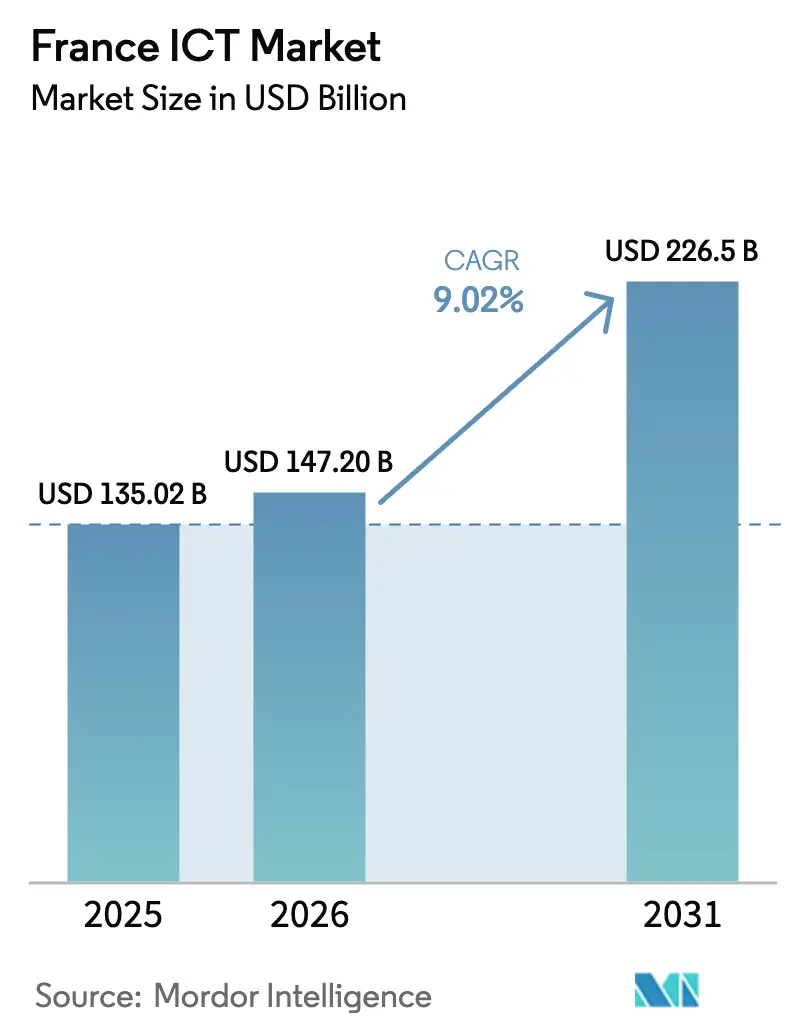
The France ICT market size was valued at USD 135.02 billion in 2025 and estimated to grow from USD 147.2 billion in 2026 to reach USD 226.5 billion by 2031, at a CAGR of 9.02% during the forecast period (2026-2031). Robust upside stems from the government’s EUR 54 billion France 2030 program, complementary private AI investments topping EUR 109 billion, and pervasive 5G and fiber coverage that now blankets 95% of the population. These factors converge with strict sovereign-cloud mandates to anchor the France ICT market in Europe’s digital-sovereignty agenda. Fiber-to-the-home (FTTH) penetration of 90% eligibility and 75.4% subscription has moved competition away from basic connectivity toward data-intensive services, while a nationwide 5G standalone footprint enables industrial IoT, network slicing, and edge-computing use cases. Rising power-efficient data-center builds, supported by France’s low-carbon nuclear grid, are further lowering the total cost of compute and meeting corporate decarbonization targets. Together, these structural shifts accelerate cloud migration, AI adoption, and green-IT demand, setting the stage for sustained double-digit expansion across the France ICT market.
Key Report Takeaways
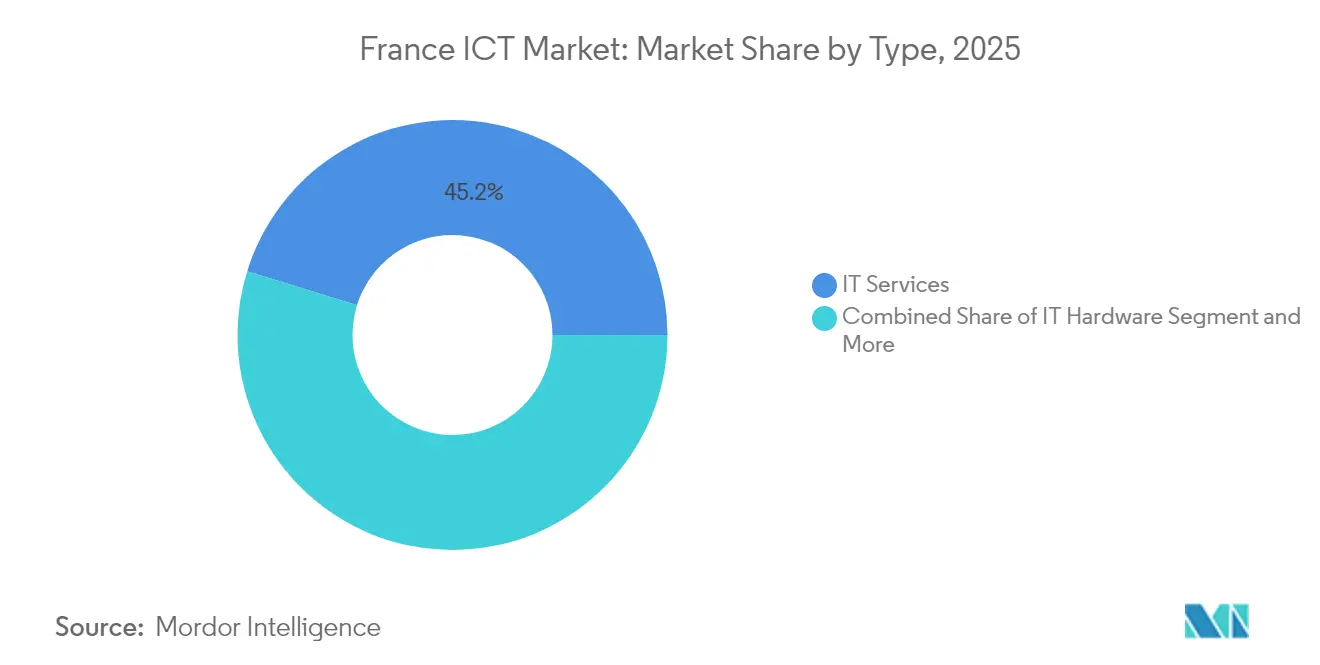
- By type, IT Services led with 45.20% of the France ICT market share in 2025, while Cloud Services is advancing at a 12.10% CAGR through 2031.
- By enterprise size, large enterprises controlled 70.30% of the France ICT market size in 2025; small and medium enterprises (SMEs) posted the fastest 9.55% CAGR to 2031.
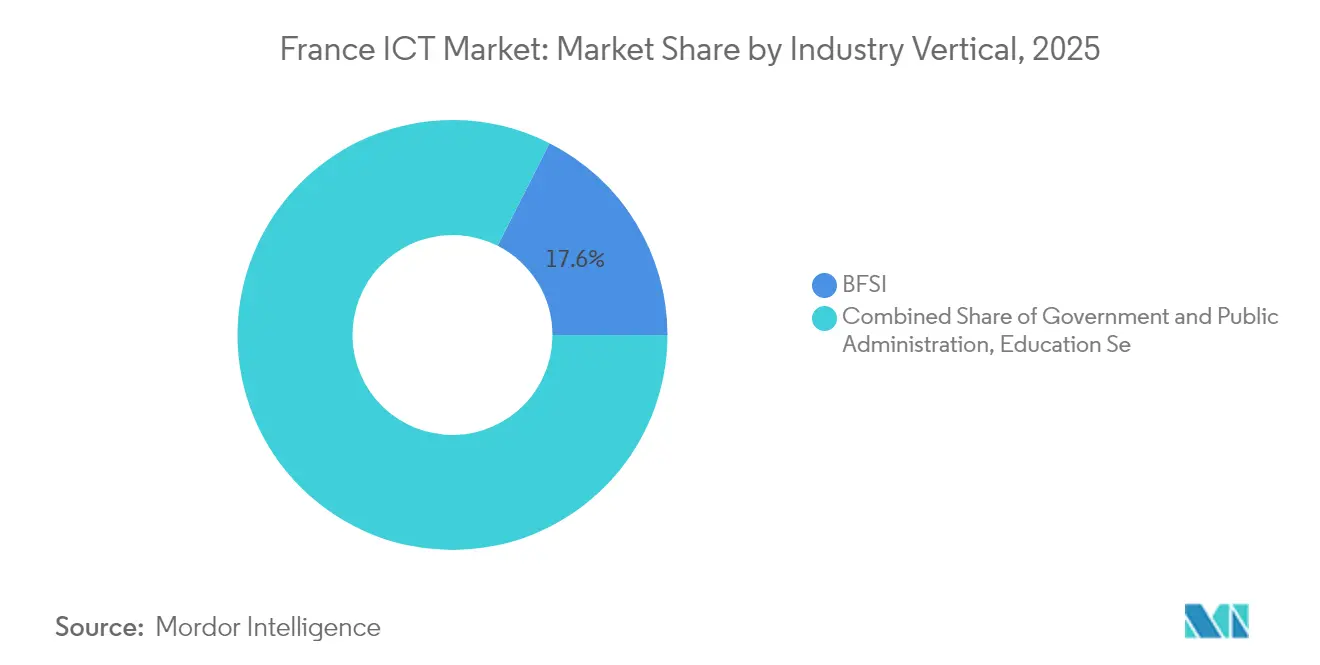
- By industry vertical, BFSI contributed 17.55% of the France ICT market size in 2025, whereas Gaming and Esports is expanding at a 14.35% CAGR through 2031.
- By deployment model, cloud-only solutions captured 56.85% of the France ICT market share in 2025, with the public-cloud segment forecast to climb at an 17.60% CAGR to 2031.
Note: Market size and forecast figures in this report are generated using Mordor Intelligence’s proprietary estimation framework, updated with the latest available data and insights as of 2026.
France ICT Market Trends and Insights
Drivers Impact Analysis*
| Driver | (~)% Impact on CAGR Forecast | Geographic Relevance | Impact Timeline |
|---|---|---|---|
| Surge in 5G spectrum auctions and network build-outs | +1.8% | National, with urban concentration in Paris, Lyon, Marseille | Medium term (2-4 years) |
| France's "Cloud de Confiance" certification drives sovereign-cloud uptake | +1.5% | National, with public sector priority | Long term (≥ 4 years) |
| EU Chips Act incentives accelerate local semiconductor design hubs | +0.9% | Regional clusters in Grenoble, Toulouse, Paris | Long term (≥ 4 years) |
| Corporate decarbonisation targets boost demand for green data-centres | +1.2% | National, with concentration in renewable energy regions | Medium term (2-4 years) |
| Nationwide fibre-to-the-home (FTTH) completion unlocking higher-value services | +2.1% | National, with rural area emphasis | Short term (≤ 2 years) |
| Rise of AI-powered language models tailored for French public sector | +1.3% | National, with government sector focus | Medium term (2-4 years) |
| Source: Mordor Intelligence | |||
Surge in 5G Spectrum Auctions and Network Build-Outs Drive Enterprise Transformation
Free Mobile’s national 5G-SA launch over 20,000 sites in 2024 triggered a wave of competitive deployments, lifting authorized 5G sites to 50,268 by March 2025 and extending coverage to 95% of residents[1]Telecoms, “France’s Free makes bold 5G standalone claims,” telecoms.com. Standalone architecture brings network-slicing that lets manufacturers, logistics operators, and public-safety agencies reserve deterministic bandwidth. Orange, SFR, and Bouygues Telecom are refarming 700 MHz and 2.1 GHz spectrum while ARCEP prepares new 3.8-4.2 GHz allocations to accommodate edge-AI workloads. Latency-sensitive use cases such as collaborative robotics and autonomous guided vehicles that stalled under 4G now move to commercial pilots. In parallel, systems integrators bundle 5G private-network design with managed-edge services, monetizing the connectivity-plus-compute stack across the France ICT market.
France’s “Cloud de Confiance” Certification Creates a Sovereign-Computing Paradigm
The Bleu platform, a EUR 525 million joint venture of Capgemini and Orange using Microsoft technology, began commercial operations in 2024 to serve workloads subject to French data-sovereignty statutes. The ANSSI SecNumCloud framework enforces 360 controls spanning administrative isolation and European legal immunity, guiding tender criteria in defense, healthcare, and critical-infrastructure domains. Hyperscalers without SecNumCloud status now partner with certified operators or lose access to public contracts, reshaping vendor shortlists across the France ICT market. Organizations handling sensitive workloads must therefore weigh sovereignty alongside cost and feature sets, elevating compliance as a decisive buying factor. The national stance also influences EU regulation: Paris resists broader, less stringent schemes, aiming to preserve its first-mover advantage in sovereign-cloud services.
Corporate Decarbonization Targets Reshape Data-Center Investment Patterns
Energy-intensive AI workloads push data-center load to 10 TWh—2.2% of France’s power draw in 2022—with forecasts calling for a 74% surge by 2050[2]RTE, “Data centers: 11 figures on growth and power needs,” rte-france.com. Operators exploit the nation’s 90% low-carbon electricity mix and nuclear baseload to market “green-compute” placements that help multinationals meet science-based-target pledges. Modern campuses post power-usage-effectiveness (PUE) scores near 1.1, halving energy waste versus legacy halls. Mandatory energy-performance audits for facilities above 500 kW, effective April 2025, accelerate retrofit cycles, favoring liquid cooling and heat-reuse schemes. Enterprises now bundle carbon-footprint audits with hosting contracts, embedding sustainability metrics into vendor scorecards. This green premium reinforces France’s competitive edge as cloud providers scale GPU farms for generative-AI services within the France ICT market.
Nationwide FTTH Completion Enables Service Innovation Beyond Connectivity
FTTH eligibility reached 92% of premises in March 2025, with 25.1 million active lines making up 77% of fixed subscriptions. Copper switch-off began in 162 municipalities, pushing legacy DSL users toward gigabit packages and freeing operators to refocus capital on service differentiation. SLA-grade fiber now anchors bundled offerings that integrate direct public-cloud peering, SD-WAN orchestration, and managed security. SMEs in rural communes gain symmetric bandwidth essential for SaaS ERPs and video-first collaboration, slicing through historic urban–rural digital divides. As ubiquitous fiber removes last-mile bottlenecks, developers roll out high-bandwidth apps such as immersive tele-health and virtual vocational training, enhancing addressable demand for the France ICT market.
Restraints Impact Analysis*
| Restraint | (~)% Impact on CAGR Forecast | Geographic Relevance | Impact Timeline |
|---|---|---|---|
| Highly fragmented SME channel inflates go-to-market costs | -1.4% | National, with rural concentration | Medium term (2-4 years) |
| Shortage of bilingual (FR/EN) cyber-security talent limits project delivery | -1.8% | National, with Paris region concentration | Long term (≥ 4 years) |
| Legacy mainframe estates in BFSI slow cloud migration | -0.9% | National, concentrated in financial districts | Long term (≥ 4 years) |
| Growing dependence on non-EU hyperscalers raises data-sovereignty concerns | -1.1% | National, with public sector emphasis | Medium term (2-4 years) |
| Source: Mordor Intelligence | |||
Fragmented SME Channel Creates Scale Disadvantages for Technology Providers
Only 52% of French SMEs meet the EU’s basic-digital-intensity benchmark despite 73% enjoying fiber access, forcing vendors into high-touch education cycles that erode margins[3]France Num, “Baromètre 2024: perception et usages,” francenum.gouv.fr. Procurement is splintered across 4 million firms, each demanding tailored support yet generating modest contract values. Marketing spend per euro booked, therefore, remains multiples higher than enterprise business, deterring scale-out SaaS models. Government grants and France Num coaching temper the barrier, but suffer from fragmented awareness campaigns. Unless channel aggregators or regional digital-advisory hubs mature, friction around discovery, onboarding, and change management will continue to trim momentum for the France ICT market.
Cybersecurity Talent Shortage Constrains Market Growth Despite Rising Demand
The economy lacks 15,000 cybersecurity professionals even after 89% headcount growth since 2021, with dual-language skills most acute at[4]Government of France, “Attirer les jeunes vers les métiers de la cybersécurité,” info.gouv.fr . Median salaries of EUR 70,000 outstrip general ICT wages by 40%, inflating project costs and delaying cloud-migration timelines. Banks and utilities postpone zero-trust initiatives for want of certified engineers, and MSPs cap new logo intake when staffing pipelines dry up. Universities expand curricula, but certification paths such as CISSP and CISM extend learning cycles, slowing supply elasticity. Until international talent-mobility rules loosen or vocational fast-tracks scale, security bottlenecks will temper upside in the France ICT market.
*Our forecasts treat driver/restraint impacts as directional, not additive. The impact forecasts reflect baseline growth, mix effects, and variable interactions.
Segment Analysis
By Type: Services Dominance Accelerates Cloud Transformation
IT Services contributed 45.20% to the France ICT market share in 2025 as enterprises outsourced complex digital-transformation workloads. Price-premium mandates around AI integration, cybersecurity hardening, and legacy modernization are locked in multiyear managed-service contracts. Cloud Services, advancing at a 12.10% CAGR, benefit directly from sovereign-cloud mandates and green-data-center preferences. The France ICT market size for Cloud Services is projected to rise in tandem with Bleu’s roll-out as ministries port sensitive workloads from on-premise stacks to SecNumCloud-ready environments. Hardware refresh cycles persist around edge gateways and enterprise Wi-Fi 7 upgrades, yet value shifts decisively toward X-as-a-Service models that monetize talent scarcity rather than physical assets.
The mid-term narrative centers on platform orchestration: providers bundling observability, FinOps, and AI-ops capabilities out-compete pure-play resellers. Software vendors embed generative-AI copilots into ERP and CRM suites, lifting attach revenues. Communication-service providers reposition into digital-experience orchestrators, fusing 5G-MEC capacity with SaaS marketplaces. Collectively, these trends reinforce the service-weighted composition of the France ICT market and tilt margins toward knowledge-intensive offerings.


By Enterprise Size: SME Growth Momentum Challenges Large-Enterprise Dominance
Large enterprises retained 70.30% of the France ICT market size in 2025 but face slower expansion as mainframe remediation and compliance reviews elongate project cycles. SMEs, posting a 9.55% CAGR, leverage cloud marketplaces and low-code tooling to bypass legacy constraints. Subscription-priced cybersecurity bundles and all-inclusive managed-LAN packages flatten upfront cost barriers, letting SMEs achieve digital parity.
Government vouchers under France Num subsidize hardware refreshes and digital-skills training, widening the funnel of qualified buyers. Marketplace aggregators that pre-integrate accounting, e-commerce, and cyber-insurance serve as one-stop shops, sidestepping the fragmented reseller ecosystem. As FTTH penetration removes last-mile constraints, rural micro-enterprises adopt SaaS POS and cloud storage. This groundswell narrows the digital-intensity gap and reallocates incremental spending toward the SME cohort within the France ICT market.
By Industry Vertical: BFSI Leadership Faces Gaming-Sector Disruption
BFSI owned 17.55% of the France ICT market share in 2025, channeling budgets into core-bank modernization, open-finance APIs, and real-time payment compliance. However, Gaming and Esports, fueled by a EUR 6.1 billion domestic games market, is on track for a 14.35% CAGR, positioning consumer-experience workloads as the next demand frontier SELL.FR.
Banks pilot quantum-ready encryption and federated-learning fraud models, yet must divert OpEx to remediate 84% of legacy mainframe estates. Conversely, studios and esports platforms exploit 5G-edge rendering and AI-generated content pipelines that require elastic GPU capacity. The divergent growth trajectories widen the sector-mix shift: by 2030, entertainment workloads could surpass regulated-finance use in incremental cloud consumption, redefining workload prioritization across the France ICT market.
By Deployment Model: Cloud-Only Dominance Accelerates Public-Cloud Adoption
Cloud-only architectures represented 56.85% of the France ICT market in 2025 as boards endorsed cloud-first mandates to access advanced analytics and generative-AI toolchains. Public-cloud consumption is forecast at an 17.60% CAGR, assisted by sovereign instances that satisfy data-residency clauses while retaining hyperscaler innovation velocity. The France ICT market size for public-cloud workloads will therefore expand faster than hybrid or private counterparts.
On-premise environments linger in defense and utilities where latency or national-security statutes dictate physical control. Nevertheless, as SecNumCloud certifications proliferate and dual-region redundancy becomes turnkey, even mission-critical workloads migrate. Edge mini-data-centers supplement public-cloud backbones for deterministic latency, letting service providers offer “local cloud” zones to manufacturing sites. Consequently, cloud-only paradigms will predominate in new workload placement across the France ICT market.
Geography Analysis
The Île-de-France region concentrates over 70 tier-III and higher data centers worth EUR 1.2 billion and serves as the backbone for continental traffic exchange. The France ICT market size for the capital cluster, therefore, dwarfs provincial hubs, yet the balance is shifting. In Auvergne-Rhône-Alpes, Lyon combines automotive and biotech verticals, sparking edge-data-center builds and 5G testbeds. Grenoble attracts EU-Chips-Act subsidies, anchoring a semiconductor design corridor that catalyzes specialized EDA and HPC software demand. Occitanie’s Toulouse aerospace complex employs digital-twin platforms and predictive-maintenance AI, lifting regional ICT outlays.
Fiber-to-the-home completion equalizes rural connectivity: Grand Est and Nouvelle-Aquitaine SMEs now procure SaaS tools previously out of reach, raising per-capita ICT spend. Brittany and Normandy leverage offshore wind and tidal energy to lure green-compute campuses, aligning with data-center decarbonization strategies. Cross-border submarine-cable landing points at Marseille foster Middle East and Africa traffic, transforming Provence-Alpes-Côte d’Azur into a latency-optimized hub for streaming and gaming workloads. Nationally, the France ICT market benefits from France’s EU membership while wielding independent sovereignty controls, striking a balance between continental scale and domestic governance that few peers replicate.
Regulatory Landscape
France is tightening ICT governance around sovereignty, security, and portability, with ANSSI playing a central role through SecNumCloud qualification requirements that affect which suppliers can serve sensitive and public-sector workloads. The SREN Act (Law n°2024-449) reinforces safeguards for sensitive data in the digital space, including obligations tied to interoperability and data portability for cloud services, while France aligns national cybersecurity requirements with the EU NIS2 framework for governance, risk management, and incident notification.
In 2026, policy instruments further clarified operational expectations for administrations and providers. The Prime Minister-led digital public procurement circular dated 5 February 2026 sets out the State approach to balance market solutions with internally developed and open source tools (including elements of La Suite numerique) to support sovereignty and reduce lock-in. Decree n°2026-272 of 14 April 2026 specifies protection requirements for sensitive administrative and public-interest data processed by private cloud providers, raising the compliance bar for cloud contracting in regulated and public domains.
Value Chain Analysis
The France ICT value chain spans hardware and network equipment OEMs, telecom operators, hyperscalers and sovereign-cloud platforms, software publishers, and a large services layer of systems integrators, MSPs, and engineering and consulting firms. The overall ecosystem includes around 30,000 companies employing more than 660,000 people, with activity split across digital services (about half), software publishing, and engineering and technology consulting. This structure keeps services and integration central to how end-users buy and operate ICT.
Public-sector and regulated-industry demand is increasingly organized as a tiered supply chain, where foundational sovereign building blocks sit alongside commercial offerings that must satisfy interoperability, security, and procurement doctrine requirements. ANSSI operates as a key validator for secure-information-system supply chains through qualification of trusted providers and security products, which influences vendor shortlists and partner strategies for both domestic players and foreign technology firms active in France. This qualification layer raises the importance of compliance engineering, auditability, and portability capabilities across software, cloud, and managed services delivered into the French market.
Competitive Landscape
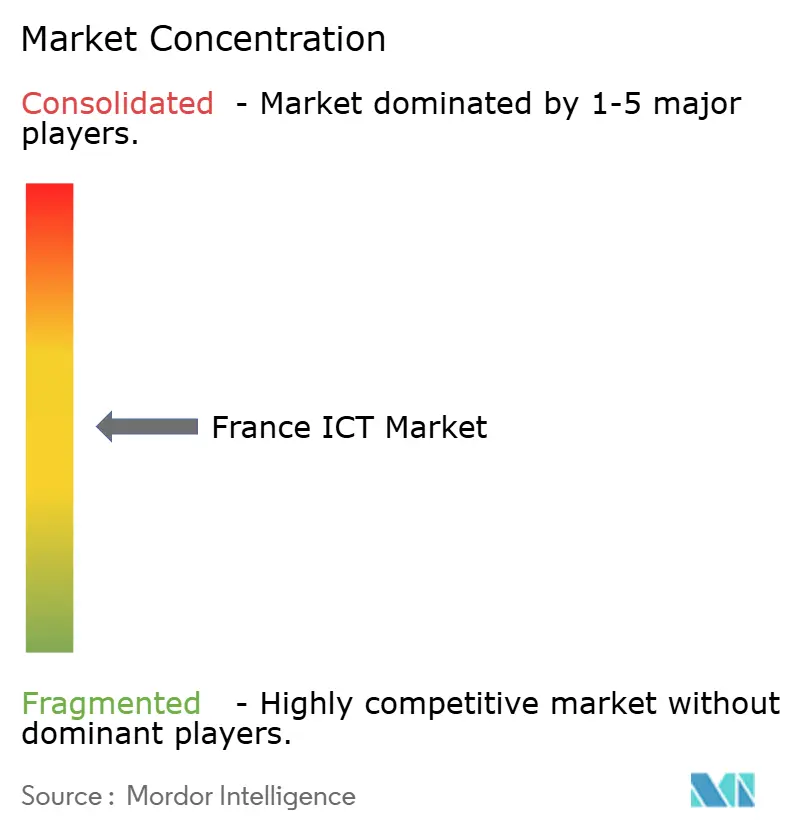
France’s ICT arena is moderately concentrated: the top five providers hold an estimated 48% revenue share across connectivity, cloud, and services. Orange leads fixed and mobile access, monetizing FTTH and 5G-SA upgrades, while SFR, Bouygues Telecom, and Free Mobile defend share via aggressive unlimited-data bundles. Microsoft, IBM, and AWS capitalize on enterprise-cloud migrations, yet SecNumCloud qualifiers Capgemini-Orange (Bleu) and Thales-Google (S3NS) carve out protected niches. OVHcloud leverages European roots to market sovereign-ready IaaS and has opened liquid-cooling GPU clusters in Roubaix.
Strategic pivots focus on regulatory differentiation more than raw price. Orange bundles sovereign-cloud resell with managed-MEC security; Capgemini invests in generative-AI centers to offset slower consulting growth; Dassault Systèmes layers cloud-delivered PLM with sustainability metrics for manufacturing clients. Carlyle’s planned acquisition of Ciril Group underscores private-equity appetite for sovereign providers amid rising compliance spend. Talent scarcity drives M&A for specialized skills: HCLTech acquired Zeenea to secure data-governance IP, and ChapsVision bought Sinequa to embed AI-search into defense analytics stacks.
Emerging challengers include Mistral, developing French-language large language models, and Foxway, scaling circular-IT refurb services to satisfy ESG procurement rules. Overall, competition hinges on who best fuses sovereignty, sustainability, and sector-specific AI, a triad redefining value capture in the France ICT market.
France ICT Industry Leaders
Samsung Electronics Co., Ltd
Microsoft Corporation
IBM Corporation
Infosys Limited
Accenture plc
- *Disclaimer: Major Players sorted in no particular order

Market Opportunities and Future Outlook
Sovereign cloud migration and compliance-by-design delivery models create whitespace across consulting, integration, and managed operations, especially for workloads involving sensitive administrative and public-interest data. The 5 February 2026 digital public procurement circular gives suppliers a concrete pull to package interoperable offerings and support administrations in balancing market solutions with internal and open source foundations (DINUM-led digital commons such as La Suite numerique). This opens opportunities for systems integrators, software publishers, and MSPs with strong security and portability credentials.
A second opportunity area centers on data-intensive infrastructure and services that bundle cloud, cybersecurity, and edge capabilities under French governance expectations. Decree n°2026-272 (14 April 2026) increases practical requirements for private-cloud processing of sensitive public data, which in turn lifts demand for assurance tooling (identity, logging, encryption, governance) and for trusted hosting and managed security that align with ANSSI expectations. At the same time, France 2030 programming and ecosystem-building initiatives referenced in official commercial guidance (cloud consulting, data analytics, 5G and edge computing, cybersecurity, and AI) support routes to market for innovative SMEs and startups through procurement mechanisms and partner-led delivery models.
Recent Industry Developments
- July 2026: Microsoft France signed a new framework agreement with the Ministry of National Education and Research. The signing formalizes a government technology mandate alignment for AI and education software. The collaboration consolidates Microsoft France's AI and education sector footprint in France.
- May 2026: The third cohort of the Microsoft GenAI Studio reached a milestone, with over 1,800 startups supported by Microsoft France since 2024 toward a goal of 2,500 by 2027. The program accelerates AI startup enablement in France. It expands Microsoft's enterprise and GenAI ecosystem in the country, catalyzing local AI adoption and services growth.
- April 2026: The French government officially selected Scaleway to host the national Health Data Platform PDS, replacing Microsoft Azure. The selection strengthens Scaleway's sovereign-cloud position in France. It could shift large scale health data cloud workloads away from US providers in France.


Research Methodology Framework and Report Scope
Market Definition and Coverage
For this study, the France ICT market is defined as the total spending generated within France across core information and communication technology offerings, including IT products and services and electronic communications services, measured in revenue terms in USD for the stated year.
Scope exclusions: We exclude informal or non-invoiced activity, most consumer second-hand device resale, and purely internal IT cost allocations that do not translate into supplier revenue.
Segmentation Overview
- By Type
- IT Hardware
- Computer Hardware
- Networking Equipment
- Peripherals
- IT Software
- IT Services
- Managed Services
- Business Process Services
- Business Consulting Services
- Cloud Services
- IT Infrastructure
- IT Security
- Communication Services
- IT Hardware
- By Deployment Model
- On-Premise
- Public Cloud
- Private Cloud
- Hybrid Cloud
- By Enterprise Size
- Small and Medium Enterprises (SMEs)
- Large Enterprises
- By Industry Vertical
- Government and Public Administration
- Banking, Financial Services and Insurance (BFSI)
- Retail, E-commerce and Logistics
- Manufacturing and Industry 4.0
- Energy and Utilities
- Healthcare and Life Sciences
- Gaming and Esports
- Education
- Other Verticals
Data Sources, Market Sizing, and Validation
Desk Research
Desk research was used to set the outer guardrails before assumptions were finalized, especially for the size of telecom service revenues and the direction of IT spending by French enterprises. We mainly relied on public statistics and sector trackers that are readable and comparable year to year, so the model does not get pulled by one-off headlines.
Common starting points included sources such as ARCEP telecom market observatories, INSEE structural business statistics for ICT activities, Eurostat digital economy series, and OECD ICT indicators, followed by checks against annual reports, regulatory filings, and investor decks of major operators and IT service providers active in France. For pricing and activity signals, we also used press releases from French digital industry associations and government digital strategy publications where relevant. A few inputs were cross-checked using paid subscriptions that cover company financials, news and filings, and patent databases for innovation intensity trends. These desk research sources are not exhaustive, and other public documents and datasets were used to collect, validate, and clarify inputs.
Primary Interviews and Surveys
Primary work focused on validating what desk research cannot reliably show, such as how fast cloud and cybersecurity budgets are shifting, how telecom ARPU movements are being realized in revenue, and where buyers are delaying projects. We spoke with a mix of operators, IT service providers, software and platform stakeholders, channel partners, and enterprise buyers, and then compared notes across regions of France to make sure the final assumptions were not Paris-centric.
To keep the model realistic, we pushed respondents to share usable ranges for revenue mix, contract duration patterns, renewal behavior, and price change pass-through (especially for managed services and connectivity bundles), which then fed directly into the sizing and forecast drivers.
Distribution of primary research fieldwork respondents
| Company type | Respondent position | Region |
|---|---|---|
| Top tier: 35% | CXOs: 15% | |
| Mid tier: 48% | Functional/Unit leaders: 38% | |
| Smaller Players: 17% | Managers: 47% |
Market-Sizing & Forecasting
The sizing model starts from a top-down rebuild of France ICT demand, where telecom service revenue series, national accounts style activity splits for ICT services, and published enterprise IT spend indicators are brought onto a consistent year and currency basis. Only after those totals were stable did we use selective bottom-up checks, such as sampled provider revenue splits, channel feedback on shipment volumes for key hardware lines, and ASP ranges for managed services, which were then used to adjust areas that looked overstated or undercounted.
A few practical inputs were treated as the key levers, including telecom service revenue trends (fixed and mobile), the share of enterprise budgets moving from on-premise to cloud, cybersecurity spend intensity by regulated verticals, data center and hosting service expansion signals, and the pace of software subscription migration versus perpetual licensing. Where bottom-up detail was thin, gaps were handled using conservative penetration ranges guided by interview feedback, followed by sensitivity checks so one assumption could not swing the full market.
For forecasting, we used scenario analysis supported by time-series smoothing on the most stable lines (like connectivity revenue), and then layered in driver-based growth paths for the faster-moving lines (such as cloud and security). The final trajectory was accepted only after the driver paths matched what buyers and suppliers described as achievable under typical budget cycles.
Data Validation & Update Cycle
Outputs were checked in several passes so obvious errors did not survive into the final numbers. We compared modeled totals with independent signals, such as telecom operator revenue aggregates, ICT sector turnover directionality, and enterprise spending sentiment, and then investigated any large variances before sign-off.
When an anomaly appeared, assumptions were revisited and, where needed, a small set of respondents was re-contacted to confirm whether it was a real shift or a definition mismatch. Reports are refreshed annually, with interim updates when material events occur that can move spending, pricing, or deployment timelines. Before delivery, an analyst performs a fresh pass of key inputs so clients receive the latest updated view.
Mordor Intelligence's France Ict Market Size Measured Against Other Published Estimates
Published market sizes for France ICT often do not match because authors choose different coverage for telecom services versus IT spend, and they also handle currency timing and inflation pass-through in different ways. The spread becomes larger when one study reports only the enterprise digital market, while another includes wider communication services and device categories.
In the table, the main gap drivers are scope and what is counted as ICT revenue versus adjacent digital economy activity, followed by how mixed bundles are split between connectivity, devices, and services. Differences also come from whether forecasts assume faster subscription price progression, whether data center and hosting are grouped into IT services, and how frequently base-year inputs are refreshed. This is why the stricter separation of telecom service revenues from broader digital services is used by Mordor Intelligence.
Benchmark comparison
| Source | Market Size | Gaps in Research Methodology |
|---|---|---|
| Mordor Intelligence | USD 135.02 B (2025) | |
| Industry Association A | USD 76.00 B (2024) | This figure is closer to the narrower digital market view that centers on software, cloud platforms, and digital services, and it typically excludes large portions of electronic communications service revenues that are included in a wider ICT definition. |
| Trade Agency B | USD 76.00 B (2024) | This estimate is presented as a total digital market snapshot with broad segment shares, but it is not always explicit on inclusions like wholesale telecom revenues, device revenues, and hosting boundaries, which can keep the total below an ICT revenue build-up. |
Taken together, the comparison shows that a single label like ICT can hide large counting choices, especially around telecom services and where cloud and hosting sit in the spend stack. Our approach stays traceable because totals are rebuilt from stable public revenue series and then pressure-tested with supplier and buyer checks, so each adjustment can be explained and repeated.


Key Questions Answered in the Report
What is the current value of the France ICT market?
The France ICT market size is USD 147.2 billion in 2026.
How fast is ICT spending growing in France?
Market value is projected to expand at a 9.02% CAGR, reaching USD 226.5 billion in 2031.
Which segment is growing the fastest?
Cloud Services is the fastest-growing type, posting a 12.10% CAGR through 2031.
Why is sovereign cloud important in France?
SecNumCloud standards and the Bleu platform ensure data residency and legal immunity from non-EU jurisdictions, driving adoption in public and regulated sectors.
Page last updated on:






