
Market Overview
| Study Period | 2021 - 2031 |
|---|---|
| Forecast Data Period | 2026 - 2031 |
| Base Year Market Size (2025) | USD 2.17 Billion |
| Market Size (2026) | USD 2.25 Billion |
| Market Size (2031) | USD 2.70 Billion |
| Growth Rate (2026 - 2031) | 3.73 % |
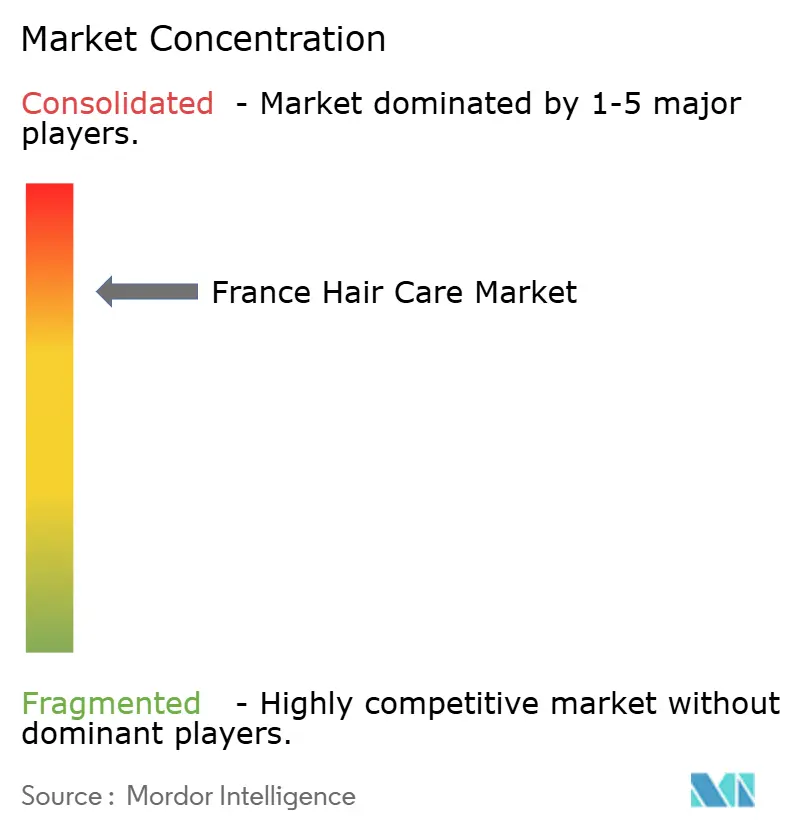
| Market Concentration | High |
Major Players *Disclaimer: Major Players sorted in no particular order Image © Mordor Intelligence. Reuse requires attribution under CC BY 4.0. | |
France Hair Care Market Analysis by Mordor Intelligence
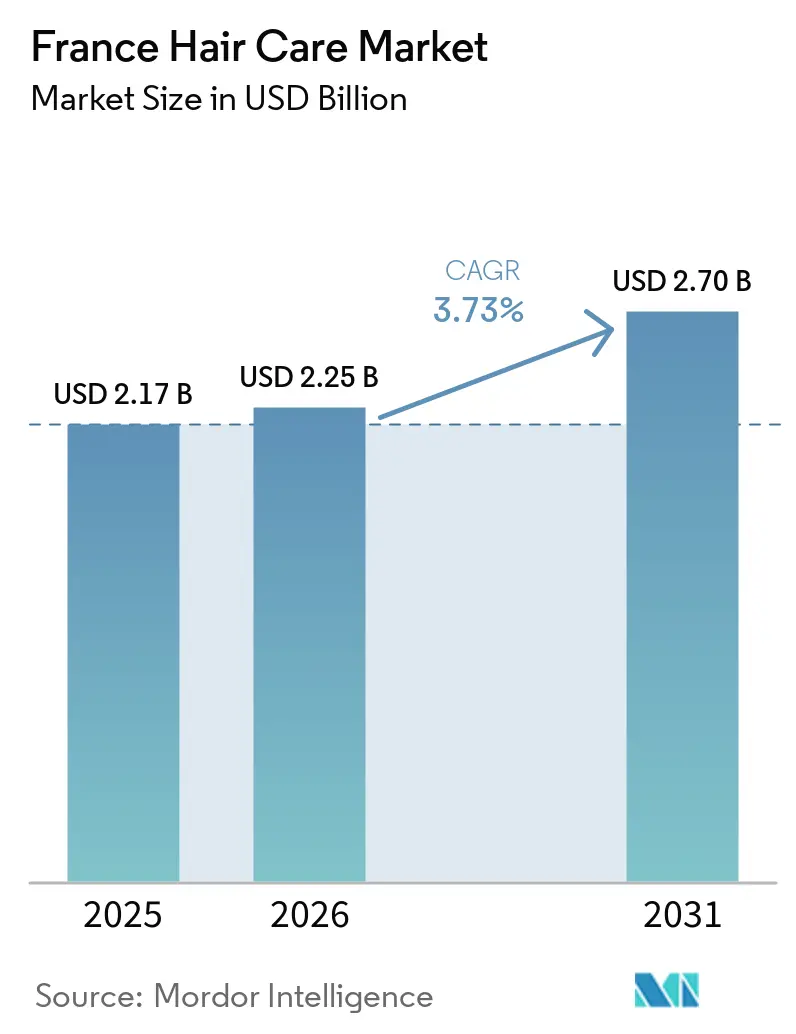
The France hair care market was valued at USD 2.17 billion in 2025 and is expected to reach USD 2.25 billion in 2026, with a projected value of USD 2.70 billion by 2031, registering a CAGR of 3.73% during the forecast period. Recognized as one of Europe's most advanced beauty markets, the French hair care industry is witnessing growth driven by premiumization and evolving consumer preferences. Five key trends are shaping the market dynamics: the shift toward premium products, rising demand for natural and organic solutions, a focus on scalp health through "skinification," the adoption of beauty-tech for personalized solutions, and sustainability initiatives influencing product formulations and packaging. Despite the increase in value sales, market growth faces challenges from cost-conscious consumers opting for home remedies and the prevalence of counterfeit products, which erode brand trust. The competitive landscape is becoming more intense as established multinational companies contend with agile indie brands that are targeting niche segments through focused innovation. Additionally, the convergence of beauty and wellness is creating new opportunities, particularly in medicated shampoos and scalp health products, which are increasingly viewed as essential by French consumers.
Key Report Takeaways
- By product type, shampoo led with 31.43% of the France hair care market share in 2025; hair styling products are projected to expand at a 4.23% CAGR through 2031.
- By category, mass products held 72.32% of the France hair care market in 2025, while premium hair care is poised for a 4.46% CAGR to 2031.
- By ingredient type, conventional/synthetic formulations accounted for 67.43% of 2025 sales; natural/organic lines are set to grow at a 4.78% CAGR through 2031.
- By distribution channel, supermarkets/hypermarkets captured 60.34% of the revenue in 2025; online retail stores are rising at a 5.03% CAGR as digital shopping gains traction.
Note: Market size and forecast figures in this report are generated using Mordor Intelligence’s proprietary estimation framework, updated with the latest available data and insights as of January 2026.
France Hair Care Market Trends and Insights
Drivers Impact Analysis*
| Driver | (~) % Impact on CAGR Forecast | Geographic Relevance | Impact Timeline |
|---|---|---|---|
| Rising demand for natural and organic formulations | +1.2% | France (strongest in major cities) | Medium term (2-4 years) |
| Growing scalp-health focus driving medicated shampoo | +0.9% | France (pharmacies and salons nationwide) | Short to medium term (1-3 years) |
| Demand for clean, sustainable, and ethical products | +0.8% | France (nation-wide; amplified by retailer pledges) | Medium term (2-4 years) |
| Technological innovations in product formulations | +0.6% | France (research and development hubs and premium salons) | Long term (3-5 years) |
| Rising popularity of premium hair care products | +0.5% | France (notably Île-de-France) | Medium term (2-4 years) |
| Increased awareness of hair damage from environmental factors | +0.30% | France (urban pollution corridors) | Medium to long term (3-6 years) |
| Source: Mordor Intelligence | |||
Rising demand for natural and organic formulations
The France hair care market is undergoing significant changes, driven by a growing consumer preference for products made with natural and organic ingredients over synthetic alternatives. This trend is primarily influenced by increased awareness of ingredient safety and a stronger emphasis on environmental sustainability. Consumers in France are paying closer attention to product labels and demanding greater transparency from brands to make informed purchasing decisions. This shift is particularly pronounced among younger consumers, who are willing to pay a premium for hair care products they consider safer, cleaner, and more environmentally friendly. In response to these evolving preferences, L’Oréal has enhanced its focus on incorporating natural ingredients and ensuring sustainable sourcing. The company's 2023 Universal Registration Document highlights its commitment to Green Sciences and sustainable innovation, demonstrating its strategic alignment with changing consumer demands in the market.
Growing scalp-health focus driving medicated shampoo
Awareness of the link between scalp health and hair quality is increasingly influencing the France hair care market. Consumers, particularly younger individuals and those experiencing hair thinning, sensitivity, or scalp irritation, are shifting their focus toward therapeutic and preventive solutions rather than purely cosmetic products. This trend, often referred to as the “skinification” of hair care, mirrors the adoption of skincare-inspired routines, including multi-step processes such as cleansing, exfoliation, and targeted treatments. Consequently, the demand for medicated shampoos and scalp-focused formulations has grown significantly. These products incorporate ingredients aimed at addressing issues like dandruff, dryness, inflammation, and hair fall, while also promoting hair growth and shine. Brands such as L’Oréal Paris, with products like Elvive Glycolic Gloss, are utilizing science-backed ingredients to cater to both scalp and hair care needs, combining functional benefits with a premium market position. This emphasis on scalp health is driving innovation, premiumization, and increased consumer investment in products that deliver tangible results, positioning medicated shampoos as one of the fastest-growing segments in the France hair care market.
Demand for clean, sustainable, and ethical products
In the France hair care market, sustainability has evolved from a selling point to a core consumer expectation. This shift is reflected in various areas, including the use of responsibly sourced ingredients, eco-friendly packaging, greener manufacturing practices, and stronger commitments to social responsibility. Groupe Rocher has set notable goals, such as reducing greenhouse gas emissions by 67% by 2030 and improving transportation operations to minimize environmental impact. The market is witnessing growing demand for eco-friendly innovations, such as solid shampoos and refillable formats, which not only reduce waste but also align with consumer preferences for convenience and sustainability. Brands like Yves Rocher are responding to this demand by introducing sulfate-free product lines made with sustainably sourced ingredients, including organic chestnut milk and algae, which cater to the growing preference for natural and environmentally friendly formulations. This transformation is largely driven by the strong environmental values of French consumers, who are among the most eco-conscious in Europe, consistently prioritizing products that align with their sustainability principles.
Technological innovations in product formulations
The France hair care market is experiencing a notable transformation, driven by technological advancements that support the creation of new product categories and enhance existing formulations. For example, L’Oréal is leading this shift by leveraging its focus on Beauty Tech and Green Sciences to deliver innovative, science-based solutions. Through its Professional Products Division, L’Oréal has launched products such as Kérastase Première and Redken Acidic Color Gloss, which provide salon-quality results at home and set new benchmarks for performance and effectiveness. A prominent trend in the market is the integration of skincare-inspired ingredients into hair care products. Ingredients such as hyaluronic acid, niacinamide, and ceramides are being incorporated to address concerns like scalp health, hydration, and barrier repair. Premium products like Kérastase Nutritive combine plant-based proteins with niacinamide to enhance both hair fiber and scalp condition, demonstrating the convergence of skincare and haircare science. Furthermore, the adoption of AI-powered personalization tools is driving additional innovation in the market. These tools enable brands to offer highly customized hair care solutions tailored to individual consumer needs, including specific scalp conditions and hair textures. This development marks a new era of precision and personalization in the hair care industry.
Restraints Impact Analysis*
| Restraint | (~) % Impact on CAGR Forecast | Geographic Relevance | Impact Timeline |
|---|---|---|---|
| Adoption of traditional at-home hair care solutions | -0.7% | France (more pronounced in rural areas) | Medium term (2-4 years) |
| Proliferation of counterfeit products | -0.5% | France (online marketplaces) | Short term (1-2 years) |
| High cost of premium hair care products | -0.4% | France (price-sensitive households) | Short to medium term (1-3 years) |
| Stringent regulations on cosmetic ingredients | -0.3% | France (European Union and national compliance) | Long term (3-5 years) |
| Source: Mordor Intelligence | |||
Adoption of traditional at-home hair care solutions
The France hair care market faces challenges from a segment of consumers, particularly older individuals and those in rural areas, who continue to prefer traditional at-home remedies over commercial products. These consumers often rely on generational knowledge and household ingredients, such as vinegar rinses, herbal infusions, and oil treatments, which directly compete with natural and organic hair care products. These remedies are perceived as cost-effective, easily accessible, and free from synthetic chemicals, making them appealing to this demographic. Although demand for natural and clean-label products is increasing, a portion of the market remains inclined toward DIY solutions, limiting the adoption of commercial alternatives. This trend poses a challenge for manufacturers aiming to expand in the natural segment, as their products must either align with or complement these traditional practices to effectively engage this consumer group. Additionally, building trust and educating these consumers on the benefits of commercial natural products may be necessary to encourage a shift in preferences.
Proliferation of counterfeit products
The France hair care market faces growing challenges from counterfeit products, which undermine consumer trust and damage brand equity, particularly in the premium segment. High-value products from luxury brands such as Kérastase and L’Oréal Professionnel are especially vulnerable, as counterfeiters exploit price differences to attract buyers. The expansion of e-commerce and social media marketplaces has exacerbated this issue, allowing counterfeiters to directly and widely access consumers. These platforms often lack stringent monitoring mechanisms, making it easier for counterfeit products to be listed and sold alongside genuine items, further confusing consumers. In addition to revenue losses, counterfeit hair care products pose significant safety concerns due to the use of unregulated ingredients and substandard manufacturing practices. Such products may contain harmful chemicals that can cause allergic reactions, skin irritation, or long-term health issues. According to the European Union Intellectual Property Office, counterfeit cosmetics and personal care products result in billions of euros in annual economic losses [1]. France, known for its luxury beauty industry, is disproportionately affected, with its reputation for high-quality products at risk. Addressing this issue requires coordinated efforts from brands, retailers, and regulatory authorities to safeguard consumers, enforce stricter regulations, and preserve market integrity.
*Our forecasts treat driver/restraint impacts as directional, not additive. The impact forecasts reflect baseline growth, mix effects, and variable interactions.
Segment Analysis
By Product Type: Shampoo Dominates While Styling Innovates
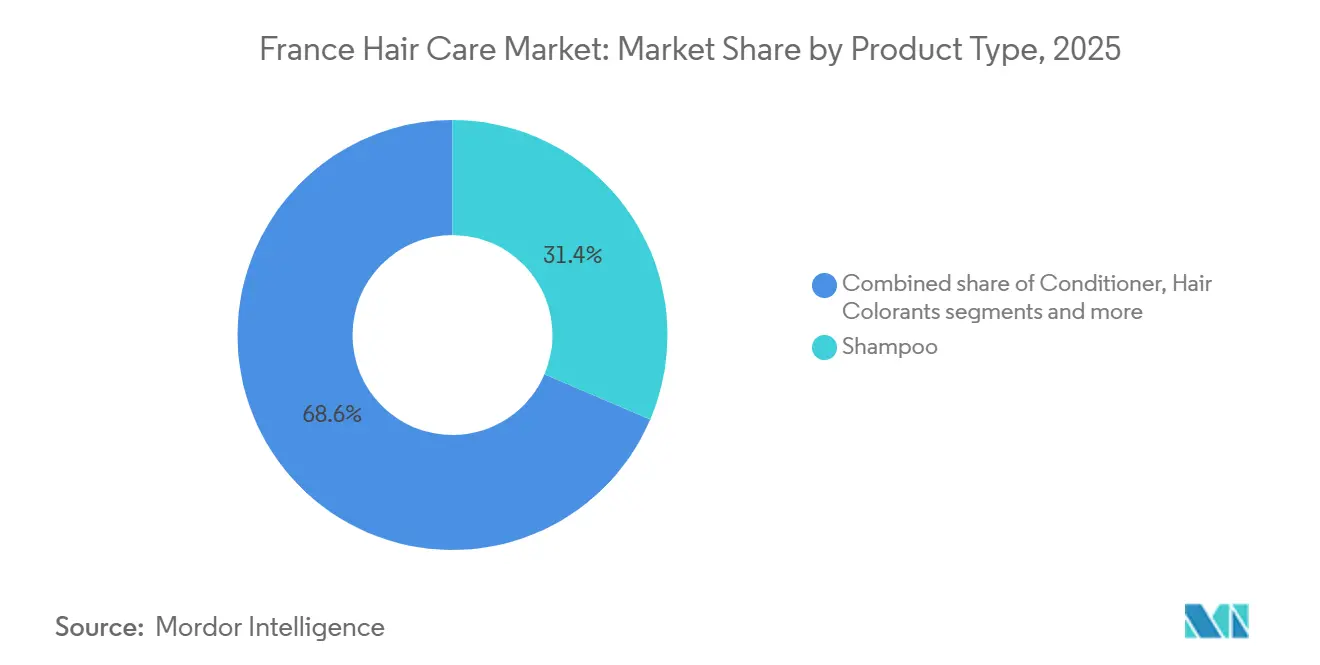
In 2025, the shampoo segment remained the largest category in the France hair care market, accounting for a 31.43% share and serving as a key component of daily hair care routines across various demographics. Its market leadership is supported by ongoing innovations in formulations, particularly in medicated, anti-dandruff, and scalp-focused shampoos, addressing consumer concerns such as hair thinning, scalp sensitivity, and overall scalp health. The segment also reflects a trend toward premiumization, with brands incorporating natural, clean-label, and sustainably sourced ingredients to align with evolving consumer preferences. Meanwhile, hair styling products are emerging as the fastest-growing segment, with a projected compound annual growth rate (CAGR) of 4.23% between 2026 and 2031. This growth is driven by technological advancements that enhance product performance, such as improved hold, reduced breakage, and enhanced natural shine and texture.
Trends like “glass hair” styles, anti-frizz treatments, and salon-inspired looks are gaining popularity, particularly among younger, fashion-conscious consumers. Leading brands, including Kérastase and L’Oréal Professionnel, are expanding their premium styling product lines with formulations inspired by skincare, combining styling benefits with nourishing and protective ingredients for the scalp and hair fibers. The segment is further benefiting from the adoption of AI-driven personalization tools, smart applicators, and multifunctional products, enabling consumers to achieve professional-quality results at home. This combination of performance, wellness, and personalization positions hair styling products as a high-growth category in the France market, complementing the established dominance of the shampoo segment.

By Category: Premium Segment Outpaces Mass Market
In 2025, mass-market products maintained their dominance in the France hair care market, representing 72.32% of the market share. However, the premium segment is anticipated to grow at a faster CAGR of 4.46% between 2026 and 2031, indicating a gradual shift in consumer preferences toward higher-quality, performance-oriented hair care products. This trend aligns with broader skincare-inspired consumer behaviors, as French consumers increasingly prioritize products that offer a combination of efficacy, innovation, and indulgence. Hair care remains a significant growth driver for major companies, for example, L’Oréal’s Consumer Products Division recorded a 12.6% like-for-like growth in 2023, highlighting the strategic importance of this segment.
The distinction between mass and premium categories is becoming less defined. Mass-market brands are introducing premiumized product lines featuring advanced formulations, innovative ingredients, and higher price points to appeal to aspirational consumers. In urban areas such as Paris, luxury hair care products are prominently showcased in specialized boutiques and department store beauty halls. These locations emphasize curated selections, immersive brand experiences, and personalized services, reinforcing the premium positioning and justifying higher price tags. This blending of accessibility and luxury is transforming competitive dynamics, as both mass-market and prestige brands aim to attract consumers who value quality, effectiveness, and experiential elements in their hair care products.
By Ingredient Type: Natural Formulations Gaining Ground
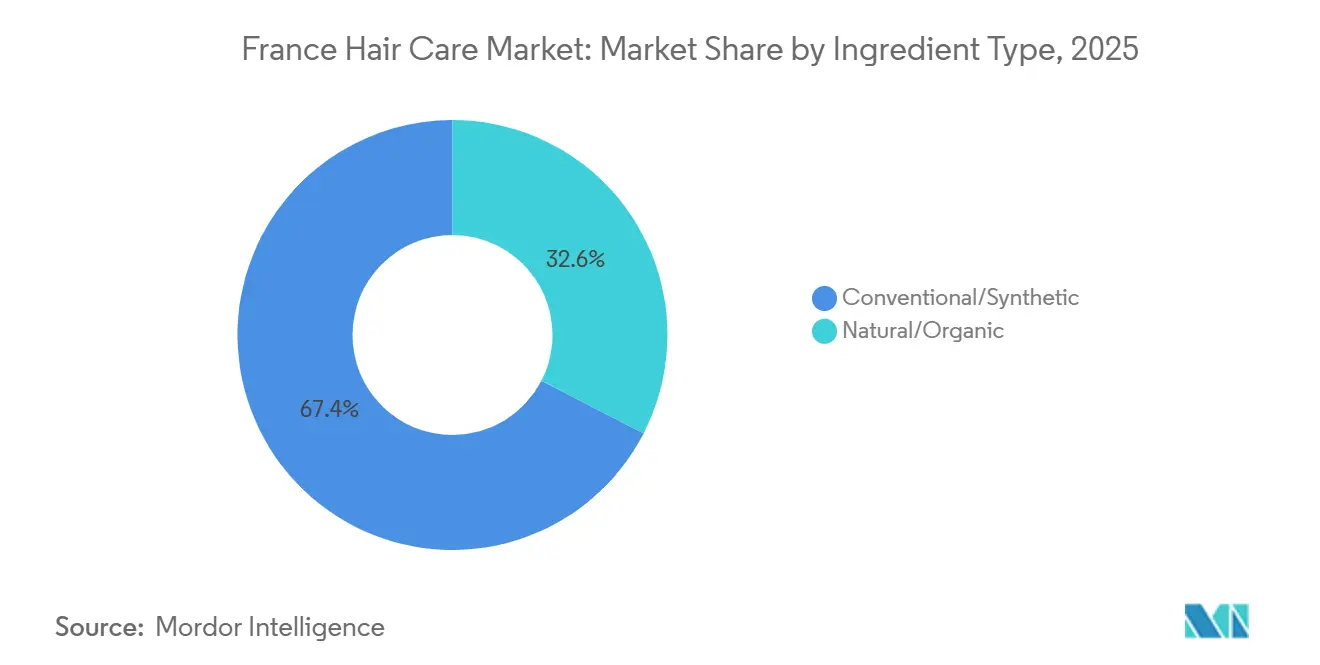
In 2025, the conventional/synthetic ingredient segment maintained its dominance in the France hair care market, accounting for a 67.43% share. However, natural/organic formulations are anticipated to grow at a higher CAGR of 4.78% from 2026 to 2031, reflecting a shift in consumer preferences toward cleaner, safer, and more environmentally sustainable products. This trend is driven by increasing awareness of ingredient safety and sustainability, with younger consumers, particularly Gen Z, playing a significant role by prioritizing eco-friendly practices in their purchasing decisions.
Industry players are actively adapting to this changing landscape. For instance, Yves Rocher introduced six new sulfate-free hair care lines in March 2023, incorporating botanical ingredients such as white lupin, ginseng, and organic chestnut milk. While natural formulations have historically struggled to match the performance of synthetic ingredients, particularly in areas like styling and hold, recent technological advancements, such as plant-based silicone alternatives and green preservatives, are addressing these challenges. These innovations are enabling brands to offer high-performance, sustainable products that meet evolving consumer demands, positioning natural and organic hair care as a rapidly growing segment in the France market.
Distribution Channel: Digital Transformation Reshapes Retail
In 2025, supermarkets/hypermarkets dominated the France hair care distribution market, accounting for a 60.34% share. This dominance is attributed to their extensive product range and convenience for everyday shoppers. However, online retail is emerging as the fastest-growing distribution channel, with a projected CAGR of 5.03% from 2026 to 2031, reflecting evolving consumer purchasing behaviors. E-commerce is already a significant contributor to sales for major players. For instance, L’Oréal reports that 27% of its global sales currently come from online channels, with plans to increase this figure to 50% in the near future. Additionally, EuroCommerce data shows that the proportion of French consumers purchasing consumer goods online, including hair care products, rose from 77% in 2020 to 83% in 2023, highlighting the growing preference for digital shopping [2].
Retailers in France are adapting to this shift by implementing omnichannel strategies, such as online ordering combined with click-and-collect services, to merge the convenience of digital shopping with the immediacy of physical stores. Specialty stores continue to hold relevance by offering curated product selections and expert guidance, particularly for premium and professional hair care lines, catering to consumers seeking personalized advice. Brands like L’Oréal are utilizing Beauty Tech innovations, such as virtual try-on tools and personalized diagnostics, to enhance in-store experiences and engage digitally savvy consumers, effectively bridging the gap between online convenience and offline expertise.
Geography Analysis
The France hair care market showcases considerable regional differences that influence product preferences and purchasing behaviors across the nation. Cities like Paris and Lyon serve as key innovation hubs where premium products and international trends are first introduced before spreading to smaller towns and rural areas. These urban markets, marked by higher disposable incomes and greater exposure to global beauty trends, act as strategic entry points for new brands and product innovations. The market's expansion is supported by France's deeply rooted beauty culture and a sophisticated consumer base that prioritizes quality and performance over price.
Variations in water hardness across different regions of France create diverse consumer requirements. In areas with harder water, there is a demand for specialized products to address issues such as mineral buildup and color fading. This has led to the development of chelating shampoos and protective treatments tailored to these specific needs. The distribution network also varies by region, with specialty and department stores being more prominent in urban areas, while supermarkets and hypermarkets dominate suburban and rural regions. For instance, the International Trade Administration reported that France had over 5,716 supermarkets in 2023 [3]. E-commerce has emerged as a vital channel, bridging geographic disparities and enabling consumers across the country to access a wider variety of products regardless of their location.
The France hair care market also benefits from the country's prominent position in the global beauty industry, with Paris acting as a trendsetting center that influences product development and marketing strategies worldwide. This status attracts significant investment in research and innovation, with leading companies like L'Oréal operating advanced research facilities in France. French consumers exhibit distinct hair care preferences, with studies indicating that individuals in France experience higher stress and reduced well-being due to damaged or dry hair compared to consumers in other countries. This has fueled strong demand for reparative and moisturizing treatments within the market.
Competitive Landscape
The France hair care market is predominantly controlled by multinational corporations and is currently undergoing a phase of high concentration. L'Oréal stands as the leading player in this market, offering a diverse range of products that span mass-market, premium, and professional categories. Alongside L'Oréal, other major companies such as Unilever, Procter & Gamble, Beiersdorf, and Pierre Fabre are intensifying their efforts to innovate and develop new products aimed at attracting and retaining a loyal consumer base. A key trend shaping the market is the increasing emphasis on premiumization, where mass-market brands are introducing upscale product lines to align with the growing consumer preference for superior-quality hair care products. This shift reflects a broader trend of consumers seeking enhanced value and performance in their hair care routines.
Within the market, niche segments addressing specific consumer needs, such as products for curly and textured hair, are emerging as highly promising areas for growth. These segments are witnessing a surge in demand, driven by a growing awareness and appreciation for tailored solutions that cater to diverse hair types. This trend has not gone unnoticed by major players, who are beginning to invest in these underserved categories. A notable example is the launch of Innovative Beauty Group's Curls Matter, which debuted in 150 Monoprix stores across France in February 2025. This development underscores the untapped potential within this segment and highlights the increasing focus on inclusivity and diversity in product offerings.
Technological advancements are playing a pivotal role in reshaping the dynamics of the French hair care market. L’Oréal has been at the forefront of this transformation, leveraging its Beauty Tech ecosystem to integrate advanced technologies such as AI diagnostics, personalized e-commerce platforms, and sustainable refillable packaging solutions. These innovations are powered by real-time consumer insights, enabling the company to streamline product development processes and deliver a more tailored and engaging customer experience. This tech-driven approach not only enhances operational efficiency but also strengthens consumer loyalty by addressing their evolving needs and preferences. In response to these advancements, other leading companies in the market are making significant investments in specialized digital platforms and forming partnerships with data science startups. These initiatives aim to accelerate innovation, improve adaptability to rapid digital changes, and maintain competitiveness in an increasingly technology-oriented market environment.
France Hair Care Industry Leaders
-
L'Oréal S.A.
-
Unilever PLC
-
Procter and Gamble Company
-
Pierre Fabre Group
-
Beiersdorf AG
- *Disclaimer: Major Players sorted in no particular order
Recent Industry Developments
- July 2026: Caudalie announced a strategic partnership with a leading French retailer to co-develop and co-brand a hair care regimen. The move signals premium scalp solutions integration into mass-market channels and broadens distribution in mainstream beauty outlets.
- March 2025: Innovative Beauty Group launched Curls Matter in France across around 150 Monoprix stores, targeting multiple curl patterns with a three-step regimen (Wash, Treat, Define). The rollout strengthened mass-premium shelf presence for textured-hair solutions and signaled broader retailer appetite for inclusive, niche-led ranges.
- February 2024: L'Oréal introduced Kérastase Première in France, positioning the line around molecular-level repair of hair structure. The launch reinforced salon-grade technology transfer into at-home routines and supported premium price architecture in a mature hair care market.
Research Methodology Framework and Report Scope
Market Definition and Coverage
For this study, the France hair care market covers consumer spend on products used to clean, condition, treat, color, and style human hair, across retail and professional channels, and measured in value terms.
Scope exclusions: We exclude electrical styling devices and prescription therapeutic products that are regulated and sold as medicines.
Segmentation Overview
- By Product Type
- Shampoo
- Conditioner
- Hair Colorants
- Hair Styling Products
- Other Product Types
- By Category
- Premium Products
- Mass Products
- By Ingredient Type
- Natural/Organic
- Conventional/Synthetic
- By Distribution Channel
- Specialty Stores
- Supermarkets/Hypermarkets
- Online Retail Stores
- Other Channels
Data Sources, Market Sizing, and Validation
Desk Research
Desk research started with mapping how hair care is sold and used in France, and then pulling the most stable public data series that can anchor demand. We referred to sources such as INSEE household consumption indicators, Eurostat price and consumer statistics, French Customs trade statistics for relevant product flows, and OECD macro and consumer indicators to set the context for spend and pricing.
To turn context into usable inputs, we also reviewed brand and retailer communications such as annual reports, investor presentations, and category updates from reputed business press, which helped us understand channel shifts and promotion intensity. Where it was important to cross-check company footprints and product activity, we used subscriptions that provide company financials and news intelligence, as well as patent databases to track innovation signals. These desk research sources are illustrative only, and many other public references were used to collect data, validate assumptions, and clarify open points.
Primary Interviews and Surveys
Primary work focused on validating what desk research cannot reliably show, especially the split between mass and professional demand and the practical price ladder across key formats. We spoke with a mix of brand-side roles, distributors and channel specialists, and salon and retail stakeholders across France to pressure-test assumptions and align on realistic volume and price movement.
Distribution of primary research fieldwork respondents
| Company type | Respondent position |
|---|---|
| Top tier: 28% | CXOs: 15% |
| Mid tier: 55% | Functional/Unit leaders: 33% |
| Smaller Players: 17% | Managers: 52% |
Market-Sizing & Forecasting
Sizing was built using a top-down and bottom-up approach, where national beauty and personal care spend indicators were reconstructed into a hair care demand pool for France and then split by channel based on observed shopping behavior and salon usage. To keep the total realistic, selective bottom-up checks were used, such as sampled price points times estimated unit movement for common formats, and supplier and channel checks that helped adjust shares when the first cut looked off.
Key inputs that shaped the model included average selling price movement by format, frequency of purchase and replenishment patterns, share of sales going through e-commerce versus physical retail, salon service activity as a proxy for professional pull-through, and inflation and disposable income trends that influence trading up or down. For forecasting, we used scenario analysis supported by macro expectations and what interviewees expect on pricing and channel mix, and then ran sensitivity checks so unusual price jumps did not overstate value growth. When bottom-up checks had gaps, the missing parts were filled using conservative ranges that were later narrowed during follow-up validation.
Data Validation & Update Cycle
Validation was done by comparing model outputs with independent signals, including consumer spend direction, channel momentum, and plausibility checks on price and mix. Outliers were flagged, reviewed, and recalculated, and follow-up calls were triggered when a key assumption could not be explained clearly.
Each deliverable goes through multi-step analyst review before sign-off, and the model logic is re-checked so changes in one input do not create hidden distortions elsewhere. Reports are refreshed annually, with interim updates when a material event affects demand, pricing, or channel structure. Before delivery, a final pass is completed so clients receive the most current view available.
Mordor Intelligence's France Hair Care Market Size Compared Against Other Published Estimates
It is normal to see different market sizes for France hair care, even when the topic name looks the same, because the counted products, channels, and price basis are not always aligned. Differences also come from how older base years get carried forward, how inflation is treated, and whether checks are done against real channel signals.
The main gap comes from whether professional salon consumption and adjacent leave-in treatments are counted together with retail shampoos and conditioners, and in Mordor Intelligence's model they are included only when the purchase is for hair-specific use and the format sits within standard hair care shelves or salon resale, which avoids mixing in devices and prescription items.
Benchmark comparison
| Source | Market Size | Gaps in Research Methodology |
|---|---|---|
| Mordor Intelligence | USD 2.07 B (2026) | |
| Industry Publisher A | USD 2.84 B (2024) | Uses an earlier base year and a broader category list that can blend premium treatment add-ons and channel totals without clearly separating salon resale from services, which can lift the value number. |
| Industry Publisher B | USD 2.33 B (2023) | Often reports from a different starting year and may apply a flatter price progression across the forecast window, which can keep the stated market value lower when inflation and mix premiumization are not fully reflected. |
The spread in published values is mostly explained by scope and price logic rather than a single right or wrong number. By keeping inclusions tied to observable hair care purchasing and then cross-checking with channel and price signals, the estimate stays traceable to clear inputs and repeatable steps.
Key Questions Answered in the Report
How large is the France hair care market in 2026?
The France hair care market size reached USD 2.25 billion in 2026 and is on track to hit USD 2.70 billion by 2031 at a 3.73% CAGR.
Which product type is growing fastest?
Hair styling products are forecast to register the fastest 4.23% CAGR through 2031, outperforming traditional cleansing segments.
What drives the shift toward natural formulations?
Consumer label scrutiny and COSMOS ORGANIC certification standards, combined with REACH restrictions on synthetics, push natural/organic SKUs to a projected 4.78% CAGR.
Which region spends most on premium hair care?
Île-de-France leads prestige consumption thanks to higher disposable incomes, dense pharmacy networks, and tourist traffic.