
Market Overview
| Study Period | 2021 - 2031 |
|---|---|
| Forecast Data Period | 2026 - 2031 |
| Base Year Market Size (2025) | USD 1.81 Billion |
| Market Size (2026) | USD 1.89 Billion |
| Market Size (2031) | USD 2.46 Billion |
| Growth Rate (2026 - 2031) | 5.45 % |
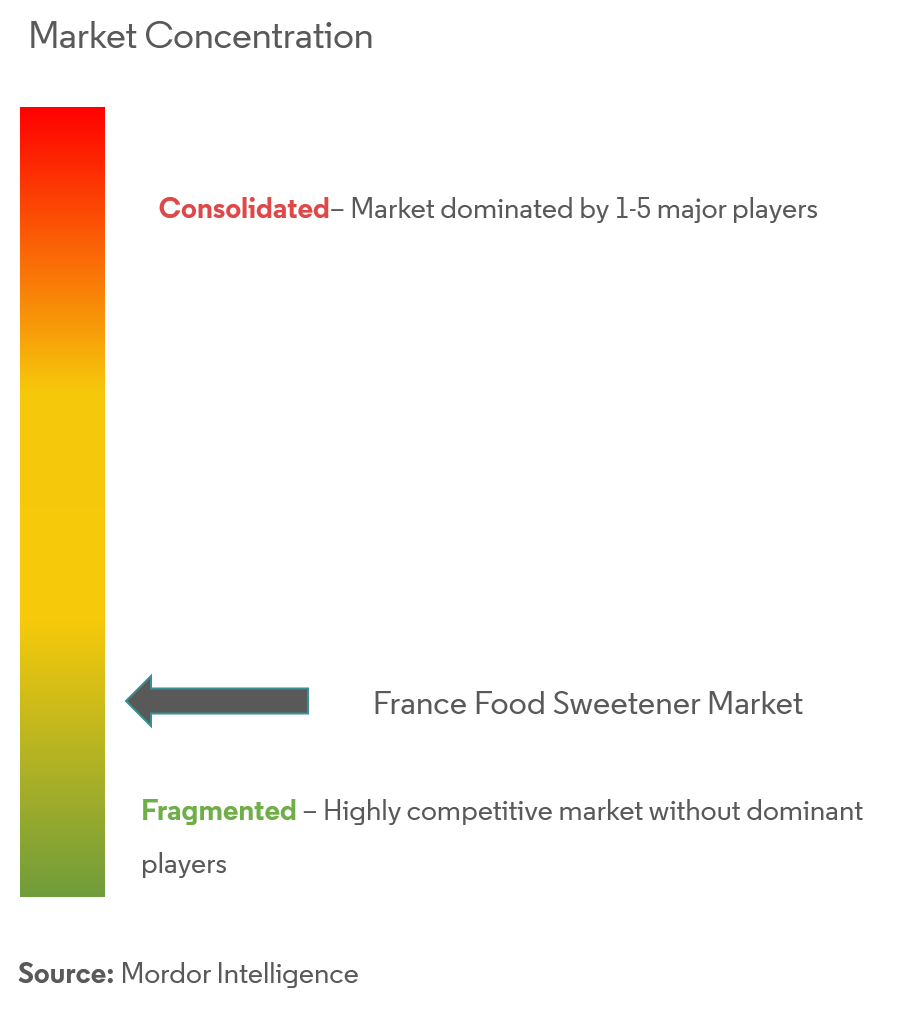
| Market Concentration | Low |
Major Players *Disclaimer: Major Players sorted in no particular order Image © Mordor Intelligence. Reuse requires attribution under CC BY 4.0. | |
France Food Sweetener Market Analysis by Mordor Intelligence
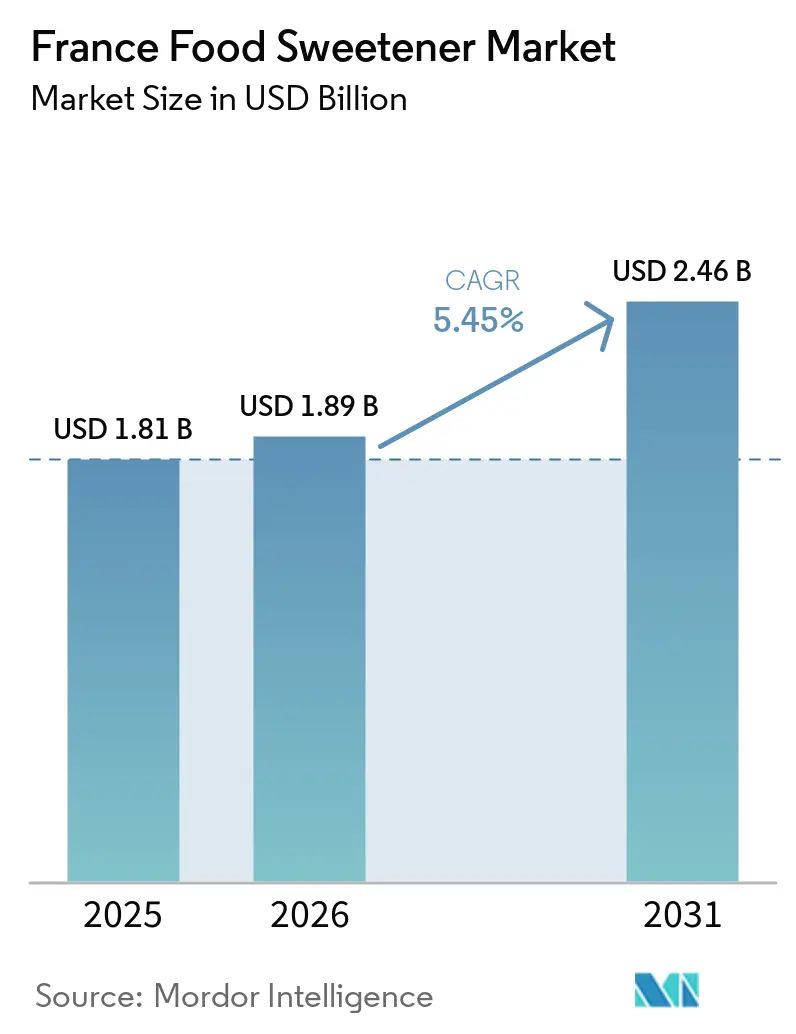
The France Food Sweetener Market size is expected to grow from USD 1.81 billion in 2025 to USD 1.89 billion in 2026, reaching USD 2.46 billion by 2031, at a CAGR of 5.45% over 2026–2031. The market is supported by the continued importance of sweetness in maintaining product palatability, flavor balance, and overall sensory quality across everyday food consumption. Demand is also shaped by the need to preserve texture, mouthfeel, stability, and flavor consistency when adjusting sugar content, as sweetness contributes to several functional properties beyond taste alone. Advances in sweetener blending, taste modulation, and ingredient optimization are helping address formulation challenges and improve the acceptability of reduced-sugar products.
Key Report Takeaways
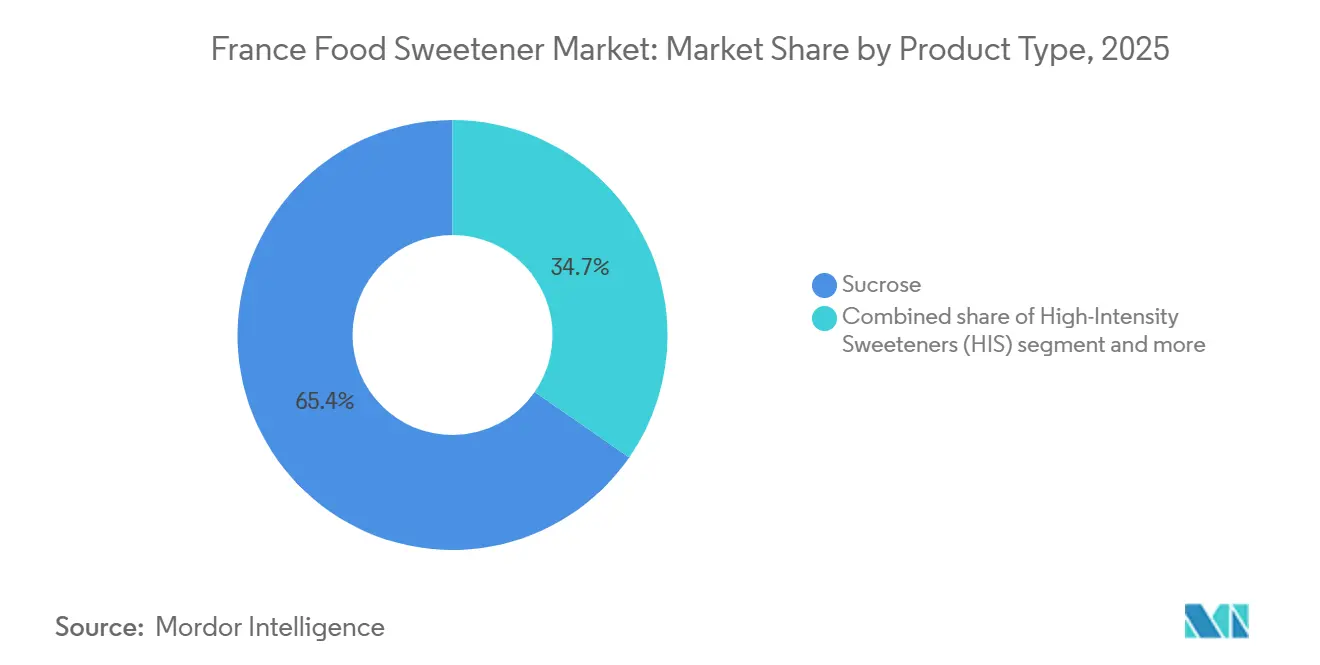
- By product type, sucrose held 65.35% of the France food sweetener market share in 2025, while high-intensity sweeteners are forecast to grow at a CAGR of 6.87% through 2031.
- By form, solid sweeteners accounted for 63.23% of the France food sweetener market share in 2025, while liquid and syrup formats are projected to expand at a CAGR of 6.71% through 2031.
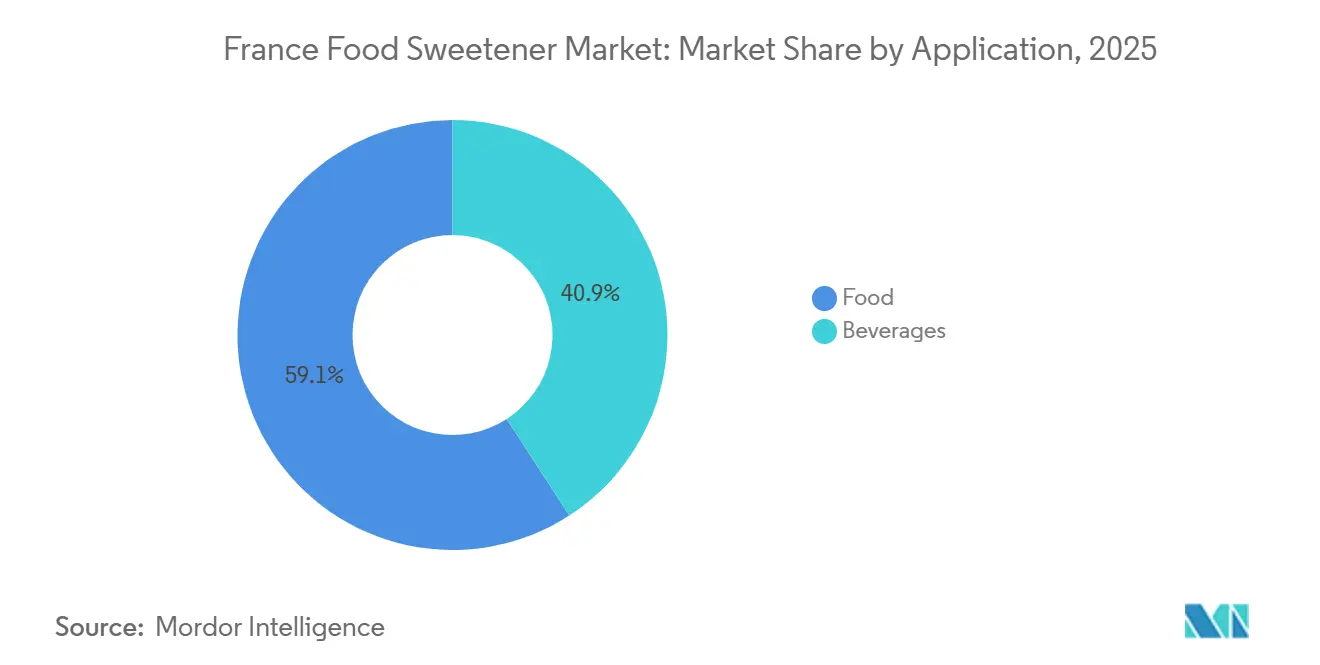
- By application, food accounted for 59.13% of the France food sweetener market size in 2025, while beverages are forecast to record the highest CAGR of 7.09% through 2031.
Note: Market size and forecast figures in this report are generated using Mordor Intelligence’s proprietary estimation framework, updated with the latest available data and insights as of January 2026.
France Food Sweetener Market Trends and Insights
Drivers Impact Analysis*
| Driver | (~) % Impact on CAGR Forecast | Geographic Relevance | Impact Timeline |
|---|---|---|---|
| Growing demand for sugar-reduced food and beverage products | +1.4% | National, concentrated in Île-de-France, Auvergne-Rhône-Alpes, and Bretagne food clusters | Short term (≤ 2 years) |
| Increasing prevalence of health-conscious food choices | +1.1% | National, with pronounced urban influence in Greater Paris and Lyon metropolitan areas | Medium term (2–4 years) |
| Growth in functional foods and clean-label product innovation | +0.8% | National, with early gains in Bretagne (dairy), Auvergne-Rhône-Alpes (nutraceuticals) | Medium term (2–4 years) |
| Technological advancements in sweetener blending | +0.7% | National, adoption across Île-de-France-based Food and Beverages companies | Long term (≥ 4 years) |
| Use of sweeteners in sports and functional nutrition products | +0.5% | National, with Paris-region and Auvergne-Rhône-Alpes specialty nutrition clusters | Medium term (2–4 years) |
| Regulatory support for reduced sugar consumption | +0.8% | National; EU-wide EFSA re-evaluation framework applies to all French operators | Short term (≤ 2 years) |
| Source: Mordor Intelligence | |||
Growing Demand for Sugar-Reduced Food and Beverage Products
Growing demand for sugar-reduced food and beverage products is supporting the expansion of the market, as food manufacturers reformulate existing products to lower sugar content while maintaining sweetness, taste, and overall product acceptability. Increasing consumer attention to sugar consumption and its association with dental health, weight management, and metabolic health is encouraging the adoption of alternative sweetening ingredients across packaged foods and beverages. Manufacturers are incorporating high-intensity sweeteners, polyols, and plant-derived sweetening ingredients into product formulations to achieve the desired sweetness with reduced sugar content. This trend is particularly relevant for product developers seeking to align formulations with France's sugar-reduction objectives and consumer demand for healthier everyday food choices.
Increasing Prevalence of Health-Conscious Food Choices
The increasing prevalence of health-conscious food choices is supporting the French Food Sweetener Market as consumers become more attentive to added-sugar intake and the nutritional composition of everyday foods and beverages. For instance, according to France Assos Santé, a French national association representing healthcare users, 92% of participants reported reducing their added-sugar consumption in 2024[1]. This highlights growing engagement with sugar-reduction practices among consumers and encourages food and beverage manufacturers to explore reformulation strategies that maintain sweetness while lowering sugar content. As a result, demand for alternative sweetening ingredients, including high-intensity sweeteners, polyols, and plant-derived sweeteners, is supported by manufacturers' efforts to meet evolving dietary preferences and develop products aligned with sugar-conscious consumption.
Growth in Functional Foods and Clean-Label Product Innovation
Growth in functional foods and clean-label product innovation is supporting the Market by increasing the relevance of sweetening ingredients that align with nutritional goals, ingredient transparency, and wellness preferences. Consumers increasingly seek products that offer benefits such as added protein, fiber, probiotics, or improved nutritional profiles without excessive sugar content. Clean-label preferences are also driving greater attention to ingredient origin, familiarity, and perceived naturalness, supporting interest in plant-derived sweeteners and alternative sweetening solutions. These trends are strengthening the role of sweeteners in developing products that balance sweetness, taste, and nutritional positioning, while demand for reduced-sugar and functional formulations is broadening the potential use of alternative sweetening ingredients across the French food market.
Technological Advancements in Sweetener Blending
Technological advancements in sweetener blending support the French food sweetener market by improving the taste quality and functionality of sugar-reduced formulations. Combining different sweeteners allows manufacturers to balance sweetness profiles more effectively, helping reduce bitterness, metallic notes, and lingering aftertastes associated with certain high-intensity sweeteners. Blending also helps achieve a more sugar-like sweetness experience while improving flavor balance and mouthfeel, making alternative sweeteners more suitable for a wider range of food and beverage applications. Advances in sensory optimization and taste-modulation techniques further support the development of sweetener combinations tailored to specific formulation requirements, strengthening the role of blended sweetening systems in France's reduced-sugar food market.
Restraints Impact Analysis*
| Restraint | (~) % Impact on CAGR Forecast | Geographic Relevance | Impact Timeline |
|---|---|---|---|
| Higher costs of natural sweeteners compared to traditional options | -1.2% | National; strongest in price-sensitive mid-market segments across all regions | Medium term (2–4 years) |
| Consumer skepticism about artificial sweetener safety | -0.9% | National, amplified in urban health-conscious markets (Paris, Lyon, Bordeaux) | Short term (≤ 2 years) |
| Unfavorable taste profiles and lingering aftertaste | -0.6% | National, particularly affects ready-to-drink beverages and dairy categories | Medium term (2–4 years) |
| Potential digestive discomfort associated with polyols | -0.4% | National, most relevant in high-volume polyol-sweetened confectionery clusters | Long term (≥ 4 years) |
| Source: Mordor Intelligence | |||
Higher Costs of Natural Sweeteners Compared to Traditional Options
Higher costs of natural sweeteners compared with conventional sugar limit their affordability and wider adoption in price-sensitive applications, constraining the growth of the Market. Sweeteners such as stevia extracts and other plant-derived alternatives incur additional expenses related to agricultural sourcing, extraction, purification, and quality standardization. These costs make natural alternatives less commercially attractive compared with established sweeteners such as sucrose, particularly in products requiring large ingredient volumes. Price differences also influence purchasing decisions, as consumers may be less willing to pay a premium for products formulated with natural sweetening ingredients.
Consumer Skepticism About Artificial Sweetener Safety
Consumer skepticism about the safety of artificial sweeteners acts as a restraint on the French Food Sweetener Market by creating uncertainty around the perceived health effects of synthetic sweetening ingredients. Concerns about potential long-term health implications, metabolic effects, and the safety of frequently consumed sweeteners make some consumers hesitant to choose products containing ingredients such as aspartame, sucralose, and saccharin. These perceptions may drive preference toward conventional sugar or sweeteners considered more natural, limiting the acceptance of certain artificial alternatives despite their regulatory approval. The European Food Safety Authority (EFSA) evaluates sweeteners for safety and establishes acceptable conditions of use; however, ongoing public debate about artificial sweeteners continues to influence consumer confidence and purchasing preferences.
*Our forecasts treat driver/restraint impacts as directional, not additive. The impact forecasts reflect baseline growth, mix effects, and variable interactions.
Segment Analysis
By Product Type: Sucrose Dominates, but HIS Reshaped by Science and Regulation
Sucrose accounted for 65.35% of the France Food Sweetener Market value in 2025, reflecting its established role as a conventional sweetening ingredient. This position is supported by its familiar taste profile, predictable performance, and broad compatibility with existing food manufacturing processes. Sucrose provides balanced sweetness, bulk, texture, and mouthfeel, making it difficult to replace entirely with high-intensity sweeteners, which deliver sweetness without replicating sugar's physical and functional properties. Sucrose also offers manufacturers a well-understood ingredient with consistent processing behavior and reliable formulation performance, helping maintain product quality across production batches.
High-intensity sweeteners (HIS) are projected to be the fastest-growing segment of the France Food Sweetener Market, registering a CAGR of 6.87% during 2026–2031. Developments in steviol glycosides are contributing to segment growth by improving ingredient production methods and broadening the range of sweetener options available for commercial formulations. For instance, in April 2025, the European Commission authorized a fermentation-produced steviol glycoside variant, E 960b, under Commission Regulation (EU) 2025/652, establishing specifications and permitted conditions of use for the ingredient. This regulatory development supports the commercial application of fermentation-derived sweeteners and encourages manufacturers to explore new ingredient options for sugar-reduced formulations.

By Form: Solid Leads on Volume, Liquid Formats Accelerate with Beverage Innovation
Solid sweeteners accounted for 63.23% of the France Food Sweetener Market value in 2025, supported by their established role in everyday sweetening and versatility across different food preparation needs. Their crystalline and powdered forms offer convenient portioning, predictable dissolution behavior, and easy incorporation into household recipes, supporting continued use in cooking, baking, and beverage preparation. Consumer familiarity with granulated sugar and powdered sweetening ingredients reinforces acceptance, while availability in different grain sizes and formats accommodates varied culinary requirements. The stability of dry ingredients under appropriate storage conditions also supports longer shelf life and convenient pantry use.
Liquid and syrup sweeteners are projected to be the fastest-growing form in the France Food Sweetener Market, registering a CAGR of 6.71% during 2026–2031. Growth is supported by increasing interest in specialty sweetening formats, including agave syrup and other naturally derived liquid alternatives, as consumers explore options that offer distinctive flavor profiles and convenient incorporation into food preparation. Syrups also provide flexibility in adjusting sweetness intensity and consistency, allowing users to customize recipes and beverages without handling or dissolving granular ingredients separately. Growing interest in premium, organic, and plant-derived sweetening products is creating opportunities for differentiated syrup varieties, while their pourable format supports convenient portioning and blending.
By Application: Food Anchors Demand, Beverages Emerge as the Innovation Frontier
The food application segment accounted for 59.13% of the France Food Sweetener Market value in 2025, supported by the widespread use of sweetening ingredients in everyday food products and their contribution to taste, texture, aroma development, and overall product acceptability. Sweeteners remain integral to established dietary habits, where sweetness plays an important role in balancing flavor profiles and maintaining consistent sensory characteristics. Their continued use is reinforced by consumer familiarity with sweet-tasting foods and the importance of sweetness in product enjoyment. At the same time, growing attention to nutritional composition is encouraging interest in reduced-sugar formulations and alternative sweetening ingredients, creating opportunities for innovation within the food application segment.
Beverages are projected to be the fastest-growing application in the France Food Sweetener Market, registering a CAGR of 7.09% during 2026–2031. The segment's growth is supported by rising demand for reduced-sugar soft drinks, functional beverages, flavored waters, and sports drinks. The sports drinks segment is gaining momentum as interest in fitness, recreational exercise, and active lifestyles increases demand for hydration and electrolyte-replenishment products. Sweeteners help balance the taste of electrolytes and other functional ingredients, supporting beverage palatability and the development of reduced-sugar formulations. According to France's National Institute of Youth and Popular Education (INJEP), 71% of people aged 15 and over practiced at least one physical or sporting activity in 2024[2]. This high level of sports participation provides relevant context for the potential expansion of sports nutrition and hydration products, although it does not directly measure sports drink consumption.
Geography Analysis
France's food sweetener market is supported by a well-established agricultural and sugar-processing industry, with sugar beet serving as the primary raw material for domestic sugar production. The country's geographic distribution of cultivation, established farming practices, and processing infrastructure help maintain a reliable supply of conventional sweeteners for food manufacturers. The industry also benefits from established connections between agricultural producers and sugar processors, supporting the availability of beet-derived sugar for a wide range of food formulation requirements.
The principal sugar beet-growing regions in mainland France are Hauts-de-France, Grand Est, Île-de-France, Normandy, Centre-Val de Loire, Bourgogne-Franche-Comté, and Pays de la Loire. These regions collectively support the country's beet sugar industry, with cultivation concentrated mainly in the northern and eastern parts of mainland France. Their established agricultural activities and proximity to processing facilities strengthen the regional supply chain, while production across multiple regions contributes to the continuity of raw material availability for the domestic sweetener industry.
According to Cultures Sucre, a French interprofessional association, during the 2024–2025 campaign, Hauts-de-France was the leading sugar beet-producing region in France, cultivating approximately 200,125 hectares, representing nearly 49% of the country's total 411,770 hectares[3]. This concentration establishes Hauts-de-France as the principal production region of France's sugar beet industry, supporting the supply of beet-derived sugar for food processing and sweetener applications.
Competitive Landscape
The French food sweetener market is fragmented, with competition spanning conventional sugar, starch-based sweeteners, polyols, and specialized sweetening solutions. Major players include Tereos SCA, Cristal Union, Roquette Frères SA, Cargill, Incorporated, and Tate & Lyle PLC. Tereos and Cristal Union benefit from established sugar beet supply chains and domestic processing operations, while Roquette, Cargill, and Tate & Lyle compete through broader ingredient portfolios and specialized sweetening capabilities. The competitive environment is shaped by product range, supply reliability, ingredient functionality, pricing, and the ability to serve diverse food formulation needs.
Companies across the market are increasingly focusing on technological innovation to improve sweetener functionality, sweetness consistency, and sensory performance. Developments in sweetener blending, taste modulation, and ingredient optimization help address challenges such as bitterness, lingering aftertaste, and reduced mouthfeel in sugar-reduced formulations. Innovation also extends to plant-derived sweeteners, polyols, and specialized carbohydrate ingredients that support different sweetness levels and formulation requirements. These capabilities enable market participants to respond to demand for reduced-sugar products while maintaining taste, texture, and product acceptability.
Competitive differentiation is also influenced by sustainability, sourcing practices, product customization, and compliance with European food safety requirements. Companies are working to improve resource efficiency, optimize agricultural and ingredient supply chains, and develop sweetening solutions that align with clean-label preferences and changing nutritional expectations. Investment in research and development, reliable ingredient availability, and partnerships across the food value chain further support competitive positioning. As food reformulation continues to shape demand, the ability to balance cost, functionality, sensory quality, and sustainability will remain important to maintaining market presence.
France Food Sweetener Industry Leaders
-
Tereos SCA
-
Cristal Union
-
Roquette Frères SA
-
Cargill, Incorporated
-
Tate & Lyle PLC
- *Disclaimer: Major Players sorted in no particular order
Recent Industry Developments
- May 2026: Tate & Lyle expanded its joint sweetener development program with BioHarvest Sciences to cover multiple plant-based sweetener molecules, following strong technical progress. The expanded scope targets naturally derived sweetening solutions for the food and beverage industry.
- September 2025: Cristal Union completed the acquisition of the Sucrerie de Nangis sugar factory in Seine-et-Marne, France, making it a wholly owned subsidiary of the cooperative group. The acquisition strengthened Cristal Union's industrial capacity and expanded its presence in the southern Paris sugar beet-growing region.
- May 2025: Tereos invested EUR 19 million at its Attin plant in Pas-de-Calais, France, to support industrial decarbonization through improvements in production efficiency and energy use. The investment was expected to reduce the plant's carbon dioxide emissions.
France Food Sweetener Market Report Scope
A food sweetener is any natural or artificial substance added to food or beverages to impart a sweet taste. The France Food Sweetener Market is segmented by product type, form, and application. Based on product type, the market is segmented into sucrose, starch sweeteners and sugar alcohols, high-intensity sweeteners (HIS), and others. Starch sweeteners and sugar alcohols are further segmented into dextrose, high-fructose corn syrup (HFCS), maltodextrin, sorbitol, xylitol, and other sugar alcohols. High-intensity sweeteners (HIS) are further segmented into sucralose, aspartame, saccharin, cyclamate, acesulfame-K, neotame, stevia, and other high-intensity sweeteners (HIS). Based on form, the market is segmented into solid and liquid/syrup. Based on application, the market is segmented into food and beverages. Food is further segmented into bakery and confectionery, dairy and desserts, meat and savory products, nutraceuticals and functional foods, sauces, dressings and spreads, and other processed foods. Beverages are further segmented into soft drinks, sports drinks, and other beverages. For each segment, the market sizing and forecast have been done based on value (in USD).
By Product Type
| Sucrose | |
| Starch Sweeteners and Sugar Alcohols | Dextrose |
| High-Fructose Corn Syrup (HFCS) | |
| Maltodextrin | |
| Sorbitol | |
| Xylitol | |
| Other Sugar Alcohols | |
| High-Intensity Sweeteners (HIS) | Sucralose |
| Aspartame | |
| Saccharin | |
| Cyclamate | |
| Acesulfame-K | |
| Neotame | |
| Stevia | |
| Other High Intensity Sweeteners (HIS) | |
| Others |
By Form
| Solid |
| Liquid/Syrup |
By Application
| Food | Bakery and Confectionery |
| Dairy and Desserts | |
| Meat and Savory Products | |
| Nutraceuticals and Functional Foods | |
| Sauces, Dressings and Spreads | |
| Other Processed Foods | |
| Beverages | Soft Drinks |
| Sport Drinks | |
| Other Beverages |
| By Product Type | Sucrose | |
| Starch Sweeteners and Sugar Alcohols | Dextrose | |
| High-Fructose Corn Syrup (HFCS) | ||
| Maltodextrin | ||
| Sorbitol | ||
| Xylitol | ||
| Other Sugar Alcohols | ||
| High-Intensity Sweeteners (HIS) | Sucralose | |
| Aspartame | ||
| Saccharin | ||
| Cyclamate | ||
| Acesulfame-K | ||
| Neotame | ||
| Stevia | ||
| Other High Intensity Sweeteners (HIS) | ||
| Others | ||
| By Form | Solid | |
| Liquid/Syrup | ||
| By Application | Food | Bakery and Confectionery |
| Dairy and Desserts | ||
| Meat and Savory Products | ||
| Nutraceuticals and Functional Foods | ||
| Sauces, Dressings and Spreads | ||
| Other Processed Foods | ||
| Beverages | Soft Drinks | |
| Sport Drinks | ||
| Other Beverages | ||
Key Questions Answered in the Report
What is the projected value of the France food sweetener market by 2031?
The France food sweetener market is projected to reach USD 2.46 billion by 2031, rising from USD 1.89 billion in 2026 at a CAGR of 5.45%.
Which product type leads food sweetener demand in France?
Sucrose leads demand, holding 65.35% share in 2025. France’s established sugar beet cultivation and processing base supports its continued use across food and beverage applications.
What is the fastest-growing sweetener category in France?
High-intensity sweeteners are the fastest-growing product category, with a projected CAGR of 6.87% through 2031. Plant-derived alternatives are gaining attention as manufacturers seek lower-sugar formulations.
What factors could limit adoption of alternative sweeteners in France?
Higher costs for natural sweeteners, consumer concerns about artificial sweeteners, unfavorable taste profiles, and digestive concerns associated with polyols may constrain wider adoption.