
Market Overview
| Study Period | 2021 - 2031 |
|---|---|
| Forecast Data Period | 2026 - 2031 |
| Base Year Market Size (2025) | USD 137.25 Million |
| Market Size (2026) | USD 142.36 Million |
| Market Size (2031) | USD 171.71 Million |
| Growth Rate (2026 - 2031) | 3.82 % |
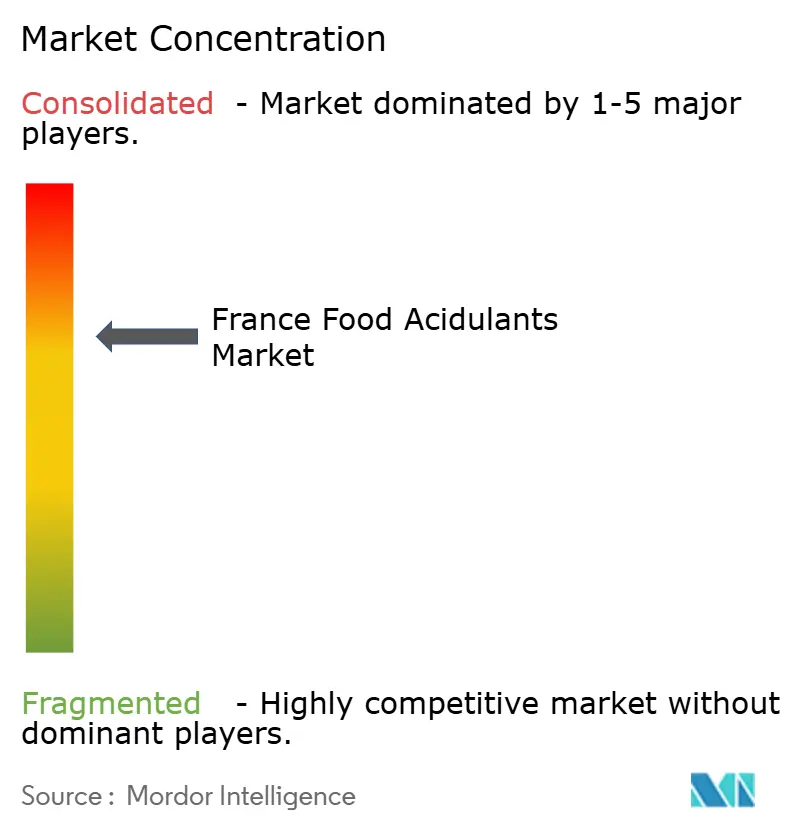
| Market Concentration | Medium |
Major Players *Disclaimer: Major Players sorted in no particular order Image © Mordor Intelligence. Reuse requires attribution under CC BY 4.0. | |
France Food Acidulants Market Analysis by Mordor Intelligence
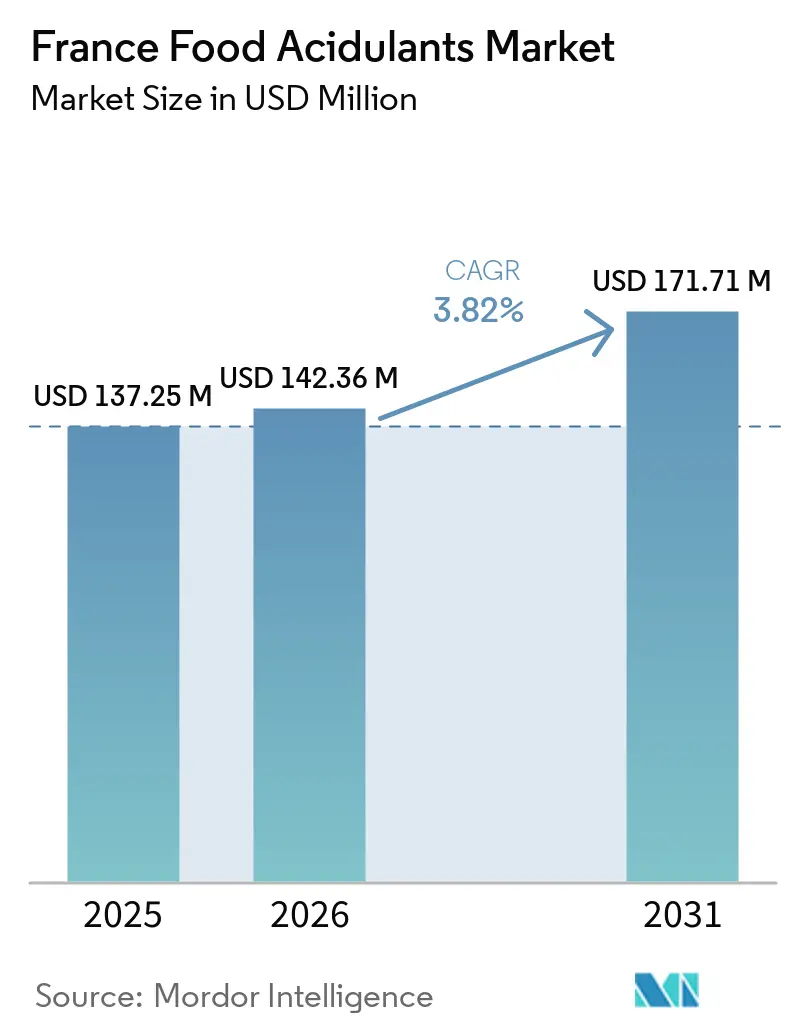
The France food acidulants market size is expected to increase from USD 142.36 million in 2026 to USD 171.71 million by 2031, growing at a CAGR of 3.82% over 2026-2031. The market is moving toward fermentation-derived ingredients as food producers seek clearer ingredient declarations and more traceable supply arrangements. Domestic capacity is becoming more relevant after AFYREN began continuous production at its NEOXY biorefinery in 2025, although imported citric and phosphoric acid still support a large share of French food manufacturing requirements. Demand is supported by the need to manage acidity, flavor, microbial stability, and shelf life in processed foods. Suppliers are responding with application support, traceability records, and tailored ingredient systems rather than competing only on bulk pricing. The France food acidulants market also faces pressure from strict additive rules, alternative preservation technologies, and feedstock costs, which makes regulatory readiness and dependable sourcing important competitive factors[1].
Key Report Takeaways
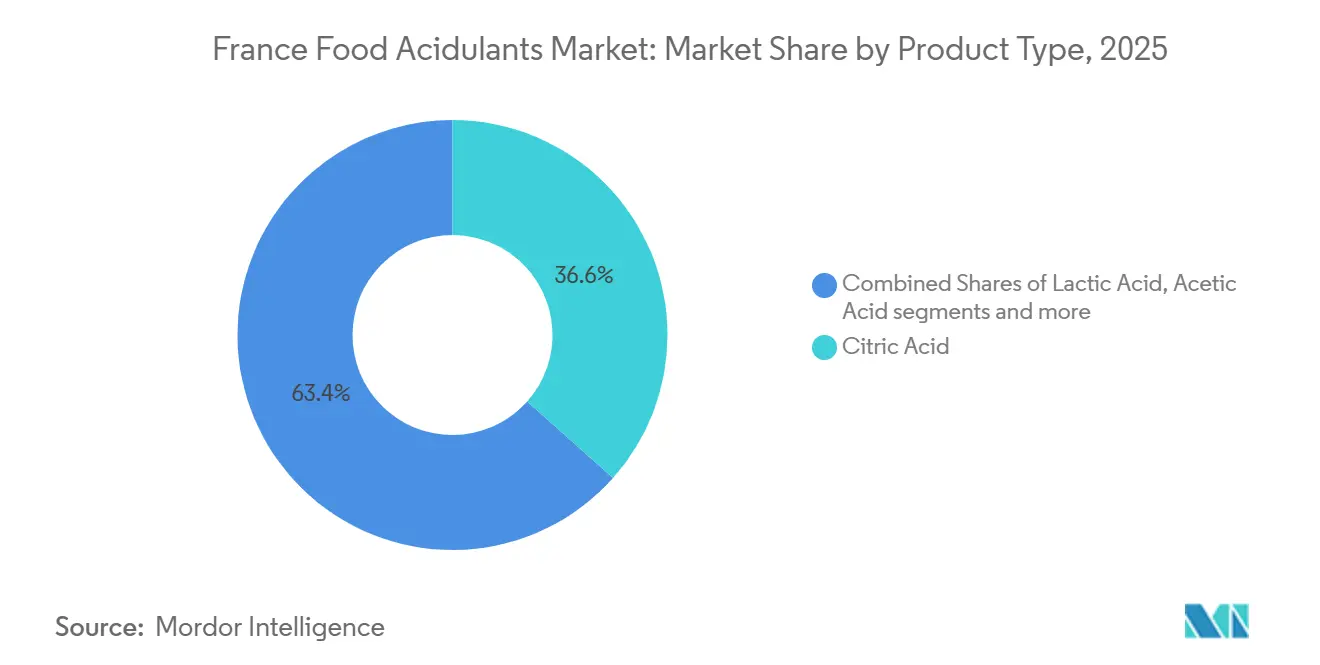
- By product type, citric acid held 36.58% of the France food acidulants market share in 2025, while acetic acid is forecast to grow at a 5.55% CAGR through 2031.
- By source, bio-based and fermentation-derived acids accounted for 56.48% of the France food acidulants market size in 2025 and are forecast to expand at a 5.82% CAGR through 2031.
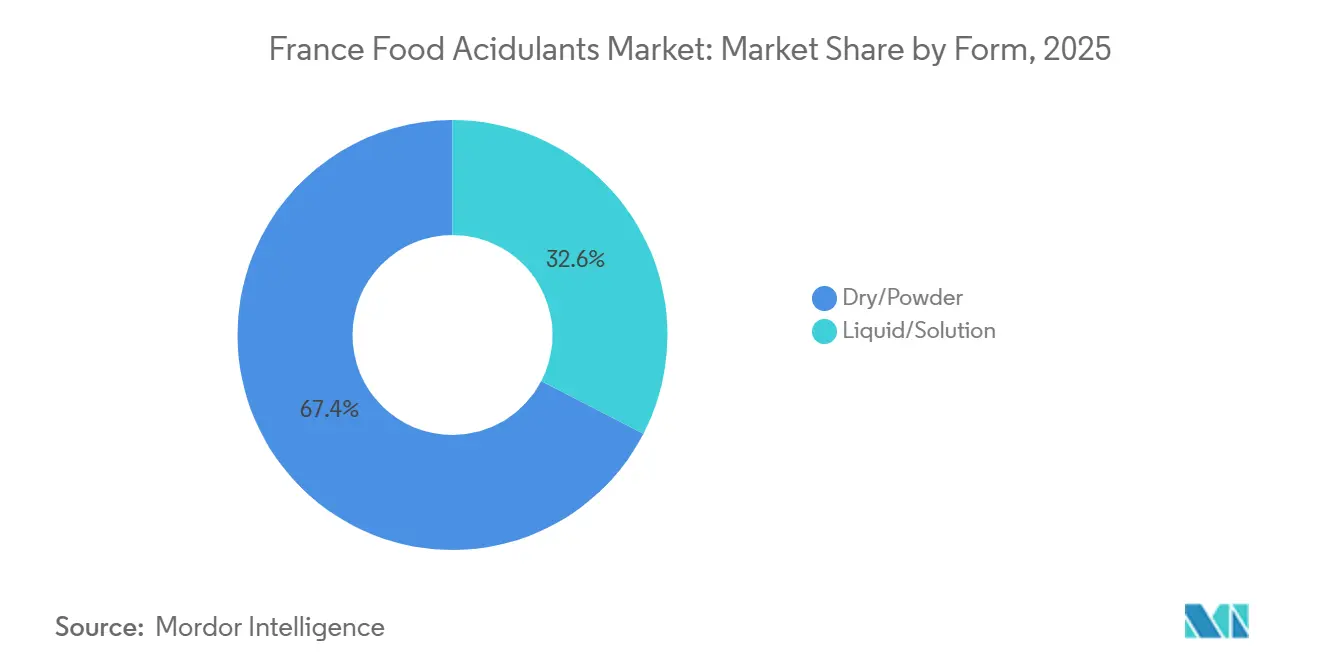
- By form, dry and powder products held a 67.40% share in 2025, while liquid and solution products are forecast to grow at a 6.15% CAGR through 2031.
- By application, beverages accounted for a 36.24% share in 2025, while bakery and confectionery are forecast to grow at a 6.57% CAGR through 2031.
Note: Market size and forecast figures in this report are generated using Mordor Intelligence’s proprietary estimation framework, updated with the latest available data and insights as of January 2026.
France Food Acidulants Market Trends and Insights
Drivers Impact Analysis*
| Driver | (~) % Impact on CAGR Forecasts | Geographic Relevance | Impact Timeline |
|---|---|---|---|
| Increasing demand for natural and bio-based ingredients | +0.8% | France-wide, concentrated in Grand Est and Normandy food processing corridors | Medium term (2-4 years) |
| Expanding bakery and confectionery applications | +0.6% | National, with early gains in Île-de-France, Auvergne-Rhône-Alpes, and Nouvelle-Aquitaine | Short term (≤ 2 years) |
| Increasing demand for clean-label food formulations | +0.5% | National, with the strongest relevance in retail-oriented urban markets and mass-market brand reformulations | Short term (≤ 2 years) |
| Growing focus on food safety and shelf-life management | +0.4% | National, with relevance for EU export markets served by French processors | Medium term (2-4 years) |
| Increasing use of acidulants in sauces, dressings, and condiments | +0.3% | National, with relevance for food service and private-label sauce manufacturing clusters | Medium term (2-4 years) |
| Technological advancements in fermentation and acidulant production | +0.3% | France-wide, led by Grand Est biorefinery investment and EU research programs | Long term (≥ 4 years) |
| Source: Mordor Intelligence | |||
Increasing Demand for Natural and Bio-Based Ingredients
French food processors are revising ingredient specifications to reduce the use of petrochemical-derived inputs. This change supports demand for certified bio-based acidulants with clear origin information. AFYREN confirmed continuous industrial production at its NEOXY biorefinery in Carling-Saint-Avold in June 2025. The company reported several hundred tonnes of bio-based organic acid production and more than EUR 165 million in committed multiyear customer revenue across food, cosmetics, and pharmaceutical applications. The April 2025 completion of the AFTERBIOCHEM project also established a reference point for domestic production using agricultural by-products. The France food acidulants market benefits when large buyers place longer-term contracts for bio-based materials instead of relying only on spot purchasing.
Expanding Bakery and Confectionery Applications
Acidulants play a critical role in baked products by supporting leavening control, improving dough conditioning, balancing flavor profiles, and helping manage shelf life. France’s bakery sector generated more than EUR 17.2 billion in turnover in 2025 and recorded 5.85% growth on a rolling-year basis, reflecting continued demand across industrial and artisanal bakery formats. Large industrial baking facilities increasingly adopt liquid lactic acid systems, as these systems integrate effectively with automated processing lines and enable more consistent dosing during high-volume production. In contrast, independent bakeries and confectioners continue to favor powdered citric acid because it offers convenient storage, simple handling, and precise manual dosing. This variation in purchasing preferences across customer segments creates an advantage for suppliers that can provide both liquid and dry acidulant products through a single commercial relationship.
Increasing Demand for Clean-Label Food Formulations
French food companies are seeking ingredient lists that consumers can understand without technical explanations. Fermentation-origin acetic acid can replace some synthetic acetate systems in charcuterie products. Citric acid produced through fermentation also fits premium beverage reformulations where producers want a familiar ingredient declaration. NATCOL describes definitions used for natural-origin food color ingredients, which reflects the wider importance of processing route and ingredient origin in labeling discussions. Retail customers and large food brands are giving more attention to traceability and recognizable ingredients. The France food acidulants market is therefore gaining demand for products that offer both acidulation performance and documentation on source materials.
Growing Focus on Food Safety and Shelf-Life Management
Acidulants are used in preservation strategies for ambient and chilled foods because they help control pH. Food processors use them while reducing thermal processing intensity to protect sensory and nutritional qualities. EFSA continues to evaluate food additives that were authorized before 2009, which increases the value of well-documented ingredients with established safety information[2]. Citric acid and lactic acid are supported by extensive safety documentation and established food uses. Research published in 2025 found that pH reduction combined with high-pressure processing can support microbial safety in cheese production. This operating environment favors suppliers that can provide stable specifications, technical records, and dependable quality controls.
Restraints Impact Analysis*
| Restraint | (~) % Impact on CAGR Forecasts | Geographic Relevance | Impact Timeline |
|---|---|---|---|
| Stringent food additive regulations and compliance requirements | -0.5% | National, as EU harmonization applies to French food manufacturers | Medium term (2-4 years) |
| Competition from alternative acidity regulators and preservation methods | -0.4% | National, with the greatest relevance in premium dairy, plant-based, and organic-certified segments | Medium term (2-4 years) |
| Dependence on imported acidulants and supply chain disruptions | -0.3% | National, with heightened exposure in citric acid and phosphoric acid sourcing | Short term (≤ 2 years) |
| Volatility in raw material and feedstock prices | -0.3% | National, with sugar beet and corn feedstock exposure concentrated in Grand Est | Short term (≤ 2 years) |
| Source: Mordor Intelligence | |||
Stringent Food Additive Regulations and Compliance Requirements
EU food additive regulations require prior authorization and establish specific conditions of use for every approved additive, including the food categories in which the additive may be used and the applicable usage limits. In France, the Directorate General for Competition Policy, Consumer Affairs and Fraud Control (DGCCRF) enforces these EU requirements. Suppliers must therefore maintain robust documentation covering product specifications, safety assessments, purity criteria, intended applications, and compliance with permitted food categories. EFSA updated its guidance on food additive applications in January 2026, further emphasizing the need for complete, scientifically substantiated technical and safety dossiers. The updated application process may increase regulatory and documentation requirements for suppliers seeking approval for novel acid types or modified acidulant blends. Smaller suppliers, in particular, may face challenges in funding the technical studies, safety assessments, and regulatory submissions required to support such products.
Competition from Alternative Acidity Regulators and Preservation Methods
High-pressure processing, pulsed electric fields, and protective microbial cultures can reduce the need for conventional acidulants in selected products. These approaches are most relevant to premium chilled foods where brand owners seek products without certain additive declarations. A 2025 scientific review reported that high-pressure processing, plant extracts, and protective cultures can support microbial safety in cheese[3]. Equipment costs limit immediate adoption among small and artisanal producers. Plant-based dairy and organic food brands are more likely to test these systems because clean-label positioning is central to their value proposition. The France food acidulants market may lose demand in specific premium applications when these technologies replace acidity regulators rather than complement them.
*Our forecasts treat driver/restraint impacts as directional, not additive. The impact forecasts reflect baseline growth, mix effects, and variable interactions.
Segment Analysis
By Product Type: Citric Acid Leads While Acetic Acid Has the Fastest Growth
Citric acid held 36.58% of the France food acidulants market share by product type in 2025. It remains widely used in soft drinks, confectionery glazes, jams, processed sauces, and dairy products. Its role as both a flavoring ingredient and a chelating agent supports this leading position. Citric acid also benefits from long-standing use in recipes where manufacturers value predictable acidity and broad regulatory familiarity. Phosphoric acid remains relevant to cola-style beverages, though reformulation pressure is affecting some beverage applications. Lactic acid is gaining relevance in plant-based dairy analogues, while tartaric acid and glucono-delta-lactone continue to serve specialized applications.
Acetic acid is forecast to grow at a 5.55% CAGR from 2026 to 2031. Its use in vinegar-based acidulation fits charcuterie products, ready sauces, and selected functional beverage formats. French consumers are familiar with vinegar, which gives acetic acid a recognizable role on ingredient labels. This familiarity helps manufacturers reformulate products without losing their expected acidity profile. ICL Group announced an agreement to acquire Bartek Ingredients in December 2025, bringing malic and fumaric acid capabilities into its specialty ingredient portfolio. The transaction reflects continued interest in specialty organic acids used by bakery, confectionery, and beverage producers.

By Source: Bio-Based Acids Become the Preferred Procurement Route
Bio-based and fermentation-derived acids accounted for 56.48% of the France food acidulants market size by source in 2025. The same source category is forecast to advance at a 5.82% CAGR through 2031. Food manufacturers are seeking materials with traceable raw materials, lower reliance on petrochemical routes, and clear supporting documentation. AFYREN reported more than EUR 165 million in committed customer revenue related to its bio-based organic acid platform. This supports the view that established buyers are placing longer-term orders for fermentation-derived supply. The segment’s expansion is also supported by French and EU interest in industrial bioeconomy projects.
Chemically synthesized acids continue to serve bulk applications where price and consistent availability are the main purchasing considerations. These products remain important where manufacturers use established high-volume recipes. However, their position is narrowing in applications that place a premium on fermentation origin and transparency. Corbion presented its BRIGHT 2030 strategy in November 2025, with natural preservation and fermentation capacity among its priorities. This demonstrates that established suppliers are placing greater emphasis on bio-based preservation systems. The France food acidulants industry is consequently seeing competition based on origin, traceability, and formulation support as well as price.
By Form: Dry Products Lead While Liquids Add Growth
Dry and powder products held 67.40% of the France food acidulants market by form in 2025. Their leading position is supported by storage stability, straightforward logistics, and flexible dosing. Independent bakeries, confectioners, and small-to-medium food processors use powders because they fit existing handling practices. Powder citric acid remains important for applications where operators add ingredients in batches. These products can also be distributed widely without the handling requirements associated with bulk liquid systems. Their continued use provides a stable demand base across decentralized food production locations.
Liquid and solution products are forecast to grow at a 6.15% CAGR from 2026 to 2031. Industrial food facilities use liquid systems with automated inline pH dosing equipment. These systems can support accurate acid delivery and documented quality controls. Liquid formats can reduce powder-dusting issues and limit waste caused by over-acidulation. Their growth is concentrated in larger processing accounts that can invest in automated production lines. The France food acidulants market is therefore divided between stable powder demand among smaller operators and faster value growth in liquid systems used by industrial producers.
By Application: Beverages Lead While Bakery and Confectionery Expands Faster
Beverages accounted for a 36.24% share of applications in 2025. Citric and phosphoric acids remain important in carbonated soft drinks, flavored waters, and functional beverages. These acids influence flavor balance and help producers achieve a consistent pH profile. Beverage manufacturers also require reliable acid quality because production lines operate at high throughput. Demand is linked to established consumption patterns and familiar product formats. The segment continues to provide a baseline volume outlet for major food acidulants.
Bakery and confectionery is forecast to register a 6.57% CAGR through 2031, the fastest application growth in the France food acidulants market. Acidulants support dough conditioning, leavening control, flavor adjustment, and shelf-life extension. France’s bakery sector has a large commercial base, supporting both artisanal and industrial product demand. Dairy and frozen desserts remain significant applications for lactic acid, especially in yogurt and plant-based cream cheese. Meat and seafood products use vinegar-based marinades to support chilled shelf life, while sauces and condiments follow the wider shift toward acetic acid systems. Infant and clinical nutrition remain smaller-volume applications that require demanding traceability and safety documentation.
Geography Analysis
The France food acidulants market is growing, supported by food manufacturing demand across several regional production clusters. Grand Est is important because it combines sugar-beet processing infrastructure with AFYREN’s NEOXY biorefinery in Carling-Saint-Avold. Île-de-France is a procurement and distribution center, while Auvergne-Rhône-Alpes has a material bakery and dairy manufacturing presence. France also operates within a wider European supply network for organic acid production and food ingredient distribution. EU additive rules apply nationally, creating a single regulatory framework for suppliers serving French manufacturers.
Regional demand varies according to local food processing activity. Normandy and Pays de la Loire generate demand for lactic and malic acids through dairy cooperatives and cider production. Nouvelle-Aquitaine links bakery activity with wine-related processing, where tartaric acid from wine by-products can support circular sourcing. Provence-Alpes-Côte d’Azur uses citric and lactic acids in olive-based sauces, tapenade, and tomato products. The France food acidulants market benefits from suppliers that can serve these different applications without requiring separate product platforms for every local need.
The France food acidulants market remains exposed to international supply disruption because it imports important acid grades. Citric acid imports and beverage-grade phosphoric acid sourcing can be affected by freight availability and geopolitical conditions. The 2024 Red Sea disruption highlighted the importance of resilient logistics planning for food ingredient buyers. The AFTERBIOCHEM project demonstrated a domestic biorefinery model that can support greater supply resilience for selected organic acids.
Competitive Landscape
Pan-European suppliers with fermentation capability, regulatory documentation, and established food customer relationships lead competition in the French food acidulants market. Commodity exporters and specialty distributors compete most directly in standardized acid grades. Leading companies are moving beyond bulk sales toward application-specific blends and technical support. Suppliers also compete on food safety records, traceability, and continuity of supply.
Corbion’s BRIGHT 2030 strategy prioritizes natural preservation and fermentation capacity, showing its focus on bio-based food ingredient systems. Tate & Lyle reported USD 30 million in run-rate cost synergies from the CP Kelco integration in March 2025. ICL Group’s planned acquisition of Bartek Ingredients would expand its portfolio of malic and fumaric acids for food applications. These moves show how larger suppliers are expanding ingredient breadth and production scale. AFYREN offers a domestic bio-based alternative through its Carling-Saint-Avold operation and confirmed customer commitments.
The strongest commercial opening is in blends designed for bakery products and clean-label sauces. Commodity suppliers may not provide the technical customization needed for these applications. Pure distributors may also have limited ability to offer formulation development and long-term sourcing assurance. Chinese suppliers remain competitive in standardized grades, while some French multinational buyers are placing greater weight on supply chain sustainability review. Jungbunzlauer announced the acquisition of a manufacturing site in Thomson, Illinois, in August 2026, establishing a direct U.S. manufacturing presence
France Food Acidulants Industry Leaders
-
Tate & Lyle PLC
-
Corbion N.V.
-
Jungbunzlauer Holding AG
-
Merck KGaA
-
Brenntag AG
- *Disclaimer: Major Players sorted in no particular order
Recent Industry Developments
- September 2026: European Commission initiated an interim review of anti-dumping measures on citric acid and trisodium citrate dihydrate originating in China. The review followed a request from Jungbunzlauer Austria and Citribel, representing EU citric acid producers.
- January 2025: Brenntag Pharma extended its distribution partnership with Citribel to include Turkey, Israel, and South Africa. The existing collaboration already covered France, Germany, Spain, and the Benelux region.
- November 2024: Jungbunzlauer partnered with the Technical University of Vienna's Christian Doppler Laboratory to improve citric acid production by selecting and refining naturally efficient fungal strains. The research aims to improve production yields and sustainability.
France Food Acidulants Market Report Scope
The France food acidulants market is segmented by product type, source, form, and application. By product type, the market includes citric acid, lactic acid, acetic acid, phosphoric acid, malic acid, fumaric acid, succinic acid, tartaric acid, and other acidulants, such as glucono delta-lactone (GDL) and gluconic acid. By source, the market is divided into bio-based or fermentation-derived acidulants and chemically synthesized acidulants. By form, the market comprises dry or powder and liquid or solution acidulants. By application, the market covers beverages, dairy and frozen desserts, bakery and confectionery, meat and seafood, sauces, dressings and condiments, infant and clinical nutrition, and other processed foods.
By Product Type
| Citric Acid |
| Lactic Acid |
| Acetic Acid |
| Phosphoric Acid |
| Malic Acid |
| Fumaric Acid |
| Succinic Acid |
| Tartaric Acid |
| Others (GDL, Gluconic, etc.) |
By Source
| Bio-based / Fermentation-derived |
| Chemically Synthesized |
By Form
| Dry/Powder |
| Liquid/Solution |
By Application
| Beverages |
| Dairy and Frozen Desserts |
| Bakery and Confectionery |
| Meat and Seafood |
| Sauces, Dressings and Condiments |
| Infant and Clinical Nutrition |
| Other Processed Foods |
| By Product Type | Citric Acid |
| Lactic Acid | |
| Acetic Acid | |
| Phosphoric Acid | |
| Malic Acid | |
| Fumaric Acid | |
| Succinic Acid | |
| Tartaric Acid | |
| Others (GDL, Gluconic, etc.) | |
| By Source | Bio-based / Fermentation-derived |
| Chemically Synthesized | |
| By Form | Dry/Powder |
| Liquid/Solution | |
| By Application | Beverages |
| Dairy and Frozen Desserts | |
| Bakery and Confectionery | |
| Meat and Seafood | |
| Sauces, Dressings and Condiments | |
| Infant and Clinical Nutrition | |
| Other Processed Foods |
Key Questions Answered in the Report
What is the projected value of the France food acidulants sector by 2031?
The France food acidulants market is forecast to reach USD 171.71 million by 2031, from USD 142.36 million in 2026, at a 3.82% CAGR.
Which product type leads food acidulant demand in France?
Citric acid leads by product type with a 36.58% share in 2025, supported by use in beverages, confectionery, sauces, and dairy products.
Which source category is growing fastest in France?
Bio-based and fermentation-derived acids are forecast to grow at a 5.82% CAGR through 2031 and held a 56.48% share in 2025.
Why are liquid acidulant products growing faster than powders?
Liquid and solution products are forecast to grow at a 6.15% CAGR because industrial facilities use them in automated inline pH dosing systems.