
Market Overview
| Study Period | 2020 - 2031 |
|---|---|
| Forecast Data Period | 2026 - 2031 |
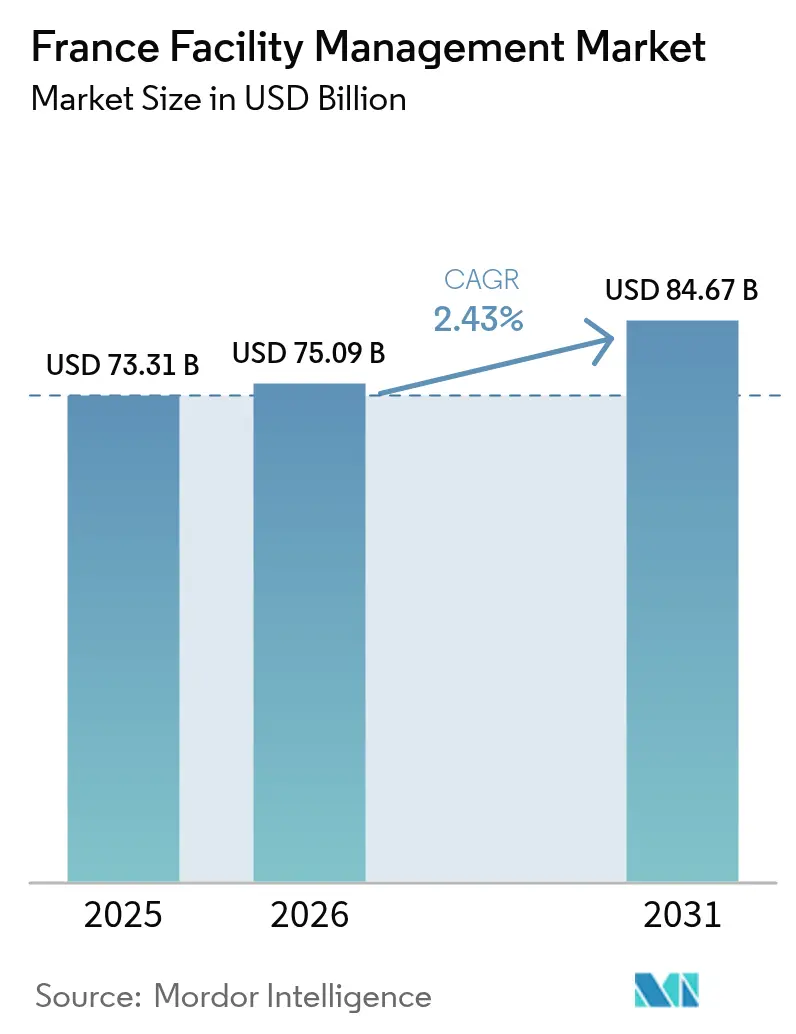
| Base Year Market Size (2025) | USD 73.31 Billion |
| Market Size (2026) | USD 75.09 Billion |
| Market Size (2031) | USD 84.67 Billion |
| Growth Rate (2026 - 2031) | 2.43 % |
| Market Concentration | Medium |
Major Players *Disclaimer: Major Players sorted in no particular order Image © Mordor Intelligence. Reuse requires attribution under CC BY 4.0. | |
France Facility Management Market Analysis by Mordor Intelligence
The France facility management market size was valued at USD 73.31 billion in 2025 and is estimated to grow from USD 75.09 billion in 2026 to reach USD 84.67 billion by 2031, at a CAGR of 2.43% during the forecast period (2026-2031). Demand is shifting toward bundled and integrated contracts as the Tertiary Decree’s 40% energy-reduction mandate, the 2026 Energy Performance Certificate (EPC) enforcement, and the Building Automation and Control Systems Decree reshape compliance obligations. Persistent labor shortages, especially for HVAC and multi-technical trades, are accelerating investment in IoT sensors, predictive maintenance, and digital dashboards that let providers deliver more output with fewer technicians. Price pressure is easing as inflation moderates, yet fixed-price contracts must now factor in future carbon costs ahead of the EU ETS2 launch in 2027. Consolidation is evident after ONET acquired ISS France operations in 2024, while global players such as Sodexo, VINCI Facilities, and Veolia leverage scale, self-delivery, and data analytics to guard margins in the France facility management market.
Key Report Takeaways
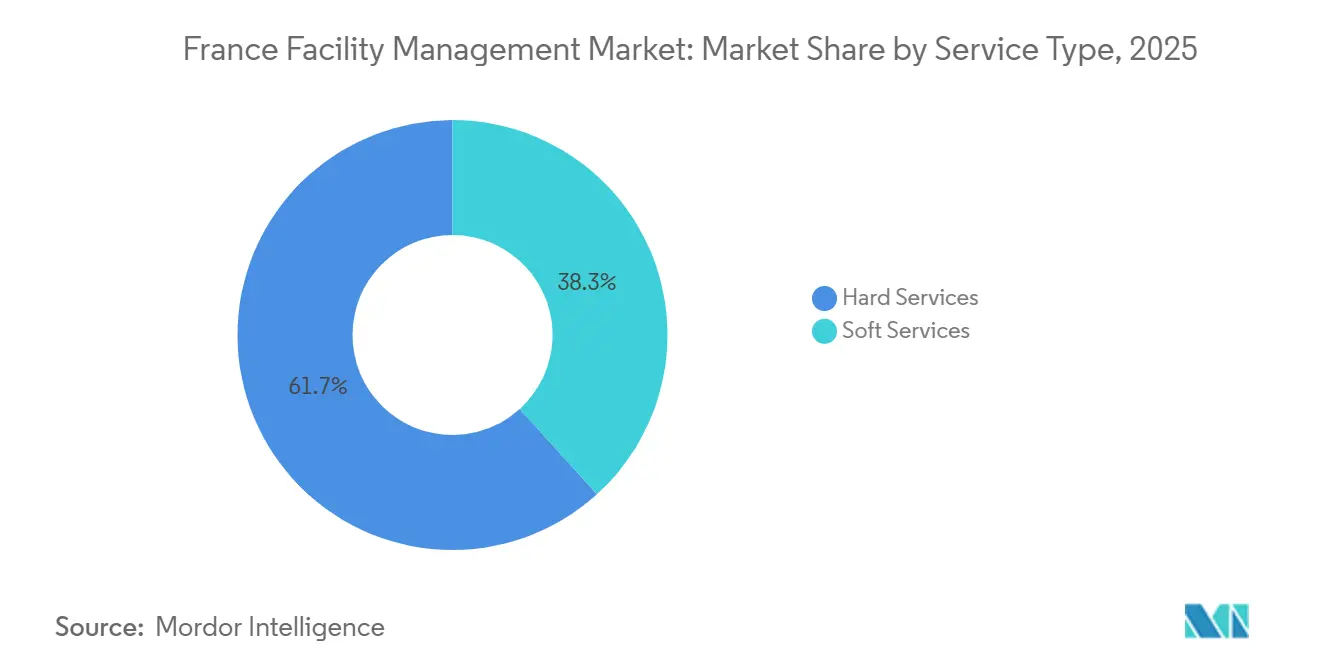
- By service type, hard services led with 61.73% of France facility management market share in 2025. Soft services are forecast to advance at a 2.57% CAGR through 2031.
- By offering type, in-house models retained 66.59% share in 2025; outsourced integrated facility management is projected to expand at a 2.82% CAGR over 2026-2031.
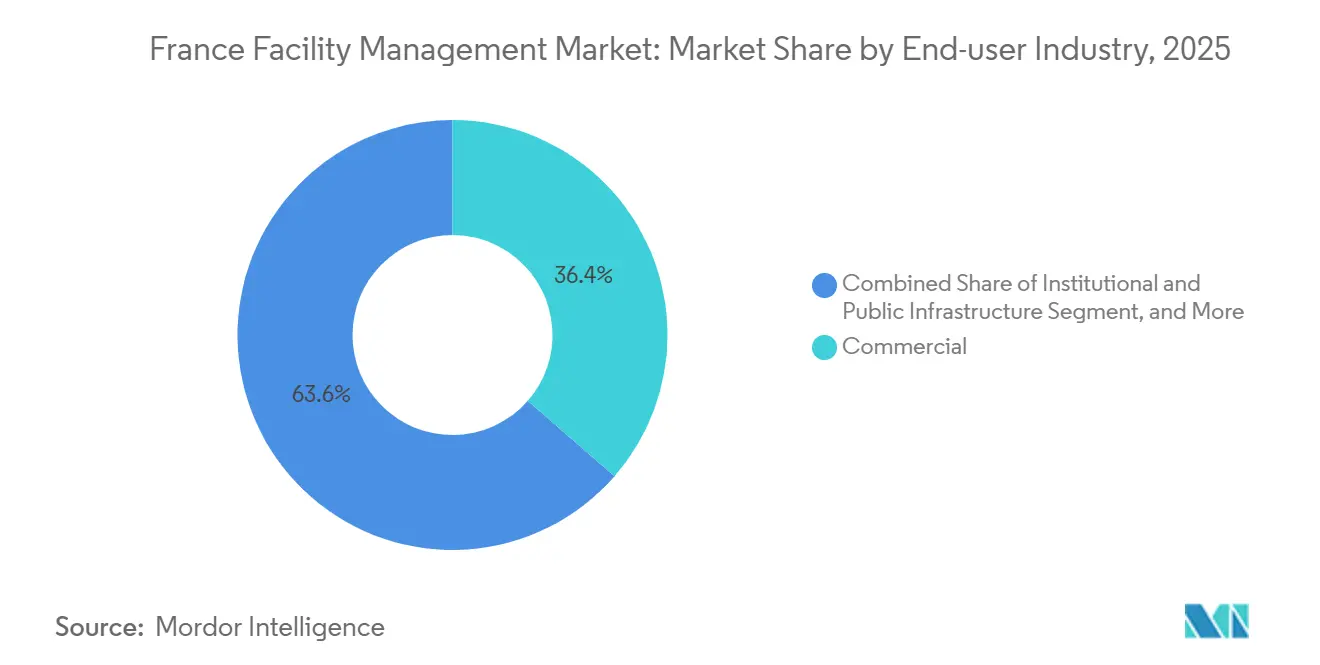
- By end-user, commercial real estate held a 36.42% share of the France facility management market size in 2025 and is poised to grow at a 2.48% CAGR to 2031.
Note: Market size and forecast figures in this report are generated using Mordor Intelligence’s proprietary estimation framework, updated with the latest available data and insights as of 2026.
France Facility Management Market Trends and Insights
Drivers Impact Analysis*
| Driver | (~)% Impact on CAGR Forecast | Geographic Relevance | Impact Timeline |
|---|---|---|---|
| Technological Advancements in Building Management Systems | +0.6% | Paris, Lyon, Marseille, Lille, Toulouse metro areas | Medium term (2-4 years) |
| Mandated Energy Performance Certificates Enforcement from 2026 | +0.5% | National, stricter in Île-de-France | Short term (≤ 2 years) |
| Growth of the Real Estate Sector | +0.4% | Paris, Lyon, Marseille, secondary cities | Medium term (2-4 years) |
| Increasing Emphasis on Green Building Practices | +0.3% | National, led by HQE projects | Long term (≥ 4 years) |
| Post-Pandemic Hybrid Work Models Driving Flex-Space Servicing | +0.3% | Major commercial hubs | Short term (≤ 2 years) |
| Rising Adoption of Integrated FM Contracts | +0.2% | National multi-site portfolios | Medium term (2-4 years) |
| Source: Mordor Intelligence | |||
Technological Advancements in Building Management Systems
The BACS Decree requires automation in all non-residential buildings over 290 kW by 2025 and 70 kW by 2027, forcing owners to add IoT sensors, real-time energy tracking, and anomaly detection platforms.[1] Providers deploy cloud analytics that merge HVAC, lighting, and water data into unified dashboards. Eiffage’s AI engine lowered prediction error on a high-speed rail network to 4% for one-month horizons, showing predictive maintenance is maturing. Orange Business Services and Sensinov have documented 30-48% energy savings in pilots that couple LoRaWAN devices with centralized controls. These outcomes help the France facility management market satisfy performance guarantees despite labor gaps.
Growth of the Real Estate Sector
Paris office vacancy hit 8.1% in Q3 2024, yet flexible office take-up jumped 15%, creating a two-speed landscape. Traditional landlords focus on cost-cutting and ESG retrofits, while coworking operators require daily service adjustments triggered by occupancy sensors. Government portfolios, 90 million m² managed by France Domaine, face the same 60% reduction mandate, lining up long-duration retrofit contracts. Capital is selective: investment volumes fell 19% year-on-year to EUR 7.8 billion (USD 8.35 billion) in 2024, rewarding assets that already embed smart FM tools.[2]
Increasing Emphasis on Green Building Practices
HQE certification now covers more than 1,000 buildings, and RE2020 carbon caps tighten again in 2025, 2028, and 2031.[3] Energy performance contracts offered by Equans and Bouygues Énergies et Services tie provider fees to verified consumption cuts. The requirement to justify target modulation through energy studies opens advisory revenue for audits and payback analysis. As lifecycle carbon metrics become bid qualifiers, digital twins and embodied-carbon dashboards differentiate bids in the France facility management market.
Mandated Energy Performance Certificates Enforcement from 2026
France tightened EPC rules in 2025, adding QR codes for instant audits and escalating fines up to EUR 7,500 (USD 8,025) per legal entity. Owners must report consumption on the OPERAT portal and hit 40% savings by 2030 or meet absolute targets set by the Tertiary Decree.[4] Hotels will post A-to-E environmental grades from 2026, broadening demand for carbon accounting, data normalization, and supplier screening. Facility managers that bundle energy studies, retrofits, and performance monitoring gain a compliance premium in the France facility management market.
Restraints Impact Analysis*
| Restraint | (~) % Impact on CAGR Forecast | Geographic Relevance | Impact Timeline |
|---|---|---|---|
| Labor Market Constraints and Skills Shortage | -0.4% | Île-de-France, Lyon, Marseille | Long term (≥ 4 years) |
| Economic Fluctuations and Inflationary Pressures | -0.3% | National, construction exposed | Medium term (2-4 years) |
| High Market Fragmentation Limiting Economies of Scale | -0.2% | Cleaning and single-service segments | Long term (≥ 4 years) |
| Imminent Carbon-Tax Pass-Through Risks on FM Contract Margins | -0.2% | Energy-intensive facilities | Short term (≤ 2 years) |
| Source: Mordor Intelligence | |||
Labor Market Constraints and Skills Shortage
France Stratégie estimates 170,000-250,000 additional workers are needed by 2030 to meet renovation goals INSEE found 27% of construction firms lacked labor in October 2025, hampering envelope upgrades. Cleaning jobs face high turnover, with an average worker age of 43 and widespread musculoskeletal issues. Providers are responding with robotics, route-optimization apps, and cross-training into catering or logistics, yet persistent scarcity raises wage costs and strains France facility management market profitability.
Economic Fluctuations and Inflationary Pressures
Construction contracted 3.9% in 2024 and order books sank to -33 in November 2025, the weakest since 2016. IPEA climbed to 118.0 in Q3 2025, led by HVAC sub-indices above 122, while labor costs rose with each minimum-wage revision. Clients hesitate to fund retrofits amid weak demand, pushing providers to absorb cost increases or risk non-renewal. Banque de France’s January 2026 survey shows near-term construction activity still negative, signaling a slow pipeline for new FM contracts .
*Our forecasts treat driver/restraint impacts as directional, not additive. The impact forecasts reflect baseline growth, mix effects, and variable interactions.
Segment Analysis
By Service Type: Hard Services Retain Lead as Soft Services Accelerate
Hard services captured 61.73% of the France facility management market in 2025, anchored by multi-technical maintenance, MEP compliance, and the BACS-driven retrofit surge. Providers such as SPIE Facilities and Equans manage nationwide agency networks that embed predictive analytics into HVAC and electrical upkeep. AI models cut reactive interventions by flagging drift in vibration or temperature data a month in advance, protecting uptime on aging assets. Fire-safety testing has intensified under ERP and IGH rules, adding steady audit revenue.
Soft services are projected to grow at a 2.57% CAGR, lifted by hybrid work patterns that require occupancy-based cleaning, variable catering, and modular security. The cleaning sector generated EUR 21 billion (USD 22.47 billion) in 2025 across 15,000 companies, yet 85% employ fewer than 50 staff, limiting technology adoption. Environmental labeling in hotels from 2026 pushes catering firms to source organic menus, while security specialists expand into remote monitoring that integrates with building IoT stacks. These shifts expand wallet share for providers that can bridge hard and soft scopes within the France facility management market size.
By Offering Type: Outsourcing Momentum Builds on Compliance Complexity
In-house delivery still held 66.59% share in 2025, especially inside public hospitals and heavy-industry campuses where institutional knowledge of process utilities is critical. Yet huge backlogs, EUR 25 billion (USD 26.75 billion) in hospitals alone, require capital and expertise unavailable internally, nudging administrators toward mixed models that pair internal clinical engineering with outsourced energy contracts .
Outsourced solutions will rise at a 2.82% CAGR as single-service contracts consolidate into bundled and integrated facility management formats. Atalian’s 85% self-delivery and eight-year average tenures show how embedded digital cockpits and energy dashboards lock in clients.[5] The World Bank’s Paris office tender, which demanded USD 60 million in provider revenue, underlines how bid thresholds now screen out small specialists. Performance-based fee structures tied to EPC targets shield margins once carbon pricing advances, accelerating the shift toward integrated models within the France facility management market.
By End-User Industry: Commercial Real Estate Dominates, Healthcare Faces Backlog
Commercial buildings commanded 36.42% of France facility management market share in 2025 and should grow at 2.48% CAGR as landlords retrofit space to win ESG-minded tenants. Flexible office demand climbed 15% in 2024, prompting operators to deploy real-time cleaning dispatch and sensor-linked catering. Retail portfolios turn to centralized BMS platforms, Sensinov reports up to 48% energy savings in 350 stores, to manage refrigeration loads.
Healthcare facilities confront a EUR 25 billion (USD 26.75 billion) maintenance gap plus stricter infection-control and fire-safety rules. The Ségur de la Santé program allocates EUR 19 billion (USD 20.33 billion) for upgrades but still leaves room for energy-performance contracts that wrap HVAC modernization with guaranteed savings. Industrial sites adopt AI-enabled predictive maintenance to cut downtime that can erase 11% of turnover, as Orange’s digital twin pilot illustrates. Outcome-based contracts that tie fees to uptime and kilowatt-hour reductions are spreading through these capital-intensive sectors of the France facility management market share.

Geography Analysis
Île-de-France remains the epicenter of the France facility management market. Paris posted 8.1% office vacancy in 2024, yet La Défense still generates large retrofit projects aimed at EPC compliance. Government real-estate holdings cluster in the region, and a 25-year concession to run the district-heating network from 2027 underscores the pipeline for long-run multi-technical contracts.
Regional hubs such as Lyon and Marseille host heavy manufacturing clients. Veolia’s preventive-maintenance pact with Renault Trucks in Lyon covers HVAC, water loops, and high-voltage systems, showcasing integrated models beyond the capital. Lille and Toulouse face similar aging-stock challenges; rising enforcement of EPC rules pulls in digital audits and phased retrofit scopes to hit the 2030 40% energy-cut mandate.
Secondary towns and rural communes show lower outsourcing penetration, with many schools and municipal buildings still self-managed. Yet France Stratégie forecasts up to 250,000 extra renovation jobs by 2030, and its reindustrialization scenario adds as many as 740,000 industrial positions, spreading demand to new geographies. Providers able to mobilize mobile teams and remote monitoring tech will capture these dispersed opportunities in the France facility management market size.
Regulatory Landscape
Facility management compliance in France is being reshaped by energy and building-performance obligations for tertiary buildings and public-facing premises. Under the Tertiary Decree (tertiary eco-energy scheme), owners and occupiers of tertiary-sector buildings above 1,000 m2 must submit annual energy-consumption data to the ADEME-managed OPERAT platform and track progress against reduction trajectories to 2030, 2040, and 2050. This is pushing FM providers to operationalize metering, data normalization, and recurring reporting within their contracts.
Building compliance also extends to mandatory diagnostics and enforcement mechanisms that influence service scopes and documentation. Public service facilities (ERP) above defined size thresholds must perform and display an energy performance diagnosis in visible areas, with penalties for non-compliance, while industrial sites classified as ICPE must manage administrative declarations around significant changes and operator modifications via prefectural and regional environmental directorates (DREAL/DRIEAT/DAAF). This increases demand for audit-ready maintenance logs, HSE procedures, and traceable subcontractor management across multi-technical FM programs.
Value Chain Analysis
The France facility management value chain runs from building owners and occupiers (commercial real estate, public estates, and industrial operators) that define outcomes and compliance needs, to FM prime contractors that bundle hard and soft services, and then to specialist subcontractors (HVAC, electrical, fire safety, cleaning, security) and temporary labor that executes site work. Technology and equipment suppliers support delivery through BMS/BACS platforms, IoT sensors, CMMS/EAM software, and energy-measurement hardware. Interoperability and secure protocols are becoming more central as building automation turns into a compliance layer under the BACS thresholds.
Downstream, integrated FM delivery increasingly depends on digital enablement partners and OEM service ecosystems for critical assets (elevators, HVAC, power, and controls), alongside utilities and waste or energy operators when sites include district heating or waste-to-energy interfaces. Trade bodies such as IDET (formerly ARSEG) also shape best practices for workplace and service procurement. In parallel, large multisite contracts and high-availability environments (for example, data centers) pull FM providers into tighter SLAs, structured reporting cadences, and coordinated vendor management across regions.
Competitive Landscape
The top 10 cleaning firms control 43% of revenue, signaling moderate concentration, while the long tail of 12,000 micro-companies keeps price competition fierce. ONET’s 2024 takeover of ISS France expanded its footprint and client roster, reflecting a consolidation trend. Atalian, backed by private equity, recorded EUR 2.011 billion (USD 2.24 billion) revenue in 2024 with 71% from France and 44,000 staff, and leverages its ERGELIS energy platform to deliver 14-45% savings depending on asset class.
VINCI Facilities, Eiffage, and Bouygues Énergies et Services use construction heritage to cross-sell multi-technical maintenance and EPC-linked retrofits. Eiffage’s AI algorithm for rail assets demonstrates deep data science capability, giving it an edge in outcome-based bids. Veolia wraps FM into broader water, waste, and energy services, winning industrial portfolios like PSA Group sites through single-provider utility management.
Mid-tier contenders such as Seris Group, Samsic Facility, and DEF Network focus on retail or hospitality niches and adopt SaaS BMS solutions from Sensinov to stay competitive without heavy capex. Technology vendors thus act as force multipliers, enabling smaller firms to enter integrated contracts and widening competitive intensity across the France facility management market.
France Facility Management Industry Leaders
-
Sodexo Group
-
VINCI Facilities
-
Atalian Group
-
L'Agence du Panier
-
AItenders
- *Disclaimer: Major Players sorted in no particular order

Market Opportunities and Future Outlook
Compliance-driven building digitalization is expanding addressable work around audits, instrumentation, and continuous optimization tied to Tertiary Decree requirements (OPERAT reporting) and the BACS Decree thresholds (automation obligations for non-residential buildings). This supports opportunities in data governance and performance monitoring services that connect HVAC and multi-technical maintenance to verified energy outcomes, particularly for owners seeking turnkey delivery that combines metering, controls upgrades, and documentation.
A second opportunity area is secure, interoperable building connectivity as FM scopes extend into connected controls and remote operations. Industry efforts to standardize and harden protocols (for example BACnet/SC and KNX Secure) support packaged offers where providers manage both operational resilience and energy performance. This is especially relevant for high-availability sites such as data centers, where SPIE Facilities has expanded multi-technical maintenance coverage with Bouygues Telecom across a multisite footprint.
Recent Industry Developments
- June 2026: Atalian Group launched its Stellar strategic plan alongside a global recapitalization and up to EUR 140 million in new financing. The program targets smart facility management, digitalization, and energy performance. This supports Atalian's ability to fund technology and capability upgrades for compliant contracts in France.
- December 2025: Paris approved the Dalkia-Eiffage-RATP Solutions Ville consortium for a 25-year district-heating concession starting in January 2027. The concession expands demand for multi-technical operations, energy optimization, and performance reporting services aligned with public-infrastructure obligations.
- January 2024: VINCI Energies renewed a five-year facility management contract covering 59 Thales sites in France, with energy-reduction commitments. The renewal shows how large buyers are tying FM renewals to measurable efficiency targets and digital monitoring improvements.
Research Methodology Framework and Report Scope
Market Definition and Coverage
For this methodology, the France facility management market includes outsourced and in-house services used to keep buildings and sites running safely and efficiently, covering day-to-day soft services and technical hard services delivered across commercial, public, and industrial facilities.
Scope exclusions: We exclude pure construction and one-off capital project work that does not relate to ongoing operations and maintenance of occupied facilities.
Segmentation Overview
- By Service Type
- Hard Services
- Asset Management
- MEP and HVAC Services
- Fire Systems and Safety
- Other Hard Facility Management Services
- Soft Services
- Office Support and Security
- Cleaning Services
- Catering Services
- Other Soft Facility Management Services
- Hard Services
- By Offering Type
- In-house
- Outsourced
- Single Facility Management
- Bundled Facility Management
- Integrated Facility Management
- By End-user Industry
- Commercial
- Hospitality
- Institutional and Public Infrastructure
- Healthcare
- Industrial and Process
- Other End-User Industries
Data Sources, Market Sizing, and Validation
Desk Research
Desk research started with public series that help us understand the size of the built environment and how much is likely spent to run it. We referred to sources such as INSEE economic and employment tables, Eurostat national accounts and construction indicators, and ADEME publications on energy efficiency actions in buildings.
We also used materials from French government and regulator sources that shape FM demand, for example, tertiary building energy reduction obligations and building automation requirements. Alongside trade association releases, we reviewed reputable press coverage on outsourcing, service pricing, and contract trends. Company annual reports and investor presentations were reviewed to understand revenue mix and the wording around service scope. Select paid subscriptions were used only for company financials, patent checks, and import-export context when equipment-intensive services were discussed. The examples above are illustrative and not exhaustive, and many other public sources were also consulted to collect data, validate figures, and clarify definitions.
Primary Interviews and Surveys
Primary interviews focused on validating what is counted as facility management in France across hard and soft services, and then confirming the typical split between in-house and outsourced delivery by end user. We spoke with operators, subcontracting networks, procurement leads, and site managers across major French metros and secondary cities, so assumptions on contract scope, pass-through costs, and service frequency could be corrected before finalizing the model.
Distribution of primary research fieldwork respondents
| Company type | Respondent position |
|---|---|
| Top tier: 34% | CXOs: 12% |
| Mid tier: 49% | Functional/Unit leaders: 33% |
| Smaller Players: 17% | Managers: 55% |
Market-Sizing & Forecasting
Sizing began with a top-down build where the demand pool was reconstructed from France building stock signals and operating spend patterns, then mapped into hard and soft service intensity by facility type. Inputs that shaped the model included service labor availability and wage trends, energy and utilities management intensity, outsourcing penetration by end user, contract bundling rates, and the share of technical systems that require scheduled compliance checks, such as HVAC, fire safety, and critical MEP assets.
After that, selective bottom-up approximations were used to keep totals realistic, such as rolling up sampled provider revenues in key service lines and checking implied average spend per square meter against what site teams reported for comparable assets. Where revenue disclosures were not clean, gaps were handled by applying service mix ratios first set from desk research and then adjusted through interviews. Forecasting used scenario analysis, with demand drivers like tertiary building energy compliance timelines, office occupancy recovery assumptions, and outsourcing appetite tested under a base case before the final outlook was locked.
Data Validation & Update Cycle
Outputs were checked against independent signals, including in-house versus outsourced shares, hard versus soft service splits, and implied spend intensity versus building footprint and staffing needs. If a variance looked abnormal, the assumption behind it was revisited, and follow-up calls were triggered with respondents closest to that part of the market.
A second analyst review was completed to confirm math integrity, unit consistency, and year-over-year logic. After that, the narrative and tables were aligned to the same model cut. The report is refreshed annually, and interim updates are made when material events shift pricing or demand, followed by a final pre-delivery review so clients receive the latest view.
Mordor Intelligence's France Facility Management Market Size Compared With Other Published Estimates
Published market sizes for France facility management can look far apart because some sources mix total national FM spending with the addressable services market, and they may also handle in-house delivery differently. Differences in year labeling, inflation treatment, and how bundled contracts are split across service lines also add to the spread.
Some published figures lean toward a broad spend view that includes internal facility teams and wider public infrastructure style spending, so totals can rise even when outsourced contract volumes are not expanding at the same pace. In Mordor Intelligence, the count is limited to defined facility management services across hard and soft activities, and in-house delivery and outsourced delivery are estimated explicitly to avoid double counting in bundled and integrated contracts.
Benchmark comparison
| Source | Market Size | Gaps in Research Methodology |
|---|---|---|
| Mordor Intelligence | USD 73.31 B (2025) | |
| Trade Journal A | USD 110.30 B (2024) | Uses a broad total spending view and can include internal labor costs plus public infrastructure related FM activity, which may not be adjusted back to a defined FM services scope. |
| Regional Consultancy B | USD 73.60 B (2024) | Sits close to the services market level, but the treatment of bundled contracts, price escalation, and the in-house share is not always clearly stated, which can move the final value. |
The comparison suggests the largest differences are usually created by spend-based definitions and by whether in-house activity is included cleanly or mixed into outsourced contract values. Our checks on service intensity and delivery mode splits keep the final estimate traceable to inputs that can be repeated year after year.
Key Questions Answered in the Report
What is the projected value of the France facility management market in 2031?
It is forecast to reach USD 84.67 billion by 2031, growing at a 2.43% CAGR from 2026.
Which service category is expanding fastest?
Soft services, including cleaning, catering, and security, are expected to post a 2.57% CAGR over 2026-2031.
Why are integrated facility management contracts gaining traction?
Owners seek single-point accountability for meeting the Tertiary Decree's energy-cut targets and for handling complex compliance reporting.
How does the labor shortage affect providers?
Scarcity of skilled HVAC and multi-technical workers raises wage costs and pushes firms to adopt IoT automation and robotics to maintain service levels.
Which region drives the highest demand?
Île-de-France generates the largest concentration of projects thanks to dense commercial stock, government estates, and large infrastructure concessions.
What risks do fixed-price FM contracts face from 2027?
The EU ETS2 will add carbon costs to building operations, so providers are embedding pass-through clauses or switching to performance-based fee structures.