
Market Overview
| Study Period | 2020 - 2031 |
|---|---|
| Forecast Data Period | 2026 - 2031 |
| Base Year Market Size (2025) | USD 9.10 Billion |
| Market Size (2026) | USD 10.11 Billion |
| Market Size (2031) | USD 17.09 Billion |
| Growth Rate (2026 - 2031) | 11.08 % |
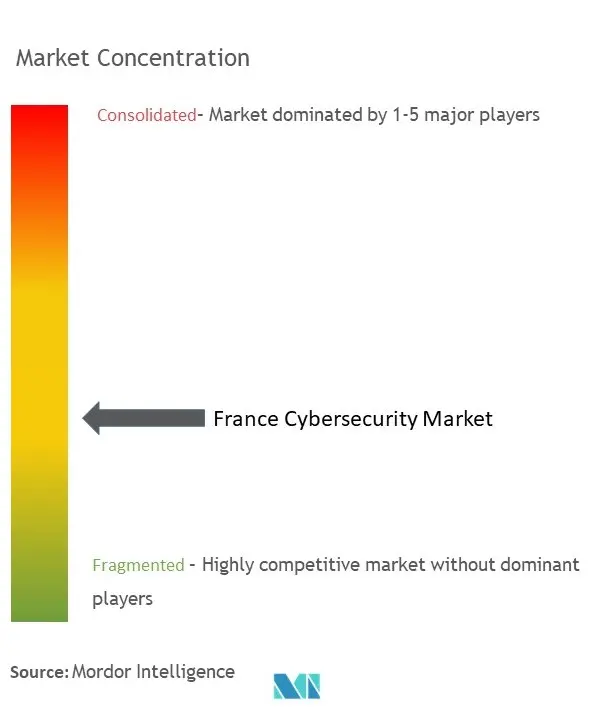
| Market Concentration | Medium |
Major Players *Disclaimer: Major Players sorted in no particular order Image © Mordor Intelligence. Reuse requires attribution under CC BY 4.0. | |
France Cybersecurity Market Analysis by Mordor Intelligence
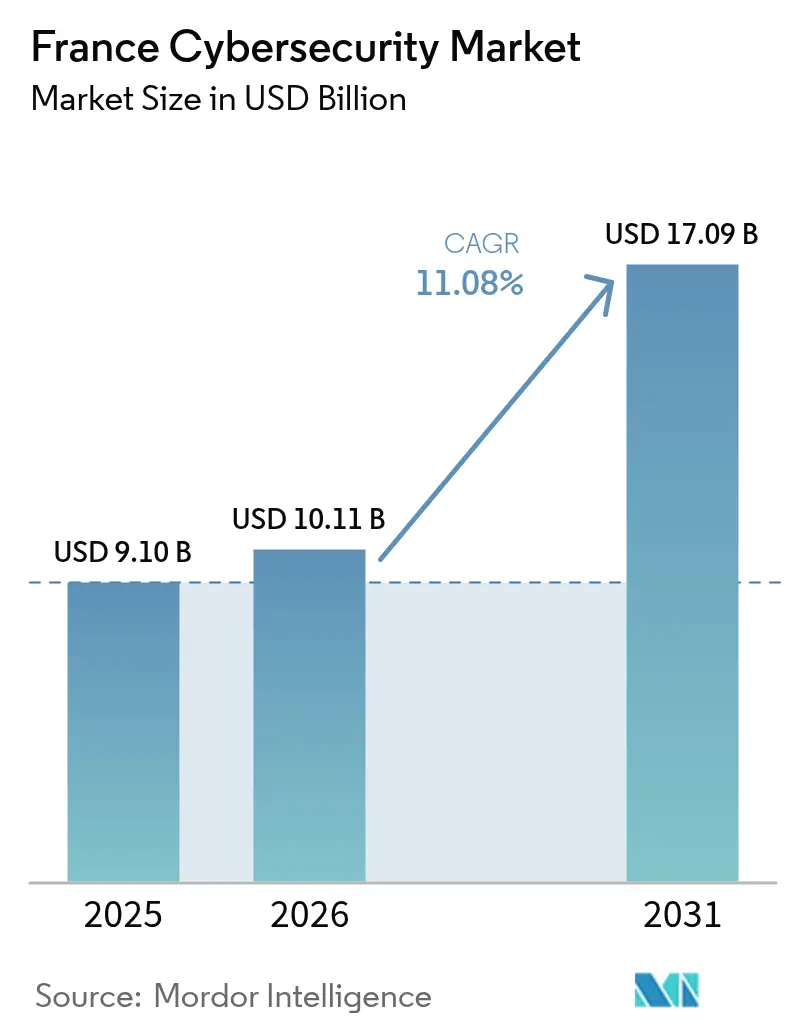
The France cybersecurity market size was valued at USD 9.10 billion in 2025 and estimated to grow from USD 10.11 billion in 2026 to reach USD 17.09 billion by 2031, at a CAGR of 11.08% during the forecast period (2026-2031). Rapid regulatory expansion under NIS2, heavier public-sector funding, and a sharp rise in cloud migration are synchronizing to widen the addressable opportunity for vendors. Enterprises continue to consolidate security stacks, channeling spending toward integrated platforms that ease compliance and talent pressures. Managed security services are surging as buyers offset a persistent shortage of skilled practitioners, while AI-driven analytics are becoming standard in French security operations centers. Heightened Olympic-period cyber activity has permanently recalibrated domestic threat awareness, prompting long-term investment in threat-monitoring infrastructure across critical sectors such as healthcare, energy, and transportation.
Key Report Takeaways
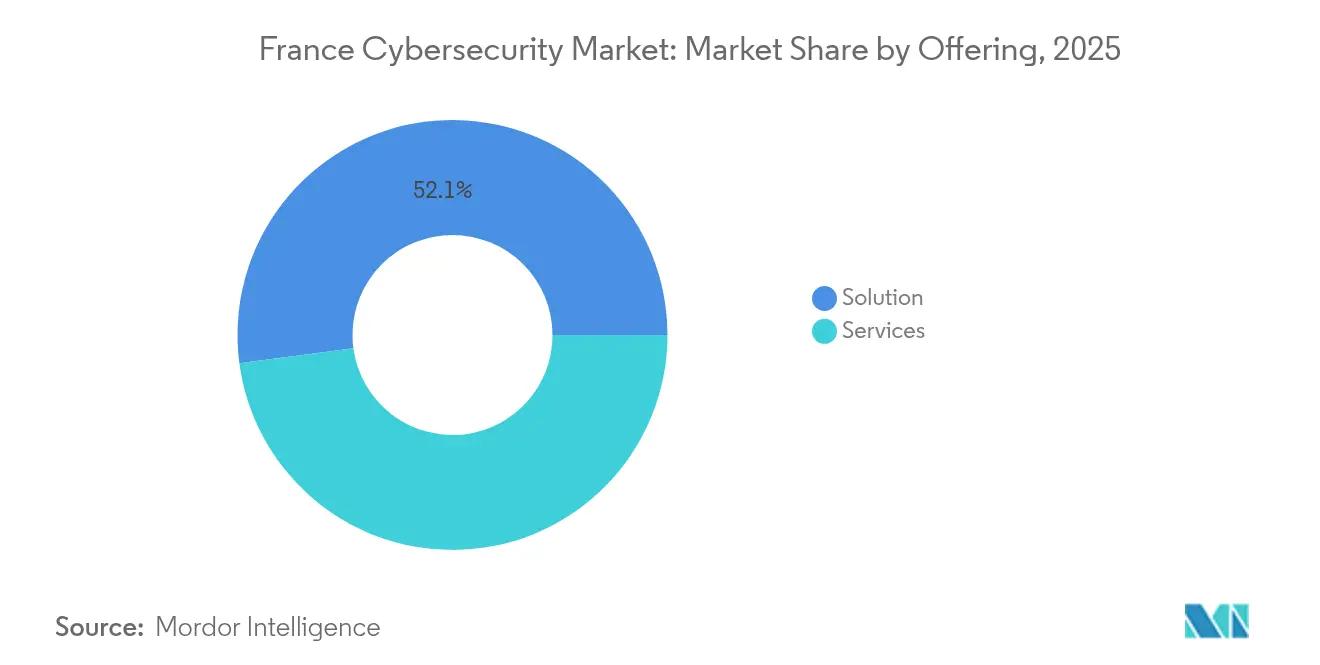
- By offering, solutions held 52.10% of the France cybersecurity market share in 2025, whereas services are projected to expand at a 12.85% CAGR through 2031.
- By deployment mode, cloud platforms captured 59.78% revenue share of the France cybersecurity market in 2025 and are tracking a 14.25% CAGR to 2031.
- By enterprise size, large organizations controlled 64.05% of the France cybersecurity market in 2025; SMEs represent the fastest trajectory at a 12.15% CAGR through 2031.
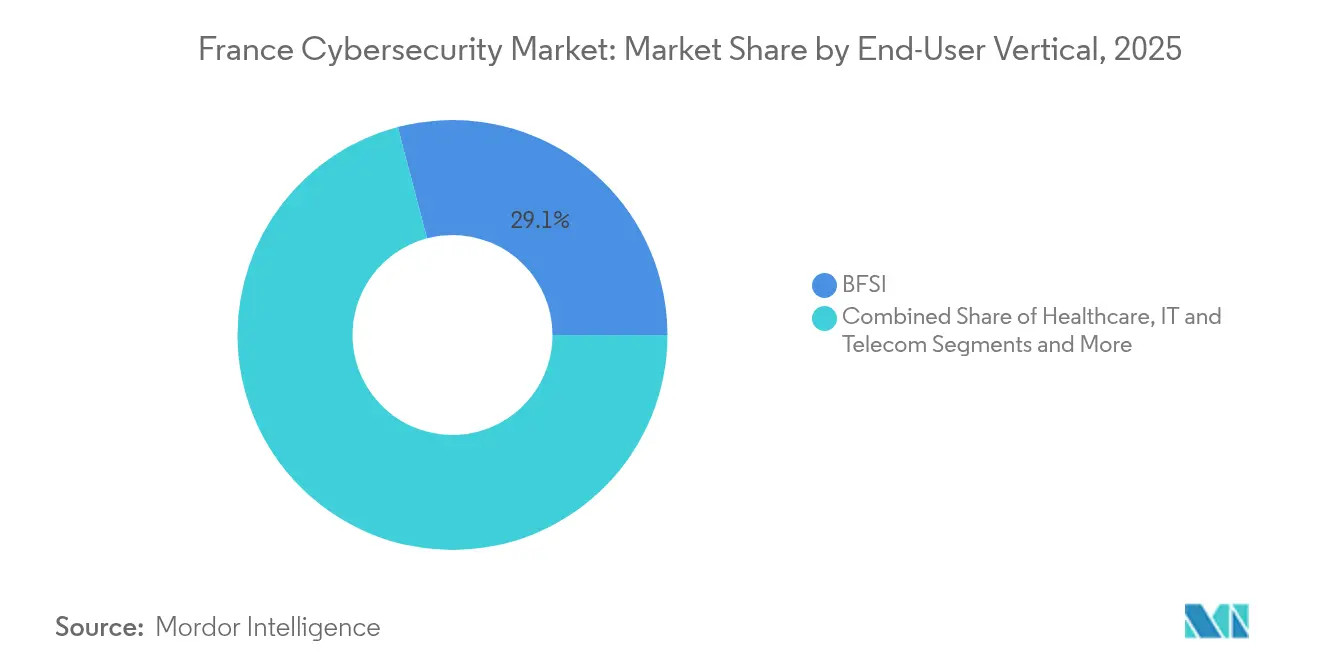
- By vertical, BFSI contributed 29.10% to the France cybersecurity market size in 2025, while healthcare is on course for a 12.74% CAGR to 2031.
Note: Market size and forecast figures in this report are generated using Mordor Intelligence’s proprietary estimation framework, updated with the latest available data and insights as of 2026.
Market Trends and Insights
Drivers Impact Analysis of France Cybersecurity Market*
| Driver | (~) % Impact on CAGR Forecast | Geographic Relevance | Impact Timeline |
|---|---|---|---|
| Accelerated NIS2 adoption & Increasing French Government Cyber Plan funding | +2.8% | National, with spillover to EU compliance frameworks | Medium term (2-4 years) |
| Ransomware surge on French critical infrastructure & healthcare | +2.1% | National, concentrated in metropolitan areas | Short term (≤ 2 years) |
| Paris 2024 Olympics-driven threat-monitoring investments | +1.4% | National, with Paris region epicenter | Short term (≤ 2 years) |
| SME cloud-migration boom under "France Num" digital vouchers | +1.7% | National, with regional variations | Medium term (2-4 years) |
| Campus Cyber ecosystem catalysing local solution innovation | +1.2% | National, centered in Paris Region | Long term (≥ 4 years) |
| Remote-work shift demanding Zero-Trust & IAM upgrades | +1.6% | National, with urban concentration | Medium term (2-4 years) |
| Source: Mordor Intelligence | |||
Accelerated NIS2 adoption and French Government cyber funding
NIS2 widens the compliance net from 500 to roughly 15,000 French entities, tripling the number of regulated sectors and intensifying demand for governance, risk, and compliance tooling. France 2030 earmarked EUR 39 million (USD 42 million) for 17 cybersecurity projects, anchoring sovereign capability development[1]. ANSSI’s phased roll-out stresses enablement over sanction, spurring advisory services as firms race to close gaps. Government interest in acquiring Atos’ cybersecurity assets for EUR 700 million (USD 748 million) further underlines the strategic value of domestic IP. Together these moves inject capital, enlarge the client base, and reinforce the France cybersecurity market as a continental compliance hub.
Ransomware surge on French critical infrastructure and healthcare
ANSSI logged 4,386 security incidents in 2024, up 15% year on year, with healthcare representing 10% of ransomware filings. Hospitals at Armentières and Corbeil-Essonnes endured emergency shutdowns, driving urgency around endpoint detection and incident-response retainer services. Cultural landmarks such as the Louvre and Grand Palais also faced disruptions, proving no sector is immune. Spending is pivoting toward XDR platforms and crisis-management consulting, reinforcing the France cybersecurity market as a responsive services arena.
Paris 2024 Olympics-driven threat-monitoring investments
ANSSI coordinated a two-year security program that neutralized more than 140 attempted attacks during the Games, validating large-scale, multi-stakeholder defense models. Eviden deployed real-time analytics across 500 venues, embedding automated playbooks now repurposed for critical infrastructure. Cisco and Palo Alto Networks formed intelligence alliances that persist beyond the event, extending the France cybersecurity industry’s ecosystem appeal.
SME cloud-migration boom under “France Num” digital vouchers
France Num subsidizes up to EUR 1,500 (USD 1,605) per SME for security expenses, with regional grants reaching EUR 50,000 (USD 53,500). As 53% of SMEs now host workloads in the cloud, demand spikes for SaaS-based identity management and managed detection services suited to lean IT teams. This subsidy-driven adoption enlarges the cloud portion of the France cybersecurity market and feeds a robust MSP channel.
Restraints Impact Analysis of France Cybersecurity Market*
| Restraint | (~) % Impact on CAGR Forecast | Geographic Relevance | Impact Timeline |
|---|---|---|---|
| Acute cyber-talent shortage inflating SOC service costs | -1.8% | National, with Paris region concentration | Medium term (2-4 years) |
| Budget aversion among French SMEs viewing cyber as OPEX | -1.4% | National, with rural/regional emphasis | Short term (≤ 2 years) |
| Regulatory overlap (GDPR, NIS2, ANSSI sector rules) delaying buys | -1.2% | National, with cross-border compliance implications | Medium term (2-4 years) |
| Tool-sprawl and integration complexity across fragmented stack | -1.0% | National, concentrated in large enterprises | Short term (≤ 2 years) |
| Source: Mordor Intelligence | |||
Acute cyber-talent shortage inflating SOC costs
Roughly 15,000 cybersecurity vacancies persist nationwide, despite an 89% workforce expansion since 2020. Salary inflation reaches EUR 90,000 (USD 96,300) for senior analysts, squeezing provider margins and stimulating automation. Thales responded with GenAI4SOC to improve case triage efficiency by 40%. Such initiatives temper, but do not erase, the talent gap that restrains the France cybersecurity market’s ability to scale fully.
Budget aversion among SMEs viewing cyber as OPEX
Forty percent of SMEs cite cost as the main hurdle to stronger defenses while 18% run no formal controls at all. Limited awareness of state subsidies compounds the hesitancy, leaving small firms prone to fines under GDPR and imminent NIS2 rules. Vendors targeting this segment must emphasize outcome-based pricing and turnkey managed offerings to unlock untapped layers of the France cybersecurity market.
*Our forecasts treat driver/restraint impacts as directional, not additive. The impact forecasts reflect baseline growth, mix effects, and variable interactions.
France Cybersecurity Market Segment Analysis
By Offering:
Balanced platform demand amid services accelerationSolutions generated 52.10% of 2025 revenue, with unified threat-management suites and XDR gaining traction as enterprises rationalize tool sprawl. The managed-services slice is growing at 12.85% CAGR as clients contract out 24/7 monitoring to compensate for staffing gaps. Identity-and-access tools, especially privileged-access management, underpin Zero-Trust rollouts. Wallix, for example, leverages its ANSSI qualification to court regulated clients. Professional services complement software spend, delivering assessment and remediation projects tied to NIS2 milestones. Hardware appliances remain foundational but are increasingly bundled with AI-driven analytics, illustrating the convergence that defines the France cybersecurity market.
The integration trend is fostering hybrid consumption models in which buyers license core platforms and overlay retained services for incident response. This approach expands lifetime value for vendors while providing flexibility in tight budget cycles. As ransomware campaigns intensify, incident-response retainers are now a baseline requirement across BFSI and healthcare, pushing the France cybersecurity market size for services steadily upward.

By Deployment Mode:
Cloud predominance strengthensCloud deployments accounted for 59.78% of 2025 spending, reflecting widespread SaaS preference and rapid SME onboarding. The France cybersecurity market size attached to cloud solutions is forecast to rise at a 14.25% CAGR, outpacing the on-premise base as more critical workloads move to hybrid environments. SecNumCloud certification accelerates trust in domestic hosting, benefiting players such as OVHcloud and Outscale.
On-premise models persist in defense and heavily regulated utilities where data residency and latency demands outweigh elasticity. Yet even these sectors adopt cloud-based analytics to augment legacy controls. Multi-cloud orchestration platforms that normalize policy across providers are gaining lift, mitigating vendor lock-in risks for enterprises expanding beyond a single hyperscaler. As a result, the France cybersecurity market continues to blur traditional deployment lines, pivoting toward control-plane-centric architectures.
By End-User Vertical:
BFSI lead with healthcare surgeBFSI led 2025 revenue with a 29.10% contribution to the France cybersecurity market size, compelled by stringent supervisory directives and high attacker return ratios. Healthcare, however, is advancing fastest at a 12.74% CAGR after a wave of hospital breaches spotlighted vulnerabilities in outdated medical networks. Industrial and defense operators are layering IT and OT defenses to protect mission-critical systems, aided by ANSSI-certified vendors such as Stormshield.
Retail and e-commerce entities focus on payment security and fraud analytics, while energy firms shore up SCADA environments against supply-chain exploits. Cross-sector convergence creates demand for platforms able to ingest telemetry from both corporate and industrial domains. Vendors that demonstrate competence across IT-OT boundaries capture increasing mindshare within the France cybersecurity market.
By Enterprise Size:
Large-enterprise dominance with SME momentumLarge organizations held 64.05% of 2025 spend, leveraging broad budgets to build in-house security operations and bespoke compliance workflows. SMEs, buoyed by subsidy schemes, are forecast to grow at 12.15% CAGR, injecting fresh volume into the France cybersecurity market. Managed security providers tailor subscription packages that align to cash-flow realities of small firms.
Cloud-native secure web gateways, micro-segmentation tools, and turnkey MDR services resonate with mid-market buyers needing immediate coverage without capital outlay. Vendors that couple automation with advisory touchpoints lower entry friction, expanding addressable demand and nurturing the long-tail of the France cybersecurity market.
Geography Analysis
The Paris Region anchors 60% of domestic cybersecurity startups and produced EUR 14.6 billion (USD 15.6 billion) in segment revenue during 2021, reinforcing the city as the gravitational center of the France cybersecurity market. Campus Cyber facilitates cluster effects by co-locating enterprises, regulators, and academia. The region also hosts ANSSI headquarters, ensuring policy proximity and rapid certification cycles.
Beyond Paris, metropolitan areas such as Lyon, Lille, and Toulouse have expanded incident-response hubs to conform with NIS2 requirements, spreading demand geographically. Nouvelle-Aquitaine offers grants up to EUR 50,000 (USD 53,500) for digital security projects, catalyzing local partner ecosystems that feed into the national channel. Cross-border initiatives under the EU Cybersecurity Act encourage French vendors to scale within the single market, enlarging export potential for the France cybersecurity industry.
Regional threat profiles vary. Coastal energy infrastructure in Brittany faces state-linked reconnaissance, whereas Alsace manufacturers report heightened industrial-espionage attempts. Such diversity reinforces a multi-layered defense imperative and positions the France cybersecurity market as a patchwork of localized needs under a unifying regulatory umbrella.
Regulatory Landscape
France cybersecurity regulation is anchored by ANSSI (under SGDSN) for national cyber policy, incident response, and supervision of regulated operators, with EU-driven obligations such as GDPR and the incoming NIS2 regime. On January 29, 2026, the French government published the National Cybersecurity Strategy 2026-2030, setting priorities across cyber talent, resilience, threat suppression, securing digital foundations, and international cyber stability, including an emphasis on sovereignty that supports demand for trusted and qualified solutions.
As of July 2026, NIS2 transposition remained incomplete, and on July 8, 2026 the European Commission referred France to the CJEU for failure to notify full transposition. ANSSI has also published and iterated the Cyber France Reference Framework (ReCyF) and opened MesServicesCyber for voluntary pre-registration and self-identification, pushing organizations to strengthen governance, controls, and reporting readiness ahead of final national legislation and enforcement. Investigations and compliance orders are handled by ANSSI, while administrative fines are imposed via a dedicated commission des sanctions, up to EUR 10 million or 2% of global annual turnover.
Value Chain Analysis
The France cybersecurity value chain begins with research and capability formation, where public research actors (CNRS, CEA, Inria) and public programs such as France 2030 feed innovation pipelines for areas such as AI security and cryptography. It then moves into product development and integration led by domestic champions and specialized vendors. Qualification, certification, and assurance act as a key midstream gate, with ANSSI-driven frameworks shaping trusted offerings for sensitive buyers, while national and EU requirements, including NIS2 and DORA, translate into sustained demand for risk, compliance, and incident-response capabilities.
Go-to-market is carried out through direct enterprise sales and partner channels. Telecom operators bundle managed security with connectivity, systems integrators package compliance-focused projects, and MSSPs deliver 24/7 monitoring to offset the talent shortage. Industry coordination bodies such as Clusif, Hexatrust, the Federation Francaise de la Cybersécurité, and InterCERT France, which unites 130+ CERT/CSIRT teams, support information sharing, readiness, and incident collaboration, enabling more repeatable deployment models across regulated verticals and SMEs.
Competitive Landscape
France hosts a moderately concentrated supplier base. Thales, Orange Cyberdefense, and Atos together hold 28% of 2024 revenue, while a vibrant startup tier fills niche requirement. Domestic champions emphasize sovereign cloud, ANSSI accreditation, and AI differentiators to counter global hyperscalers. Thales’ GenAI4SOC illustrates generative-AI infusion into incident workflows, promising 40% analyst time savings[3]. Eviden capitalized on its Olympics contract to showcase large-event security orchestration.
Specialists target vertical pain points: Stormshield safeguards industrial control systems; HarfangLab advances endpoint detection with EUR 25 million (USD 27 million) in new funding. International entrants such as Palo Alto Networks and Cisco deepen local footprints through threat-intelligence alliances and Paris RandD labs. MandA activity is intensifying, evidenced by Integrity360 acquiring Holiseum to secure industrial expertise. These moves hint at an impending consolidation wave that could raise entry barriers across the France cybersecurity market.
Channel ecosystems evolve in tandem. Telecommunication operators bundle managed security with connectivity, expanding reach into SMB segments. Systems integrators curate compliance-as-a-service packages aimed at NIS2 newcomers. Startups leverage Campus Cyber to co-develop solutions with anchor corporates, accelerating commercialization cycles. The competitive chessboard remains dynamic yet tilts toward players boasting sovereign hosting, scalable AI, and clear regulatory alignment.
France Cybersecurity Industry Leaders
-
IBM Corporation
-
Cisco Systems Inc
-
Dell Technologies Inc.
-
Fortinet Inc.
-
Intel Security (Intel Corporation)
- *Disclaimer: Major Players sorted in no particular order
France Cybersecurity Market Companies Covered in this Report
- IBM Corporation
- Cisco Systems Inc.
- Dell Technologies Inc. (SecureWorks)
- Fortinet Inc.
- Intel Security (McAfee LLC)
- F5 Networks Inc.
- AVG Technologies (Gen Digital)
- IDECSI Enterprise Security
- Trellix (Formerly FireEye)
- Thales Group
- Orange Cyberdefense
- Atos SE (Eviden)
- Capgemini SE
- Sopra Steria Group SA
- Airbus Defence & Space CyberSecurity
- Stormshield
- Wallix Group
- Exclusive Networks SA
- Check Point Software Technologies Ltd.
- Palo Alto Networks Inc.
- CrowdStrike Holdings Inc.
- Trend Micro Inc.
- Okta Inc.
- Darktrace plc
Market Opportunities and Future Outlook
NIS2 onboarding expands the compliance perimeter and, together with adjacent resilience requirements, creates a near-term gap for assessment, remediation, and continuous monitoring services, especially for organizations that have not operated under ANSSI-aligned expectations. ANSSI has reinforced this direction through operational tooling such as ReCyF (including a March 2026 version release) and MesServicesCyber pre-registration, and the French State published a 2026-2027 cybersecurity roadmap on April 9, 2026, giving vendors and integrators a more concrete structure to convert into delivery backlogs.
Sovereign and trusted security capabilities also offer a clear opportunity set, backed by government positioning in the National Cybersecurity Strategy 2026-2030 (January 29, 2026) and related ecosystem actions. Airbus signed an agreement in April 2026 to acquire Quarkslab to strengthen sovereign cybersecurity capabilities, while WALLIX partnered with Inria in June 2026 to accelerate trusted AI for identity and access cybersecurity, pointing to productization pathways for AI-assisted IAM and operational security. The funding environment adds scale to these themes: French cybersecurity startups raised EUR 133.3 million across eight deals in Q1 2026, exceeding total 2025 funding, which increases the pipeline for niche controls and managed offerings targeted at SMEs moving toward cloud-first security stacks.
Recent Industry Developments in France Cybersecurity Market
- June 2026: WALLIX and Inria announced a strategic partnership to develop trusted AI applied to identity and access cybersecurity. The collaboration targets sovereign innovation for IAM workflows and security operations, aligning with regulated-sector requirements and domestic trust considerations.
- April 2026: Airbus entered an agreement to acquire Quarkslab to strengthen sovereign cybersecurity capabilities in France and Europe. The move consolidates advanced offensive and defensive expertise under a major national aerospace and defense group, reinforcing domestic capacity for high-assurance security programs.
- November 2024: Thales introduced GenAI4SOC, embedding generative AI into security operations center workflows for French enterprises. The launch elevated automation as a practical response to SOC talent scarcity and accelerated interest in AI-assisted detection and triage capabilities.
France Cybersecurity Market Report Scope and Research Methodology
Market Definition and Coverage
For this methodology, the France cybersecurity market is the spending in France on cybersecurity software, hardware, and services that prevent, detect, and respond to cyber threats across private and public organizations.
Scope exclusions: It excludes general IT operations that are not security-specific (for example, routine network management without security controls).
Segments Covered in This Report
- By Offering
- Solutions
- Application Security
- Cloud Security
- Data Security
- Identity and Access Management
- Infrastructure Protection
- Integrated Risk Management
- Network Security Equipment
- Endpoint Security
- Other Services
- Services
- Professional Services
- Managed Services
- Solutions
- By Deployment Mode
- On-Premise
- Cloud
- By End-User Vertical
- BFSI
- Healthcare
- IT and Telecom
- Industrial and Defense
- Manufacturing
- Retail and E-commerce
- Energy and Utilities
- Others
- By End-User Enterprise Size
- Small and Medium Enterprises (SMEs)
- Large Enterprises
Data Sources, Market Sizing, and Validation
Desk Research
Desk research was used to set the market boundary, build the demand story, and collect measurable signals that can be checked year to year. We leaned on public sources such as ANSSI publications, ENISA threat landscape outputs, French government digital policy and cyber programs, Eurostat business and ICT indicators, and OECD digital economy statistics, which helped anchor the country context.
To turn context into sizing inputs, we also reviewed vendor annual reports and France-focused investor decks, procurement announcements, reputable press coverage, and select peer-reviewed papers on incident trends and control adoption. For company-level financial consistency and to reduce double counting, we selectively used paid subscriptions for company financials and intelligence, news and financials, and patent databases where it supported cross-checking. These desk research sources are illustrative, and many other public and paid references were also consulted for data collection, validation, and clarification.
Primary Interviews and Surveys
Primary work focused on validating what organizations in France actually buy, how budgets are split across solutions versus services, and how buying behavior shifts with cloud migration and new compliance needs. We spoke with demand-side security leaders, IT operations managers, and procurement teams, and we also checked assumptions with channel partners, managed security providers, and systems integrators active in France.
Because adoption and pricing vary by sector, feedback was balanced across regulated and less regulated industries, including public services, finance, healthcare, manufacturing, and IT. Where desk data had gaps, interviews were used to calibrate penetration rates, typical contract lengths, and the share of security delivered as managed services.
Distribution of primary research fieldwork respondents
| Company type | Respondent position |
|---|---|
| Top tier: 31% | CXOs: 15% |
| Mid tier: 52% | Functional/Unit leaders: 36% |
| Smaller Players: 17% | Managers: 49% |
Market-Sizing & Forecasting
The core model is built using a top-down and bottom-up blend where France IT and digital security spend is reconstructed into a cybersecurity-only demand pool, which is then allocated across solutions and services based on adoption and budget-split checks. To keep totals realistic, results are corroborated with selective bottom-up approximations such as sampled contract value patterns, channel checks on service attach rates, and a limited supplier revenue roll-up for France-exposed lines.
Inputs that shaped the model include cloud adoption and workload migration intensity, incident and breach reporting signals, regulatory pressure points, such as NIS2 readiness work, managed security services uptake, and average pricing movement for common security stacks (endpoint, network, identity, and cloud security). When a variable was not observable for a niche area, the gap was handled using proxy indicators from adjacent categories and then corrected using interview-based ranges.
For forecasting, we used scenario analysis supported by simple trend extrapolation on the key drivers, followed by expert-led adjustments for policy timing and procurement cycles. The final forecast reflects a base case that balances budget growth expectations with measured adoption constraints inside French enterprises and the public sector.
Data Validation & Update Cycle
Validation is handled through multiple checks so the final numbers do not depend on one source type or one assumption. We compare the modeled totals against independent signals such as security hiring trends, public-sector cyber program activity, and the direction of enterprise IT budget allocation, and then outliers are reviewed and corrected before sign-off.
A second analyst reviews the key inputs, the arithmetic, and the reasonableness of pricing and penetration assumptions. Clarifications are re-checked with respondents when a variance is material. Reports are refreshed annually, and interim updates are triggered by major regulation milestones, large incident waves, or meaningful macro shifts. Before delivery, a fresh pass is completed so clients receive the latest updated view.
Mordor Intelligence's France Cybersecurity Market Size Compared With Other Published Estimates
Published market values for France cybersecurity can look different because the scope line is drawn in different places and the same spend is sometimes counted twice. Differences also come from how services are treated, how cloud security is classified, and whether values are reported as a spending view or a supplier revenue view.
By checking managed services attach rates, cloud workload migration, and compliance-driven refresh cycles, Mordor Intelligence keeps the total tied to cybersecurity-only spend in France and avoids counting broader IT consulting that is not delivered as a security control.
Benchmark comparison
| Source | Market Size | Gaps in Research Methodology |
|---|---|---|
| Mordor Intelligence | USD 9.10 B (2025) | |
| Industry Association A | USD 8.30 B (2025) | Uses a narrower definition that emphasizes security services and incident response, and it tends to exclude some productized platform spending and cloud security tooling bought via broader IT contracts. |
| Global Consultancy B | USD 11.60 B (2025) | Often folds in adjacent IT risk and compliance programs, and it can apply higher assumed price growth and faster cloud-security reclassification without country-level validation checks. |
The spread in the table is mainly explained by what gets counted as cybersecurity versus adjacent IT work, and by how fast pricing and cloud mix are assumed to change. Our approach stays repeatable because each major input is linked to a measurable signal and then stress-tested using primary feedback before totals are finalized.
Key Questions Answered in the Report
What is the current value of the France cybersecurity market?
The France cybersecurity market size stands at USD 10.11 billion in 2026.
How fast is the France cybersecurity market expected to grow?
Revenue is projected to rise at an 11.08% CAGR, reaching USD 17.09 billion by 2031.
Which deployment model leads spending in France?
Cloud-based security dominates with a 59.78% share of 2025 revenue and a 14.25% CAGR outlook.
Why is healthcare the fastest-growing vertical?
Repeated ransomware attacks on French hospitals have accelerated investments, sending healthcare on a 12.74% CAGR trajectory.
How is the talent shortage influencing market dynamics?
Around 15,000 open cybersecurity roles inflate service costs and spur automation, prompting providers to launch AI tools such as Thales GenAI4SOC.