
Market Overview
| Study Period | 2020 - 2031 |
|---|---|
| Forecast Data Period | 2026 - 2031 |
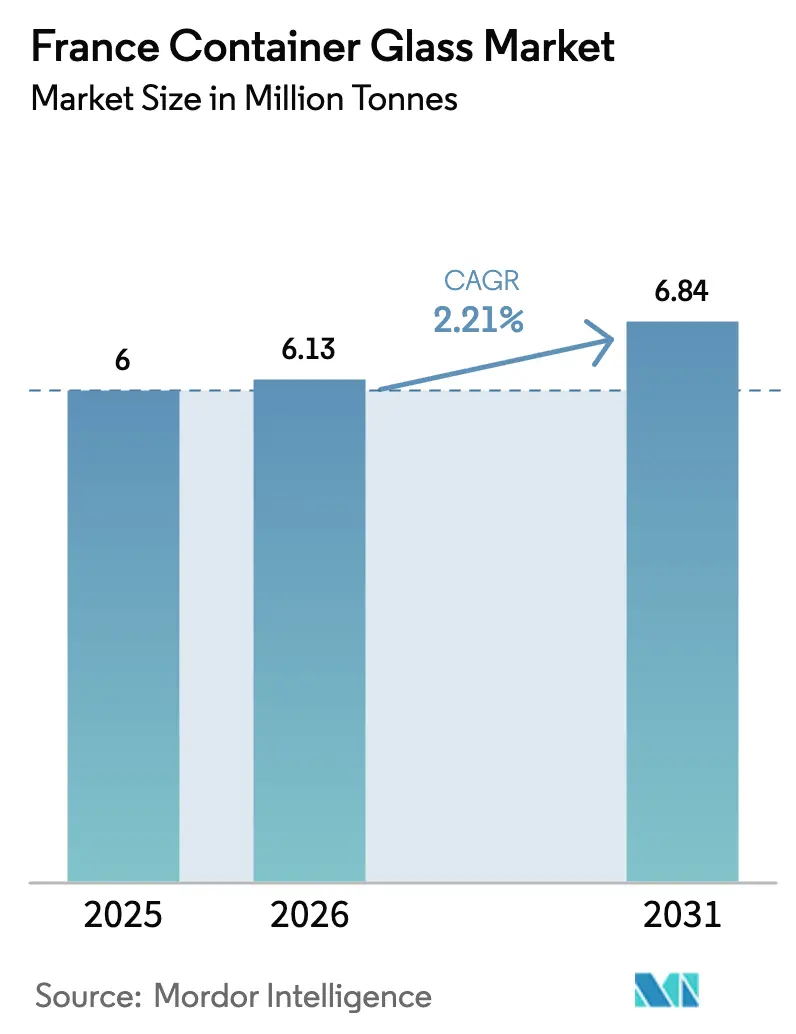
| Base Year Market Size (2025) | 6 Million tonnes |
| Market Volume (2026) | 6.13 Million tonnes |
| Market Volume (2031) | 6.84 Million tonnes |
| Growth Rate (2026 - 2031) | 2.21% CAGR |
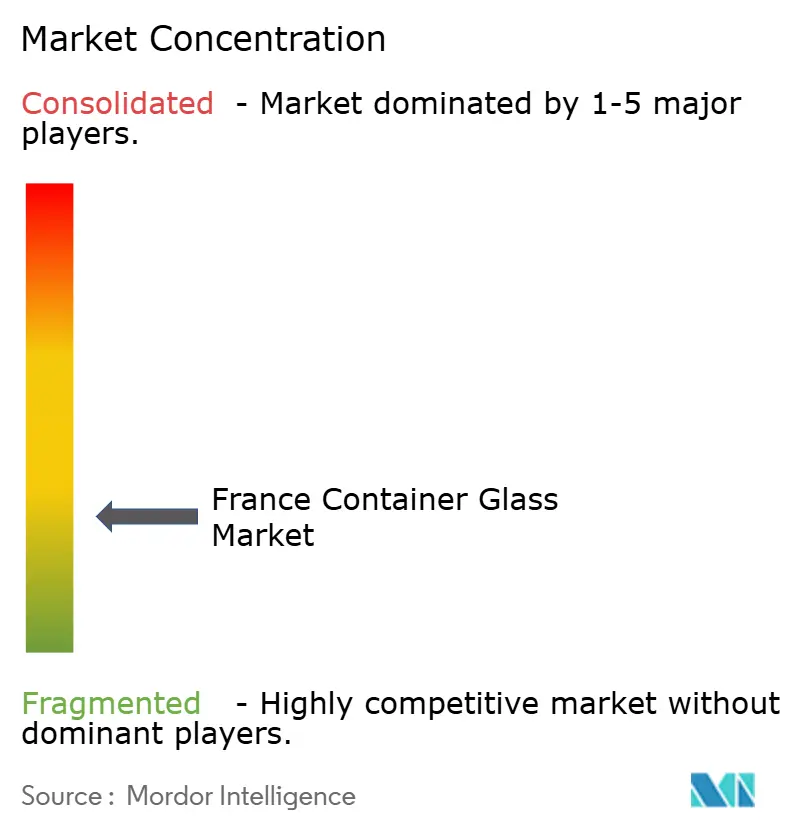
| Market Concentration | Low |
Major Players *Disclaimer: Major Players sorted in no particular order Image © Mordor Intelligence. Reuse requires attribution under CC BY 4.0. | |
France Container Glass Market Analysis by Mordor Intelligence
The France Container Glass Market size was valued at 6 million tonnes in 2025 and estimated to grow from 6.13 million tonnes in 2026 to reach 6.84 million tonnes by 2031, at a CAGR of 2.21% during the forecast period (2026-2031). Steady growth reflects a mature yet resilient ecosystem anchored in premium alcoholic beverages, luxury cosmetics, and high-end food segments. Deposit-return legislation that came into force in June 2025, with EUR 0.20-0.30 (USD 0.23-0.34) deposits per container, is improving reverse-logistics economics and raising effective recycling rates. Meanwhile, France’s EUR 5.6 billion (USD 6.33 billion) industrial-decarbonization program is accelerating furnace-electrification and hybrid-fuel trials that promise lower CO₂ intensity but require sizable capital commitments. Demand remains concentrated in beverages, which represented 60.28% of 2024 shipments, yet the cosmetics and personal-care channel is expanding at a faster 2.83% CAGR, propelled by glass’s perceived luxury cues and regulatory pressure against certain plastics. Competitive positioning increasingly revolves around furnace-retrofit investments, as evidenced by Verallia’s fully electric furnace in Cognac and O-I’s USD 65 million hybrid project in central France.[1]Greg Morris, “Verallia: No further furnace shutdowns planned,” Glass International, glass-international.com
Key Report Takeaways
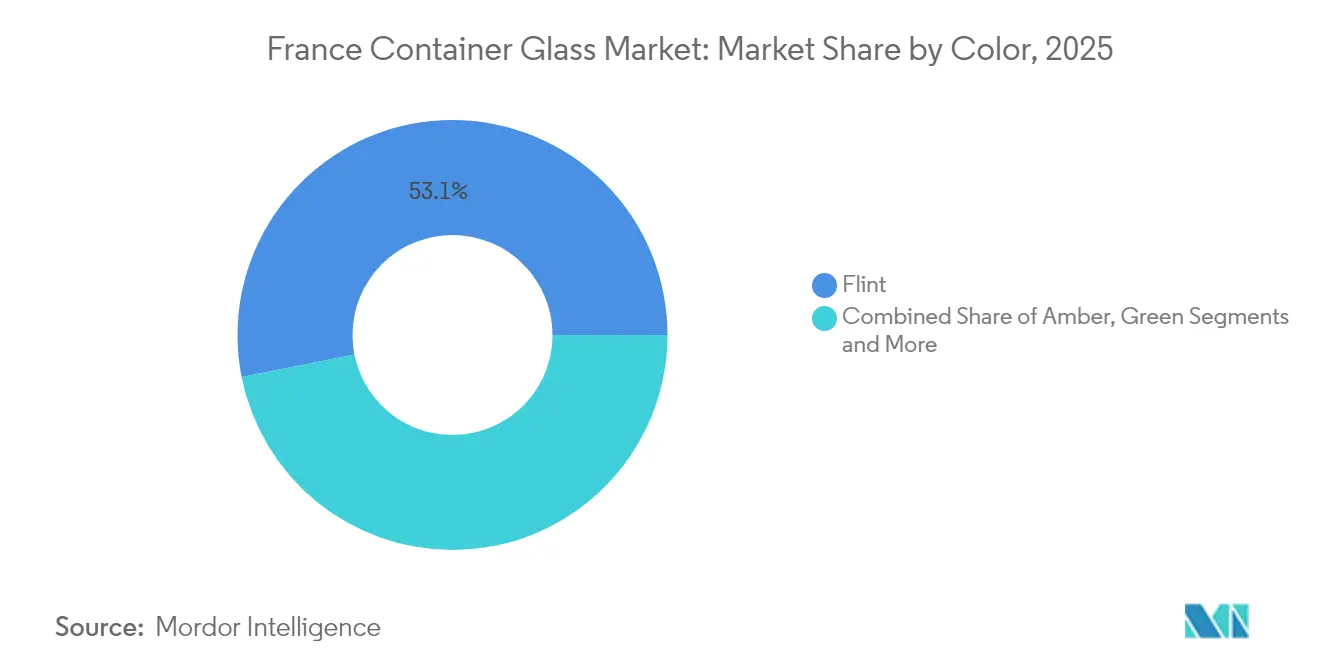
- By end-user, beverages captured 59.62% of the France container glass market share in 2025.
- By color, the France container glass market size for amber glass is projected to grow at a 2.74% CAGR between 2026-2031.
Note: Market size and forecast figures in this report are generated using Mordor Intelligence’s proprietary estimation framework, updated with the latest available data and insights as of 2026.
France Container Glass Market Trends and Insights
Drivers Impact Analysis*
| Driver | (~) % Impact on CAGR Forecast | Geographic Relevance | Impact Timeline |
|---|---|---|---|
| Growth in premium alcoholic beverages | +0.8% | Champagne, Cognac, export hubs | Long term (≥ 4 years) |
| Expansion of cosmetics and luxury perfumes | +0.5% | Île-de-France, PACA, EU exports | Medium term (2–4 years) |
| Consumer preference for non-toxic packaging | +0.4% | Nationwide, EU | Medium term (2–4 years) |
| Technological advances in lightweight glass | +0.3% | Nouvelle-Aquitaine, Grand Est | Long term (≥ 4 years) |
| Rise in eco-conscious consumer behavior | +0.3% | National, EU | Long term (≥ 4 years) |
| Export demand for French packaged goods | +0.2% | National | Medium term (2–4 years) |
| Source: Mordor Intelligence | |||
Growth in Premium Alcoholic Beverages
Champagne and cognac houses continue to specify thick-wall flint and specialty amber flasks to reinforce brand heritage, making glass effectively non-substitutable despite price sensitivity in other beverage niches. Wine export earnings rose to EUR 9.58 billion (USD 10.83 billion) in 2024, even as volumes plateaued, illustrating value migration to premium SKUs where elaborate punted bottles and embossing justify higher unit economics. Diageo’s stated goal of seizing 12% of French spirits sales by 2030 underscores external appetite for high-margin formats anchored in glass. Protected-designation rules under AOC further cement glass’s role in authenticity verification, locking in structural demand.
Expansion of Cosmetics and Luxury Perfumes Sector
Luxury perfume houses in Grasse and Paris favor intricately molded flacons with metallized necks and acid-etched logos that only container glass can deliver at scale. The segment is growing at 2.83% CAGR through 2030, outpacing the broader France container glass market, helped by regulatory curbs on certain plastic components and consumer pursuit of recyclable prestige packaging. SGD Pharma invested EUR 31 million (USD 35 million) in 2024 to modernize two domestic furnaces geared toward cosmetic formats, signaling entrenched demand. Internal siliconization treatments such as SEALIAN mitigate interaction with volatile fragrance bases while enabling further lightweighting.
Consumer Preference for Non-Toxic Packaging
Post-COVID surveys by French retailers show willingness to pay premiums of up to 6% for food packaged in inert materials, elevating glass’s appeal for preserves and gourmet condiments. FEVE’s June 2025 response to microplastics research re-emphasized glass’s chemical stability, driving private-label conversions in dairy and non-alcoholic beverages. The nascent deposit-return scheme is accelerating circular-economy messaging, giving retailers additional marketing leverage.
Technological Advancements in Lightweight Glass Manufacturing
Verallia’s all-electric Cognac furnace and O-I’s 70% electric hybrid installation cut thermal energy needs by at least 25%, enabling wall-thickness reductions that drop bottle mass from 400 g to 300 g without compromising strength. Ardagh’s finite-element modeling shifts glass distribution toward the heel and shoulder, letting wine bottles shed 40 g and still pass ASTM impact tests. Lower freight weight plus higher cullet ratios, Saverglass hit 73.3% cullet in 2024, offsetting rising electricity tariffs.
Restraints Impact Analysis*
| Restraint | (~) % Impact on CAGR Forecast | Geographic Relevance | Impact Timeline |
|---|---|---|---|
| High energy consumption in glass production | –0.6% | Nationwide plants, EU ETS zone | Short term (≤ 2 years) |
| Competition from lightweight alternatives | –0.4% | Domestic and export markets | Medium term (2–4 years) |
| Fragility and higher transport costs | –0.3% | Export corridors | Long term (≥ 4 years) |
| Volatility in raw material prices | –0.2% | Global sand and soda ash supply | Short term (≤ 2 years) |
| Source: Mordor Intelligence | |||
High Energy Consumption in Glass Production
Melting temperatures of 1,600°C keep energy intensity elevated, amplifying exposure to electricity prices that nearly doubled for French industry in 2024. Phase IV of the EU ETS slices free allocations, lifting carbon compliance costs by EUR 80–90 (USD 90–102) per ton of CO₂ emitted for a standard end-fired furnace. Verallia’s 8.7% revenue drop in 2024 shows immediate margin erosion when price hikes cannot fully cover energy surcharges.[2]Verallia, “Verallia URD 2023,” verallia.com
Competition from Lightweight Alternatives
PET bottles weigh 85% less than equivalent glass units and enjoy mature recycling pathways, especially in still-water and carbonated-soft-drink categories. Aluminum cans deliver rapid line-change flexibility and are gaining shelf appeal among craft beverages, eating into commodity beer bottle demand. Smart labels embedded in plastics add digital-engagement features that are costlier to incorporate in glass, raising switching temptations for marketing teams. Regulation curbing single-use plastics nonetheless tempers the threat in premium SKUs.
*Our forecasts treat driver/restraint impacts as directional, not additive. The impact forecasts reflect baseline growth, mix effects, and variable interactions.
Segment Analysis
By End-user: Beverages Dominate Despite Premiumization Pressures
The beverages channel generated 59.62% of 2025 shipments, equal to 3,577.2 kilotons of the France container glass market size. Growth in Champagne, cognac, and premium still wines secures baseline volume even as lighter PET erodes entry-level cider and juice bottles. Premium alcoholic labels retain glass for superior oxygen ingress protection and tactile cues that rationalize higher shelf prices. Domestic microbreweries lean into embossed, returnable glass to emphasize craft provenance, slightly offsetting aluminum’s surge among mass-market lagers.
Food, cosmetics, and pharmaceuticals collectively account for the remaining 40.38% of France's container glass market volume, yet cosmetics and personal care are expanding at a 2.69% CAGR on strong luxury exports.Cartier, Dior, and Hermès launch limited-edition scents in sculptural flacons, stimulating demand for specialty furnaces with color-changing forehearths. Pharmaceutical firms adhere to type-I borosilicate vials for biologics, reinforcing baseline throughput during beverage cyclicality.


By Color: Amber Glass Accelerates Through Premium Applications
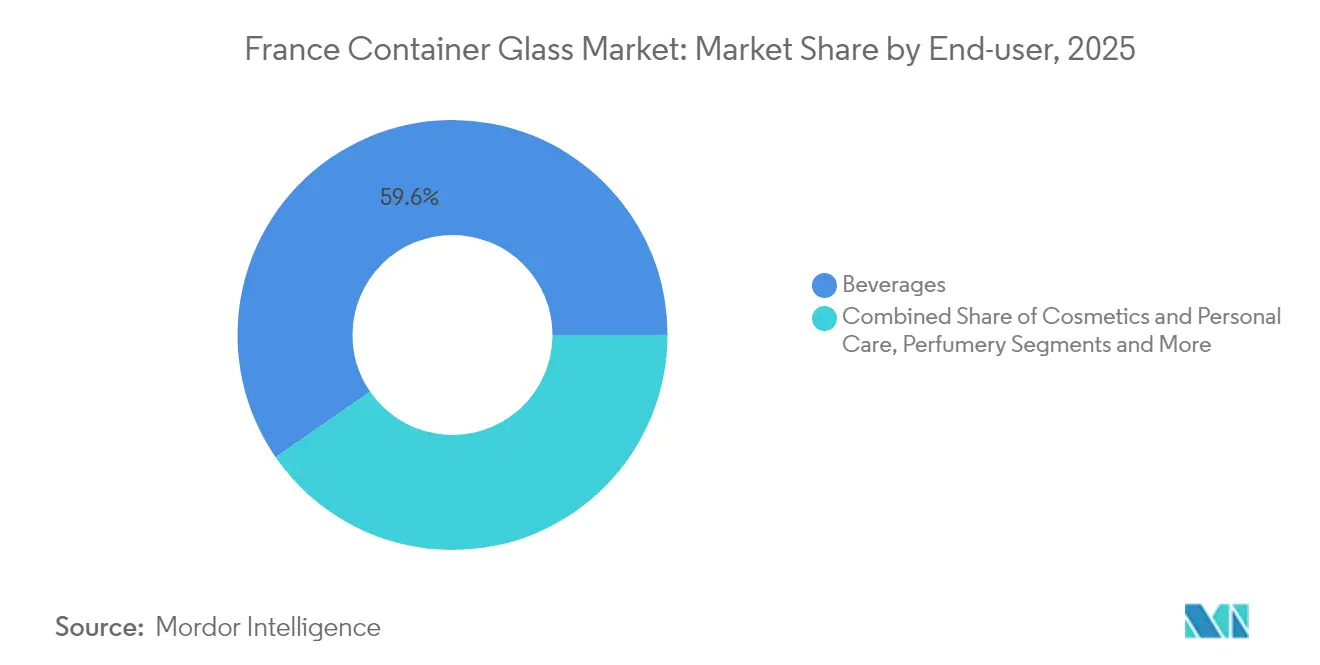
Clear flint retained 53.12% of 2025 output thanks to its versatility across wine, food, and cosmetics. Growth expectations remain moderate at 2.02% through 2031 amid trade-down trends in value wine tiers. The France container glass market share of amber glass is forecast to reach 29.65% by 2031, up from 27.25% in 2025, buoyed by UV-sensitive pharmaceuticals and dark rum presentations.
Saverglass’s 73.3% cullet incorporation in colored lines lowers energy intensity by 3-4%, letting amber compete more effectively on cost per unit. Specialty hues such as cobalt and antique green occupy niche volumes under 4% but command margins exceeding 20%, appealing to craft gin and apéritif brands seeking shelf differentiation. O-I’s modular forehearths allow rapid switchover among tints, aligning capacity with promotional runs and seasonal limited editions.
Geography Analysis
France’s 11 operating container-glass furnaces are concentrated in Nouvelle-Aquitaine, Hauts-de-France, and Grand Est, giving manufacturers proximity to sand quarries and premium beverage clients. The Champagne and Cognac corridors together represented 38% of national off-take in 2025, reflecting entrenched luxury-beverage clusters. Those districts are predicted to log a 2.07% CAGR, consistent with premium wine growth trajectories and AOC production quotas.
Hauts-de-France houses France’s largest cullet-processing center, enabling flint producers to average 60% recycled content and sidestep higher soda-ash prices. The region is forecast to expand at a 2.45% CAGR between 2026 and 2031, topping the national mean, supported by government grants targeting industrial decarbonization projects.
Export dynamics further elevate domestic throughput. In 2024, container-glass exports worth EUR 189.8 million (USD 214.5 million) moved to the UK, confirming France’s hub role for high-end packaging across Northern Europe. Access to low-carbon nuclear and renewable power gives French plants an emission-factor advantage versus German peers relying heavily on gas, a differentiator as Scope 3 reporting gains traction among multinational beverage brands.
Competitive Landscape
Competitive intensity is moderate, with the top five suppliers accounting for roughly 80% of domestic capacity. Verallia dominates premium spirits bottles through embedded client relationships in Cognac and Epernay, while O-I specializes in hybrid furnaces serving beer, food, and soft drinks. Saverglass emphasizes ultra-premium short-run designs, leveraging multi-color forehearths and micro-embossing to command higher ASPs.
Strategic investments focus on decarbonization and lightweighting. Verallia is allocating EUR 420 million (USD 474 million) through 2028 for electrified and hydrogen-ready melters, aiming for a 46% CO₂ cut versus the 2019 baseline. O-I completed a 100% biofuel trial at its Harlow facility that slashed Scope 1 emissions by 90%, signaling potential replication in French furnaces contingent on feedstock supply. Saverglass works with Fives Group on next-generation electric forehearths, a partnership that could reduce changeover downtime by 30%.
M&A is reshaping capacity distribution. Verallia’s EUR 230 million (USD 259 million) acquisition of Vidrala’s Italian plants bolsters Southern European coverage, reinforcing economies of scale in cullet sourcing. BWGI’s August 2025 buy-out of 77.05% of Verallia stock layers financial heft behind long-range capex ambitions. Emerging disruptors such as Q-Tech are piloting additive-manufactured molds that cut tooling lead times by 40%, but remain outside top-tier share rankings for now.
France Container Glass Industry Leaders
O-I Glass, Inc.
Verallia Packaging
Gerresheimer AG
SGD S.A.
Stoelzle Glass Group
- *Disclaimer: Major Players sorted in no particular order

Market Opportunities and Future Outlook
France's deposit-return scheme that took effect in June 2025 (EUR 0.20-0.30 per container) improves collection economics and raises cullet availability, which creates room for plants and brands to lock in higher recycled content and support low-carbon packaging claims. At the same time, decarbonization capex is shifting from pilots to operating assets, with O-I commencing production on an air-gas hybrid furnace at Veauche on June 7, 2026 (Fives technology, CO2 reduction cited versus conventional furnaces) and Verallia's hybrid fusion furnace (80% electric, 20% gas) at Saint-Romain-le-Puy, where operations are targeted by 2026. These actions support demand for lightweighting and high-cullet flint and amber runs across beverage, cosmetics, and pharma segments, where buyers are tightening Scope 3 requirements.
Premium beverage formats (Champagne and Cognac corridors) and specialty cosmetics and perfumery flacons remain value-led specifications where glass is harder to substitute. Energy-cost volatility and EU ETS exposure keep incentives focused on efficiency upgrades. Verallia and Dalkia's waste-heat recovery project at Lagnieu (operations scheduled for October 2026, with an announced CO2 reduction target) shows a second opportunity track beyond electrification, centered on site-level energy integration that can lower operating costs and support compliance positioning. Separately, Verallia's February 2026 industrial footprint adaptation announcement indicates an active reset in capacity allocation, creating commercial openings for suppliers offering flexible forehearths, short-run capability, and regional cullet sourcing models aligned with the Veauche approach (high cullet sourcing proximity).
Recent Industry Developments
- June 2026: O-I Glass commenced production at Veauche plant using the new air-gas hybrid furnace technology. The launch adds capacity with a hybrid furnace at a key French site and ties directly to the company's electrification and efficiency efforts. It supports O-I Glass's position in the premium beverages segment by enabling lower CO2 intensity per container produced.
- February 2026: Verallia Industrial footprint adaptation project in France and Europe announced. The announcement reshapes the company's footprint in the container glass market and could affect capacity allocation across regions. It targets demand shifts and may improve regional supply resilience for its beverage and cosmetics offerings.
- January 2026: Verallia 6-year partnership with Dalkia to recover waste heat from Lagnieu furnace; construction starting April 2026; operations October 2026. The partnership pushes decarbonization and cullet utilization at a key site through waste-heat recovery. It also aligns with regulator-driven emissions targets and may reduce energy costs over the project life cycle.


Research Methodology Framework and Report Scope
Market Definition and Coverage
This market covers container glass produced and used in France for packaging applications, measured as volume in tonnes. It includes glass containers supplied to end users such as beverages, food, cosmetics, and related uses, across common container colors.
Scope exclusions: Excludes flat glass, fiberglass, laboratory glassware, and other non-container glass products that are not used as packaging containers.
Segmentation Overview
- By End-user
- Beverages
- Alcoholic
- Beer
- Wine
- Spirits
- Other Alcoholic Beverages (Cider and Other Fermented Drinks)
- Non-Alcoholic
- Juices
- Carbonated Drinks (CSDs)
- Dairy Product Based Drinks
- Other Non-Alcoholic Beverages
- Alcoholic
- Food (Jam, Jelly, Marmalades, Honey, Sausages and Condiments, Oil, Pickles)
- Cosmetics and Personal Care
- Pharmaceuticals (excluding Vials and Ampoules)
- Perfumery
- Beverages
- By Color
- Green
- Amber
- Flint
- Other Colors
Data Sources, Market Sizing, and Validation
Desk Research
Desk research was used to set the factual base for France production and demand signals, and to keep units and definitions consistent through the model. We reviewed public sources such as INSEE industrial statistics, Eurostat production and trade series, French Customs trade tables, and European Commission policy notes tied to packaging and recycling.
To connect market movement with observable activity, we also checked sources such as FEVE publications, ADEME materials and recycling references, and peer reviewed packaging or materials journals for cullet use, recycling rates, and furnace transition context. Company annual reports, investor decks, and reputable business press were then used to validate capacity changes, plant outages, and pricing narratives, with selective support from paid subscriptions for company financials, patent lookups, and shipment level import export checks when needed. The sources listed here are illustrative, and many other public and paid references were also used to collect data, validate assumptions, and clarify open questions.
Primary Interviews and Surveys
Primary work was used to pressure test the desk inputs and to fill gaps that are not cleanly visible in public datasets, especially around the demand mix split between beverages and non-beverage packs. We spoke with participants across manufacturing, distribution, procurement, and packaging decision roles, and then reconciled what we heard across France wide demand centers so the final model reflects practical volumes and typical shipment patterns.
Distribution of primary research fieldwork respondents
| Company type | Respondent position | Region |
|---|---|---|
| Top tier: 30% | CXOs: 14% | |
| Mid tier: 48% | Functional/Unit leaders: 35% | |
| Smaller Players: 22% | Managers: 51% |
Market-Sizing & Forecasting
Sizing starts from a top-down build where national container glass volumes are reconstructed from production context, trade flows, and end use demand signals available in official statistics. The total is then checked with selective bottom-up approximations, such as sample plant and line capacity references, typical utilization ranges, and sampled container weight by major pack types, which helps adjust the total when one input series is noisy.
In the model, we track practical fingerprints that move the tonnage outcome in a visible way. These include beverage filling activity and packaging intensity, the share of returnable versus one-way formats, cullet content and recycling capture rates, furnace upgrades or shutdown timelines, and seasonality in beverage demand. When a data point is missing for a sub-area, we bridge it using nearby indicators (for example, proxying with closely related end use output and then rebalancing to the known national total).
For forecasting, scenario analysis is used because energy costs, regulation driven packaging shifts, and plant changes can move volumes unevenly across years. Assumptions are set using consensus ranges from interviews, and then the outlook is cross-checked against the implied growth path to ensure it remains realistic for France's manufacturing base and demand profile.
Data Validation & Update Cycle
Validation is done by triangulating outputs against independent signals, such as trade direction, reported production trends, and end use activity indicators, followed by variance checks at the total and key use levels. Where the model produces an unusual jump, the input drivers are reviewed, and we may re-contact sources to confirm whether a plant event, substitution trend, or a short-term shock explains it.
Before sign-off, the work is reviewed in steps so that unit conversions, time alignment, and the main assumptions are checked by more than one analyst. Reports are refreshed annually, with interim updates when material events occur, and a final pre-delivery review is completed so clients receive the latest updated view.
Mordor Intelligence's France Container Glass Market Size Versus Other Published Estimates
Published market numbers for France container glass often vary because some sources report value while others report tonnage, and they do not always align on what counts as container glass versus broader glass packaging. Differences also show up when the base year is not the same, or when growth is driven by aggressive assumptions on substitution away from plastics.
Glass packaging items like vials and ampoules often get grouped into a wider packaging glass total, but they sit outside Mordor Intelligence scope here because this study is framed as container glass volume in tonnes. That framing changes the reported size versus value-based totals.
Benchmark comparison
| Source | Market Size | Gaps in Research Methodology |
|---|---|---|
| Mordor Intelligence | USD 6.00 M (2025) | |
| Industry Publisher A | USD 2.20 B (2024) | Uses revenue for broader French glass packaging activity and mixes product types beyond container glass, so the number is not directly comparable to a tonnes-based container-only view. |
| Global Data Firm B | USD 2.48 B (2025) | Reports value in USD with different pricing and currency timing assumptions, and typically includes a wider set of container and packaging glass definitions, which can inflate totals versus a pure container glass tonnage measure. |
The table shows that the biggest spread comes from unit choice and product coverage, then from how pricing is applied when value is used. By keeping the model traceable to tonnes, trade signals, and end use activity checks, we can explain each step and reconcile differences without relying on hidden price assumptions.


Key Questions Answered in the Report
What is the projected volume for France’s container glass sector by 2031?
Output is expected to reach 6.84 million Tonnes by 2031, reflecting a 2.21% CAGR from 2026 (2026-2031).
How does the new French deposit-return scheme influence glass demand?
Deposits of EUR 0.20-0.30 (USD 0.23-0.34) incentivize returns, lift cullet availability, and reinforce glass’s circular-economy credentials.
Which end-use category is expanding fastest?
Cosmetics and personal care shipments are growing at 2.69% CAGR through 2031 on luxury export momentum.
Why is amber glass gaining share?
Its UV-blocking properties suit pharmaceuticals and premium spirits, driving a 2.74% CAGR that outpaces clear and green variants.
What decarbonization technologies are French plants adopting?
Manufacturers are trialing all-electric furnaces, hybrid biofuel melters, and hydrogen-assisted combustion to lower Scope 1 emissions by up to 90%.
How concentrated is supplier power in France’s container glass arena?
The top five companies command about 80% of capacity, yielding a moderate-to-high concentration score of 3.
Page last updated on:






