
Market Overview
| Study Period | 2020 - 2031 |
|---|---|
| Forecast Data Period | 2026 - 2031 |
| Base Year Market Size (2025) | USD 9.56 Billion |
| Market Size (2026) | USD 9.94 Billion |
| Market Size (2031) | USD 12.05 Billion |
| Growth Rate (2026 - 2031) | 3.92 % |
| Market Concentration | Medium |
Major Players *Disclaimer: Major Players sorted in no particular order Image © Mordor Intelligence. Reuse requires attribution under CC BY 4.0. | |
France Cold Chain Logistics Market Analysis by Mordor Intelligence
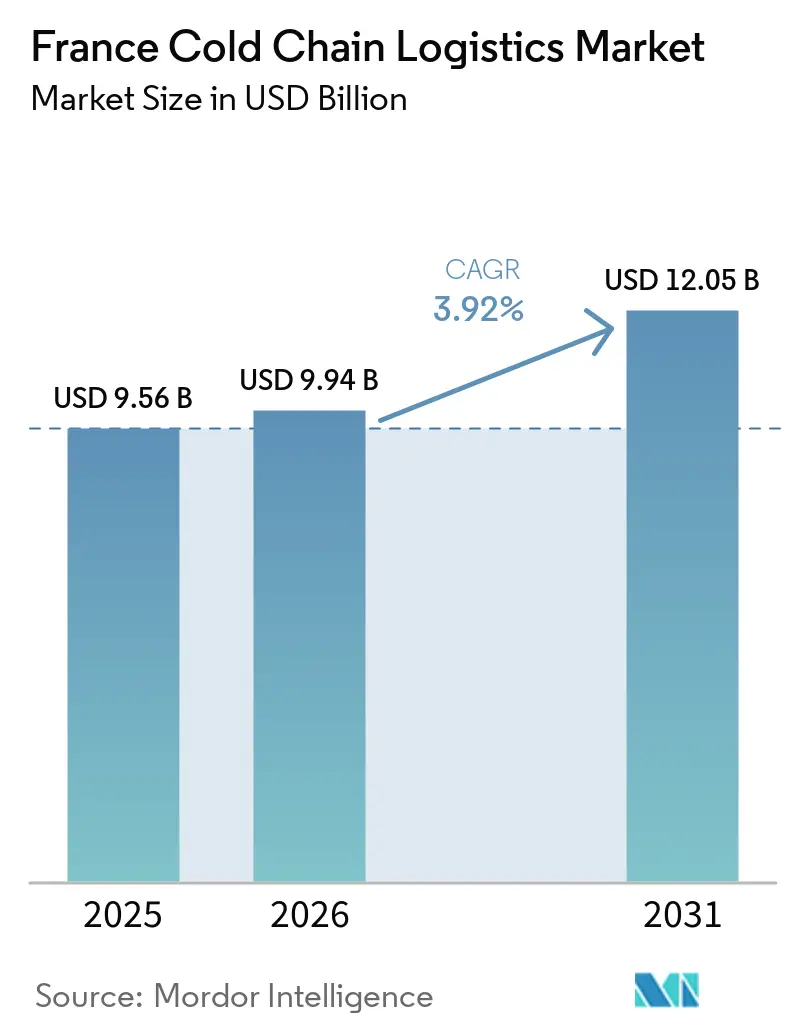
The France Cold Chain Logistics Market size is estimated at USD 9.94 billion in 2026, and is expected to reach USD 12.05 billion by 2031, at a CAGR of 3.92% during the forecast period (2026-2031).
A shift towards ultra-low-temperature pharmaceutical corridors, electrification of pivotal port assets, and the gradual rollout of hydrogen pilots are counterbalancing challenges like refrigerant phase-downs and a shortage of drivers. While there's a surge in demand for temperature-validated biologics logistics, leading to increased capital spending on ISO-compliant storage, traditional dairy and produce lanes are facing margin compression due to inefficiencies from empty returns. Upgrades at the Port of Le Havre, along with mandates for real-time IoT monitoring, are giving integrated operators a competitive edge. At the same time, EU regulations on food waste and F-gases are pushing smaller firms to retrofit their systems at a premium, further driving consolidation in the French cold chain logistics landscape.
Key Report Takeaways
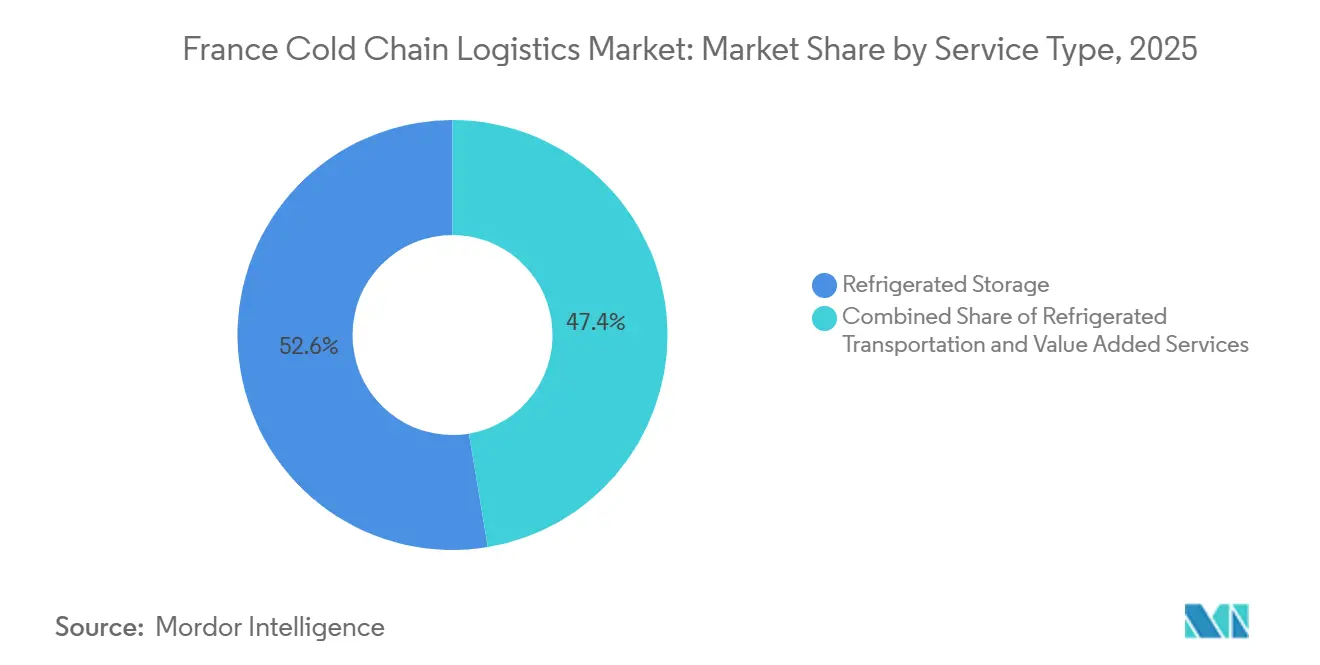
- By service type, refrigerated storage led the France cold chain logistics market share with 52.63% in 2025, while value-added services are projected to expand at the fastest rate, with a 7.14% CAGR through 2031.
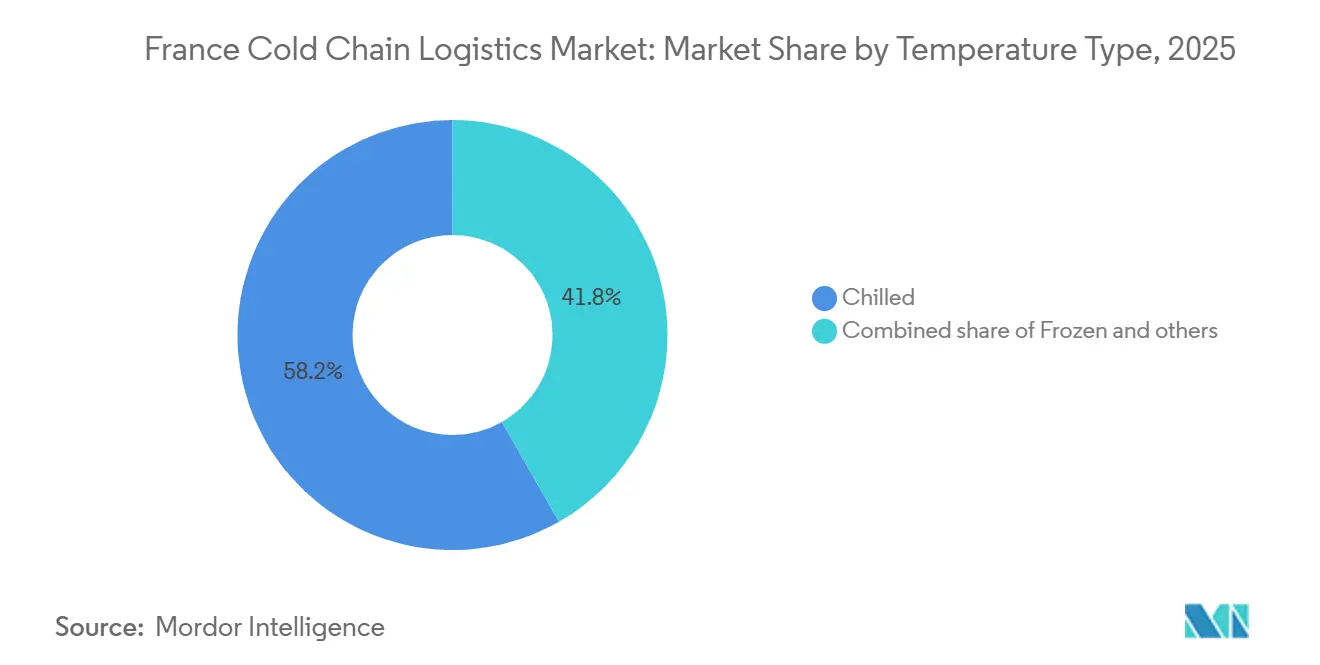
- By application, chilled applications commanded 58.24% of the France cold chain logistics market size in 2025, while frozen applications are forecast to post a 6.78% CAGR between 2026 and 2031.
- By sector, dairy & frozen desserts accounted for 29.76% of the France cold chain logistics market size in 2025, whereas pharmaceuticals & biologics are expected to register an 8.21% CAGR to 2031.
Note: Market size and forecast figures in this report are generated using Mordor Intelligence’s proprietary estimation framework, updated with the latest available data and insights as of January 2026.
France Cold Chain Logistics Market Trends and Insights
Drivers Impact Analysis*
| DRIVER | (~) % IMPACT ON CAGR FORECAST | GEOGRAPHIC RELEVANCE | TIMELINE |
|---|---|---|---|
| Post-COVID e-grocery boom elevates last-mile refrigerated demand | +0.8% | National focus on Ile-de-France, Lyon, Marseille | Short term (≤ 2 years) |
| Biologics and mRNA vaccine pipeline scaling GDP-compliant logistics | +1.2% | Pharmaceutical clusters in Lyon, Paris, Strasbourg | Medium term (2-4 years) |
| EU and France-wide food-waste reduction mandates creating cold-chain gaps | +0.5% | Retail chains and food-service networks nationwide | Medium term (2-4 years) |
| Port of Le Havre reefer-plug expansion spurring import volumes | +0.4% | Northern France and Seine corridor | Short term (≤ 2 years) |
| AI-driven predictive maintenance cutting refrigeration OPEX | +0.6% | Large-scale cold-storage hubs nationwide | Medium term (2-4 years) |
| Hydrogen-powered forklifts and reefers gaining policy incentives | +0.3% | Paris region, Nord-Pas-de-Calais pilots | Long term (≥ 4 years) |
| Source: Mordor Intelligence | |||
Post-COVID E-grocery Boom Elevates Last-mile Refrigerated Demand
France leads Europe in online grocery growth, driven by rising demand for home delivery of fresh and frozen goods. The food and beverage e-commerce sector is expected to grow at double-digit rates through 2030, boosting demand for compact refrigerated vans suited to urban routes and strengthening France food logistics capabilities. Yet, low order density and high fuel costs are straining profitability. Retailers are testing hub-and-spoke models to improve efficiency, but these raise temperature control risks. Meanwhile, grocery and pharmaceutical chains maintain separate vehicle fleets due to differing standards, increasing capital costs. This is pushing France’s cold chain sector toward specialization grocery fleets expand for last-mile delivery, while GDP-certified vehicles focus on higher-margin pharmaceutical transport.[1]
Biologics and mRNA Vaccine Pipeline Scaling GDP-compliant Logistics
In 2025, the EU enforced stricter GDP rules requiring real-time temperature monitoring at 2-8°C, -20°C, and -70°C, electronic quarantines, and 10-year data storage. Compliance now depends on GPS-tracked trailers, tamper seals, Qualified Person oversight, and annual staff training. In France, hubs in Lyon and Paris are key for handling temperature-sensitive medicines, with noncompliance fines reaching USD 586,000. Certified leaders like DHL, UPS, and Kuehne + Nagel are gaining ground, while smaller firms struggle with costly validation and blockchain tracking. Rising demand for ultra-low temperatures, driven by mRNA therapies, is fueling high-spec warehouse development with redundant power and LNG backup systems, raising entry barriers in France’s cold chain logistics market.
EU and France-wide Food-waste Reduction Mandates Creating Cold-chain Gaps
EU rules require a 10% cut at processing and a 30% cut at retail and consumption by 2030, pushing French retailers to lengthen product shelf life via tighter temperature control[2]. Fragmented regional distribution makes consistent handoffs difficult, prompting investment in IoT temperature logging and blockchain traceability. Retrofitting legacy fleets with telematics costs USD 540-1,080 per truck, so mid-tier operators defer upgrades, risking penalties. Longer inventory dwell times raise warehouse energy consumption, and RTE reported record summer peak demand in cold-storage zones during 2025. The France cold chain logistics market, therefore, juggles parallel pressures to cut waste and reduce power consumption, an operational paradox that favors integrated operators with renewable on-site generation.
Port of Le Havre Reefer-plug Expansion Spurring Import Volumes
Haropa Port has expanded to 3,900 reefer sockets along the Seine-axis, enabling shore power use and cutting vessel emissions. In early 2025, container traffic hit 1.51 million TEUs, driven by rising cold cargo imports from South America and Africa. However, limited hinterland storage is prolonging dwell times and increasing demurrage costs, offsetting efficiency gains. High inland grid and peak-tariff fees further deter smaller forwarders, prompting some to shift to Belgian and Dutch ports. Consequently, growth at Le Havre mainly benefits larger cold chain operators able to pre-book capacity and leverage bonded warehouses to navigate delays.
Restraints Impact Analysis*
| RESTRAINTS | (~) % IMPACT ON CAGR FORECAST | GEOGRAPHIC RELEVANCE | IMPACT TIMELINE |
|---|---|---|---|
| Grid-capacity bottlenecks for energy-hungry cold warehouses | -0.5% | Ile-de-France load pocket and Alpes load pockets | Short term (≤ 2 years) |
| Phase-down of HFC refrigerants inflating retrofit capex | -0.7% | Operators with legacy fleets nationwide | Medium term (2-4 years) |
| Empty-run share above 20% on international legs | -0.4% | France-Germany and France-Spain corridors | Short term (≤ 2 years) |
| Acute shortage of GDP-trained drivers and technicians | -0.6% | Lyon and Paris pharmaceutical hubs | Medium term (2-4 years) |
| Source: Mordor Intelligence | |||
Grid-capacity Bottlenecks for Energy-hungry Cold Warehouses
France’s cold chain sector, especially around suburban Paris and Lyon, faces severe grid constraints as RTE prioritizes renewables over new industrial links. This limits approvals for energy-intensive cold stores consuming 50-100 kWh per m² annually. Ultra-low temperature pharma sites require costly redundant power feeds, adding USD 216,000-324,000 upfront, pushing operators toward solar-plus-battery microgrids with decade-long paybacks. Peak tariffs run 3-4 times higher than off-peak rates, leaving little flexibility for continuous refrigeration. Some facilities pre-cool overnight, risking temperature swings, while grid scarcity delays permits and stalls new cold storage projects despite strong demand.
Phase-down of HFC Refrigerants Inflating Retrofit Capex
The EU’s steep HFC quota cuts-79% by 2027 and 85% by 2030 are pushing French cold chain operators to replace high-GWP refrigerants like R-404A with ammonia or CO₂ systems, costing over USD 54,000 per chamber with added safety upgrades. Smaller firms rely on reclaimed HFCs, but inconsistent purity and soaring R-404A prices (up to EUR 120/kg in 2024) strain margins under fixed shipper contracts. While natural refrigerants cut emissions sharply, they require scarce expertise in trans-critical CO₂ systems, causing installation delays. High upfront costs and technician shortages are slowing equipment upgrades just as demand for e-commerce perishables accelerates.
*Our forecasts treat driver/restraint impacts as directional, not additive. The impact forecasts reflect baseline growth, mix effects, and variable interactions.
Segment Analysis
By Service Type: Value-added Services Capture Pharma Premiums
Refrigerated Storage controlled 52.63% of the France cold chain logistics market share in 2025 and continues to anchor regional consolidation hubs that feed pan-European distribution[3]. This dominant share reflects France’s dense warehouse network that services food retail and pharmaceuticals from single locations. Road transport remains essential in hub-and-spoke models and absorbs the bulk of cross-border volume, yet France cold chain logistics market size value-added services such as kitting, relabeling, and compliance audits are winning the fastest growth at a 7.14% CAGR through 2031. Shippers pay premiums for end-to-end temperature validation, serialization support, and digital paperwork, margins that storage-only facilities cannot secure.
Hydrogen pilots under the FresH2 project could cut diesel exposure for truck fleets after 2028, lowering operating costs and improving ESG scores. Rail remains a second-tier option because reefer-wagon supply is thin, while air transport captures niche pharma shipments under tight lead times. Sea freight benefits from new plugs at Le Havre, but hinterland congestion dilutes port efficiency gains. The segment outlook therefore favors integrated players with diversified modal capacity inside the France cold chain logistics market.

By Temperature Type: Frozen Gains as Retailers Rebuild Safety Stock
Chilled logistics held 58.24% of the France cold chain logistics market share in 2025, powered by dairy, ready meals, and produce flows. Retailers have rebuilt frozen safety stocks since pandemic disruptions, leading the frozen category to a 6.78% forecast CAGR. Energy costs for -18°C storage run 30-40% higher than chilled, yet lower spoilage offsets part of the extra spend. Ultra-low zones below -70°C, primarily for biologics, command the highest yields but require capital-intensive redundant power and validation systems.
Plant-based frozen offerings are multiplying shelf facings, adding new SKUs that raise demand for -18°C transport legs. AI-based capacity planning, validated by MIT, cuts energy use and eases peak-load penalties, boosting adoption among operators pressured by grid constraints. Ambient-controlled lanes for bakery items remain a steady niche but offer thin margins. Investment decisions now hinge on balancing higher frozen returns against volatile energy prices, a dynamic that shapes capital allocation within the France cold chain logistics market.
By Application: Pharmaceuticals Outpace Traditional Food Segments
Dairy & Frozen Desserts represented 29.76% of application revenue in 2025, anchored by France’s status as Europe’s second-largest dairy producer. Pharmaceuticals & Biologics are projected to log an 8.21% CAGR through 2031 as mRNA vaccines and gene therapies proliferate. Fruits & Vegetables and Meat & Poultry remain mature, sub-4% growth lines constrained by flat consumption and retailer consolidation that compresses logistics rates.
Operators are converting chilled dairy warehouses into ultra-low pharmaceutical chambers to capture higher yields despite losing short-term volume. Meat & Poultry and Fish & Seafood face longer dwell times under waste-reduction rules, raising refrigeration costs without equivalent rate lifts. Chemicals and specialty materials need hazmat compliance plus temperature control, creating a niche for specialized fleets. Overall, the application mix polarizes between high-volume, low-margin food and low-volume, high-margin pharma within the France cold chain logistics market.
Geography Analysis
Ile-de-France hosts 35-40% of national cold storage, driven by proximity to Charles de Gaulle Airport’s pharma hub and dense e-grocery demand. Grid constraints in suburban zones limited new warehouse approvals in 2025, pushing operators toward rooftop solar and battery systems despite decade-long paybacks. Rhone-Alpes benefits from Lyon’s pharmaceutical cluster and its position on Alpine trade lanes, yet labor costs run higher because Swiss employers lure drivers across the border.
Northern France leverages the Port of Le Havre for reefer imports that feed Belgium and Germany, but inland storage is lagging, causing congestion that occasionally diverts cargo to Rotterdam. Grand Est and Brittany manage cross-border dairy and seafood flows, yet eastbound empty-return rates exceed 25%, squeezing margins. Southern France serves Mediterranean produce exports and tourism-driven catering, but seasonal peaks limit asset utilization, so operators prefer flexible leases over fixed capacity in these regions.
Regulatory intensity varies. Ile-de-France and Rhone-Alpes receive the strictest GDP audits given pharmaceutical density, while peripheral areas face lighter oversight, creating compliance arbitrage. The decentralized geography of the France cold chain logistics market raises network complexity; nationwide coverage requires redundant nodes, but concentrated footprints risk grid overload and wage inflation.
Regulatory Landscape
France cold chain logistics is shaped by a layered framework that combines EU food hygiene rules (including the Hygiene Package) with enforcement in France through the Ministry of Agriculture and Food Sovereignty. DGAL sets national food-safety policy and cold-chain integrity, while DDPP units conduct decentralized official controls across food operators, including logistics sites, making audit readiness and documented temperature controls a recurring compliance expectation.
For temperature-controlled land transport equipment, the ATP Agreement defines technical performance obligations, with conformity verified through testing and the issuance of certificates. In practice, operators use delegated bodies such as GIE Cemafroid for technical controls and certification workflows. For storage and transport of non-animal food products, France also applies the Order of October 8, 2013, which reinforces temperature maintenance and record-keeping duties, and operators align their procedures to HACCP and Good Hygiene Practices guides (GBPH) referenced in inspections and customer audits.
Value Chain Analysis
The France cold chain logistics value chain starts with shippers in food (dairy, meat, seafood, produce, ready meals) and healthcare (pharmaceuticals, vaccines, clinical materials), then moves through packaging, pre-cooling, and compliant handoffs into multi-temperature transport and storage. Upstream inputs include refrigeration equipment and refrigerants, temperature loggers and telematics, insulated packaging, and energy supply, with grid access and peak tariffs shaping warehouse site selection for facilities that can consume 50-100 kWh per m2 annually.
Core service nodes include port and airport gateways (reefer imports via Haropa Port and pharma flows connected to Charles de Gaulle), regional DCs and bonded warehouses, and last-mile refrigerated fleets. Compliance and assurance sit alongside physical operations through ATP certification for equipment, HACCP-aligned operating procedures for food, and GDP-compliant processes for medicines, overseen in France by ANSM for healthcare distribution and by DGAL/DDPP for food controls. Industry coordination and capability development are supported by bodies such as La Chaine Logistique du Froid, UNTF, USNEF, and AFF, while network densification and consolidation continue through investments and acquisitions that add certified capacity in hubs such as Strasbourg and Lyon.
Competitive Landscape
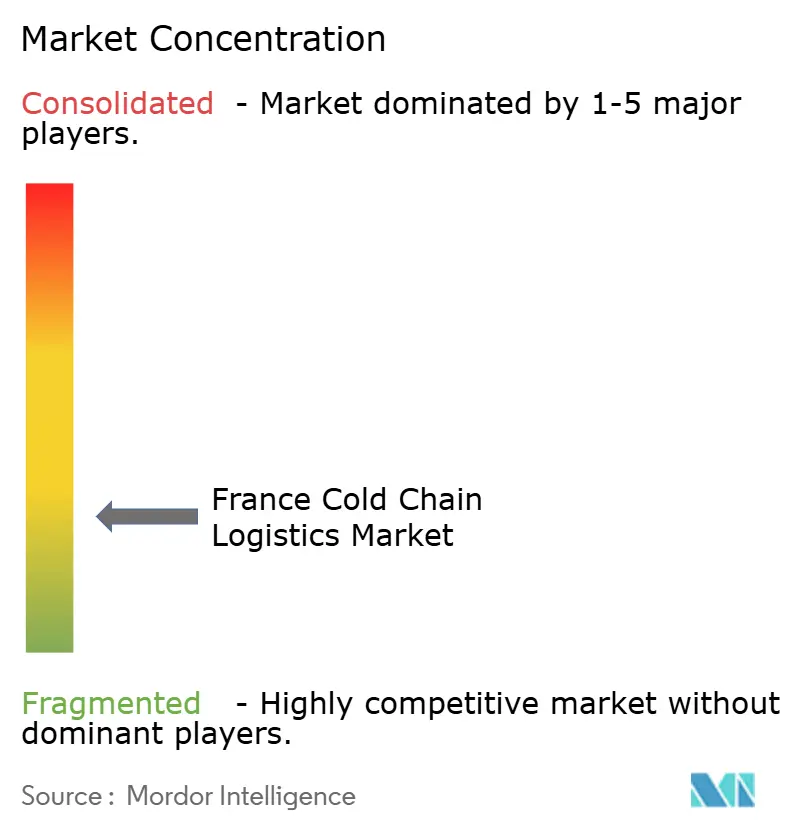
The France cold chain logistics market remains moderately fragmented. STEF controls the largest domestic network of 250 sites and 5,500 refrigerated vehicles, yet its share is below 15%, so international integrators and niche specialists still find room to grow. DSV’s 2025 integration of DB Schenker boosted cross-border capabilities, especially in pharma lanes. Kuehne + Nagel and DHL expanded GDP-certified depots in Lyon and Paris, tailoring solutions for clinical-trial staging. Strategy splits along scale lines: incumbents invest in alternative fuels and AI routing to retain share, whereas challengers acquire certified facilities rather than build from scratch.
Technology is the competitive fulcrum. IoT sensors provide real-time temperature visibility, blockchain underpins traceability, and digital twins optimize energy use, yet roll-out costs slow adoption by mid-tier firms. STEF’s deployment of hydrogen forklifts signals early compliance with future F-gas caps. Disruptors such as TSE Express Médical focus on customized biotech handling, capturing clients that prize agility over network breadth. ISO 9001:2015 and GDP certifications act as entry barriers, clustering pharmaceutical flows among operators that can fund audits and validation.
Cost pressure from refrigerant phase-downs and labor deficits is accelerating consolidation. Smaller warehouses without natural-refrigerant systems face retrofit bills that they cannot finance, prompting sale or leaseback deals. Meanwhile, e-grocery growth lures parcel specialists into chilled last-mile segments, increasing competitive overlap. Overall, rivalry intensifies along two fronts: sustainability leadership and pharmaceutical compliance excellence within the France cold chain logistics market.
France Cold Chain Logistics Industry Leaders
-
STEF
-
Kuehne + Nagel
-
Sofrilog
-
Olano Group
-
XPO
- *Disclaimer: Major Players sorted in no particular order
Market Opportunities and Future Outlook
Urban and peri-urban capacity constraints leave room for high-density refrigerated warehousing and more efficient distribution models. The Rungis International Market project reflects this direction with a two-level refrigerated warehouse designed to meet BBCA (low-carbon building) standards, while STEF's Strasbourg (Port du Rhin) refrigerated site (15,500 m2) is another example of consolidation closer to multimodal nodes and cross-border flows.
Decarbonization and digitization are also creating near-term service upgrades that operators can package as value-added offerings, especially when customers pay for verifiable temperature integrity and lower emissions. DHL Group's EUR 160 million investment plan in France for 2026-2027 targets expansion and upgrades to logistics infrastructure tied to the clean-energy transition, and France Supply Chain and BearingPoint survey findings point to broad adoption of automation and technology investments across logistics organizations. Separate from the large-network model, cold last-mile alternatives are being scaled, including Sofrigam and Kleuster's temperature-controlled cargo bike solutions, which provide an entry point for refrigerated distribution in dense city centers where van access, congestion, and delivery windows constrain conventional fleets.
Recent Industry Developments
- June 2026: STEF inaugurated a major expansion of its multi-temperature platform in Reichstett (Strasbourg), adding a 65,000 cubic meter deep-freeze chamber and 15,000 pallet positions for Mars Wrigley. The added deep-freeze capacity supports industrial food customer servicing and increases the availability of large-scale frozen positions in the Grand Est corridor.
- April 2026: Olano Group acquired Transports Lambec, a Brittany-based specialist in meat and fresh product transport, to reinforce its cold chain footprint in western France. The acquisition densifies regional distribution capacity and supports faster coverage for temperature-controlled food lanes where route efficiency and asset utilization drive margins.
- December 2025: GEODIS partnered with EDF to deploy on-site renewables and energy-optimization software across logistics facilities. The deployment targets a structural reduction in cold-store energy intensity, helping operators manage electricity cost volatility while meeting customer requirements on emissions and facility performance.
Research Methodology Framework and Report Scope
Market Definition and Coverage
This market covers paid logistics services in France that keep products within a controlled temperature range during storage, handling, and transportation. Revenue is counted for cold storage and refrigerated freight tied to food and life-science supply chains.
Scope exclusions: on-site refrigeration equipment sales, standalone packaging material sales, and in-house logistics not billed as a third-party service are excluded.
Segmentation Overview
- By Service Type
- Refrigerated Storage
- Refrigerated Transportation
- Road
- Rail
- Sea
- Air
- Value-Added Services
- By Temperature Type
- Chilled (0–5 °C)
- Frozen (-18 °C)
- Ambient
- Deep-Frozen / Ultra-Low (less than -20 °C)
- By Application
- Fruits & Vegetables
- Meat & Poultry
- Fish & Seafood
- Dairy & Frozen Desserts
- Bakery & Confectionery
- Ready-to-Eat Meals
- Pharmaceuticals & Biologics
- Vaccines & Clinical Trial Materials
- Chemicals & Specialty Materials
- Other Perishables
Data Sources, Market Sizing, and Validation
Desk Research
Desk work started by locking the France scope and aligning it with public indicators that explain cold movement needs. We relied on sources such as INSEE for macro and sector activity, Eurostat for trade and transport series, the French Ministry of Agriculture for agri-food production context, and the French Customs administration for import and export signals that translate into refrigerated handling demand.
To structure service revenue, we also reviewed public company filings, investor presentations, and reputable press coverage to understand capacity additions, network footprints, and pricing behavior. A paid subscription for company financials and a shipment-level import and export database were used selectively to cross-check operator scale and trade lane intensity when public detail was thin. These examples are illustrative only, and there were many other sources used for data collection, validation, and research clarification.
Primary Interviews and Surveys
Primary inputs came from interviews and structured surveys with cold storage operators, refrigerated carriers, and logistics managers at food manufacturers, retailers, and pharma distributors operating across France. We used these discussions to confirm how contracts are priced (storage, handling, and transport), how utilization and seasonality affect revenue, and which flows are kept out of third-party billing. Model assumptions were then adjusted accordingly.
Distribution of primary research fieldwork respondents
| Company type | Respondent position |
|---|---|
| Top tier: 37% | CXOs: 16% |
| Mid tier: 43% | Functional/Unit leaders: 33% |
| Smaller Players: 20% | Managers: 51% |
Market-Sizing & Forecasting
Sizing used top-down and bottom-up logic, but the starting point was a top-down reconstruction of France demand. This was done by mapping temperature-controlled logistics needs to food and pharma throughput, then applying the intensity of chilled versus frozen handling. To keep totals realistic, we corroborated the results with selective bottom-up checks, including sampled price per pallet-position per day for storage, typical handling fees, and refrigerated transport rates applied to indicative volumes shared by operators.
Key inputs in the model included cold storage capacity utilization ranges, the share of perishable and frozen categories in retail and foodservice flows, pharma cold distribution requirements, cross-border trade intensity for temperature-sensitive products, and fuel and labor cost pass-through patterns that move logistics pricing. Where company-level revenue disclosures were incomplete, we used triangulated proxies (fleet size, warehouse footprint, and service mix) so gaps did not inflate totals. Forecasting used scenario analysis anchored to expected throughput growth and cost-driven price progression, then the final curve was checked against what interviewees considered achievable for contract renewals and capacity additions over the period.
Data Validation & Update Cycle
Outputs were checked in layers to reduce single-source bias. We compared modeled totals against independent signals such as trade movement trends, announced capacity expansions, and observed pricing changes, then reworked anomalies until the calculations and the market story aligned.
Before sign-off, assumptions and calculations were reviewed by another analyst. We re-contacted sources when variances were larger than what normal seasonality would explain. Reports refresh annually, with interim updates when material events occur (for example, regulatory shifts or major capacity changes). Right before delivery, a final review pass is completed so clients receive an updated view based on the latest available information.
Mordor Intelligence's France Cold Chain Logistics Market Size Compared With Other Published Estimates
Published values for France cold chain logistics often differ because authors do not always count the same services. They also use different base years and currency timing. The gaps show up most when adjacent revenue streams are mixed into the total, or when capacity and throughput assumptions are not cross-checked with operators.
In this market, the largest gap drivers are usually whether the figure includes only third-party cold storage and refrigerated transport fees, or whether it also folds in packaging, equipment, and non-temperature-controlled food logistics. Another common driver is how price is projected, since contract indexation and energy-linked surcharges can move revenue even with stable volumes. A clearer split between chilled and frozen activity, plus a tighter refresh cadence on pricing and utilization, helps keep totals closer to how the industry bills for services.
Benchmark comparison
| Source | Market Size | Gaps in Research Methodology |
|---|---|---|
| Mordor Intelligence | USD 9.56 B (2025) | |
| Industry Association A | USD 8.70 B (2024) | Uses a broader cold chain industry lens and can blend non-logistics revenue, and it also anchors on a prior-year value without a clear service revenue split for storage versus transport. |
| Regional Consultancy B | USD 12.00 B (2024) | Often counts the full cold logistics ecosystem, including packaging and equipment-linked services, and it can apply aggressive price uplift without checking utilization and contract indexation with operators. |
The spread mainly comes from what is treated as billable logistics services and how price growth is carried forward between years, and the table shows that clearly. When packaging and refrigeration equipment related revenue is left out and storage plus refrigerated transport is counted only as third-party service billing within France, the number typically sits lower, which is the scope applied by Mordor Intelligence.
Key Questions Answered in the Report
How large is the France cold chain logistics market in 2026 and what growth is expected?
The market is valued at USD 9.94 billion in 2026 and is projected to reach USD 12.05 billion by 2031, showing a 3.92% CAGR.
Which service type currently dominates French temperature-controlled logistics?
Refrigerated Storage leads, holding 52.63% share in 2025 thanks to the country’s dense warehouse network.
What is the fastest-growing application category through 2031?
Pharmaceuticals & Biologics are forecast to expand at an 8.21% CAGR as biologic therapies and mRNA vaccines scale.
Where are infrastructure bottlenecks most acute?
Grid-capacity constraints are most severe around Île-de-France and Rhône-Alpes, slowing new ultra-low-temperature warehouse approvals.