
Market Overview
| Study Period | 2020 - 2031 |
|---|---|
| Forecast Data Period | 2026 - 2031 |
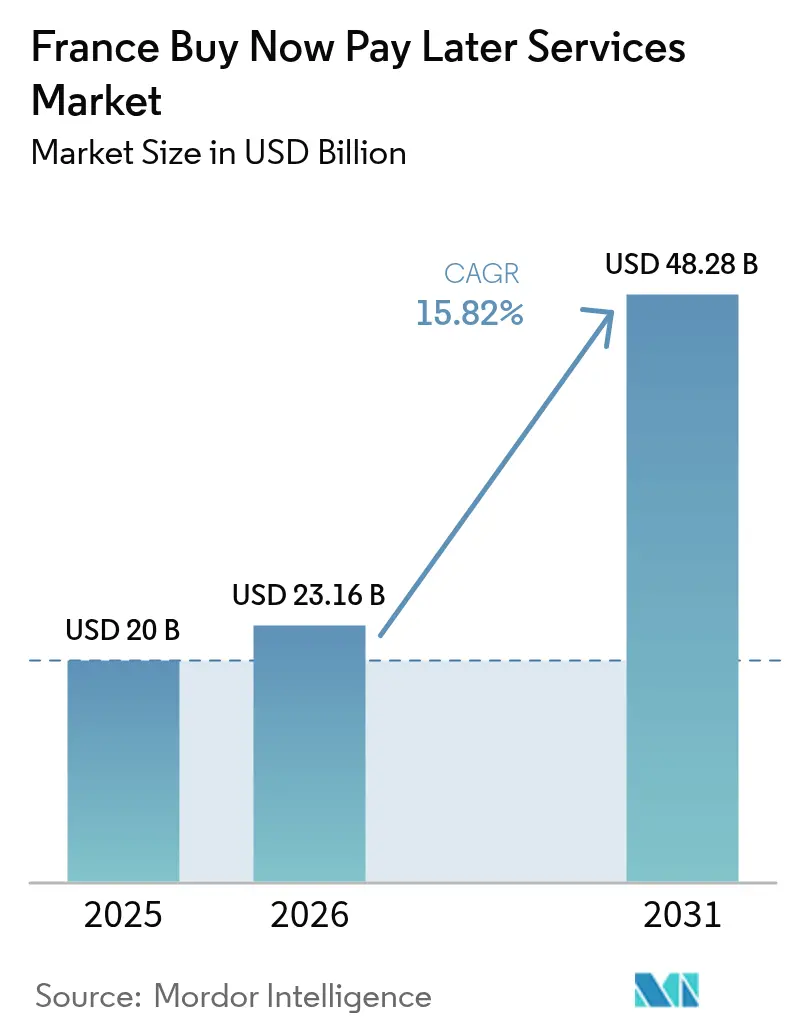
| Base Year Market Size (2025) | USD 20 Billion |
| Market Size (2026) | USD 23.16 Billion |
| Market Size (2031) | USD 48.28 Billion |
| Growth Rate (2026 - 2031) | 15.82 % |
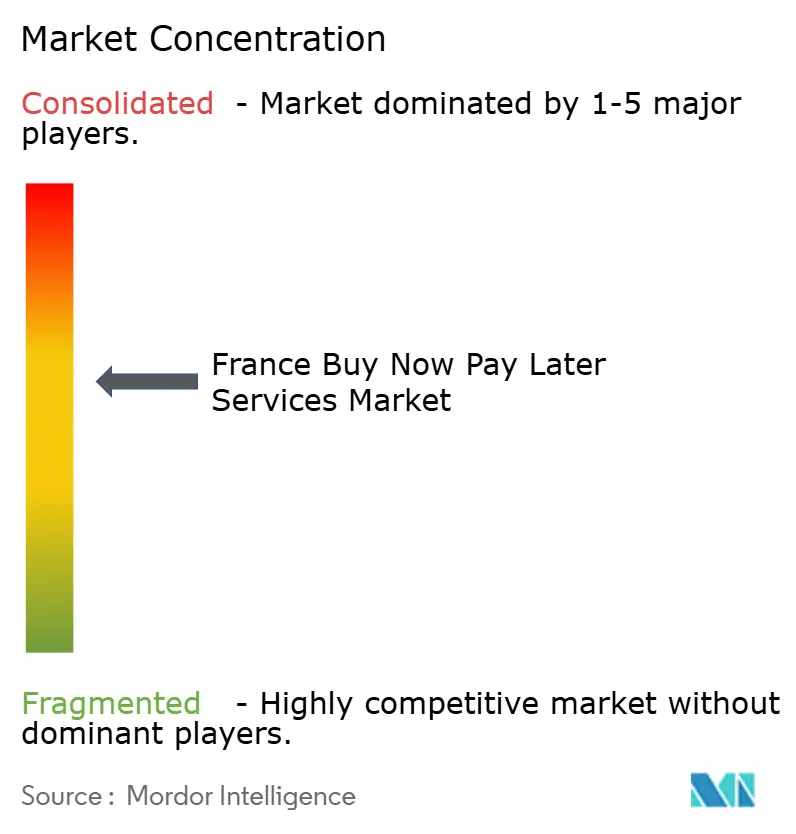
| Market Concentration | Medium |
Major Players *Disclaimer: Major Players sorted in no particular order Image © Mordor Intelligence. Reuse requires attribution under CC BY 4.0. | |
France Buy Now Pay Later Services Market Analysis by Mordor Intelligence
The France BNPL services market size was valued at USD 20 billion in 2025 and estimated to grow from USD 23.16 billion in 2026 to reach USD 48.28 billion by 2031, at a CAGR of 15.82% during the forecast period (2026-2031). Expansion rests on five pillars: merchants looking for cheaper acceptance after interchange-fee caps, consumers managing tight household budgets, instant-payment rails lowering funding costs, large marketplaces embedding BNPL APIs, and banks scaling low-cost balance-sheet lending. Competition remains intense as fintechs refine risk analytics while incumbent banks cross-sell to cardholders. Regulation increases complexity; CCD2 compliance forces fuller credit checks that raise costs, yet should improve long-run trust in providers. Technology upgrades—Carte Bancaire tokenisation, biometric authentication, and mobile in-app roll-outs—are lowering fraud and boosting checkout conversion. Neo-banks reach digital natives, whereas cost-of-living pressures extend BNPL into semi-essential categories, keeping demand resilient across economic cycles.
Key Report Takeaways
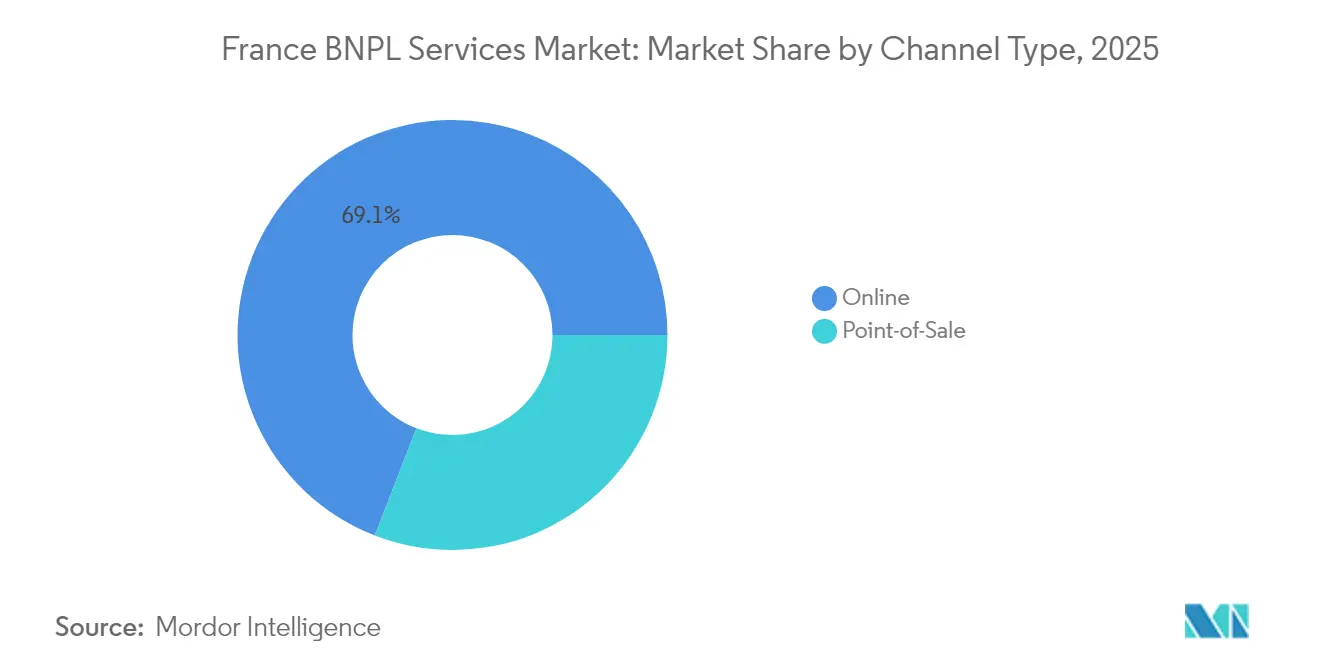
- By channel, online checkout commanded 69.12% of the France BNPL services market share in 2025, while in-store solutions are projected to expand at an 17.6% CAGR through 2031.
- By end-use industry, fashion & apparel led with 32.10% of the France BNPL services market share in 2025; travel & leisure is forecasted to grow at a 18.55% CAGR to 2031.
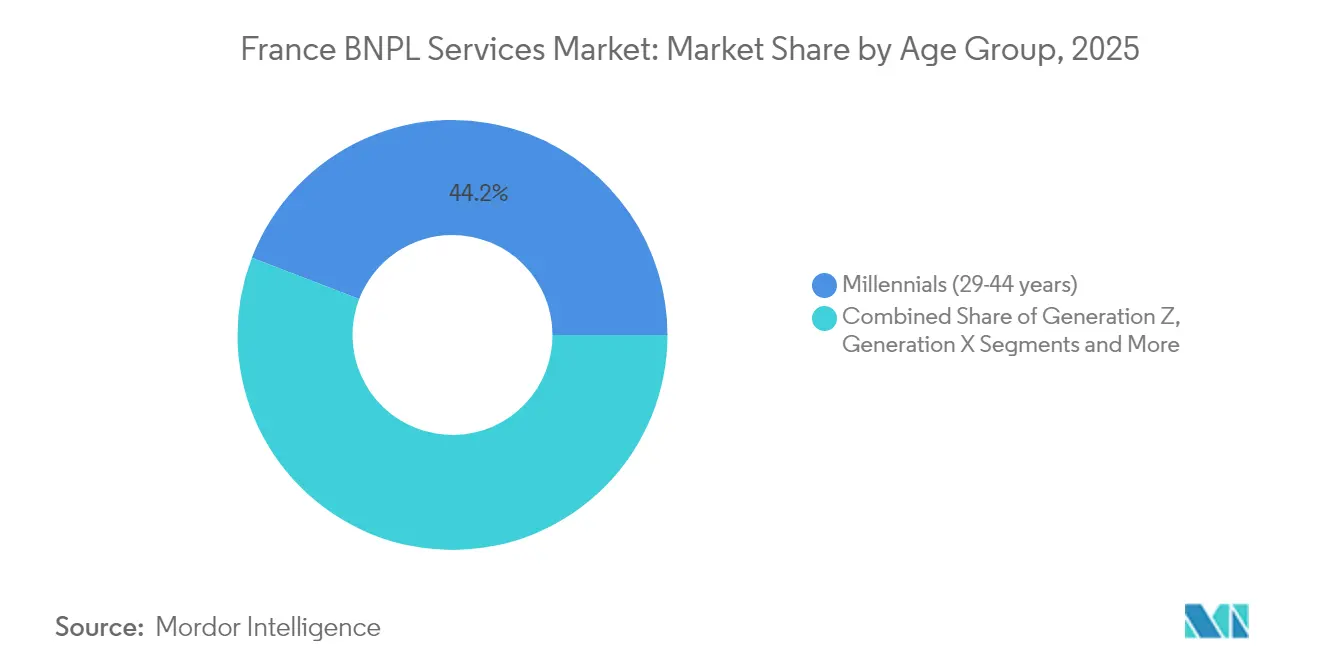
- By age group, millennials captured 44.15% of the France BNPL services market size in 2025; generation Z posts the fastest 18.92% CAGR.
- By provider type, fintech specialists held 59.45% share of the France BNPL services market size in 2025; they are set to post the highest 17.25% CAGR over 2026-2031.
Note: Market size and forecast figures in this report are generated using Mordor Intelligence’s proprietary estimation framework, updated with the latest available data and insights as of 2026.
Market Trends and Insights
Drivers Impact Analysis of France Buy Now Pay Later Services Market*
| Driver | (~) % Impact on CAGR Forecast | Geographic Relevance | Impact Timeline |
|---|---|---|---|
| Cost-of-living squeeze boosting demand for short-term interest-free credit | +4.0% | National, stronger in urban zones | Short term (≤ 2 years) |
| BNPL API integration by major French marketplaces (Cdiscount, La Redoute) | +3.3% | France, concentrated in large e-commerce hubs | Short term (≤ 2 years) |
| Neo-bank in-app BNPL roll-outs (Lydia, Nickel) | +3.4% | National, tech-savvy demographics | Medium term (2-4 years) |
| Tightening of interchange-fee caps prompting merchant BNPL adoption | +2.7% | France with spillover across EU | Medium term (2-4 years) |
| Expansion of Carte Bancaire e-commerce tokenisation | +2.2% | France, primarily urban centres | Short term (≤ 2 years) |
| ECB/BoF instant-payment rails (TIPS) improving provider liquidity | +2.5% | France plus Eurozone | Medium term (2-4 years) |
| Source: Mordor Intelligence | |||
Cost-of-living squeeze boosting demand
Elevated inflation keeps French household budgets under pressure in 2025, turning zero-interest instalments from a novelty into a necessity. BNP Paribas recorded 43% European usage in 2024, a 22% jump on 2023, while Capgemini showed 70% adoption among French shoppers. Floa found BNPL utilisation for groceries and utilities rising 34%. Repeat usage lengthens customer lifecycles and raises lifetime value, even as average ticket sizes dip. Merchants in food, pharmacy, and utilities now present BNPL alongside cards, cementing mainstream status. Banque de France data indicate delinquencies remain manageable thanks to tighter, data-rich underwriting.
BNPL API integration by major French marketplaces
Cdiscount and La Redoute standardised BNPL APIs in 2024, streamlining onboarding for 15,000 merchants. Mollie credits this rollout with lifting BNPL availability to 42% of French online shoppers, up from 28% in 2022. Integration times fell 60%, unlocking broader verticals such as hardware and cosmetics. Worldline reports tokenised BNPL baskets running 20-25% above card equivalents. Providers also harvest richer data, improving risk scoring and enabling tailored repayment plans.
Neo-bank in-app BNPL roll-outs widening reach
Lydia and Nickel embed instalments within everyday banking apps, offering 8 million users a single-click path to credit. Lydia says 38% of its customers activated BNPL within six months, trimming acquisition cost by 62%. Proprietary current-account data halves fraud triggers and cuts default rates 40% versus market averages. Neo-banks also cater to lightly banked regions with limited card penetration, broadening inclusion and adding a sustained 3.4% lift to France's BNPL services market growth through 2029.
Tightening interchange-fee caps prompting merchant adoption
EU-wide caps hold credit-card fees at 0.3% and debit fees at 0.2%, narrowing acquirer margins. BNPL charges around 4%, yet merchants still benefit because conversion rises 30% and average basket values climb 45%, according to BNP Paribas. Mid-tier retailers that once balked at card costs now view BNPL as a growth lever, especially in electronics and home furnishings.
Restraints Impact Analysis of France Buy Now Pay Later Services Market*
| Restraint | (~) % Impact on CAGR Forecast | Geographic Relevance | Impact Timeline |
|---|---|---|---|
| Transposition of EU CCD2 raising compliance costs | -2.0% | France and EU | Medium term (2-4 years) |
| High default rates in sub-prime segments | -2.3% | National, economically challenged regions | Short term (≤ 2 years) |
| CNIL data-privacy enforcement limiting risk-scoring data | -1.6% | France, heavier for cross-border providers | Medium term (2-4 years) |
| ACPR scrutiny on capital adequacy for non-bank players | -1.3% | France, particularly fintechs | Medium term (2-4 years) |
| Source: Mordor Intelligence | |||
EU CCD2 transposition is increasing compliance costs
CCD2, due in French law by November 2025, brings stricter credit checks and disclosure mandates. Hogan Lovells highlights the removal of minimum loan thresholds and repayment windows capped at 50 days. Oliver Wyman forecasts 15-20% cost inflation for smaller providers. Compliance burdens could force consolidation, diminishing provider diversity yet improving transparency.
High default rates in sub-prime segments
Aggregate BNPL delinquencies stay near 2.1%, but Rothschild & Co. and the EBA flag rising stress in lower-income regions[1]. OECD modelling shows stricter underwriting could exclude 18-22% of applicants[2]. Providers have tightened scorecards, adding up-front deposits and shorter tenors, trimming the addressable pool, and subtracting a part from the France BNPL services market CAGR.
*Our forecasts treat driver/restraint impacts as directional, not additive. The impact forecasts reflect baseline growth, mix effects, and variable interactions.
France Buy Now Pay Later Services Market Segment Analysis
By Channel:
Online dominance challenged by in-store growthOnline transactions comprised 69.12% of the France BNPL services market in 2025, supported by frictionless widgets and biometric login. Checkout.com places BNPL at 5.1% of global e-commerce value, with France above the continental average. One-click tokenisation cuts checkout abandonment, while cross-border localisation broadens merchant reach. The France BNPL services market size for online payments is projected to expand at 15.18% CAGR through 2031 as 5G penetration deepens and social-commerce links proliferate.
Point-of-sale BNPL, although nascent, logs an 17.6% CAGR. Worldline says 42% of physical retailers now offer instalments, up from 18% in 2022. Upgraded terminal firmware and QR code options enable paperless enrolment, and Edgar Dunn & Company reports ticket uplifts of 20% in DIY outlets. By 2031, in-store transactions could account for 39.20% of France BNPL services market share if NFC-enabled phones become universal.

By End-Use Industry:
Fashion leads while travel acceleratesFashion & apparel commanded 32.10% of the France BNPL services market size in 2025, buoyed by high return rates and “try now pay later” propositions. McKinsey highlights the growing adoption of Buy Now Pay Later (BNPL) options among French fashion chains, with 68% of these chains now offering at least one BNPL solution. This payment method has gained traction due to its higher transaction value, which is significantly above traditional card purchases. Furthermore, the implementation of automated refund-against-installment processes has streamlined operations and reduced costs. The BNPL segment is expected to experience robust growth, supported by its increasing popularity among mid-range brands.
Travel & leisure is the fastest-growing category with a 18.55% CAGR. Floa observes an 85% jump in BNPL bookings in 2024, with average transaction values near EUR 850 (USD 929 million). Flexible plans encourage consumers to lock in itinerary spend earlier, boosting occupancy for hotels and tour operators. Ancillary revenues, such as seat upgrades, enlarge provider fee pools, lifting France's BNPL services market share for the vertical.
Healthcare & wellness and home improvement tuck in with 16.52% and 15.05% CAGRs. Dental chains, optical boutiques, and vet clinics pitch six-month plans to spread essential outlays, while hardware stores pair BNPL promotions with energy-efficiency home upgrades.
By Age Group:
Millennials dominate, Gen Z surgesMillennials held 44.15% of France's BNPL services market share in 2025, supported by established incomes and bigger ticket sizes. BNP Paribas lists an average BNPL basket of EUR 285 (USD 312 million) for this cohort. Family-formation pressures spur demand for furniture and daycare subscriptions spread over multiple instalments. Providers favour the cohort’s repayment reliability, keeping approval rates high.
Generation Z posts a 18.92% CAGR on digital-native behaviours. Capgemini finds 46% of French Gen Z buyers check out directly from social feeds. Embedded BNPL widgets in influencer storefronts mesh with their impulse-buy mindset, though ticket values average EUR 125 (USD 137 million). As Gen Z’s income climbs, their share of the France BNPL services market size will expand in tandem. Generation X and baby boomers adopt BNPL mainly for healthcare and home upgrades, demonstrating widening multigenerational appeal.
By Provider:
Fintech leadership amid banking pushFintechs retained 59.45% of France BNPL services market share in 2025. Alma’s partnership with Mollie enrolled 19,000 merchants and 6.8 million shoppers, lifting sales 20%. Klarna localised its French app, adding chatbots that cut service handle time by 35%. Product agility—split-payment scheduling and carbon-footprint tracking—differentiates fintechs, undergirding a 17.25% CAGR through 2031.
Banks control a 33.12% share, leveraging cheap deposits and broad client bases. BNP Paribas’s Floa unit saw 32% production growth in Q1 2025. Crédit Agricole’s joint venture with Worldline unites acquiring rails and branch distribution, broadening physical-merchant reach. Greater regulatory capital strength provides buffers against CCD2 compliance shocks, suggesting bank shares could rise steadily within the France BNPL services market.
Retailer-run instalment programs and niche credit providers occupy a 7.43% share but face rising compliance costs. M&A is accelerating: Crédit Agricole bought Pledg to internalise its merchant pipeline. Younited Credit’s SPAC listing opens liquidity for tech upgrades.
Geography Analysis
Paris and Île-de-France deliver 37.62% of BNPL transaction volume, reflecting e-commerce dominance and 100% fibre coverage. Dense delivery networks and high smartphone usage drive adoption, with click-and-collect BNPL services cutting last-mile costs.
Provence-Alpes-Côte d’Azur and Occitanie record 27.4% and 25.2% growth respectively, fuelled by tourism spending packaged with instalment offers. BNPL options for holiday rentals, ferry tickets, and festival passes broaden seasonal demand windows, boosting local SME revenue.
The north-east lags but offers untapped potential. Providers partner with chambers of commerce to onboard artisanal merchants, while mobile risk models accommodate irregular agricultural incomes. Cross-border activity matters: J.P. Morgan shows 50% of French shoppers purchase from China, the UK, and Germany, often via BNPL wallets. The Paypers stresses local-method acceptance in overseas carts, reinforcing the need for multilingual, multicurrency BNPL plugs.
Regulatory Landscape
France is moving BNPL deeper into the consumer-credit perimeter through the transposition of EU Consumer Credit Directive 2023/2225. Ordonnance n 2025-880 du 3 septembre 2025 reclassifies most instalment and deferred-payment solutions as consumer credit, with the new requirements entering into force on November 20, 2026. This brings previously lighter-touch short-term, interest-free split payments into scope.
Under this framework, providers must implement mandatory creditworthiness assessments and consumer-protection disclosures, including systematic checks of the FICP (Fichier national des incidents de remboursement des credits). Oversight is led by the ACPR (Autorite de controle prudentiel et de resolution), with stronger pre-contractual and advertising transparency around credit cost (TAEG/APR). The change raises compliance and operating complexity for fintech-led models and increases the bar for authorization and controls, while also standardizing product governance across banks and non-bank providers active in France.
Value Chain Analysis
France's BNPL value chain starts with funding and balance-sheet capacity (banks and credit institutions such as Floa/BNP Paribas, Oney, and Cofidis, and, in some cases, partner funders for fintech programs). It then moves through underwriting and decisioning (KYC/AML, credit scoring, and broader creditworthiness checks as CCD2 rules take effect). Product distribution is primarily embedded at merchant checkout via payment service providers, gateways, and marketplaces, with providers competing on integration speed, acceptance rates, and fraud controls, and increasingly extending into in-store flows through terminals, QR-based journeys, and wallet-based experiences.
Downstream, settlement and servicing sit at the core of unit economics. Merchants pay fees for conversion uplift, consumers manage repayment via apps and reminders, and providers handle collections and dispute and refund workflows. The 2026 applicability milestone for the CCD2 transposition (November 20, 2026) tightens handoffs across the chain, especially around mandated disclosures, FICP checks, and auditability. As a result, compliant data pipelines and risk operations move closer to the center of execution, while partnerships between acquirers and banks (for merchant reach and low-cost funding) and between fintech specialists and PSPs (for distribution) remain pivotal for onboarding and portfolio performance.
Competitive Landscape
Leading providers dominate a significant portion of France's BNPL services market volume, indicating moderate concentration. Alma rolls out dynamic spending limits tied to real-time income feeds, cutting defaults by 18%. Klarna pilots carbon-tracking to attract eco-minded consumers. BNP Paribas leverages 13,000 branches to introduce Floa POS plans in rural stores, deepening reach. Worldline and Crédit Agricole’s joint venture, slated for 2025, merges acquiring tech with bank distribution.
Consolidation speeds up as CCD2 raises thresholds: Crédit Agricole Consumer Finance bought Pledg, and Younited Credit went public to fund AI risk modelling. Emerging white-space niches include B2B BNPL and biometric wallet integration post-Digital Markets Act, now that Apple must open NFC to third parties.
France Buy Now Pay Later Services Industry Leaders
-
Alma
-
Klarna
-
Paypal
-
Oney Bank
-
Floa Bank
- *Disclaimer: Major Players sorted in no particular order
France Buy Now Pay Later Services Market Companies Covered in this Report
- Alma
- Klarna
- Oney Bank
- PayPal
- Floa Bank
- Scalapay
- Clearpay (Afterpay)
- Younited Credit
- Splitit
- Uplift
- Sezzle
- Thunes
- Cofidis Pay
- Lydia
- Orange Bank
- Nickel
- BNP Paribas Personal Finance (Cetelem)
- Banque Casino (Cdiscount Pay)
- Billie GmbH
- Pledg
Read Analysis of France Buy Now Pay Later Services Companies
Market Opportunities and Future Outlook
CCD2-driven standardization creates whitespace for providers that can industrialize compliant, low-friction credit decisioning at checkout while meeting ACPR-supervised expectations around transparency and creditworthiness testing. The enforcement date of November 20, 2026, sets near-term investment priorities around automated affordability assessment, FICP-check orchestration, consent and data-governance tooling, and updated customer journeys designed to preserve conversion without weakening disclosures.
Product and channel expansion is also appearing in current moves by large platforms and providers. For higher-ticket categories where instalments extend beyond classic pay-in-3 or pay-in-4, PayPal expanded its French BNPL suite in June 2026 to add longer instalment tenors (six, 12, and 24 months). This signals merchant demand for financing options that can cover larger baskets and support new verticals. On the demand side, a Floa-commissioned Kantar study published in 2026 reported 69% of French consumers using instalment payment solutions, supporting merchant-led rollout in both online checkout and upgraded point-of-sale journeys, particularly where conversion and basket-size uplift help justify acceptance costs.
Recent Industry Developments in France Buy Now Pay Later Services Market
- June 2026: PayPal expanded its BNPL offer in France by adding longer instalment plans (six, 12, and 24 months) alongside its existing Pay in 4X option. The change focuses on higher-value purchases and broadens BNPL use cases beyond short-duration split payments across more merchant categories.
- April 2025: Worldline and Credit Agricole announced a joint venture to build a scaled merchant-services platform, combining acquiring reach with banking distribution. This supports the distribution layer for instalment payments at checkout and helps expand rollout across French physical and online merchants.
- April 2024: Groupe BPCE announced a strategic collaboration with a fintech to co-develop BNPL rails, enabling accelerated digital lending across online and in-store flows. The partnership targets faster deployment of BNPL capabilities through shared infrastructure.
France Buy Now Pay Later Services Market Report Scope and Research Methodology
Market Definition and Coverage
This market covers the value of purchases in France that are completed using buy now pay later at checkout, where the consumer pays later through short, fixed installments that are typically interest-free.
Scope exclusions: We exclude revolving credit cards and longer duration consumer installment loans that run beyond 12 monthly payments.
Segments Covered in This Report
- By Channel
- Online
- Point-of-Sale (In-store)
- By End-Use Industry
- Consumer Electronics
- Fashion & Apparel
- Healthcare & Wellness
- Home Improvement
- Travel & Leisure
- Media & Entertainment
- Other End-Use Industries
- By Age Group
- Generation Z (18-28 Years)
- Millennials (29-44 Years)
- Generation X (45-60 Years)
- Baby Boomers (61-79 Years)
- Silent Generation (80 Years and Above)
- By Provider
- Fintechs
- Banks
- Others
Data Sources, Market Sizing, and Validation
Desk Research
Desk research starts by mapping the demand context for deferred payments in France, then isolating the portion that behaves like BNPL at checkout. We typically review public payment market statistics and consumer credit indicators, so the starting pool reflects how people actually pay and borrow in practice.
Sources used include non-paywalled and official materials such as Banque de France releases, ECB payments statistics, INSEE household consumption indicators, ACPR publications, and European Commission regulatory notes (for credit and consumer protection). We also use company filings, investor presentations, reputable press, and a paid subscription for company financials and news, plus a paid patent database to cross-check product capability timelines. The sources listed are illustrative, and additional references are used for data collection, validation, and clarification.
Primary Interviews and Surveys
Primary work is used to pressure-test what we see in public data, especially where BNPL is blended into broader payments reporting. We speak with payment executives, risk and compliance leaders, commercial heads, and operations managers, and we cover viewpoints from large merchants, PSPs, lenders, and platform partners operating in France. When answers diverge, we re-check assumptions such as average ticket size, offline versus online mix, default management, and how plans are counted when converted into longer installment products.
Distribution of primary research fieldwork respondents
| Company type | Respondent position |
|---|---|
| Top tier: 32% | CXOs: 14% |
| Mid tier: 49% | Functional/Unit leaders: 39% |
| Smaller Players: 19% | Managers: 47% |
Market-Sizing & Forecasting
Sizing begins with a top-down build using France payment and consumption indicators to reconstruct an addressable checkout spend pool, which is then filtered through BNPL penetration assumptions to estimate annual BNPL purchase value. To keep the model grounded, we corroborate totals with selective bottom-up checks such as sampled merchant category volumes, provider-reported activity ranges shared in interviews, and simple validations using average order value multiplied by transaction counts where signals are available.
Inputs that typically matter for France BNPL include e-commerce and retail spending direction, BNPL adoption by channel (online versus in-store), average ticket size patterns, the mix of pay-in-3 or pay-in-4 versus longer plans, and observed credit approval and decline behavior that changes completed volume. For forecasting, scenario analysis is used so the outlook reflects realistic paths for merchant onboarding, consumer repeat usage, and rule changes affecting credit treatment and disclosure. When bottom-up signals are missing for smaller cohorts, we fill gaps with conservative proxies based on adjacent merchant categories, then validate the impact with expert feedback.
Data Validation & Update Cycle
Outputs are checked against independent signals such as payments growth, consumer spending direction, and provider and merchant narratives on conversion and checkout financing share. We also run variance checks across years so any jumps are tied to clear drivers like penetration, ticket size, or channel mix, and anything unusual is reviewed again by a second analyst before sign-off.
The report is refreshed annually, and interim updates are triggered when material events occur, such as major regulatory actions or sharp demand shifts. Before delivery, we do a final refresh pass so clients receive the latest view with assumptions aligned to the most recent available information.
Mordor Intelligence's France Buy Now Pay Later Services Market Size Compared Against Other Published Estimates
Published BNPL figures for France often differ even when they sound similar, because the underlying unit being counted is not always the same. Some sources report provider revenue or outstanding credit, while others report the value of purchases financed, and that alone can create a wide spread.
The table shows a noticeable gap that mainly comes from scope and counting rules, such as whether longer installment credit is grouped into BNPL, how in-store volumes are treated, and what exchange-rate timing is used for USD conversion. The comparison also reflects differences in refresh cadence, since fast changes in adoption can make a prior-year assumption set look out of date within a few quarters.
Benchmark comparison
| Source | Market Size | Gaps in Research Methodology |
|---|---|---|
| Mordor Intelligence | USD 20 B (2025) | |
| Trade Journal A | USD 13.72 B (2024) | Uses a prior-year base and often aligns BNPL to online checkout only, which can understate in-store usage and can apply a different USD conversion timing. |
| Industry Research Bulletin B | USD 12.89 B (2025) | Leans toward a narrower definition that can exclude parts of pay-in-3/pay-in-4 activity routed through broader payment stacks, and may not fully separate longer duration installment credit from checkout BNPL. |
The table points to scope as the biggest driver, and in the Mordor Intelligence model the market is counted as France BNPL purchase value (GMV) for short-term, interest-free checkout installments across online and physical points of sale, while revolving credit and longer duration loans are left out. With that boundary set, the remaining spread is usually explained by base-year choice, channel coverage assumptions, and how quickly figures are refreshed as adoption and ticket sizes move.
Key Questions Answered in the Report
What is the 2026 value of the France BNPL services market?
It stands at USD 23.16 billion and is forecast to reach USD 48.28 billion by 2031.
Which sales channel leads BNPL adoption in France?
Online checkouts hold 69.12% share, although in-store options grow fastest at an 17.6% CAGR.
Which demographic group drives the most BNPL volume?
Millennials account for 44.15% of volume, while Generation Z is expanding quickest at a 18.92% CAGR.
How will EU CCD2 reshape the BNPL landscape?
CCD2 enforces stricter credit checks and disclosures, raising operating costs by up to 20% and encouraging market consolidation post-2025.
Why are merchants embracing BNPL despite higher fees than cards?
Instalments raise conversion rates by 30% and average basket values by 45%, offsetting fee differentials and lifting revenue.
Which industry vertical shows the fastest BNPL growth?
Travel & leisure is projected to log a 18.55% CAGR to 2031 as flexible plans encourage higher-value bookings.