
Market Overview
| Study Period | 2020 - 2031 |
|---|---|
| Forecast Data Period | 2026 - 2031 |
| Historical Data Period | 2020 - 2024 |
| Base Year Market Size (2025) | USD 0.94 Billion |
| Market Size (2026) | USD 1.01 Billion |
| Market Size (2031) | USD 1.48 Billion |
| Growth Rate (2026 - 2031) | 7.90 % |
Major Players *Disclaimer: Major Players sorted in no particular order Image © Mordor Intelligence. Reuse requires attribution under CC BY 4.0. | |
France Blood Glucose Monitoring Devices Market Analysis by Mordor Intelligence
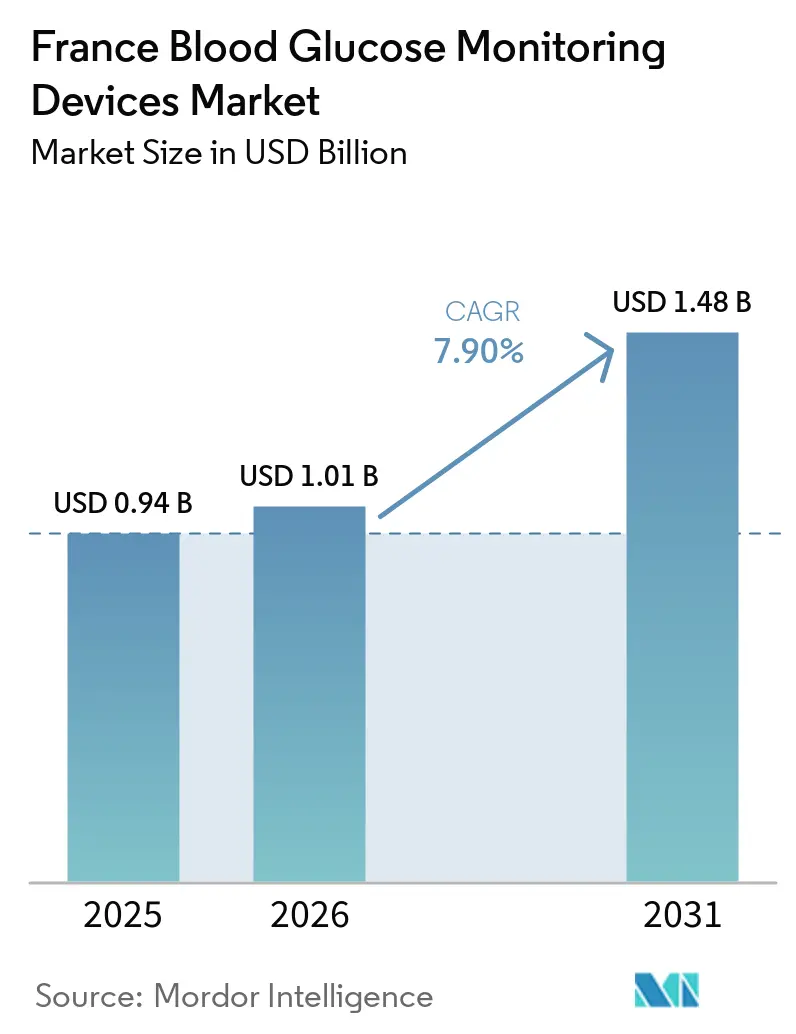
The France Blood Glucose Monitoring Devices Market size was valued at USD 0.94 billion in 2025 and estimated to grow from USD 1.01 billion in 2026 to reach USD 1.48 billion by 2031, at a CAGR of 7.9% during the forecast period (2026-2031).
One of the most significant risk factors for a severe course of COVID-19 is diabetes mellitus. This risk is believed to be influenced by several variables that are frequently present in diabetes mellitus, such as advanced age, a proinflammatory and hypercoagulable condition, hyperglycemia, and underlying comorbidities (hypertension, cardiovascular disease, chronic kidney disease, and obesity). Diabetes was quickly recognized as a risk factor for bad results during the coronavirus disease-2019 (COVID-19) pandemic epidemic. Diabetes has previously been identified as a significant risk factor for death in individuals infected with either the Middle East respiratory syndrome-related coronavirus (MERS-CoV) or the 2009 H1N1 pandemic influenza. More recently, one of the main comorbidities linked to COVID-19 has consistently been diabetes.
Diabetes has the highest prevalence among all chronic conditions covered 100% by France's statutory health insurance (SHI), and the number of covered patients has doubled in the past 10 years. France is one of the major countries in the Europe region. According to the World Health Organization (WHO), about a million are diagnosed with diabetes in France. The prevalence of diabetes is growing among all ages in France, which can be attributed to the growing obese population, along with unhealthy diets and sedentary lifestyles of people. Furthermore, approximately 0.26 million are estimated to live with Type 1 diabetes in the region. Thus, the rising prevalence of diabetes and obesity, growing awareness, regarding diabetic care, healthcare expenditure, and technological advancements are a few factors that are further driving the market for diabetes care devices in France. In France, there is a centralized health care system their all the reimbursement decisions are taken at a national level and then applies to all of the countries. For diabetes technological devices in France, the reimbursement is based on the tariff system.
Therefore, owing to the aforementioned factors the studied market is anticipated to witness growth over the analysis period.
Note: Market size and forecast figures in this report are generated using Mordor Intelligence’s proprietary estimation framework, updated with the latest available data and insights as of 2026.
France Blood Glucose Monitoring Devices Market Trends and Insights
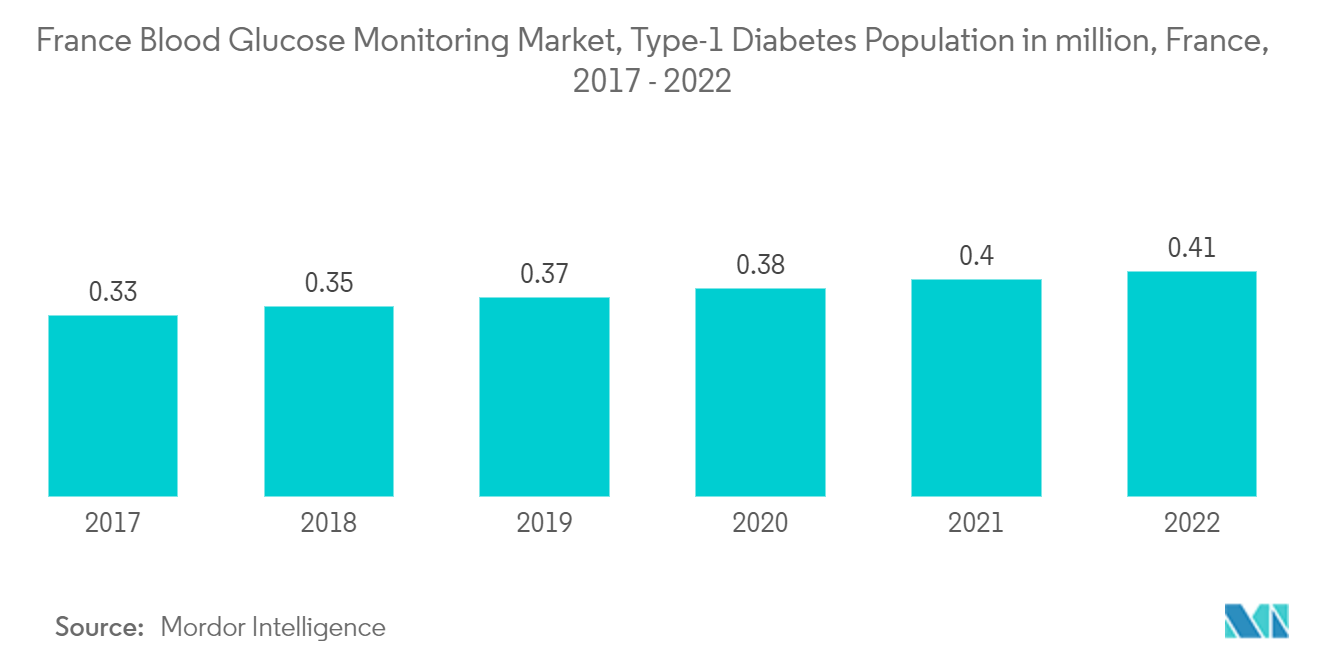
Increasing Type-1 diabetes population across France
Over the forecast period 2022-2027, the population of people with type 1 diabetes in France increased at a rate greater than 3%. France is one of 59 countries in the IDF EUR zone. Furthermore, diabetes will affect 61 million people in Europe and 537 million worldwide in 2021, rising to 69 million by 2045. According to an EU Commission survey, the number of people with chronic diabetes is highest in France, with one in every ten suffering from the disease. Diabetes is common in France, even though the rules' target of 80% compliance with recommended healthcare consultations is not always met. New techniques that focus on the patient and the environment are being developed to encourage proactive therapy adjustment and reduce therapeutic inertia. Physician education and information are necessary to lessen the burden of complications and hospitalizations associated with diabetes. Therefore, owing to the factors above, the growth of the studied market is anticipated in France Country. Diabetes has the highest prevalence among all chronic conditions, covered 100% by France's statutory health insurance (SHI), and the number of covered patients has doubled in the past 10 years. France is one of the major countries in the Europe region. According to the World Health Organization (WHO), about a million are diagnosed with diabetes in France. The prevalence of diabetes is growing among all ages in France, which can be attributed to the growing obese population, unhealthy diets, and sedentary lifestyles.
Furthermore, approximately 0.26 million are estimated to live with Type 1 diabetes in the region. Thus, the rising prevalence of diabetes and obesity, growing awareness regarding diabetic care, healthcare expenditure, and technological advancements are a few factors that are further driving the market for diabetes care devices in France. France has a centralized healthcare system where all reimbursement decisions are taken nationally and applied to all countries. For diabetes technological devices in France, the reimbursement is based on the tariff system.
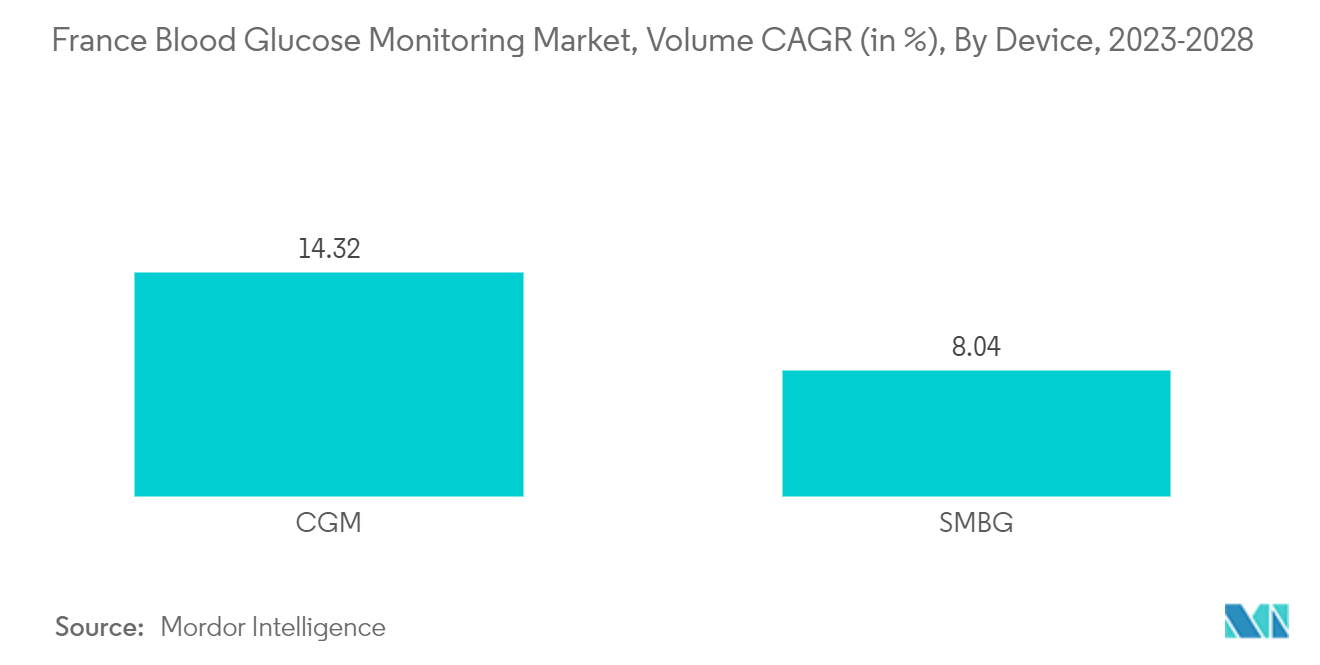
Continuous Glucose Monitoring Holds Highest CAGR in France Blood Glucose Monitoring Devices Market.
In France, the G6 RT-CGM system is likely more cost-effective than SMBG over a lifetime horizon for individuals with long-standing T1D. One of the commitments made in the French National Health Strategy for 2018-2022 is to ensure immediate and universal access to innovations such as new medical devices. However, due to rising financial pressures in many healthcare systems, the cost of innovative technologies must be justified by a clinical benefit sufficient to outperform currently available technologies in light of the Dexcom G6 RT-CGM system's incremental clinical and QoL benefits in France. Because people with diabetes are more likely to contract COVID-19, French companies are ensuring an adequate supply of required Monitoring Devices in the market to ensure the well-being of the affected citizens.
CGMs are used to deliver a further descriptive picture of blood glucose patterns and trends than what can be achieved by traditional routine checking of glucose levels at set intervals. The current CGM devices can either retrospectively display the trends in blood glucose levels by downloading the data or give a real-time picture of glucose levels through receiver displays. Most real-time CGMs can alert patients, parents, or caregivers during actual or pending glycemic visits to facilitate the timely management of blood glucose. This factor, along with the fact that CGM devices are becoming cheaper with the advent of new technologies, like cell phone integration, the CGM market is expected to witness steady growth during the forecast period.
The rise in national awareness of diabetes is anticipated to drive the adoption of both SMBGs and CGMs, supporting the expansion of france continuous glucose monitoring alongside traditional glucose testing.
Competitive Landscape
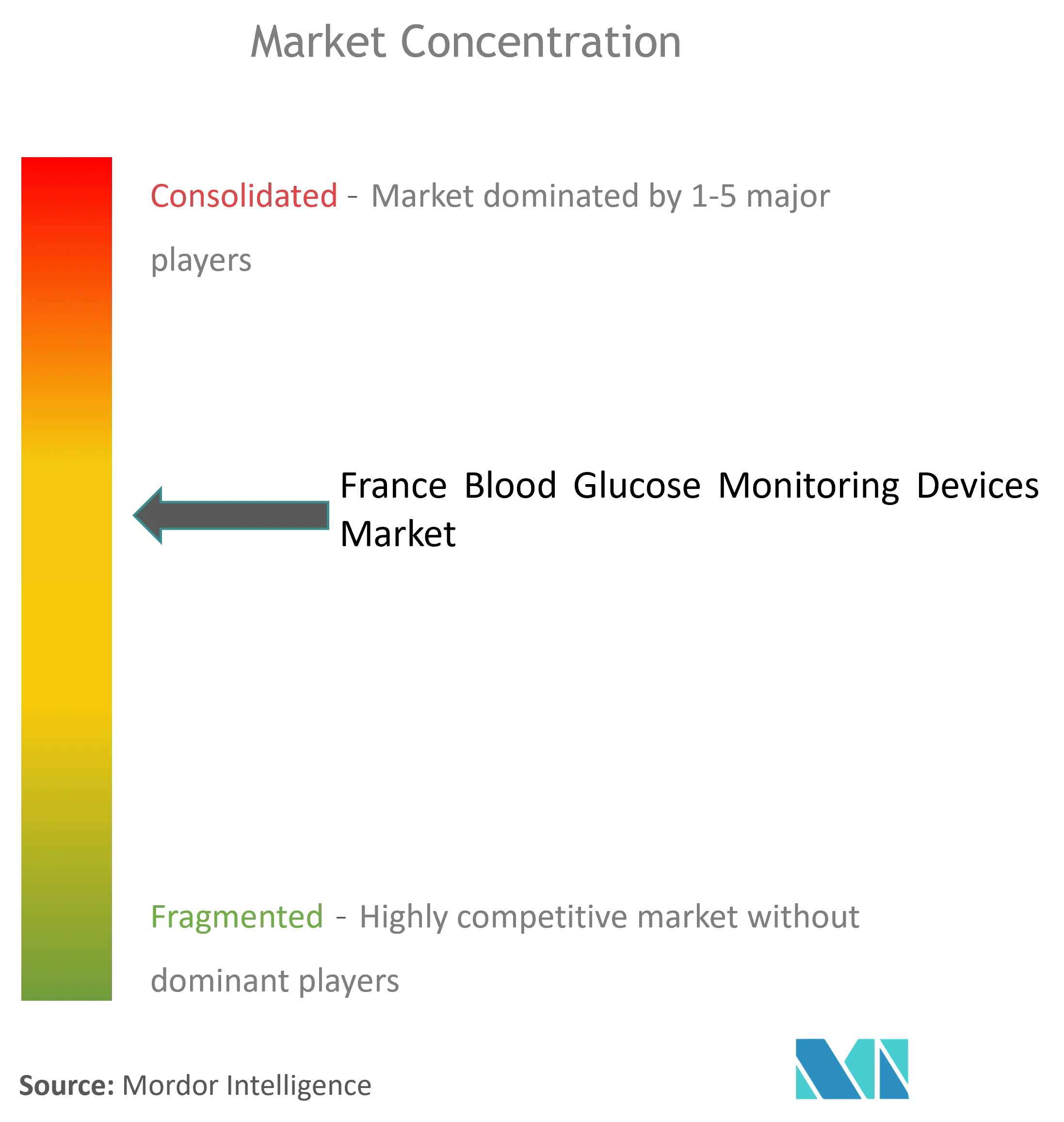
The France Blood Glucose Monitoring Devices Market is highly fragmented, with a few major manufacturers present in the market. The CGM devices market is dominated by major players like Dexcom, Medtronic, Abbott, and Senseonics. The market for BGM devices comprises more generic players like Roche, LifeScan, Arkray, Ascensia, etc. Technological innovations in the recent past helped companies to strengthen their market presence.
France Blood Glucose Monitoring Devices Industry Leaders
-
Roche
-
Abbott
-
Medtronics
-
LifeScan
-
Dexcom
- *Disclaimer: Major Players sorted in no particular order
Market Opportunities and Future Outlook
France offers room for broader uptake of CGM and connected diabetes-management, particularly as reimbursement indications and care pathways are being aligned. HAS and CNEDiMTS evaluations, together with the LPPR listing framework, continue to govern access conditions for glucose monitoring and connected diabetes solutions. Recent updates that relax certain prior-initiation constraints for some CGM use cases also broaden where advanced insulin-delivery associated systems can be started, including initiation in both public and private hospital centers.
A second opportunity is closer integration of glucose data into France's national digital health infrastructure. The country is working on interoperability and patient access through Mon espace sante and related digital identity and coordination building blocks (including Pro Sante Connect), which supports software-enabled diabetes monitoring, remote follow-up, and data-sharing workflows tied to CGM and SMBG. Alongside this, France's national strategy for AI and health data, positioned in the context of European Health Data Space alignment, provides an institutional backdrop for analytics-led diabetes platforms that can use validated device data for care-team support and population monitoring within French evaluation pathways.
Recent Industry Developments
- June 2026: MiniMed and Abbott expand partnership to commercialize dual glucose-ketone sensors integrated with MiniMed smart dosing systems. The expansion of dual-sensor technology supports automated insulin delivery and adds momentum for demand for integrated CGM and insulin delivery across Europe. The collaboration also strengthens competitive positioning in CGM-enabled insulin delivery in France/Europe.
- March 2026: Arrêté du 24 mars 2026 modifying reimbursement conditions for the Dexcom ONE+ under the LPP. The reimbursement pathway changes create a clearer route for CGM adoption in the French market. That update will feed into pricing and market-access planning for Dexcom ONE+ in France.
- March 2026: CE Mark for MiniMed 780G system with Abbott-made Instinct sensor and European rollout including France. The regulatory authorization enables broader MiniMed sensor integration across Europe and supports wider availability. This accelerates product availability and expands the potential CGM-insulin integration footprint in France.
Research Methodology Framework and Report Scope
Market Definition and Coverage
For this study, the market includes blood glucose monitoring devices sold and used in France for checking glucose levels for diabetes care, across home use and care settings. The sizing is built around device and consumable revenues linked to routine glucose testing and ongoing monitoring.
Scope exclusions: It excludes insulin delivery devices, diabetes drugs, and general lab diagnostics that are not used for routine blood glucose monitoring.
Segmentation Overview
- Self-monitoring Blood Glucose Devices
- Glucometer Devices
- Test Strips
- Lancets
- Continuous Blood Glucose Monitoring Devices
- Sensors
- Durables (Receivers and Transmitters)
Data Sources, Market Sizing, and Validation
Desk Research
Desk work started by mapping the demand context in France, where diabetes prevalence, care pathways, and reimbursement rules influence monitoring frequency and product adoption. To keep inputs grounded, we used public sources such as Assurance Maladie publications on coverage and claims rules, France Ministry of Health and public health agency statistics, OECD health indicators, Eurostat population time series, and customs trade statistics where device flows offered a useful cross-check.
On the supply and pricing side, we reviewed device regulatory and safety references within the EU framework, peer-reviewed clinical publications that describe usage patterns for self monitoring and continuous monitoring, and public tenders and hospital procurement signals where available. We also used paid subscriptions for company financials and news, plus a patent database, to validate product cycles and to avoid overstating newer sensor-driven growth. The desk sources listed above are illustrative, and many other public documents and datasets were also used for collection, cross-checks, and clarification.
Primary Interviews and Surveys
Primary work was used to pressure-test desk assumptions on testing frequency, channel mix, and average selling price ranges for meters, strips, lancets, sensors, and durables. We spoke with a mix of manufacturers, distributors, care providers, and diabetes-focused stakeholders in France so that adoption differences between SMBG and CGM, and changes linked to reimbursement, were reflected in the final model.
Distribution of primary research fieldwork respondents
| Company type | Respondent position |
|---|---|
| Top tier: 26% | CXOs: 12% |
| Mid tier: 53% | Functional/Unit leaders: 36% |
| Smaller Players: 21% | Managers: 52% |
Market-Sizing & Forecasting
Sizing was built mainly using a top-down demand pool, where the diabetes population in France and monitoring utilization rates were translated into annual consumption for strips and sensors, then expanded using device attachment and replacement cycles. To keep the model practical, a small set of inputs was prioritized, including the treated diabetes population trend, share of patients on intensive insulin therapy, testing frequency per patient, CGM adoption rate by patient cohort, replacement cycle for receivers and transmitters, and price movement for strips and sensors.
After the core totals were formed, selective bottom-up checks were run using sampled price points by channel and sanity checks against supplier revenue exposure to France. This helped adjust outliers and fill gaps where public data was thin. Forecasts used scenario analysis so reimbursement tightening or faster sensor uptake could be expressed as clear cases, and then they were aligned to the most common expert view from interviews for the base case.
Data Validation & Update Cycle
Validation is done through multiple passes, starting with basic math checks and then moving to reasonableness checks against independent signals such as diabetes prevalence trends, product mix shifts, and import flow direction where relevant. When a number looks off, assumptions are revisited and, if needed, experts are re-contacted to confirm whether the variance is real or driven by timing, pricing, or channel effects.
Before sign-off, the model and write-up are reviewed by another analyst so that key inputs, conversions, and year mappings are consistent. Reports are refreshed annually, and interim updates are added when material events occur, such as reimbursement changes or major product transitions. Right before delivery, a fresh review is done so clients receive the latest updated view.
Mordor Intelligence's France Blood Glucose Monitoring Devices Market Sizing Compared With Other Published Estimates
Published market values for France blood glucose monitoring devices can vary because studies mix different product baskets and different end-use settings, and they also treat consumables and connected components in different ways. Differences also show up when pricing assumptions are taken from list prices instead of reimbursed levels, or when older base years are carried forward without a refresh.
Insulin pumps and pens are not counted here, and that excluded item sits outside Mordor Intelligence's scope, which keeps the estimate centered on SMBG meters, strips, lancets, and CGM sensors with their associated durables. The other big gap drivers usually come from whether nonprescription retail sales are blended with reimbursed volumes, how fast sensor ASP decline is modeled, and whether receiver and transmitter replacement timing is handled as a recurring cycle or a one-time purchase.
Benchmark comparison
| Source | Market Size | Gaps in Research Methodology |
|---|---|---|
| Mordor Intelligence | USD 0.94 B (2025) | |
| Trade Journal A | USD 0.95 B (2023) | Uses an earlier base year and a broader diabetes device discussion that can blend monitoring with adjacent care spend, and it does not clearly show how reimbursed pricing and sensor ASP decline are applied. |
| Industry Publisher B | USD 0.49 B (2026) | Appears to focus mainly on self monitoring revenue and may undercount CGM sensors and durables, and the forecast path looks conservative on adoption within insulin treated cohorts. |
The comparison shows that scope alignment and year selection explain most of the spread, more than simple math differences. When the product basket is clearly limited to monitoring devices and recurring consumables, and when utilization and reimbursement-linked pricing are refreshed, the resulting market value becomes easier to trace and repeat across updates.
Key Questions Answered in the Report
How big is the France Blood Glucose Monitoring Devices Market?
The France Blood Glucose Monitoring Devices Market size is expected to reach USD 1.01 billion in 2026 and grow at a CAGR of 7.9% to reach USD 1.48 billion by 2031.
What is the current France Blood Glucose Monitoring Devices Market size?
In 2026, the France Blood Glucose Monitoring Devices Market size is expected to reach USD 1.01 billion.
Who are the key players in France Blood Glucose Monitoring Devices Market?
Roche, Abbott, Medtronics, LifeScan and Dexcom are the major companies operating in the France Blood Glucose Monitoring Devices Market.
What years does this France Blood Glucose Monitoring Devices Market cover, and what was the market size in 2025?
In 2025, the France Blood Glucose Monitoring Devices Market size was estimated at USD 1.01 billion. The report covers the France Blood Glucose Monitoring Devices Market historical market size for years: 2019, 2020, 2021, 2022, 2023 and 2024. The report also forecasts the France Blood Glucose Monitoring Devices Market size for years: 2026, 2027, 2028, 2029, 2030 and 2031.