
Market Overview
| Study Period | 2021 - 2031 |
|---|---|
| Forecast Data Period | 2026 - 2031 |
| Base Year Market Size (2025) | USD 71.32 Million |
| Market Size (2026) | USD 75.17 Million |
| Market Size (2031) | USD 97.72 Million |
| Growth Rate (2026 - 2031) | 5.39 % |
| Market Concentration | Medium |
Major Players *Disclaimer: Major Players sorted in no particular order Image © Mordor Intelligence. Reuse requires attribution under CC BY 4.0. | |
France Anti-Caking Market Analysis by Mordor Intelligence
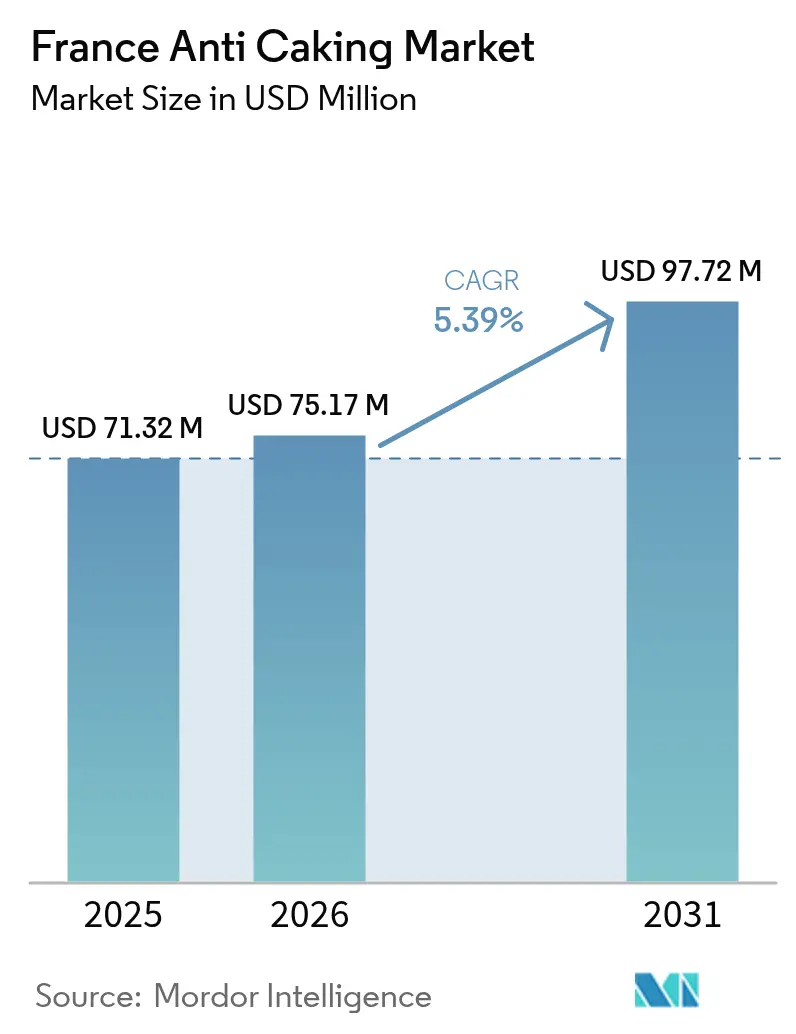
The France anti-caking market size is expected to grow from USD 71.32 million in 2025 to USD 75.17 million in 2026 and is forecast to reach USD 97.72 million by 2031 at 5.39% CAGR over 2026-2031. This growth is driven by changing consumer lifestyles, particularly the rising demand for processed and convenience products that require improved stability and flow in powdered and granulated forms. Manufacturers are focusing on innovation, developing advanced additive formulations, including liquid and plant-based options, to enhance product performance, handling ease, and alignment with clean-label trends. Additionally, technological advancements are enabling improved moisture control, uniform dispersion, and greater efficiency in production processes, supporting automated and high-throughput manufacturing. Overall, the France anti-caking market is becoming increasingly sophisticated and application-oriented, driven by evolving industry requirements, a focus on product quality, and ongoing innovation, positioning it for sustained growth across both traditional and emerging segments.
Key Report Takeaways
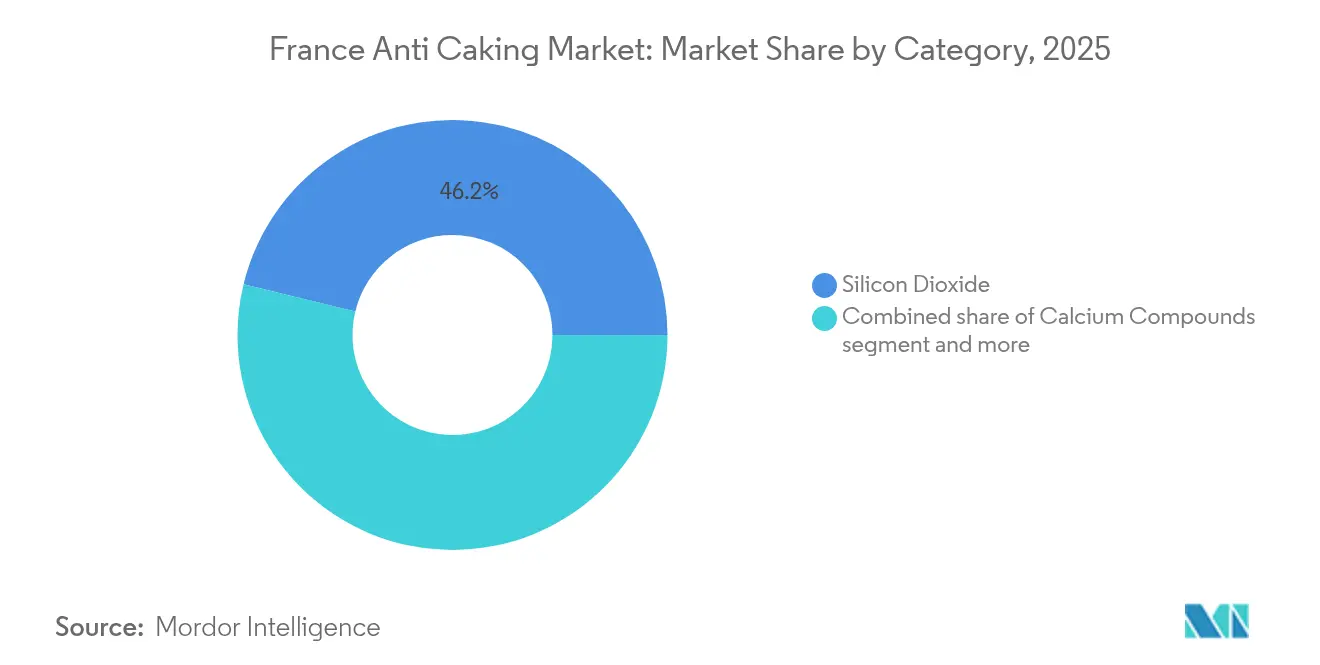
- By type, silicon dioxide led with 46.21% of the France anti-caking market share in 2025; sodium compounds are forecast to expand at a 5.55% CAGR through 2031.
- By form, powders held 68.93% of the France anti-caking market in 2025, while liquids are advancing at a 5.74% CAGR to 2031.
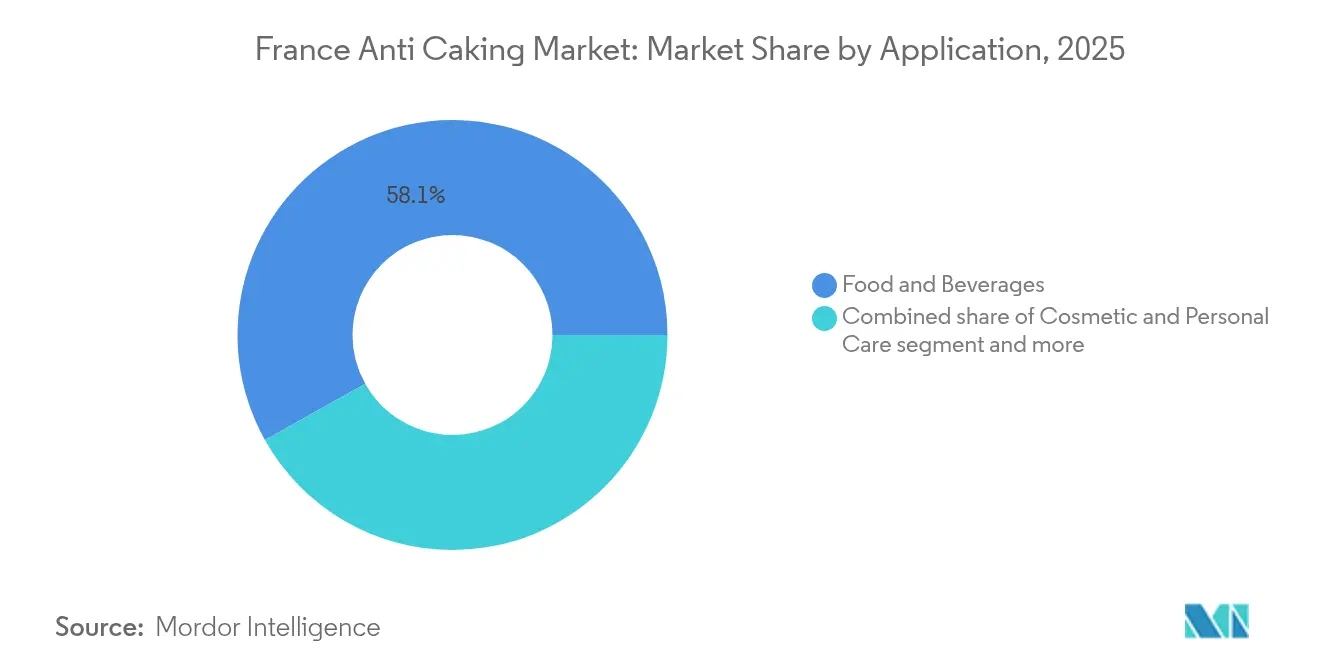
- By application, food and beverages accounted for 58.12% of the France anti-caking market size in 2025, and cosmetics are growing at a 5.85% CAGR through 2031.
Note: Market size and forecast figures in this report are generated using Mordor Intelligence’s proprietary estimation framework, updated with the latest available data and insights as of 2026.
France Anti-Caking Market Trends and Insights
Drivers Impact Analysis*
| Driver | (~) % Impact on CAGR Forecast | Geographic Relevance | Impact Timeline |
|---|---|---|---|
| Rising demand for processed and convenience foods | +1.2% | National, concentrated in Île-de-France and Auvergne-Rhône-Alpes food hubs | Medium term (2-4 years) |
| Preference for natural and clean-label ingredients | +1.5% | National, with strongest pull in urban centers (Paris, Lyon, Marseille) | Long term (≥ 4 years) |
| Technological advancements in additive formulations | +0.9% | National, clusters in Hauts-de-France (Roquette) and Rhône-Alpes | Medium term (2-4 years) |
| Growth in the pet food industry fuels demand | +0.8% | National, production concentrated in Pays de la Loire and Occitanie | Long term (≥ 4 years) |
| Expanding culinary and seasoning culture | +0.7% | National, with premium segment growth in Paris and Côte d'Azur | Medium term (2-4 years) |
| Growing consumer awareness of quality and safety | +0.6% | National, driven by Nutri-Score adoption and ANSES transparency initiatives | Long term (≥ 4 years) |
| Source: Mordor Intelligence | |||
Rising demand for processed and convenience foods
The increasing demand for processed and convenience foods is a significant driver of the France anti-caking market, reshaping the country’s food production landscape. With accelerating urbanization and fast-paced lifestyles, consumers are opting for ready-to-eat, easy-to-prepare, and long-shelf-life products such as instant soups, beverages, bakery mixes, dairy powders, and seasoning blends. These products are particularly susceptible to caking and moisture-induced aggregation. The growing consumption of processed foods directly increases the need for effective anti-caking solutions to preserve the quality of powders during storage, transportation, and handling. According to the United States Department of Agriculture (USDA), as of 2025, France’s food processing sector comprises approximately 19,000 companies, generating total annual sales exceeding USD 176.7 billion [1]. This highlights the scale, diversity, and economic importance of the market. The expansive food processing ecosystem not only drives the volume consumption of anti-caking agents but also encourages innovation, as manufacturers develop new formulations to meet evolving consumer expectations for convenience.
Preference for natural and clean-label ingredients
The growing preference for natural and clean-label ingredients is driving the market, as consumers increasingly prioritize transparency, health, and sustainability in food and personal care products. Manufacturers are addressing this demand by developing anti-caking agents derived from natural sources, free from synthetic additives, and compatible with organic or clean-label claims. These products maintain essential functional properties such as moisture absorption, flowability, and product stability. This trend is particularly significant in powdered foods, beverages, and nutritional products, where consumers are closely examining ingredient lists and favoring items that align with health and environmental considerations. Supporting this shift, data from the Bio Agency indicates that in 2024, 23% of French consumers reported consuming organic food products at least once a week, highlighting a substantial and growing segment of the population actively seeking products with natural or certified organic components. This consumer-driven demand for transparency and natural formulations continues to shape market dynamics.
Technological advancements in additive formulations
Technological advancements in additive formulations are a significant driver of the France anti-caking market. Innovations in material science and processing technologies are facilitating the development of more effective, versatile, and application-specific solutions. Modern anti-caking agents are being designed with optimized particle size distributions, tailored surface properties, and enhanced moisture-absorbing capacities. These features enable manufacturers to achieve better flowability, extended shelf life, and consistent product quality, even under challenging storage and processing conditions. Additionally, these advancements allow for lower inclusion rates, reducing costs and minimizing potential impacts on taste, texture, or appearance. Furthermore, the development of liquid and hybrid formulations, along with functional blends containing multiple active agents, offers benefits such as precise dosing, easier integration into automated production lines, and reduced dust-handling or regulatory compliance challenges. These innovations address the growing demand for high-performance anti-caking solutions across various industries while aligning with trends such as convenience foods, clean-label products, and sustainable manufacturing practices.
Growth in the pet food industry fuels demand
The growth of the pet food industry is a significant driver of the France anti-caking market, as it increases the demand for high-quality, free-flowing powdered and granulated feed products. With rising pet ownership and a growing focus on the health, convenience, and nutritional quality of pet food, manufacturers are expanding their offerings to include dry kibble, powdered supplements, and specialized feed blends. These products are particularly prone to caking and moisture-induced clumping, making anti-caking agents essential for maintaining product consistency, ease of handling, and extended shelf life during storage, transportation, and retail distribution. Supporting this trend, data from the FranceAgriMer indicates that pet food exports from France totaled EUR 4,096.6 million in 2023, highlighting the scale and international presence of the country’s pet food industry [2]. This expanding domestic and export-oriented market is driving the adoption of effective anti-caking solutions, available in both powdered and liquid formats, to ensure products remain free-flowing, visually appealing, and functional under varying climatic and logistical conditions.
Restraints Impact Analysis*
| Restraint | (~) % Impact on CAGR Forecast | Geographic Relevance | Impact Timeline |
|---|---|---|---|
| Stringent EU food additive regulations | -0.7% | National, compliance enforced by ANSES and DGCCRF | Short term (≤ 2 years) |
| Limited effectiveness of natural agents | -0.4% | National, most acute in high-humidity coastal regions (Brittany, Normandy, Provence) | Medium term (2-4 years) |
| Volatility in raw material prices | -0.5% | National, linked to European energy and logistics costs | Short term (≤ 2 years) |
| Complex reformulation challenge | -0.3% | National, disproportionately affects SMEs lacking Research and Development budgets | Medium term (2-4 years) |
| Source: Mordor Intelligence | |||
Stringent EU food additive regulations
A significant restraint for the France anti-caking market is the stringent EU food additive regulations, which enforce strict safety, labeling, and usage limits on substances used in food products. Anti-caking agents must adhere to standards established by the European Food Safety Authority (EFSA) and comply with relevant EU directives. These regulations specify permissible types, maximum inclusion levels, and labeling requirements. While these measures ensure consumer safety and maintain product quality, they also restrict formulation flexibility for manufacturers and increase compliance costs. This is particularly challenging for smaller or mid-sized producers who may lack in-house regulatory expertise. Furthermore, the approval process for new anti-caking agents or innovative formulations is often lengthy and resource-intensive, which can delay product launches and hinder manufacturers' ability to quickly adapt to market trends, such as the demand for clean-label or natural ingredients.
Limited effectiveness of natural agents
The limited effectiveness of natural anti-caking agents acts as a restraint in the market when compared to conventional synthetic or mineral-based options, such as silicon dioxide or sodium compounds. Although consumer demand for clean-label, plant-derived, and organic ingredients is increasing, many natural alternatives often demonstrate lower moisture absorption, reduced flowability, and decreased stability under high-humidity conditions. These limitations can lead to clumping, uneven dispersion, or shorter shelf life, presenting challenges for manufacturers of powdered foods, beverages, animal feed, and personal care products. The functional drawbacks of these natural agents make them less suitable for replacing traditional anti-caking solutions in high-volume or industrial applications, where consistent product performance is essential. Consequently, despite their marketing appeal and regulatory benefits, the technical limitations of natural anti-caking agents hinder their adoption, creating a barrier to broader integration in France's anti-caking market.
*Our forecasts treat driver/restraint impacts as directional, not additive. The impact forecasts reflect baseline growth, mix effects, and variable interactions.
Segment Analysis
By Type: Silicon Dioxide Anchors, Sodium Compounds Accelerate
Silicon dioxide accounted for 46.21% of France’s anti-caking market in 2025, underscoring its position as the most widely used and trusted anti-caking agent in the country. This dominance is attributed to its excellent functional performance, as it effectively absorbs excess moisture and forms a physical barrier between particles, ensuring free-flowing properties in powders without altering taste, color, or aroma. These features make it particularly valuable in France’s food and beverage industry, which emphasizes quality. Silicon dioxide is widely used in various applications, including bakery mixes, dairy powders, soups and sauces, seasonings, and instant beverages. Beyond the food sector, its inert and non-reactive nature supports its use in pharmaceuticals, animal feed, cosmetics, and industrial powders, driving demand across various end-use industries.
Sodium compounds are projected to grow at an annual rate of 5.55% through 2031, highlighting their increasing significance in France’s anti-caking market. This growth is driven by their effective performance in moisture control and flow enhancement. Sodium-based anti-caking agents are widely applied in products such as salt, seasoning blends, soups, sauces, and feed formulations, where they help maintain uniformity and prevent lump formation during storage and transportation. Their relatively lower cost compared to calcium- or specialty silica-based alternatives makes them an appealing choice for mass-market food products and feed manufacturers operating under tight margins.

By Form: Powder Leads, Liquid Gains on Processing Efficiency
In 2025, powder formats accounted for 68.93% of France's anti-caking market, highlighting their critical role in addressing the processing and formulation needs of end-use industries, particularly food and beverage manufacturing. Powdered anti-caking agents are well-suited for the significant volume of dry and powdered products produced in France. Their ease of blending, precise dosing, and seamless integration into existing production lines make them the preferred choice for manufacturers prioritizing efficiency, scalability, and cost management. Additionally, powder anti-caking agents provide superior surface contact with host materials, enabling more effective moisture absorption and flow improvement compared to other forms.
Liquid anti-caking agents are projected to grow at an annual rate of 5.74% through 2031, indicating a gradual shift toward more specialized and application-specific solutions within France's anti-caking market. This growth is driven by their increasing use in niche applications such as food processing, animal feed, and industrial sectors, where uniform surface coating, rapid dispersion, and precise moisture control are essential. Liquid formats enable manufacturers to apply anti-caking agents directly onto particles during processing, enhancing coverage and minimizing dust formation. This feature is particularly advantageous in high-speed, automated production environments. As production technologies in France advance and manufacturers invest in sophisticated processing equipment, liquid anti-caking agents are becoming a more attractive option, despite their currently smaller market share.
By Application: Food Anchors, Cosmetics Surge
In 2025, food and beverages accounted for 58.12% of France’s anti-caking market, establishing it as the largest and most influential end-use segment. This dominance is attributed to the country’s robust food processing industry and stringent standards for product quality and safety. Anti-caking agents are widely utilized in bakery products, dairy powders, soups and sauces, beverages, and other dry food formulations to ensure free flow, prevent lump formation, and maintain consistent texture throughout the product's shelf life. The segment's prominence is further supported by the increasing consumption of processed and convenience foods, along with rising demand for ready-to-use mixes. As the market evolves, the food and beverage segment continues to drive innovation in anti-caking formulations, focusing on clean-label compatibility, lower dosage efficiency, and enhanced performance under varying humidity conditions.
Cosmetic and personal care applications are projected to grow at an annual rate of 5.85% through 2031, reflecting their increasing significance within France’s anti-caking market. This growth aligns with France’s position as a global leader in beauty manufacturing and exports. Anti-caking agents play a vital role in cosmetics and personal care formulations, particularly in products such as face powders, eyeshadows, dry shampoos, deodorants, and skincare actives. These agents improve flowability, prevent agglomeration, and enhance product consistency and sensory appeal. The strong performance of France’s beauty industry underpins this growth. For example, according to the French Federation of Beauty Companies (Febea), France exported EUR 22.5 billion worth of cosmetic and personal care products in 2024, demonstrating robust international demand and sustained production activity . As cosmetic brands increasingly prioritize premiumization, product aesthetics, and manufacturing precision, the demand for high-performance anti-caking agents that ensure uniform particle distribution and stable shelf life continues to rise.
Geography Analysis
Northern and Northeastern France, including Hauts-de-France and Grand Est, play a significant role in the anti-caking market due to their concentration of food processing, dairy, bakery, and animal feed facilities. These regions benefit from proximity to major European trade routes and well-developed transportation networks, facilitating cross-border trade. The demand for anti-caking agents in these areas is driven by the need to ensure product stability during storage and export. Large-scale manufacturers in these regions consume high volumes of standard, cost-efficient anti-caking solutions, particularly for powdered food and feed applications.
Regions such as Pays de la Loire, Bretagne, and Centre-Val de Loire are closely associated with dairy production, agricultural processing, and specialty food manufacturing. The demand for anti-caking agents in these areas is influenced by applications in dairy powders, nutritional products, and bakery ingredients, where moisture control and flow consistency are essential. Anti-caking solutions here prioritize food-grade compliance, low sensory impact, and suitability for high-humidity environments, aligning with the specific needs of these industries.
Île-de-France serves as a strategic center for innovation, formulation, and distribution rather than heavy manufacturing. The region sees strong demand from pharmaceuticals, nutraceuticals, cosmetics, and specialty food producers. These industries require high-purity and customized anti-caking solutions, reflecting the region's focus on premium and specialized applications. Southern and Southeastern France, including Auvergne-Rhône-Alpes and Provence-Alpes-Côte d’Azur, contribute to the anti-caking market through a mix of food processing, cosmetics, and chemical manufacturing. These regions benefit from access to ports and export-oriented supply chains. The demand here is driven by higher-value applications such as cosmetic and personal care powders, specialty ingredients, and industrial formulations, where performance consistency and regulatory compliance are critical.
Competitive Landscape
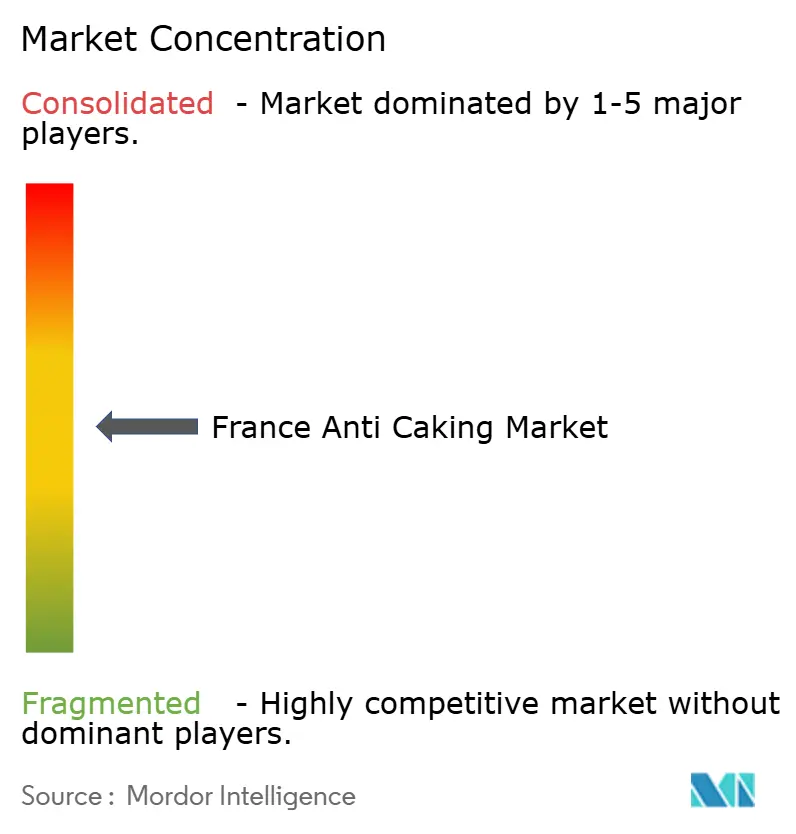
France's anti-caking market demonstrates moderate concentration, with a mix of multinational chemical and specialty ingredient companies alongside smaller regional and niche suppliers. Key players in the market include BASF SE, Evonik Industries AG, Merck KGaA, Arkema S.A., and Kao Corporation. These companies leverage robust Research and Development (R&D) capabilities, extensive global manufacturing networks, and established relationships with customers in sectors such as food, pharmaceuticals, cosmetics, and industrial applications. Competition among these players is driven by factors such as product performance, regulatory compliance, supply consistency, and the ability to deliver application-specific solutions.
Competition in the French anti-caking market is increasingly influenced by innovation and differentiation rather than price alone. This shift is driven by heightened regulatory scrutiny and rising customer expectations. Leading companies are investing in advanced material engineering, surface modification, and tailored particle-size control to enhance moisture resistance, flowability, and performance under challenging processing conditions. Additionally, manufacturers are prioritizing value-added services such as formulation support, co-development with customers, and compliance assistance to foster long-term partnerships. While large players dominate mainstream applications, smaller and specialized companies are establishing footholds in niche segments that demand customized, high-purity, or clean-label solutions.
Opportunities in the competitive landscape include the development of non-nano-certified alternatives to silicon dioxide, addressing increasing regulatory and consumer concerns while maintaining comparable performance. Additionally, liquid anti-caking formats that minimize or eliminate dust-handling and workplace safety compliance costs are particularly appealing for automated and high-throughput manufacturing environments. Plant-derived anti-caking agents that qualify for organic certification also align with clean-label and sustainability trends in the food and personal care industries. Companies that effectively balance performance, regulatory compliance, and sustainability are likely to gain a competitive edge, gradually influencing the market while preserving its moderately concentrated structure.
France Anti-Caking Industry Leaders
-
BASF SE
-
Evonik Industries AG
-
Merck KGaA
-
Arkema S.A.
-
Kao Corporation (Kao Chemicals)
- *Disclaimer: Major Players sorted in no particular order
Recent Industry Developments
- December 2025: Merck announced the launch of the ChemiSphere app, a digital tool enabling scientists to access product documentation and quality information instantly through 2D barcodes on Life Science products.
- April 2025: Willows Ingredients introduced the Mg Neezium Series, with each variant tailored for specific health applications, including sports nutrition, digestive support, and premium wellness supplements.
France Anti-Caking Market Report Scope
France anti-caking market is segmented into calcium compounds, sodium compounds, magnesium compounds, and others. The study also includes revenue generated through food and beverage, cosmetic and personal care, feed, and others.
By Type
| Silicon Dioxide |
| Calcium Compounds |
| Sodium Compounds |
| Magnesium Compounds |
| Others |
By Form
| Powder |
| Granule |
| Liquid |
By Application
| Food and Beverages | Bakery Products |
| Dairy Products | |
| Soups and Sauces | |
| Beverages | |
| Others | |
| Cosmetic and Personal Care | |
| Animal Feed | |
| Others |
| By Type | Silicon Dioxide | |
| Calcium Compounds | ||
| Sodium Compounds | ||
| Magnesium Compounds | ||
| Others | ||
| By Form | Powder | |
| Granule | ||
| Liquid | ||
| By Application | Food and Beverages | Bakery Products |
| Dairy Products | ||
| Soups and Sauces | ||
| Beverages | ||
| Others | ||
| Cosmetic and Personal Care | ||
| Animal Feed | ||
| Others | ||
Key Questions Answered in the Report
How large is the France Anti-Caking Market in 2026?
The France Anti-Caking Market size is USD 75.17 million in 2026, with a 5.39% CAGR projected to lift value to USD 97.72 million by 2031.
Which compound currently dominates demand?
Silicon dioxide leads with 46.21% France Anti-Caking Market share because of its high moisture-binding efficiency at low dosage.
Why are liquid anti-caking agents gaining traction?
Liquids disperse evenly in high-shear mixers, eliminate dust-handling rules, and record the fastest 5.74% CAGR among forms.
How do EU regulations influence supplier strategy?
Stringent particle-size and purity limits, plus the titanium-dioxide ban precedent, push suppliers to certify non-nano alternatives and invest heavily in regulatory dossiers.