
Market Overview
| Study Period | 2021 - 2031 |
|---|---|
| Forecast Data Period | 2026 - 2031 |
| Base Year Market Size (2025) | USD 29.57 Billion |
| Market Size (2026) | USD 30.82 Billion |
| Market Size (2031) | USD 37.91 Billion |
| Growth Rate (2026 - 2031) | 4.23 % |
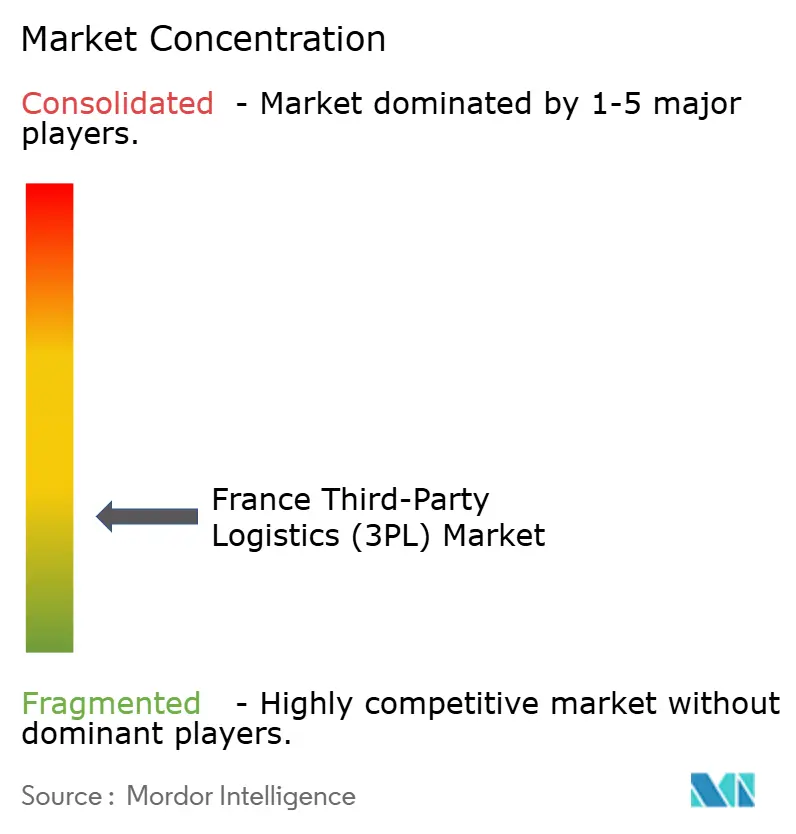
| Market Concentration | Low |
Major Players *Disclaimer: Major Players sorted in no particular order Image © Mordor Intelligence. Reuse requires attribution under CC BY 4.0. | |
France Third-Party Logistics (3PL) Market Analysis by Mordor Intelligence
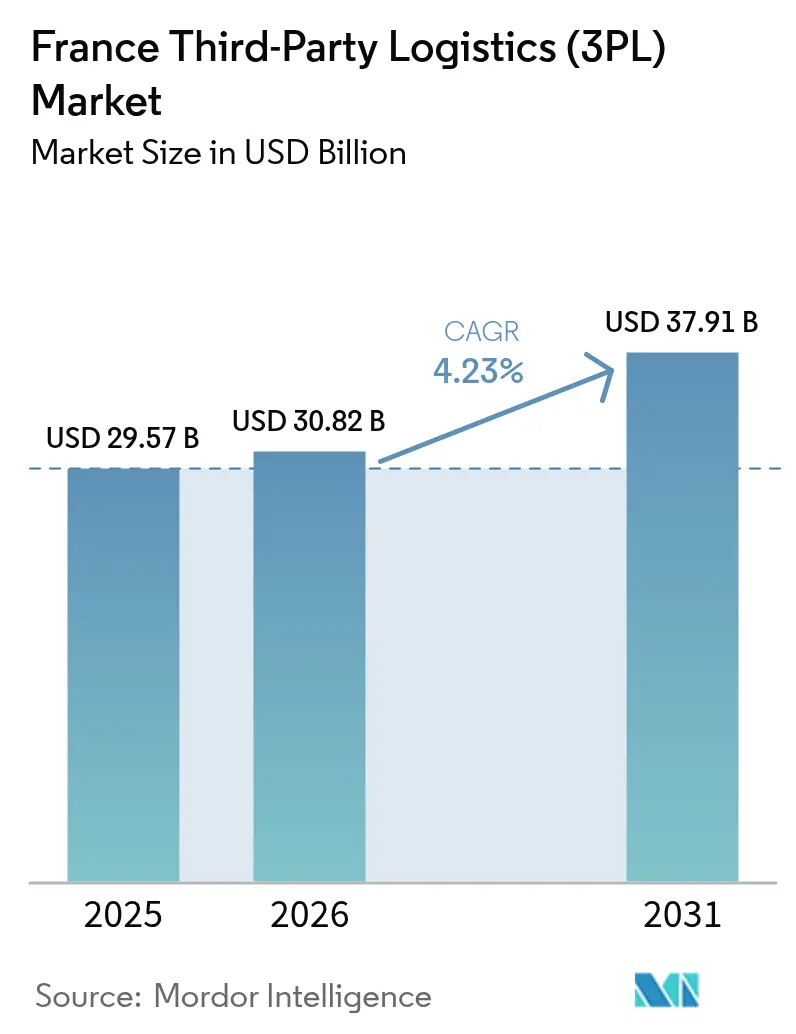
The France Third-Party Logistics market size is expected to grow from USD 29.57 billion in 2025 to USD 30.82 billion in 2026 and is forecast to reach USD 37.91 billion by 2031 at 4.23% CAGR over 2026-2031.
The moderate expansion is underpinned by France’s role as a continental gateway, rising omnichannel fulfillment needs, and tighter carbon-reporting mandates that are reshaping fleet decisions. Domestic Transportation Management dominates with a 43.2% share, yet Value-Added Warehousing & Distribution is accelerating fastest at a 7.2% CAGR as shippers demand integrated inventory, personalization, and returns capabilities. The automotive industry remains the single-largest user of 3PL services, while life sciences and healthcare lead in growth as cold-chain compliance widens. Asset-light operators hold a slim majority of activity, but hybrid models are scaling swiftly as providers blend owned automation hubs with subcontracted line-haul capacity. Competitive intensity stays high: traditional champions face margin compression, driver shortages exceed 50,000 vacancies, and new environmental taxes start in March 2025, yet more than 80% of logistics firms still expect favorable conditions by 2030[1]Claire Dubois, “Portrait Sectoriel: Transport-Logistique,” France Travail, francetravail.gouv.fr.
Key Report Takeaways
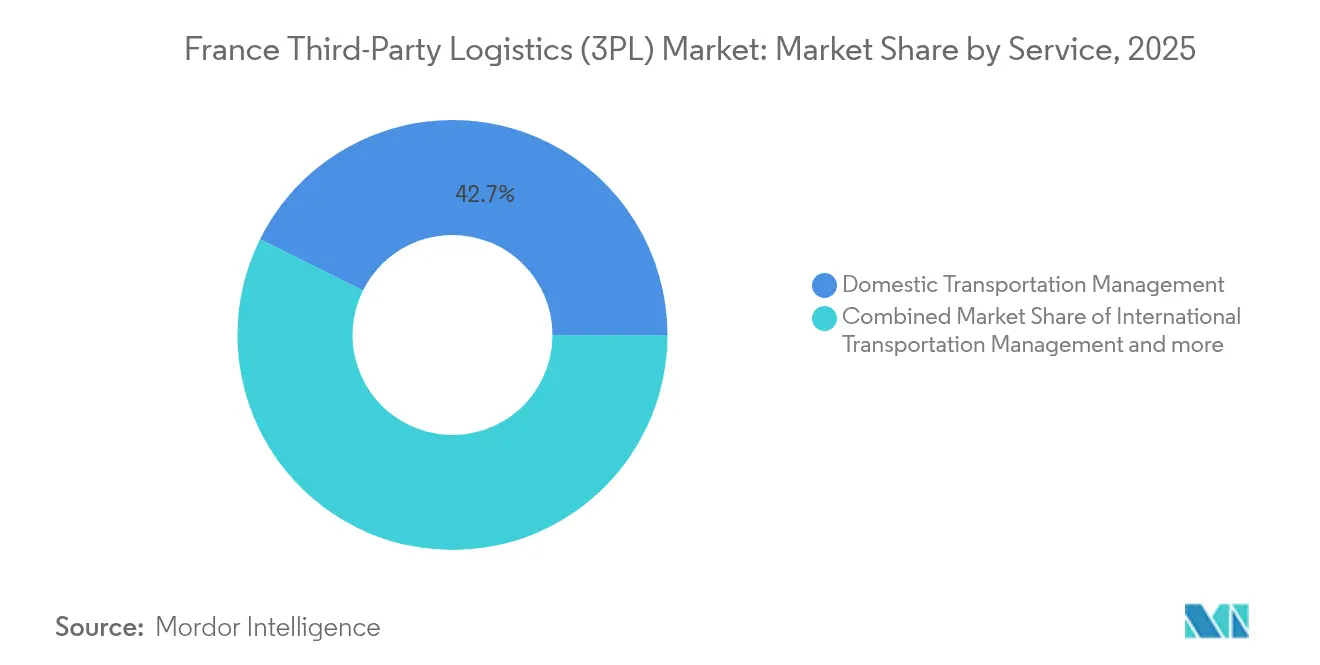
- By service, Domestic Transportation Management captured 42.65% of France third-party logistics market share in 2025, while Value-Added Warehousing & Distribution is projected to grow at a 6.85% CAGR through 2031.
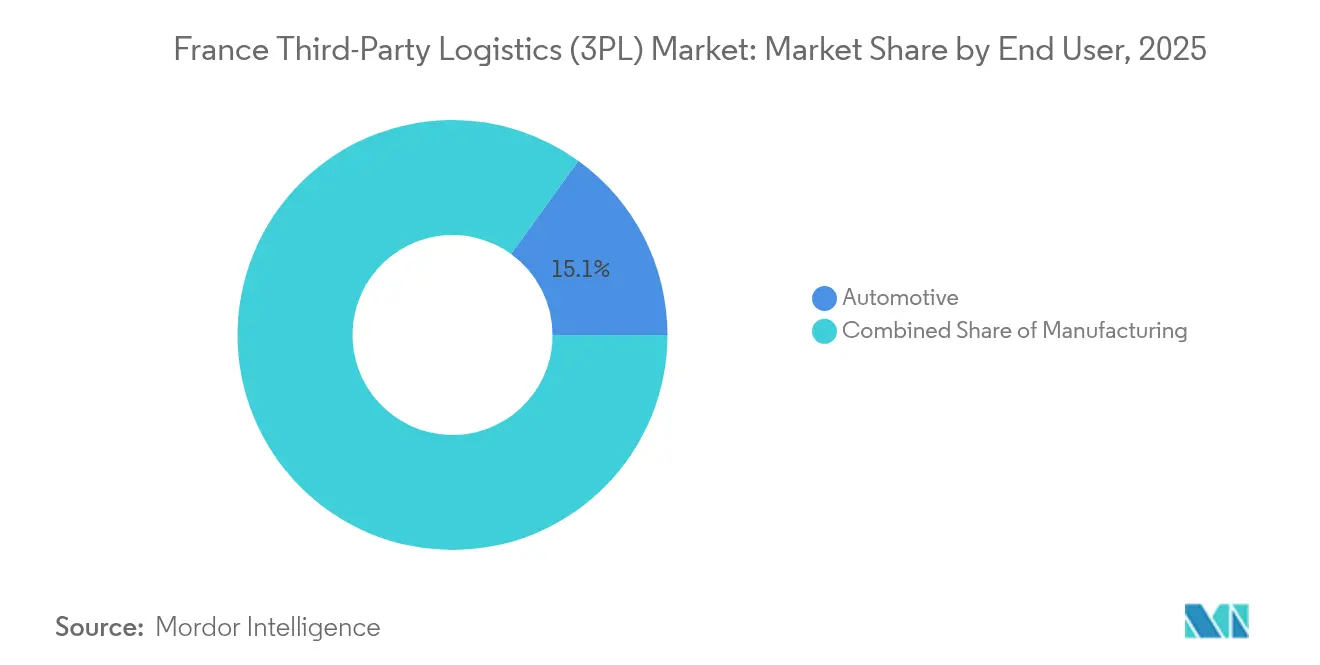
- By end user, automotive accounted for 15.05% of the France third-party logistics market size in 2025, whereas life sciences & healthcare is advancing at a 6.42% CAGR over 2026-2031.
- By logistics model, asset-light providers held a 49.70% share of the France third-party logistics market size in 2025, yet hybrid models record the fastest momentum with a 7.18% CAGR to 2031.
Note: Market size and forecast figures in this report are generated using Mordor Intelligence’s proprietary estimation framework, updated with the latest available data and insights as of 2026.
France Third-Party Logistics (3PL) Market Trends and Insights
Drivers Impact Analysis*
| Driver | % Impact on CAGR Forecast | Geographic Relevance | Impact Timeline |
|---|---|---|---|
| Surge in e-commerce fulfilment demand | 1.8% | Global, with concentration in Paris, Lyon, Marseille urban areas | Medium term (2-4 years) |
| Growing intra-EU cross-border trade | 1.2% | Northern France corridors, Calais-Dunkerque axis | Long term (≥ 4 years) |
| Outsourcing focus of French manufacturers | 0.9% | Industrial regions, automotive clusters in eastern France | Medium term (2-4 years) |
| Expansion of cold-chain in pharma & food | 1.1% | National, with early gains in Lyon, Strasbourg, Marseille | Short term (≤ 2 years) |
| 5G-enabled warehouse automation pilots | 0.7% | Major logistics hubs, Paris region priority | Long term (≥ 4 years) |
| Rail-freight revitalisation boosting intermodal 3PL | 0.5% | APAC core, spill-over to Eastern France corridors | Long term (≥ 4 years) |
| Source: Mordor Intelligence | |||
Surge in E-commerce Fulfillment Demand
France’s rapid online retail migration is stretching last-mile capacity, prompting 3PLs to redesign city-center networks around electric vans, micro-hubs, and parcel lockers rather than pure speed. Seventy percent of French online shoppers now prefer low-emission delivery options, pushing providers to balance sustainability and service costs. The resale economy’s climb toward a €14 billion valuation by 2030 intensifies reverse logistics and inspection needs, steering retailers toward value-added warehouse solutions instead of basic transport. Fashion continues to post the deepest online penetration, yet grocery and homeware categories are closing the gap, further lifting demand for temperature-controlled urban facilities. Together, these shifts explain why warehousing and distribution services outpace core trucking within the France third-party logistics market.
Growing Intra-EU Cross-Border Trade
Post-Brexit rerouting places France at the center of mainland trade flows, supported by multimodal investments that connect Northern manufacturing belts to Mediterranean ports. The mandatory ELO digital envelope, effective September 2025, automates customs paperwork for roll-on/roll-off freight, trimming wait times and encouraging smaller 3PLs to add international lanes[2]Pierre-Yves Gahinet, “Présentation du Dispositif ELO,” French Customs, douane.gouv.fr. New corridors stemming from the India–Middle East–Europe initiative will designate French ports as the first continental landing points, raising long-haul forwarding and customs brokerage demand. Government strategy papers for 2025-2026 earmark funding for smart-border technology and low-carbon truck parking along the A1 and A16 highways. As near-shoring expands, shippers increasingly request integrated warehousing in Calais and Lille that can service both domestic and Benelux markets within 24 hours.
Outsourcing Focus of French Manufacturers
Automotive and aerospace OEMs continue to hand off logistics tasks once deemed core, redirecting capital toward electrification and advanced composites. Logistics Service Providers now operate “control towers” that manage multimodal flows, supplier coordination, and carbon dashboards across dozens of plants. Groupe Blondel’s new centralized platform for Mecachrome illustrates the trend, targeting a 45% carbon cut by 2028 through optimized truck loading and alternative fuels. Falling road-transport EBIT—down to 1.4% in 2023—encourages manufacturers to tap 3PL economies of scale instead of operating private fleets. Specialized providers respond by embedding engineering teams capable of line-side delivery and sequencing, thereby blurring the line between logistics contractor and tier-1 supplier within the France third-party logistics market.
Expansion of Cold-Chain in Pharma & Food
Biotechnology breakthroughs and personalized medicines push France’s pharmaceutical logistics bill past €3.5 billion, with cold-chain already one-fifth of the total and heading higher. CEVA’s new Strasbourg campus and Omer-Decugis’s planned 20,000 m² platform at Dunkirk each add critical temperature-controlled capacity. The food sector mirrors this growth as consumer demand for fresh and organic produce rises, requiring 3PL operators to integrate smart packaging, real-time temperature alerts, and HACCP documentation. Investment in dual-fuel reefers and photovoltaic-powered cross-docks gains momentum, enabling providers to meet stricter ATP regulations without sacrificing payload. Cold-chain know-how is becoming a premium differentiator, especially for hybrid 3PL models that retain ownership of highly specialized assets while outsourcing primary haulage.
Restraints Impact Analysis*
| Restraint | % Impact on CAGR Forecast | Geographic Relevance | Impact Timeline |
|---|---|---|---|
| Driver shortage & mounting labour costs | -1.5% | National, acute in Paris and Lyon metropolitan areas | Short term (≤ 2 years) |
| Stringent carbon-emissions compliance costs | -0.8% | National, with higher impact on fleet-intensive operators | Medium term (2-4 years) |
| Urban consolidation-zone truck restrictions | -0.4% | Major urban centers: Paris, Lyon, Marseille, Lille | Medium term (2-4 years) |
| Post-Brexit volatility at Calais & Channel ports | -0.6% | Northern France, Calais-Dunkerque corridor | Short term (≤ 2 years) |
| Source: Mordor Intelligence | |||
Driver Shortage & Mounting Labor Costs
Unfilled truck positions surpass 50,000 nationwide, constraining capacity even as demand rebounds. Warehouses feel parallel stress, with 72% of operators citing recruitment difficulties and 85% flagging retention challenges. The financial strain shows in insolvency filings—486 logistics firms entered administration during Q1 2024 alone, a level unseen since the 2008-2009 crisis. Fuel volatility and limited pricing power compress already thin margins, especially for smaller operators that lack automation capital. These pressures invite accelerated robotics adoption, but payback periods remain lengthy for asset-heavy fleets unless complemented by densification and route-optimization software.
Stringent Carbon-Emissions Compliance Costs
January 2025 introduces €3,000 fines for late emissions declarations, while March adds an annual fleet tax pegged to low-emission vehicle ratios for operators with 100-plus trucks. From 2027, transport firms will enter the SEQE-UE 2 carbon trading scheme, exposing them to cap-and-trade price swings. GEODIS’s pledge to amplify its electric fleet tenfold by 2030 illustrates the scale of capital reallocation away from network expansion and into decarbonization. Asset-light operators that charter subcontracted trucks can shift some responsibility downstream, but shippers increasingly demand end-to-end carbon auditing, limiting the pass-through effect.
*Our forecasts treat driver/restraint impacts as directional, not additive. The impact forecasts reflect baseline growth, mix effects, and variable interactions.
Segment Analysis
By Service: Transportation Leadership Meets Warehousing Innovation
Domestic Transportation Management contributed 42.65% of France third-party logistics market share in 2025, buoyed by dense motorway coverage and sustained road-freight preference. Yet the segment’s mid-single-digit growth is eclipsed by Value-Added Warehousing & Distribution, whose 6.85% CAGR echoes rising SKU counts, omnichannel order profiles, and shrinking delivery windows. International Transportation Management remains vulnerable to geopolitical uncertainty, though the ELO customs envelope and fresh rail links to Spain and Italy are expected to lift volumes from 2026 onward.
The France third-party logistics industry is shifting from transactional trucking to integrated lifecycle stewardship. Retailers request kitting, personalization, and returns grading inside warehouses, embedding 3PLs deeper into the downstream customer experience. This service layering underpins incremental fees and fortifies long-term contracts, offsetting margin squeezes in pure line-haul. Meanwhile, intermodal volumes benefit as government subsidies rekindle rail; MEDLOG’s Paris hub plans to process one million TEUs per year by 2027, supporting emission-cutting objectives and enhancing regional capacity balance.


By End User: Automotive Dominance Faces Healthcare Momentum
Automotive generated 15.05% of the France third-party logistics market size in 2025, reflecting the complexity of just-in-time component flows and tier-1/2 supplier clustering in eastern regions. Assembly-plant shifts to electric vehicles and battery modules add hazardous-goods rules that only seasoned 3PLs can navigate. Nevertheless, life sciences & healthcare posts a brisk 6.42% CAGR as biologics, cell therapies, and vaccine platforms demand validated cold-chain lanes and GDP-compliant facilities.
E-commerce keep climbing on the back of urban micro-fulfillment and resale loops, while food & beverages track parallel growth through chilled and frozen expansion. The France third-party logistics industry sees technology & electronics and consumer goods adapting to circular-economy mandates, necessitating re-processing centers able to triage returns for refurbishment or recycling. Energy & utilities, led by hydrogen and offshore wind components, adds niche oversized-cargo opportunities that reward 3PLs owning specialized trailers and route-planning tools.
By Logistics Model: Asset-Light Supremacy Meets Hybrid Acceleration
Asset-light configurations captured 49.70% of France third-party logistics market share in 2025, offering cash-flow resilience by leasing fleet and facilities. Rising carbon fees further tilt preference toward variable-cost models that transfer capex and compliance to subcontractors. Yet hybrid solutions, blending owned cold-chain depots or automated mezzanines with outsourced trunking, expand fastest at 7.18% CAGR as shippers demand visibility and ESG control without full capital burden.
Large 3PLs now segment portfolios: core verticals such as pharma, perishables, and aerospace receive dedicated, owned infrastructure, while commoditized dry freight leverages brokerage networks. Smaller contenders replicate the formula through asset-share alliances, pooling specialized warehousing yet avoiding full fleet ownership. The France third-party logistics industry expects hybrid penetration to widen once emission-reporting granularity forces precise asset-level disclosures.
Geography Analysis
Paris-Île-de-France anchors the country’s logistics ecosystem through Charles de Gaulle air cargo and a 35-million-consumer catchment reachable within two hours. Warehouse vacancy sits below 3%, fueling a record EUR 4 billion of logistics real-estate investment in 2024. Urban consolidation regulations drive up demand for electric van depots and rooftop solar integration, reinforcing the shift toward value-added city-fringe facilities.
Northern corridors from Calais to Lille remain vital for UK flows despite Brexit turbulence, servicing 38 daily ferry routes. The France third-party logistics market size for the region is poised to lift once the ELO system streamlines border checks from September 2025. Eastern clusters around Metz and Mulhouse thrive on automotive and machinery exports into Germany, while new hydrogen transport lanes emerge from Alsace chemical plants. Southern gateways like Marseille-Fos connect North Africa and the Middle East, with CEVA’s headquarters overseeing a global network from the port city.
Western France, notably Nantes and Cholet, attracts food distribution platforms that service Atlantic coastal tourism centers. Inland, Lyon consolidates life-science logistics due to a dense biotech base and proximity to Alpine cold-chain routes. Government rail-freight incentives are funneled to these corridors, with national targets to double tonnage by 2030, offering modal diversification benefits to 3PLs. Overall, regional specialization enhances the France third-party logistics market’s resilience by spreading exposure across multiple growth levers.
Regulatory Landscape
France’s freight and logistics policy framework is steered by the Ministry for Ecological Transition and Territorial Cohesion through the Direction generale des infrastructures, des transports et des mobilites (DGITM), while the Autorite de regulation des transports (ART) regulates key transport markets including rail network access and concessions affecting multimodal logistics. For professional road freight carriers, market entry continues to require registration via regional authorities (DREAL/DRIEA/DEAL) under EU rules, notably Regulations (EC) 1071/2009 and 1072/2009, which keeps compliance and capacity licensing central for 3PLs managing subcontracted fleets.
Regulation is also tightening around data, carbon, and circularity requirements that shape 3PL operating models. The EU eFTI framework (Regulation (EU) 2020/1056) underpins the shift toward electronic transport information exchange between operators and administrations, while France is simultaneously pushing sector digitalization through the 2025-2026 national logistics roadmap and the public data platform logistique.data.gouv.fr. On circular economy, Decree 2025-1081 takes effect on January 1, 2026, extending producer responsibility obligations to professional packaging, which raises demand for packaging traceability and reverse logistics processes inside 3PL warehousing and distribution operations.
Value Chain Analysis
In France, the 3PL value chain typically starts with shipper sourcing and production planning (industrial and retail), then runs through inbound transport and freight forwarding, customs and documentation for cross-border lanes, and into storage, order preparation, and distribution. Providers deliver core services (domestic line-haul and last-mile), supported by value-added warehousing functions such as kitting, returns grading, labeling, and temperature-controlled handling for life sciences and food. Inputs include logistics real estate, labor (drivers and warehouse staff), subcontracted carrier capacity, packaging, energy, and enabling technologies such as TMS/WMS, telematics, and automation equipment.
Bottlenecks and value capture are increasingly concentrated at the warehouse and control-tower layers, particularly near Paris and Lyon where land availability and labor constraints make automation, multi-client operations, and data-driven orchestration more valuable. Recent competitive moves point to where chain integration is happening: GEODIS completed the acquisition of Transports Malherbe in March 2026 to reinforce road freight capacity, and ID Logistics expanded contract logistics capability with a new 16,000 sqm site south of Paris (reported in April 2026) for cosmetics flows. Retail-linked partnerships also remain a downstream lever, illustrated by GXO Logistics renewing its long-term logistics work for Castorama in France (July 2026), with an emphasis on operational upgrades and lower-carbon execution within distribution.
Competitive Landscape
The France third-party logistics market is fragmented. GEODIS, once the clear leader, slipped to seventh place domestically after a 15% revenue slide to EUR 11.6 billion in 2023, prompting its Ambition 2027 plan focused on digital control towers and an electric fleet expansion[3]Sylvie Charles, “Ambition 2027: GEODIS Strategic Plan,” GEODIS, geodis.com. DHL leverages global scale, winning Sanofi’s three-site contract that includes GDP-certified warehousing and secondary distribution, reinforcing its healthcare stronghold. Kuehne+Nagel, posting CHF 24.8 billion turnover in 2024, is integrating IMC Logistics and City Zone Express to widen U.S. and Southeast Asian routes funneling into France.
Portfolio reshaping continues: Modalis entered hydrogen logistics via its Air Flow acquisition, while CEVA invested in a Strasbourg pharma campus and a Côte d’Ivoire decarbonized maritime lane. Retailer–3PL joint ventures such as METRO and ID Logistics’ Cholet facility illustrate cross-sector collaboration, uniting food-service demand with green building certification. Technology adoption accelerates—55% of providers rate generative AI favorably and 58% are ramping robotics—yet only 29% intend to deploy at scale within 12 months, pointing to a future competitive wedge between digital frontrunners and laggards.
France Third-Party Logistics (3PL) Industry Leaders
DSV
DHL Supply Chain
Kuehne + Nagel
CEVA Logistics
UPS Supply Chain Solutions
- *Disclaimer: Major Players sorted in no particular order

Market Opportunities and Future Outlook
Capital deployment and industrial programs create whitespace in automated fulfillment, urban last-mile assets, and decarbonized infrastructure that 3PLs can monetize through multi-client platforms and sector-specific solutions. At the Choose France Summit in June 2026, companies including Amazon, DHL, InPost, and GXO announced nearly EUR 3 billion in logistics-related investment commitments across France, spanning fulfillment capacity and parcel locker expansion that expands outsourcing addressable demand in e-commerce and parcel-linked reverse logistics. Financial backing for last-mile real estate also surfaced with CPP Investments completing a EUR 400 million co-investment with Blackstone in Proudreed (May 2026), reflecting investor appetite for scaled, city-proximate logistics footprints where 3PLs can layer value-added services.
Operational opportunities also concentrate on warehouse automation and energy efficiency, alongside sector-focused logistics. Active Ants and Staci launched an automated e-commerce fulfillment hub near Lyon (Pusignan, February 2026), while GEODIS and BOA Concept modernized a logistics campus in Douvrin with automation designed for lower energy use (June 2026), reinforcing the business case for throughput and labor productivity improvements in constrained labor markets. On the enabling side, the French government has reinforced digital adoption with DGE guidance for applying AI in logistics and CILOG orientation work (both in March 2026), supporting 3PL investment cases around control towers, visibility, and the compliance reporting demanded by shippers.
Recent Industry Developments
- June 2026: DHL Group announced an around EUR 160 million investment plan for 2026-2027 to strengthen logistics infrastructure in France and support the clean energy transition. The program highlights how large integrators are tying network upgrades to decarbonization requirements, raising the competitive bar for energy-efficient facilities and low-emission transport solutions.
- April 2026: DHL Supply Chain France signed a 9-year contract with Bayer Crop Science to manage seed logistics flows using a new 23,300 sqm facility in Alzonne. The long-duration contract adds dedicated capacity for an agribusiness vertical that demands tight handling processes and reinforces the shift toward specialized contract logistics beyond commodity warehousing.
- February 2025: Logicor forward funded a 12,850 sqm warehouse project in Beaucaire, designed with EV charging and green technologies and scheduled for completion in Q1 2026. This development adds modern, electrification-ready space that supports 3PL customers seeking lower-emission distribution and compliance-aligned site specifications.


Research Methodology Framework and Report Scope
Market Definition and Coverage
For this methodology, the France 3PL market value refers to outsourced logistics services delivered by third-party providers within France. This includes transportation management and warehousing and distribution activities that shippers contract out.
Scope exclusions: In-house logistics run by manufacturers or retailers, pure parcel courier revenue booked as standalone express delivery, and the sale of logistics software are not counted as 3PL service revenue.
Segmentation Overview
- By Service
- Domestic Transportation Management (DTM)
- Roadways
- Railways
- Airways
- Waterways
- International Transportation Management (ITM)
- Roadways
- Railways
- Airways
- Waterways
- Value-Added Warehousing & Distribution (VAWD)
- Domestic Transportation Management (DTM)
- By End User
- Automotive
- Energy & Utilities
- Manufacturing
- Life Sciences & Healthcare
- Technology & Electronics
- E-commerce
- Consumer Goods & FMCG
- Food & Beverages
- Others
- By Logistics Model
- Asset-Light (Management-Based)
- Asset-Heavy (Own Fleet & Warehouses)
- Hybrid
Data Sources, Market Sizing, and Validation
Desk Research
Desk work starts by building a demand picture for outsourced logistics in France, then checking it against supply-side signals from operators and public statistics. We rely on non-paywalled source types such as Eurostat transport and warehousing series, France customs trade statistics, the French transport ministry and road freight publications, the European Commission transport market monitoring, and OECD macro and industry indicators.
For company-level context, we review annual reports, investor presentations, and credible press releases covering contract wins, warehouse openings, and network changes. When needed, paid subscriptions for company financials and news are used to reduce missing revenue data. Shipment-level trade databases help validate cross-border freight intensity. The sources listed here are illustrative, and other public materials were also used for data collection, cross-checking, and clarification.
Primary Interviews and Surveys
Primary work is used to pressure-test assumptions that desk sources do not fully resolve, such as outsourcing penetration, typical pricing movement, and how warehousing contracts are being re-scoped. We speak with logistics providers, shipper logistics heads, and industry specialists across France. We also cross-check perspectives with contacts tied to wider European freight lanes, so the local picture stays aligned with cross-border execution realities.
Distribution of primary research fieldwork respondents
| Company type | Respondent position |
|---|---|
| Top tier: 30% | CXOs: 18% |
| Mid tier: 52% | Functional/Unit leaders: 24% |
| Smaller Players: 18% | Managers: 58% |
Market-Sizing & Forecasting
The core sizing is built using a top-down approach. National freight activity, trade flows, and warehousing intensity are used to reconstruct the outsourced logistics revenue pool in France, then the outsourced share is applied by service type. To keep totals grounded, we corroborate results using selective bottom-up approximations, including sampled provider revenue splits for France operations, channel checks on typical contract sizes, and simple price-times-volume checks for major transport modes.
Inputs that matter for this market include road freight ton-km and trucking activity, import and export values by key goods groups, industrial production and retail turnover trends, warehouse space additions and occupancy signals, fuel and labor cost direction (used as a proxy for pricing pass-through), and e-commerce parcel growth as an indicator of fulfillment demand. Where bottom-up data is incomplete for smaller operators, gaps are handled through ratio-based scaling linked to the observed market structure and interview ranges.
For forecasting, scenario analysis is applied so the model can reflect different paths for industrial demand, consumer spending, and cross-border trade. These are the variables most interviewees link to near-term 3PL volume changes. The final growth path is then adjusted to keep pricing and volume assumptions consistent with the expected cost environment and contract renewal cycles.
Data Validation & Update Cycle
Validation is done through checks that look for mismatches between model outputs and independent signals, including freight activity series, trade momentum, warehouse absorption, and disclosed operator performance trends. If a variance looks too large, we re-check assumptions, revisit the desk sources, and re-contact selected interviewees to confirm whether a real shift is occurring or a modeling input needs adjustment.
Before sign-off, the work is reviewed in steps so calculation errors, unit issues, and currency timing mismatches get caught early. Reports are refreshed annually, with interim updates when material events occur, such as policy changes, major network expansions, or sudden demand shocks. Right before delivery, a fresh pass is completed so clients receive the latest updated view.
Mordor Intelligence's France 3pl Market Size Compared Against Other Published Estimates
Published market sizes for France 3PL can differ significantly, even when authors are focused on the same geography and similar timeframes. In our experience, the gaps usually come from what is counted as 3PL revenue, how transport and warehousing are bundled, and how pricing and inflation are carried through the forecast.
Some published numbers expand scope by bundling in enabling technologies or broader supply chain services that sit next to 3PL contracts. For Mordor Intelligence, the count is limited to outsourced logistics service revenue in France, and technology-only spending and other adjacent categories are excluded. This changes the total even before growth assumptions are applied.
Benchmark comparison
| Source | Market Size | Gaps in Research Methodology |
|---|---|---|
| Mordor Intelligence | USD 29.57 B (2025) | |
| Regional Consultancy A | USD 35.00 B (2025) | Uses a wider service bundle that appears to fold in additional logistics-related solutions alongside core 3PL, and it is anchored to a different base year setup that can lift the starting value. |
| Global Consultancy B | USD 45.70 B (2024) | Reports a larger total with a different base year, and its scope signals suggest broader inclusions by service type and related activities, which can overstate pure outsourced 3PL service revenue when compared on like-for-like terms. |
Taken together, the spread is mainly explained by scope choices and base-year alignment, followed by how pricing progression is modeled for transport and warehousing contracts. By keeping inputs tied to observable freight, trade, and warehousing indicators, then checking them through interviews, the final estimate remains traceable and easier to reproduce.


Key Questions Answered in the Report
How large is the France third-party logistics market in 2026?
The market is valued at USD 30.82 billion in 2026 and is projected to reach USD 37.91 billion by 2031.
Which service segment is expanding fastest?
Value-Added Warehousing & Distribution is growing at a 6.85% CAGR through 2031 as retailers demand integrated inventory and returns management.
What is driving life sciences logistics demand?
Growth stems from cold-chain requirements for biologics and vaccines, prompting specialized facilities such as CEVA’s new Strasbourg hub.
How are environmental regulations affecting 3PL costs?
From 2025, fleet taxes and emissions-reporting fines compel operators to invest in electric vehicles and emissions auditing, raising compliance outlays.
Page last updated on:


 Your data is secure and never sold or shared.


