
Market Overview
| Study Period | 2020 - 2031 |
|---|---|
| Market Size (2026) | USD 31.81 Billion |
| Market Size (2031) | USD 40.39 Billion |
| Growth Rate (2026 - 2031) | 4.89 % |
| Fastest Growing Market | Asia Pacific |
| Largest Market | Asia Pacific |
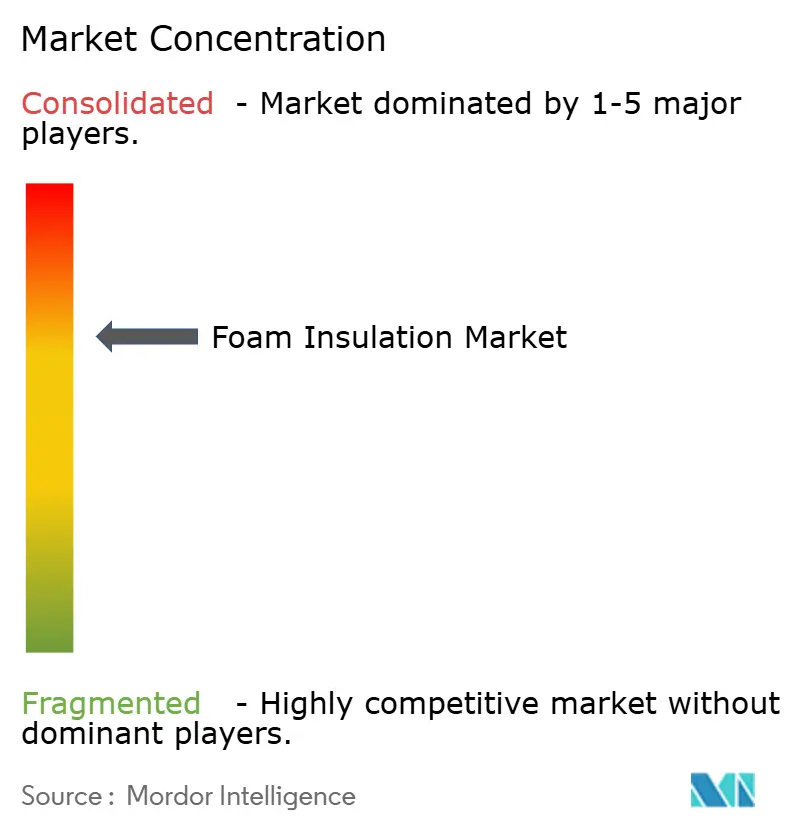
| Market Concentration | Medium |
Major Players *Disclaimer: Major Players sorted in no particular order Image © Mordor Intelligence. Reuse requires attribution under CC BY 4.0. | |
Foam Insulation Market Analysis by Mordor Intelligence
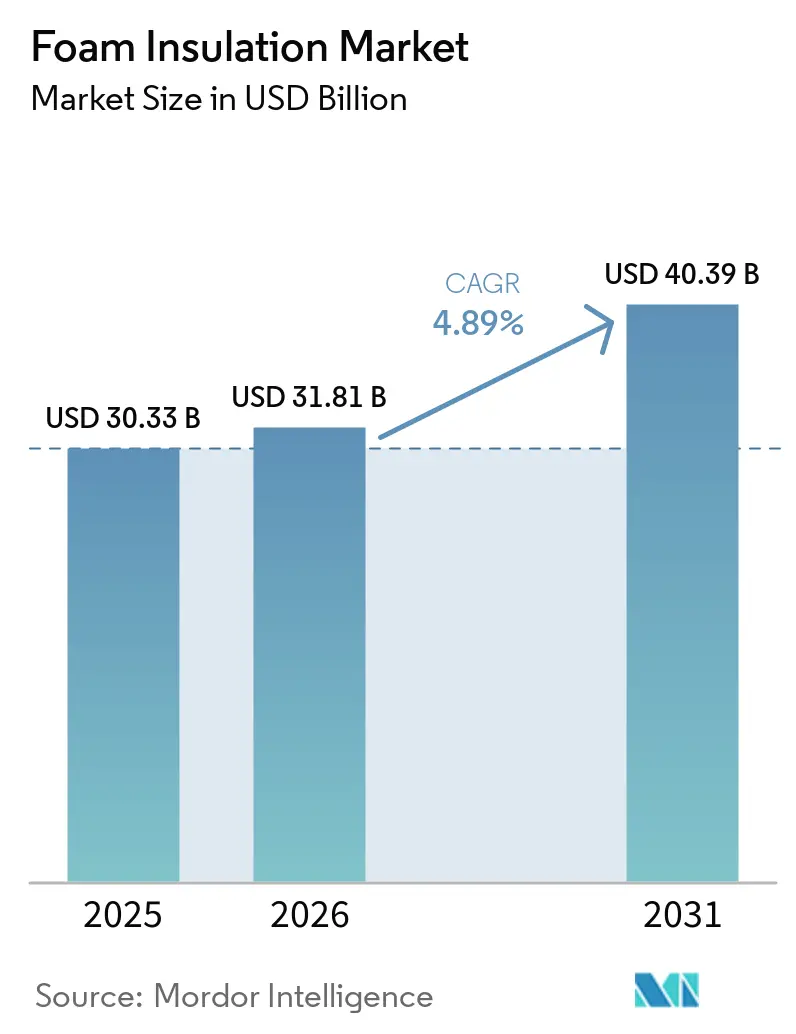
The Foam Insulation market size is expected to grow from USD 30.33 billion in 2025 to USD 31.81 billion in 2026 and is forecast to reach USD 40.39 billion by 2031 at 4.89% CAGR over 2026-2031. Strong demand is tied to energy-efficient construction codes, infrastructure spending, and the need for materials that combine high thermal resistance with structural support. Key suppliers are expanding capacity, broadening product portfolios, and pursuing circular-economy feedstocks to contain raw-material volatility. The competitive field is also innovating around low-GWP blowing agents, bio-based polyols, and vacuum technologies to meet both performance and sustainability criteria. Asia-Pacific remains the primary growth engine as urbanization, policy incentives, and industrial expansion widen the application base across buildings, cold-chain logistics, and consumer appliances.
Key Report Takeaways
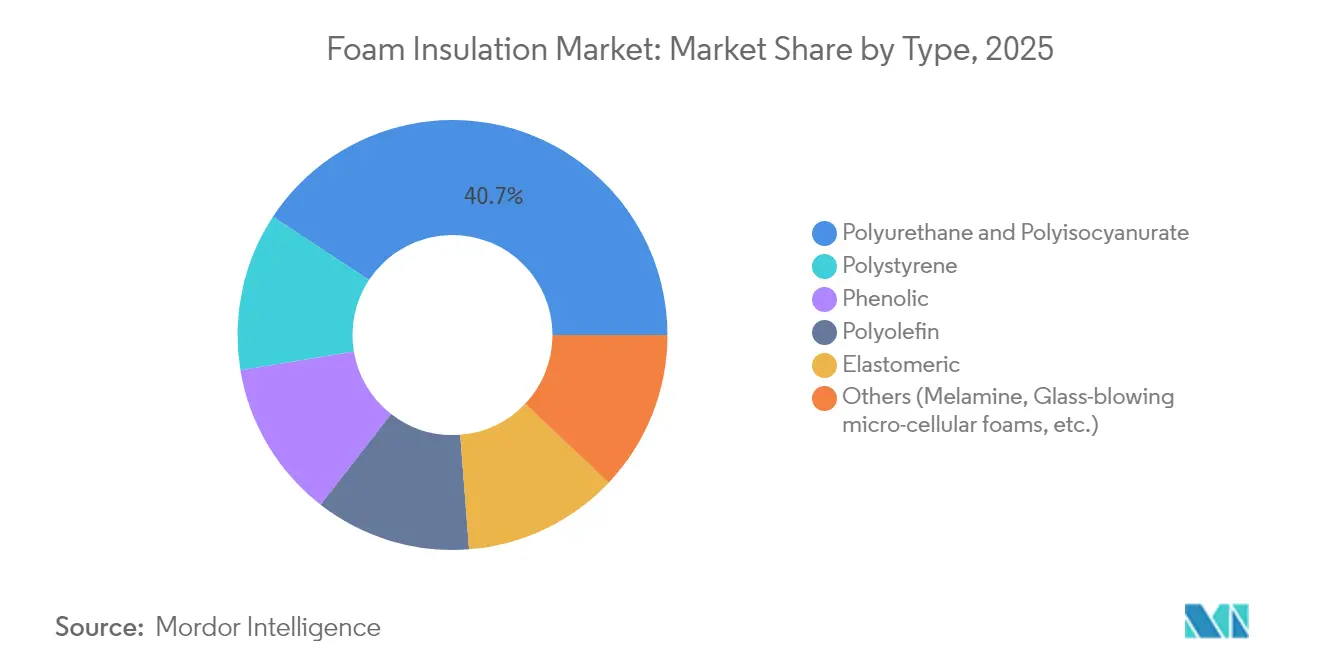
- By type, polyurethane and polyisocyanurate foams held 40.74% of the foam insulation market share in 2025; the Other Types segment is projected to advance at a 5.03% CAGR through 2031.
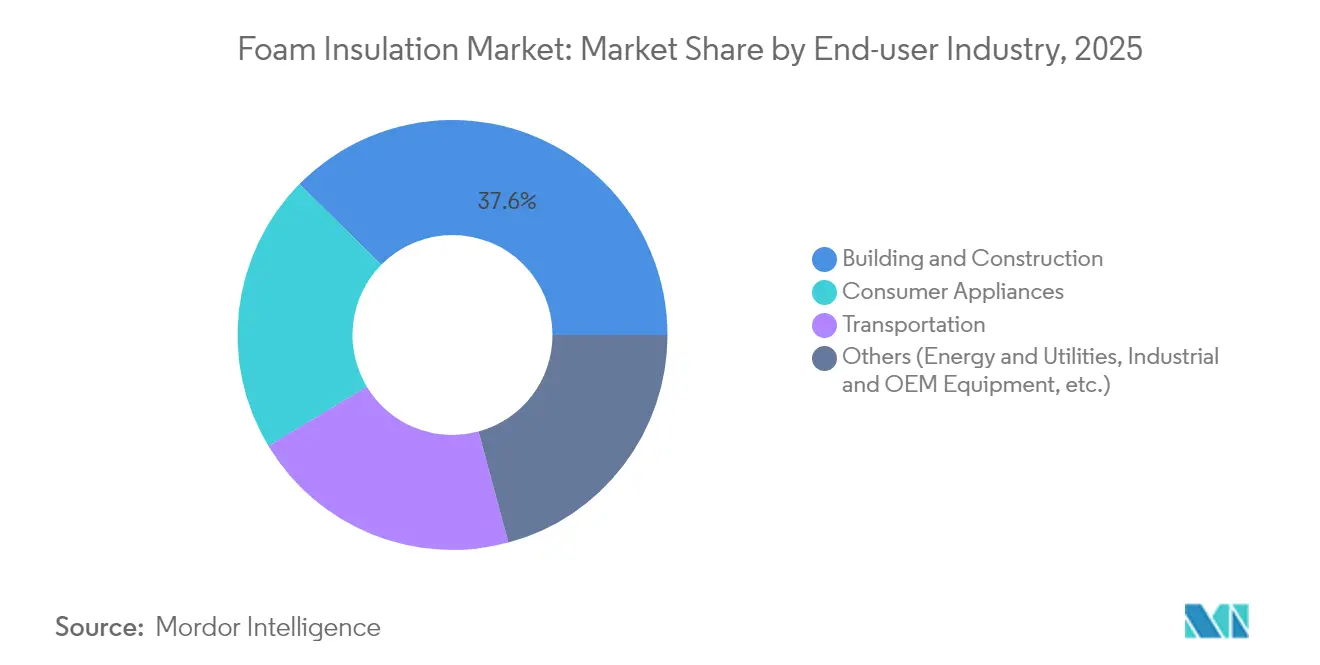
- By end-user industry, building and construction accounted for 37.62% of the foam insulation market size in 2025, whereas consumer appliances are poised for the highest 5.24% CAGR to 2031.
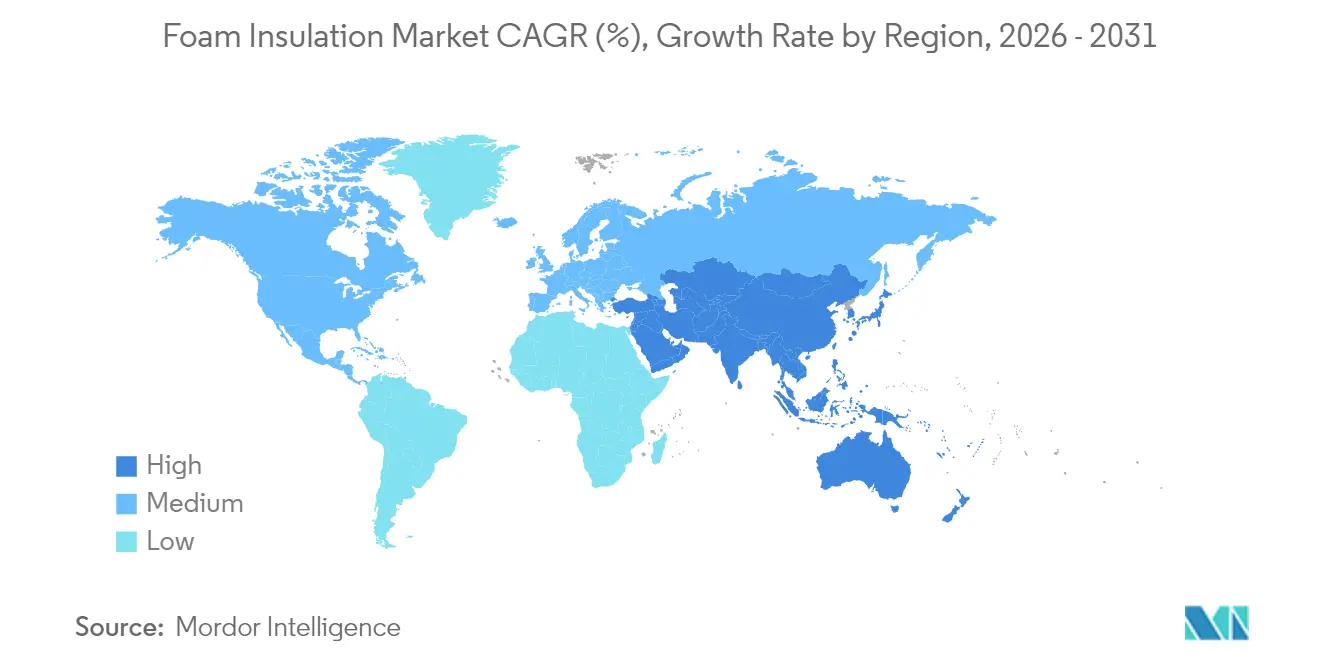
- By geography, Asia-Pacific captured 41.30% of 2025 revenue and is forecast to expand at a 5.78% CAGR, outperforming every other region.
Note: Market size and forecast figures in this report are generated using Mordor Intelligence’s proprietary estimation framework, updated with the latest available data and insights as of 2026.
Market Trends and Insights
Drivers Impact Analysis of Foam Insulation Market*
| Driver | (~) % Impact on CAGR Forecast | Geographic Relevance | Impact Timeline |
|---|---|---|---|
| Tightening building-energy codes and green-building certifications | +1.6% | Global | Medium term (2-4 years) |
| Infrastructure stimulus reviving non-residential construction | +1.2% | North America, Asia-Pacific, Europe | Short term (≤2 years) |
| Rapid e-commerce cold-chain build-out | +0.9% | North America, Asia-Pacific | Medium term (2-4 years) |
| Growing modular off-site construction using foam panels | +0.7% | Asia-Pacific, North America, Europe | Long term (≥4 years) |
| Growing emphasis on sustainable construction | +0.4% | Global | Long term (≥4 years) |
| Source: Mordor Intelligence | |||
Tightening Building-Energy Codes & Green-Building Certifications
New codes such as the 2024 IECC raise mandatory R-values, continuous-insulation requirements, and air-leakage limits across climate zones. Builders are adopting high-density polyurethane, polyisocyanurate, and composite SIPs to comply with these stricter standards. Retrofit activity is also rising, driven by incentives that reward energy-efficiency upgrades to existing building stock. Foam solutions are favored because they deliver high thermal resistance in thinner profiles, freeing up interior space while meeting code-mandated performance thresholds. Manufacturers are responding with higher R-value spray formulations and panel systems certified for net-zero and LEED projects. Regulatory momentum is therefore embedding advanced foam products in both new construction and renovation pipelines[1].
Infrastructure Stimulus Reviving Non-Residential Construction
Large infrastructure packages in the United States, China, and the European Union are accelerating projects that have significant insulation intensity, including data centers, hospitals, and logistics hubs. Foam boards and spray systems are specified for their moisture resistance and installation speed, which shorten construction schedules. Public funding is cascading into regional supply chains, prompting capacity additions by leading producers to secure long-term contracts. The foam insulation market benefits directly from the volume of roofing, wall, and foundation area insulated in these public works. Suppliers are also leveraging specification momentum to introduce bio-based polyiso boards into federally funded projects, aligning with emission-reduction targets[2].
Rapid E-Commerce Cold-Chain Build-Out
The expansion of temperature-controlled warehousing and last-mile delivery vehicles requires insulation that minimizes thermal loss while withstanding repeated thermal cycling. EPS, rigid polyurethane, and vacuum-panel hybrids are chosen for their balance of R-value, weight, and cost. The cold-chain wave spreads beyond food to pharmaceuticals and biologics, elevating specification standards around hygiene and fire safety. OEMs are therefore shifting to low-GWP blowing agents to pre-empt coming refrigerant quotas. Adoption of composite SIP envelopes in new warehouses is shortening build times and supporting energy-efficiency targets, reinforcing demand across the foam insulation market.
Growing Modular Off-Site Construction Using Foam-Insulated Panels
Off-site fabrication of wall, roof, and floor modules integrates polyisocyanurate or EPS cores with steel or OSB facings. The approach addresses labor shortages by enabling factory automation and cuts project schedules by delivering weather-tight shells within days. High insulation values lower HVAC loads, boosting operating-cost savings for owners and tenants. Modular producers increasingly specify foams with recycled or bio-based content to align with ESG mandates. Strong uptake in multifamily housing, hospitality, and education facilities points to sustained material demand over the coming decade. Regional production lines in Asia-Pacific and North America are scaling to support this shift.
Restraints Impact Analysis of Foam Insulation Market*
| Restraint | (~) % Impact on CAGR Forecast | Geographic Relevance | Impact Timeline |
|---|---|---|---|
| Volatile MDI/TDI and styrene prices | -1.0% | Global | Short term (≤2 years) |
| Fire-safety and flame-retardant regulations raising compliance cost | -0.8% | North America, Europe, Asia-Pacific | Medium term (2-4 years) |
| Recyclability mandates and limited foam-reclaim programs | -0.6% | Europe, North America, Japan | Long term (≥4 years) |
| Source: Mordor Intelligence | |||
Volatile MDI/TDI & Styrene Prices
Price swings in MDI, TDI, and styrene reflect supply disruptions, geopolitical risks, and evolving trade rules. Sudden cost spikes squeeze margins and complicate long-term contracting with builders and OEMs. Large producers hedge through backward integration, alternate feedstocks, and inventory buffers, while smaller converters face thinner pricing power. Bio-based polyols and recycled styrene streams are being trialed to mitigate exposure, yet remain commercially limited. Persistent volatility therefore tempers near-term profitability and could delay capacity expansions in the foam insulation market[3].
Fire-Safety & Flame-Retardant Regulations Raising Compliance Cost
Updated building codes now demand stricter flame-spread and smoke-density limits, particularly for high-occupancy structures. Manufacturers must reformulate products with advanced flame retardants or intumescent coatings, raising material and certification costs. Additional testing lengthens product-development cycles and restrains smaller players that lack dedicated R&D resources. While compliance enhances occupant safety and brand trust, the associated cost burden narrows price differentials relative to mineral-fiber alternatives. Market leaders with certified product lines gain an edge during specification, reshaping competitive dynamics.
*Our forecasts treat driver/restraint impacts as directional, not additive. The impact forecasts reflect baseline growth, mix effects, and variable interactions.
Foam Insulation Market Segment Analysis
By Type:
Polyurethane Dominance, Innovation in Other TypesPolyurethane and polyisocyanurate foams commanded 40.74% of the foam insulation market in 2025, a lead that stems from their superior R-values, chemical resistance, and ease of on-site application. Strong compatibility with both spray and board formats makes these foams the workhorse for exterior walls, low-slope roofs, and industrial tanks. Manufacturers are integrating bio-based polyols and CO₂-derived feedstocks into mainstream grades, helping designers meet embodied-carbon benchmarks without compromising performance. Rapid code changes have further entrenched these foams, reinforcing their place at the core of project specifications across climate zones.
The Other Types”category, which groups phenolic, melamine, elastomeric, and vacuum panels, is on track to post a 5.03% CAGR through 2031. Performance attributes such as ultra-low thermal conductivity, fire resistance, and sound dampening support demand for high heat foam in high-rise façades, petrochemical plants, and specialty HVAC equipment. Producers are innovating around aerogel-infused and nano-cellular structures that can achieve R-10 per inch. Although volume remains modest, sustained investments suggest these alternatives will influence value-added segments and gradually diversify the broader foam insulation market.

By End-User Industry:
Construction Anchors Demand, Appliances AccelerateBuilding and construction retained 37.62% of foam insulation market share in 2025, reflecting the sheer footprint of global new-build and retrofit activity. Continuous insulation boards, spray foams, and ICFs help contractors hit energy-code targets while simplifying detailing around thermal bridges. Non-residential sub-segments, especially data centers and healthcare facilities, exhibit high insulation intensity because they run 24/7 and pay steep utility tariffs. Public-sector procurement frameworks are increasingly awarding points for low-carbon materials, encouraging the switch to bio-based PIR boards at scale.
Consumer appliances represent the fastest-growing end-user, expanding at 5.24% CAGR as manufacturers like Whirlpool deploy vacuum panels that cut refrigerator wall thickness by 60%, increasing storage volume without raising energy draw. Polyurethane and cyclopentane-blown foams remain dominant in mid-tier models, but next-generation low-GWP agents and composite VIPs are winning share at premium price points. Regulatory minimum-efficiency standards in the United States, China, and the European Union compel constant thermal-performance improvements, guaranteeing a durable pull-through for specialized foam grades in the foam insulation industry.
Geography Analysis
APAC Foam Insulation Market
Asia-Pacific owns 41.30% of global revenue and is forecast to grow the fastest at a 5.78% CAGR through 2031. Rapid urban migration and programs such as China’s 14th Five-Year Plan channel capital into green office towers, smart warehouses, and cold-chain facilities. National building codes now specify higher insulation values, aligning with China’s dual-carbon goals and India’s Energy Conservation Building Code. Suppliers are commissioning rigid-foam board lines and spray-foam blending plants close to demand centers, shortening lead times and cutting logistics emissions.
North America Foam Insulation Market
North America is benefitting from unprecedented federal infrastructure funding that prioritizes energy-efficient public buildings, bridges, and transit facilities. Insulation intensity is particularly high in data centers, where heat-management demands are critical and downtime is costly. The foam insulation market size for institutional retrofits in the United States is projected to expand steadily as school districts and hospitals tap tax incentives to upgrade aging envelopes. Close collaboration between builders and material suppliers speeds approvals for novel low-GWP formulations, broadening regional adoption.
Europe Foam Insulation Market
Europe maintains a leadership role in sustainability, pushing manufacturers toward life-cycle assessments and recyclability roadmaps. The Fit-for-55 package and F-gas phase-out schedule encourage foam makers to introduce third-generation blowing agents and recycled-content formulations. Germany and France are implementing extended producer-responsibility schemes for construction materials, prompting joint ventures in chemical recycling to recover polyols. Southern Europe and emerging Eastern markets provide incremental growth as their building codes align with EU directives. Together, these factors sustain a diversified yet cohesive demand landscape across the foam insulation market.
Regulatory Landscape
Foam insulation regulation is increasingly tied to building-energy performance and to the phase-down of high-GWP blowing agents used in polyurethane, polyisocyanurate, and polystyrene foams. In the United States, the EPA Technology Transitions Program under the AIM Act has driven a nationwide shift away from higher-GWP HFCs in new foam products, tightening formulation and labeling requirements and increasing the need for compliant supply of next-generation blowing agents across spray foam and boardstock.
In Europe, Regulation (EU) 2024/573 (F-gas Regulation) extends controls beyond manufacturing into product movement and end-of-life handling, including export restrictions for certain foam-containing products and stronger requirements to avoid emissions and recover F-gases during renovation and demolition by qualified personnel. The policy direction is reinforced by the recast Energy Performance of Buildings Directive (EU) 2024/1275, applicable from 2026, which embeds minimum energy performance requirements into national building plans and elevates insulation performance compliance as a pathway for zero-emission building objectives. In China, the phase-out of HCFC-141b for rigid foams, including further restrictions for spray polyurethane foam during 2026, accelerates regional conversion toward alternative blowing agents and compliant premix supply.
Value Chain Analysis
The foam insulation value chain begins with petrochemical and chemical inputs (MDI/TDI, polyols, styrene and polymer resins, flame retardants, catalysts, surfactants, and blowing agents), followed by formulation and conversion into spray polyurethane foam systems, rigid boardstock (PU/PIR, EPS/XPS), and specialty foam formats. Upstream concentration in isocyanates and polyols gives large chemical producers influence over availability, formulation consistency, and pass-through pricing, while regulatory shifts to low-GWP blowing agents add qualification steps across formulators, system houses, and downstream converters.
Midstream manufacturing includes foam producers, board manufacturers, and system houses, with distribution through building-products dealers, insulation contractors and installer networks, OEM channels (appliances and transportation), and project-specification routes (architects, engineers, code officials). Recent supply fragility has underscored dependencies on a limited number of feedstock and intermediate production sites and on chemical logistics. Covestro declaring force majeure on North American MDI in May 2026 amplifies lead-time and allocation risks for downstream spray foam and polyiso producers, which in turn affects contractors and OEMs through longer procurement cycles, substitution across foam types where feasible, and greater emphasis on regional stocking and multi-sourcing.
Competitive Landscape
Foam Insulation market is moderately consolidated in nature. Global suppliers are consolidating to gain feedstock, technology, and distribution advantages. Market leaders now bundle multi-material envelope packages to secure turnkey contracts, raising entry barriers for single-product specialists. Innovation cycles are accelerating, with Covestro and Carlisle introducing bio-based polyiso boards containing up to 20% renewable content, BASF piloting chemical-recycled polyurethane for boardstock production, and Kingspan adding timber-fiber insulation to its PIR range for mixed-material façade systems. Regional players like Owens Corning leverage recycled-content strategies, while mid-tier firms such as TopBuild and Installed Building Products consolidate installer networks through localized acquisitions, offering end-to-end service packages. This evolving market balances economies of scale with innovation speed, fostering a competitive yet increasingly concentrated foam insulation sector.
Foam Insulation Industry Leaders
-
Covestro AG
-
Owens Corning
-
Dow
-
BASF
-
Kingspan Group
- *Disclaimer: Major Players sorted in no particular order
Foam Insulation Market Companies Covered in this Report
- Armacell
- BASF
- Carlisle Spray Foam Insulation
- Covestro AG
- Dow
- HOLCIM
- Huntsman Corporation
- Icynene-Lapolla
- Johns Manville
- Kingspan Group
- Knauf Insulation
- NCFI Polyurethanes
- Owens Corning
- Carpenter Co.
- Saint-Gobain
- SEKISUI CHEMICAL CO., LTD.
Market Opportunities and Future Outlook
A key opportunity is emerging where energy-code compliance overlaps with blowing-agent transitions, enabling manufacturers that commercialize low-GWP, code-compliant foam systems to win specifications for building envelopes, cold-chain facilities, and appliance insulation. Capacity and portfolio moves add support to this channel, including IKO breaking ground in June 2026 on a new extruded polystyrene (XPS) insulation facility in Brantford, Ontario (over USD 45 million, 67,000 square feet). The expansion supports regional availability of rigid foam products and helps shorten supply lines for North American construction and industrial insulation demand.
Installer capacity and service reach also remain a whitespace in labor-constrained markets, which has supported consolidation and network build-out among insulation contractors and distributors. Installed Building Products expanded its insulation installation footprint through acquisitions completed in early 2026, while manufacturers and building-envelope suppliers continue to pursue vertical integration to secure feedstock access and local production, as illustrated by Carlisle Companies completing the acquisition of EPS manufacturer ThermaFoam in February 2025. Alongside these structural moves, growing interest in circular-economy feedstocks (bio-based polyols and chemically recycled inputs) and higher-performance architectures (vacuum-panel hybrids and advanced composites) supports differentiation in projects that reward thinner insulation profiles, tighter envelopes, or reduced embodied carbon without sacrificing thermal resistance.
Recent Industry Developments in Foam Insulation Market
- June 2026: Kingspan commenced operations at a new automated manufacturing facility in Dammam, Saudi Arabia, producing HVAC ductwork and building insulation boards. The added capacity supports shorter lead times and aligns Kingspan's local footprint with Saudi Vision 2030 construction and energy-efficiency activity.
- May 2026: Owens Corning launched PINK Pipe Gel FG, a food-grade corrosion inhibitor that completes the FOAMULAR XPS Pipe Insulation System for ammonia refrigeration applications in food, beverage, and cold storage. The release strengthens Owens Corning's position in specialized cold-chain and industrial insulation specifications where material compatibility and compliance requirements influence purchasing decisions.
- April 2026: BASF introduced ELASTOSPRAY BMB, a biomass balance isocyanate for spray polyurethane foam systems in North America. The launch broadens options for lower-embodied-carbon SPF formulations while keeping performance continuity for installers and system users adapting to sustainability-driven material selection.
Foam Insulation Market Report Scope and Research Methodology
Market Definition and Coverage
This market is defined as revenue earned from foam-based thermal insulation materials sold into construction, appliances, transport, and other insulation uses. We treat the market as the value of foam insulation supplied in common commercial forms across the major consuming regions.
Scope exclusions: Excludes non-foam insulation materials such as mineral wool, fiberglass, cellulose, and aerogel blankets.
Segments Covered in This Report
- By Type
- Polystyrene
- Polyurethane and Polyisocyanurate
- Polyolefin
- Elastomeric
- Phenolic
- Others (Melamine, Glass-blowing micro-cellular foams, etc.)
- By End-user Industry
- Building and Construction
- Transportation
- Consumer Appliances
- Others (Energy and Utilities, Industrial and OEM Equipment, etc.)
- By Geography
- Asia-Pacific
- China
- India
- Japan
- South Korea
- ASEAN Countries
- Rest of Asia-Pacific
- North America
- United States
- Canada
- Mexico
- Europe
- Germany
- United Kingdom
- France
- Italy
- NORDIC Countries
- Rest of Europe
- South America
- Brazil
- Argentina
- Rest of South America
- Middle East and Africa
- Saudi Arabia
- South Africa
- Rest of Middle East and Africa
- Asia-Pacific
Data Sources, Market Sizing, and Validation
Desk Research
Desk work starts with building the fact base that lets us connect demand signals to foam insulation consumption. We leaned on public construction and industrial indicators, such as building permit and housing series from the US Census Bureau, energy and building efficiency references from the US Department of Energy, and macro and price series from the World Bank.
To ground the materials side, we also reviewed sources such as UN Comtrade trade statistics for relevant HS codes, public customs and tariff schedules where needed, and technical papers from journals and standards bodies that discuss foam families and performance requirements. Company annual reports, investor decks, and reputable press helped validate capacity additions, regional exposure, and product mix shifts. For hard-to-find company level financial context, a paid subscription focused on company financials and intelligence was used selectively. The sources listed here are illustrative only, and many other public and company-level sources were also used to collect, cross-check, and clarify data points.
Primary Interviews and Surveys
Primary work was used to pressure-test the desk assumptions that have the biggest impact on value, which are pricing, channel mix, and where demand is tied to code-driven retrofits versus new builds. We spoke with a mix of manufacturers, distributors, contractors, and end users across APAC, EMEA, and the Americas so gaps in public data could be filled and then checked again with another respondent group.
Distribution of primary research fieldwork respondents
| Company type | Respondent position | Region |
|---|---|---|
| Top tier: 29% | CXOs: 16% | APAC: 45% |
| Mid tier: 50% | Functional/Unit leaders: 24% | EMEA: 32% |
| Smaller Players: 21% | Managers: 60% | Americas: 23% |
Market-Sizing & Forecasting
Sizing is built using a top-down structure where construction activity and retrofit intensity by region are translated into an insulation demand pool, and then filtered to the foam share based on application suitability and regulations. The totals are then corroborated with selective bottom-up approximations, such as sampled producer and importer revenues, channel checks on typical pricing, and volume times ASP sanity checks for major foam families.
For foam insulation, the model is sensitive to a few practical inputs, including residential starts and permits, non-residential floor space additions, cold-chain and appliance production indicators, typical foam penetration in wall and roof assemblies, and regional price movements linked to feedstock and blowing agent trends. Where country data was thin, proxy indicators were used at the regional level first, and then reconciled back to known trade flows and respondent feedback so the implied consumption pattern stayed realistic.
Forecasts were developed using a mix of scenario analysis and multivariate regression, where demand drivers like construction output and retrofit spending are the main explanatory variables, and pricing is kept consistent with what interviewees expect for the next few years. The final time series was smoothed only after checking that year-to-year jumps matched observable events, such as new energy codes, major capacity changes, or shifts in construction cycles.
Data Validation & Update Cycle
Validation is done through a set of checks that compare the modeled market with independent signals, including trade direction, construction activity trends, and the implied foam consumption per unit of activity. When variances are large, assumptions are revisited, and the team re-contacts select respondents to confirm whether the issue is mix, pricing, or timing.
Before sign-off, the dataset goes through multi-step analyst review, including outlier screening and cross-region consistency checks so the final numbers do not hinge on a single source. The report is refreshed on an annual cycle, and interim updates are made when material events occur, such as major regulatory changes, sharp feedstock price moves, or meaningful capacity announcements. Right before delivery, a fresh review pass is completed so clients receive the most current view available.
Mordor Intelligence's Foam Insulation Market Sizing Compared With Other Published Estimates
Published market sizes for foam insulation can look far apart because each study draws the line differently on what counts as foam, how prices are normalized, and which end uses get measured with demand signals versus broad assumptions.
Non-foam insulation materials such as mineral wool and fiberglass sit outside Mordor Intelligence's scope, which can pull the 2025 value lower than estimates that start from the wider insulation materials basket and then apply a foam share. Gaps also show up when spray foam and rigid board pricing are blended differently, when flexible foam is counted in packaging-type demand pools, or when a single currency timing is applied across regions with uneven inflation and exchange movement.
Benchmark comparison
| Source | Market Size | Gaps in Research Methodology |
|---|---|---|
| Mordor Intelligence | USD 30.33 B (2025) | |
| Global Consultancy A | USD 40.60 B (2025) | Often presented as manufacturer revenue in constant USD, with a broader end-use sweep that can include flexible foam forms and adjacent applications that do not always map cleanly to insulation installed in buildings and appliances. |
| Industry Publisher B | USD 39.34 B (2025) | May assume higher blended average selling prices and wider inclusion of foam systems across construction and technical insulation, which can lift the value if regional mix and channel margins are not rechecked with local distribution inputs. |
Overall, the spread is mostly explained by scope and pricing normalization rather than a disagreement on growth direction. By tying demand to observable construction and industrial indicators and then re-validating the biggest assumptions through interviews, we keep the estimate traceable to repeatable inputs and simple checks.
Key Questions Answered in the Report
What is the current size of the foam insulation market?
The foam insulation market is valued at USD 31.81 billion in 2026.
Which foam type holds the largest market share?
Polyurethane and polyisocyanurate foams lead with 40.74% of 2025 revenue.
Which is the fastest growing region in Foam Insulation Market?
Asia Pacific is estimated to grow at the highest CAGR over the forecast period (2026-2031).
Why are consumer appliances a high-growth end-user?
Appliance makers are adopting advanced vacuum panels and low-GWP foams to meet stringent efficiency standards, driving a 5.24% CAGR for the segment.
What are the major restraints limiting market expansion?
Raw-material price volatility, stricter fire-safety rules, and limited foam-recycling infrastructure weigh on near-term growth prospects.