
Financial Advisory Services Market Size and Share
Market Overview
| Study Period | 2020 - 2031 |
|---|---|
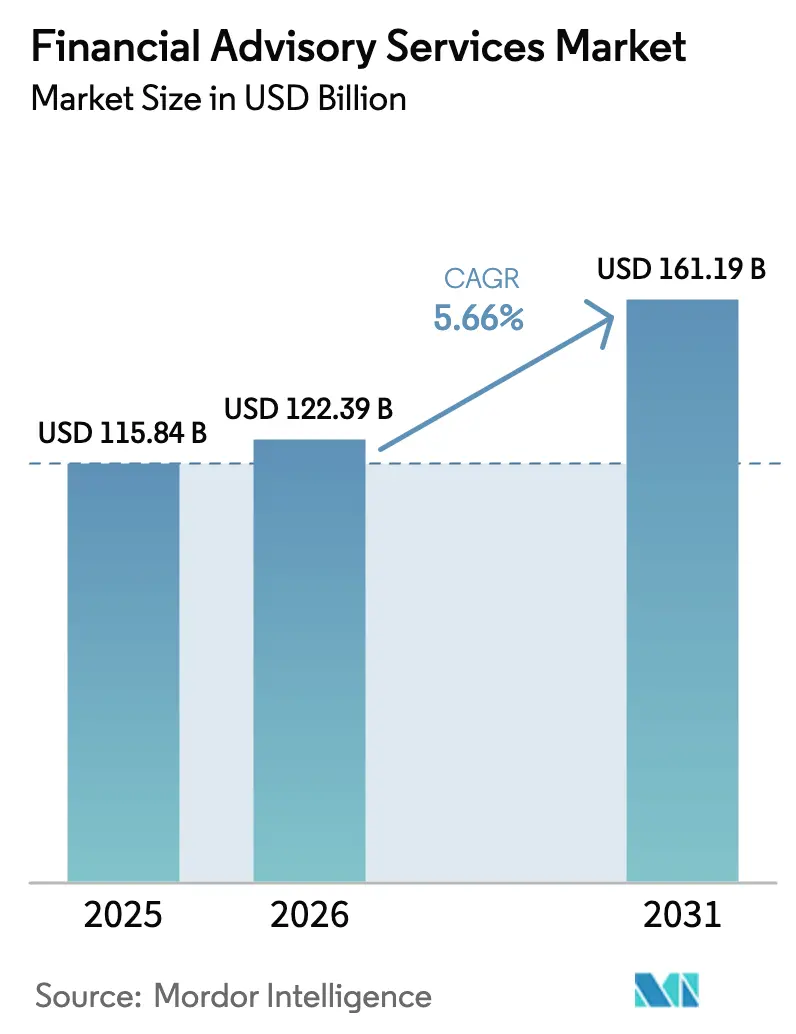
| Market Size (2026) | USD 122.39 Billion |
| Market Size (2031) | USD 161.19 Billion |
| Growth Rate (2026 - 2031) | 5.66 % |
| Fastest Growing Market | Asia-Pacific |
| Largest Market | North America |
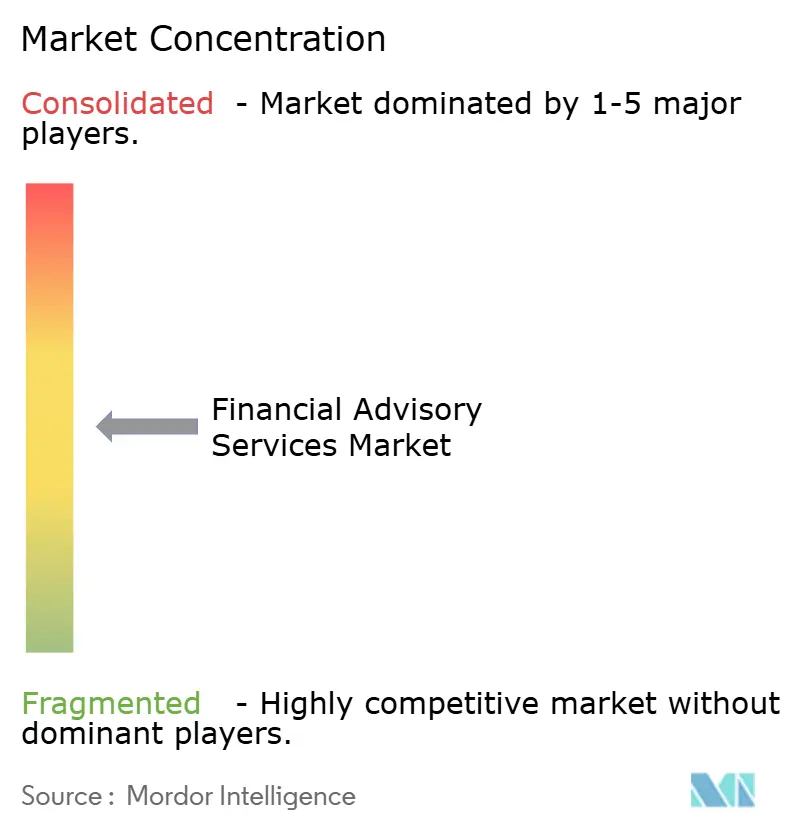
| Market Concentration | Medium |
Major Players *Disclaimer: Major Players sorted in no particular order Image © Mordor Intelligence. Reuse requires attribution under CC BY 4.0. | |
Financial Advisory Services Market Analysis by Mordor Intelligence
The financial advisory services market size is expected to grow from USD 115.84 billion in 2025 to USD 122.39 billion in 2026 and is forecast to reach USD 161.19 billion by 2031 at 5.66% CAGR over 2026-2031. Healthy expansion is tied to rapid digitalization, tighter regulatory oversight, and shifting client expectations that reward transparent fee-based relationships. Artificial-intelligence tools are delivering hyper-personalized advice that lifts client engagement, while low-cost robo platforms continue to democratize professional portfolio management. New hybrid delivery models that connect human judgment with algorithmic efficiency are gaining momentum, particularly among affluent millennials and Gen Z heirs. Advisory firms that successfully integrate technology, address evolving ESG disclosure rules, and manage a shrinking talent pool are positioned to capture outsized gains across the financial advisory services market.
Key Report Takeaways
- By service type, investment advisory led with 38.25% share of the global financial advisory services market in 2025; it is expected to expand at a 7.29% CAGR through 2031.
- By organization size, large enterprises commanded 63.10% of the global financial advisory services market share in 2025, while SMEs are projected to grow the fastest at 6.59% CAGR through 2031.
- By industry vertical, BFSI held 35.75% of the global financial advisory services market in 2025; healthcare and pharmaceuticals are expected to be the quickest-growing verticals at 6.86% CAGR through 2031.
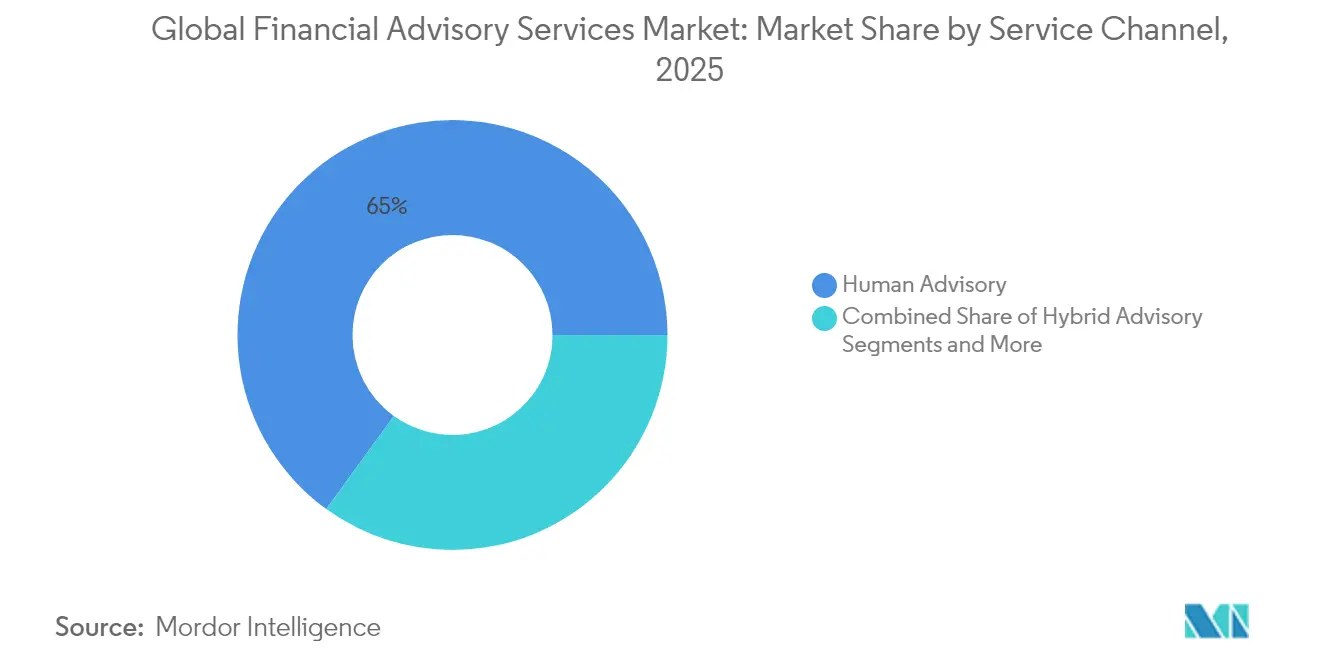
- By service channel, human advisory represented 65.02% of the global financial advisory services market share in 2025, and robo advisory is projected to register the highest 16.95% CAGR through 2031.
- By delivery mode, on-site consulting accounted for 73.40% of the global financial advisory services market size in 2025; remote and virtual consulting is expected to rise at a 10.45% CAGR through 2031.
- By region, North America retained 39.95% share of the global financial advisory services market in 2025; Asia-Pacific is forecasted to post the strongest 7.78% CAGR to 2031.
Note: Market size and forecast figures in this report are generated using Mordor Intelligence’s proprietary estimation framework, updated with the latest available data and insights as of 2026.
Global Financial Advisory Services Market Trends and Insights
Drivers Impact Analysis*
| Driver | (~) % Impact on CAGR Forecast | Geographic Relevance | Impact Timeline |
|---|---|---|---|
| AI-enabled hyper-personalized advice uptake | +1.2% | Global, early adoption in North America & APAC | Medium term (2-4 years) |
| Shift from commission to fee-based models | +0.8% | North America & EU, expanding to APAC | Long term (≥ 4 years) |
| Democratization via low-cost robo-platforms | +1.5% | Global, strongest in developed markets | Short term (≤ 2 years) |
| Generational wealth transfer to digital heirs | +0.9% | North America & EU, emerging in APAC | Long term (≥ 4 years) |
| Reg-tech lowering compliance burden | +0.6% | Global, regulatory-heavy markets first | Medium term (2-4 years) |
| Sovereign wealth funds outsourcing mandates | +0.4% | Middle East, APAC, selective global impact | Medium term (2-4 years) |
| Source: Mordor Intelligence | |||
AI-Enabled Hyper-Personalized Advice Uptake
Artificial intelligence is reshaping how advisory firms collect, process, and apply client data, creating bespoke portfolios that adapt in real time to shifting life events, tax regimes, and market conditions. Federal Reserve surveys put AI penetration among financial-services workers at 20%–40%, with year-on-year growth reaching up to 145%[1]Board of Governors of the Federal Reserve System, “Artificial Intelligence Adoption in Financial Services,” federalreserve.gov. Morgan Stanley’s wealth arm, stewarding more than USD 4.2 trillion, relies on proprietary AI research to sharpen asset allocation and deepen engagement. Where human advisers once sifted spreadsheets, machine-learning engines now scan millions of data points in seconds, freeing professionals to focus on complex planning. Adoption is particularly strong in digitally mature Asia-Pacific wealth hubs, where clients consider advanced analytics a hygiene factor rather than a differentiator. Firms that master AI-driven personalization earn higher wallet share and more durable client stickiness.
Shift From Commission to Fee-Based Models
Regulators and clients are accelerating the pivot toward fee transparency, reducing conflicts embedded in product commissions. T. Rowe Price already manages around USD 1.5 trillion on fee-aligned mandates, proving the commercial viability of asset-based charging[2]T. Rowe Price Associates, “Form ADV Part 2A,” troweprice.com. The Consumer Financial Protection Bureau has intensified its crackdown on opaque charges, labelling overdraft fees and similar levies “junk fees”. Europe’s MiFID II framework, which ring-fences advice fees, offers a blueprint now spreading to other regions. As firms pivot, stable recurring revenue streams improve valuation multiples, yet they also expose advisers to margin pressure if investment performance lags. Successful operators couple fee-based portfolios with high-touch planning, tax, and retirement strategies that reinforce perceived value.
Democratization via Low-Cost Robo-Platforms
Robo-advisors slash entry barriers by automating portfolio construction, rebalancing, and tax-loss harvesting at fractions of traditional adviser pricing. Personalized target-date funds represent the next evolution, with providers such as Capital Group and PIMCO tailoring allocations to income and contribution rates while keeping costs between fund-of-funds and bespoke mandates. Bank of America research shows young adults juggling housing costs and student debt still prioritize digital investment apps and “buy now, pay later” spending tools[3]Bank of America Institute, “Consumer Checkpoint 2025,” bofainstitute.com. As mass-affluent cohorts grow, low-friction onboarding and intuitive mobile interfaces channel a new wave of assets toward robo platforms, forcing incumbent advisers to refine value propositions or face fee erosion.
Generational Wealth Transfer to Digital-Savvy Heirs
Roughly USD 84 trillion is set to flow from baby boomers to millennials and Gen Z over two decades. A report suggests that 44% of family offices will boost commercial property exposure while screening holdings against ESG metrics. Digital natives prize seamless experiences, real-time dashboards, and sustainable portfolios, prompting advisers to add impact-scoring tools and climate analytics. Asia-Pacific captures the trend’s sharpest edge, given its high smartphone penetration and rapid wealth creation. Hybrid models combining virtual servicing with periodic in-person coaching are emerging as the standard, retaining personal trust while meeting always-on digital expectations.
Restraints Impact Analysis*
| Restraint | (~) % Impact on CAGR Forecast | Geographic Relevance | Impact Timeline |
|---|---|---|---|
| Advisor talent shortage & ageing workforce | -1.1% | Global, acute in developed markets | Short term (≤ 2 years) |
| Margin compression from passive wave | -0.7% | Global, strongest in developed markets | Medium term (2-4 years) |
| Cyber-security & data-privacy liabilities | -0.5% | Global, regulatory-heavy markets first | Short term (≤ 2 years) |
| ESG-greenwashing litigations | -0.3% | North America & EU | Medium term (2-4 years) |
| Source: Mordor Intelligence | |||
Advisor Talent Shortage & Ageing Workforce
More than one-third of practicing advisers in North America and Western Europe are within a decade of retirement, creating a pipeline gap that constrains capacity and stresses service levels. Younger professionals gravitate toward technology or entrepreneurial roles offering flexible schedules and equity upside, leaving advisory firms scrambling to refresh ranks. Heightened regulatory complexity further raises entry barriers, demanding advanced credentials that require time and capital to acquire. In specialties such as estate planning, advisors with deep tax knowledge command premium compensation, escalating cost structures. Firms are responding with apprenticeship tracks, tuition reimbursement, and increased reliance on digital workflows that let senior advisers support a larger client base through junior staff.
Margin Compression from Passive Investing Wave
Passive funds, ETFs, and direct indexing are siphoning assets from high-fee active strategies, prompting clients to question adviser value. Morningstar data show aggregate fund fees sliding every year since 2015, a trend unlikely to reverse. As investment selection becomes commoditized, advisers pivot to planning, behavioral coaching, and tax optimization to defend fees. Yet scaling these holistic services requires tech investments and continual staff training, placing pressure on smaller firms. European regulators’ insistence on fee unbundling intensifies the squeeze, encouraging price competition that ripples into North America and Asia.
*Our forecasts treat driver/restraint impacts as directional, not additive. The impact forecasts reflect baseline growth, mix effects, and variable interactions.
Segment Analysis
By Service Type: Investment Advisory Extends Leadership
Investment advisory services captured the largest 38.25% slice of the financial advisory services market in 2025 and will propel overall growth with a 7.29% CAGR to 2031. This combination of scale and velocity underscores the client's appetite for portfolios that integrate planning, tax, and estate considerations within single adviser relationships. As assets migrate toward fee-based accounts, the financial advisory services market size for investment advisory is projected to widen in absolute dollars at a pace that outstrips other categories. Major deal counsel, notably Capital One’s USD 35 billion purchase of Discover Financial, spotlights how corporate finance teams lean on specialist advisers for valuation, structuring, and shareholder communications.
Across the wider service landscape, accounting and tax advisory services enjoy steady uptake as multijurisdictional reporting and ESG metrics create data-collection complexity. Digital-asset and succession-planning sub-segments, housed within “other services,” register niche but rising contributions. Competitive differentiation now hinges on bundling: firms marrying investment management with holistic planning see lower churn and stronger cross-selling. As technology automates many allocation tasks, advisers redeploy bandwidth to behavioral coaching that addresses client biases and emotional triggers during volatile markets.


By Organization Size: Enterprise Clout Meets SME Momentum
Large enterprises accounted for 63.10% of the financial advisory services market in 2025, reflecting entrenched relationships and complex balance-sheet requirements that demand bespoke advisory. Treasury optimization, debt structuring, and cross-border M&A ensure sticky mandates. However, the SME cohort, aided by digital onboarding and modular service bundles, is forecasted to expand at a 6.59% CAGR, increasing its share of the financial advisory services market size. Technology platforms lower ticket-size thresholds, allowing advisers to profitably serve family-owned manufacturers, tech startups, and professional partnerships that previously relied on in-house finance staffs or retail banks.
Many SMEs face regulatory burdens similar to large corporates—such as beneficial-ownership reporting and sustainability disclosures—yet lack specialized expertise. Cloud-based dashboards that consolidate cash-flow projections, tax calendars, and portfolio analytics empower owners to act swiftly. Leading advisers deploy AI chatbots to field routine queries, reserving human interaction for annual planning and transaction events. Geographic dispersion is widening; SMEs in Southeast Asia and Latin America increasingly seek US-dollar bond issuance advice, driving cross-border engagement.
By Industry Vertical: BFSI Dominance, Healthcare Acceleration
The BFSI sector retained 35.75% of the 2025 financial advisory services market share, anchored by bank treasury units, insurer general accounts, and asset-manager affiliates that rely on external advisers for capital optimization and regulatory insight. The segment benefits from continual capital adequacy rule changes and digital banking transformations that demand strategic advice. Meanwhile, healthcare and pharmaceuticals are forecasted to deliver a 6.86% CAGR, the fastest among all verticals, lifting their contribution to the financial advisory services market share by 2031. Drug-pricing reforms, clinical-trial funding needs, and intellectual-property monetization fuel demand for bespoke financial structuring.
Information technology and telecommunications also wield significant advisory budgets, especially for cross-border cloud-data-center financing and employee-stock-plan design. Manufacturing and retail sectors continue to lean on advisers for supply-chain funding and ESG-linked lending, while public-sector entities seek guidance on green bonds and digital-identity infrastructure financing. The rise of healthcare underscores the shift toward knowledge-intensive, R&D-heavy models where access to sophisticated capital markets advice drives competitive advantage.
By Service Channel: Human Advisory Retains Core, Robo Scales Fast
Human advisers controlled 65.02% of the financial advisory services market share in 2025, safeguarding complex net-worth clients that value empathy and bespoke planning. Yet, robo platforms are projected to grow at 16.95% CAGR, steadily enlarging their slice of the overall financial advisory services market. Scale players such as Betterment and Wealthfront refine goal-based algorithms, while incumbents like Charles Schwab embed robo modules inside traditional practices to offer tiered service. The financial advisory services market size allocated to hybrid models is set to jump as advisers integrate automated tax-loss harvesting and predictive spending analytics into face-to-face engagements.
Consumer preference surveys reveal that young professionals accept chat-based check-ins and digital document vaults, reserving video calls for milestone events such as home purchases or inheritance settlements. Fee compression drives innovation; subscription pricing and pay-per-plan packages proliferate. Advisers track engagement metrics—login frequency, content-consumption patterns—to personalize outreach and pre-empt attrition.
By Delivery Mode: On-Site Strength, Virtual Uptick
On-site consulting held 73.40% of the financial advisory services market share in 2025, demonstrating that for ultra-high-net-worth families, multisession estate planning and fiduciary briefings still benefit from physical presence. The pandemic, however, normalized virtual interactions, bolstering remote consulting’s 10.45% CAGR over the forecast period. The financial advisory services market size tied to virtual delivery will more than double by 2031 if current adoption persists. Advisers increasingly organize quarterly video reviews supplemented by secure portal dashboards, which clients access on demand.
New York Life Investments notes that many female investors prefer touchpoints every 4–6 months, and virtual meetings meet that cadence without travel friction. Productivity gains surface as advisers cover broader geographies; a single specialist can advise clients in Boston, Singapore, and Dubai within a day. Compliance teams adapt by recording sessions and archiving screen shares to satisfy audit trails. Firms also roll out virtual reality pilots for immersive risk-profiling experiences, though mainstream uptake remains nascent.
Geography Analysis
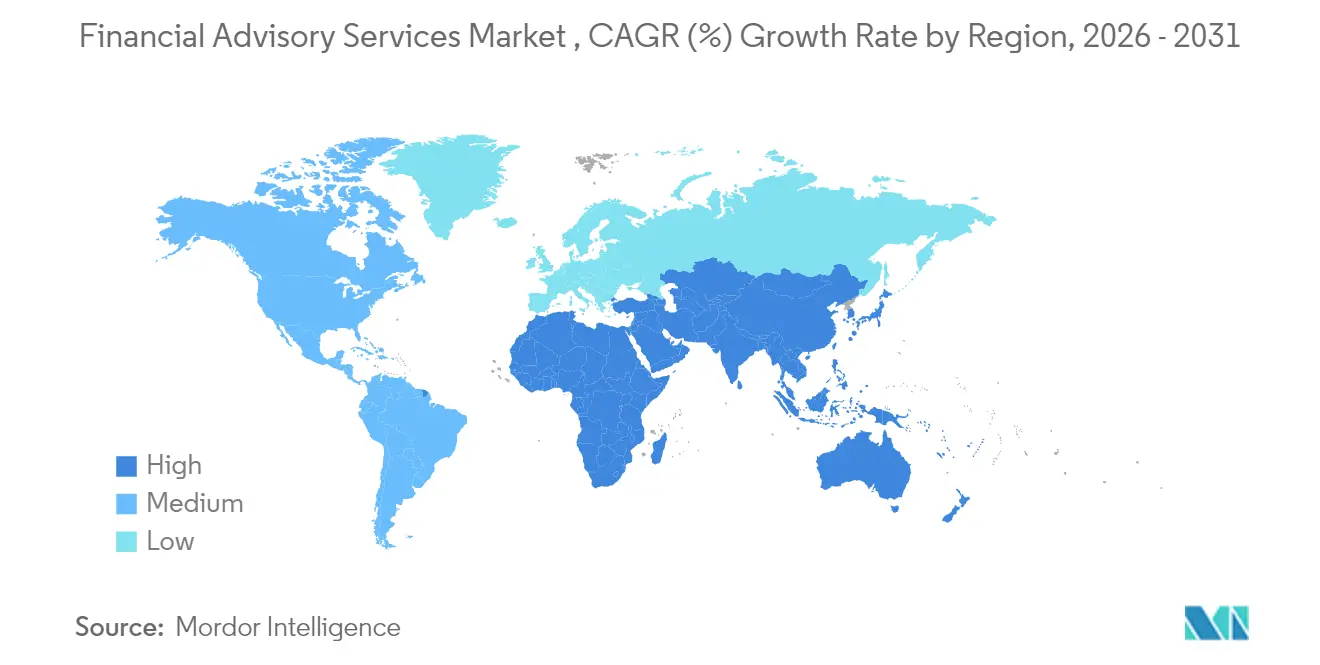
North America dominated the financial advisory services market with 39.95% market share in 2025. Mature capital markets, deep wealth pools, and a rigorous yet stable regulatory environment allow advisers to price complex planning services at premium levels. New York, Chicago, and San Francisco remain command centers, housing JPMorgan Chase, Goldman Sachs, and Morgan Stanley, each managing multi-trillion-dollar books. Canadian institutions buttress regional heft; the proposed merger of Prospera, Coast Capital, and Sunshine Coast credit unions would create a purpose-driven co-operative overseeing USD 38.6 billion in assets, signaling consolidation momentum.
Asia-Pacific is projected to be the fastest-growing region, set to log an 7.78% CAGR to 2031. Rising middle-class affluence, digital-bank innovation, and progressive regulatory sandboxes cultivate fertile ground for adviser expansion. Japan’s SBI Holdings and SMBC Group will debut “Olive Infinite” in 2026, pairing algorithmic allocation with live consultants. Taiwan chose Kaohsiung as the pilot hub for an Asian asset-management centre aimed at channeling more than TWD 30 trillion into professional portfolios. Chinese and Indian fintechs continue to onboard millions of first-time investors, giving rise to regional robo leaders.
Europe contributes a sizable revenue base anchored by London, Frankfurt, and Zurich, though economic uncertainty and dense regulation temper growth. Sweden transposed the EU Corporate Sustainability Reporting Directive into national law in 2024, expanding demand for ESG audit and advisory. Brexit realignment imposes additional licensing costs and data-transfer complexities that advisers must absorb to serve continental clients from UK hubs. Meanwhile, GCC wealth centers in the Middle East recruit global advisers to steward diversified sovereign portfolios, yet political volatility in parts of Africa restrains broader regional penetration.
Mordor Intelligence provides coverage of the financial advisory services market across other key regional markets, including North America and Europe, each with their regulatory frameworks and demand patterns.

Regulatory Landscape
Financial advisory services operate under a growing set of conduct, disclosure, and operational-resilience requirements that shape how advice is delivered, priced, and supervised across jurisdictions. In the United States, the SEC continues to pursue enforcement tied to adviser sales practices, reinforcing scrutiny on conflicts and suitability. In parallel, banking supervision is shaped by capital and stress-testing regimes such as the Federal Reserve scenarios used in company-run Dodd-Frank Act Stress Tests (DFAST), which Goldman Sachs disclosed in April 2026. In Europe, MiFID II fee unbundling keeps pressure on transparent pricing and documentation, while the EU Digital Operational Resilience Act (DORA) program moves firms toward more formalized ICT risk controls and third-party oversight through 2026.
Regulatory fragmentation is also increasing, with jurisdictions emphasizing local competitiveness and domestic policy objectives over global harmonization. This raises compliance workload for cross-border advisory platforms and multi-entity groups. Hong Kong implemented operational resilience and cybersecurity legislation effective January 1, 2026, adding another locus of requirements for firms serving Asia-Pacific wealth hubs. These changes extend governance expectations beyond the adviser-front office into vendor management, data controls, and subsidiary-level accountability, lifting demand for reg-tech, auditable client communications, and standardized controls across human, hybrid, and robo-advisory channels.
Value Chain Analysis
The financial advisory services value chain starts with client acquisition and onboarding, including KYC/AML checks, risk profiling, and fee disclosures. It then moves into discovery and planning, such as goals, tax and estate considerations, and liabilities, before portfolio construction and product selection across brokerage, banking, and fund platforms. Ongoing servicing focuses on monitoring, rebalancing, reporting, and client communications delivered through human advisers, hybrid models, and robo interfaces.
Upstream inputs include market and issuer data, research and analytics, and proprietary models. Downstream outputs include advice documentation, investment policy statements, performance reporting, and compliance artifacts that support audits and dispute resolution. Enabling layers increasingly determine differentiation and cost-to-serve, especially data infrastructure, AI and workflow tools, cybersecurity, and compliance operations. Large institutions integrate these capabilities with capital markets access and funding sources, while regulatory disclosure frameworks (for example, Basel III-aligned Pillar 3 disclosures used by major banks such as Goldman Sachs) anchor risk governance for institutional and wealth clients. At the ecosystem level, the operational perimeter is widening to cover critical third-party technology providers, cryptoasset firms, and ESG ratings providers that influence advice delivery and disclosure. This pushes advisory firms to formalize vendor oversight, resilience testing, and incident response as part of standard service delivery.
Competitive Landscape
The financial advisory services market remains moderately fragmented, featuring global banks, Big Four consultancies, specialised boutiques, and digital disruptors. Incumbent powerhouses such as JPMorgan Chase, Bank of America, and Goldman Sachs couple balance-sheet strength with multi-disciplinary advisory arms. They invest billions in generative-AI research, client-facing apps, and data lakes to defend their share against agile fintechs. Deloitte, EY, KPMG, and PwC leverage regulatory, cybersecurity, and tax expertise to undercut investment banks in middle-market M&A and restructuring mandates.
Robo pioneers Betterment and Wealthfront exploit low-cost structures and gamified interfaces to capture mass-affluent flows. Their combined assets under management exceeded USD 65 billion in 2024, reflecting compound growth north of 25%. To respond, traditional players launch white-label robo offerings or acquire fintechs; Morgan Stanley’s 2020 E*TRADE purchase continues to yield cross-sell synergies, and its investment-management arm reached USD 1.66 trillion AUM by December 2024. Competitive battlegrounds now revolve around content (ESG research, private-market access), experience (hyper-personalized dashboards), and confidence (cyber-security certifications).
Pricing dynamics shift as client sophistication rises. Subscription tiers, performance-linked retainers, and micro-fee plans are expanding. Firms embracing advisory ecosystems—integrating legal, tax, and philanthropy partners—retain higher share of wallet. Talent strategies increasingly include in-house data scientists, behavioral psychologists, and sustainability analysts, reflecting a broadened definition of adviser expertise. The capacity to orchestrate these multidisciplinary teams while protecting client confidentiality differentiates market leaders from scale-chasing laggards.
Financial Advisory Services Industry Leaders
Bank of America Corporation
Goldman Sachs Group Inc.
Morgan Stanley
Deloitte
EY
- *Disclaimer: Major Players sorted in no particular order

Market Opportunities and Future Outlook
White space is opening where advisory firms combine transparent, fee-based planning with technology-enabled personalization at scale, especially for mass-affluent and SME clients that historically fell below the economics of high-touch models. Remote and virtual consulting is one of the clearest commercial levers because it lets specialists (tax, estate, cross-border, and retirement) serve broader geographies while maintaining audit trails through recorded sessions and secure client portals. Hybrid propositions also benefit as incumbents embed automation, including tax-loss harvesting, goal-based modeling, and document vaults, into adviser-led relationships. This fits client expectations for digital dashboards while preserving human coaching for complex decisions.
Institutional advisory opportunities are expanding through outsourced investment and retirement solutions, alongside private-market access and private credit allocations where governance, liquidity, and disclosure complexity increase reliance on specialist advice. The same pattern shows up in large OCIO mandates, including Goldman Sachs being appointed by Verizon Communications and Lockheed Martin in July 2026 for retirement plan assets totaling over USD 70 billion. On the corporate advisory side, banks are adding coverage capacity and industry specialization, exemplified by Bank of America expanding Regional Investment Banking coverage in July 2026, which supports more localized M&A and financing advice for middle-market clients. Operational resilience and third-party oversight programs, such as EU DORA rollouts through 2026 and new operational resilience and cybersecurity rules effective in Hong Kong from January 1, 2026, also create demand for advisory services that connect strategy, controls, and technology governance across financial institutions and regulated asset managers.
Recent Industry Developments
- July 2026: Bank of America expands regional investment banking coverage to better serve middle market clients with local market teams. The expansion strengthens advisory coverage for mid-market M&A and financing. The move enhances client access to cross-border dealmaking and regional advisory capacity
- July 2026: Goldman Sachs appointed Outsourced Chief Investment Officer for Verizon Communications and Lockheed Martin for retirement plan assets over 70 billion. The OCIO engagement expands large-institution advisory footprint. Increases scale and integration opportunities for institutional asset management advisory services
- May 2026: Goldman Sachs partnership with Anthropic, Blackstone, and Hellman and Friedman to launch an AI native enterprise services firm. AI enabled enterprise advisory services development. Broadens AI driven advisory capabilities and cross sell potential with strategic partners


Research Methodology Framework and Report Scope
Market Definition and Coverage
For this study, the market covers paid, professional financial advisory work delivered to individuals and organizations, where the core output is advice, planning, or transaction support tied to financial outcomes. We size the market as service revenue generated from advisory engagements across major regions.
Scope exclusions: It does not count pure product manufacturing revenue (for example, fund management product fees) unless it is bundled and billed as advisory service revenue.
Segmentation Overview
- By Service Type
- Corporate Finance
- Accounting And Tax Advisory
- Investment
- Other Services
- By Organization Size
- Large Enterprises
- Small & Medium-sized Enterprises (SMEs)
- By Industry Vertical
- Banking, Financial Services, Insurance (BFSI)
- IT & Telecommunication
- Manufacturing
- Retail And E-Commerce
- Public Sector
- Healthcare And Pharmaceuticals
- Other Industry Verticals
- By Service Channel
- Human Advisory
- Hybrid Advisory
- Robo-Advisory
- By Delivery Mode
- On-site Consulting
- Remote / Virtual Consulting
- By Region
- North America
- United States
- Canada
- Mexico
- South America
- Brazil
- Argentina
- Chile
- Peru
- Rest of South America
- Europe
- United Kingdom
- Germany
- France
- Spain
- Italy
- Benelux (Belgium, Netherlands, and Luxembourg)
- Nordics (Sweden, Norway, Denmark, Finland, and Iceland)
- Rest of Europe
- Asia Pacific
- China
- India
- Japan
- South Korea
- Australia
- South-East Asia (Singapore, Indonesia, Malaysia, Thailand, Vietnam, and Philippines)
- Rest of Asia-Pacific
- Middle East and Africa
- United Arab Emirates
- Saudi Arabia
- South Africa
- Nigeria
- Rest of Middle East and Africa
- North America
Data Sources, Market Sizing, and Validation
Desk Research
Desk research sets the floor for the model by anchoring how big the addressable client pool is and how advisory demand changes with macro and financial cycles. We referenced public sources such as World Bank and IMF macro series, BIS indicators on credit and financial conditions, OECD statistics, SEC and FINRA investor and industry publications, and central bank releases that reflect rate and inflation regimes.
To convert those signals into a usable revenue model, we also reviewed materials such as company annual reports, 10-K style filings, investor presentations, regulatory guidance pages, and reputable business press coverage of fee trends, suitability rules, and digital-advice adoption. In a few cases, paid subscriptions were used only to cross-check company financials, track major contracts and tenders, and review broad patent and innovation activity tied to advisory tooling. The desk sources listed here are illustrative, and many other public references were also used for data capture, validation, and clarification.
Primary Interviews and Surveys
Primary work was used to pressure-test service scope, typical fee structures, and what gets booked as advisory revenue versus adjacent brokerage or asset-based charges. We spoke with a mix of advisory firm leaders, practice heads, and managers across key regions, so assumptions on client mix, delivery models (human, hybrid, and digital), and demand drivers could be tuned to what is seen in day-to-day engagements.
Distribution of primary research fieldwork respondents
| Company type | Respondent position | Region |
|---|---|---|
| Top tier: 33% | CXOs: 14% | APAC: 43% |
| Mid tier: 45% | Functional/Unit leaders: 37% | EMEA: 37% |
| Smaller Players: 22% | Managers: 49% | Americas: 20% |
Market-Sizing & Forecasting
Sizing starts with a top-down build where we reconstruct the demand pool from broad economic activity and investable-asset and capital-market signals, which are then converted into advisory spend using service penetration and fee intensity assumptions. To keep the numbers grounded, we also corroborate totals with selective bottom-up checks, including sampled revenue ranges by advisory line, channel-mix checks, and sanity tests using typical fee rates applied to realistic engagement volumes.
Key inputs used in the model include interest rate and inflation regimes, equity and fixed income market direction (as a proxy for client activity and risk appetite), corporate deal and refinancing cycles, regulatory change pressure that drives compliance-led advisory work, and the adoption rate of digital and hybrid advice. Where coverage gaps appear in bottom-up views, we fill them using conservative proxies based on similar client cohorts, and then we re-test the impact during expert validation.
For forecasting, scenario analysis is applied around a base case, with main variables projected using externally observable series and then adjusted using interview-led expectations on fee compression, client behavior, and advisory staffing capacity. This keeps the forecast explainable and repeatable, even when local data depth differs by country.
Data Validation & Update Cycle
Outputs are validated through multiple checks so one noisy input does not drive the final number. We compare implied advisory spend against independent signals such as macro growth, market activity conditions, and disclosed revenue trends in public filings, and then we review variances before sign-off.
When the model shows unusual jumps, we revisit the assumptions behind fee rates, channel mix, and regional splits, and we do targeted re-contacts with experts if the gap persists. Reports are refreshed annually, with interim updates triggered by material events such as sharp rate shifts, major regulatory changes, or sudden deal-cycle reversals. Before delivery, we do a final update pass so clients receive the latest view aligned to the most recent data releases.
Mordor Intelligence's Financial Advisory Services Market Sizing Compared With Other Published Estimates
Published market values for financial advisory services can differ quite a lot, even when the labels look similar, because the counted revenue streams are not always the same and the time base can shift by a year. Differences also come from how firms treat digital advice, how they normalize currency, and whether they apply a single growth rate across all regions.
The biggest gap drivers in this market usually sit around what gets bundled into advisory, such as whether brokerage and asset-based wealth management fees are added, and whether corporate finance support is captured beyond headline M&A cycles. Another source of spread is the refresh cadence for fee compression and client mix shifts, which can move the current-year value quickly when markets are volatile, and this is handled with service-level checks and re-validation of fee assumptions before the number is finalized by Mordor Intelligence.
Benchmark comparison
| Source | Market Size | Gaps in Research Methodology |
|---|---|---|
| Mordor Intelligence | USD 122.39 B (2026) | |
| Industry Publisher A | USD 215.92 B (2024) | Uses a broader definition that can fold in banking, brokerage, and other financial services revenue, so advisory-only billing is not cleanly separated, and the base year is earlier than the current cycle. |
| Industry Publisher B | USD 162.60 B (2025) | Often aligns to financial planning and advice as an econometric category, which can miss corporate finance and transaction-led advisory lines, and it can apply uniform regional scaling that does not reflect fee compression differences. |
The table mainly shows that scope choices and the year used for measurement can move the headline value more than the growth math itself. By keeping the revenue definition tied to advisory services and cross-checking it with observable activity and fee signals, the final estimate stays traceable to clear inputs and can be repeated when new data arrives.


Key Questions Answered in the Report
How large is the financial advisory services market today?
It generated USD 122.39 billion in 2026 and is projected to reach USD 161.19 billion by 2031 at a 5.66% CAGR.
Which region leads revenue in the financial advisory services market?
North America holds the top spot with 39.95% of 2025 market share, supported by deep capital markets and high net-worth populations.
What is driving growth in Asia-Pacific?
Rising middle-class wealth, digital adoption, and supportive regulatory sandboxes are propelling an 7.78% CAGR through 2031.
Are robo advisers replacing human advisers?
No; human advisers still managed 65.02% of market share as of 2025, but robo platforms are projected to scale quickly at 16.95% CAGR, leading to hybrid service models.
Which industry vertical is expanding the fastest?
The healthcare and pharmaceuticals segment is projected to grow at a 6.86% CAGR due to complex R&D financing and regulatory needs.
What is the biggest threat to advisory firms?
Talent shortages and ageing workforces could trim sector growth by 1.1% of the forecast CAGR unless firms recruit and implement productivity technologies.
Page last updated on:


 Your data is secure and never sold or shared.


